About the blogger:
This blog is associated with the former Chief of Staff in Puntland State Presidency, 1998-2004. He also worked with the UN and World Bank Joint Secretariat for Somalia’s Re-construction and Development Program (RDP), 2005-2006, as a Zonal Technical Coordinator for Puntland and later as National Aid Technical Coordinator with the Transitional Federal Government of Somalia and European Union. He is now an independent political analyst and commentator on current issues and occasionally gives historical perspective on modern Somalia’s politics. He lives and works in Toronto, Canada. He can be reached at: ismailwarsame@gmail.com
Same forces are involved in this violence. External political forces are added to the mix and initiated this confrontation. The State President is absent from the scene of action. Puntland officials were caught by surprise, they reported- no prior information was available to them on the trip of a Federal delegation to Bosaso. At least 16 persons have lost their lives in the crossfire, according to preliminary reports. Bari traditional elders complain about turning away airborne federal officials from Bosaso Airport and aid handouts they were carrying, instead of lives lost in this renewed violence in Bosaso. Nobody is talking about the existence of rogue Puntland forces there. Puntland State political uncertainty continues. This looks like waning days of Garowe Regime. Inside observers are worried and extremely concerned about Puntland Stability.
Various sources of information including satellite imagery now suggest this increased partnership may be starting to take shape. In this blog post, I will summarize some aspects of the relationship between the United States and Somaliland and explain why I think this cooperation may be taking shape.
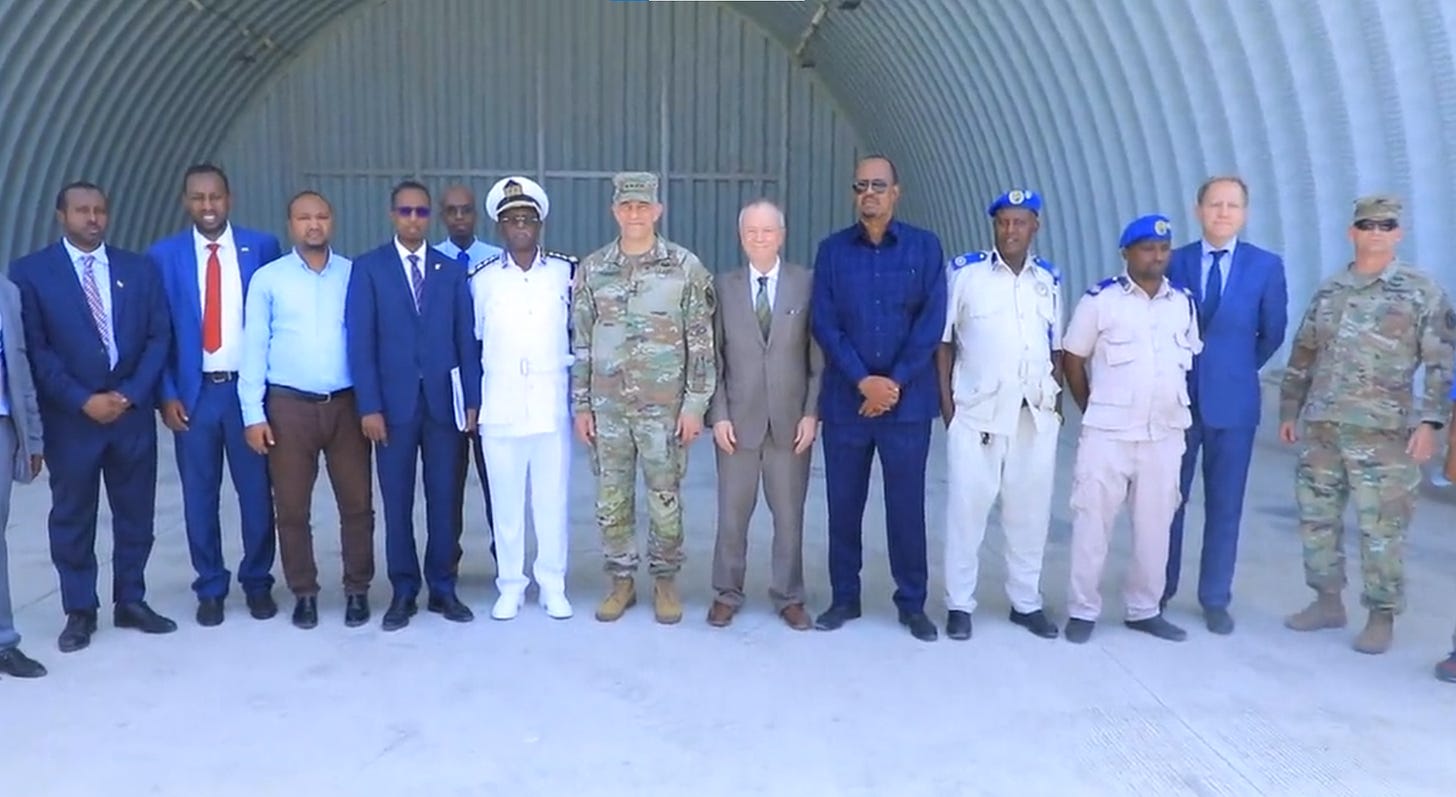
Americans and Somalilanders inside an aircraft shelter at Berbera Airport, Somaliland, 12 May 2022. In the middle are U.S. Army Gen. Stephen Townsend (camouflage uniform) and Larry E. André Jr. to his right. Video capture.
US AFRICOM, Berbera and Somaliland
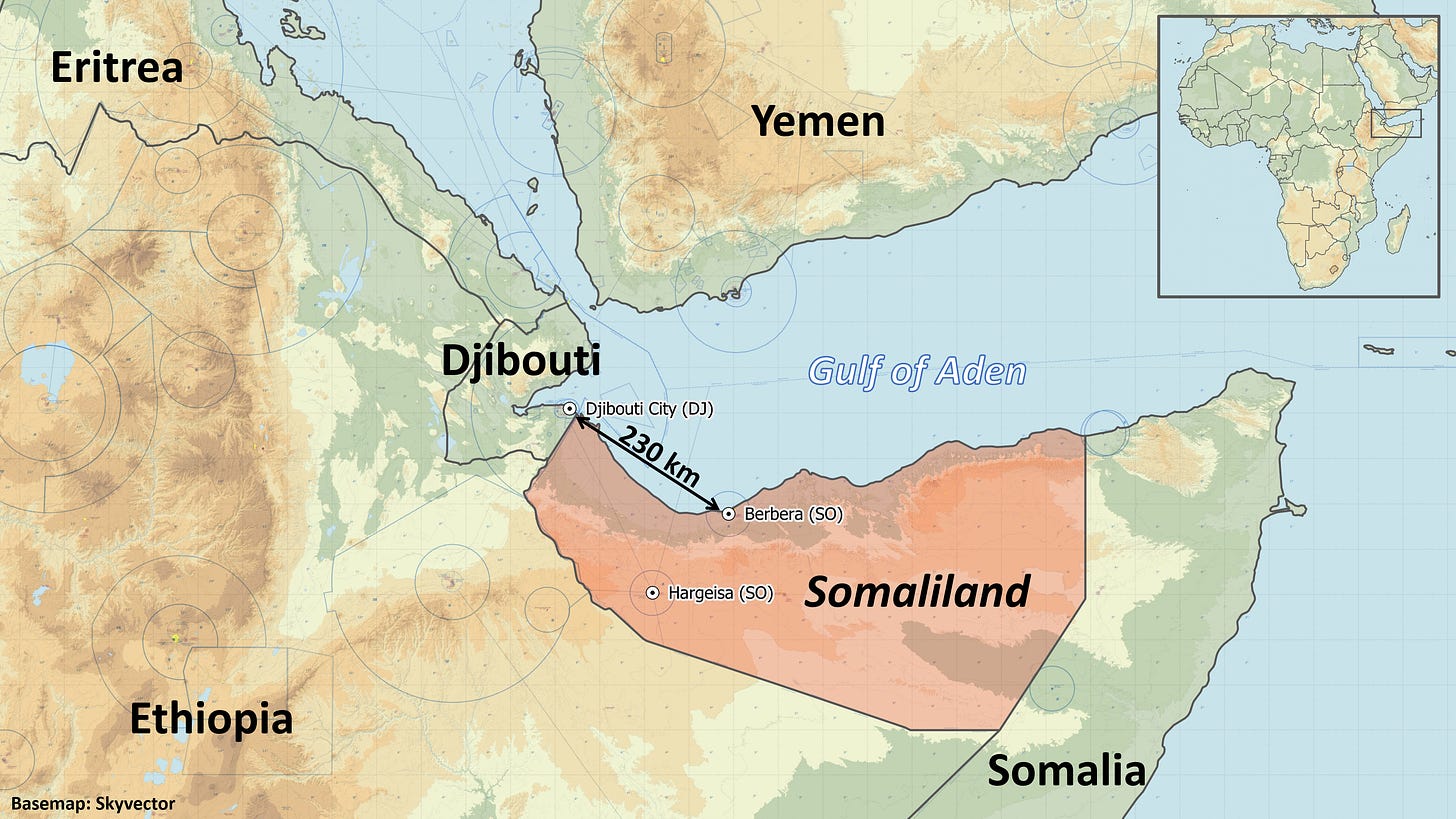
Overview of Somaliland, Somalia, Djibouti and the Gulf of Aden.
31 years ago, Somaliland broke away from Somalia and claimed independence. Even though it is a de facto state, independence was never recognized by the international community, including the United States.
According to Foreign Policy, a Somaliland delegation visited the United States in March 2022, lobbying the United States to recognize Somaliland. Although Washington made clear they were unwilling to recognize their independence, they did signal that they would like to deepen ties with Somaliland.
On 12 May 2022, a United States delegation visited Somaliland’s capital city Hargeisa, followed by a visit to Berbera, located on shores of the Gulf of Aden. I previously looked into this visit to Berbera. Besides a description of the visit, the thread attached to the tweet below contains more information about the history of the airport, so just click on the post in order to read it.
On the day of the visits, a United States Marine Corps (USMC) KC-130J reg. 169533 was tracked flying over Somaliland, including a landing and take-off at Berbera. This same KC-130J can also be seen in video footage made at the airport.
According to US AFRICOM, the meetings focused on “mutual benefits from closer U.S. cooperation with Somaliland authorities”. They add that a cooperation between “[US] AFRICOM and Somaliland’s military and coast guard will advance shared interests in regional stability, protecting vital trade routes”.
A BBC article summarizes some of the reasons why Berbera is of interest to the United States. First and foremost the airport is located on the shores of the Gulf of Aden, a major shipping route. Furthermore, it “is close to some of the world’s most unstable places, including Yemen, Somalia and Ethiopia, which has been a key US ally in the ‘War on Terror’ but is now wracked by internal conflict.”
The United States currently have a large military presence at Camp Lemonnier, which is located just south of Djibouti–Ambouli International Airport in Djibouti, sharing a runway. According to US AFRICOM, Camp Lemonnier “provides, operates and sustains superior service in support of combat readiness and security of ships, aircraft, detachments and personnel for regional and combatant command requirements; and enables operations in the Horn of Africa while fostering positive U.S.-African Nation relations”.
In recent years, Djibouti has seen an increased presence of Armed Forces from around the globe, including Japan, France, Italy and most importantly China: a Chinese Naval Base is located only about 10 km from Camp Lemonnier. In 2018, there were multiple instances of Chinese lasers interfering with U.S. military aircraft.
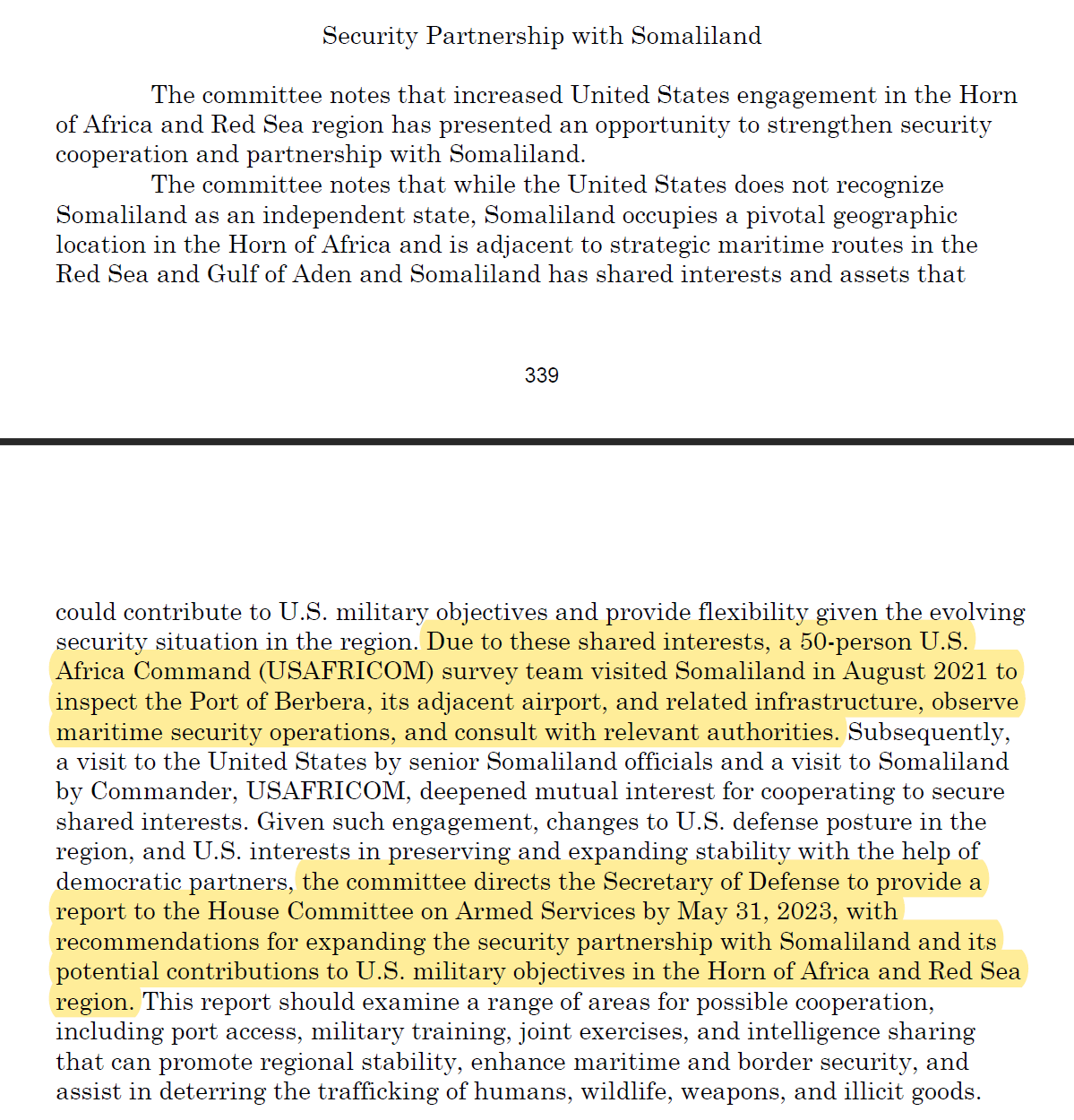
Berbera is located about 230 km southeast of Djibouti, and would offer more space and privacy for United States military operations. The United States already recognized the benefits of Berbera in 2021: In Aug 2021, a 50-person US AFRICOM survey team visited Berbera for inspection and “consult[ing] with relevant authorities”, a recent (Jun 2022) United States National Defense Authorization Act (NDAA) report states. In Dec 2021, a U.S. Congress delegation also visited Somaliland, including Berbera.
According to this recent NDAA report, the U.S. Secretary of Defense should provide a report containing “recommendations for expanding the security partnership with Somaliland and its potential contributions to U.S. military objectives in the Horn of Africa and Red Sea Region”. This report is to include “a range of areas for possible cooperation, including port access, military training, joint exercises, and intelligence sharing that can promote regional stability, enhance maritime and border security, and assist in deterring the trafficking of humans, wildlife, weapons, and illicit goods”
From all of this, it becomes very clear that the United States is showing great interest in Berbera Airport.
Recent developments
According to a Berbera News report dated 04 Jul 2022, American troops have taken full control of security at the airport. According to the report, all Somaliland staff has been sent on a 12-day holiday, and “the UAE official1 at Berbera Airport returned home”. They add that “a number of military planes” landed at Berbera on 03 Jul 2022, followed by “a large number of US planes” on 04 Jul 2022.
I have not yet been able to find evidence that these flights did actually take place. It is possible that U.S. Military aircraft would not be using ADS-B, or not even using Mode-S, for the short flights from nearby Camp Lemonnier to Berbera. This would make the flights invisible to the general public.
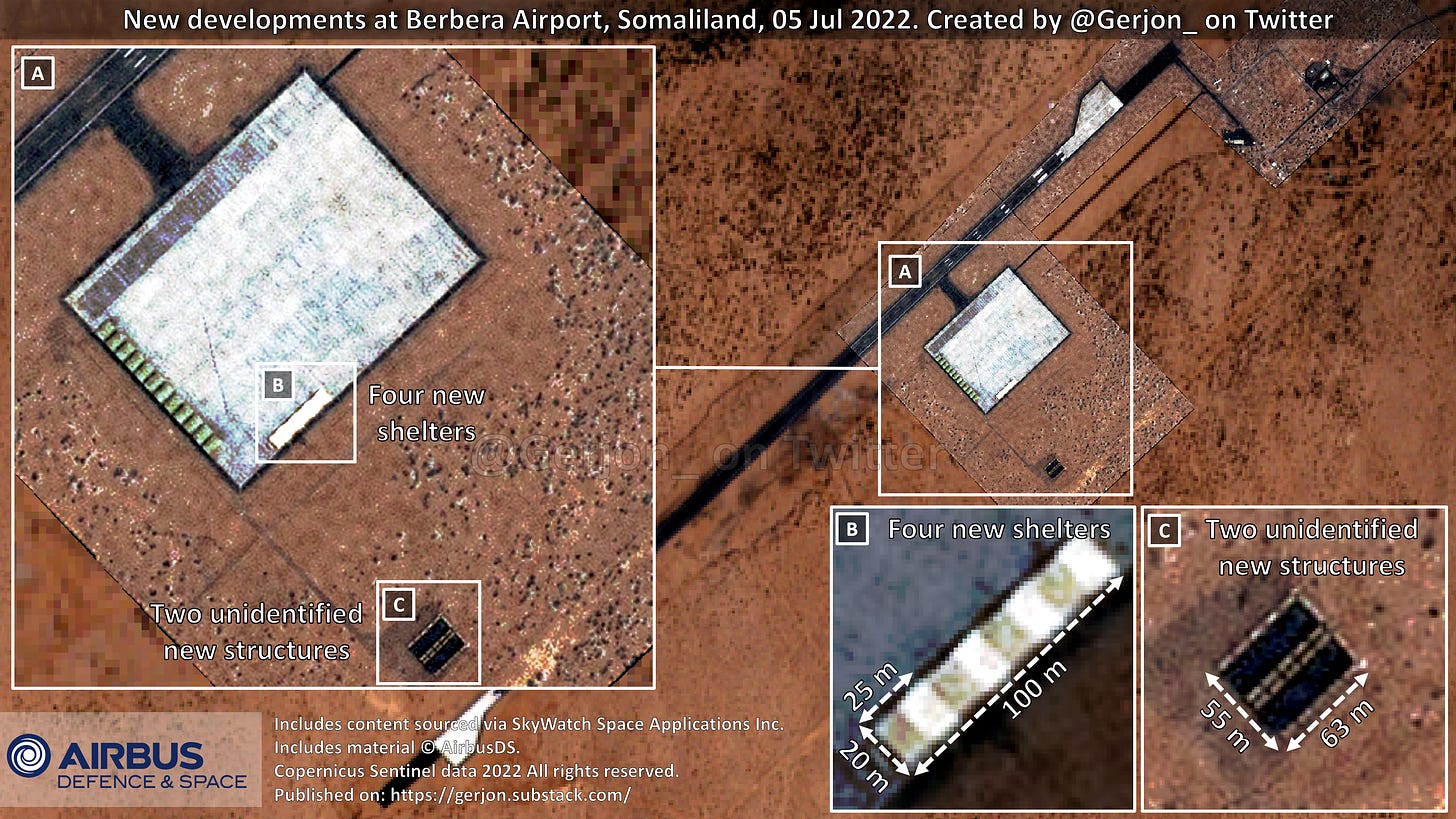
However, there are indeed signs for recent activity at Berbera Airport. Sentinel-2 satellite imagery shows that something was constructed on Berbera’s main apron in the period following 21 Jun 2022.
A closer look at this structure (using SPOT satellite imagery, dated 05 Jul 2022) reveals that this consists of four shelters or canopy buildings, perhaps similar to those of HTS Tentiq, each at a size of 20 x 25 m, or 20 x 100 m in total. Two more new and unidentified structures are located some 300 m further Southeast.
At this point in time, it remains unclear by whom and for what purpose these structures were created. However, they first appear around the same time American presence at Berbera Airport was confirmed.
Conclusions
The United States and Somaliland are developing increasingly close ties. These ties are relevant to Somaliland in their strive for international recognition of their independence. The United States on the other hand may be looking for a new base on the shores of the Gulf of Aden, to serve as a potential future alternative for the increasingly crowded Djibouti–Ambouli International Airport and Camp Lemonnier.
In the past week, unconfirmed news reports claim multiple flights to Berbera Airport and claim American presence at Berbera Airport. These claims have not yet been proven. However, they do coincide with newly developed structures identified at the airport, seen on satellite imagery. At this point in time, it remains unclear why and by whom these new structures were developed.
Future updates about Berbera Airport will be posted on my Twitter and on this blog. Various Twitter followers have notified me that they no longer see my tweets pop up in their feeds. Therefore please subscribe to this blog using the button below to make sure you don’t miss my future work.
Although my investigations take up most of my free time, all of this work is fully unpaid. Also subscribing to and reading my blog is free of charge.Subscribe
SLOW UNFELT POLITICAL CHANGES IN SOMALIA TAKING ROOT
In Mogadishu, the capital, one would note a fledgling government in operation with Villa Somalia 🇸🇴 receiving foreign dignitaries, rudimentary public institutions taking shape, world diplomatic community bringing their credentials to a Somali President. Federal Member States seem to be recovering from the onslaught of Farmajo regime and Houses of Parliament, the Upper House, in particular, has gained constitutional recognition following the fall of Nabad & Nolol anti-federalism campaign.
Despite population pessimism and cynicism that things are getting worse, one could say that there is a light at end of the tunnel that Somalia’s better days are ahead and coming up.
Somalia shares some problems with the rest of world like high energy prices and shortages of food and bottle-necks in supply chain. Severe drought is the most concern now due to failure of successive rainy seasons, combined with centuries old poor management of livestock resources and uninnovative nomadic existence of the bulk of Somalia’s population. Environmental degradation is one of the biggest calamities Somalia faces today. It is mostly man-made and partially out of ignorance and lack of protection. This has to change.
Absence of work ethics and lack of understanding of putting work hours into everyone’s daily business is another chronic issue in the way towards progress in this country. Trying to short-cut required hard work is another critical issue. Encouraging and learning the skills needed here for Somalia’s self-reliance is fatally absent. Somalia has become a Gulf state without the power of petro-dollar in terms of native population’s disability to fully participate in nation-building. Here national leadership to inspire the nation into reaching new heights towards progress is badly needed.
I think the reason is more out of traditions than personal convictions. For example, the New Year Eve is more celebrated in Europe, particularly in Russia and East European countries than their own respective national days, while Christmas 🎄 Eve is the day to look for by all family members in Western Europe and the Americas. But, that doesn’t mean that they put less importance to national days
Here in Somalia, since the overthrow of the civilian government by the Military in 1969 and rise of Islamist and secessionist groups, national holidays like the Independence Days of June 26 and July 1st are slowly fading in significance in the minds of the general public. The unilateral declaration of secession by Somalia’s North West Regions plays out in this mix. Instead, religious celebrations are becoming the only unifying factor, along other Islamic countries, marking these dates not only in faith, but also in continued tradition. When any nation collectively succeeds in the removal of foreign colonial yoke, gratitude to Allah is as important as repentance. If someone is not noting personal or national successes, certainly he or she isn’t appreciative of the blessings of Allah – and this could be interpreted as less faithful.
In the case of Somaliland, not marking June 26 would mean ignoring the sacrifices by hundreds of thousands of its people who fought against British repressive forces in Hargeisa, Berbera, Burco and other towns in the North West Somalia. It is extremely unfair not to acknowledge those who lost their lives to gain their freedoms from a colonial power, which was on the brink of even ceding Hargeisa and Zeilac like Haud and Reserved Area to the Emperial Ethiopia just before Independence. Unfortunately, today in Somaliland there are quite a few, who feel nostalgic about old colonial days of occupation as a result of indoctrination against Somali unity. Bad and unwise leaders bring about similar legacies.
Elections have consequences, and this is true to Puntland State as well. The defeat of President Said Abdullahi Deni in the recent Somalia’s presidential race in Mogadishu had impacted negatively not only on the president, but also on the entire Puntland administration and political system as a whole, including the planned one person one vote forecasts, whereby there is diminished political will to go ahead despite the pronouncements that he was committed to implementing the project of holding municipality elections.
Although President Deni has never been accused of being open to the general public and even to members of his own administration in his closed poor policy of running Puntland affairs, he is now more isolated than ever before. Nobody knows what he has been doing lately, other than he was often traveling overseas solo without any prior public announcement and any attempt to justify his over-rated trips to foreign cuntries, in particular, to Dubai and Nairobi.
Members of Puntland Cabinet are as disillusioned as the general public.The representatives of the House of Puntland Parliament are restless nowadays, only to reject the submitted list of the composition of Puntland Supreme Court by the President. The list was intended to fill in a long-time existing vacuum in Puntland judiciary. The President has used veto, however, to override the House Resolution by re-submitting the same list to the House to reconsider it at next session.
Political opposition in Puntland is slowly getting assertive following the defeat of Deni in the Federal elections, including the betrayal by his own hand-picked and funded MPs from Puntland and Jubaland.
There is anxiety and political uncertainty now in the State that worries everyone. To get out of this dilemma, Puntland political elites must get serious to embark upon political path of democratization and general elections as the only remaining option to govern.
The wedding ceremony for Ms Suban Hussein Khalif Haji Jama Attosh and Mr Qalib Barud, hailing from Majertaine and Dhulbahante respectively was held in Beerta Barako at 22 Km off Garowe City yesterday afternoon. Eminent traditional leaders from both Harti subclans were present to give their blessings to this important traditional event. A dozen of Puntland Cabinet ministers were invited, among many prominent personalities in the crowd. Someone was wondering why Puntland President wasn’t there too.
This event attended by people of diverse political opinions and travelling from different regions and even from continents makes one wonder why they couldn’t put their acts together to liberate and unify Puntland regions, some of which are still occupied forcefully by Somaliland Administration in Hargeisa.
Yesterday’s spirit of union in attending this family event is a clear demonstration that Somalis care more about their family relations in inter-clan marriages than defending their own territories and securing their freedoms. Generally, this could be true for Somali clans, who raise livestock and inhabit in semi-desert, keen to forge ties with other clans because of scarcity of water and grazing areas for their herds, just in case these relationships would bring benefits when desperately needed.
Certainly, yesterday’s wedding ceremony for Suban and Qalib was well attended.
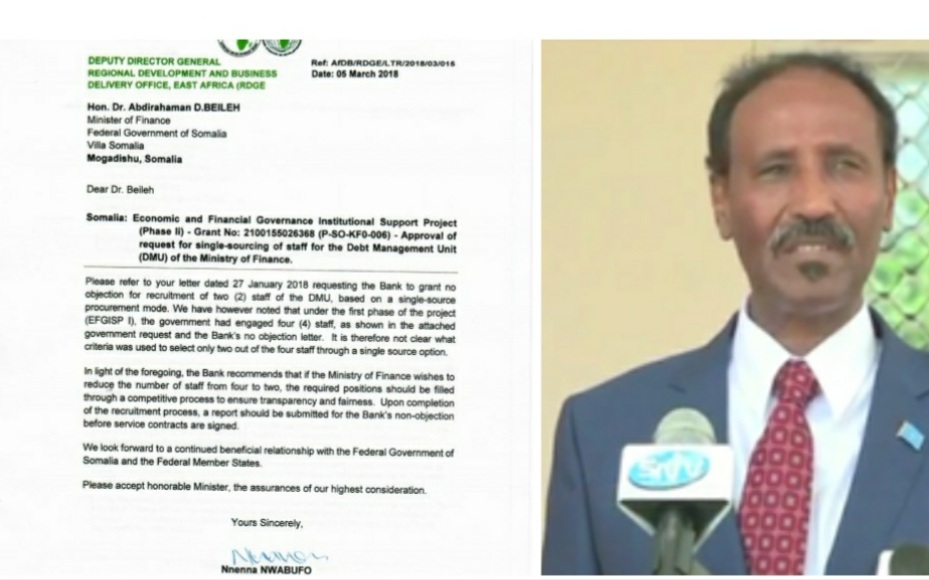
According to the people in the know, Somali Federal Minister of Finance, Dr Abdirahman Beyle, has turned the department into his clan enclave with 80-90% of the ministry staff drawn on nepotism. Taking advantage of corrupt nature of his former bosses and Somali politicians, he is reported to have amassed huge personal fortune, while perfecting the art of theft and looting of public wealth, by creating special accounts for him and his bosses for plunder of public funds, which had never been accounted for in the government budget. Beyle is reported to have built skyscrapers in Hargeisa, using looted public funds.
Beyle’s corrupt adventures and nepotism have no limits to the extent that he even tried to insert his clan members in international financial institutions like Africa Development Bank, on behalf of Somalia, to forget the hundreds of thousands of dollars he gifted to a fellow clan member as the later was appointed Somali Ambassador to Canada, a man named Dhimbil and a former minister of the secessionist Somaliland. Once secured these large sums of money, Mr Dhimbil had trafficked a dozen of his kids from two marriages to Ottawa in Canada. With nowhere to accommodate such huge number of family members, he had to seek large property to rent. The situation had attracted the attention of the Canadian authorities to warrant an investigation into the matter. Diplomatic reports said that his diplomatic immunity has now been suspended, pending to the installation of a new Somali government.
This scandal unnoticed by Somali government had ended up in Ambassador’s family seeking asylum in Canada, with the host government sending a diplomat note of protest to the Somali government complaining about lack of operating funds for Somalia’s mission. The Ambassador was reported shamelessly begging for handouts from the Canadian Somali community there.
Somali Federal Parliament and some legal authorities have been recently looking into the matter of Dr Beyle’s mal-administration and mismanagement of Finance Department’s funds. Whether they have legal strengths to have him accountable is yet to be seen.
They say democracy dies in the darkness. It is equally true democracy suffers from demagoguery. Nowadays, a trend sets in Somali politics. It is NewsBlackout and subsequent public confusion as a result of a situation whereby the general public is kept in the dark on what is happening in their government. This confusion led to disappointment and loss of hope for the future for most Somalis. Man, by nature, thrives on hope for better days to come. Despite the prevailing difficulties in his life, he keeps struggling if he knows steps are being taken to improve his plight.
Strangely, there is a dangerous political culture Somali politicians are learning from Farmajo Regime: AbsoluteNewsBlackouts on running public affairs and occasional demagoguery speeches. This means no transparency and accountability in public affairs. It is an artificial creation of despair and disillusionment in the minds of the general public. It is a removal of better tomorrow from the public psychology and discourse. It is the beginning of social decay and dystopian situation.
If the successors of Mohamed Abdullahi Farmajo were to salvage the situation from getting even worse, they have to act fast to unlearn Farmajo’s ways in public policy, and get real with the Somali public in transparency manners that incite and inspire people in their bitter struggle for better future.
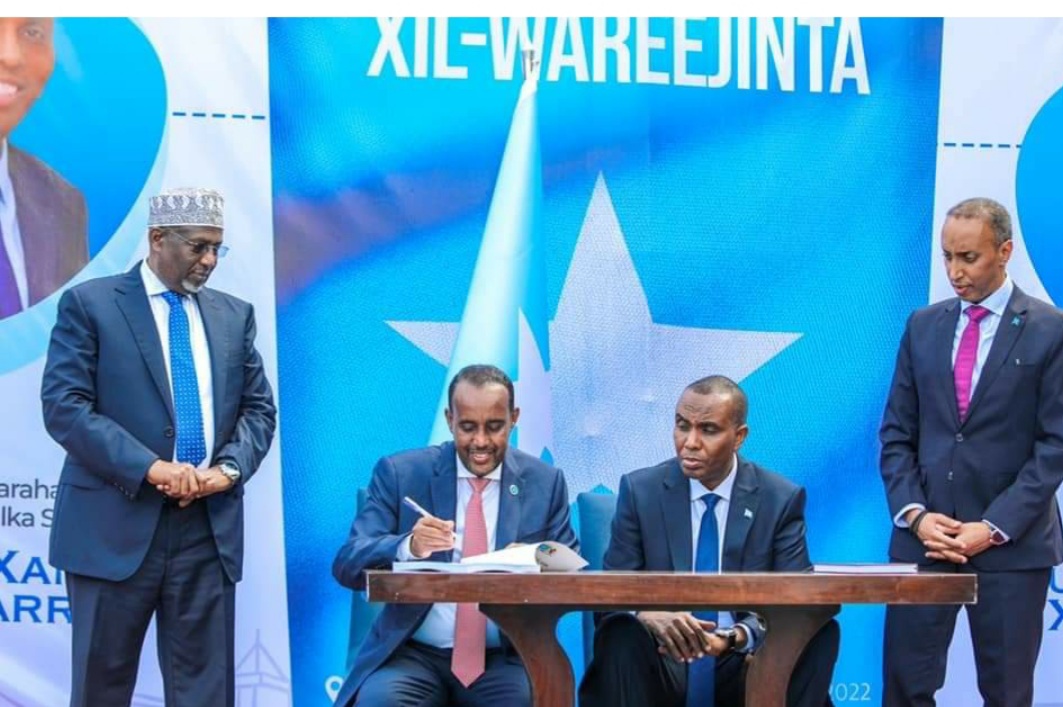
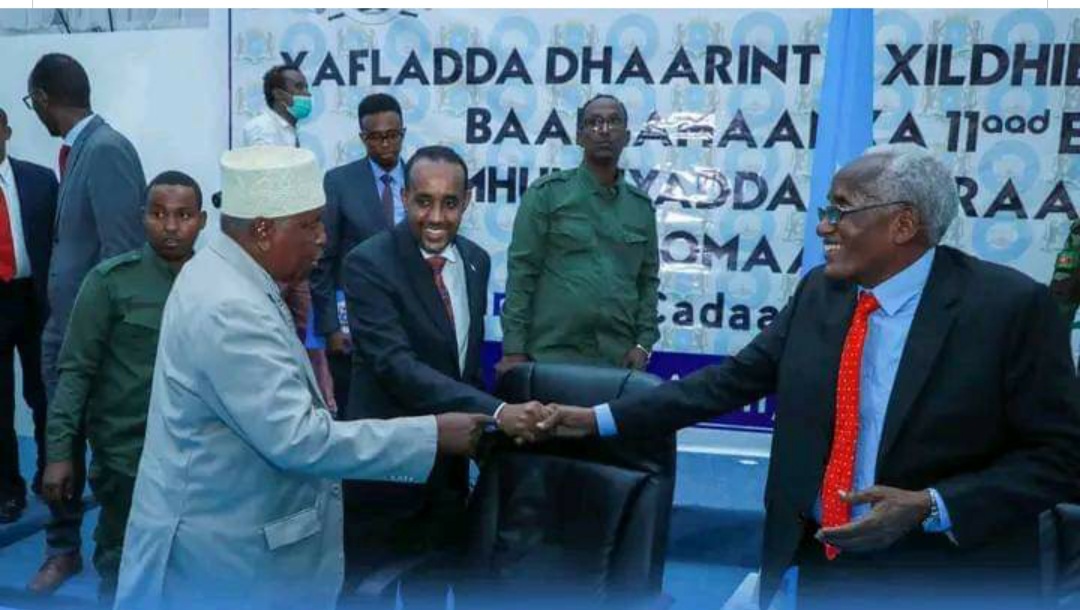
(Feature picture: In the absence of the President due to sickness or incapacity to perform his duties, the Speaker of the Lower House acts as the President in overseeing the installation of the New PM, Hamse Abdi Barre.)
Retrospectively, Prime Minister Hamse Barre has been an incompetent executive, but an effective enabler of President Hassan Sheikh Mohamud‘s (HSM’s) unconstitutional grab of all powers of the Executive Branch of the Somali Federal Government. Many were surprised when HSM appointed him on June 14, 2022, for reasons he only knew. But setting a historical precedence similar to Farmajo’s appointment of Hassan Ali Khayre wasn’t one of his reasons. What people didn’t know at the time was that Hamse was a decoy to musk Mohamud’s Dambul-Jadid‘s grand plan of HAG (Hawiye Action Group) agenda on avenging their historical grievances against Daroods.
This WDM editorial below under the above title was written after HSM had appointed Mr Barre. Ogaden Somalis received this editorial negatively at the time for emotional tribal reasons. They didn’t get it. We hope they read it differently today. Take a look:
WDM EDITORIAL
Historically and constitutionally, any person of Somali origin enjoys equal citizenship rights in Somalia. Equally, Ethiopia and Kenya consider any person of Darood/Ogaden subclan a citizen in each of their respective country. So, Prime Minister Barre, by virtue of his new position in his own country, automatically creates a bit of complications in their diplomatic and political relationships with neighboring Somalia.
It is worthnoting also to refer to former Somali President, Mohamed Abdullahi Farmajo, who couldn’t visit USA as Head of State of a foreign country with the full protection of diplomatic immunity as he was a US citizen. Accordingly, Farmajo was reported to have abandoned his US citizenship to visit America as a Somali President.
To avoid such potential strained relations with Kenya and Ethiopia, on top of already intractable disputes, historical conflict and violence, successive Somali regimes didn’t appoint or elect an Ogaden man to such highly visible position as Chief Executive.
While one may commend President Hassan Sheikh Mohamud for having made this decision in appointing Prime Minister Hamze Barre, someone may also be tempted to raise the question on whether he did due diligence to improve relationships with Somalia’s neighbors, given the historical burdens between Somalia, Ethiopia and Kenya.
Whatever the consequences of Mohamud’s appointment, all Somalis congratulate the New Prime Minister and wish him well.
Free press is a rarity in many countries, including Somalia. What is peculiar in some countries like Somalia is an additional self-censorship in favor of emotional bias involving sectarianism, tribalism and political factionalism.
Warsame Digital Media WDM
(https://ismailwarsame.blog) is committed to clear out this clutter and present unbiased and balanced critical analysis on socio-political situation in Somalia and the Sub-region.
To keep the service going as a free press without fear or favor, we need your help with annual subscription. Send your Annual Subscription of $37 to Sahal Account at 252 90 703 4081 or EVCPLUS at 252 611588 388.
All are kindly requested to renew their Annual Subscriptions.
Mr President, Ministers and Members of the Parliament
I thought that public relations are important component of public affairs. An attempt to reach out to the office of the President by the members of the general public cannot be discarded as routine modus operandi of the Presidency.
Since Military Regime of 1969-1991, and throughout Transitional Governments of Post-Civil War, Somali Members of the Parliament were more rogue elements in the State than genuine representatives of their respective constituencies. This is the main reason for mal-administration, corruption and bankruptcy of intellect and initiatives in Somalia.
The public is full of ideas as well as concerns to address issues of public interests. Some are looking for opportunities to contribute to nation-building. Still others are thinking of how to join campaigns for national reconstruction. Are these issues fall into areas of your Excellencies’ interests? If so, think of creating public affairs section in each portofolio of the government and Parliament. It is an office ran by one officer with an assistant attached to each ministry and offices of the House Speakers reporting to a designated officer agreed upon. Correspondences by the members of the general public to offices of the government at levels shouldn’t be ignored to avoid harming the public image and perception of the government.
All the best, Ismail H. Warsame Tel: +252 90 703 4081 Email: ismailwarsame@gmail.com
Puntland Presidency is in disarray. Appointment of officials by the Vice President and refusal of the President to endorse it poses a direct security threat of destabilization of the State by own leadership. These appointments are not in the best interests of both the President and Vice President. The President wants to campaign in Mogadishu for Somalia’s Presidency with a peace of mind, and the Vice President would be better off in inheriting a functioning administration of Puntland.
Right now, neither of them is leading a sound policy for the people of Puntland. They seem to be playing a game of drones among themselves. This is ridiculous and laughable for men of such advanced age to behave like school skids, oblivious to the heavy responsibilities entrusted in them. They truly failed Puntland.
Stop the baby game.
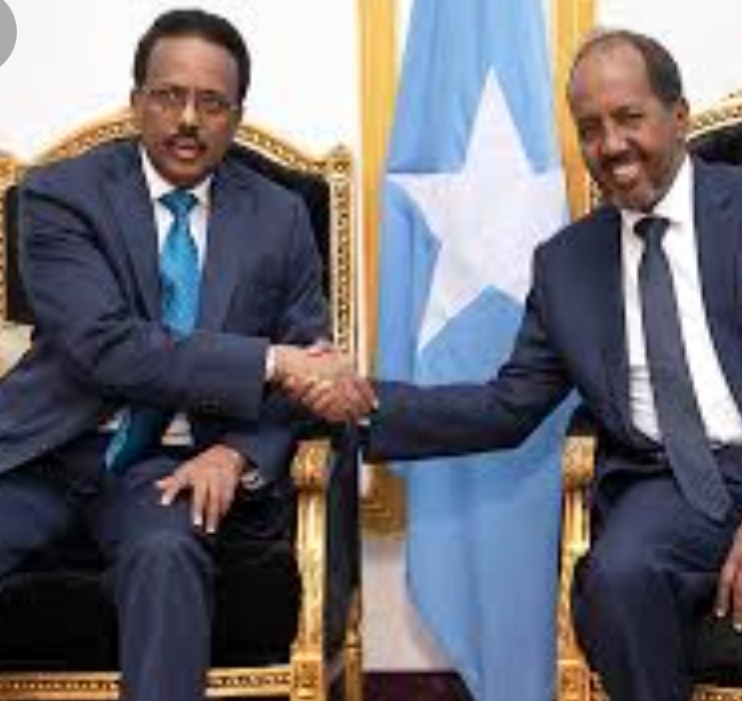
President DeniVice President Ahmed Elmi Osman (Kraash)
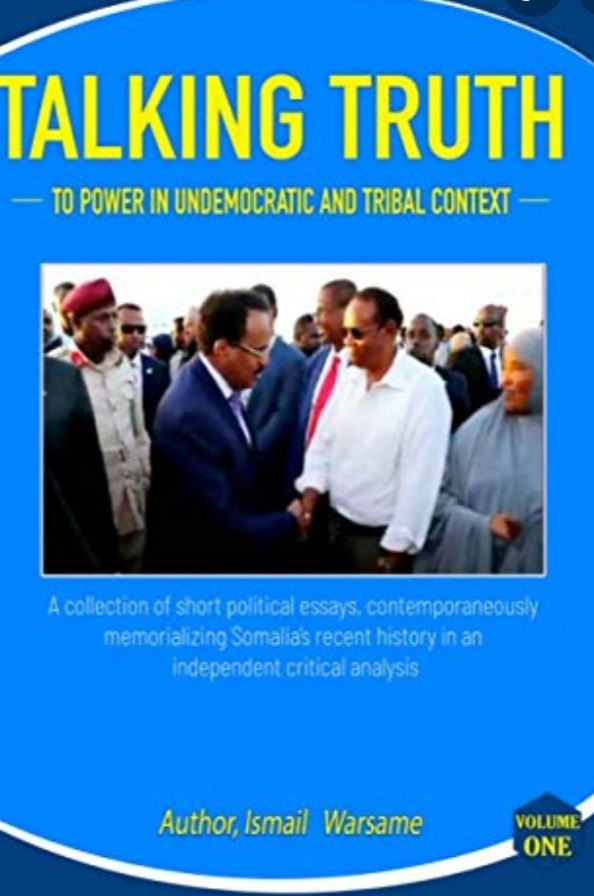
I have known the Author, Ismail Haji Warasme, for many years both in his public and private life. I knew him as honest and hard working professional. I have been following and reading his articles in various international and local media outlets. I had read some of the articles compiled in this book as they appeared first time in the media.The articles gathered in this book are as objective as they are critical and unbiased analysis of latest political developments in Somalia. This is a unique book to appear in the bookshelves. I would recommend this book to anyone interested in Somalia’s affairs. Ambassador Mohamed Awil Ahmed, Formerly, Somali Ambassador to the People’s Republic of China.
It has been a long time home-coming to reach at this stage – a controversial election produces controversial outcome, however. Despite press reports and multiple eye-witness accounts of election manipulations at constituencies levels, though, the New Parliament composing of two chambers is finally constituted with the election of the temporary speakers today, based on age criteria, until the leadership of the both houses are voted for. The temporary speakers are Senator Mohamed Ali Yusuf (Gaagaab) from Puntland State and MP Abdisalam Haji Ahmed (Dabancad) from Galmudugh State.
Given the long delays, political controversy and in-fightings between different levels of the government and FEIT (Federal Electoral Implementation Team), today’s Swearing-In Ceremony is significant.
Today’s proceedings in Mogadishu is shadowed, however, by incomplete conduct of election in Gedo of Jubaland State, and Beletweyne and Jowhar of Hirshabelle State, a total number of MPs close to 30 still to get elected. At this moment, the New Parliament has more than the Quorum to sit and pass resolutions. Whether they would go ahead to hold sessions without waiting for the remaining unelected MPs is to be seen.
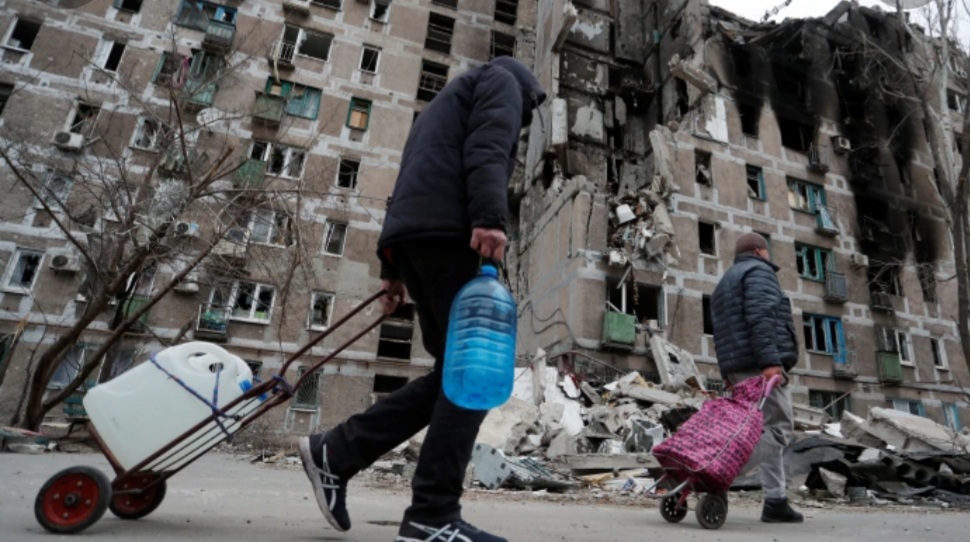
Let us start with Russia. The war does not meet the minimum security objectives of President Putin – prevention of NATO expansion into the security buffer zone of the Russian Federation, with Europe’s neutral countries of Sweden and Finland now pondering to join NATO. The war in Ukraine may drag on, wiping out Russian economy and resources. Russia is already isolated and decoupled from major world business and financial networks, as a result of this war.
Ukraine War has caused European anxiety and feeling of security threat from Russia since World War II.
The war has shaken up entire economies of many countries beyond Europe – nations in the developing world, who rely on Russian-Ukraine wheat imports would suffer heavily.
The outbreak of this war would encourage proliferation of nukes and development of biological weapons from now on as deterrent among nations, including Ukraine.
In conclusion, the Russian War (“Special Military Operation”) against Ukraine clearly demonstrates its foreign policy failure and diplomatic fiasco. Painfully, the Russian-Ukraine war is a slaughter between closely related slavic nationalities. It would have traumatic effect on children even beyond Ukraine. The hatred so caused here due to destruction of lives and livelihoods on both sides of the war would last for generations to come.
My father passed away in De Martini Hospital on the southern seashore of Mogadishu in 1968. He withdrew his last breath, while I was holding his hand at his death bedside. Hovering and standing over me were the late Prime Minister of Somalia 🇸🇴, Abdirizak Haji Hussein and Mr Yassin Nur Hassan Bidde, the late Interior Minister at the time. In attendance was a Chinese physician trying his best to save my father’s life, who was suffering from malaria. At that moment, the ministers were contemplating and discussing on the possibility of evacuating my father to a better medical facilities in the People’s Republic of China 🇨🇳. My father’s medical situation brought together a former prime minister, who was leading a strong political opposition to the government of the day, and the minister of Internal Affairs of the administration then. Tragically, my father died prematurely before he was airlifted to China. Following his death, I was devastated, depressed and sick for a week. At the time, I was in school.
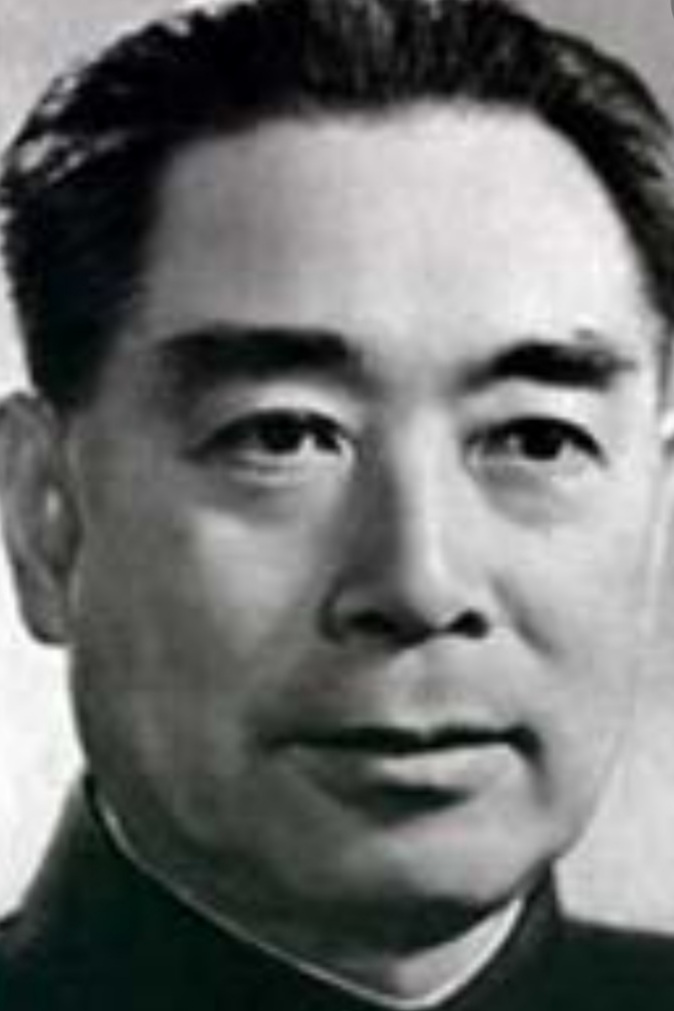
Earlier in my childhood, in 1964 to be exact, I do recall the visit of Zhou En Lai, the first and late Chinese Premier, in Mogadishu. I was a kid with some members of my family among the crowd at airport, welcoming the Premier. I vividly remember Zhou En Lai speaking in Chinese at Airport reception. What I found remarkable was the fact that a Somali interpreter of Mandarin suddenly appeared on the stage. It was hilarious. Somali singers sang a song right there: “Zhou Lai ha jiroo cadowgii ha jabee” ( Let Zhou Lai long live, let his enemies perish.)
Since then, I had the opportunity to learn a lot about the Soviet Union, China and other countries of the left from the late Secretary-General of the Somali Democratic Union (SDU), a leftist political party popularly known in Somali political history as the “Great” (a term standing for greater Somalia), Mr. Yusuf Osman Samater (Bardacad). Bardacad was a good friend of my former Boss, the late President of Puntland and Transitional Federal Government of the Somali Republic, Abdullahi Yusuf. That was an extra education on the top of myself winning a scholarship to the Soviet Union immediately after leaving high school.
أعلن رئيس بونتلاند ، سعيد عبد الله ديني ، ترشحه لرئاسة الحكومة الفيدرالية الصومالية. السيد ديني ليس فقط قائدًا تم اختباره ولديه خبرة واسعة في كل من القطاعين العام والخاص ، ولكنه شغل أيضًا العديد من المنافذ الحكومية المهمة على المستوى الوطني ومستوى الولاية. إنه ضليع بالقضايا والحكم الصوماليين. خلال الفترة التي قضاها كرئيس لولاية بونتلاند ، واجه بثقة عددًا من الأزمات وحلها ، الأمر الذي كان سيتحدى أي زعيم آخر. لقد تعرّف على أعضاء المجتمع الدولي وتفاعل معهم ويعرف كيف يعمل الشركاء الدوليون الصوماليون. سيتعامل الرئيس ديني بشكل أفضل:
استكمال الدستور الاتحادي.
تحسين وتطوير الفيدرالية في الصومال.
علاقات أفضل مع الجيران الصوماليين.
بنية الأمن القومي المتوازنة.
محاربة الماكرة والفساد.
أعضاء اتحاد المرشحين الرئاسيين ، الذين لديهم رغبة حقيقية في التغيير السياسي في الصومال ، يجب أن يتجمعوا خلف الرئيس ديني – لديه فرصة أفضل في فيلا الصومال (Villa Somalia).
Puntland President, Said Abdullahi Deni, has declared his candidacy for Somali Federal Government Presidency. Mr Deni is not only a tested leader with vast experiences in both public and private sectors, but he has also held important government portofolios at national and state levels. He is well versed with Somali issues and governance. During his stint as the President of Puntland State, he confidently faced and resolved a number of crisises, which would had challenged any other leader. He has been exposed to and interacted with the members of the international community and knows how Somali International Partners operate.
President Deni would handle better:
Completion of the Federal Constitution.
Improvement and development of federalism in Somalia.
Better relationships with Somali neighbors.
Fight against crafty and corruption.
Balanced National Security Architecture.
Members of the Union of Presidential Candidates, who have genuine desire for political change in Somalia, should rally behind President Deni- he has a better shot at Villa Somalia.
The obvious reason is punishing Russia for Ukraine invasion. But, there are other non-obvious reasons, namely,
Russia is increasingly becoming again a military, political and economic competitive after the collapse of the USSR (Soviet Union). Ukraine was a part of the Soviet Union.
Rise of Russia has been historically considered a multifaceted threat to Europe.
Ukraine has the potential to be a nuclear state, having inherited the know-how and technology of the Soviet Union. Russia wants prevent Ukraine from becoming a nuclear power as its neighbor, on the top of being a NATO and EU member.
Russia considers Ukraine as part of greater Russia.
Russia feels threatened by EU and NATO expansion towards Russia and breach of earlier commitments by USA and EU not to do that.
Mistreatment of ethnic Russians by the current Ukrainian leadership in Kiev. There are reportedly fascist elements in Ukrainian society to which Russians don’t tolerate because of Hitler’s atrocities against Soviets in the WWII. There is also anti-Russian sentiments in Kiev and Western Ukraine.
There are many other subtle reasons why Russia can’t leave Ukraine alone.










 Warsame Policy & Media Network (WAPMEN)
You must be logged in to post a comment.