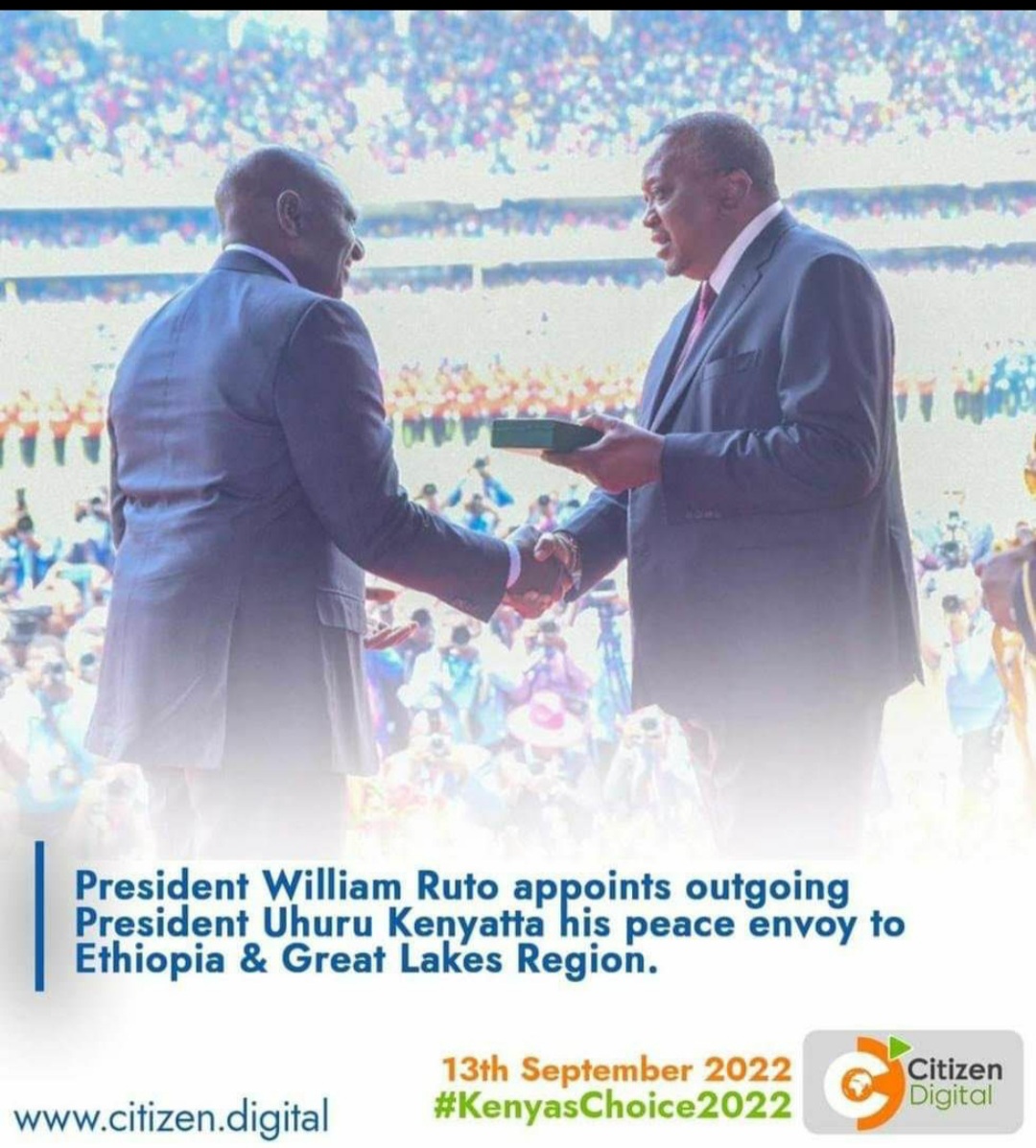
PEACEFUL TRANSFER OF POWER IN KENYA

Peaceful transfer of power captures the essence of democracy. In that sense, Kenya, Somalia’s neighbor, has made gigantic move forward and joined to world democracies with its African heritage of multiple tribes and numerous ethnic groups, proving most Somali analysts deeply wrong in their debates on the subject. Clans aren’t the problem in Somalia. It is the politicians who use them for opportunistic and selfish aims, cultivating divisions and hatred among clans in the process.

The cornerstone of democracy is respect and adherence to the spirit and letter of the constitution. That solemn civil contract is what binds the citizens to constitute a nation-state, exercising the laws of the land. Clans, in the case of Somalia, are positive forces of identification as genuine Somalis and belonging to a clan solidifies its ownership as a stakeholder. There is no other way to define or distort this reality. When discoverers of 4.5 Clan Power-sharing Formula in Somali politics introduced their invention, they struck at elusive discovery of Somali reality, hypocritically denied by many. Inventors of the Clan Formula didn’t hide the fact that it is good only before general free and fair elections take place, after which the Formula requires some adjustments for Power-sharing and clan balance reasons. For example, the Head of State and Head of Government cannot come from the same sub-clan of the 4.5 clan political configuration. There must be a clan balance in government. Even after general elections, you are dealing with the 4.5 sort of a scenario.

Welcome to Kenya, whereby save the President, every elected person is picked by his/her own constituency in most cases. In tribal politics, it is hard to discover a neutral party. Only laws are needed in place to make public servants apolitical. Other than that, accept the reality and move on.

Somalia: Speech by High Representative/Vice-President Josep Borrell at the joint medal parade with EUCAP and EUTM Somalia

 11.09.2022  

Mogadishu

 EEAS Press Team

Thank you. Thank you, Commanders for hosting me today in Mogadishu. Thank you to all of you for joining this ceremony.  

Mogadishu is a long way from Brussels. I made this long way to come and see you, and the new leadership in Somalia.  

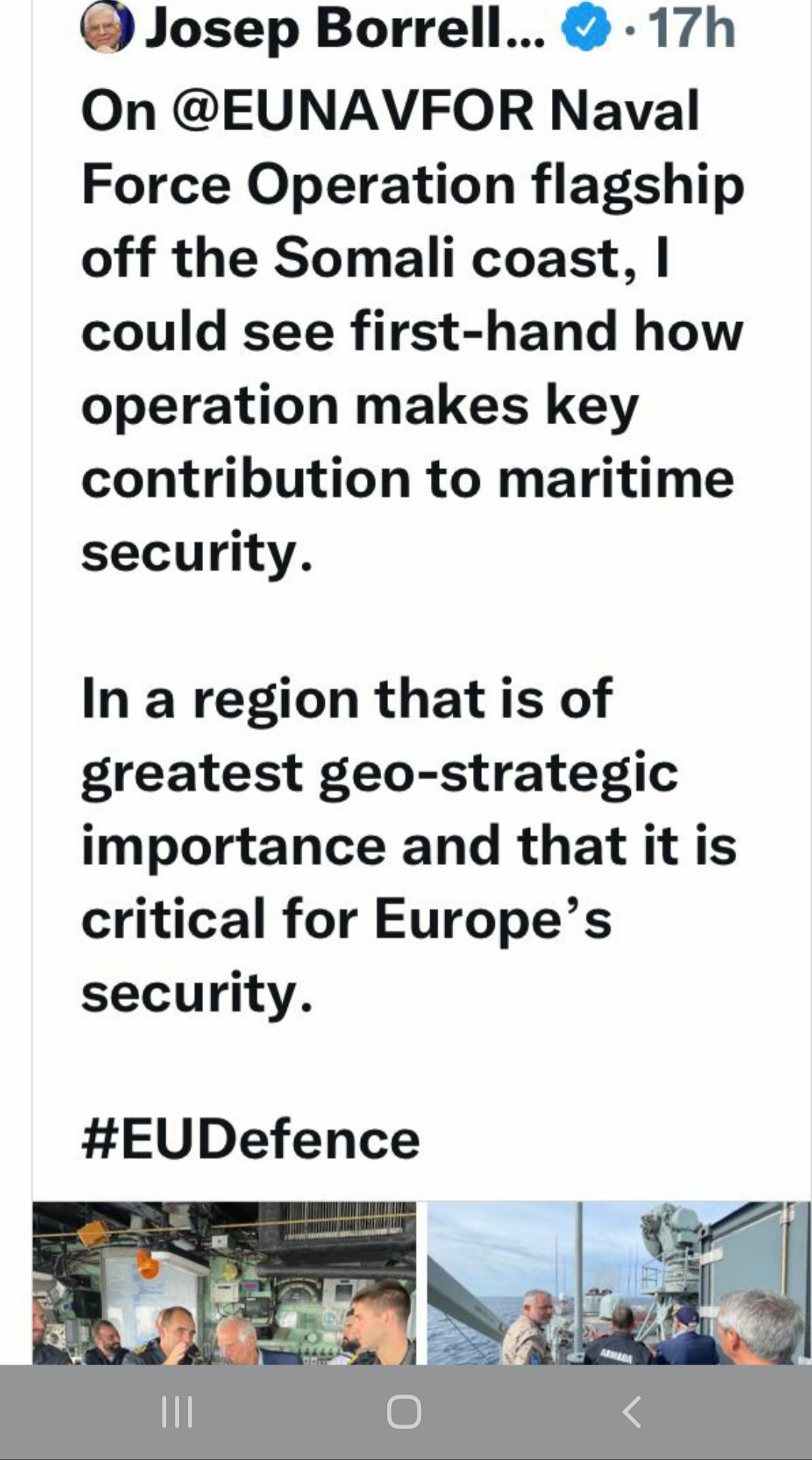
Somalia and its broader region remain critical for [the] Europeans’ security and interests.  This is why we are deploying here three missions [and operations] of our Common Security and Defence Policy (CSDP). And the European Union’s Delegation need to continue working side by side in Somalia.  And this is why the European Union needs to sustain its efforts in this difficult and troubled part of the world.  

But every policy needs men and women to implement it, and your personal efforts are crucial to implement this strategy.  

I commend your commitment and your hard work here in Mogadishu – I know that it must be difficult -, but also in Hargeisa, Garowe and Berbera. I know that it takes courage and resilience. And on behalf of the European Union, I have to thank you. 

Your dedication to promote and to protect the European Union’s values and interests here in Somalia, and in the region, is fully recognised in Brussels and across the European Union Member States.  

It is difficult, but we need to continue. We need you to continue to strive for tangible results. 

I just had a meeting with the Somali President [Hassan Sheikh Mohamud] and recalled to him that the EU Training Mission (EUTM) has already trained 8,000 Somali military [personnel] so far. And thanks to this mission and thanks to your work, the Somali National Army has increased its capacity to train its personnel by itself. Because we hope that we are not going to stay here forever, and they should be able to take their responsibilities. Recently, it took responsibility for a fully manned and equipped training centre in Mogadishu.  

Another tangible action on which we need to continue to build: two out of the four Somali National Army Battalions trained by us – by you, by this mission – have received equipment funded by the African Peace Facility. And now, with the European Peace Facility – a new financial tool – we are scaling up this support.  

And a last example that comes to my mind: in the port of Mogadishu, the EU Capacity Building Mission in Somalia (EUCAP Somalia) has considerably improved the efficiency and the working conditions for the Maritime Police Unit. I know that is not enough, and the Somalis are far away from being able to replace the EU Naval Force Somalia – Operation ATALANTA. But we have to look for an exit for the EU Naval Force Somalia – Operation ATALANTA.  

In the meantime, EU Naval Force Somalia – Operation ATALANTA’s contribution to maritime security on the coast of Somalia and the EUCAP [Somalia]’s efforts on shore to build the capacity of the Coast Guards and police continue and are mutually reinforcing.

When I will come back to Brussels, I will recommend the Member States to extend the mandate of [EUCAP Somalia and EUTM Somalia] missions by two years. This is part of our strategic engagement in Somalia.  

In the next two years, your missions will need to continue demonstrating professionalism and ambition; striving for concrete results. Neither EUTM [Somalia] nor EUCAP [Somalia] have yet fulfilled all their objectives – this is certainly an understatement.  

We have to continue. And I have discussed with the Somali President the reason why this is the case and the challenges facing Somalia and its security sector, in particular.  

I told the President that our objective is to continue to strengthen the security institutions while diminishing gradually our support to the African Union-led operation – the so-called ATMIS (African Union Transition Mission in Somalia).  

Somalia needs to take full ownership for its own security by the end of 2024. I assured the President that you would stand by the [Somali National] Army, by the Police and the Coast Guards of Somalia to help them to fulfil this objective. 

This is critical for Somalia in the first place, but it is also critical for European security. Our fellow citizens should know that their security starts far away from our borders. The security of Europe starts also in Mogadishu. That is why your missions, and your daily work, are so important.  

It was my honour to be here in Mogadishu today with so many men and women in uniform, as well as civilians serving this objective.

Thank you for that and keep up the good work.

CONTACT DETAILS

PETER STANO

Lead Spokesperson for Foreign Affairs and Security Policy

peter.stano@ec.europa.eu

+32 (0)460 75 45 53

JENNIFER SÁNCHEZ DA SILVA

Press Officer for International Partnerships/Foreign Affairs and Security Policy

Jennifer.Sanchez-Da-Silva@ec.europa.eu

+32 (0) 229 58316

SOMALIA: MENACED BY EXTREMISTS, ITS CAPITAL CITY OCCUPIED BY FOREIGN TROOPS AND COUNTRY BESIEGED OFF SHORE

It was a democratic country until a general of the National Army seized power in a coup in October 21, 1969. At the time, for more than two decades the country was a playground for Cold War rivalries – until all hell got loose, leading it to a failed state status in 1991. Power vacuum so created had offered opportunities for all sorts of dark forces: War lords, Islamic Courts, Alqaeda, Alshabab and UN Military Mission for Somalia (AMISOM, now ATMIS). This was followed by UN Naval Force Operation off Somali Coast (UNNAVFOR) seiging the country at sea from the Red Sea to the Indian Ocean.

Somali fishermen and fishing communities at Somal territorial waters have been decimated within a year, many have been seized with their fishing nets deemed pirates and transported to distant foreign lands without legal representation.

Yes, there were pirates, but they were symptoms of foreign illegal fishing, not the root causes of the problem, and initially, a reaction to the destruction of the environment and abuses against fishing communities by aggressive foreign fishing trawlers along Somali shores. One is tempted to ask the question: Did UNAVFOR stop illegal fishing and toxic waste dumping? The answer is unequivocally no. Instead, they provided protection for foreign trawlers with banned fishing gears. Give us one incident when UNAVFOR caught just one foreign vessel fishing illegally in Somali waters? You wouldn’t find one example.

The successive fledgling administrations of the Somali Federal Republic were unable to reclaim sovereignty over their territory and sea waters, as they have been coerced to enter into treaties of protection under unfavorable conditions. Somalia’s sovereignty is only theoretical at international forums and doesn’t extend to its own territory.

Former Government of Farmajo, demogogic as it was, tried to show some sort of resentment against foreign meddling in the domestic affairs of Somalia. It refused to renew UNAVFOR agreement. Enter 2nd Administration of Hassan Sheikh Mohamud, who willingly re-endorsed that treaty yesterday, after a little of more than hundred days in office. One would wonder whether Somalia’s Federal Parliament has any teeth to look into HSM’s latest political shenanigans and seemingly power abuses, and unlawful embrace of foreign contracts and suspicious deal-making.

AFRICA/SOMALIA – From the port of Garacad a road that brings development and hope to the entire area

AFRICA/SOMALIA – From the port of Garacad a road that brings development and hope to the entire area

Thursday, 8 September 2022

Garowe (Agenzia Fides) – There is recent news of an important road project launched in Somali Puntland that will favor strong development of the area.
It is a regional project with strategic importance that involves the Horn of Africa, in particular Ethiopia. The new road will connect the new port located in the historical city of Garacad, 700 km from Mogadishu, with the city of Galcayo and Galdogob, on the Ethiopian border. Once completed, it will allow the goods arriving in the port (Indian Ocean and Gulf of Aden) to arrive in the country in a short space of time. The aim of the project is to serve the Horn of Africa, central Somalia and the south-eastern region of Ethiopia by providing new trade routes accessible to the rest of the world, in particular to the Persian Gulf and Asia, also helping the populations of Oromia, Ogaden, far from the port services of Djibouti.
“The Administration of the port of Garacad hopes to create commercial relations and relations with the entire maritime world, a new port needs international relations”, said Prof. Sonkor Geyre, President of the IFSA Institute of Federalism and Security Analysis. “It will thus be possible to sort out goods and goods useful for the humanitarian crises of the entire area. In addition to the contacts already underway – explains Sonkor – we are inviting maritime authorities from all over the world to visit the port which will be inaugurated in October. This is the largest project in Somalia in the last 40 years”.
The port of Garacad, in the Modug region, borders Ethiopia to the west and the Somali regions to the north and south, and is a development point for the whole area. The Garacad-Galkacyo-Galdogob corridor crosses an area inhabited by about 1,000,000 Somalis, most of them farmers in an area under development.
The study of the 309 km that will connect the cities is carried out by the Puntland Highway Authority, the government body responsible for road transport and infrastructure in the state of Puntland in Somalia, and sees the participation of the KAAD Institute and foreign engineers and will allow transport goods arriving in the port of Garacad as far as Ethiopia. (GF/AP) (Agenzia Fides, 8/9/2022)

DEEP-WATER SOMALI PORT GIVES LANDLOCKED ETHIOPIA NEW TRADE ROUTE -BLOOMBERG.COM

“Somalia will open a deep-water port on its northern coast next month, with a road link forging a new trade route connecting Ethiopia’s south-eastern region with the city of Gara’ad.
The development is part of a $531 million investment plan aimed at boosting the export of livestock, fish, minerals and agricultural commodities, according to Saed Faadi, the chief executive officer of Wadagsan LLC, the developer.

The first two deep-water berths in the Puntland state’s city will be capable of docking 40,000-ton container ships and provide services such as modern loading equipment, refrigerated storage facilities and feeding grounds for animals.
“The port will also provide easy access to food imports from the outside world,” Faadi said in an interview. “This will allow food to be less expensive and enhance food security in the region, which is plagued by droughts and famine.”

The Gara’ad port will be the Horn of Africa nation’s fifth deep-water facility providing access to the Indian Ocean, but it’s the closest to Ethiopia, a landlocked country of 115 million people whose economy was one of the fastest growing in the world before the coronavirus pandemic and conflict curbed expansion.”

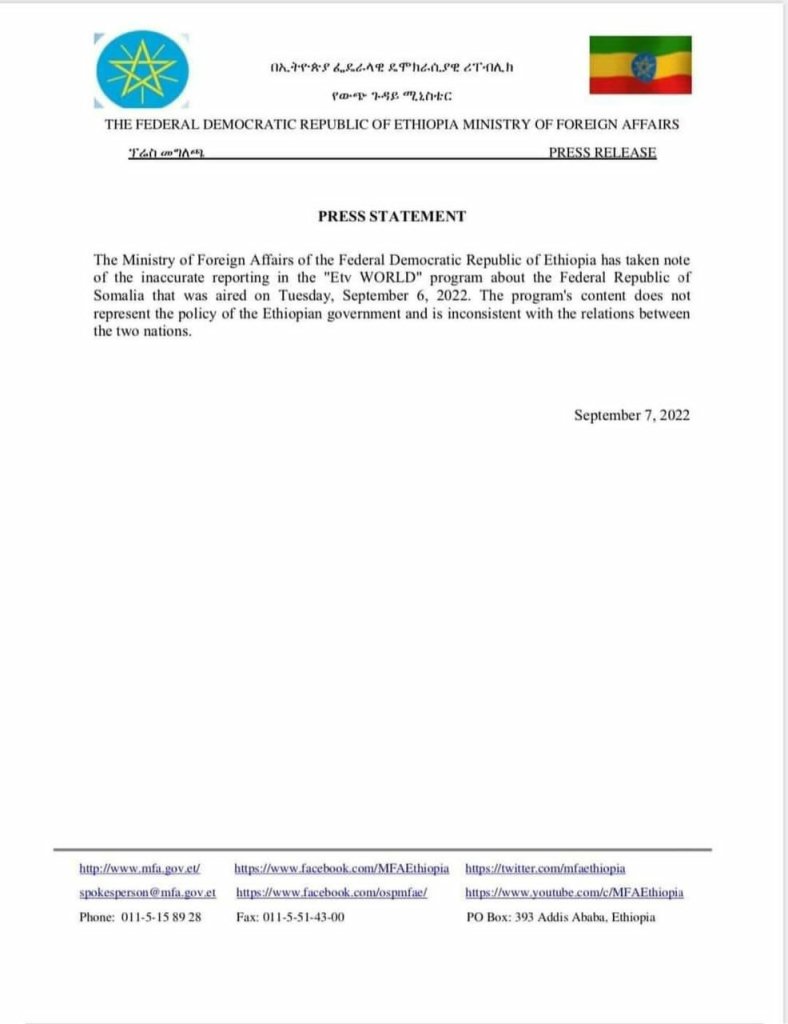
ETHIOPIA’S PRESS STATEMENT

FISCAL FEDERALISM

Ministers of finance of the Federal Government and Federal Member States will be gathering in Mogadishu tomorrow. The issue is working relationships and resource sharing. In other words, it is about fiscal Federalism. There is no policy, no guidelines and no regulations to adhere to. These finance ministers meet often in ad hoc fashion, always addressing stalemate in working relationships or complaints from ministers of Federal Member States. Federal Finance minister is always the target of these complaints. The issues often end up in political compromise and bargain with the endorsement of respective political bosses. That is a difficult socio-economic environment to operate.

The bigger picture of the issue, though, lies in incomplete constitutional framework that most leaders see no urgency to tackle with. Completing the incomplete Federal Constitution would define the powers of states and shared responsibilities. Until that happens there will be always frictions, mistrust and potential abuses by the Federal Government in Mogadishu.

Payment transfer and distribution must follow by guidelines and regulations on resources sharing approved by legislative bodies. This makes the job of finance management tools and personnel easier. Unfortunately, some officials prefer to work under the cover of darkness and closed-door deals. This is what is happening now.

Postscript

As predicted, political bosses will gather in Mogadishu to iron out differences on fiscal Federalism.

INTRESTING READ: PRICE OF CIVIL WAR IN SOMALIA

Courtesy

WDM EDITORIAL

EYL COUNCIL FORMALLY ESTABLISHED

Congratulations are due to the residents of Eyl District of Puntland, Somalia, on completing and concluding local council election. President Said Abdullahi Deni did a commendable job in seeing through First Phase of democratic exercise of one person one vote in three Puntland districts. We strongly urge the President and Puntland Government to implement the rest of local elections still outstanding in most districts. President Deni is on the verge of leaving behind a democratic legacy in Somalia that none of his predecessors in recent memory was able to achieve.

To the critics of the election process with regards to potential irregularities, no democratic election is perfect anywhere in the world. What the current administration of Puntland has been doing in holding some district elections is the right step forward to a democratic Somalia. We urge all residents of Puntland to close ranks and support the President’s election efforts.

The newly elected Eyl Council Chairman, the mayor, Faisal Khalif Wacays

SOMALIS ARE NOW FREE TO FISH IN THEIR TERRORIAL WATERS

The former administration of President Farmajo had been able to end the Counter Piracy Resolution and EUNAVOR because it enabled all navies (including the hostile nations) unfettered access to our sea waters and victimized the Somalis as pirates. Many fishermen were overrun, killed or arrested in the high seas, causing the fishing communities to be fearful of fishing in their own coastline. Watch the Somali Representatives at UN Human Rights Council:

https://media.un.org/en/asset/k16/k16s2jj4a0

Watch “Join Warsame Digital Media WDM” on YouTube

CENTRES OF COMPLAINT AND INFLUENCE

In a society there are always two groups of debaters, the centre of complaint and centre of influence. Example of centre of complaint include Somali arm-chair debaters (Fadhi-Ku-Dirir). Centres of influence include, for instance, Somali Alliance, Somali Concern and Hawiye Action Group to which most Hawye intellectuals belong, including Federal President Hassan Sheikh Mohamud. Here in Puntland a small, insignificant group as a centre of influence is known as Aaran Jaan to which Puntland President Deni belongs.

Most Puntlanders belong to the centres of complaint. They became so good at Fadhi-Ku-Dirir that they formed multitudes of internet chat-rooms to air their frustrations and chronic grievances to each other, turning themselves to political cynics. Centres of complaint like the communities of Sool Region (Las Anod City) never take concrete and measurable actions to move any agenda of their debates forward. In the end, their internet chat-rooms turn into media of personal attacks and disappear from internet networks one by one. That is because you cannot sustain an enterprise without an achievabale objective and purpose to serve.

Action speaks louder than words. If Somalis were to be action-oriented, they should debate on implementable course of action and discard time-wasting arm-chair lazy debates.

Postscript

Centres of influence in Somalia also includes Al-Shabab, among other radical groups, in their evil mission against the nation.

UPDATE ON THE GAROWE TALKS BETWEEN FGS AND PL

https://wp.me/p32mpX-47v

HISTORY

WHY DID SOMALI STATE FAILED?

That question was raised by one of us in a group discussion tonight at teatable in Garowe, Puntland. Everyone expressed his take on that colossal Somali tragedy. The consensus was that Somali state failed due to one man-rule. In other words, the rise of Madax-Ka-Nool is the root cause of Somalia’s collapse. Did we learn anything from this experience?, asked one man. Nothing, responded another. Is there a guarantee that it won’t fail again?, asked 3rd man. No, you won’t get different result from repeating the same experience, volunteered to the debate yet another man.

The conversation was as enlightening as it gets. But what was more exciting was the understanding that since some past and present leaders of the Federal Government and Federal Member States have no capacity or resources to act Siyad Barre, at least this weakness combined with Federal system are deterrent against dictatorship, but for how long? The current problem though lies in leaders of mini-states have created their own enclaves to act as mini-despots in their own right – again one man-rule in a much smaller scale. It means the sum total of the leaders of the Federal Government and FMS amount to a system of despotism in Somalia – an unintended outcome of federalism.

How to come out of this political quagmire? Did you see workshops and training on governance by subject-matter experts in Somalia? But do despots need such transfer of knowledge to the general public and government personnel? Of course not. A vicious cycle sets in which leads to the philosophy hardest question of which was created first, chicken or the egg.

Where does the rule of law fit into all of those? How about independent body of legislators? How does a country call itself democracy in the absence of free and fair elections? We must be all kidding ourselves.

REPORT ON HSM-DENI GAROWE TALKS

President Hassan Sheikh Mohamud (HSM) intends to visit USA, and he is expected to come up with consensus of the Federal Government and Federal Member States on security architecture, debt relief, among others. Initial reports on the meeting said it was getting tough and HSM could remain in Garowe until Sunday.

Yesterday HSM had arrived Garowe at unusual low profile official reception by Puntland Authorities, and encountered even pockets of anti-HSM public demonstrations along Garowe streets.
President Deni was reported to have insisted on revision of all legislations by the Federal Parliament not endorsed by the Federal Member States and resources sharing, among other things. It is tough negotiations.

Stay tuned.

Post Script:

President HSM also plans to meet with officials and managers of Coastline Exploration Limited (formerly, SomaOil) in Texas. HSM had met with W. Richard Anderson, the CEO, in Istanbul, Turkey, recently during the President’s visit there.

NO PROTECTION FOR POOR AND VULNERABLE SOMALIS FROM SPECULATIVE MARKET PRICE HIKES

WDM EDITORIAL

Is there an agency to check and control market price hikes that most often triple on stable customer goods and basic foodstuffs in Puntland?

Since the outbreak of COVID-19, followed by the impact of severe drought and war in Ukraine causing dramatic reduction of grain import, we have been seeing destitute women and children in the streets of Puntland towns. When there is a problem of hunger and nobody seems to care about the plight of the poor in a country where humanitarian food banks to feed the hungry are unknown, the situation becomes not only desperate, but also a curse in human tragedy. Something must be done to avoid mass starvation. Now you can’t cross the street without being confronted by multitudes of begging hands. The problem of dollar-based transactions in Puntland adds to the dire situation of the needy.

To confront this scale of poverty and hunger, we need three things to happen hand-in-hand:

1. A compassioned society to care for the disabled and vulnerable. To offer some relief to the hungry, we have to setup feeding centres and donate to food banks so established for the purpose. Mosques are not equipped and can’t handle such magnitude of misery.

2. A government agency to study the situation and submit expert recommendations on how to tackle with the whole issue of speculative market prices on basic commodities, and the main factors contributing to this unprecedented poverty in Puntland State.

3. International humanitarian organizations must change their modus operandi to come up with fresh ideas to alleviate the dire plight of Somali poor and hungry. It is unprecedented situation that requires unprecedented approaches to help the affected population.

ATTEMPTS TO MARGINALIZE PUNTLAND AND IGNORE ITS PROMINENT POLITICIANS WONT CUT

WDM EDITORIAL

If you think the title of this short article is bit too strong or even biased towards Puntland, stay on your lane like a few others before you, until you learn this fact of Somali politics in the hard way. But, aptitude to change and learn new stuff like common sense is not so common. Puntland State is a major historical part of Somalia with rich cultural heritage of governance and traditions that symbolize ideals of liberalism and tolerance. The State had paid huge sacrifices to re-instate the failed government of Somalia, losing men, minds and material to realize the objective.

Somali politicians who ignored lessons of political history had never been successful. President Hassan Sheikh Mohamud (HSM) will suffer the same fate, barring fundamental changes in his working relationships with Federal Member States, and especially with Puntland.

Today’s low profile reception for President Mohamud in Garowe by Puntland authorities was not even felt by the residents in town beyond the inconveniences of police temporarily closing some roads to the traffic upon HSM’S arrival. Citizens relate to their leaders based on the common understanding of whether they have champions for people’s causes and issues, or not. HSM doesn’t enjoy even the benefit of the doubt in that regard, given the negative double political perception he had earned in his two terms as president of Somalia. Is HSM redeemable?

Have your say.

LOOKING BACK AT SOMALI HISTORY

TAKE A NOTE

The Office of the Puntland Human Rights Defender has been cut from the government’s constitutional budget, according to Chairman  Said Abdi Mumun.   The chairman of the Puntland Human Rights Defender explained the budget cuts as a way to cripple the work of the office, and blamed the violation on the Puntland President and the Ministry of Finance.   He said that they have already submitted the complaint to all concerned, now they are waiting for a final answer from the Puntland Parliament.   The Office of the Defender carries out tasks such as investigating citizen complaints, supporting victims of human rights violations and producing an annual report on the human rights situation in Puntland.

IN SOMALIA’S  POLITICS, NOTHING MOVES WITHOUT PUNTLAND

https://ismailwarsame.blog/2019/04/28/in-somalias-politics-nothing-moves-without-puntland/

WHY SOMALI POLITICAL DOCTRINE IS STILL VALID

The Somali Political Doctrine of never re-electing a president to 2nd term is proved right again, indicating why it was an accident to return Hassan Sheikh Mohamud (HSM) to the seat of power. He had already failed in his first term in office as he was coming from the cold in 2012 presidential election as the leader of Damul-Jadid Group, a semi-religious interest clique. See what is already happening in the security sector under his watch with emboldened Alshabab, while government security apparatus is breaking down due to politicization as they are being treated like political agents of Mohamud’s predecessor, Farmajo.

HSM is a microcosm of all Somali political leaders, who ignorantly defy continuity of government in public affairs- a tendency of every new president to run things anew from the scratch. This is a huge loss of hard works over many decades or at least four years of modest endeavors by previous administration. Wise leaders build on previous societal achievements, and it is the art of statecraft to benefit from experiences and history of a nation.

Every elected (selected) Somali politician has a track record of both his mudane achievements and failures, doing often more harm to the society. Often the failures overshadow any achievements, signaling that they cannot be politically rehabilitated and given a 2nd chance. The Somali Political Doctrine is right even with the rare accident of re-electing President Hassan Sheikh Mohamud.

You are right – you are thinking about the political ratings of the leaders of the Federal Member States. Given your impression of their performances so far, do you think anyone of them deserves re-election?

Have your say.

SECURITY STATUS QUO IN MOGADISHU IS UNSUSTAINABLE

WDM EDITORIAL

Residents of Mogadishu and fledgling Federal Government of Somalia have been coexisting with extremist groups and various religious Tariqas for decades now. You can’t fight back against these extremists when the society itself is split along religious lines, when the government is headed by one of those religious sects (Damul-Jadid), the rank-and-file of the security forces are infiltrated by terrorists or recruited mainly from a few subclans from the vicinity of Banadir Region, with mistrust caused by Civil War still fresh in the minds of people, and Federal officials and administrators are being intimidated by Al-Shabab and ISIS on daily basis.

Unless there is a serious commitment on the part of impowered Judiciary (judges, police, secret services) with sound public policy behind them to address the epidemic of Al-Shabab and underlining problems of government security apparatus, Mogadishu and rest of the country will coexist with another government by the extremists, who are bent to take over the country and beyond in the same way Taliban have been projecting, and eventually succeeded.

Alshabab, Alqaeda and ISIS are no different from other historical Mafia groups. They coexist with corrupt societies and compromised security personnel. Since they thrive in intimidating members of the general public, they extort money and new recruits..

World community can’t help out Somalia in this fight in the absence of Somali authorities ready to get rid of the menace of terrorism from their own land.

SOMALIA: A COUNTRY WHOSE GOVERNMENT OFFICIAL TITLES CORRESPOND NO MERIT

In 1969 the post-colonial government of Somalia had been overthrown by a military junta led by general Siyad Barre, the commander, with the help of the Soviet KGB. Soon the junta declared a pseudo-socialist order in Somalia. The military regime started pursuing policy of house cleaning by uprooting the educated, especially those from Majeertaine community. These were considered anti-revolutionaries and reactionary bourgeoisie. They were purged from public and security services in the same way Pol Pot of Kampuchea (Khmer Rouge) did. Soon the junta found itself with huge job vacancies in all government departments. They couldn’t afford to hire expatriates like Indians, Pakistanis, Philippinos, etc. The junta instead devised “Crush and Literacy” campaigns to prepare cadre resource to fill in the employment gaps. In 1975 these ill-prepared semi-literate favorites of the “revolution” graduated from adult night schools to take up jobs in all badly affected sectors of the country. Anybody among the recruites could be appointed to any job title, or any police and military rank. It isn’t an exaggeration that an office cleaner had been appointed director general of the same ministry he was a cleaner only recently. Official titles lost any meaning of merit. This is the main reason why Somalia’s State had failed.

“Somalis are the most dangerous people. They call you General, Ambassador, while they know you are neither of them. By hearing this address so often, you would finally accept the title”, Said Col. Gebre, the Ethiopian military/political commissar, when I met him in Baydhaba in 2006.

Later, resistance to the military dictatorship grew within all Somali clan system proportional to the repressive measures by the junta, until the regime withdrew in its last breath in January 1991 – a total collapse of public institutions taking place and expulsion of its dictator, Siyad Barre, from the country. He died in exile in Nigeria a decade later.

As Somali State collapsed in 1991, former government officials and high ranking security officers found themselves refugees mainly in Europe, Australia and North America. To earn one’s living in those countries, one has to get a job. You can’t get hired without relevant labour and social skills. Big titles from Siyad Barre Regime couldn’t do the trick.

We should return to meritocracy, the value of hard work and experience and quality education.

WHY SOMALIS SHOULD BE WORRIED BY MARCH OF HISTORY

Nearly 6 decades have passed since Somalis made first missteps in their attempts to create a strong nation-state. They blame a few things for their misfortune: Neo-colonialism, tribalism and religious sectarianism. They never find faults in their ways of life and attitudes towards collective bargaining. They are adverse to critical thinking and unemotional take of stuff they deal with on daily basis is amazing. They are quick to self-defence and don’t go half-way to consider other party’s interests. They don’t appreciate the ingenuity and entrepreneurship of their rivals in every field of human endeavors. Clan rivalries over centuries had created a peudo-culture of cynicism towards each other. In politics, they don’t agree on anything, even among long-term friends and school classmates. One may tempted to consider this phenomenon as egalitarianism, but think how destructive it may be to discover people who couldn’t agree on their own common good. Many of them don’t understand the importance of these statements and to ask questions about the way they live and upbring their offsprings could put you in trouble, citing convenient religious messages to avoid accountability. They desire for everybody to fail. Isn’t this a recipe for failure for all?

Note, time and history aren’t waiting for you to put your house in order. History marches on with or without you. A nation, nationality and race are like company businesses – if they don’t compete, they die and give way to the rise of more adventurous and successful entrepreneurs. It is already happening here with foreign troops in our country because we couldn’t govern ourselves, we have defenseless, porous and stretched borders with our historical enemies, and unguarded longest coastline in Africa, and most unfortunately, we have merceless extremists tearing us apart and inside out, and with no agreed upon public policy and strategy to fight back. Our political leaders have no vision beyond staying on under their poorly performing titles. Our traditional elders no longer represent fair arbitration within subclans. Some of them desire to keep their entitlements while acting as politicians/king makers, turning famed tribal mechanism for conflict resolution upside down. Our intellectuals produce no more than internet chat rooms to spread gossips and uninformed personal opinions. Our traditional nomadic life is deeply impacted by globalization of plastic vessels (containers) and dangerous habit of Qat chewing among herders. Worst of all, our social sector is broken with education suffering from lowest quality as a result of unscrupulous entrepreneurs caring only the business bottom line taking over with mass printing of fake graduation certificates. Somalia now exports sick population to India, Turkey, Kenya, among others, for basic medical care. We don’t even listen to each other without foreign intervention. We talk past each other. We have been left behind long time ago. Can we mend things together to try do some catching-up?

TRIALS AND ERRORS IN PUNTLAND GOVERNANCE

A review of last night’s political debate called for by President Said Abdullahi for a chit-chat at Presidency ensued today between participants over a teatable conversation at a hotel lobby. Since some of us weren’t privy to the substance of the overnight’s debate, we were good listeners to those who wanted to compare notes among themselves and didn’t mind our presence at table. The issue was Puntland democratization and how to better manage traditional tribal mechanism. That event at Presidency is one of President Deni’s rarest occasions he was improvising lately, after many trials and errors in governing Puntland from the perspective of one man show, as other state institutions are weakened almost beyond repair.

Some of us, who casually had happened to be around at that hotel table, tried to contribute to the interesting discussion. We were looked at as outsiders since we weren’t privy to the last night’s prestigious auspice granted by the President to a selected group of Puntland VIPs not considered out of favor from the Presidency. Some of the participants in last night’s get-together with the President came from Somali Diaspora communities. Although they were in deep learning curve on Puntland governance and history of the young Federal Member State, they were eager to offer new ideas to the debate on Puntland socio-economic developments, we learned.

As our round hotel table discussion developed further, we came to debate on the notion of democratization of Puntland system of governance and how to manage the disadvantages of tribal system in the State and Somalia, in general. The issue is management of clans in a democratic society or a tribal society desirous of establishing a modern democratic society as in the case of Puntland. One of us asked the question: “In a country of laws, who is sovereign or supreme, traditional leadership or the rule of law by the state’s institutions?” This fundamental inquiry sparked off fierce debate at table. Although there was no common understanding reached here, the consensus was that successive Puntland administrations were to blame on the state of affairs of Puntland governance. Political leaders had failed Puntland, a situation that led to stagnation of the state in all sctors.

HSM NEEDS TO LEARN THE ROPES OF DIPLOMACY

WDM EDITORIAL

You don’t go to visit a foreign country and start negotiations at the top as a Head of State or Head of Government. Instead, you send diplomats and subject-matter experts upfront to prepare and negotiate on behalf of your government. Then, the head of your government goes there for photo opportunity and signing ceremony. The 2nd option is to select respective teams to work out together the details of possible agreement upon arrival of the delegation for signature and joint press briefing by the heads of State or Heads of government. That is how it works and President Hassan Sheikh Mohamud should abandon amateur foreign visits and adequately prepare before he leaps into diplomatic fiasco. Look at what had happened in Uganda only yesterday, with two Heads of State negotiating and washing their dirty linens in Public.

What is amazing to note here is that Mohamud and Museveni press briefing was about military and security situation in Somalia, an issue that should be kept close to chest. This is good news for the extremists and enemies of Somali peace and stability monitoring Mohamud’s hasty foreign adventures. To President Mohamud: If you are unable to learn and grow, don’t try to lead.

Watch: https://youtu.be/5x22ct9PFNg.

Postscript

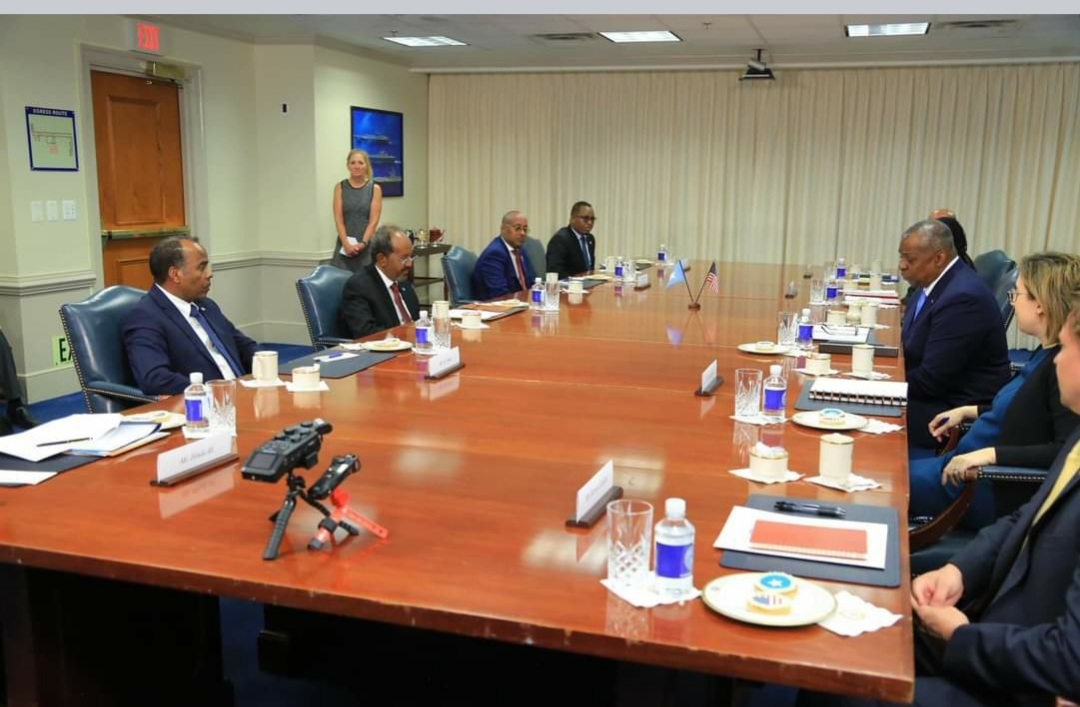
Here we go again. Look carefully at this photo. President Hassan Sheikh Mohamud meeting with US Defence Secretary Austin. On the Somali side, who is attending? His Chief of Staff and rightly the Somali Ambassador to Washington. But, what has happened to Mohamud’s security and military personnel? A Somali cameraman is out of place in this meeting. He shouldn’t be there. Mohamud is either doing these diplomatic and protocol irregularities intentionally, or he is damn inert to learn the art of diplomacy and statecraft. Why isn’t there the Somali Foreign Minister?

ETHIOPIA’S “BUFFER ZONE”FOREIGN POLICY THEORY TOWARDS FAILED STATE OF SOMALIA

“IT IS GRATIFYING TO LIVE LONG ENOUGH TO LEARN WHAT YOUR SEEMINGLY FRIENDS THEN WERE DOING OR UPTO“, Ismail Warsame

Seyoum Mesfin, the late long-serving Ethiopian Minister for foreign affairs and Ambassador to the People’s Republic of China, and Abdeta Beyene, Executive Director of Ethiopia’s Center for Dialogue, Research and Cooperation (CDRD) and Director General of the same ministry, were people I knew and interacted with, as a member of the National Salvation Council (Sodare Group) 1996-1997, and as an official of Puntland Government (1998-2004). These two gentlemen authored an essay published in American Academy of Arts and Sciences (Daedalus) and called it “The Practicality of Living with Failed States“. The issue is mainly explaining Ethiopian foreign policy towards the “Failed State of Somalia”. The authors had extensively deliberated how Ethiopia has been infiltrating into and meddling in the internal affairs of Somalia, using the excuse of lack of capacity on the part of Somalia to maintain internal stability and security at its borders with other countries like Ethiopia and Kenya. The authors tried to broaden the concept of Ethiopian Foreign Policy intervention of “Buffer Zone” (areas of influence and proxies) establishment as an academic discourse worthy of publication in reputable journals.

What is particular interesting in this essay is the unexpected and frank exposure of Ethiopian Foreign Policy towards different state and non-state actors inside Somalia, some of which they had intentionally created and others so formed on their own to provide “Buffer Zone” for Ethiopia’s security against Alshabab and other extremist groups. In dealing with stateless Somalia, the terms of sovereignty and territorial intergrity had lost any constraints in the thinking of Ethiopian policy makers, and paradoxically suggest to the international community some lessons to learn from Ethiopian experiences outside the constructs of international law and relations. Because of the security threats to Ethiopia from Somali regions of Gedo, Bay and Bakool, through the use of extremists as launching areas for attacks against neighboring countries, they said Ethiopia had to occupy forcefully these regions and create proxies like Raxanweyn Resistance Army (RRA) and SNF, according to the paper by these men. In Mogadishu, they claimed that Ethiopian forces entered to wipe out Islamic Courts Union (ICU) after it had threatened Ethiopia, and to support the fledgling Transitional Federal Government of Somalia (TFG). They also claimed that Ethiopian authorities helped Somali regional federal state in Central Somalia and South West after Ethiopia had benefitted from the security and stability in Puntland and Somaliland. They said, after some delay, Ethiopia helped Sunna Wal-Jamaac Group in its fighting with Alshabab, and to reconcile the group with Galmudugh authorities, which was treated as a buffer zone for Ethiopia.

The overarching objective of this exposition was to explain why Ethiopia was interfering in the internal affairs of Somalia, regardless of the letter and spirit of the International Law. Finally, they also asserted that Kenya was creating its own buffer zones with Somalia too, but unlike Ethiopia, Kenya was using Somali local Ogaden politicians to invade Jubaland. However, corruption had weakened Kenya’s efforts to manage its buffer zones successfully.

I would say, as a long time observer of this policy, there is nothing new here other than the frankness of the authors of this essay, for Ethiopia has been historically hell-bent to weaken and isolate Somalia from Emeror Menelik, onwards. Somali armed opposition fronts of SSDF, SNM, USC and others in the 1980s, were part of the proxies Ethiopia has been using, although to the opposition, there was no other option, but to work with the devil in order to get rid of Barre’s oppressive Military Regime in Mogadishu then.

Warsame Digital Media ANNUAL SUBSCRIPTION FEE

Dear Subscribers,

Kindly send us WDM Annual subscription Fee of US$37 to Sahal Account at +252 90 703 4081 or MyCash at 71 681 4371, Garowe, Puntland. or/and, ECVPLUS at +252 61 588 388, Mogadishu, Somalia.

HSM’S ELECTION CAMPAIGN PROMISES BROKEN

“XASAN SHIIKH MAXAMUUD INTUU YAQAANAY WAA DHAAFTAY” (Hassan Sheikh Mohamud is doing more than he could handle).

Wada Ogool” (Governing by Consensus) and “Soomaali Wada Heshiis ah, Dunidana Heshiis la ah” (Somalis in agreement with themselves and with the world community) were big slogans and promises President Hassan Sheikh Mohamud repeatedly uttered during his presidential campaign for election or re-election, given he broke the Somali Doctrine for the first time in Somali history (winning re-election). That was quite impressive. But election campaign promises became inconvenient to keep once elected, and now he is doubling-down on Former President Farmajo’s disdain for consensus building and working with Federal Member States. Strangely, he started governing by non-stop foreign visits without his new government in place, something even Farmajo couldn’t do. He made high profile appointments immediately after he was sworn-in. It took him more than a month to screen out able and potential candidates for efficient Cabinet. While he was busy in unilateral decision-making on Cabinet formation and foreign visits without even his foreign policy team instituted, a few things were happening:

  1. Alshabab got bolder and deadlier;
  2. Ethiopia stepped in to reconnect with Federal Member States;
  3. Scramble for Miraa import from Kenya was occurring in Mogadishu among supporters and non-supporters of Hassan Sheikh Mohamud in Mogadishu.

Since his campaign promises meant nothing now, political cynicism sets in in most Somali regions. It looks that Mohamud didn’t take advantage of popular optimism generated by the recent change of guard in Villa Somalia. Can he mend things and regain lost momentum? Some observers say that HSM’s mind on governance is already set like his predecessor, but in the case of HSM, he is a micromanager, who wouldn’t delegate even to his Prime Minister.

Have your say.

Neighborly Security Tension at border with Somalia

WHAT IS HAPPENING WITH SOMALI-ETHIOPIAN RELATIONS AND AT SOMALI FRONTIER?

WDM EDITORIAL

It looks that Ethiopia is back on its past tracks to infiltrate and divide Somalis in order to weaken Somalia. In Hargeisa and elsewhere in the Federal Member States, public visits by Ethiopian security officers are being conducted. Whether it is security concern on the part of Abyi Government, given recent attacks by Al-Shabab in Southern and Eastern Ethiopian boundary line, or provocative move to destabilize President Hassan Sheikh Mohamud’s Government for geopolitical reasons, isn’t clear yet. One thing is known – President Mohamud had close relations with Tigray Regime of Ethiopia and that is enough justification and reasoning for an African despot to get suspicious and annoyed. Tigrayan Provincial leaders were among the first to congratulate President Mohamud on his victory in the recent Somalia’s Presidential Race.

Whatever the case may be, Somalia has to mend its neighborly relations with Ethiopia. Somalia’s relationships with Ethiopia carry huge historical burden and shared cultural heritage that require careful consideration and risk management exercises. Hassan Sh. Mohamud must rise up to the occasion to improve relations with Ethiopia and outgrow Tigrayan hangover.

Ethiopian Chief Security Officer in Hargeisa

HISTORICAL FACT FOR ALL TO NOTE

Abdullahi Yusuf (RIP), the Late President of the Transitional Federal Government (TFG) was a Somali leader that had the greatest impact on Somalia’s political scene historically. What Somalis are doing and debating on now is his work in terms of governance, federalism, construction of federal member states, fighting extremism, religious sectarianism etc. Truly, he was a historical giant, whether all Somalis are willing to accept, honor him or not.

Nobody could come near him, whether it was Sayed Mohamed Abdulle Hassan or Siyad Barre.

Abullahi Yusuf was the founder of the 2nd Somali Republic (The Federal Republic of Somalia). He was the first Somali leader who formed and led the First Somali Opposition Front ( the Somali Salvation Democratic Front SSDF) against the Military Dictatorship of General Mohamed Siyad Barre with a vision to transform Somalia into a democratic state. He later founded Puntland State of Somalia, the first federal member state, before becoming the president of the Transitional Federal Government, the TFG (current Somali Federal Republic). Under his watch, needs assessment research for Somalia’s reconstruction and development Program (RDP) was launched by the UN and World Bank, leading to the New Deal by international donor community signed in Brussels with the pledge of US$2 billion. It was based on that research. It came through later as Somali government was recognized after transition.

We are reminding people of this historical fact, in response to a WDM Subscriber, who has raised the issue in another context.

Have your say.

WHY HASSAN SHEIKH MOHAMUD ISN’T OPEN-MINDED

So, the long awaited list of Somali Federal Government Cabinet is finally out. Here it is:

1- Saalax Axmed Jaamac, Ra’iisul Wasaare ku-xigeen
2- Mukhtaar Rooboow Abuu Mansuur, Wasiirka Awqaafta iyo Diinta
3- Xasan Macallin, Wasiirka Cadaaladda iyo Dastuurka
4- Axmed Macallin Fiqi, Wasiirka Arrimaha Gudaha
5- Dr. Cilmi Maxamuud Nuur, Wasiirka Maaliyadda
6- Cabduqaadir Maxamed Nuur (Jaamac), Wasiirka Gaashaandhigga
7- Abshir Cumar Huruuse, Wasiirka Arrimaha Dibadda iyo Iskaashiga Caalamiga
8- Faarax Sheekh Cabdulqaadir, Wasiirka Waxbarashada iyo Tacliinta Sare
9- Maxamuud Cabdiraxmaan Beena Beene, Wasiirka Qorsheynta iyo Maalgashiga
10 -Jaamac ilka Jiir, Wasiirka Dekedaha iyo Gaadiidka
11 -Fardowsa Cismaan Dhoore, Wasiirka Gaadiidka Cirka iyo Dhulka
12- Jaamac Xasan Khaliif, Wasiirka Boosatada iyo Isgaarsiinta
13- Xasan Xuseen Eelaay, Wasiirka Xananaada Xoolaha
14- Jibriil Cabdirashiid, Wasiirka Ganacsiga Warshadaha
15- Ismaaciil Sheekh Bashiir, Wasiirka Howlaha Guud iyo Gureyenta
16 -Khadiija Maxamed Diiriye, Wasiirka Haweenka
17- Dr. Crisaaq Cumar Maxamed, Wasiirka Batroolka iyo Macdanta
18- Maxamuud Doodishe, Wasiirka Amniga Gudaha
19- Axmed Madoobe Nuunoow, Wasiirka Beeraha iyo Waraabka
20 – Cali Xaaji Aadan, Wasiirka Caafimaadka
21- Axmed Xasan Aadan, Wasiirka Kalluumeysiga iyo Kheyeaadka Badda
22- Daa’uud Aweys Wasiirka Warfaafinta
23 – Biixi Iimaan Cige. Wasiirka Shaqada iyo Shaqaalaha
24 – Jaamac Taqal, Wasiirka Korontada iyo Biyaha
25- Maxamed Barre Maxamuud, Wasiirka Dhallinyarada iyo Ciyaraaha
26- Khadiija Al-Makhzuumi, Wasiirka Bay’adda iyo isbddelka Cimiladda

Looking at composition of this list and underservingly prolonged time it took to produce, it is obvious that there has been deep screening to find persons who had no experience, or having no knowledge of business or public office expertise, with only few exceptions. Here, one is tempted to recall a Somali saying: “A mountain has been laboring painfully for days, and finally gave birth to a rat”.

We don’t want to get into the description and analysis of other constituencies from which President Hassan Sheikh Mohamud has drawn the list of members of the New Cabinet, although we are fairly sure that some of the other constituencies fare no better in Mohamud’s selection or choice for his enterprise than Puntland. The few appointed ministers from Puntland include General Ilkajir, Fardowsa Osman Egal, Abshir Huruse and Hange, among one or two more. Those who haven’t yet looked at this selection from Puntland constituency, will discover that none of them, save General Ilkajir, has anything or experience to bring to Hamse Cabinet, a man who is nominally the “Prime Minister” of Somalia, but actually a decoy to deceive people. They have been cleaverly picked up by Hassan Sheikh Mohamud to screen out any able candidates from Puntland State. Some people may argue otherwise. Be fair to Mohamud’s appointees, I agree. But, tell us what experience, skills or knowledge a still single young girl, Fardowsa Osman Egal, would bring to the Cabinet or her portofolio? What about Abshir Huruse, the Foreign Minister designate? How would he be able to handle Somali foreign affairs and diplomacy in this complex world of conflict, wars and ideological confrontation, when he had never held public office before? Hange was a junior minister in Said Deni’s Cabinet here in Puntland. As a Deputy Minister in Hamse’s Cabinet, that may be ok. But, still there are others more qualified.

To make a long story short, like most politicians of Somali origin, Mohamud’s concern in governance and leadership is personal, biased and prejugemental. As a student of Somali Civil War and religious sectarianism, he is daring, though, in carrying out his unbalanced political agenda, given the chance. After all, it wasn’t a long ago during his first term as Federal President that he fought hard to derail the formation of Jubaland Administration, and only accepted it after Jubaland President Madoobe had offered him some Hawiye members in Jubaland Cabinet and House of Representatives in a non-Hawiye constituency.

Finally, one Somali observer put the percentage at 45 of the total 26 cabinet members, who belonged to now defunct Union of Islamic Courts (Islamic Court Union, ICU). Amazing! Mr Mohamud had also managed to stuff his men into most key ministries like petroleum, education, security, interior, planning and others. He has eliminated the Ministry of Human Affairs and Disaster Management to give leeway to his Special Envoy, Abdirahman Abdishakur.

As a graduate of General Aideed’s ideology on ethnic cleansing and marginalization, he is committed to getting even more biased towards his own constituency. I can bet my money on this. Recall what tribalistic ideology of SOMALI CONCERN, HAWIYE ACTION GROUP (HAG) and SOMALI DIASPORA ALLIANCE, among other hate groups, HSM adhered to in the past. He was sympathetic to ICU as well and allowed militarily untrained SIMAD College students to fight alongside ICU militants against the Somali Transitional Federal Government. These young kids were decimated by the defending Ethiopian forces at Baydhaba City vanity in 2006. The decision to fight along ICU, Alshabab and Alqaeda militants by Al-Islah splinter group led by Hassan Sheikh Mohamud led to the rise of a faction called “Damul-Jadid. Watch out!

[This article was updated since posting].

TWO FATEFUL NIGHTS FOR PUNTLAND FOUNDATION

Towards the celebration of Puntland Day.

https://ismailwarsame.blog/2015/08/30/two-fateful-nights-for-puntland-foundation/

HISTORY: The New Somali e-Passport

https://ismailwarsame.blog/2019/07/29/history-the-new-somali-passport/

THE ECONOMIST: WAR AND HUNGER

Stopping Somalis from starving

Saving lives will involve talking to terrorists

In the contest to win recruits and funding, Africa’s jihadists
aim for notoriety. Al­Qaeda’s affi�liate in Burkina Faso has 
booby­trapped bodies to kill doctors. Islamic State West Africa
Province has beheaded captives. Boko Haram in Nigeria has
strapped ticking bombs to children and sent them into mosques
and markets. But al­Shabab in Somalia can claim to top this list
of savagery. America’s military command for Africa calls it “al-
Qaeda’s fastest­growing and most kinetically active affi�liate”. It
has abducted thousands of children to use as soldiers, slaves and
child brides. It has targeted schools and hospitals. Despite all
that, the world needs to talk to al­Shabab.
The reason is that Somalia faces a famine. The worst drought
in 40 years is killing livestock and causing crops to shrivel. Rus-
sia’s invasion of Ukraine has exacerbated the
crisis by raising grain prices, meaning that
farmers and herders cannot aff�ord to supple-
ment their diets. Roughly 7m people, or 40% of
Somalia’s population, are struggling to fi�nd
enough food to eat. Around 1.4m children are
severely malnourished. Experts say that, unless
urgent action is taken, this famine may be even
deadlier than the one that claimed more than
250,000 Somalis in 2011 (see Middle East & Africa section).
The fi�rst step towards averting calamity is for the world to
send more aid, quickly. A rapid response in 2017 prevented a
drought in Somalia from turning into a disaster. Cash sent early
is spent more effi�ciently, so less money is needed. Unfortunate-
ly, the funding today is falling far behind the targets laid down
fi�ve years ago. Although America pledged an additional $476m
on July 24th, the total raised so far is only 46% of the $1.5bn the
un says is needed in Somalia. Others should also do their part. 
The next step is where al­Shabab comes in. For the food to get
to the hungry, aid groups must negotiate with the jihadists, who
control large swathes of the countryside in central and southern
Somalia. At the moment, little help gets through to people in
these areas because aid workers are afraid of being kidnapped or
killed. As a result, starving families risk long, dangerous jour-
neys to squalid informal camps on the edge of cities. By the time
they set out, their children are often too weak to survive.
Countless lives would be saved if the food made its way to
people in the countryside, rather than the other way round. But
negotiating access with al­Shabab takes aid workers into moral-
ly hazardous territory. In previous famines the jihadists forced
humanitarian groups into handing over cash. This imposed a
dire choice on aid agencies: “Pay off� al­Shabab, a listed ‘terrorist’
organisation, or let people die,” said a report by the Overseas De-
velopment Institute, a British think­tank. Some groups, such as
the un‘s World Food Programme, temporarily withdrew from
southern Somalia. Others agreed to pay as
much as $10,000 for access, putting them at risk
of criminal prosecution under laws banning
the fi�nancing of terrorists. 
Although the president, Hassan Sheikh Mo-
hamud, elected this year, has said he would talk
to al­Shabab when the time was right, there are
plenty of reasons to balk at dealing with it now.
The group would be largely in control of where
and how food is distributed, helping it coerce Somalis. The jiha-
dists will want to deny the government credit for supplying the
aid, by controlling whose logos feature on lorries when it is deli-
vered. Payments by aid organisations would make al­Shabab
stronger. Meanwhile, charities have concluded that if they are
accused of supporting jihadists donors may abandon them, hin-
dering their work elsewhere.
None of that is good for the security of Somalia or the region.
But the world faces a trade­off�: to shun al­Shabab and watch a
famine claim perhaps hundreds of thousands of lives; or to talk
to al­Shabab in order to get food to the starving in the knowledge
that the jihadists will grow stronger. Caught between evils, the
world should choose the lesser of the two.  n�
Saving lives will involve talking to terrorists
Stopping Somalis from starving

[Courtesy: The Economist]

IS RELIGION A FORCE OF SOCIAL DIVISION IN SOMALIA?

Since time immemorial, or as long as Somalis considered themselves people of faith, the Sheikhs and Mufties of different Sunny Sects have been in ideological war against each other. This is perhaps true in other Sunny Muslim countries. Like Christian World, there are multiplying religious divisions and subdivisions. The difference is that Christian nations had managed to separate the state from the church, after a long and bitter historical struggle. Lately, Western nations were bragging about the term “freedom of religion”, while after the incident of 9/11, anyone carrying a Muslim name is a suspect of terrorism. This is clearly in demonstration at immigration entry points, police checkpoints and discrimination in the workplace. Nowdays, the state and church can’t, by law, interfere in each other’s affairs in the Christian World. Here, the only exception, enjoying common leadership (Imam) is the Shia division, mainly led by Iran. However, many Sunny scholars or sects consider Shia Muslims blasphemous, a rebellion against common spiritual leadership inherited from the Caliphates that followed Prophet Mohammed (SCWS). Whatever the case is, the Shiates enjoy more unity than the adherents of Sunny teaching.

Today any political leader in Muslim countries is rarely secular. Most often than not, he or she belongs to a particular Sunny Sect, immediately inviting resistance and anger from other sects of different school of thought. As a result, there is always political fluidity and instability within countries of Islamic Faith. Is religion a dividing force and permanent factor for national disunity in the same way tribalism plays a critical role in societal contradictions?

Here in Somalia, SYL nationalism, the First National Party for independence, temporarily succeeded in halting tribalism, but failed to freeze religious sectarianism. Obviously, this sectarianism is rooted deeper in Somali society than all the evils of tribalism. Yet, national leaders don’t show any sense of urgency to address the issue for the sake of national cohesion, least they are branded blasphemous, or at least, secular, and hence not fit to rule in a Muslim nation, according to most Somali clerics -roughly translated Qur’anic verse: “those who don’t rule by Allah’s heavenly messages are among the strayed”. To avoid criticism, Somali law-makers are defensive by saying that Somali legislations are based on Islamic law.

Let us know what you think about the matter.

JUDICIAL PHILOSOPHY IN ORIENTAL AND WESTERN CIVILISATIONS

Tonight, again, we sat at tea-table in Garowe, Puntland, for a chit-chat to exchange news on daily events in Somalia and around the world. Like typical Somali conversations under similar circumstances, the issues covered were wide and hopelessly scattered- some of us chiming in with out-of-topic subjects and boring life stories. Others talk in monotone hard to tolerate and maintain attention span. Suddenly the theme of discussion turned into the subject of justice. Luckily, there was a lawyer among us. Since most of us weren’t lawyers, we tried to show respect to the legal argument of our lawyer-friend. Incidentally, a colleague in the gathering said, “there are two kinds of judicial philosophy: The Oriental and Western”. The lawyer jumped in to ask, “what are you talking about? There is no such thing?
The other guy responded, “I mean that in the penal code or criminal law, the burden of proof of the accused is on the government in Western system of justice, while the burden of proof is on the accused in most Eastern countries”. The lawyer, irritably asked, “are you talking about the Sharia law?” The lawyer seemed puzzled, as if he has heard about this judicial distinction for the first time.
Another interculator dropped in his observation: “Somalis are now accusing each other everyday through the media outlets and social media on all sorts of malfeasances with no proof and no possibility or means to defend themselves. We are helpless against unscrupulous media persons. This is partly what is wrong with Somalia. It is endless civil war in par with extremists’ activities. Let us ask the lawyer what to do about it”.

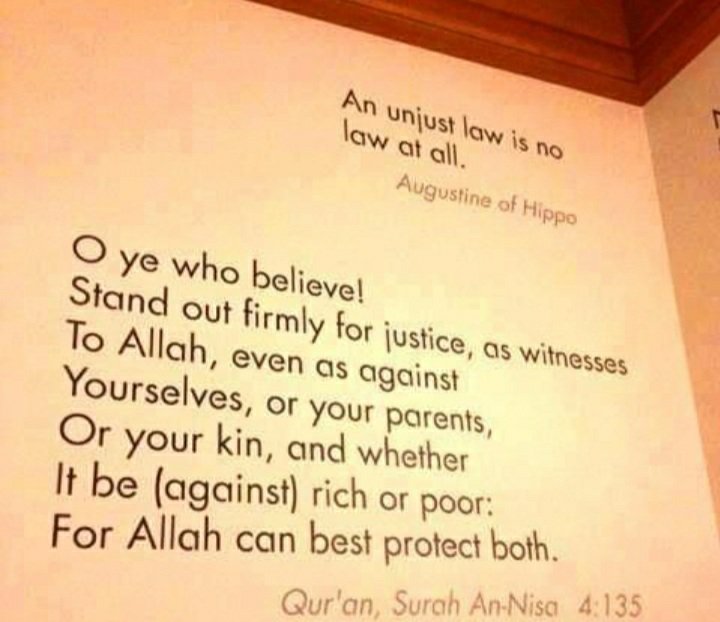
Another colleague interjected saying, ”there is no absolute justice – you must always take it into context. But what impressed me most is the Qur’anic verse on the Walls of Havard University in the US about selflessly delivering justice” (see feature photo, Surah AnNisa, 4:135.)

As usual, the attention span of Somali debate on specific subject is limited, and the debate drifted again over to wondering generalities and meaningless specifics.

SEARCH FOR POTENTIAL RESOLUTION TO BOSASO MILITARY STANDOFF

There was a debate among friends last night over tea on how to resolve the impending confrontation and potential for violence in Puntland Port-city of Bosaso, a dangerous situation that went out of control twice already. The issue here involves two government forces, one acting as renegade with the blessings of traditional elders in Bari Region opposed to the rule of President Said Abdullahi Deni. Since titled elders in Puntland are divided and bickering along political lines due to prolonged absence of democratization in the State, there is diminishing returns to find compromise in conflict resolution.

Observers believe that President Deni and elders are on collusion course as all possibilities of negotiated settlement is unlikely to occur, given the environment of mistrust between two opposing centers now posed for potential outbreak of violence in a port-city constituting the backbone of the economy and commercial activities of Puntland State of Somalia.

Other colleagues in the debate, Warsame Digital Media WDM, among them, suggest to convene an all inclusive congress to deliberate on what went wrong in stability, good governance and progress of the State. Despite the pressing need to hold such important gathering, Puntland Administration seems not to understand the gravity of the time-bomb that could explode anytime with far-reaching consequences for Puntland self-government. The circumstance resembles a scenario when an English man once said “Wherever God builds a house of prayer, the devil erects a chapel there, and it has been found upon examination that the devil has the biggest congregation”. There are always elements within the society engaged in ill-wish for the people of Puntland. Let us all think about finding lasting solution to this unfortunate political and security situation.