
Author: warsame digital media
About the blogger:
This blog is associated with the former Chief of Staff in Puntland State Presidency, 1998-2004. He also worked with the UN and World Bank Joint Secretariat for Somalia’s Re-construction and Development Program (RDP), 2005-2006, as a Zonal Technical Coordinator for Puntland and later as National Aid Technical Coordinator with the Transitional Federal Government of Somalia and European Union. He is now an independent political analyst and commentator on current issues and occasionally gives historical perspective on modern Somalia’s politics. He lives and works in Toronto, Canada. He can be reached at: ismailwarsame@gmail.com
BREAKING NEWS: MINISTER AHMED HUSSEN OF CANADA ELECED TO HOUSE OF COMMONS FOR 3RD TIME. WDM CONGRATULATES HIM

MAIN REASON FOR CURRENT SOMALIA’S POLITICAL CONFLICT
Did you get yet the main reason for the present political confrontations between #Farmaajo and #Rooble? Is it Ikram’s case, elections, Kenya, Qatar, UAE or something else?
The main reason for this conflict is the politicization of security forces by Farmaajo. Directors of NISA and commanders of Police Force and Somali National Army, SNA, had been recruited for political purposes by Farmaajo to stay in power. It was impossible to conduct free elections with the security and financial grip of Farmaajo in the country. The mastermind of this policy was Fahad Yassin. This policy was in the making for the entire mandate of Farmaajo. Countries like Turkey, Ethiopia, Eritrea and Uganda had been used for this objective in mind only, whether they knew it or not didn’t matter. Farmaajo and Rooble are struggling now for the control of security forces, especially the powerful NISA secret and intelligence service.
This dangerous situation was exposed during Farmaajo’s attempt to illegally extend his term to two more years and subsequent armed confrontations between the forces of the opposition and government. Lives had been lost in exchange for foiling Farmaajo’s military and constitutional coup.
Ikram’s case, among many others, yet to be contested are excuses and symptoms of the conspiracy to a power grab before everybody’s eyes. It is really madness to ignore the laws of the land to attempt to cling to power in this 21st century. It is simply not normal state of mind to try this nowadays.
How an intelligence officer’s disappearance in Somalia has ripped the government apart
Washingtonpost article (courtesy).
By Rachel Chason and Omar Faruk Today at 1:38 p.m. EDT
NAIROBI — The disappearance of a young intelligence officer in Somalia has led to a rapidly escalating power struggle between the president and prime minister that has torn the government apart and potentially gives new openings to al-Qaeda-linked militants.
Details of what happened to Ikran Tahlil Farah, a 25-year-old cybersecurity analyst, are still murky. But her abduction led President Mohamed Abdullahi Mohamed on Thursday to suspend the powers of the prime minister, who has accused him of obstructing justice in Tahlil’s case.
The political showdown risks becoming a security crisis, experts say, and has blown up any pretense that Somalia’s federal government is functioning. That could strengthen the hand of al-Shabab — which Somalia’s government has been fighting for years, aided by billions of dollars in security support from the United States.Story continues below advertisementnull
“Anytime you have this level of political infighting, it benefits al-Shabab in so many ways,” said Omar Mahmood, senior Somalia analyst at the International Crisis Group. “This narrative paints into everything they say about the federal government. That it is ineffective, weak, divisive and provides nothing to the public. And it is hard to argue against that.”
Implications of the back-and-forth between the president, known by his nickname, Farmaajo, and Prime Minister Mohamed Hussein Roble rippled Friday across international borders. The president’s office accused neighboring Djibouti of illegally detaining the former head of the National Intelligence and Security Agency, Fahad Yasin, as he tried to board a flight to Mogadishu. Roble suspended Yasin — who is known as the president’s right-hand man — earlier this month in connection with Tahlil’s disappearance.
Djibouti’s foreign minister rejected the assertion by Somalia’s government, saying it was meant to “create confusion and drag Djibouti into Somalia internal challenges and crisis.”Story continues below advertisementnull
The events were just one example of increasing tensions that could risk further delaying an already slow-moving election process, Mahmood said. The elections involve committees of sub-clan elders convened around the country to elect members of Parliament, which then elects the president. Only 37 of the 330 open seats, including the presidency, have been filled, he said. The president is currently serving more than seven months past his term.
“It’s time to start talking about more punitive measures from the international community to keep everyone in line before the election,” Mahmood said.
Among officials in Washington, there has been increased concern about the situation in Somalia since February, when gunfire broke out on the streets of the capital, Mogadishu, after the president did not hold scheduled elections. That raised questions about the depth of Somalia’s political instability — and about whether U.S. strategy needs to shift.
But there have been few changes to U.S. policy since the Trump administration ordered the removal of 700 U.S. soldiers from the country, with the United States continuing to support military operations in the region against al-Shabab.
Al-Shabab controls the majority of Somalia’s interior and has about 10,000 active fighters in the country, experts believe, with a much larger network of supporters. An attack it launched in Kenya last year killed one U.S. service member and two American private contractors, according to a U.S. military statement. But the biggest risk al-Shabab poses, experts say, is to residents within Somalia and to its neighbors in the region, where attacks are regular.
Biden’s top intelligence official said Monday that the greatest terrorism threat to the United States does not come from Afghanistan but from countries including Somalia, Yemen, Syria and Iraq.
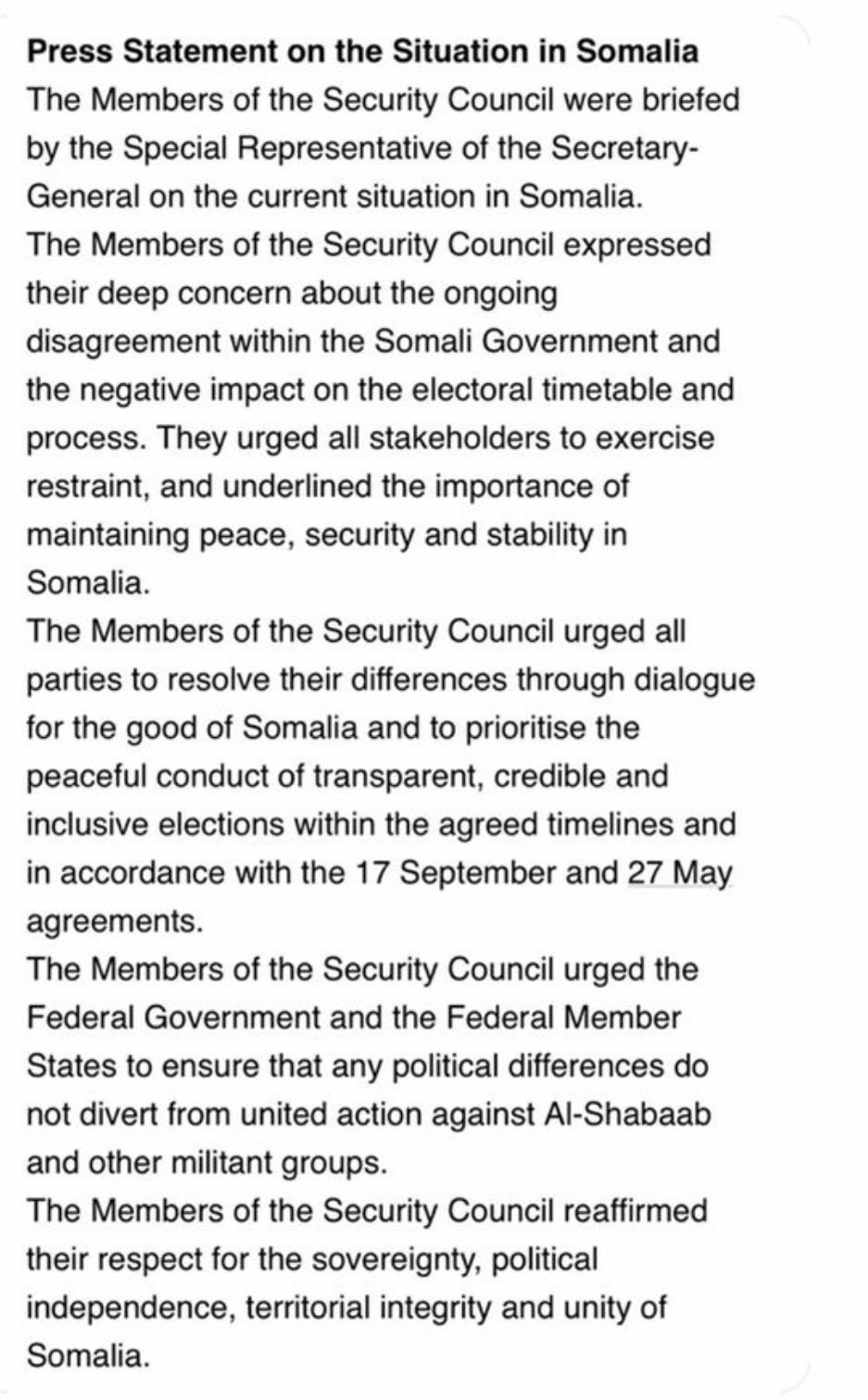
Members of the U.N. Security Council released a statement Saturday expressing “deep concern about the ongoing disagreement within the Somali Government and the negative impact on the electoral timetable and process.”
‘If I don’t pay, they kill me’: Al-Shabab tightens grip on Somalia with growing tax racket
Rep. Michael McCaul (Tex.), the ranking Republican on the House Foreign Affairs Committee, said he is closely monitoring current political divisions within Somalia and “deeply concerned about the trajectory of the country.”
“With the withdrawal of U.S. forces from Somalia and an emboldened al-Qaeda network from the continued debacle in Afghanistan, al Shabaab is surely taking notes,” McCaul said in a statement. “They remain a dangerous and capable threat to U.S. interests and the homeland. Unfortunately, years of support to the Somali armed forces and billions of dollars of assistance has barely moved the needle toward lasting stability in the country.”
Facing intense pressure from the West after the violence in February and April, including threats of sanctions from Secretary of State Antony Blinken, Somalia’s president — once a Department of Transportation administrator in Buffalo — backed down and agreed to hold elections. Roble was tapped to lead the process in May.
It was not too long afterward — on June 26 — that the analyst Tahlil was abducted, said her mother, Qali Mohamud Guhad, in an interview. The last time she spoke with her daughter was via a WhatsApp call that night, Mohamud said. Tahlil told her that she was going to see the security chief Yasin, who she said had been calling her all day.
The intelligence agency announced in early September that an investigation found that al-Shabab had killed Tahlil. But the terrorist group quickly denied it, saying it takes responsibility for attacks on intelligence officers and did not kill her.
Mohamud said she is still holding out hope that her daughter is alive somewhere in captivity. She said she does not know why Tahlil was abducted, but noted that her daughter had information about soldiers from Somalia who were rumored to have been sent by the government to fight in Ethiopia, which has been one of the many political weak spots for Somalia’s president.
Somalia’s politicians strike a last-minute deal, but fears of conflict remain high
Mohamud personally met this month with Roble, who she said assured her that he would take the steps necessary to achieve justice.
Roble’s decision to suspend Yasin — over the objections of the president — reportedly led this month to a brief military standoff, after each selected a different person to lead the intelligence agency. Roble’s spokesman, Mohamed Ibrahim Moalimuu, said in an interview Saturday that he views the president’s suspension of his powers as unconstitutional and that the prime minister is committed to seeing the elections through.
“The more [the president] stays and keeps doing these illegal and unconstitutional behaviors, the closer we get to a civil war,” said Ismail Osman, a former NISA deputy chief, who is based in Washington.
Matt Bryden, director of Sahan Research, a Somalia-focused think tank, said that al-Shabab’s strength is always in inverse proportion to the weakness of its adversaries.
“It fills a vacuum,” he said. “And this is a protracted vacuum.”
Faruk reported from Mogadishu.
UK statement on the political crisis in Somalia
Press release
Vicky Ford, Minister for Africa, has issued a statement about the escalating political crisis in SomaliaFrom:Foreign, Commonwealth & Development Office and Vicky Ford MPPublished18 September 2021
Minister for Africa, Vicky Ford said:
The UK is deeply concerned by the escalation of the current political crisis in Somalia. The situation threatens to undermine the credibility of Somalia’s leadership and risks the safety and future of the Somali people.
It is vital that Somalia’s leaders refrain from unilateral actions that could deepen political tensions, including any further public statements and personnel announcements which could increase the risk of violence.
We urge that all stakeholders maintain peace to avoid any risks to Somalia’s stability and security. Likewise, it is important that Somalia’s security forces remain focused on countering the common threat of Al Shabaab, who stand to gain from this ongoing political crisis. As champions of the debt relief efforts, the UK also urges the de-politicisation of Somalia’s finances to protect the gains made through the process.
This is a moment for statesmanship, restraint and compromise. We look to Somalia’s leaders to engage in meaningful mediation and to agree ways forward that de-escalate the situation and restore the focus on the priority of conducting peaceful elections, as agreed on 27 May, without further delay. Somalia needs effective governance. The continued failure to move quickly towards elections will increase insecurity and exacerbate the grave humanitarian challenges the country is facing.
A continued deterioration in the situation leading to further electoral delays will have a substantial impact on the legacy of Somalia’s leaders.
Media enquiries
Email newsdesk@fcdo.gov.uk
Telephone 020 7008 3100
Contact the FCDO Communication Team via email (monitored 24 hours a day) in the first instance, and we will respond as soon as possible.
UN SECURITY COUNCIL: PUT UP OR SHUT UP
House of Cards in Villa Somalia
- Post author By René Brosius
- Post date 17. September 2021
- No Comment son House of Cards in Villa Somalia

Source: Sigmund 2020
ANALYSIS René Brosius 17 September 2021
In April 2021, after Somalia was on the brink of civil war, it seemed for a long time that the solution would be found in a tough (s)election process. The May 27, 2021 agreement and Prime Minister Roble’s timetable presented at the end of June stipulated that this process would be completed by October 10, 2021. A new president would then also be elected by the new deputies of both chambers by the end of the year. With just over a month to go before the end of this deadline, events in Mogadishu are coming to a head. In order to grasp the significance and impact of these upcoming events, the protagonists must be introduced once again:
(1) Mohamed Abdullahi Mohamed (“Farmajoo”) came to the presidency with great sympathy in February 2017. However, his tenure has been marked by increasing political violence and a politicization of the security and army apparatus. Although there has been modest economic growth, little progress is visible in the areas of state-building, political freedoms, anti-corruption, or democratization. He is considered an ally of Ethiopian Prime Minister Abiy Ahmed and Eritrea’s autocratic president, Isayas Afewerki. With other neighbours, conflicts have been repeatedly reported. Conflicts that triggered breaking points in diplomatic relations. In the spring of 2021, his attempt to extend his term by two years provoked considerable opposition both in Somalia itself and among international partners.
(2) Fahad Yasin, was until recently head of the notorious NISA intelligence agency and is considered a close confidant of the president. After the largest terrorist attack in the country’s history, on October 14, 2017, with nearly 600 dead, the intelligence service was initially disbanded and shortly thereafter reconstituted with presidential loyalists. Fahad Yasin is considered the mastermind of the strategy of using violence, intimidation, and pressure on individuals as political tools. This included the targeted recruitment of employees of certain clan affiliations to secure loyalties. NISA has since evolved to be an uncontrollable force in the country. Al Shabab has never claimed responsibility for the devastating attack in 2017. Suspicions suggest that this only served as a smokescreen to reorganize the intelligence service at the time as well as Somalia’s entire security apparatus accordingly. Fahad Yasin is also considered Qatar’s representative in Somalia. He is said to have ties to Al Shabab and Al Qaeda. Many political assassinations claimed by Al Shabab, such as the assassination of the former mayor of Mogadishu, Abdirahman Osman (“Yerisow”), were only possible through insider knowledge. As a result, rumors of cooperation between NISA and the terrorist organization have surfaced time and again.
(3) Ikraan Tahliil, (was) a young woman from Mogadishu who was considered highly gifted in mathematics as a child. She was recruited early by NISA and trained in cybersecurity. It is said about her that she had no concerns with the new direction of the intelligence agency. She quickly made a career for herself, arguably gaining information about intelligence activities that made her a danger to Fahad Yasin and other top regime officials, such as the background of certain assassinations. This was followed by her flight to Great Britain. After apparently threatening her family, she returned to Mogadishu in late June 2021. After a brief visit with her family, relatives report, she was picked up by a high-ranking NISA employee in an official vehicle. After that, her trace was lost. The parents put pressure on the public and worried about the fate of their daughter. Calls for an independent investigation were made. Two months later, in early September, Radio Mogadishu (a pro-government station) announced, without further background, that she had been murdered by Al Shabab. This account was followed by widespread public scepticism, especially on social media. How could an experienced intelligence officer have been abducted and murdered from one of Somalia’s most secured buildings – the NISA headquarters? Shortly after the radio reports, Al Shabab also denied having anything to do with the young woman’s disappearance.
(4) Prime Minister Mohamed Hussein Roble is formally the head of government and thus also the chief executive. After former Prime Minister Hassan Ali Khaire was unexpectedly dismissed without prior political debate in July 2020, Farmajoo appointed the politically completely unknown Roble, a man from the Swedish diaspora, as the new prime minister on September 23, 2020. Judging by his past actions, he seems committed to a prompt and transparent election. He is supported by the opposition in this. He has repeatedly been said to have presidential ambitions, though he has always expressed the opposite view. On one of his conspicuously frequent visits abroad, he recently said that he could not be a neutral mediator in the elections if he ran himself. He is seen as a reconciler with neighbouring Kenya and also strikes more moderate tones with regard to Somaliland and Saudi Arabia.
A lot has happened between these actors in the last two weeks. After public protest regarding the alleged death of Ikraan Tahliil did not die down, Roble set a 48-hour deadline for the head of NISA to personally brief him on the background of the case. After 24 hours, Fahad Yasin then published an open letter in which he made a counter-proposal. He suggested reporting to the Presidential Security Council instead. It was not the intelligence chief’s first disrespect for the prime minister. When Roble removed Deputy Intelligence Chief Abdullahi Kulane a few weeks ago for intimidating opposition politicians on behalf of the government and being responsible for various acts of violence within the country, Fahad Yasin promptly appointed him as his personal security advisor. It was an affront that called into question the prime minister’s authority. Immediately after the counterproposal, Roble therefore dismissed Fahad Yasin and appointed a new intelligence chief. Farmajoo, whose term expired Feb. 8, 2021, strongly criticized this decision, calling it unconstitutional – also on social media. After initially trying to keep his confidant Fahad Yasin in office, he later appointed him his personal security adviser and promoted the NISA chief of Mogadishu, who was loyal to him, as the new Somali intelligence chief. He published this decree via also the official account of the Somali Chancellery, Villa Somalia (413,246 followers). These two political counter-positions physically clashed at NISA headquarters. While the headquarters was surrounded by Farmajoo loyalists to prevent the prime minister-appointed chief from entering, Robles’ supporters took control inside the building, according to media reports. Concern is high that there will be fighting between government forces. The opposition, as well as some states, support the prime minister’s actions. So do large parts of the cabinet. After some ministers declared that they were loyal to the prime minister, Roble took advantage of this moment to dismiss another of the president’s confidants, the minister of security (interior minister).On September 9, 2021, he instructed the Minister of Finance to disburse all payments from public budgets, including funds provided by the IMF, only after prior approval by the Prime Minister’s Office.
1 Month Before the Elections
With just over a month to go before the elections, the country is therefore once again on the brink of armed conflict. Not so much between the opposition and the government, as was the case in April 2021, but the split appears to be running amidst the government. If the goal of either side was to make the situation as confusing as possible, it has succeeded very well. Outsiders, such as the international community, find it difficult to comprehend the moves of the individual actors, and the comments are correspondingly thin-lipped. On the prime minister’s credit side, despite these events, the upper house elections in Puntland, Jubaland, Galmudug and South West State have already been completed, and the elections in Hir Shabelle and for Somaliland seats will be concluded shortly. What impact this will have on the electoral process for the lower house and the support of each presidential candidate is unclear. One can assume, however, that in many places the actual political course has already been set with the upper house elections in mind, and that the lower house elections can be realized much more quickly. In Mogadishu itself, however, the situation has intensified. If Roble prevails, Farmajoo seems significantly weakened politically. With Fahad Yasin, he loses his eyes and ears as well as his arsenal of threats. In addition, he loses the ability to appeal to and mobilize his still quite numerous supporters in the military and security apparatus through the usual chains of command. He and his supporters also appear to have lost access to finances, one of the most important instruments in Somali political practice, especially with regard to the loyalty of the security forces.
While now the president’s (remaining) supporters argue that the prime minister was originally given the power to organize only the election and therefore there is something unconstitutional about his behaviour, the prime minister’s supporters take the position that only with this power can the ongoing disruptive manoeuvres on the part of Villa Somalia be prevented and the elections properly conducted. The point, they say, is to prevent continued negative influence on the elections and thus not to jeopardize the credibility of the incoming government. However, the whole skirmish is more than just about who has the real power in the country. It is also a bit about the soul of the country. Is it permissible to have a power in the country, NISA, that can get away without a judicial process even in targeted killings? An experience the country has had over decades of Siad Barre’s dictatorship. The appointment of those responsible as advisors to the government currently serves primarily to protect them from prosecution. Thus, part of the conflict is also the question of whether the case of Ikraan Tahliil will be investigated by a military court or whether-as Farmajoo has suggested-there should only be a compensation payment to the family to prevent a public investigation. Already, the first voices are being raised to prevent a possible departure/escape of those responsible, including Farmajoo, so that his reign can be judicially reviewed. These voices are matched by other cases being brought all over the country, such as against those responsible for the kidnapping of the Islamist and then candidate for state-president of South West State, Mukhtar Robow. The latter has reportedly been held without trial in house arrest in Mogadishu since 2018. Several people were killed in the demonstrations against this detention. If one wants to find something positive in this situation, it is ultimately these reflexes to the rule of law that make one optimistic. Should Somalia succeed in electing a new and accepted government, the population and also the (clan-) system would have proven resilient to autocratic structures-despite all prophecies of doom. The international community should honor this fact accordingly.
PUT UP OR SHUT UP

AT UN SECURITY COUNCIL

WARBIXIN
HAVE YOU THOUGHT OF RESOLVING FARMAAJO-ROOBLE CONFRONTATION?
To resolve the case, isolate the most sticking point in this conflict? What is it?
Ikram’s disappearance, NISA claim of her demise and who was responsible. Right?
Then, family and public suspicion followed on that report and claim of NISA on Ikram. Correct?
How to handle the case? First of all, let us answer the question: Is it a crime/homicide? Disappearance and possible murder? Yes?
If yes, then this case belongs to the criminal justice. It has nothing to do with politics, administration or civil investigative committees. Agree?
If yes, then, since there is suspicion on the NISA report on the disappearance of Ikram, NISA top directors should have stepped aside until the case is resolved. The minister for security should have resigned or asked to resign.This is common sense and best practice when there is a suspicion of foul play within a department.
Since Farmaajo is known to have close relations with Fahad Yassin, then Farmaajo was required to consult with the Cabinet on acceptable compromise candidate to replace Fahad on temporary capacity until the case of Ikram is resolved. Farmaajo shouldn’t be seen as shielding Fahad from possible responsibility on the disappearance of Ikram, unless there is something else we aren’t aware of. In all considerations, this case belongs to a court of law.
No further nuisances and noises were necessary. It was as simple as that to avoid this unfortunate confrontation.
THE RICHEST MAN IN HISTORY
Chasing Mirages Across Somalia
Abukar Arman. 5 years ago
Hopelessness is a dangerous dead-end. As with people, nations need a sense of hope to exist and deal with the inevitable challenges confronted throughout their development and existence. But that sense of hope must be grounded on reality; otherwise, it turns into delusion.
With the so-called election being around the corner in Somalia, it is fair to say that this systematically eroding nation is in the thick of that season of delusional self-assurance. Positive change is inevitable without making any change in method and mindset.
Many candidates are lined up to replace the de facto President, Hassan Sheikh Mohamud, whose term has ended on September 10th, who is enjoying an extension without mandate, who himself is a candidate. The Parliament is sidelined as in 2011 right before the transitional period came to an end. Worse, there is no Constitutional Court to judicially arbitrate.
These candidates, by and large, have only one thing in common: the conviction that “The president must go.” This sentiment which resonates with the majority of Somalis has ironically rendered any substantive inter-candidate debate on critical issues unnecessary, at best.
Most seem confident that a replacement would automatically bring about the direly needed change to repair brokenness and rectify ills. However, history reminds us of successive disappointments that resulted from such false assumption in the past decades.
Governance by Tourism
Four years ago, I have privately counseled and publicly cautioned that the newly elected President was bound to fail if his government does not provide direly needed public services, make genuine reconciliation and transparency to end corruption his top priorities. And fail, he did.
Against this backdrop, President Mohamud has been expanding his authority by issuing unconstitutional decrees that are intended to become part of the policies shaping the electoral process. His effective tactics worked like this: He would issue a decree that clearly overreaches the legislative authority of the Parliament, and then swiftly, before any public outcry or any candidate could react, IGAD and UNSOM would issue their respective congratulatory statements. Implementation ensues.
Meanwhile, in order to present a façade of legitimacy, the coopted Speaker of the Parliament is granted a symbolic seat at the so-called National Leadership Forum. The NLF is an IGAD concocted and international community supported political sham that grants a handful of regional actors and government officials with clear conflict of interest the exclusive political authority to decide Somalia’s existential fate. Make no mistake; this can only lead into a never-ending process of transitioning out of transition, bloodshed and perpetual dependency.
Smoke-screened by this political theatrics, the reinvention of President Mohamud is smoothly underway. He is in effective hands of professional image-makers who are capable of making miserable failures look like exemplary successes. In this recent article with all dramatic visual and sound effects, President Mohamud, the man under whose watch Ethiopia got a blank check to run the Somali political affairs and al-Shabaab became more lethal than ever before, claims to have a new plan to restore security and defeat that terror group.
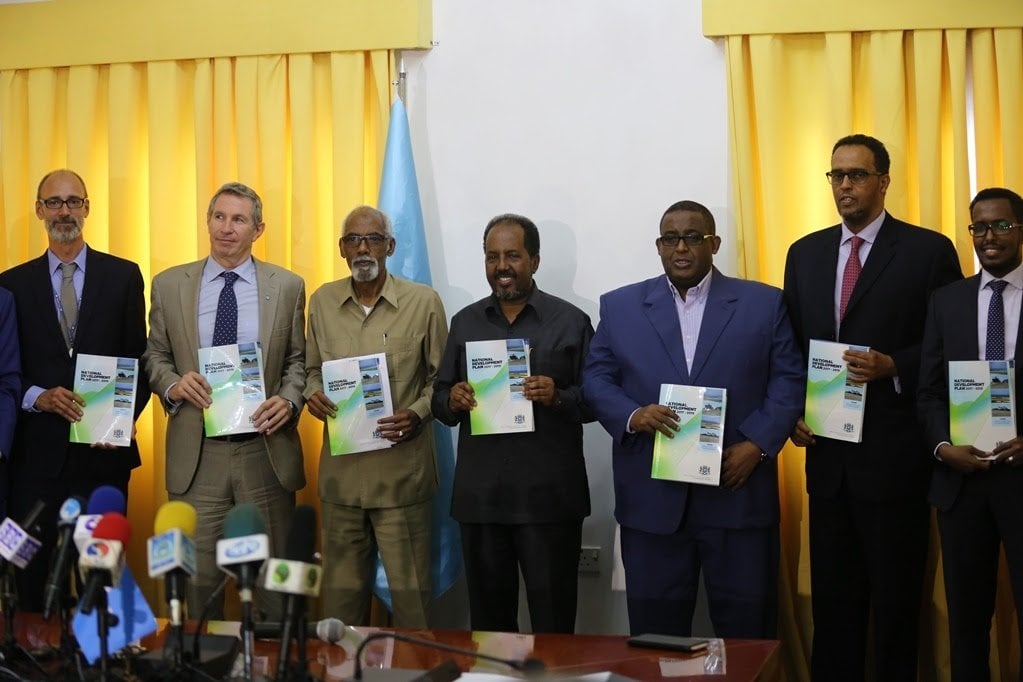
On their part, the Council of Ministers has completed the National Development Plan or the cosmetically enhanced version of the cash-sucking New Deal Somali Compact 52 days before their term expired. The subsequent political fanfare by the advocates of status quo was hardly surprising.
Never mind that the current leadership are yet to designate national currency and are yet to address how having US dollar, the Ethiopia’s Bir, and Kenya’s Shilling–the national de facto currencies—contribute to inflation and make life economically unbearable for the average Somali. People are led to believe that these same leaders whose ‘national budget’ is made of salaries and operation costs, who are yet to set up a single government-funded clinic or feeding and housing centers for the nearly one million internally displaced persons (IDPs) in Mogadishu alone, are set to improve the Somali per capita income and reduce poverty.
Meanwhile, suits are pressed, shoes are shined and suitcases are packed. The Somali leadership team is anxiously waiting for the next great conference being convened somewhere across the seas.
Coercive Institutionalization of clan federalism
Ever since certain members of the political elite accepted that clan-based federalism is a viable governance system; that false narrative has neither faced serious scrutiny nor serious setback. Well, at least not until the government, IGAD, and UNSOM have at various times attempted to lure, pressure, and coerce the traditional leaders of Hiiraan to merge into an arbitrary union with Middle Shabelle and immediately form a federal-state before the upcoming election. Apparently this trio has forgotten Hiiraan’s historical reputation as the womb of Somali patriotism.
So, Hiiraan became ‘Laf dhuun ku taagan’ or the ‘bone that stuck in the throat’ of the trio and a major setback against the political formula engineered to make the reconstitution of the Somali state impossible, and inter-clan perpetual enmity and bloodshed the political order.
Which of the Presidential Candidates might be the right one?
In identifying the right person, it is critical to establish criteria through which each candidate could be evaluated. None should be granted advantage based on name recognition, clan affiliation, or cash cushion. Election or selection should be criteria-based:
– Does he or she have a clear vision, grand strategy and a viable implementation plan to help him or her shake up the current externally manipulated political order?
– Is he or she willing to cut the umbilical cord of dependency and spearhead a nation willing to mainly rely on itself?
– Is he or she willing to put genuine reconciliation, public service and transparency on top of his or her priority list?
– Is he or she willing to pushback against IGAD & UNSOM diktats and accept the fact that the authority to govern comes from the people, and that he who grants you that authority can also take it away from you?
– Does he or she recognize the existential importance of having one or two strategic partners instead of an array of states and interest groups of conflicting interests?
If these criteria seem too difficult to meet, rest assured, they are. No one should be misled to believe otherwise.
Sowing Before Harvesting
The succeeding president and government will not make substantive change so long as they do not put genuine reconciliation, followed by constitutional convention that addresses all critical issues ignored by the current counterfeit document, at the top of their priority list.
The new constitution must overhaul the political order of the day. It may acknowledge the social relevance of clan structure but must declare in no uncertain terms the separation of clans and state and ensure that clans have no political authority and that clan-based distribution of political power is done with. In their very nature, clans promote exclusive rights and perpetual zero-sum strife against other clans.
Somalia may not get a candidate who meets every aspect of the criteria but it cannot afford not to raise the bar. It is time for the public to demand accountable leaders with transformational vision. It is time to resist getting intoxicated with political rhetoric. It is time to end the mirage-chasing game.
Categories: Horn of Africa
Tags: elections, Ethiopia, Hassan Sheikh Mohamud, IGAD, peace, Shabaab, Somalia, Terrorism, UNSOM
WDM BREAKING NEWS
In this conflict between former President Farmaajo (whose mandate has expired) and Caretaker Prime Minister Rooble, institutions have lost relevance. The Caretaker Cabinet is non-existent. It is a fight between two persons in sheer power struggle. Here government is absent. Rooble is a lone gunman.
This situation was probably brought about by the fact that since former prime minister Khayre was topled, Farmaajo has been acting both as Head of State and Head of Government (prime minister) in the same way former president, Hassan Sheikh Mohamud, was acting during the stint of prime minister Saacid Shirdoon.
It looks that Rooble doesn’t have the entire support of the Caretaker Cabinet.
For laughter
WHAT’S IN A NAME
“President Idi Amin once wanted to change the name of Uganda to “Idi”.
Except for one man, Maliyamungu, everybody else who was close to him feared to challenge that decision!
Maliyamungu said to him, “Your Excellency Sir, have you heard of a country called ‘Cyprus’?”
With a surprised look, Amin asked, “What has Cyprus got to do with my decision to change our country’s name to ‘Idi’?”
Maliyamungu said, “Well, the people of Cyprus are called Cypriots. If you change Uganda to ‘Idi’, all of us, including you, will be called ‘Idiots’! So, please, let’s maintain our current name!”
Idi Amin said, “Aaah…! Maliyamungu! You are very intelligent! In fact, more intelligent than everyone in Uganda except me! Let’s leave it!”
THE TWO RISING STARS IN SOMALIA’S PRESIDENTIAL POLITICS: DENI vs ROOBLE
None has declared candidacy yet. Each one of the two is currently in a position of power and influence. Each has the resources at his disposal to push his presidential ambition. Each enjoys frontrunner status from their respective constituencies, according to public opinion – Deni among the Daroods, Rooble among the Hawiye. Each hails from one of neighboring Federal Member States of Puntland and Galmudugh. Regionally, they have common interests geopolitically, economically and in security cooperation. They could be complementary as president and prime minister of Somalia. They have federal ambitions at a time when Galkayo is no longer a divided city along clan lines. They seem, therefore, to realize their political chance has arrived.
While this is, at this moment, a pure speculation, there is a potential that both would run in this federal election.
One would ask what about other possible candidates, especially from Hawiye camp. Good question. Give me names. Sheikh Sharif Ahmed, Hassan Sheikh Mohamud, to name just two of those running now as they look frontrunners among individuals in that camp. Each of the two was a former president. None was impressive enough to be given a 2nd shot at Presidency. The Somali Doctrine of not re-electing a president plays out here too. Moreover, the two are antagonistic too as they were rivals in previous presidential race. They are unlikely to form a joint front in this race.
In conclusion, expect surprises in these Federal elections as Somali politics is as unpredictable as peace and war among Somali nomads.
WDM EDITORIAL
THE PRECARIOUS STATE OF SOMALI AFFAIRS
Current political crisis in Mogadishu could degenerate into violence. The political confrontation between the leaders of the Federal Government could lead into disarray and unraveling of public institutions, massive displacement of residents and pull-out or evacuation of members of the international community. Only cool heads and common sense to understand and appreciate the potential danger could save the situation.
Tribal incitements reminiscent of 1990s insurrection would make the matter worst. Removing stubborn leaders by mob force would lead to destruction of Somali State again. Law and order in the Capital must be maintained at any cost. Mohamed Abdullahi Farmaajo must put all his cards on the table and accept whatever cooler heads advise him to do now. He must realize that he has no presidential mandate to govern and could remain in Villa Somalia only quietly until elections are held in the country. He can’t afford to rock the boat. He should listen to the deep public concerns about his illegal occupation of the presidency. He must see the writing on the wall that he has no further political future in Somalia, and should try to save whatever might have remained of his reputation. There is a zero chance that he could continue to stay on any longer by political manipulations or force. It is in his best interest to go away quietly. That way he spares his country too from the experience of more troubles. Let the Caretaker government hold elections peacefully.
On the top, read the Somali Doctrine https://ismailwarsame.blog/2020/07/14/the-somali-doctrine-2/
HIGHLIGHTS OF SOMALI DANGEROUS MEDIA BIAS
The young, inexperienced and inmature Somali media outlets in various platforms worldwide have exposed themselves to the general public in terms of their lack of any resemblance of objectivity and enthusiasm for spreading lies and misinformation, especially in the past few days. If you look at them from the side of national security and unity, they could be deemed dangerous. Particularly perilous and damaging are their video clips to lie and mislead non-critical minds of the bulk of Somali gullible population.
The current confrontation within the leadership of the Federal Government of Somalia 🇸🇴 has exposed the sinister roles of these media outlets, fanning out the venoms of tribalism and clan hatred. Whether they are the infamously known CBB individuals or equally notorious flame- video internet producers as worst examples, they are disseminating poisons of hate and tribal conflicts. People may not realize that they are the most dangerous public entertainners of our time. They are interested in only their internet public ratings than the well-being and unity of their country of origin (mostly they reside in foreign countries). It looks the phenomenon is unique among Somalis of Internet age. They are bounded neither by professional self-censorship nor cultural ethics. They are tribal wolves on the loose, a new phenomenon of media carnage destroying Somalia 🇸🇴 willingly.
We need to look into this media phenomenon deeper with subject matter research and eventually try to reach out those destructive individuals to discontinue their distabilizing careers.
Read also Abdikarim Hassan’s article carried by WardheerNews.com https://wardheernews.com/somali-media-ethics-truth-and-integrity/
KNOW THE FUNDAMENTALS
People should get right the political fundamentals of the current situation in the country:
1. Mandates of the legislative and executive branches of FGS have expired. 2. As a result, there is political agreement between FGS and FMS reached in September 17, 2020 and subsequent amendments with caretaker designation for the prime minister to conduct elections and ensure the security of the polls. Neither the president nor the prime minister has full authority of their current temporary positions. Both are in so-called lame-duck situation. It is obvious that they will be running routine day-to-day operations of the government until their replacements. No major executive decisions unrelated to holding elections were expected from them. One has to prove NISA case is related to election security since there are alleged reports of former Head of the agency intervening in elections as he was himself a candidate for parliament membership. Since NISA is a suspect in the disappearance of Ms Ikram Tahlil, at least the Head of Agency should step aside until the case is resolved through proper investigations and cleared by a court of law. Farmajo is wrong and outside the norms of government behaviour to appoint him to a new positions before this clearance.
It is common sense and legally required from responsible leadership of any institution to investigate a crime and leave its deliberations to competent authorities. There shouldn’t be any fuzz about it.
The whole current conflicts in Mogadishu, therefore, boils down to a power struggle between politicians who have no constitutional legitimacy after their mandates have expired. It is actually a struggle between politicians to predetermine the final election outcome. These chronic infightings, especially in this crucial election time, have irreparably damaged any remaining positive image of the fledgling Somali government in the eyes of both Somalis and international community. It is unfortunate reoccurance.
POTENTIAL POLITICAL CRISIS FORETOLD
The Bureaucrat From Buffalo Who Pushed Somalia to the Brink
Have you read this article? This is the information you need to understand the current political crisis in Somalia.
https://www.nytimes.com/2021/04/30/world/africa/somalia-president.html
PRIME MINISTER MHR ON THE POLITICAL CRISIS IN SOMALIA
Prime Minister MHR Meeting with
C6+ Mogadishu, 8th September 2021
Excellencies,
Good evening,
Ladies and Gentlemen.
I thank you for sparing sometime this evening for us to share some update on the election process, the unfortunate political crisis that has erupted in the last few days; and the case of Ikran Tahlil.
• Since the last NCC, we have made some significant progress.
• My consistent encouragement of the two sides of Somaliland electoral
dispute and engagement with their leaders have finally led to Somaliland-
led and owned agreement. I will facilitate the Somaliland senate election to take place in the next few days Insha Allah. I hope their election will set a
good example in terms of transparency and you will be able to observe it.
• As you may have also heard President Gudlawe of Hirshabelle state today
has finally released the list of the nominees for the senate race. I want to
thank President Gudlawe for opening the senate election to anyone who
wants to contest. Three or more candidates are contesting for each senate seat which is very good.
• I have engaged with various political and civic groups and have been able to
clarify and correct some of the misperceptions and misunderstandings about the procedures that we have passed in our last NCC.
• I have brought together the electoral bodies for internal dialogue which led
to the resolution of their internal differences.
• FEIT was able to release new schedule for elections.
• National Election Security Committee will meet soon to discuss the state-
level security plans for elections.
• To fill the gaps in election and enabling activities budget, our minster of foreign affairs will meet with Arab league in Cairo this week to raise funds.
• Let me assure you that I and my fellow NCC are committed to keep the
election on track.
• We would not allow ourselves to be diverted from this important national
undertaking.
Ladies and Gentlemen
• I am deeply concerned as you are about the impact of political crisis at a time the country is going through elections and is facing significant security and political risks.
• Somalia cannot afford another political crisis. The violence in April which resulted from unilateral decisions and politicization of security forces is still fresh in our memories. A similar crisis must be avoided.
• The separation of powers between different branches of government, de-
politicization of security forces, free and fair elections, respect for the rule
of law and protection of the rights of citizens cannot be subject of deal
making between individual leaders. They are important pillars of the
government legitimacy and our constitutional order. If we ignore them, we cannot claim to be a legitimate government, and citizens will take law into their hands.
• The executive branch is by law responsible for steering elections and
managing security. The President explicitly confirmed this in his address to parliament on May 1st 2021.
• On my part, I have made a concerted effort to avert and manage the crisis in
a responsible and sober manner. I have engaged with all those concerned to
calm down the situation and resolve the issues through dialogue and within
the confines of government institutions in accordance with the constitutional separation of powers. I am committed to continue dialogue with President and I am optimistic that the ongoing negotiations will lead to a peaceful resolution to this crisis.
Ladies and Gentlemen,
• On Ikran Tahilil’s case, it is unfortunate that a simple directive from my office demanding an accountability and credible investigation to give justice to
Ikran and her family and to share the facts of this case with Somali leaders
and larger public could cause such a reaction from our President who is
supposed to be the custodian of the constitution and rule of law.
• Why president chooses to shield individuals from accountability rather than protecting the rights of citizens is beyond my comprehension.
• I have given sufficient time to former NISA Director to present credible
report on Ikran’s disappearance. He failed to do so. He resorted to political
sideshows instead of sharing the facts. His letter asking for convening of non-
existent national security council was clearly an act of insubordination and
bad faith and attempt of coverup
• In the light of this unacceptable behavior, I was left with no option except to suspend him and appoint an acting director to pave the way for credible investigation.
• Unfortunately, the former director got a willing accomplice for his acts of
impunity in the highest office of the land.
• It is my principled position that the investigation of the case must proceed
and all obstructions to getting justice for Ikran be removed. It will be travesty
of justice to keep suspects in this case to be in charge of NISA.
• Finally, I will continue to extensive engagement to all political and security
stakeholders including the NCC, president, judiciary leadership, commanders of security forces and civil society leaders for smooth election process and impartial investigation for Ikran’s case. I also reiterate my firm commitment to resolving our differences peacefully, act in accordance of constitutional
mandate and the best interest of Somali people.
• I urge the members of international community to be firm in their position
to demand credible investigation for Ikran’s case, resolve the current crisis
peacefully and support the electoral process.
• I think it is high time for your respective capitals to take the necessary
measures against the peace spoilers. If their impunity, election interference
and undermining of government institutions continues unchecked, they will continue with their violence mind-set, erase all the gains we have made over the years with your support towards peace and stability and take the country to an abyss.
VILLA SOMALIA
Watch “KALAMAAN 08 SEPTEMBER 2021” on YouTube
SUUGAANTA
INTERNATIONAL PARTNERS: A VEILED SUPPORT TO THE PRIME MINISTER ROOBLE

HOW TO READ FARMAAJO-ROOBLE POLITICAL SHOWDOWN

Mohamed Abdullahi Farmaajo, an official of the Somali Federal Government whose current job title is difficult to name because the title of “former president”doesn’t properly fit him here as he is still in office without mandate. So is the title of the Caretaker President without any official references or legal tools. Nobody knows how to address him. Most Somali media address him “Madaxweynaha Xilkiisii dhamaaday” (the president whose mandate had expired). He is a sort of a defacto occupier of Villa Somalia, following the end of his term in office in February 8, 2021.
Farmaajo had come to power through demagoguery of working towards holding one person one vote general elections in Somalia, a trick that had backfired and been exposed as he intended by this to engage in sham elections after topling most, if not all non-compliant leaders of the Federal Members States (FMS). As he failed in his deceptive plan, he decided to stay on by seizing power with force and constitutional coup through illegal means that attempted to extend his term by two more years. That too has failed badly. He was compelled to transfer power to a Caretaker prime minister to conduct election-related operations of the Government. He has been keeping low profile for a while. Finally, he got uncomfortable with the slow, but independent operations and decisions of the prime minister.
It is noteworthy to remind people that prime minister Rooble took a number of provocative and controversial decisions and foreign trips that marginalized Mohamed Farmaajo’s role in the Executive Branch of the FGS. It is one of the basis for this political conflict.
Farmaajo’s chance to avenge Rooble appeared when he had reinstated Kulane, a NISA officer fired by Rooble a little more than a month ago. Rooble didn’t counter-act and let it go that time. This had encouraged Farmaajo to push back Rooble’s unilateral operations. Constitutionally, the prime minister’s executive power is drawn from the Council-in-Session. He has no powers outside the cabinet. But, a new political situation sets in: The executive powers of the Federal Government have shifted to the leaders of the peripheries, the FMS, as far as the election issues are concerned. Now, suddenly the powers of the prime minister is FMS-based. Farmaajo, therefore, saw diminishing returns for his re-election prospect as there is no predictable chance to manipulate the election. The dismissal of Fahad Yassin now is the biggest and last Farmaajo’s political chance to challenge Rooble and leaders of the FMS. He has two objectives in this manufactured confrontation:
- To prolong his stint in Villa Somalia.
- To derail the electoral process, which he sees it as unfavorable for his re-election bid, but most importantly, not to allow the persecution of his influential strategic and financial supporter on re-election campaign, Fahad Yassin.
Now that the two men have dug-in positions, it is difficult to bridge the gap in a compromise without serving justice to the family of Ikram Tahlil and people of Somalia.
Most leaders of the FMS would probably side with the position of the prime minister. International Partners are expected to express support to the prime minister’s efforts to avoid derailing the election plans. Farmaajo’s position is unsupportable as it is unsustainable.
(Photo above: former Speaker and Deputy Speaker trying to mediate the two men. Body language here hides no secrets.)
https://amazon.com/author/ismailwarsame
Postscript: One should know that, NISA under Farmaao and Fahad, is a subversive political and security institution organized to eliminate, blackmail and harass political opponents of Mohamed Farmaajo. Reshuffling directors within NISA by Farmaajo the other night will not absolve Fahad Yassin and others of heinous crimes committed under his watch. Finally, and as usual, the rumor mills in Somalia surrounding the disappearance of Ms Ikram were busy producing alternative reports and conspiracy theories about her fate. Some say she is still alive in Kenya in the hands of foreign intelligence services. One can only rely on NISA statement on her disappearance. As it clearly appears now the political confrontation between Farmaajo and Rooble has degenerated into purely power struggle. One has to win. It has reached at a point of no return.
(This article has been updated since posting).
REAL TOWN INFRASTRUCTURE FOR AVOIDING TRAFFIC JAMS, CHINA

Geellow Daaq oo Daaq, Laakiin Waxaa Laguu yaabaa Markaad Ciin Daaqdo

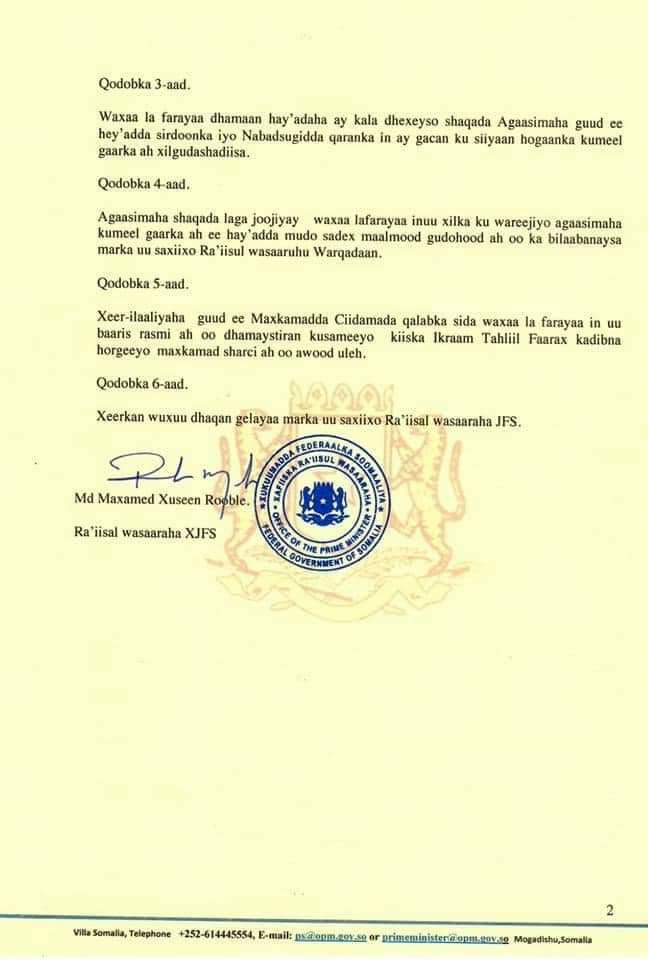
Qore: Maxamed Muuse Cartan
Ikraan waxa ku dhacay waxba kama duwana wixii ku dhacay Cabdiraxmaan Cabdishakuur, kaliya Cabdiraxmaan wuxuu haystay askar hubaysan oo ilaalisa oo si fudud ama sahal looma afduuban karin sida ku dhacday Ikraan.
Mana jiri karto wax sabab ah oo Ikraan loo dili karo, sidii aysan u jirin wax sabab ah oo dhali kartay in Cabdirahmaan Cabdishakuur duulaan qaawan habeen-barkii loogu soo qaado, laguna laayo ilaaladiisii iyo dad la joogey , isagana dhaawac loogu geystey, oo aan ka ahayn awood sheegasho (Abuse of power) iyo waxa afka baxaariga Jubada hoose lagu yiraahdo: KU TUSIYEE, afka reer mudugana lagu yiraahdo: Wallaahi baan la iskaa weydiinayn!
haddaba galka dacwada Ikraan waa ka weyn yahay Gaaljecel iyo Soomaali labada, waana arrin Caalami ah, waxaana laga yaabaa in mar hore xaqiiqdeeda la uruuriyey, sidii loo uruuriyey xaqiiqadii wariye Khashoogi safaaradda sacuudiga loogu dhex diley. Waxaa filayaa in Ikraan ay haysatay waddaniyad ah Isbahaysiga Boqortooyada Ingiriska (UK) ama British Passport.
Soomaalidu waxay ku maahmaahdaa: “Geelow daaq oo daaq, waxaase laguu yaabaa maalintaad ciin daaqdid,”
Fahad iyo Farmaajo waxaa laga sugayaa ciddii ay isku furan lahaayeen, markii xaqiiqadu soo baxdo, si la mid ah sidii Maxamed salmaan uu isugu furtay qaar ka mid ah dambiileyaashii fuliyey dilka iyo saraakiil ka mid ah sirdoonka Sacuudiga oo madaxa laga saaray eeddii dhammaanteed.
Haddaba waxaa dhici karta in Fahad Yaasiin oo awalba ul booc ah loogu tukubayey, in arrintaani Rooble ku dhiiri galiso inuu xilka ka qaado, lagana xannibo inuu dalka ka baxo inta dacwada meel laga saarayo. haddii ay taasi dhacdo wax walba filo! Xaq feeraha ayuu ka dillaacaa.
“What did Farmajo know, and when did he Know it?”
Arrintu Fahad ma dhaafi doontaa. Farmaajo muxuu ka ogyahay arrintan, goorma ayuuse ogaadey,
Allow Ammuuraha sahal

ON THE CASE OF IKRAM’S MURDER

Does this strange request cut? I don’t think it does. It is a real test for Caretaker Prime Minister Rooble to pass manly or fail in disgrace. No doubt, Rooble is in trouble and the entire election process for 2020-2021 is in jeopardy because of this developing story.
Rooble wouldn’t be able to stay on as Caretaker Prime Minister, if he gets humilated by Farmajo and Fahad Yassin in connection with Ikram’s disappearance and murder as allegedly reported by NISA recently. He would be tempted to resign instead. This would put all stake-holders of the Somalia’s political establishment into disarray. All should be warned against possible ugly turn of events in the next few days. All FMS and opposition elements should start now monitoring the situation involving Rooble-Fahad-Farmajo confrontation.
In fact, this case could play out as the political opening and opportunity Farmajo Camp has been looking for to derail the momentum towards elections.
https://amazon.com/author/ismailwarsame
Afghanistan and Somalia – Common similarities: Tied in cultural extremism
To answer a question put to WDM on the subject, here is our take:
- They both host religious radicals and extremists/terrorists.
- They are primative societies engaged in dangerous tribal rivalries.
- They are ancient people historically.
- They are both particularly proud of their cultural heritage that provides moral values for popular resistance against foreign invaders.
- Alqaeda Somalia was a branch of Alqaeda at large led by its founders. It is possible that Alshabab might have developed ties with Taliban of late, but there were no historical relationships because there were no movement of people, goods and ideas between peoples. There is no geographical proximity between the peoples of these countries and have little historical ties.
- Globalization, instant news and the Internet have impact on terrorist networks and their interactions too.
- Finally, animosity of these extremist movements towards Western culture, particularly USA, may bring these groups closer together.
All of the above put together means that the peoples of Somalia 🇸🇴 and Afghanistan 🇦🇫 are anthropologically different, therefore we can only talk about common trends in religious extremism in terms of Alshabab, Taliban, Alqaeda, ISIS and other radical groups.
UNITY BASED ON SOMALINIMO
Dr Abdisalam Isse-Salwe on Somali Unity, a Research Paper
KU QOSOL KAFTAN DHABLEHA
Federalism, a Guarantor of Peace among Somali Clans
By Ismail Warsame
February 6, 2013
Nowadays and for while during the past two decades, Somali thinkers, writers and politicians were keenly debating on best way forward for Somalia’sgovernance and political arrangements Post-Civil War. This debate is extremelycrucial for the survival of Somalia as a country as well as a strong cohesive nation-state.
While many among debaters were and are still sincerelyl ooking for best possible governance system (s) and pros and cons of each ofthe “Menu of options”, a few of them continue to ignore the status quo (current Somalia’s political situation) dismissing it as sidetrack and unimportant clannish nuisance or refuse to acknowledge the extent ofpublic mistrust following the vicious civil war involving heinous crimes of ethnic cleansing, mass murder, forceful and illegal landing-grabbing, plunder of both public and private wealth and barbaric destruction of national heritageand state archives in Mogadishu and elsewhere.
In my humble opinion, any politician of conscience at any level of government (President, Cabinet and parliament members) whose political power base had committed such grave and gross human rights abuses, national robbery, national betrayal and treason should apologize to the nation and resign immediately. If that is not forthcoming, it would be mean that the civilwar is still technically on, and there is no guarantee that history would not repeat itself. Such politicians have no moral legitimacy to govern until they come clear and publicly accept their personal and power-base responsibilities for what happened in Somalia during the Barre regime and following the final collapse of Somalia’s central state in 1991. Somalis, please be warned. One should never entertainwith the idea to translate the recent US recognition of the current Somali Government as a victory of one faction over others in theCivil War, and again attempt to misuse state resources to try to subjugate others. That would be a futile exercise and would unfortunately hasten the disintegration of Somalia as we know it. It is the expectation of all Somalis from the world community to watch out any signs for the repetition of that sad saga.
During the past ten years we witness multiple self-proclamations of regional federal mini-states such as Makhir State,Khatumo State,Awdal State,Galgamud State, Hibin and Heeb State, Asania State,Ras Asayr Stateamong many others. With keen observation, one would realize that those self-proclamations were characteristically peaceful and surprisingly did not spark off any clan fighting with the unique exception of Khatumo, rightly resisting aggressive occupation of its territory by “Somaliland”militia. Why? This could be a case-study; of all clan wars in the country, the self-proclaimed federal mini-states brought relative peace to their respective constituencies. In my opinion, one ofthe main reasons for such peaceful environment within for all sub-clan systemsis the fact that their constituencies see themselves as equal stake-holders inthat mini-entity (state), which acts as the accepted and shared mechanism for conflicts resolution and constitutes common interest for all. Logically and practically, one would therefore take note of this new development to expand the concept to a national level in Somalia’s long journey to restore lost trust among its people and regions.
For historical prerspective, a few months after we had established the Puntland State of Somalia in August 1998, a sub-sub-subclan among the inhabitants of coastal Indian Ocean Mudugh town of Gara’ad andsurrounding areas including the District City of Jeriiban unilaterally announced the creation of Coastal State, declaring its independence fromPuntland State, following sub-clan grievances regarding their expected share inthe newly constituted Puntland Parliament. That grievance was actually proved to be the mistake or intentional concession of their allocated Parliament seatto another sub-clan in Mudugh Region by their local traditional elder. The subclan members opposed the move by the elder. To address the issue and resolveit, a delegation led by the Late State President, Abdullahi Yusuf Ahmed and meincluded, went to the District and met with all stake-holders. One of the first questions we asked our interlocutors was: “How many sub-subclans belong to orcreated the Coastal State, and how many regions are there in the proclaimed entity?” The audience looked at each other,and surprisingly, the answer was obvious. The District belonged to the larger Mudugh Region and even most of the inhabitants of the Jeriiban District alone via their representatives did not belong to and were not party to the “Coastal State”. That was the end of the story. I believe, Coastal State was the first unviable mini-state created in Somalia.
The lesson we learned from that experience was that a statewhether it is a national or regional must enjoy the trust of all its constituencies to survive, safeguard its unity, develop and prosper in peace and harmony. Anyone aspiring to see the Somalia he or she wants or imagines must take this lesson seriously into account.
Those Somali writers debating on federalism lately almostall of them ignore the fundamental reason for the debate itself on the issueand failed to find the answers to two critical questions:
What is the main reason that has brought us here to debate on Somalia’s governance options?
How would you restore trust of the people nation-wide in a central authority when people of Somalia have not yet officially and technically ended the Civil War in the absence of comprehensive national reconciliation given what happened?
President Hassan, in athoughtful, prepared and defiant speech to the Somali Diaspora in his recentvisits to US and Belgium says openly, “ if you look back on what happenedyesterday, you lose the opportunities of today”, thus dismissing outright any possibility for accountability for crimes of mass murder, crude human rights abuses, robbery and plunder of personal and public properties. With such a vision for Somalia,forget about reconciliation and peaceful conflict resolutions!
Finally, I am aware that many Somalis would like to give thecurrent government in Mogadishu the benefit of the doubt and wish her to succeed in the best interest of the entire nation. To those I say the taste of pudding is in the eating. Anyone who helps Somaliare cover from its present predicament will be highly appreciated and undoubtedly recognized.
FRANKENSTEIN MONSTER

Frankenstein is a work or agency that ruins its own creator. State secret services or intelligence organizations are frankenstein that pose existential threats not only to the general public, personal safety and liberties, but also to the governments that create them. The tragic story of Ms Ikram Tahlil, an internet security expert with the National Intelligence Services Agency (NISA), might not have been an isolated case, but one of many unexplained murders, bomb-blasts, blackmail and raids in Mogadishu and elsewhere in Somalia 🇸🇴. Such crime incidents had historical narrative here – at time it was Ethiopian Intelligence to blame. It was an Alqaeda operations at other times, and now they claim that all murders were committed by Alshabab. The case of Ms Ikram is different, though, in the sense that nobody, including Alshabab themselves, is willing to buy NISA story on the demise of this young lady at her workplace inside the maximum security headquarters of her employer. The subsequent coverup of the murder is a giveaway tip to the common sense. The fact that Alshabab never denies its heinous crimes against government workers and officials, and now its rejection and distancing itself from NISA claim of Ikram murder has clearly exposed the directors of that agency and its collaborators.
Until the officials of this Caretaker Government come clean on the disappearance and murder of Ms Ikram, they are all suspect and accomplices.

Related link https://ismailwarsame.blog/2019/09/24/the-state-of-mogadishu/
https://amazon.com/author/ismailwarsame
Postscript
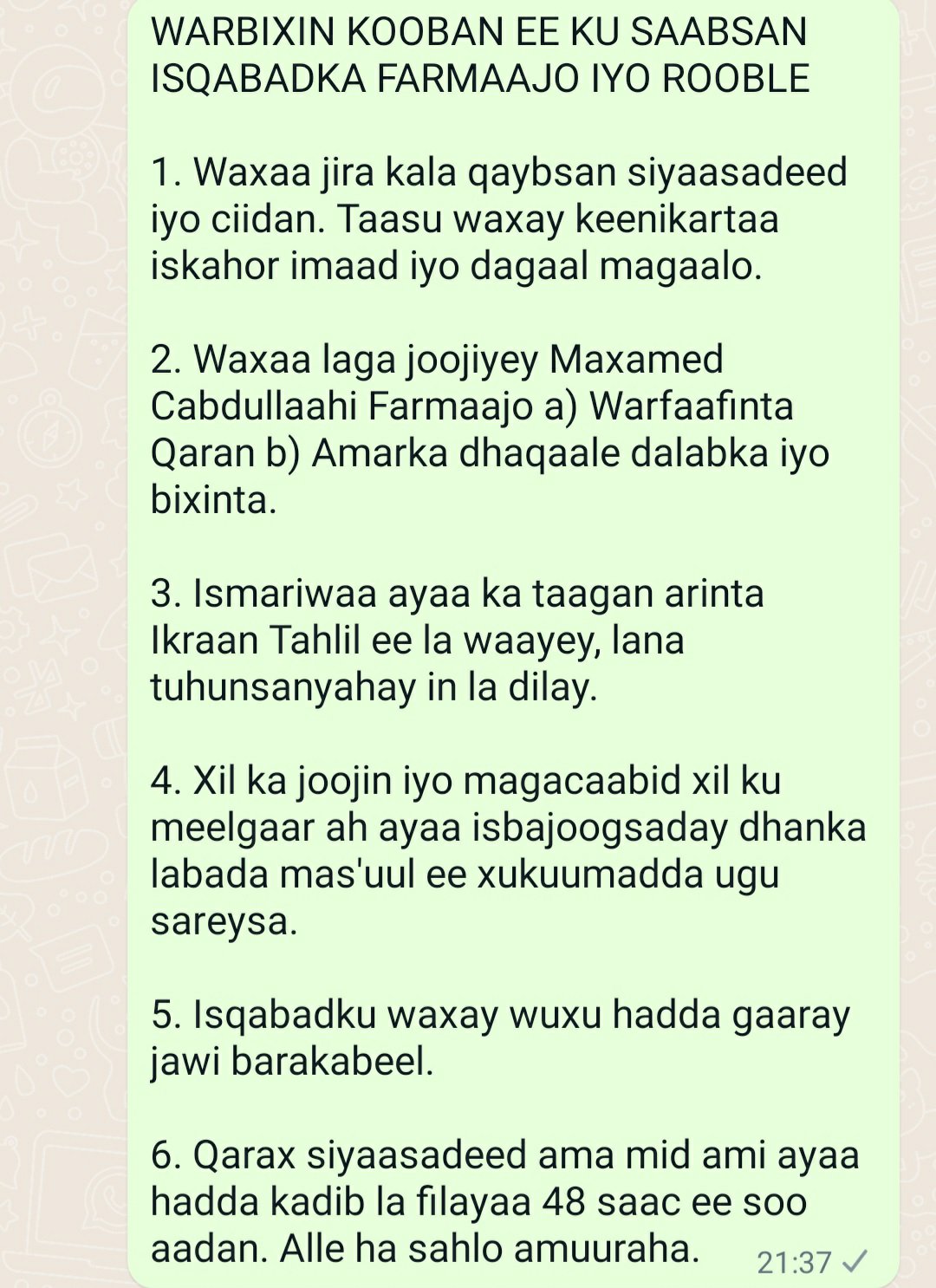
Since posting of this article, the Caretaker Prime Minister of the Somali Federal Government, Mohamed Hussein Rooble, had rejected NISA Report that Alshabab was responsible for the murder of Ikram Tahlil Farah. He instructed the Director of the Agency 48 hours to submit a credible report on the case.
SOMALI MEN’S SACRED RELATIONSHIPS WITH MOTHERS-IN-LAW AREN’T SO SACRED ELSEWHERE
JAAMAC KEDIYE: SUUGAANTA
TAARIIKHDII DARAAWIISHTA
“Taariikhdii Daraawiishta iyo Sayid Maxamed Cabdulle Xasan | maktabadda | Af-Soomaaliga” https://maktabadda.com/category/taariikhdii-daraawiishta-iyo-sayid-maxamed-cabdulle-xasan/
 Warsame Policy & Media Network (WAPMEN)
You must be logged in to post a comment.