ELECTIONS ARE CONDUCTED WITH MASSIVE PUBLICITY AND DISSEMINATION OF INFORMATION AND CITIZEN EDUCATION. THIS ISN’T HAPPENING IN PUNTLAND NOW.

WDM EDITORIAL

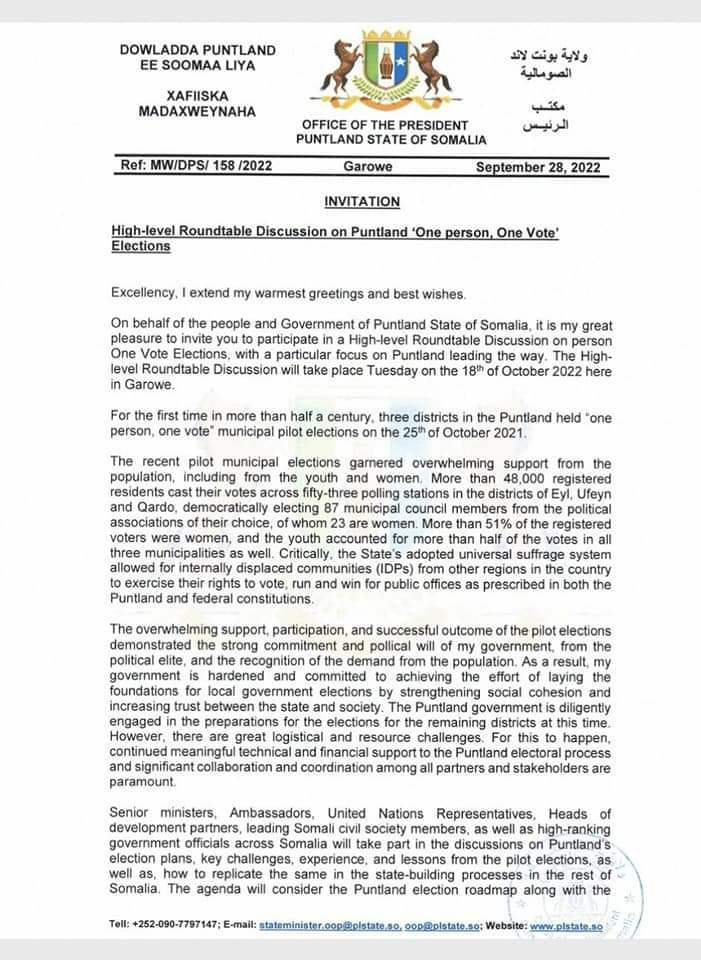
Puntland Government and Temporary Puntland Election Commission (TPEC) are missing in action with no visible preparations for elections as far as advertisements and public information are concerned. Other than occasional statements by the State President and limited officials that there will be Council Elections in the State, Puntland districts don’t feel the euphoria that comes with elections. Political associations seem nonexistent at all. The voice of small opposition elements to holding elections is louder than the proponents’. Misinformation and probability of government election failure grow by the day. TPEC seems to be concerned with technical aspects of executing elections than educating the public on the forthcoming council polls.

There is danger that misleading information, falsehoods and rumors may take hold and sway public opinion against elections. There is an urgent need to prevent this from happening and to take measures to counterattack negative information on Puntland Government intentions to hold free and fair elections. This is a wake-up call for the government, TPEC and pro-election political associations to act now before it is too late.

FORMER PUNTLAND PRESIDENTS GAAS AND FAROOLE SHOULD LET IT GO

WDM EDITORIAL

It is human nature that people hate someone else succeeding where they failed badly. The three successful Pilot Council Elections in Qardho, Uffayn and Eyl recently must have been a shock to Faroole and Gaas. That much we understand in regard to human situation of former leaders of Puntland State, but now they hurt our expectations of them to act as Puntland/Somali statesmen. What is wrong with our yesterday’s leaders and supposedly experienced politicians?

President Faroole tried his best and his administration did a huge ground work in his attempt to hold Council elections. In the end, he didn’t see the process through successfully. This trial was commendable and Puntland is now building on these efforts. It is perplexing to see him opposing the same work he had started. Shame! People of Puntland deserve better.

What some Puntlanders may find extremely odd, however, not surprising, is the case of Gaas opposing Puntland moving forward without listening to his sadistic utterings. Many Puntlanders couldn’t be deceived by any more shenanigans by a politician whose entire political career was built on shameless corruption, and abysmally failed Puntlanders in their time of need in both war and peaceful reconstruction. Gaas, a doctor in economics, was reportedly quoted as saying “Little corruption is good for the economy”.

But, let us cut chasing the wild goose – Gaas can’t have further say in Puntland affairs. People of Puntland are still reeling from the dilapidating harm done by Gaas and his despotic litte cronies of Aaran Jaan types. Recall scandal involving Garowe-Galkayo Road and P&O Bosaso Port, the infamous “15 million Dollar Golden Handshake”, on the top of unprecedented, huge, daylight bribery in Puntland House of Representatives to sell out the only Puntland port then. Where does he come from to oppose Puntland transition to democracy? Can he be a model for anyone of decent reputation? When talking to Gaas, ask him about his experience with “Tukaraq Fiasco”. Gaas is the author of the infamous “Ban Ki-moon Stament” as prelude to sell his soul and Puntland interests to President Hassan Sheikh Mohamud.

Residents of Puntland State of Somalia will march on and pass-by the lovers of doomsday and “after me, the dèluge”.

(Feature picture: Garowe-Galkayo Highway now under construction where Mr. Gaas had failed and messed up).

IN MEMORY OF PUNTLAND PRESIDENT MOHAMUD MUSE HERSI BOQOR

A Political Journey with General Mohamud Muse Hersi Boqor: Reflections on Leadership and Legacy

Early Encounters: Radio Kulmis and the SSDF Struggle (1983)
My first encounter with the late General Mohamud Muse Hersi Boqor (Cadde Muse)—later President of Puntland State—occurred in 1983 at the studio of Radio Kulmis, the clandestine broadcaster for the Somali Salvation Democratic Front (SSDF), then operating via the shortwave antenna of the Voice of the Gospel near Maskel Square in Addis Ababa. The General visited the studio alongside Abdullahi Yusuf, then Acting Chairman of the SSDF. I vividly recall posing a bold question to Cadde Muse: “Why did you join the struggle so late?” Before he could respond, Yusuf interjected, asserting that “everyone joins the struggle when the time is right.”

Unbeknownst to me then, Cadde Muse had recently defected from his post as Military Attaché at the Somali Embassy in Ottawa, Canada. His departure coincided with the impending arrival of Somalia’s dictator, Siad Barre, for an official visit to Canada. According to diplomatic sources, Barre’s inquiry about Cadde Muse’s whereabouts reportedly embarrassed the Somali Ambassador, who had no knowledge of the General’s disappearance. Barre correctly speculated that Cadde Muse had fled to Addis Ababa—a testament to the General’s strategic timing and the regime’s unraveling intelligence apparatus.

Military Leadership and SSDF Folklore
Cadde Muse soon rose to become the SSDF’s Chief of Staff, commanding its guerrilla forces. His leadership style, however, became a subject of lighthearted anecdotes within SSDF circles. Known for his affable demeanor and distinctive Banadir dialect, he defied the stereotypical image of a stern military leader. Despite this, his commitment to the anti-Barre cause was unwavering.

After Barre’s regime collapsed in 1991, Cadde Muse returned to Canada, where he transitioned into small business ventures while remaining active in the Somali diaspora community. His political ambitions, however, were far from extinguished.

From Exile to Puntland’s Turbulent Politics
The General reemerged in Somali politics during Puntland’s formative years. In the early 2000s, he resurfaced in the Karkaar region, commanding remnants of Jama Ali Jama’s short-lived administration. After suffering defeat, he fled to Ceel-Afweyn in Somaliland-administered Sanaag, where he and his loyalists reportedly endured harsh treatment from local authorities—a reflection of the volatile clan dynamics that often overshadowed broader political alliances.

During the 2002 Somali Peace and Reconciliation Conference in Eldoret, Kenya, I received a call from Boqor Buur Madow, a respected elder from Ceerigabo. He urged me to broker dialogue between Abdullahi Yusuf and Cadde Muse. Reluctantly, Yusuf agreed to engage. The call with Cadde Muse was fraught with tension; he unleashed a torrent of grievances against Yusuf and me. Yet, this marked the beginning of an unlikely political reconciliation.

Yusuf and Cadde: An Unlikely Alliance
Post-reconciliation, Yusuf and Cadde Muse forged a close partnership, so much so that Puntland’s Vice President Mohamed Abdi Hashi once quipped, “Who is really in charge here?” Observers misunderstood their dynamic: Yusuf, eyeing Somalia’s presidency, needed Cadde’s support, while Cadde leveraged Yusuf’s influence to consolidate his own authority.

When Cadde Muse assumed Puntland’s presidency in 2005, his administration became a critical lifeline for Somalia’s nascent Transitional Federal Government (TFG). His pragmatic collaboration with federal institutions underscored Puntland’s role as a stabilizing force amid Somalia’s chaos.

The 2007 Mogadishu Agreement: A Forgotten Pact
In late 2007, during a TFG-Puntland delegation visit to Mogadishu, Cadde Muse tasked me with drafting a landmark agreement. The document stipulated that Puntland would represent federal institutions until other member states were established—a strategic move that secured $3 million of the $38 million Saudi Arabia grant to TFG for Puntland State. Signed by Yusuf, Cadde Muse, and Prime Minister Ali Mohamed Gedi, the pact remains a forgotten footnote in Somalia’s federalism saga, ignored by subsequent Puntland administrations.

A Surprising Offer and Final Reflections
During that same visit, Cadde Muse summoned me privately. After dismissing his ministers, he made an unexpected proposition: “Ismail, Eng Caydaruus can’t handle the presidency. I want you to take the job.” Stunned, I declined, advising him that “kings do not make servants of their kin.” Caydaruus, a descendant of sultans, was ill-suited for subordination. Cadde Muse later appointed Khalif Nur Ali Qonof—a decision emblematic of the delicate clan calculus underpinning Somali leadership.

Legacy of a Pragmatist
General Cadde Muse’s legacy is one of contradictions: a military defector turned diaspora businessman, a guerrilla leader mocked yet respected, and a president whose tenure bridged regional and federal ambitions. His ability to navigate Somalia’s treacherous political terrain—often through personal charisma and clan alliances—cemented his place in Puntland’s history. Yet, his story also reflects the unresolved tensions between federalism and centralized governance that continue to plague Somalia.

Though the 2007 agreement faded into obscurity, Cadde Muse’s tenure remains a testament to the complex interplay of loyalty, ambition, and survival in Somali politics—a narrative as unscripted and unpredictable as the man himself.

Watch “Role of Puntland Youth in Council Elections” on YouTube

Watch “The importance of Council Elections in Puntland” on YouTube

MINISTER JUXA ON THE PRESSING ISSUE OF DEMOCRATIZATION IN PUNTLAND

ROUNDTABLE DISCUSSIONS ON PUNTLAND FORTHCOMING ELECTIONS

Watch “Different Regions of Somalia have Different Development Needs” on YouTube

PUNTLAND DOESN’T INVOKE ITS BARGAINING CHIP WITH FGS

Kindly review this article:

Ununiform development needs in Somalia is a reality on the ground, and those regions still in humanitarian or recovery stages couldn’t be allowed to hold back those which are in development stage, when considering aid distribution and technical assistance programs. Peace and stability must be the criteria to gauge development needs.

https://ismailwarsame.blog/2022/09/28/peace-and-stability-must-be-criteria-for-development/

PEACE AND DEVELOPMENT

يجب أن يكون السلام والاستقرار معايير التنمية.

حافظ على السلام لتعيش بسلام.  يدفع.  عندما أنشأنا دولة بونتلاند في الصومال في أغسطس 1998 ، على الرغم من أن المناطق الشمالية الشرقية كانت مستقرة نسبيًا باستثناء مودوغ ، كانت هناك إقطاعيات فرعية من العشائر ومقاتلين عشائريين مهددين والعديد من نقاط التفتيش غير القانونية على طول الطرق والطرق السريعة الرئيسية ، على رأس العناصر الدينية المتطرفة مثل آل.  – اتحاد الاسلامى.  قامت ولاية بونتلاند ، من خلال السلطة الأخلاقية والتشريعية ، بإزالة هذه العناصر من الفوضى المجتمعية في غضون فترة زمنية قصيرة.  عاد السلام الكامل والممتع إلى المناطق الشمالية الشرقية من الصومال.  من الحالة الإنسانية إلى الانتعاش والتنمية ، انتقلت بونتلاند إلى وضع الحكم الذاتي وتقديم الخدمات العامة ، بغض النظر عن مدى شعور الناس بعدم الرضا ، بناءً على توقعاتهم من حكومة مراوغة ، في أعقاب حرب أهلية شرسة في تاريخ  هذه الأمة المضطربة.
قارن سيناريو بونتلاند بتلك المناطق الصومالية التي لا تزال تعاني من العنف والأزمات الإنسانية.  هناك ، لا أحد يتحدث عن مرحلة التعافي من الحرب الأهلية.  لا يزالون بحاجة إلى تدخل إنساني.
خلال تقييم الاحتياجات المشتركة لفرقنا (JNA) مع الأمم المتحدة والبنك الدولي في 2005-2006 ، اكتشفنا أن أجزاء مختلفة من الصومال تحتاج إلى مناهج إنمائية مختلفة.  كان استنتاجنا أن بونتلاند وأرض الصومال قد انتقلتا إلى مرحلة التنمية بينما كانت بقية الصومال في الغالب في مرحلة إنسانية.  لا تزال احتياجات التنمية غير المعلوماتية في الصومال حقيقة واقعة على الأرض ، ولا يمكن السماح لتلك المناطق التي تمر بمرحلة إنسانية أو مرحلة التعافي بعرقلة تلك التي هي في مرحلة التنمية ، عند النظر في توزيع المساعدات وبرامج المساعدة الفنية.  يجب أن يكون السلام والاستقرار معيارين لقياس احتياجات التنمية

PEACE AND STABILITY MUST BE CRITERIA FOR DEVELOPMENT

Keep the peace to live in peace. It pays. When we established Puntland State of Somalia in August 1998, although Northeast Regions were comparatively stable save Mudugh, there were sub-clan fiefdoms and menancing clan militiamen and numerous illegal checkpoints all along the roads and main highway, on top of religious extremist elements like Al-Itihad Al-islaami. Puntland State, through moral and legislative authority, had cleared up these elements of societal anarchy within a short period of time. Full and enjoyable peace returned to Northeastern Regions of Somalia. From humanitarian situation to recovery and development, Puntland had moved forward to the status of self-government and delivery of public services, no matter how unsatisfied people felt, based on their expectations from an elusive government, following a vicious civil war in the history of this troubled nation.

Compare Puntland scenario with those Somali regions which are still experiencing violence and humanitarian crisis. There, nobody is talking about recovery stage from the Civil War. They still need humanitarian intervention.

During our Teams’ Joint Needs Assessment (JNA) of Somalia with the United Nations and World Bank in 2005-2006, we had discovered that different parts of Somalia needed different development approaches. Our conclusion was that Puntland and Somaliland had moved to development stage while the rest of Somalia was mostly in humanitarian stage. Ununiform development needs in Somalia is still a reality on the ground, and those regions in humanitarian or recovery stages couldn’t be allowed to hold back those which are in development stage, when considering aid distribution and technical assistance programs. Peace and stability must be the criteria to gauge development needs.

WHY PEOPLE OF PUNTLAND SHOULD SEIZE THIS VOTING OPPORTUNITY

WDM EDITORIAL

Aren’t you still tired and fed up of being told that your member of Parliament would be picked up by your clan elder? How would you allow your Puntland State President to continue to be selected by a group of unrepresentative 66 persons in your so-called parliament? By continuing to accept this kind of unaccountable and unrepresentative government, you risk losing the hope and future of your kids, existing generation, or even Puntland self-government. If you don’t change, you will have no rights to blame others for your misfortunes because of failure in your civic responsibilities. Once you skip the opportunity to vote and make a difference in your life and others’, you abandon all your rights as a full citizen.

In my opinion, after many trials and errors, Puntland State is now posed to make history in introducing One Person One Vote to the State and Somalia, starting with elections of District Councils. Make sure you contribute to the process and play your important role as responsible resident of Puntland State of Somalia. Good luck!

EXTENDED SESSION OF PUNTLAND HOUSE OF REPRESENTATIVES CAME TO CLOSE TODAY

NEWS BRIEF

Puntland House of Representatives has been in session for several months lately, longer than anytime in the past. The sticking issue, among others, was the establishment of the High Court. Earlier, the House rejected Puntland President’s proposal of a list of names that would constitute members of the Court. House members insisted on keeping the House in-session until the issue is resolved. It seems that the President and House Speaker struck a deal late last night to end the session, pending October session to reconsider the composition of the High Court.

Puntland House of Representatives has not been vocal or expressed support to the President’s plan of holding District Council elections. Some members even cast doubt on the timing of these elections. This is a House whose members were selected through the old system of constituency selection, and therefore, they were not expected to whole-heartedly endorse the principles of One Person One Vote. However, the legislations for these Council elections are already in place to proceed.

There are other issues as well between the Executive and Legislative Branches of which the general public knows very little about. There is lack of information sharing with or dissemination of legislative accomplishments or public issues under discussion to the residents of the State. The public is widely uninformed.

PUNTLAND IS READY FOR 1P1V

WDM EDITORIAL

Based on conversations, debates and discussions in towns, Puntland is ready for democratic elections. There is a general public understanding that the old system of indirect selection has reached the dead-end. Many believe that Puntland will not survive with the repeat of that clan selection process. The salvation lies in the introduction of democratic principles that has no alternative historically in governance.

Current Puntland Administration has no other choice but to accept the reality on the ground and expedite the process of District Council Elections. Failure to meet this challenge will be a colossal miscalculation that will see existential threat to Puntland self-government.

So, let us not waste time in political bickering. Let us move forward full of hope and confidence that better days are ahead of us.

Puntland Government Press Release

The Ministry of Fisheries and Marine Resources of Puntland Government expresses its deep concern regarding the minutes from the meeting on 21/9/2022 between the Federal Minister of Fisheries & Marine Resources and foreign ambassadors, in which the Minister of Fisheries stated that he “does not recognize any license that is not issued by the Federal Ministry of Fisheries”, and threatened, “whoever is engaged in fishing activities with a license granted by the Federal Member States will be on the list of those who are accused of illegal fishing”. 

Puntland Government wishes to highlight that the above statement contradicts the constitution and the following political agreements:

1. Article 44 of the Constitution of the Federal Republic of Somalia stipulates that the distribution of natural resources shall be negotiated by the Federal Government of Somalia and its member states through a constitutional framework. 

2. The Baidoa Convention held on February 2nd 2018, Article 2; Paragraph B, confirms that the Federal Member States (FMS) have the authority over anything below 24 nautical miles.

3. The Addis Ababa Agreement held on March 22nd 2019, Article 3, states that the revenue generated from below 24 nautical miles will be managed by the Federal Member States.  

4. The Constitution of Puntland State, Article 3; Section 3 states that foreigners who are granted a permit from Puntland Government are allowed to fish between 12-24 nautical miles. 

Therefore, such reckless statement from the Minister of Fisheries & Marine Resources of the Federal Government could incite political instability, plunge the country into further division and jeopardize the economic future of the fishing sector as a whole.

In conclusion, we call on the officials of the Federal Ministry of Fisheries of Somalia to retract for his unsubstantiated statement, and honor the previous agreements and consultations between the Federal Government of Somalia and Puntland Government.


Watch “Puntland-Ethiopian Relations” on YouTube

Watch “Abdullahi Yusuf and Jama Ali Jama” on YouTube

Watch “Shirkii Carta, Djibouti, Puntland, Somalia” on YouTube

Watch “How DJIBOUTI erred in its relations with Puntland” on YouTube

HOW PUNTLAND HAD SAVED DJIBOUTI FROM UNION WITH ETHIOPIA

WHY SOMALIA IS HARD TO RUN

The political slogan by President Hassan Sheikh Mohamud (HSM), “Somalia in peace with itself and with the rest of the world” was too good to be true. It was inconsistent with both the political character and past deeds of the Somali leader. To have a nation in peace with itself, especially in the case of Somalia, means to me that political leaders must be chosen by the people. That is the first condition, I believe, to secure national peace. You can’t maintain peace, harmony and trust when leaders come to power through manipulations, corruption, interest groups and religious Tariqa. You can’t earn trust of your citizens, if you are known to be greedy and out there to accumulate wealth through corruption and misuse of public office.

Now, think of discussing resources-sharing with such politicians symbolized by President Hassan Sheikh Mohamud. Whether it is fiscal federalism or equitable and fair management of petroleum and other mineral resources, it would look and sound like debating with General Mohamed Farah Aydid on re-instating the failed state of Somalia. HSM and his political constituency aren’t yet ready to share the spoils of Somali state, no matter what system of governance Somalis agreed upon. It is winner takes all -a zero-sum game in political and clan rivalry.

Only recently it was the meeting in Mogadishu of finance ministers of FGS and FMS, failing to reach consensus on fiscal federalism due to the political interference by the Federal President. In HSM’s style of leadership and in direct violation of the Federal Constitution, the Cabinet and Prime Minister don’t exist. The only obstacle to HSM’s absolute power is the existence of Federal Member States. How would he then share resources and power with them? This is the basis for Puntland State argument on the brewing dispute on petroleum management with the administration of President HSM. This is also one of the key factors making Somalia hard to run.

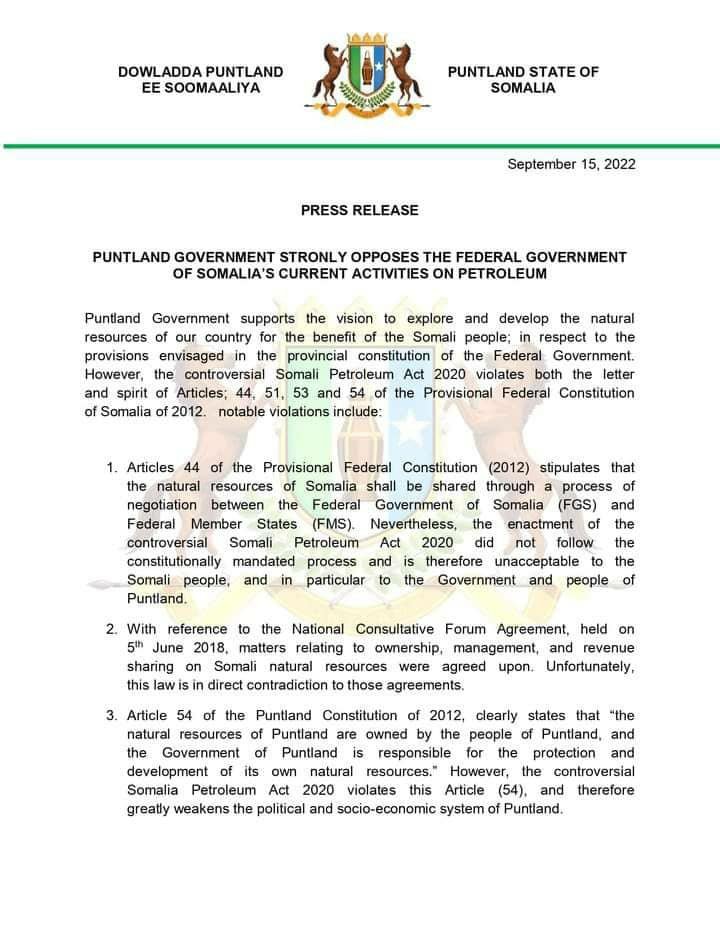
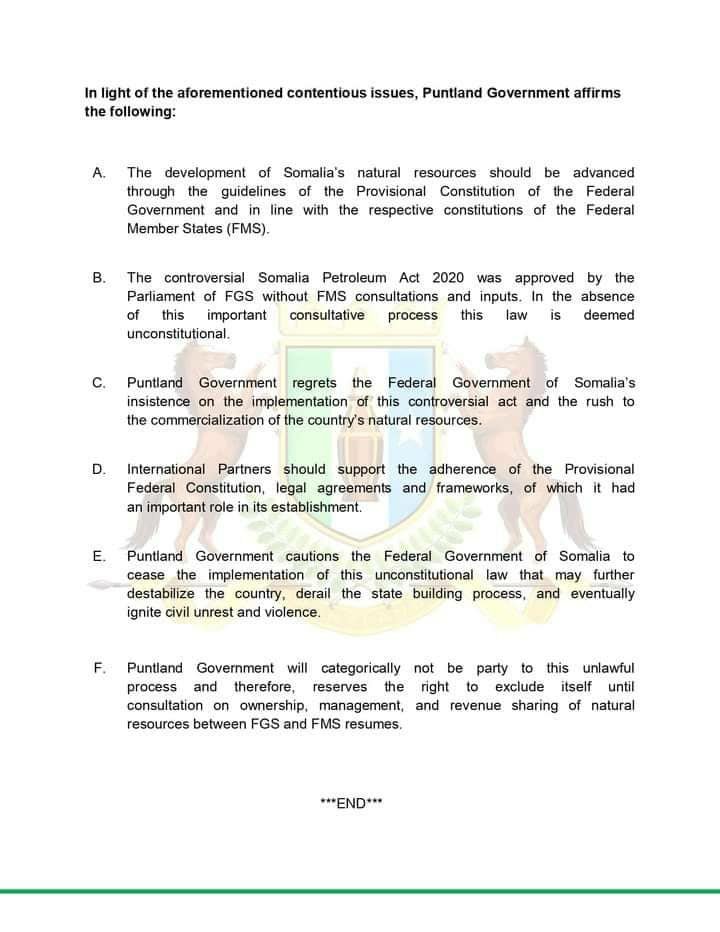
PUNTLAND RESPONDS TO SOMALIA’S UNILATERAL MISMANAGEMENT AND ABUSES OF PETROLEUM RESOURCES

Puntland response

UNELECTED COUNCILS IN PUNTLAND DISTRICTS RISK DISMANTLE

Any unelected City Council is subject to a summary dismissal for whatever reasons or excuses. Only elected officials would make sense in Puntland State from now on. Puntland political stagnation also lies in unelected district councils, unresponsive to the needs of residents, running the show for far too long. They usually serve the interests of those who appointed them. As long as they are doing their boss’s bidding, they are safe in their unearned public positions. If you notice someone being removed, it isn’t about job performance, but about disalignment with the politics of those who hired them. It isn’t often job related.

But, now there is an awareness by many progressives of the State that Puntland has come to a dead end to continue business as usual. Politicians now see the writing on the wall. It becomes obvious to them that, even if they barely succeed in taking over Puntland presidency to exercise one man show prerogatives like in the past, year after year it is increasingly becoming difficult to govern the State. Puntland political stagnation turned everyone to a cynic and suspicious towards politicians, especially those in positions of power. Nepotism, cronyism and despotism have become the style of Puntland governance, and as a result, the culture and political traditions of the State.

The only way out of the political quagmire is radical reform of the system through free and fair elections. Initially, it will be hard to implement elections because of the inertia of the decaying system and reluctance of the residents to embrace change. Democracy needs to take roots in the society, eventually becoming a way of life and ordinary. But, you will never succeed if you don’t try the experiement hard enough and get committed to realizing the democratic principle of one person one vote. So, let us move on to democratization. It provides more job security and public confidence for all, including Puntland District Councils.

AFRICA/SOMALIA – From the port of Garacad a road that brings development and hope to the entire area

AFRICA/SOMALIA – From the port of Garacad a road that brings development and hope to the entire area

Thursday, 8 September 2022

Garowe (Agenzia Fides) – There is recent news of an important road project launched in Somali Puntland that will favor strong development of the area.
It is a regional project with strategic importance that involves the Horn of Africa, in particular Ethiopia. The new road will connect the new port located in the historical city of Garacad, 700 km from Mogadishu, with the city of Galcayo and Galdogob, on the Ethiopian border. Once completed, it will allow the goods arriving in the port (Indian Ocean and Gulf of Aden) to arrive in the country in a short space of time. The aim of the project is to serve the Horn of Africa, central Somalia and the south-eastern region of Ethiopia by providing new trade routes accessible to the rest of the world, in particular to the Persian Gulf and Asia, also helping the populations of Oromia, Ogaden, far from the port services of Djibouti.
“The Administration of the port of Garacad hopes to create commercial relations and relations with the entire maritime world, a new port needs international relations”, said Prof. Sonkor Geyre, President of the IFSA Institute of Federalism and Security Analysis. “It will thus be possible to sort out goods and goods useful for the humanitarian crises of the entire area. In addition to the contacts already underway – explains Sonkor – we are inviting maritime authorities from all over the world to visit the port which will be inaugurated in October. This is the largest project in Somalia in the last 40 years”.
The port of Garacad, in the Modug region, borders Ethiopia to the west and the Somali regions to the north and south, and is a development point for the whole area. The Garacad-Galkacyo-Galdogob corridor crosses an area inhabited by about 1,000,000 Somalis, most of them farmers in an area under development.
The study of the 309 km that will connect the cities is carried out by the Puntland Highway Authority, the government body responsible for road transport and infrastructure in the state of Puntland in Somalia, and sees the participation of the KAAD Institute and foreign engineers and will allow transport goods arriving in the port of Garacad as far as Ethiopia. (GF/AP) (Agenzia Fides, 8/9/2022)

DEEP-WATER SOMALI PORT GIVES LANDLOCKED ETHIOPIA NEW TRADE ROUTE -BLOOMBERG.COM

“Somalia will open a deep-water port on its northern coast next month, with a road link forging a new trade route connecting Ethiopia’s south-eastern region with the city of Gara’ad.
The development is part of a $531 million investment plan aimed at boosting the export of livestock, fish, minerals and agricultural commodities, according to Saed Faadi, the chief executive officer of Wadagsan LLC, the developer.

The first two deep-water berths in the Puntland state’s city will be capable of docking 40,000-ton container ships and provide services such as modern loading equipment, refrigerated storage facilities and feeding grounds for animals.
“The port will also provide easy access to food imports from the outside world,” Faadi said in an interview. “This will allow food to be less expensive and enhance food security in the region, which is plagued by droughts and famine.”

The Gara’ad port will be the Horn of Africa nation’s fifth deep-water facility providing access to the Indian Ocean, but it’s the closest to Ethiopia, a landlocked country of 115 million people whose economy was one of the fastest growing in the world before the coronavirus pandemic and conflict curbed expansion.”

Watch “Xafladda Dib u furitaanka Hudheelka News Rays One.” on YouTube

THE EXPERIENTIAL LIMITS OF THE STATE: TERRITORY AND TAXATION IN GAROWE, PUNTLAND

Download this paper to indulge into an interesting read about Puntland State.

WDM EDITORIAL

EYL COUNCIL FORMALLY ESTABLISHED

Congratulations are due to the residents of Eyl District of Puntland, Somalia, on completing and concluding local council election. President Said Abdullahi Deni did a commendable job in seeing through First Phase of democratic exercise of one person one vote in three Puntland districts. We strongly urge the President and Puntland Government to implement the rest of local elections still outstanding in most districts. President Deni is on the verge of leaving behind a democratic legacy in Somalia that none of his predecessors in recent memory was able to achieve.

To the critics of the election process with regards to potential irregularities, no democratic election is perfect anywhere in the world. What the current administration of Puntland has been doing in holding some district elections is the right step forward to a democratic Somalia. We urge all residents of Puntland to close ranks and support the President’s election efforts.

The newly elected Eyl Council Chairman, the mayor, Faisal Khalif Wacays

EYL LOCAL COUNCIL FINALLY STANDING AND IN PLACE

https://www.facebook.com/100083131761242/posts/pfbid0q7Kv3b1GxwWKyzWNtCG7xguJk7hsWRUanUNt3fMcg9Q5zYcjcwjWTpQjNzDNXVHJl/?sfnsn=mo

(Courtesy: Kilwa Media)

WDM BREAKING NEWS

According to reliable news sources, former Somalia’s Intelligence Chief, Fahad Yassin Haji Dahir, and Mohamud Shido, a self-styled political broker in Puntland and unofficial boss of an interest group called “Aaran Jaan” (Devil’s kids) had met recently in Ankara, Turkey. It is known the two were sworn enemies in the past. That is why it is a strange bedfellow development worthy of news making.

According to the people familiar with the objectives of Ankara meeting, Fahad and Shido agreed to gang up against Puntland President Said Abdullahi Deni and set their focus on the 2024 Puntland Election and Federal election in 2026. The news also adds that some prominent titled elders of Bari Region were reportedly in Ankara at the time of Fahad-Shido get-together.

In the past, Shido and his Devil’s Kids group was perceived and bragged as owners of President Deni Administration in Puntland. Lately there appears disagreement as a result of political fallout from recent Somalia’s Presidential race.

Fahad Yassin Haji Dahir, former Somalia’s Intelligence Chief

CENTRES OF COMPLAINT AND INFLUENCE

In a society there are always two groups of debaters, the centre of complaint and centre of influence. Example of centre of complaint include Somali arm-chair debaters (Fadhi-Ku-Dirir). Centres of influence include, for instance, Somali Alliance, Somali Concern and Hawiye Action Group to which most Hawye intellectuals belong, including Federal President Hassan Sheikh Mohamud. Here in Puntland a small, insignificant group as a centre of influence is known as Aaran Jaan to which Puntland President Deni belongs.

Most Puntlanders belong to the centres of complaint. They became so good at Fadhi-Ku-Dirir that they formed multitudes of internet chat-rooms to air their frustrations and chronic grievances to each other, turning themselves to political cynics. Centres of complaint like the communities of Sool Region (Las Anod City) never take concrete and measurable actions to move any agenda of their debates forward. In the end, their internet chat-rooms turn into media of personal attacks and disappear from internet networks one by one. That is because you cannot sustain an enterprise without an achievabale objective and purpose to serve.

Action speaks louder than words. If Somalis were to be action-oriented, they should debate on implementable course of action and discard time-wasting arm-chair lazy debates.

Postscript

Centres of influence in Somalia also includes Al-Shabab, among other radical groups, in their evil mission against the nation.

UPDATE ON THE GAROWE TALKS BETWEEN FGS AND PL

https://wp.me/p32mpX-47v

HISTORY

UPDATE ON THE GAROWE TALKS BETWEEN FGS AND PL

Tough negotiations have been going on in Garowe, Puntland, between the two sides for 3rd straight day. There are sticking points that have a long history of Puntland complaints to the Federal Government on unsatisfactory working relationships and cooperation, lack of common vision for security architecture, absence of sound public policy on equitable resources sharing, petroleum issues, education, ports development, diplomatic postings, among other things, and preparations for the forthcoming National Consultative Conference. Observers said the two parties are close to bridge the gap in next one or two sessions before Federal President leaves town.

Stay tuned for further updates.

Post Script and updates after arrival HSM:

Since Somalia is governed by Madax-ka-Nools, Garowe talks are mainly being conducted by presidents HSM and Deni. As talks got even harder amid earnest desire of HSM to strike a deal with PL as a starting point to consensus-building with FMS as he feels pressure from the International Community, HSM is reported last night to have retired to his room earlier, visibly moody. President Deni had opted for consulting with his three close ministers: Interior Minister, Dabancad, Finance Minister, Hassan Shire Abgaal and Water and Energy Minister, Caarshe. These ministers have advised PL flexibility with HSM.

Accompanying President Hassan Sheikh Mohamud in his Puntland State visit were a number of his advisers of Puntland origin. In the past when lived in Puntland these advisers were active members of the society. Once recruited by the offices of Federal President and Prime Minister these advisers seemed to have run out of gas. Once they arrived Garowe with the President, they seem to have been left alone to take a short vacation and chit-chat with their former colleagues in town.

As Presidents HSM & Deni are close to bridge the gap of difference in their relationships, and as officials from both sides were excluded from the two men’s closed-door conversations, tonight they decided to invite some of their officials aides to dinner at PL presidency. Discreet Signals coming from Deni’s quarters indicate that they were planning to convene in Garowe a conference of the National Consultative Council (Forum), the Federal Member States. Another indication they were close to understanding on issues secretly discussed in Garowe Summit. Some of the leaders of FMS aren’t in good terms with the Federal Government as a political fallout from the recent Presidential Race in Mogadishu. It was needed to bring them back together under the auspices of the Prime Minister.

From now on, what we expect from Garowe Summit is the Communique. Pay attention to the wording used with regards to some of sensive issues discussed as other Federal Member States are monitoring the substance and outcome of the HSM-Deni Talks.

As expected today, HSM was escorted to tour important PL premises like ministries and bank. He was accompanied by Pl President Deni. HSM and members of his delegation looked impressed by the peace and stability residents of the State were enjoying, despite the fact that Puntland was under-performing after 24 years of statehood.

HSM plans to have a conversation with Puntland civil society tonight before he leaves for Mogadishu tomorrow. It is anticipated that the two sides will issue a joint statement on Garowe Talks to calm down public discomfort with regards to the closed-door negotiation style by mainly two presidents

In principle, an understanding has been reached to strengthen working relationships between the Federal Government and Federal Member State of Puntland. Counterpart ministries and agencies should be working together on federal fashion. Puntland would help in improving inter-state and inter-regional cooperation. We haven’t seen yet press statement or communique to reflect on the articles of any deal struck

Federal President Hassan Sheikh Mohamud has left Garowe for Mogadishu today, having spent four days in Puntland, while he deliberated most of his time on private and non-stop closed-door conversations with Puntland President Said Abdullahi Deni, isolated at Presidency. No expected press statement or communique ever appeared after the conclusion of the Summit Talks. Only a courtesy audience was offered last night to some titled elders. HSM’s visit to Puntland State wasn’t felt beyond President Deni HQ. Substance of was privately discussed between the two men remains a mystery as far as Puntland general public is concerned. In comparison, the visit by Former President Mohamed Abdullahi Farmajo to Puntland towards the end of his term was more impactful here.

REPORT ON HSM-DENI GAROWE TALKS

President Hassan Sheikh Mohamud (HSM) intends to visit USA, and he is expected to come up with consensus of the Federal Government and Federal Member States on security architecture, debt relief, among others. Initial reports on the meeting said it was getting tough and HSM could remain in Garowe until Sunday.

Yesterday HSM had arrived Garowe at unusual low profile official reception by Puntland Authorities, and encountered even pockets of anti-HSM public demonstrations along Garowe streets.
President Deni was reported to have insisted on revision of all legislations by the Federal Parliament not endorsed by the Federal Member States and resources sharing, among other things. It is tough negotiations.

Stay tuned.

Post Script:

President HSM also plans to meet with officials and managers of Coastline Exploration Limited (formerly, SomaOil) in Texas. HSM had met with W. Richard Anderson, the CEO, in Istanbul, Turkey, recently during the President’s visit there.

NO PROTECTION FOR POOR AND VULNERABLE SOMALIS FROM SPECULATIVE MARKET PRICE HIKES

WDM EDITORIAL

Is there an agency to check and control market price hikes that most often triple on stable customer goods and basic foodstuffs in Puntland?

Since the outbreak of COVID-19, followed by the impact of severe drought and war in Ukraine causing dramatic reduction of grain import, we have been seeing destitute women and children in the streets of Puntland towns. When there is a problem of hunger and nobody seems to care about the plight of the poor in a country where humanitarian food banks to feed the hungry are unknown, the situation becomes not only desperate, but also a curse in human tragedy. Something must be done to avoid mass starvation. Now you can’t cross the street without being confronted by multitudes of begging hands. The problem of dollar-based transactions in Puntland adds to the dire situation of the needy.

To confront this scale of poverty and hunger, we need three things to happen hand-in-hand:

1. A compassioned society to care for the disabled and vulnerable. To offer some relief to the hungry, we have to setup feeding centres and donate to food banks so established for the purpose. Mosques are not equipped and can’t handle such magnitude of misery.

2. A government agency to study the situation and submit expert recommendations on how to tackle with the whole issue of speculative market prices on basic commodities, and the main factors contributing to this unprecedented poverty in Puntland State.

3. International humanitarian organizations must change their modus operandi to come up with fresh ideas to alleviate the dire plight of Somali poor and hungry. It is unprecedented situation that requires unprecedented approaches to help the affected population.

ATTEMPTS TO MARGINALIZE PUNTLAND AND IGNORE ITS PROMINENT POLITICIANS WONT CUT

WDM EDITORIAL

If you think the title of this short article is bit too strong or even biased towards Puntland, stay on your lane like a few others before you, until you learn this fact of Somali politics in the hard way. But, aptitude to change and learn new stuff like common sense is not so common. Puntland State is a major historical part of Somalia with rich cultural heritage of governance and traditions that symbolize ideals of liberalism and tolerance. The State had paid huge sacrifices to re-instate the failed government of Somalia, losing men, minds and material to realize the objective.

Somali politicians who ignored lessons of political history had never been successful. President Hassan Sheikh Mohamud (HSM) will suffer the same fate, barring fundamental changes in his working relationships with Federal Member States, and especially with Puntland.

Today’s low profile reception for President Mohamud in Garowe by Puntland authorities was not even felt by the residents in town beyond the inconveniences of police temporarily closing some roads to the traffic upon HSM’S arrival. Citizens relate to their leaders based on the common understanding of whether they have champions for people’s causes and issues, or not. HSM doesn’t enjoy even the benefit of the doubt in that regard, given the negative double political perception he had earned in his two terms as president of Somalia. Is HSM redeemable?

Have your say.

TAKE A NOTE

The Office of the Puntland Human Rights Defender has been cut from the government’s constitutional budget, according to Chairman  Said Abdi Mumun.   The chairman of the Puntland Human Rights Defender explained the budget cuts as a way to cripple the work of the office, and blamed the violation on the Puntland President and the Ministry of Finance.   He said that they have already submitted the complaint to all concerned, now they are waiting for a final answer from the Puntland Parliament.   The Office of the Defender carries out tasks such as investigating citizen complaints, supporting victims of human rights violations and producing an annual report on the human rights situation in Puntland.

IN SOMALIA’S  POLITICS, NOTHING MOVES WITHOUT PUNTLAND

https://ismailwarsame.blog/2019/04/28/in-somalias-politics-nothing-moves-without-puntland/