WDM BREAKING NEWS

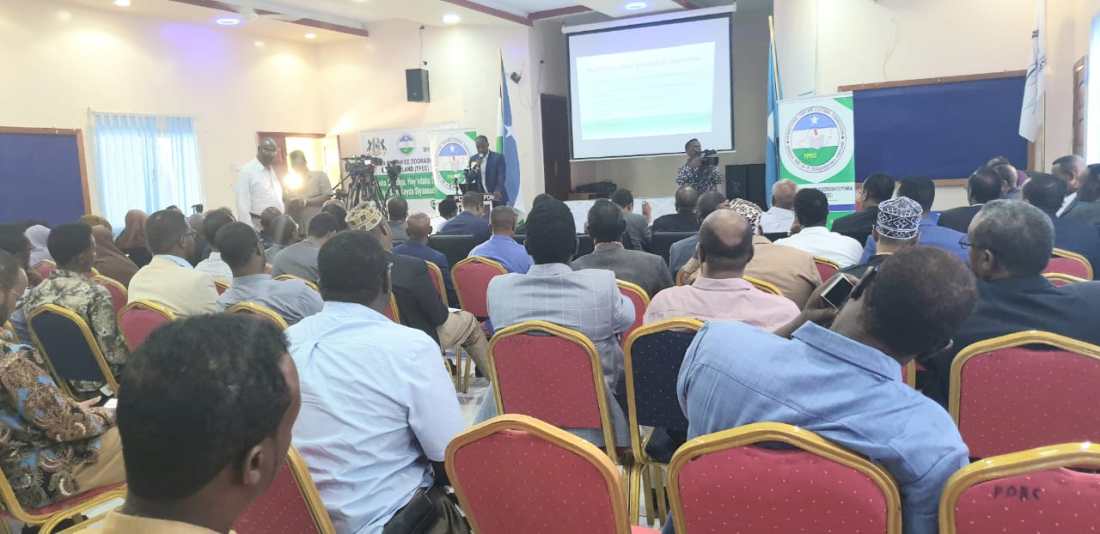
IS IT TOO EARLY TO EVALUATE PUNTLAND ON-GOING CONSULTATIVE CONFERENCE? WHAT ARE THE INITIAL TAKE-AWAYS FROM DAY ONE?

Some of the opening speeches, including President Deni’s speech, were good and adequately captured the spirit and historical background of the foundation of Puntland State and its stated mission, founding principles, policy objectives towards re-instatement and re-construction of the failed state of Somalia.

Delegates to the Conference seemed to be highly selective, acquaintance and name-recognition based and through social networking, apart from the traditional leaders and political groups.

Little acknowledgement and recognition were extended to the Founding Fathers of the State.

Plans on how to conduct the deliberations to solicit for maximum inputs from the delegates were kept in the dark and unknowable. How the Conference agenda would be drawn up, however, has created an uneasiness and concerns among the Conference delegates and Puntland general public alike.

Interest groups dominate the composition or list of delegates.

Day One of the Puntland Consultative Conference so far seemed audious in appearance, but troubling in substance and what to expect as an outcome.

The policy and fundamental constitutional differences between the leaders of the Federal Member States and Federal Government were being down-played with a few passing indirect and mild criticism at Federal Administration.

It appears that the Conference is authority-driven rather than one being led by people’s congress.

The Venue, Conference Hall at Puntland State University, was unbearably hot and unventilated, making every sitting delegate to seek and grab a booklet to blow his/her face for a cooler hand-powered breeze.

Is it too early to draw any conclusions from Conference proceedings from Day One? Stay tuned.

https://ismailwarsame.blog

@ismailwarsame

Annual subscription

$37.00

Postscript: if the above is the agenda of the Conference, it is laughable and a joke. It would be a waste of opportunity and disservice to the people of Puntland.

AN ATTEMPT TO DISTORT HISTORY IN SELF-DEFENCE

Ask Amb. Ahmed Awad about an iota of contribution Abdulqasim Arta Government had made for Somalia. Instead, he should be talking about the role he personally played during the formation of Arta Faction in destabilizing a still nascent Puntland State, on behest of Ismail Omar Ghueleh, Abdulqasim and Ali Khalif Galayr.

Arta Faction leader, Abdulqasim Salad Hassan, in which Mr. Ahmed Awad had been serving did harmfully what even Mogadishu Warlords of Aydiid and Ali Mahdi shied away: Disturbing the gentleman’s Agreement during the Civil War not to disturb the few remaining diplomatic corps in Somali Embassies still operational in some countries, mostly Arab countries, by trying to staff with his own cronies. By doing this, Abdulqasim had effectively destroyed what was left of Somalia’s spoils of the Civil War.

He still refers Arta Faction as the 3rd Somali Republic, when people know this Federal Republic is the 2nd. Thus, he believes military coups create republics. Military coups overthrow existing governments, not found republics as General Siyaad Barre did in 1969. The First Somali Republic lasted until 1991. The 2nd Federal Republic of Somalia was founded in 2004, in exile in Mbagati, Kenya, and continue to exist today.

Further, he either ignores or shamelessly doesn’t know the official name of Puntland State of Somalia ( in Somali, Dawladda Puntland ee Soomaaliya) by repeatedly hearsing “Dawlad-Gobolleedka Puntland”. He could simply said, Puntland State (Dawladda Puntland or Xukuumadda Puntland). He sounded like a resident of Banadir Region new to the correct names of the Federal Member States. A Puntland State official could feel awkward to correct him without causing him an embarrassment. His bosses don’t know any better for they wouldn’t have endorsed his skewed historical credit to defunct Arta Faction.

https://ismailwarsame.blog

@ismailwarsame

Annual subscription

$37.00

Postscript: For the benefit of those who arn’t familiar with the history of the case, it took several countries and many Somali statesmen to persuade Mr. Abdul Qasim Salad Hassan, after a distant defeat in Mbagati Presidential Election, to shake hands with late Abdullahi Yusuf, and accept reality. There was no transfer of power as there was none, not even TNG documents.

According to Minister Ahmed Awad’s thinking, if Suudi Yalaxow were to overthrow N&N Government today, he would name it “The 4th Somali Republic”.

LIFE IS ABOUT CHOICES

Life is about choices.Today it was that choice for me to attend the affairs of a friend, who accidentally fell and broke his shoulder or go to participate in the Garowe Consultative Conference. I have chosen the former and felt good about it.

My friend is doing fine now. Lucky he was.

https://ismailwarsame.blog

@ismailwarsame

[simple-payment id=”5422″

PUNTLAND YOUTH UNEMPLOYMENT

Reprint

Unskilled persons are mostly unemployable in any sector of the economy in any given country or society. This is what is happening in the state of Puntland. Puntland employment situation is both sad and funny – you don’t import housemaids and hotel cleaners to a country where unemployment rate is double digit.

It will take concerted and sustainable efforts on the part of both public sector and private employers to intervene in the abysmal state of affairs to rectify the widespread youth unemployment in Puntland. Skills training also includes changing prevailing social attitudes towards employment and doing away the culture of dependence to impress youth with the dignity of having a job and the importance of financial independence. Everybody has an important role to play here: Parents, government, local NGOs to address this pressing issue.

At moment, service, construction, fishing and farming industries suffer heavily due to unavailability of locally employable natives. These industries are trying desperately to attract non-native workers from other parts of Somalia and beyond, including Kenyans, Ethiopians, Yemeni and even Indians. The situation here resembles a Gulf Arab state scenario where thousands of expatriate employees run the economy. The difference is that there is no oil here at the present, although Puntland has more wealth than oil and gas: abundance of land for farming, huge livestock, unexhaustable marine resources, not to mention about the potential for also oil, gas and precious minerals, reportedly all rare metals.

Puntland can immediately kick-start fishing, leather and salt industries with minimum capital investment, employing thousands of youth currently unemployed.

Huge opportunities exist here. It requires local awareness, vision and commitment by all concerned.

https://ismailwarsame.blog

@ismailwarsame

Annual subscription

$37.00

THE STORY OF DHAWEEYE

Reprint

DHAWEEYE or Uber Taxi Service is a very strange phenomenon to Garaad Abdullahi Ali Eed, one of the most respected Tradional Leaders in Puntland. Garaad Eed who is staying in Garowe these days shared his experience
With the new services the other day.

The Garaad wanted to go somewhere in the city in a hurry. He couldn’t wait any longer for his chauffeur- driven vehicle. He decided to take a taxi. His young helper recommended and volunteered to call an Uber service instead. The Garaad couldn’t understand the young lad’s advice, but gave him the go ahead anyways with the call.

Within minutes drove in a nice and luxury medium-sized Salon to pick up the Garaad. A clean and nice looking young man was sitting behind the wheel.

Seeing how young the driver was and conscious of and concerned about his own safety and security, the Garaad had reluctantly boarded the car together with his helper.

Upfront and immediately before he drove off, the Dhaweeye kindly offered a fresh and cold bottle of camel’s milk to the Garaad. Surprised at this unexpected courtsey gesture from the strange driver, the Garaad politely declined the generous offer. The Garaad, however, felt safe and comfortable during his short journey with the new service of DHAWEEYE.

Dhaweeye or Uber service is a very convenient taxi service widely available in all major Puntland cities. There is even DhaweeyeApp downloadable on the Internet. On average, one way ride in Garowe costs $1.5. Waiting time is normally less than 2 minutes.

The Somali word “Dhaweeye” literally means a destination reducer.

Welcome to globalization!

https://ismailwarsame.blog

@ismailwarsame

[This was written before Late Garaad Abdullahi Ciid passed away].

WDM HEALTH ALERT

WDM alerts the organizers of Puntland Consultative Conference to be held tomorrow, March 15, 2020, at Puntland State University Conference Hall in Garowe, to get prepared and screen Conference delegates at entry gates for symptoms of contagious diseases, including Coronavirus.

Many delegates are scheduled to arrive Garowe by air from overseas countries, which reportedly, had cases of the infection. They should be thoroughly checked and screened at Puntland airports upon arrival as a matter of health priority.

Medical isolation rooms for possibly affected persons should be in place in town and at airports before the Conference starts.

A contingent of health professionals and security units should be employed to handle this vitally important exercise to protect the entire people of Puntland and Somalia from the pandemic.

The World Health Organisation, WHO, has recently declared the Coronavirus a “Worldwide Pandemic”. Accordingly, Puntland leaders should be considering this issue seriously and take up leadership role to protect the country and population.

https://ismailwarsame.blog

@ismailwarsame

Annual subscription

$37.00

Correction: early edition of this article misstated the venue of the Conference as East Africa University instead of PSU.

BEGGERS HAVE CHOICES

Reprint

Today I happened to be in a Café-shop in Garowe, Puntland, Somalia, enjoying a cup of cappuccino when an elderly man entered the space. He started addressing customers to solicit for his financial needs and pleas for help. It is my turn to hear him. The problem here in Somalia is that nobody has or uses local Somali Shillings as the currency had lost its value and almost its relevance in today’s Somali economy. The national currency has been replaced effectively by electronic US dollars accessed on smartphones with accounts through Hawillaad money transfer agencies and local telecommunication companies. It is therefore difficult, if not impossible, to assist someone in need with change from someone’s own pocket.

As a plan, I often carry on me some spare change in case I need sundry expenses like shoe-shining. So I had a bundle of Shs.So. old banknotes when the elderly begger approached me.

I was holding my phone in my right hand when I used my left hand to fish out some Somali Shilling banknotes from my left pant pocket to hand out to him. The man looked at me surprisingly without stretching out his hand towards me. Equally surprised, I asked him, “you don’t want it?” He calmly asked me, “why don’t you give me that with your right hand?”

Another man nearby who was observing my rather awkward situation jumped in to say, “he is right. Why do you give him your hand-outs by the left hand?” In self-defence, I asked them, “do you know whether I am left-handed?” The two were taken aback to consider my unexpected question.

BEGGERS have choices here in Somalia and they can refuse your assistance if there are strings attached to it, be well advised.

https://ismailwarsame.blog

@ismailwarsame

Annual subscription

$37.00

Protect yourself by any means necessary

BREAKING NEWS: WDM HEALTH ADVISORY

On the top of your prayers, wash your hands on habitual basis.

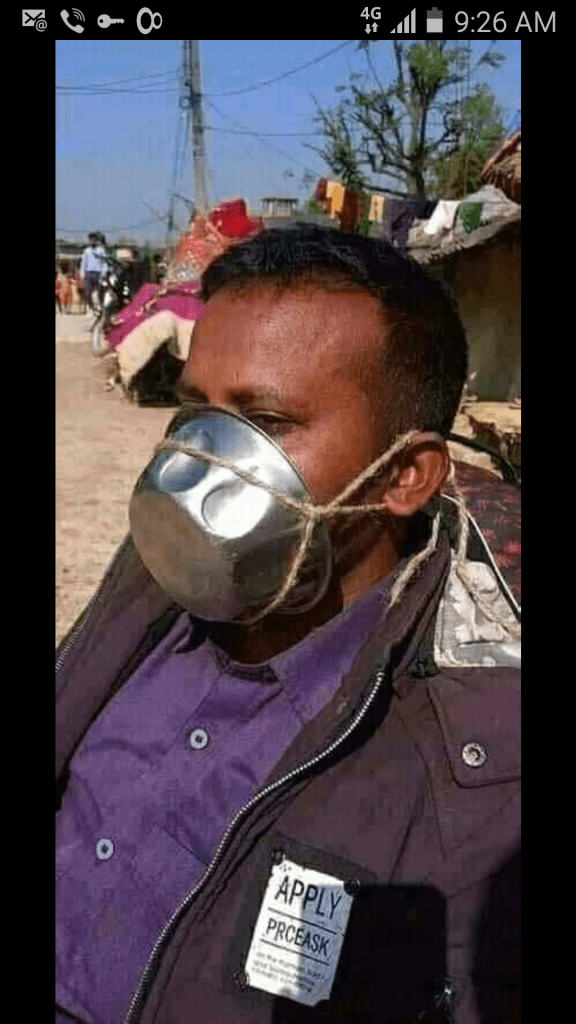
Washing your hands saves your life and others’. Normally, your hands are carriers of contagious germs and diseases. Now, given the outbreak of Coronavirus, known and unknown pandemics, it is vitally important to take the necessary health precautions.

Use soap and hand disinfectants. Limit hand-shaking and employ alternative ways of greeting people. For Muslims, ASC is enough for greeting people. When possible, use face-masks in crowded places. Stockpile these items at home and advise family members to use them extensively. Wash clothes and change them as often as you can. Health experts say Coronavirus can stay 9 hours on the cloth. Persons coming from overseas are more likely to carry the disease. They should be screened at entry points for fever and symptoms of the virus infection.

Those handling food and other service in hotels and restaurants should be instructed to use soaps, disinfectants and gloves. There is also a right way to wash hands with thorough cleaning and rinsing of hands after lathering up them completely with soap. Please stay healthy.

Finally, don’t be fooled by unscientific romours that Coronavirus doesn’t affect Muslims. Human bodies are all biologically the same and susceptible to diseases and contamination.

https://ismailwarsame.blog

@ismailwarsame

Annual subscription

$37.00

Be careful!

“DIIRATADA” PUNTLAND

ON PUNTLAND FORTHCOMING CONSULTATIVE CONFERENCE: CONFERENCE MOTTO “PUNTLAND FOR PEACE & DEVELOPMENT”

  1. Opening Ceremony Speeches on the importance of the Conference and expectations of the people of Puntland.
  2. Major objectives of this Conference and why it was necessary to convene.
  3. Major obstacles to Puntland socio-economic development to be debated in this Conference.
  4. The way forward for Puntland self-government as a Federal Member State or a Confederate Member State.
  5. Expressions of gratitude to all donor countries and international humanitarian organizations that have been helping the people of Puntland and Somalia over many years (name them individually and collectively).
  6. On Coronavarus and other contagious diseases: Healthy lifestyle, hygiene and prevention.

AN AGENDA OPTION

  1. Review of foundational and Guiding Principles of the State of Puntland
  2. Public Institution-building and reforms, especially the financial, security, health, education, judiciary and environment sectors, which under-performed over many years in the past.
  1. Obstacles to Democratization and political pluralism, including lip-service commitment to it by Puntland political elites.
  2. Re-defining the role of traditional leadership in Puntland society
  3. Strenghtening civil society, civic and professional associations in Puntland, with active participation of youth and women.
  4. Addressing youth issues – education, skill training and leadership
  5. Environment
  6. Infrastructure projects to link-up coastal and contryside with Puntland urban centres. Plans for the construction of fishing, livestock, Meidi and salt industries, encouraging venture and business investment with government incentives on taxation and enviromental regulations.
  7. Puntland-Federal Government relationships, and Puntland Vision towards the creation of the New Somalia, with proactive policies of engagement and leadership.
  8. The issue of Somaliland territorial expansionist policy
  9. Panel discussion on each of the agenda item with expert inputs and guidance 
  10. Conference Communique on adopted resolutions and a white paper.
  11. Appeal to the Federal Government of Somalia, Federal Member States and International Community to work together in moving Somalia forward by resolving all existing impediments along the way to Somalia’s full recovery and reconstruction efforts.
  12. Synthesis of consensus and Final Report with emphasis on benchmarks and timeframes to achieve goals and objectives.

The deliberations of the above agenda items could be scheduled for 3-4 day period.


https://ismailwarsame.blog


@ismailwarsame


Annual subscription

$37.00

PUNTLAND: CRISIS OF IDENTITY OR LOSS OF VISION?

Is PUNTLAND in a state of national crisis in every aspect of its public endeavors? Would the anouncement of a forthcoming PUNTLAND Congress or Conference scheduled in March 15, 2020, respond to this crisis or troubling political disillusionment of its residents, and youth, in particular? Would Puntland continue to hold the unity and cohesion of its constituency member regions, after it had lost parts of its founding members? Would the reckless and unconstitutional activities by the leaders of the Federal Government of Somalia take advantage of Puntland administrative and security vulnerabilities in Mudugh and Bari Regions? Would Puntland stage and maintain fiscal, public and security sector reforms?  Would democratization of Puntland governance finally come true before the end of President Abdullahi Said Den’s Term in office? Would Puntland leaders be able to manage the persistent political and constitutional frictions with Farmaajo Administration? Would Puntland so-called “universities” be allowed to continue to ill-educated Puntland youth with fake diplomas and degrees with the production of illiterate graduates with no work skills?


These are critically important questions before the Puntland Forthcoming Congress, begging for answers in fundamental ways.

Puntland Government role in this Congress must be limited only to security, funding and help in organization, but the public debate and agenda setting must come from the delegates to the conference. Delegates should monitor any manipulation by government agents and politicians. The Congress must be conducted in an atmosphere of freedom of expression and genuine debates on outstanding issues of the day and current Puntland socio-economic stagnation, whereby sick persons still embarrassingly go and seek medical care in Hargeisa and Mogadishu, after more than two decades of Puntland statehood and self-government. This is the legacy of systemic and run-away corruption in Puntland public health sector.

In a nutshell, Puntland Forthcoming Congress must be conducted along the Founding Principles of the State and in manners resembling the Founding Congress of the State with benchmarks and objectives to achieve in timeframes.

Finally, Farmaajo Administration is engaged in dismantling the federal system agreed upon in the foundation of the 2nd Republic in 2004. What is the Puntland State strategy and vision towards the New Somalia being created out of the Civil War? What is the alternative to a central dictatorship? Are there lessons to learn from that past experience and experiment in post colonial Somalia? Are Somalis ready relive tyranny and central command government?

Puntland State and its residents have still the potential to recover lost opportunities to mend past policy mistakes and re-gain blurred original vision


https://ismailwarsame.blog


@ismailwarsame


Annual subscription

$37.00

FGS DENIED PHOTO OPPORTUNITY TO DECEIVE WORLD COMMUNITY

Puntland and Jubaland have denied photo opportunity to the leaders of the Federal Government of Somalia to participate in a Ministrial Meeting that was scheduled to ocur in Baydhaba, Southwest State of Somalia.


Puntland and Jubaland had told Farmaajo-Khayre Administration that they had other pressing priorities to address.


It is known that Western financial institutions and donors had been  demanding for full participation of Federal Member States in Somalia’s quest for Debt Relief.


Unilateral actions and policy decision-making by FGS made most FMS uncomfortable and annoyed. The FGS was not providing national  leadership, democratic space and  environment conducive to constructive engagement with the Federal Member States.


https://ismailwarsame.blog


@ismailwarsame


Annual subscription

$37.00

SUUGAAN

Suugaan


https://ismailwarsame.blog


@ismailwarsame

Annual subscription

$37.00

WDM NEWS: FACTIONAL FIGHTING BREAKS OUT AFRESH IN SOMALIA 

Nabad and Nolool Faction (Farmaajo-Khayre Junta) has re-started fresh factional fighting in the territories of Federal Member States, engaged in forceful toppling of the leaders of Regional Administrations. The hostile operations constitute yet again a direct violation of the Federal Constitution and Peace Accord reached in 2004 on the eve of the establishment of the 2nd Somali Republic. The First Somali Republic had failed in 1991.

Since then, Somali parties to the conflict were hammering out their differences until the current Mogadishu Faction Leaders (MFL) came to power in Mogadishu in 2016 corrupt election with wholesale buying of MPs’ votes with Qatari funds.

The Farmaajo political objective is to dismantle the leadership of Federal Member States before the elections of 2020/2021, installing, instead, loyal governorship-like regimes, thus securing environment conducive to holding sham elections to cling to power.

Already, Galmudugh, Hirshabelle and Southwest states have been neutralized. Jubland is under military action now to topple Ahmed Madoobe, perhaps with Ethiopian military support, to replace Kenyan troops there as AMISOM units, in an intention to capture Kismayo in the process. This military strategy allows Ethiopia to gain access to the Port of Kismayo, the Indian Ocean and other infrastructures, including Kismayo Airport, besides, Port of Berbera is being used by Ethiopia already. This military campaign has to be done now before the election and Gu rainfalls to avoid military vehicles stuck in the oasis of Jubaland.

Puntland would be a hard nut to crack, but not impossible. 21st Somali Military Sector has been re-created and used already against the Galmudugh State to crush President Xaaf and Ahlu Sunnah-wal-Jamaaca leadership opposing factions. These troops, with re-inforcement and logistics supplies from Mogadishu, pose a fatal security threat to North Mudugh and Puntland as a whole, now that they own Southern Mudugh.


A few days ago, Ahlu-Sunnah faction in DusaMareeb in Central Somalia had been ousted in a military coup by Mogadishu Faction leaders.

Now, sketchy advance reports indicate military clashes are underway in and around Balad-Xaawo town in Gedo Region of Jubaland. There are also unconfirmed reports of military actions spilling over to the border with Kenya, forcing Kenyan Defence Forces into high alert. There are reports of casualties and property damages.


Recently, Mogadishu has been accusing Nairobi of meddling into Somalia’s internal affairs.


https://ismailwarsame.blog


@ismailwarsame


Annual subscription

$37.00

DRIVING WRONG VEHICLES ON THE RIGHT SIDE OF THE ROAD

DRIVING WRONG VEHICLES ON THE RIGHT SIDE OF THE ROAD

Reprinted.

Welcome to a country where people drive right-handed vehicles on right-hand side of the roads, where there are no rules of the road and pestetrians walk along in the middle of road, where extremely only slow driving speed saves lives and minimize road accidents, where there is no need for traffic police and not necessarily a driving license and therefore no age limit to drive a vehicle.

You guessed. It is the new Somalia emerging from the ashes of the Civil War. Guess how long it will take to bring that country back on track, how much rehabilitation works to be done on youth, regulations, institutions and infrastructure?

But, don’t despair. There is light at end of the tunnel. It is just digging it out of the deep hole.

https://ismailwarsame.blog

@ismailwarsame

Annual subscription

$37.00

GARA’AD PORT: A PEOPLE’S PORT

Gara’ad Port under heavy construction to start full marine services in mid-year 2020. Click the underlined to watch.

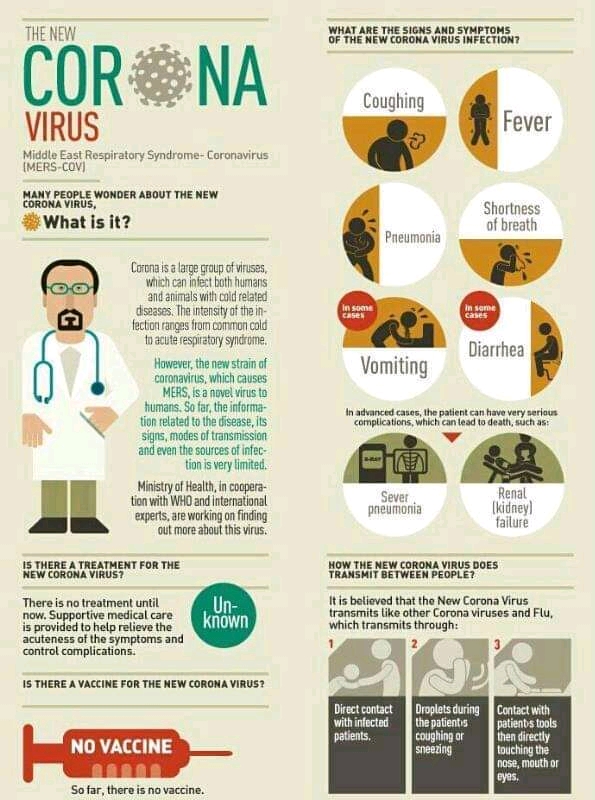
CORONAVIRUS

GAROWE vs GALKAYO IN THE ADMINISTRATION OF JUSTICE IN MURDER AND RAPE CASES, ASHA ILYAAS AND HODAN SHANLAYSANE

GAROWE is under the watchful eyes of the people of Puntland as to what public response the residents of Nugaal Region would give about the rape and murder of a pregnant woman and a mother in Garowe recently.


It would be a miscarriage of justice by Puntland Judiciary not to bring perpetrators of this heinous crime before justice and pay the legal punishment they deserve.


Puntland Government would be abandoning its constitutional respinsibilities not to pursue justice in regard to Hodan SHANLAYSANE merceless and barbaric crimes of rape and murder.


https;//ismailwarsame.blog


@ismailwarsame


Annual subscription

$37.00

NEW CHINESE GREETING AMID CORONAVIRUS

Feet Greeting

Comedy

PEACE AND PROSPERITY GO TOGETHER

Peace and prosperity go hand-in-hand. None can exist without the other. Neither can be achieved without stake-hloders in-conflic participating in the process and decision-making, not only to end the sources òf conflicts, but also to help out in the resolution of the conflicts in order to achieve common objectives in nation-building.


In the case of Somalia, there are symptomic tendencies by leaders of both Federal and FMS to ignore the fundamentals of consensual contracting, particularly at Federal level, thus putting obstacles along the way to peace, national reconciliation and stable society, striving for progress and prosperity collectively.


Someone once said that “democracy dies in the darkness”. Otherwise, how would you explain the silence and under-hand operations of the Federal Somali Authorities on:

  1. Secret talks of the leaders of FGS with the leaders of Ethiopia, Kenya, Eritrea, Uganda and Djibouti.
  2. FGS’ resistance to seek positive dialogue and discussions with the leaders of the FMS.
  3. FGS engagement in unilateral and exclusive building of Somali army and security services.
  4. FGS’ lack of transparency on foreign aid to Somalia, especially that was coming to Villa Somalia as dark money and funds to destabilize FMS regimes.

These are just a few of the outstanding examples that one would immediately point out, observing Farmaajo-Khayre political modus operandi.


You won’t build a nation-state by going in circles forever. It is time to cut the crab and get real, not attempt to device tricks to cling to power through deceit and demagoguery.


https://ismailwarsame.blog


@ismailwarsame


Annual subscription

$37.00

ALI MAHDI MOHAMED INTRODUCED TO LAW & ORDER SITUATION

By Omar Warsame

Mr Ali Mahdi is furious for having been asked to identify himself at security check point by a 19 years old officer.

Two things are absolutely wrong with the old man’s conduct, (a) this was done for his own protection, and (b) he was a disputed president 30 years ago who really hasn’t left any good legacy for the young soldier or the people of Somalia in general to warrant his respect or remembrance.

I recall Ted Kennedy being detained at one of the US airports because he was on the No Fly List, and when he was later asked about the whole experience , his response was “ they were just doing their job”.

This incident reinforces my belief that regardless of his age or experience in life, the black man has always tendencies to act before he thinks rationally.

If Mr Mahdi has and ounce of decency left in him, he should apologize to the Somali people for his offensive and inflammatory remarks, and to the government which I’m sure currently scrambling to find ways to deal with this reckless and irresponsible former president, but more importantly he should apologize to the young soldiers who are doing what amount to an impossible task and working under conditions that those of us who’re lucky enough to live in a civilized society can never imagine.

PUNTLAND HAS RUN OUT OF EXCUSES IN GENERAL ELECTION DEALYS

The notion that general elections in Somalia are difficult to conduct is falsehood and fallacy, as it is consistent neither with history nor reality. Several general elections and national constitutional referendum were held decades ago here, without even voter registration, with the full participation of the nomadic population in remote parts of the country with more difficult conditions and less means or communication.

Today the entire population of Puntland as well as other other portions of the Somalis elsewhere in the country are registered on their mobile phone acquisition, even nomads.


Resistance to conduct a general election is simply political and self-preservation by self-serving system to avoid accountability on poor leadership performance and fear of fair political competition.


Somali leaders both national and local levels, want to use corrupt tools to gain power or stay in power.


Puntland is one of the most suitable locations in Somalia to conduct a free and fair election.


Once that done in Puntland, domino reaction in other parts of Somalia shall ocur immediately. Puntland State had run out of any further excuses to delay people’s wishes to a general suffrage.


https://ismailwarsame.blog


@ismailwarsame


Annual subscription

$37.00

TRUMP SHAKE-DOWN OF USA SYSTEM OF GOVERNMENT – DRAINING THE SWAM IN WASHINGTON?

49 Small Truths About Marriage All Couples Understand

LOVE & MONEY / RELATIONSHIPS

#43: The cute little habits you love about your spouse in the beginning will, after a few years together, be the source of madness.

By Fatherly

Feb 13 2020, 11:45 AM

The first officially recorded marriage was in Mesopotamia in 2350 B.C. Since that first couple said whatever version of “I do” they said, millions have taken oaths to forever pledge their lives to one another. After the vows are said and life settles in, truths emerge. About what it takes to maintain a happy relationship. About the inevitable fights that will occur. About why never having to say you’re sorry is bullshit. About what it truly means to be a partner on good days, bad days, and those days when the sound of your partner’s chewing makes you want to muzzle them.

Marriage is life, bundled together. It contains, as it has been said, multitudes. As such, we wanted to offer some simple truths about marriage to lift the curtain, light the way, and let you know that there are some certainties everyone should keep in mind. Some of these truths are lighthearted; others are serious. All, we think, shed some light on the inner-workings of sharing your life with someone. Because while no marriage is the same, a lot of marriages — and core principals — are similar.ADVERTISEMENT

  1. Everyone thinks about leaving. That’s just a part of staying.
  2. Forgiveness is for people you don’t share a bed with. Forgetfulness is for people you do.
  3. Not everything needs to be equal. In fact, nothing ever really is.
  4. It’s important to know what parts of your partner need to be scratched from time to time.
  5. Arguing before coffee is a waste of time.
  6. Talking about your partner behind their back is a good thing. To be married is to be in need of advice.
  7. But there’s certain information that your spouse will consider confidential.
  8. Don’t presume that you have access to your partner’s professional life.
  9. Sometimes sex is tedious and boring and you’re tired and not in the mood and that’s a fact of life.
  10. Having a kid bonds you, sure. You’re doing it together, and learning together. It will also lead to intense power struggles and some of the most bare-knuckled brawls you never imagined you’d have. About things like the best way to burp the baby, or what kind of cheese you should use in that seven-layer dip recipe.
  11. You will absolutely recognize your marriage issues in family sitcoms which means that your marriage is not as special and unique as you probably thought it was.
  12. There will come a time when your most regular texts from your spouse will be “Can you pick up X from the grocery store?”
  13. Anniversaries stop being special around year ten.
  14. If you’re not talking about sex — what makes your eyes rollback, what makes them just roll — chances are it’s not that great.
  15. At some point, you have to stop being “lovers” and start being teammates who fuck occasionally.
  16. Every married couple should probably talk about finances way more often than they are.
  17. good marriage can survive you being honest about your kink.
  18. You will go to bed angry sometimes.
  19. You will wake up angry sometimes.
  20. Remembering the little things will solve so many issues. And marriage will make you realize that they’re not actually little things. They’re very, very big things.
  21. Sex will be frequent and sometimes mind-blowing. Then, for a period, it will be just fine and not as frequent. Then it will be mind-blowing again.
  22. You will hear your spouse tell the same story for 4587 times throughout the course of your marriage.
  23. Your spouse will freak out over things that you think are wildly irrational. Looking at those irrationalities as rational and treating them as such is critical. You don’t have to agree with them, but you do need to be compassionate. Emotional invalidation is a killer.
  24. There will be times when your partner will say something about a past experience that will shock you and remind you that you don’t know them as well as you thought.
  25. You will go out with other couples and think they are weird or, frankly, the fucking worst. You will go out with couples that think the same of you.
  26. Seemingly inconsequential things — how someone arranges the eggs in the fridge, the amount of paper towels they use, if they leave the cabinet doors open, if they accidentally hog the covers at night — will be the gateway to hour-long arguments.
  27. When your spouse tells you they “accidentally” hogged the covers knows precisely what they’re doing.
  28. Talking shit about other couples will be considered a great date night.
  29. You will, at some point or another, feel like your partner and the kids have a relationship you could never have.
  30. Without independent hobbies, shit will go sideways.
  31. Without regular activities to do together, shit will also go sideways.
  32. There’s some truth to this Ogden Nash quote, “Marriage is the bond between a person who never remembers anniversaries and another who never forgets them.” Understanding how you complement one another is crucial.
  33. Marriages always end poorly. The best-case scenario is that someone dies at the end.
  34. Divorce doesn’t mean that a marriage was a failure. The journey has value beyond the destination.
  35. There’s also truth to this one by Ben Franklin: “Keep your eyes wide open before marriage, half shut afterwards.” In other words, you have to take certain things with a grain of salt.
  36. Love doesn’t simply survive on its own. It is maintained through actions.
  37. Marriage will teach you, more than anything in life, when to shut up.
  38. Comparison, it has been said, is the thief of joy. But you will compare yourselves to others. It’s good to have perspective. It’s also poisonous to be covetous.
  39. Having a sense of humor about things will take you far; knowing when not to make a joke will take you further.
  40. There are many, many roles in a marriage: coach, confidant, cheerleader, chore-handler, locater-of-strange-night-noises, etc. But the most important role to remember is teammate.
  41. Intimacy — both emotional and physical — is the fuel of a marriage.
  42. In most situations, it’s helpful to assume that, not matter what the result was, your partner probably meant the best.
  43. The cute little habits you love about your spouse in the beginning will, after a few years together, be the source of madness.
  44. When you marry your partner, you marry their family and everything that comes with it. Act accordingly.
  45. It’s not enough to take care of your spouse. You also have to look after yourself.
  46. You can — and will — talk shit about your partner to others. But when others talk shit about them, it will fill you with rage.
  47. If you’re not trying to improve yourself, you’re not trying to improve your marriage.
  48. At some point, you’ll talk to your single friends and think Man, that’s the life.
  49. Equally as often, you’ll talk to your single friends and think They don’t know what they’re missing.

FARMAAJO’S APOLOGY TO SOMALILAND IS BRUTALLY SELECTIVE

While all people of goodwill would welcome the President’s apology to Somaliland’s unilateral claim of atrocities by Barre’s Junta, he deliberately, or, naively ignores the war crimes and gross human rights violations committed by the regime in Mudugh and Kismaayo. Add to this, the banditry, plunder and robbery of Barre’s retreating and fleeing forces in Bay and Bakool regions in the last days of regime’s collapse.


If Farmaajo had had any common sense and any sort of what it takes a leader to address such an important issue, he would have apologized for all atrocities of Siyaad Barre’s Regime. By apologizing to Somaliland alone, on temporary political expediency, he has complicated the situation: Now, he is required to apologize to the residents of Mudugh for Barre’s mass incarceration, killing, maining of innocent citizens en masses, destruction and poisoning of nomads’s water-holes, rape and other human rights violations amounting to undoubtedly war crimes.


Make no mistake, any effort towards yet to be called for national reconciliation talks, those atrocities in Mudugh by Barre and his henchmen shall stand out, without which popular trust in national government and public institutions couldn’t be achieved.


Finally, it is my hope that the leaders and people of Somaliland would seize this opportunity by allowing  President Farmaajo to visit Hargeisa without the entourage of Prime Minister Ethiopia, Abyi Ahmed Ali. People of Somaliland deserves better than that.

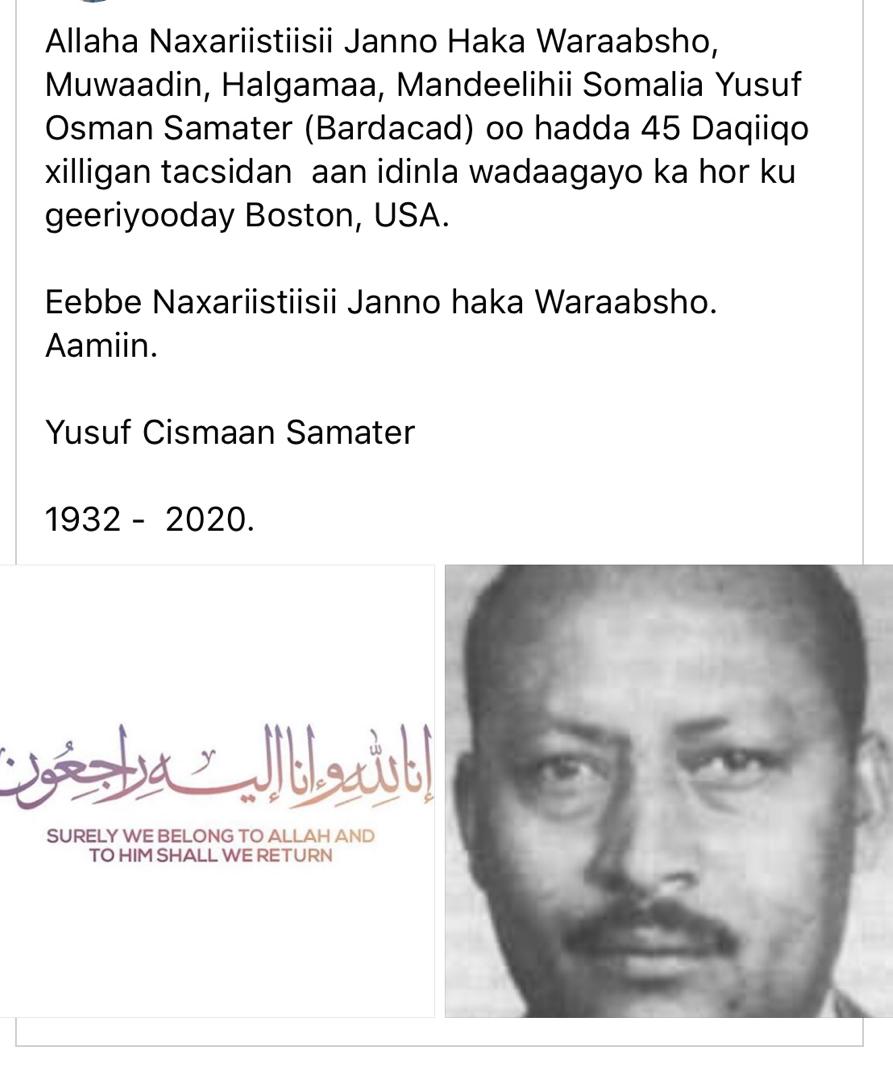
(Photo: The late politician from Mudugh, Yusuf Osman Samater, who had spent 18 years in Regime’s solitary confinement prison cell without charge).


https://ismailwarsame.blog


@ismailwarsame


Annual subscription

$37.00

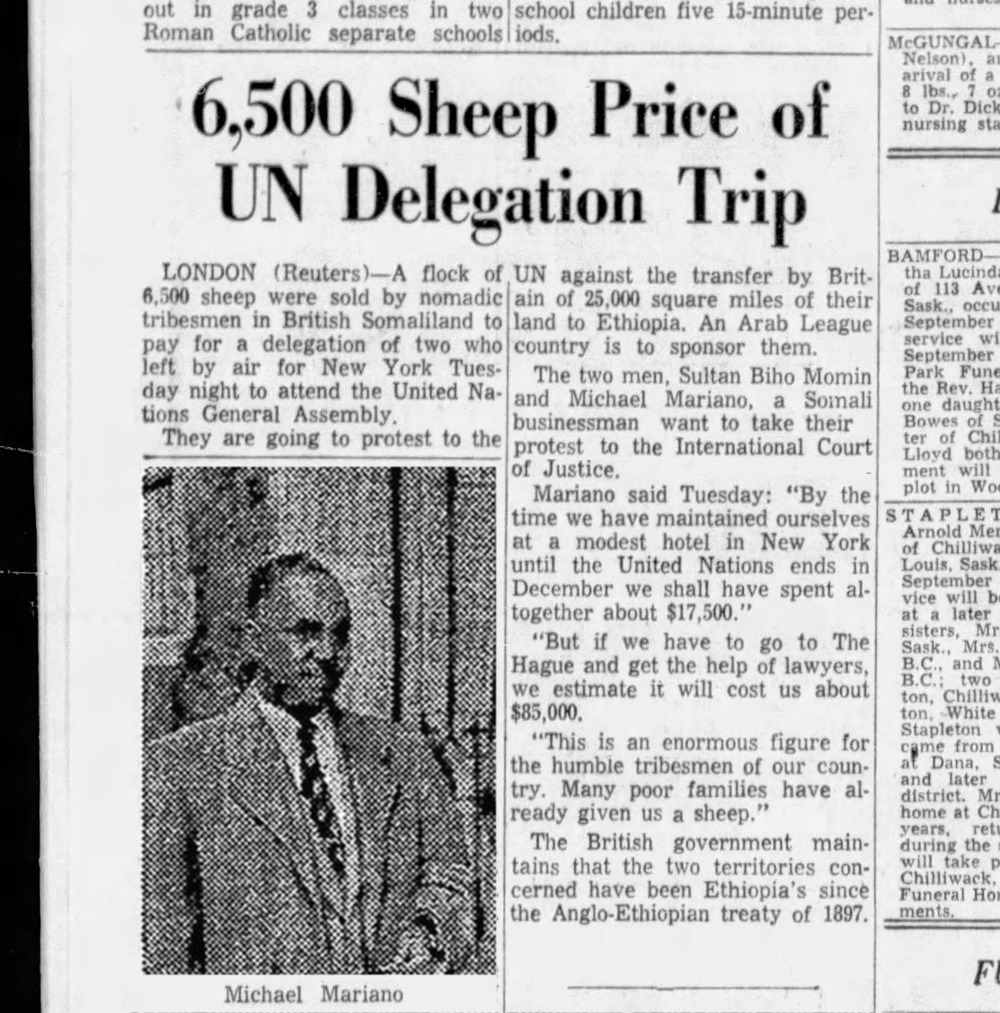
Yuusuf Cismaan Samater Bardacad

BARDACAD

Allow u naxariiso Yusuf Cismaan Samater Bardacad, Xoghayii Xisbiga Bidixda ee SDU (Gareedka), iyo Mudane ka tirsanaan jirey Baarlamaanka Somalia xukuumadahii rayedka ahaa ka hor 1969.

Marxuunku wuxuu u ugu xiraa Siyaad Barre 18 sano, dambi iyo maxkamad la’aan, qol mugdi ah oo go’doon ah.

Boqolaal kun oo kale ayaa iyana kasoo wada baxay “Kuliyedda Jaalle Siyaad” ee loo yaqaan “iihay”, sidaana lagu burburiyey xaasaskoodii iyo dhalaankoodii guryaha Ciidamada Amaanka ee Faashiisku ka qaafaalanjireen aabayaasha.

AHN-tee, Bardacad, kumayaal ardo Soomaaliyeed oo an kalasooc lahayn ayuu waxbarasho dalka dibaddiisa ugu diray inta uu xoriyedda haystay.

Special FT.com Report: Nuruddin Farah

By Katrina Manson, OCTOBER 6,2015

Nuruddin Farah: ‘I write about Somalia to keep it alive’ The author on death and corruption in Somalia

The first time someone attempted to ban Nuruddin Farah from writing he was nine years old. It happened again, twice, when he was 18 and 28. Then at 31, he was threatened with 30 years in jail over his written words, and later with death. But the epic chronicler of Somalia, now 69 and working on his 13th novel, has never allowed himself to be cowed. “I believe in the rightness of what I’m doing, and in the wrongness of being stopped,” says Farah, who was kidnapped on his first visit to Somalia in 1996, after more than three decades abroad. He believes hit squads were sent to kill him on two separate occasions when he was living in exile. “There must be a reason why my life has been spared: it is to write.” Farah has devoted that life of writing to capturing Somalia, by turn his beloved homeland and a place that appals him. “I write about it to keep it alive,” he explains, in a long conversation down the line from his home in Cape Town. Although he has not lived in Somalia for decades, he returns regularly. “I live Somalia, I eat it, smell the death of it, the dust, daily,” he says. It is a tortured relationship. In his works, Farah repeatedly takes up the fate and feelings of the vulnerable. A sometime enemy of the state — with which he is obsessed — he reserves special opprobrium not only for Somalia’s politics but also for elements of its culture, especially how it treats women. “Somali society is dictatorial,” he says of the country he has described as “the neurosis from which I write”. Born in the western Somali town of Baidoa in 1945, the country then combined traditional nomadic living with the modern influence of glamorous Italian colonialists based in the capital, Mogadishu. His father worked as a translator, and was transferred to Ethiopia’s Somali-speaking Ogaden region, where the literate young Farah experienced preferential treatment first-hand. He was sent to school; his immediate younger sister was not: “She became a servant.” “We had the delicacies of life on a plate,” says Farah of the unearned privileges that were meted out to Somali men. “My mother was a minor poet. If she had not delivered 10 children and raised them, she might have become a great poet. Our clothes would be washed and ironed by women; we were given the best parts of the food, the meat; women ate the leftovers; the list is endless. And yet in a country like Somalia the ruin is caused by men. As a generic male I am part of the problem. I’ve written about it so very often.” Farah and his brothers left for Mogadishu in 1963. In 1966, he left to study in India, returning three years later, only to leave again for the UK, again to study, in 1974. His first novel, From a Crooked Rib, written in 1968, criticised that culture he remembered from his early life, in which women were “sold like cattle”. It adopted a female perspective to tell the story of a teenage nomad who flees her family to avoid forced marriage but encounters brutal male control at every turn. Farah’s first novel describes women during his early years in Somalia as ‘sold like cattle’ After independence, Somalia began to come apart under socialist dictator Siad Barre, who came to power in 1969 and ruled for 22 years. While the socialist regime banned allusions to “cousin” in favour of “comrade” — an attempt to overturn the importance of clan links that had become central to life in Somalia — it also became increasingly dogmatic and dictatorial. Initially Farah was supportive, becoming the first author to write a story in the Somali script newly ordained by Siad Barre in 1972. It was the first time in centuries of oral and written traditions that the Somali language had gained a single alphabet of its own. Farah’s 1973 tale was serialised in a local newspaper until it was banned for being lewd and pointing to social and political hypocrisies that he argued would eventually lay waste to the country. “I was turned into a non-person; my name was no longer publishable,” he tells me. Farah’s continued criticism of the regime from abroad, such as his 1976 book A Naked Needle, in which he satirised misogynists, earned him his death sentence. Uncowed, over the next few years he unleashed a trilogy dedicated to the pervasive and paranoid security state that developed under the Siad Barre dictatorship. By 1991, Barre was deposed, but clan warfare, famine and warlords quickly destroyed the country. In the mid-2000s, as civil war raged, jihadis, later allied to al-Qaeda, took over much of Somalia, including the capital. Although they were pushed out of Mogadishu in 2011, they still control much of the countryside and launch regular suicide attacks on the capital. Farah’s books chart all this horror. In his most recent novel, Hiding in Plain Sight, the apparent hero of the book is blown up before the opening chapter, in a breakneck prologue. “Death in Somalia seldom bothers to announce its arrival,” says a line early on. “In fact, death calls with the arrogance of a guest confident of receiving a warm welcome at any time.” Death in Somalia seldom bothers to announce its arrival Instead Farah yearns for his country’s “cosmopolitan” past, when a multitude of ethnic and cultural influences flourished. “My theory is, the greatest casualty of the civil war is that the idea of cosmopolitanism is the one that has died,” he says, adding that most people today belong to “the 13th-century mentality”. “What destroyed Somalia is this clan business.” Farah argues that in a country otherwise united by the same language and ethnic make-up, clan has become “a trump card” where political representation is allocated according to the “4.5 system”, which divvies up influential and often lucrative roles according to four key clans and a multitude of smaller ones that fall under the “point five”. “You are dealing with something absolutely non-functional, inoperational. Mogadishu is now a clan family enclave — a den of corruption,” he says. “We are bigger than the 4.5 — it is concretising discrimination and privileging second-rate loudmouths who wouldn’t be able to get a job in any office in anywhere in the world.” His lead characters have long been bold and articulate intellectuals — regularly women — who lay out Farah’s anguish at the failings of his country. His prodigious output, and this effort to give voice to the voiceless in a land few write about and still fewer understand, has regularly seen him touted as a Nobel literature prize contender. His next novel will explore Somalis contending with right-wing politics and attitudes as immigrants to Norway, his latest work in a life-long effort to explain Somalia, “a country that is inexplicable”.

https://ismailwarsame.blog

@ismailwarsame

Annual subscription

$37.00

HATE-LOVE RELATIONSHIPS BETWEEN MENGISTU HAILE-MARIAM AND ABDULLAHI YUSUF: DECLASSIFIED

https://wp.me/p32mpX-kJ

ON THE HORN OF AFRICA CONFEDERARION

In November 14-15, 2002, an international conference on the Horn political and economic integration was held at Institute on Black Life in Tampa, Florida, USA. The Keynote Speaker was the former President of Zambia, Mr. Kenneth Kounda, a reknown Pan Africanist. Presenters were mostly academics of Ethiopian origin in the USA. There were negligible number of Somalis in the diaspora taking part. However, there were visible American personalities in USA government participating and facilitating the debate.


Since then, we hear constant talk or rumours about East African economic integration. This wind is always blowing from the Ethiopian side. We saw President Farmaajo’s frequent travels to Addis Ababa and Asmara, while the President is coy and deceptively silent about what was happening in his discussions with the leaders of Ethiopia and Eritrea. Somali public or their representatives in Federal Parliament are kept in the dark about the matters being discussed in these high-level talks. Normalization of Ethio-Eritrean relations is reportedly a part of the mix in these debates, for a presumely bigger political objectives for the Horn. President Farmaajo is numb about the subject of these East African Summits. Djibouti was projected to include in these secret discussions, but somehow is being excluded and sidelined altogether. Perhaps, she was found unfit because of its territorial dispute with Eritrea.

Occasionally, we hear press statements by Prime Abyi Ahmed of Ethiopia about Somalia and Ethiopia becoming one country one day. How soon that will happen, he wouldn’t say. He talks about Ethiopian intention and future plans to take advantage of Somali seaports for his land-locked country. He is also building a huge navy for his land-locked country.

Farmaajo is tight-lipped about Abyi’s claims and official statements. Pressed for comment on the issue, Farmaajo’s economic and political advisors seem resolved to keep their boss’ secrets closer to chest. It doesn’t sound well.


Paradoxically, President Farmaajo’s claim to be clean, patriotic and free from foreign influence is hard to maintain after his secret dealings in foreign lands with foreign actors, and those who bought his claims now have to listen to the music that he is reportedly a compromised figure by foreign actors, diplomats and countries. He is now in the open that whatever he had said, or says, is a lie and deception.


The eyes of the Somalis, though, are wide open now to monitor the activities of certain foreign diplomatic actors accredited to Somalia, and their agenda push with regards to this “East African Integration” at expense of Somalia’s sovereignty for the benefit of Ethiopian hegemony in the region.


https://ismailwarsame.blog


@ismailwarsame


Annual subscription

$37.00

SOMALIA AND NEW WORLD ORDER

Let me state the undeniable fact about prevailing New World Order, and with regards to the reality in Somalia as well as elsewhere in the so-called “Developing World’. The world went through two devastating World Wars. Why? When a state becomes more powerful economically and militarily with large population, it invariably seeks hegemony (domination) in its region and beyond. To prevent that happening, other states in the region pursue policies to counter-balance that threat. In the likelihood of one nation rising up too powerful, it is tempted to disrupt that balance to achieve its policy objectives of hegemony, first in its sub-region and eventually beyond, through the creation of its enabled alliances.

Good example is Germany of Bismarck and Germany of Hitler in the World War I and II respectively. After the 2nd World War, the world order splits into bi-polar (USA and Soviet Union). Stiff security and economic competition between the two blocks had come nearly nuclear blows during Cuban Crisis in 1961. Peaceful resolution of that crisis led to detente (peaceful coexistence) of the two world superpowers because no one wins in mutual destruction in a nuclear war. No one had used nuclear warheads after USA dropped nuclear bombs in Japanese cities of Hiroshima and Nagasaki killing hundreds of thousands to scare off the rising Soviet Union then. The Soviets had tested hydrogen bomb shortly afterwards. Nuclear game was over, but only as deterrent to prevent war between nuclear powers. Cultural, economic and security competition (capitalism vs communism, Adam Smith vs Karl Mark’s- ideology) between them gave way to the collapse of Soviet Union in 1991, leading to USA becoming the only superpower.

Undergoing the bitter rivalry during the Cold War and having acquired tremendous experience in regional power-plays, leading in technology, economy, finance and military, the USA would not allow the rise of another superpower again. To USA, the rise of China is a serious threat to the new World Order set and policed by USA, which enjoys hegemony in Europe and central America, and controls regional balance of power elsewhere in the the developing world. That is why the USA wouldn’t allow any disruption in the balance of power, whether it is Iraq, Iran, Cuba, Venezuela, Chile or others. President Trump’s trade war with China is nothing short of stopping China to achieve bi-polarity with the USA in world power balance. The USA are undermining China day and night. China is fighting back with theft of USA intellectual properties and other means, particularly in economic competition. Africa and Asia are the new economic battle fields. In this regard, Somalia’s strategic location, oil and other mineral resources are very much in the play.

That is why the State of Israel superior militarily over the Arabs is maintained to safeguard USA hegemony in the Middle East. In East Africa, Ethiopia, as a Western client state, would continue to safeguard that balancing act in the Region for USA, as Egypt would do in the Arab World, of course, after Israel.

Take Somalia now. Somalis as people meet all the criteria of Anglo-Saxon world not to allow Somalia to rise up. Why? Here is why:

1. They are black

2. They are Muslims

3. They are violent nomads and untrainable. They have seemingly pathetic attitudes towards public institutions, law and order, properties and human rights. Therefore, they are still primitive and uncivilized, according to the Western culture and anthropology.

4. They have tendency to expand their territories beyond Somalia that could have potential for hegemony in East Africa and beyond many years later.

5. They are incapable of lifting themselves from post- civil anarchy as they are too anarchic by nature to have and maintain a nation-state.

6. They don’t entertain allegiance to anyone except Allah and their own respective clans or tribes.

These characteristics of the Somalis aren’t acceptable to the World only Superpower America, and its Anglo-Saxon alliances of nations. This is the naked truth to the Somali race.

This is the New World Somalis have to deal with, and without coming together and thinking hard on their future as one people and nationality, their continued survival, position and destiny in Africa are undoubtedly gloomy.

https://ismailwarsame blog

@ismailwarsame

Annual subscription

$37.00

The Coronavirus has demonstrated how deeply the world population is interdepent to defy the proverb that ‘one man’s meat is another man’s poison’ ( المساءب القوم عند القوم فواءد ). What happens in Somalia could affect the entire world.

China is highly secretive state even on contagious diseases. Take a listen.

( photo credit: New York Times)

History

Does Somalia Currently Need an Army?

An army is tasked to defend state frontiers, not fight insurgents and maintain public order because the collateral damages are too huge to use the national army that way. Public resentment would be too condemning to afford, if the army is utilized that way and the very exercise defeats the whole purpose for creating the army.

A country infested with extremists and terrorists like Somalia need well trained security and intelligence units to hunt down radicalists and eliminate their cells in urban setting and a mobile, well equipped police forces.
These forces should be drawn from all regions of Somalia to undergo intensive security training for the state to unleash a cambination of intelligence gathering and lethal force to eradicate terrorism and their sources of support in fighting men and finance.


Farmaajo rhetoric on his obsession in building a strong army out of former militia of  Al-shabab, clans and defunct Union of Islamic Courts is wrong-headed to the extreme. 


One would suffice to ask President Farmaajo the question: What is the mission of the armed forces he is hell-bent building it? Why so many men are being collected from the vicinities of Mogadishu to send them overseas military training? Are they being trained to fight Al-Shabab, maintain public order, defend our porous borders or overthrow Federal Member States in the regions? Is that the normal assignment of a national army?


Somalia needs different types of security forces to stabilize at least Mogadishu. The time has not come yet to build a military without a national mission. Instead, any Somali government should mind eliminating the sources of instabilities and resistance to state-building now. That could be achieved through adequately vetted, all-inclusive and highly specialized intelligence, security and police forces. 

It is now obvious to all that foreign troops like the type of AMISOM are ineffective in urban warfare with local and home-grown extremist fighters as it turned out to be a waste of resources, including time and developing meaningful strategy to stabilize the country.

Don’t be surprised to see in the foreseeable future a newly trained in Turkey Al-shabab Somali fighter-pilot hovering over Villa Somalia and Mogadishu as his bombing targets. That is literally the Somali National Army President Farmaajo is trying to create.

Historically, the Army was the leading factor for the collapse of the First Somali Republic. Unlike Farmaajo and Khayre, we ought to learn from history.


https://ismailwarsame.blog


@ismailwarsame


Annual subscription

$37.00

PcT PRESS STATEMENT

A WARLORD’S APPROACH TO EDUCATION

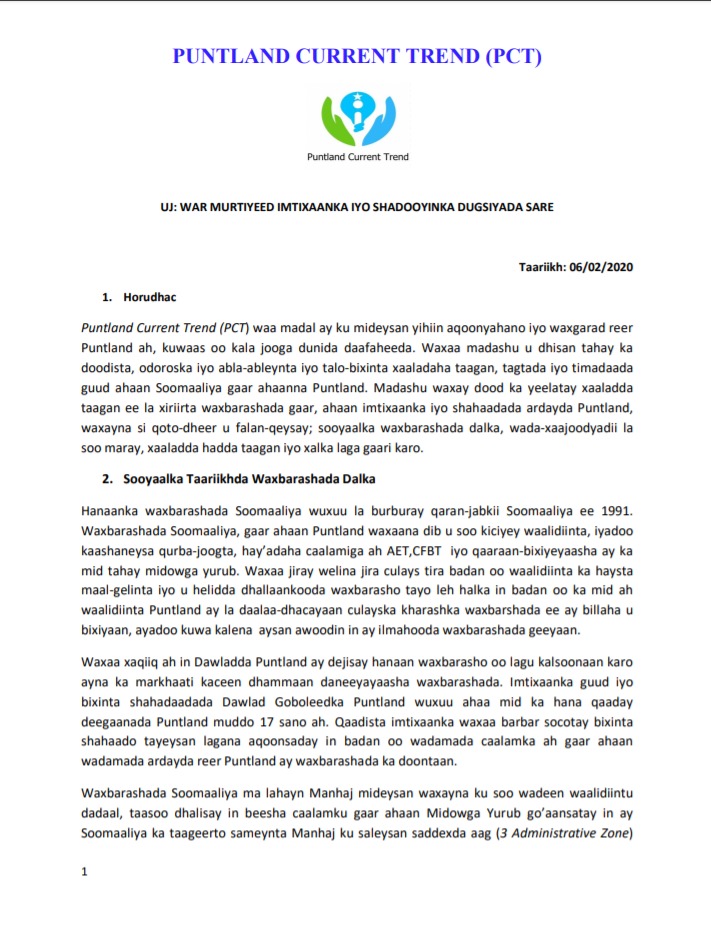
Somalia’s Federal Minister of Education clearly demonstrates why he is not the right person for the education portfolio. He went on TV to talk about a longstanding disagreement between the Federal Ministry of Education and Puntland State of Somalia on administration and certification of secondary school leaving examinations.

Clearly this is a complex subject involving complex and, in the case of Somalia, hotly contested constitutional, legal, and jurisdictional issues. Any mature and competent education minister would approach such a complicated and sensitive topic with the understanding, care, and discretion it deserves.

Unfortunately, Minister Godax Barre seems to have embraced the approach he is most comfortable with: The Warlord approach. To begin with, the Minister was shaking with rage and appeared to be afflicted with a virulent streak of partisan madness. He acted more like a political hack hellbent on insulting and maligning an entire Federal Member State and its leadership. This issue “has nothing to do with the Constitution,” he mumbled. It is bizarre for a Federal Minister of Education to make such a pedestrian statement on TV.

The issues raised by Puntland are legitimate and have every thing to do with the Constitution. The best way to resolve this issue is to engage in a genuine dialogue informed by the relevant sections of the Constitution, Education Law and Education Policy. The emphasis should be on whether a specific level of government (Federal, state, local) has jurisdiction over education or if education is in the category of joint jurisdictions managed by at least two levels of government.

In June 2013 UNESCO AND UNICEF organized a National Conference on Education in Somalia. I wrote the Concept note for the Conference and coordinated the program. We worked with Dr Maryan Qasim who was the Minister of Human Development including the education portfolio. Puntland participated the Conference and its education system was recognized as a model for the rest of the country. Abdi Farah Juxa was the Puntland Minister of Education and he led the Puntland delegation.

I do not know where Mr Godax Barre was at that time. But the participants of the Conference recognized and appreciated Puntland as a leader in the efforts aimed at reconstructing the public education system. Mr Godax should take.a look at the outcome document of that Conference.

It is doubtful if Minister Godax understands and appreciates what is at stake here: the education of the children of a nation traumatized by decades of strife and civil war in a context characterized by a new and often misunderstood federal system of government.

May God Help Somalia.

Qore: Xassan Keynaan

GEFKA GOODAX IYO GARNAQSIGA PUNTLAND (GEED SARE WAABOW GUNTAA KA ROON)


HORUDHAC
Waxbarashada Soomaaliya waxa ay soo martay heerar kala duwan oo taariikhi ah. Waxaana aasaas u ahaa dugsiyada Quraanka oo miyi iyo magaalaba ka jiray. Waxbarashada tooska ahi xilliyaddi gumeysiga aad ayey u yareyd, marba marka ka dambeysana si xawlli ah ayey u kordhaysay. Meelo badan waxaa laga soo maray dhib sidii dugsiyadaas loo furi lahaa, sababta oo ah bulshada oo dugsiyadaas u arkaysay kuwo Diinta Islaamka looga beddelayo oo lagu gaalaysiinayo ubadkooda. Xilligii Kacaanka Ciidamada ayey waxbarashadu meesha ugu sarreysa gaadhay, waxaase hareeyey tayo xumo ay sababtay dugsiyadii waxbarashada khasabka ee aan qorshaha iyo tartiibta ku socon iyo tababarkii macallimiinta ee degdegta ahaa. Waxaa kaloo tayada waxbarashada saameyn weyn ku yeelatay degdeg u qaadashadii manhajka Soomaaliga ku qoran oo ardayga ka dhigtay mid hal buug ku kooban oo aan tixraac kale meelna ka heli karin. Tayo xumadaas iyo qorsho la’aantu waxa ay si fiican u muuqatay siddeetanaadkii (80aad kii) markii in badan oo dugsiyadii khasabka lagu dhisay ka mid ihi soo xirmeen iyo markii imtixaankii shahaadada dugsiyada sare musuq weyni galay. Imtixaanka shahaadiga ee dugsiyada sare wuxuu gaaray in madax iyo ganacsato aan xilkas ahayn ay imtixaanka uga faa’iidaystaan si sharci darro ah. Waxa aan goobjoog u ahayn imtixaanka shahaadada dugsiyada sare oo marka uu xarunta yimaado kormeerayaasha qaarkood bixiyaan, lalana tago guryo ay diyaar ku yihiin macallimiin ka shaqeysa oo ku takhasusay hadba maadada la geliyo, haddana warqadaas bannaanka looga soo shaqeeyey dib loo geliyo baqshadii imtixaanka ardayda iyadoo la tuurayo tii is tuska ahayd ee ardaygu wax ku xarxarriiqay. Caddaalad darradaas waxaa keenay dad xilal haya ama dhaqaale helay oo maangaab ah, oo dayacay carruurtoodii, aynna is tustay in ay lacag dad kaga dhigi karaan. Dagaalkii sokeeyaha iyo maxay ku nuugtaa, maxayse ka nuugtaa baa ku xigtay.

IMTIXAANKA DUGSIYADA SARE EE PUNTLAND
Puntland waxaa ka jiray 4 dugsi sare dagaalkii sokeeye ka hor; dugsiga saree Cumar Samatar (Gaalkacyo), dugsiga saree Gambool (Garoowe), dugsiga saree Sh. Cusmaan (Qardho) iyo dugsiga saree Bosaaso (Bosaaso). Dugsiyadaas sare waxaa dib boorka looga jafay 1999 iyada oo Wasaaradda Waxbarashadu kaashanaysa hay’adda CfBT (Center for British Teachers) oo shaqo dhaxalgal ah ka qabatay dayactirka dugsiyada, tababarka iyo gunnada barayaasha, ku caawinta agabka waxbarashada, soo bandhigidda iyo fulinta imtixaan casriyeysan oo cid waliba kalsooni ku qabto. Imtixaankii dugsiyada sare ee u horreyey waxa la qabtay 2003dii. Barnaamijkii imtixaan ee quruxda badnaa ee wasaaradda iyo CfBT iska kaashadeen wuu mira dhalay, iyadoo hirgelintiisa iyo horumarintiisa ay ka wada qeyb qaateen wasaarada iyo hay’adaha caawiya. Waxaa si gaar ah in loo xuso ay muhiim tahay hay’adda Africa Educational Trust (AET). Waxaa lama ilaawaan ah aqoonyahanka Dr. Rod Hicks oo CfBT iyo AET labadaba u ahaa laf dhabarta Puntland xagga waxbarashada u qaabilsanaa iyo dadkii la shaqeeyey (Soomaali iyo ajnabiba) Imtixaanka Puntland wuxuu ardayda, waalidka iyo bulshada ka kasbaday tixgelin iyo kalsooni loo hayo bahda waxbarashada. Puntland waxay sameysatay shahaado la aqoonsan yahay oo leh astaamo (features) sare oo aan la been abuuri karin. Imtixaanka iyo shahaada Puntland waxay noqdeen tusaale nool oo horyaal Soomaali oo dhan. Inkasta oo dadaalkaas guuleystay ay tahay in abaal loogu hayo dhammaan inta ka qeybqaadatay, haddana waxa si gaar ah halkaan ugu xusayaa hawl wadeenada Xafiiska Imtixaanka Puntland oo geliyey waqti iyo tamar si xafiisku magacaan u kasbado. Waxaa xafiiska iskaga dambeeyey 5 guddoomiye (inta aan goobjoogga u ahaa):

  1. Axmed Salaad Maxamuud(AUN) , 2003 – 2005
  2. Ismaaciil Ducaale Qambi (AUN), 2005 – 2007
  3. Maxamed jaamac Yuusuf, 2007 – 2009
  4. Axmed Maxamuud Warsame (Saahid), 2009 – 2020
  5. Maxamuud Maxamed Saciid (Caynsane), 2020 – ilaa hadda
    Odayaashaas mid weliba meel ayuu gaarsiiyey horumarka Xafiiska Imtixaanka isagoo kaashanaya shaqaalaha hawl karka ah ee uu hoggaaminayey, waxaase muhiim ah in la xuso Ahmed-Sahid oo ugu xilli dheeraa guulaha ugu waaweynna lagu talaabsaday intii uu hoggaanka hayey. Axmed oo ku guuleystay tartan loo galay la taliyenimo xagga imtixaanada Dawladda Federaalka iyo dawlad goboleedyada waa u hambalyeynayaa. Waayo-aragnimadii uu Axmed ka kasbaday Xafiiska Imtixaanka Puntland in uu gaarsiiyo u adeegidda Soomaalida guud ahaanna waa guul. Waxaa kaloo nasiib wanaag ah in Xafiiska uu hadda qabtay Maxamuud Maxamed Saciid oo ah nin dhallinyaro ah, aqoon leh, waayo-aragnimo leh, dadnimo leh, karti iyo hufnaanna lagu yaqaan.

IMTIXAANKA DUGSIYADA SARE EE DAWLADDA FEDERAALKA
Wasaaradda Waxbarashada Dawladda Federaalku waxa ay bilowday shahaado bixin iyada oo aan wax imtixaan ah qaadin 2012kii. Waxay shahaadooyinka ku bixin jirtay imtixaanka dalladaha waxbarashada. Waxay markiiba meel walba u dirtay qoraal shahaadooyinka Soomaalida lagu beeninayo (maba dhalane dhowrteysan oga). Taas aysan imtixaankeeda qaadin ayey meel walba ka dhaadhicisay inay sax tahay. Imtixaanka ay qaaddo Dawladda Federalka ee Soomaaliyeed waxaa si rasmi ah loo bilaabay sannadkii 2016, waa xilligii aqoonyahanad Dr. Khadar Bashir. Imtixaanka federaalka waxaa juhdi badan geliyey Wasaaradda Waxabarashada Dawladda Federaalka, Dalladaha Waxbarashada iyo hay’adda Africa Educational Trust (AET) oo iskaashanaya. Waxay Wasaaradda Waxbarashada Puntland u dirtay 2 tababare oo xafiiska imtixaanka Puntland ka socda. Wuxuu imtixaanku la kulmay ammaan darro, kalsooni xumi, qish iyo bixid. Sannad uusan imtixaankiisa bixin ma jirin, waxaase sannadkii tegay gaar ku ahaa gelinta baraha bulshada. Wasiir Goodax oon tartiibin iyo turid lahayn baa malaha casharka la siinayey (Xoog waxaa ugu daran midkii xarrigga kaa gooya). Waxaa intaas dheeraa iyada oo madaxda sare ee wasaaradda iyo ciddii ay wax u waastaynayaan loo daabaco shahaado iyada oo aan qofkaasi imtixaanba gelin, in kasta oo aanan 3dii sanoo ugu dambeeyey wax badan kala socon in arrintaasi weli socoto iyo in kale. Halkii liishaanka la saari lahaa kobcinta, horumarinta iyo tayeynta imtixaanka, waxaa lagu mashquulay yaa ka maqnaan kara!
Dawladda Federaalku waxa ay heshiis Puntland kula gashay in ay shahaado siiso mar haddii ay teedii meel walba ka soo xirtay. Hadda dad maqnaa iyo dal marraa yimid! Wasiir Goodax wuxuu ku bilaabay isku dir ardayda, waalidkood iyo wasaaradda oo uu isaga hor keenayo. Markii uu ku guulaysan waayey wuxuu ku xijiyey been abuur iyo imtixaan baa baxay. Wuxuu ku xijiyey may isdabaraan haddaysan imtixaankayaga gelayn. Waxaa ugu dambeysay in uu Puntland kala qeybiyo oo yiraahdo qaar baa ila socda, u hanjabo, eeddeeyo qof kasta oo shaahada ka hadla, isu muujiyo inuu dadka hadlay uga damqasho iyo turid badan yahay ardayda Puntland. Dhaqankiisu wuxuu i soo xusuusiyey tuducyadii Dhoodaan ee ahaa “waayeel lillahiya dubaha yaa wab kaga siiyey, shaqaalaha (ardaydaan) wisiisigu ku dhacay yaa ka wayrixiyey”. Maxadweyne Faroole, Wasiir Juxa iyo Wasiir Cali Xaaji oo wasiir Godax ka dhigay dad dano gaara wata, waa raggii xilliyadoodii waxbarashadu horumarka ugu sarreeya gaartay. Geedkii ay wax ka waraabiyeen, kobciyeen markii uu ubax iyo miraha saaray yaan salka laga goyn ma dambi bay noqotay. Wasiir Cabdullaahi inuu yiraahdo awood ma leh waa ku ceeb iyo waana ku gef, “Maxaa keenay maahmaah marinkeeda aan helin”, Cabdulqaadir Cali Cigaal (AUN). Dabcan waa Goodax! Dubahase isagu daabkuu hayaaye amarku waa durugsan yahay. Waxaan taas u iri wasiir Cabdiraxmaan oo ka horreeyey hadal uu qalbi wanaag ula jeeday iyo in tayada la hagaajiyo oo sidii ugu habboonayd uusan u oran baa xilka looga qaaday. Marka tani sow uma muuqato markii uu Puntland dhagax ku tuuraba in kor laga leeyahay GOODAX! GOODAX! GOODAX!, isaguna macaansibu mar kastaba u leeyahay hadal meel an loo deyin. Waxaadse uga hadhaa “Daabaca ninkii kugu dhuftee daabka kuu celiya, iyo kii duleedshaay ku yiri wax isma doorshaane” (Qamaan Bulxan).

AR KA KUD WAA BERIGAY BAKAARAHA KU BANI JIRTEE
Sheekadaan in ay run tahay iyo in la sameeyey ma garan karo, waxa ayse xambaarsan tahay murti wax ku ool ah. Ciidamada Xoogga Dalku waxa ay dab-rid ku sameyn jiray Ceel-Cadde oo u dhexeysa Xamar iyo Cadale. Digniin ku filan ayaa la siin jiray dadweynaha marka kasta oo dab-rid jiro. Maalin maalmaha ka mid ah ayey dayuurado dab-rid ula yimaadeen meeshii. Nasiib darro rag aan maqal digniinta ama ay ka hoos baxday ayaa dhagax ka jabsanayey maalintaas. Waa maalin Talaado ah. Raggii qaar baa bunbooyinka ay dayuuraduhu tuurayeen firirkii ka dhashay ka dhigay mid jaban iyo mid jiis ah. Bulshada maalin madow bay u noqotay. Muddo ka dib raggii oo dhagax jebin ku mashquulsan baa nin ka mid ihi guux maqlay. Ar Cabdulloow buu tannaago ku yiri. Suu ye “haye” inta hadalkiisa dhiilo ka dareemay. Wallee bariga Talaada maaha? Nabee Talaada waaye buu Cabdulle ku jawaabay. Suu ye “Ar ka kud waa berigay bakaaraha ku bani jirtaye” (war ka carar waa maalintii meesha aan dhagaxa ka jabsanno ay duqeyn jirtaye). Hadda waxa ay taagan tahay ar ka kud waa berigii waxbarashada iyo imtixaanda la tayo xumeyn jiraye.

GUNAANAD IYO TALO BIXIN
Aan wada hadalno waa aan heshiinno. Hadalkuna wuxuu daawo ku yeeshaa in runta la taabto; xaajo aan sidii daba riyaad loo faydini ma fayoobaato. Runtu waa intaas aan soo bandhigay iyo in badan oo kale oo marka la wada hadlo imaan karta. Imtixaanka ha galeen hadal aqoon, xirfad iyo qiyam midna kuma salaysna. Waa in horta la fahmaa in imtixaanka ay ka horreyso manhajka oo la isku afgarto, manhajka oo macallimiin lagu tababaro, manhajka oo la fuliyo, iyo hawlo badan oo kale oo la qabto. Immisa sano ka dib bay imtixaankaas geli karaan haddiiba lagu hesheeyo. Mar haddii aysan taasi xal ahayn, waa in ardayda shahaadadooda loo tasdiiqiyo. Waa xal fudud oo xaq ah haddaan la iska indho tirayn.

Talooyin gaagaaban Ayaan halkaan ugu soo jeedinayaa Puntland & Dawladda Federaalka
A. PUNTLAND: Reer Puntland waxa aan kula talin lahaa maamul iyo dadweynaba

  1. In dooddoodu noqoto in shaahadooda oo juhdi, waqti iyo dhaqaale badani ku baxay loo tasdiiqiyo, oo aysan noqon kuwo raadiya shahaado la siiyo. Xaq bay u leeyihiin:
    a. Oo waa u soo halgameen,
    b. Oo dastuurkaa qaba,
    c. Oo horumarinta iyo tayeynta waxbarashada ayaa ku jirta
    d. Oo waxbarashada hal meel laga maamulo waa la soo tijaabiyey, lagumana guuleysan.
  2. In ay ardaydooda uga turaan in ay ku dhextuuraan imtixaan aan lagu kalsoonaan karin oo mowjado dhex muquuranaya. Tubaha halaq yaalka, Hog laygu qaniinay, ku sii hiradkiisa, ka haari agtiisa, ayaa ka hagaagsan. (Hadraawi)
  3. In ay u yeeraan oo casumaad sharafeed u fidiyaan xildhibbaanada iyo wasiirada federaalka ugu jira, u sharraxaan qadiyadda min bilow illaa dhammaad. In ay si qurux badan ugu iftiimiyaan taariikhda la soo maray, dhibka jira, waxa loo baahan yahay iyo xalka suurtagalka ah. Xildhibaanadu iyaga oo aan waxa fahamsaneyn baa laga yaaba in ay qaaddo qiiro, ka dib loo tuso in Puntland sed bursi raadinayso oo ay si sahal ah isaga qancaan. Waxa imtixaanka ka horreeya waa inay fahmaan. Imtixaan maamul goboleed qaado ama dugsi qaado ama hay’adi qaaddo inuusan waxba u dhimayn dawladda dhexe ee ay ku xiran tahay sida ay ula shaqeyso, u ilaaliso, ugu qaraynto waa in horta la isla meel dhigaa. Tuducdii Hadraawi ee ahayd “dugsi keliya baa jira, diric keliya baa dhiga” waa in laga baxaa.
  4. In la yareeyo wasiir Godax in hadalka lagu kululleeyo, in kastoo aniga laftaydu wax tuurtuuray. Haddana waxay ku qurxan tahay si asluub, tixgelin iyo qadarini ku jirto in loo wada hadlo.
    B. Dawladda Federaalka: Waxaan kula talin lahaa
  5. In aysan noqon arki-jiray doon. Ubadka iyo dhallinyarada Soomaaliyeed masuuliyad baa ka saaran ee waa in ay ku fekaraan waxa danta u ah, suurtagalka ah, cid walba qancin kara, tartan iyo tayo waxbarasho oo wax ku ool ah keeni kara. Soomaalidu waxa ay tiraahdaa hoggaamiye waxaa u liita ka yiraahda: Arkay oo anaa iska leh, iri oo looma noqdo, aniga wax la iima sheego. Sida ay jecel yihiin in loo dhegeysto, loo ixtiraamo dadka ha u tixgeliyeen, masuuliyaddana ha u ogolaadaan. Rag waxaan ku maamuli aqaan ama ku maamuusin, maso inaannu nahay oo tolnimo meerto noo tahaye (Saahid Qammaan). Waxbarashada Soomaaliya maanta waa tabar daran tahay, waxayna u baahan tahay siyaasad deggan, qorshe fadhiya, dhiirigelin iyo wada shaqeyn. Dawladda dhexe iyo maamul goboleedyadu waa in ay la yimaadaan xal wax ku ool, waase in marka hore laga helaa dawladda federaalka ah hoggaamin qabow oo leh tartiibin, tixgelin iyo turxaan bixin. Hoggaamiyaha dadnimada iyo isku wadka leh waxaa lagu gartaa adeegsiga hoggaaminta la jaanqaadda xaaladda markaas taagan. Caqliga ah shahaadada haddii aysan Dawladda Federaalku bixin dawladnimaday wiiqamaysa waa arki-jiray doonkii aan soo sheegay. Shahaada dugsiga sare waxaa bixiya dugsiyo, magaalooyin, hay’ado, maamullo iyo dawlado. Aragtida ah in dawladnimo ku daciifayso ku beddel in ay ku xoogsanayso, masuuliyad ku yeelanayso, tayada iyo tartanku ku badanayaan.
  6. In ay si rasmi ah u aqoonsato shahaada Puntland, isla markaas Xafiis Wasaaradda Arrimaha Dibadda ahi ku tasdiiqiyo Garowe. Taasi waxa ay keenaysaa masuuliyadda oo la qeybsado iyo adeegga oo dadka loo fududeeyo. Intaas ka dib waa in maamul goboleed walba iyo gobolka Banaadir la siiyaa waqti go’an oo uu kula wareego imtixaankiisa (tusaale 2 sano). Haddii maamul goboleed kula wareegi waayo imtixaankiisa muddadaas, waa in uu jiraa sharci dawladda dhexe u siinaya awood in ay u maamusho imtixaanka muddo go’an (tusaale 5ta sanoo soo socota). Haddii arrintaas la sameeyo waa dhiirigelin, waxaana bilaabanaya tartan iyo gobol waliba inuu guntiga dhiisha iska dhigo. Yeerinta iyo amar siinta waxaa ka fiican in dadka caqligooda iyo aqoontooda la adeegsado, la tartansiiyo, la dhiirigeliyo, dusha laga hago, la kormeero, la qiimeeyo, lana abaal mariyo. Hadda waxaan ku jirnaa tuducdii deeleyda ee ahayd “Dib u soco hore soco, hore iyo dibba u soco, darandoorri saan-qaad maxaa daal la kororsaday”, Yusuf Xaaji Aadan. Ma ka baxnaa iska daba meeraysiga, mise wa isdaboolnaa nin dulmiyan Allaa oge.
  7. In ay kormeer ku sameeyaan habsame u socodka waxbarashada; fulinta siyaasadaha iyo hagayaasha waxbarashada, tababarada, dejinta iyo qaadidda imtixaanda, talo celin joogta ahna la wadaagaan maamulada si loo xoojiyo kobcinta iyo horumarinta waxbarashada, loona daboolo baahiyaha iyo god daloolooyinka jira.
  8. In deeqaha waxbarashada lagu baxsho tirada ardayda, dadaalka iyo waxqabadka sarena loo qoondeeyo abaal marinno dheeraad ah, si tartanka iyo dhiirigelinta loo xoojiyo.
    Aragtidii dhankaygiyo, arag-waayahaygiyo waxaan oran laha iri. Ama aas danteenoo ubadkaas mar ha u nixin. Ama oday wax garadoo arrinshaa laguu garan. Adaan kula hadlaayaa. Waa kuma? Bal adba!
    Qoraaga qidcadu waa Cabdullaahi Nuur Salaad
    Oday Soomaaliyeed oo dhibka ardayda Puntland haystaa ka damqaday

Qore: Saed J. Abdulkadir

IS DUST SETTLING DOWN IN GALMUDUGH? NOT YET! HERE IS WHY.

June 28, 2019

Now that the recent Djibouti Agreement between Galmudugh President Ahmed Du’ale Haaf and his Dusamareb political partner, Sunna -wal-Jamaacah led by Premier Sheikh Shakir has been revoked, all previous political arrangements between the two factions are in tatters and irreconcilable.

That is because Sheikh Shakir Group has just switched their allegiance to the leaders of the Federal Government at expense of Haaf, betraying the warlord when he needed them most against Prime Minister Hassan Ali Khayre.

Haaf had temporarily found himself in no man’s land as he had escaped from Dusamareb on the eve of Khayre’s arrival in town, and he couldn’t enter Cadaado without negotiating his way through with his other rival faction leaders of the broken Galmudugh Parliament in Cadaado. He finally got allowed to enter Caado with the understanding that he had lost politically. That realization brought him to his sense and had accepted the inevitable that election is the only way out for all competing parties.

But, the dust has not settled down yet in Galmudugh conundrum as election campaigns got started, and as usual, those who have deeper pockets and financial backing of Villa Somalia have bigger chance to win.

Galmudugh has additional legitimacy complications of not fulfilling the Federal Constitutional requirements to qualify for regional state status, failing short of having territory of at least two regions.

https://ismailwarsame.blog

@ismailwarsame

warsame digital media's avatarWarsame Policy & Media Network (WAPMEN)

June 28, 2019

Now that the recent Djibouti Agreement between Galmudugh President Ahmed Du’ale Haaf and his Dusamareb political partner, Sunna -wal-Jamaacah led by Premier Sheikh Shakir has been revoked, all previous political arrangements between the two factions are in tatters and irreconcilable.

That is because Sheikh Shakir Group has just switched their allegiance to the leaders of the Federal Government at expense of Haaf, betraying the warlord when he needed them most against Prime Minister Hassan Ali Khayre.

Haaf had temporarily found himself in no man’s land as he had escaped from Dusamareb on the eve of Khayre’s arrival in town, and he couldn’t enter Caado without negotiating his way through with his other rival faction leaders of the broken Galmudugh Parliament in Caado. He finally got allowed to enter Caado with the understanding that he had lost politically. That realization brought him to his sense and had accepted…

View original post 78 more words

“ROUGH SEAS: THE CAUSES AND CONSEQUENCES OF FISHERIES CONFLICT IN SOMALI WATERS”

fish conflict Somali waters

RELEASE DATE:
28 January 2020

AUTHORS:
Colleen Devlin, Sarah M. Glaser, Ciera Villegas, Natasia Poinsatte

OVERVIEW:
As competition for finite fisheries resources increases, the risks of violent conflict over fisheries also rise. Where and when can we expect fisheries conflict to occur? Which actors are most likely to participate in fisheries conflict? What are the most frequent causes of fisheries conflict? How often does conflict result in arrests, property damage, or death? What can be done to mitigate fisheries conflict? Rough Seas: The Causes and Consequences of Fisheries Conflict in Somali Waters explores the frequency, intensity, and drivers of fisheries conflict in Somali waters between 1990 and 2018.

By analyzing event-level conflict data collected from public news reports, we expanded upon our Fisheries Conflict Database. This database contains 186 discrete instances of fisheries conflict, called Fisheries Dispute Events (FDE), in Somali waters. Each entry contains information on the date, location, actors, drivers, and consequences of the FDE. Furthermore, we derived scores measuring the intensity of fisheries conflict, on a scale of 0 to 3, for each Somali region and each year of coverage.

Our findings are as follows.

  • There were three distinct periods of conflict with different defining characteristics: conflict between domestic and foreign fishers (1998–2000), conflict driven by piracy in Somali waters (2007–2010), and conflict resulting from the return of foreign fishing fleets (2014–2015).
  • The five primary causes of fisheries conflict in Somali waters were the presence and actions of foreign fishers (legal or otherwise), illegal fishing, low governance capacity to deal with fisheries conflicts, limitations on access to fishing grounds, and piracy. 
  • Foreign fishers were the most common actor in conflicts.
  • In Somali waters, the presence of the international community—both warships and fishing vessels—is one of the major causes of maritime instability and fisheries conflict. The international community must take responsibility for its presence in Somali waters.

To learn more and see what steps can mitigate fisheries conflict, download our full report.

Document Citation: http://dx.doi.org/10.18289/OEF.2019.042

Featured Graphics

FISHERIES CONFLICT OVER TIME

fisheries conflict in Somalia over time

DRIVERS OF FISHERIES CONFLICT

Drivers of fisheries conflict

FISHERIES CONFLICT INTENSITY

Fisheries Conflict Intensity by region Map

FEATURED CONTENT

Climate change marine conflict

Climate Change, Fisheries, and Conflict in Africa

mending nets Somalia

Learning to Make Fishing Nets in Somali Coastal Communities

Somali mapping workshop community

Oceanographic Mapping Exercises Inform Fisheries Co-management

CONTACT US

RESOURCES

OUR WORK

Secure Fisheries employs a science-based approach to eliminating unmanaged competition over fisheries resources and reducing fisheries conflict. Our work supports the development of sustainable fisheries in the service of long-term food security, economic security, and community resilience.

POPULAR

Peace Foundation

Secure Fisheries is a program of
the One Earth Future FoundationSubscribe to the One Earth Future Quarterly Newsletter for updates on Secure Fisheries and other One Earth Future programming.

CORONAVIRUS