Like typical Puntland administration behavior at end of its term in office, the current government has run out of steam in pushing the agenda forward. Some politically naive persons or interest groups are propagating the notion that there is no enough time left to elect remaining local councils and have them in place before next parliament and presidential elections, not understanding a job half done is better than not doing anything at all. Members of Puntland House of Representatives fare no better than the so-called “AARAN JAAN” spin doctors in that regard, on the top of being a rubber-stamp institution for decades.
Since there is no long term vision by each of successive Puntland administrations, important public tasks are left for next administrations or generations to attend, thus becoming a vicious cycle not to initiate and administer any meaningful programs towards Puntland future governance. The State never laid down and worked out any significant public policy. It operates on ad hoc fashion as its modus operandi. Residents get accustomed to political thinking in the space of one term or one administration- for them, tomorrow doesn’t exist. Starting programs to be completed by the next administration isn’t in their books. But, the worse of all is the fact that authorities of the day see only the problems, not the opportunities. Most are likely to reason with you why this job can’t be done because of these impediments. It is people who love to raise their hands up in the air in surrender when they are challenged. They don’t get the world moves on with or without them.
People of the State of Puntland had observed how it was easy to hold municipal elections in Uffayn, Qardho and Eyl districts just recently. There aren’t any excuses not to hold similar elections in other districts of the State. Negative thinking on the part of interest groups and the government of President Said Abdullahi Deni are now the real obstacles to democratization in Puntland State of Somalia.
HAPPY PUNTLAND 24TH ANNIVERSARY, AUGUST 1ST!CONGRATULATIONS!
To quote Nurudin Farah, the famous Somali novelist, in an answer to a question put to him by a BBC reporter, said recently, “Somalis don’t read in any language, including their own”. There are, of course, a few individual exceptions. But that is even less than one percent among those who consider themselves literate. That is as alarming as it gets. Think about a nation that has no trained minds. What would happen to their culture, history, literary and technological advances? Here, we aren’t even talking about producing writers as there is no readership among the population. Education has lost its merited position and value in today’s Somalia as everything is possible through corruption, fraud, nepotism and cronyism in both public and private sectors.
Still, people debate on potential bright future for Somalia, the accident rise of good government, effective public institutions and Somalia becoming a petro-dollar country one day.
In my experience as editor of Warsame Digital Media WDM, I have noticed that the attention span of actual Somali reader is amazingly short. Forget about reading books. In conveying my message, I have to be brief and precise. Another impediment to attention span is the information overload: Non-readers and readers alike constantly watch and listen to anything that animates in the social media. Trained minds are usually selective in their intake of public information. It is the ordinary people who are now true victims of garbage-in-garbage-out in the internet. We are living in a difficult epoch of human civilization.
Go to Kenya and you would notice that a shoe-shinner boy would stare at newspaper in your hand to catch the latest headlines. How many decades would pass by until Somalis develop the habit and curiosity of readership?
Today I had the chance of interacting with former officers of Puntland paramilitary forces, the Drawiish, and police. The issue involved security sector reform bragged about by current Puntland Administration. Experienced officers acknowledged that some training and screening of rank-and-file only to satisfy payroll requirements didn’t produce able officers and commanders to lead the forces. They said that it was the core problem that Puntland forces couldn’t pacify the Port-city of Bosaso in recent confrontations and violence. Officers accepted the military doctrine that the combination of good training, effective command and leadership, logistics and public support are all that count for success. They all acknowledged that, in recent clashes between opposing forces in Bosaso, there was poor command and absence of command structure that brought about the near defeat of government forces still loyal to the current Administration.
It is also known that the Chief-of-Staff of Puntland Drawiish Forces is a close relative of the mutinying elements of the armed forces, another factor for the goverment military failure in Bosaso. He couldn’t lead and command counter-offensive against his own kinship. All accepted the fact that Puntland Security Sector reform, one of the Achelles heels of the State historically, didn’t go far enough with regards to command efficiency and required preparation of Cadet officers for military leadership.
The debating group bursted into load laughter when an officer joked: “Were President Deni belonged to Al-Itihad Al-Islami, instead of Al-Islah Sect, he could have understood military expertise better. It was hilarious.
In the contest to win recruits and funding, Africa’s jihadists aim for notoriety. AlQaeda’s affi�liate in Burkina Faso has boobytrapped bodies to kill doctors. Islamic State West Africa Province has beheaded captives. Boko Haram in Nigeria has strapped ticking bombs to children and sent them into mosques and markets. But alShabab in Somalia can claim to top this list of savagery. America’s military command for Africa calls it “al- Qaeda’s fastestgrowing and most kinetically active affi�liate”. It has abducted thousands of children to use as soldiers, slaves and child brides. It has targeted schools and hospitals. Despite all that, the world needs to talk to alShabab. The reason is that Somalia faces a famine. The worst drought in 40 years is killing livestock and causing crops to shrivel. Rus- sia’s invasion of Ukraine has exacerbated the crisis by raising grain prices, meaning that farmers and herders cannot aff�ord to supple- ment their diets. Roughly 7m people, or 40% of Somalia’s population, are struggling to fi�nd enough food to eat. Around 1.4m children are severely malnourished. Experts say that, unless urgent action is taken, this famine may be even deadlier than the one that claimed more than 250,000 Somalis in 2011 (see Middle East & Africa section). The fi�rst step towards averting calamity is for the world to send more aid, quickly. A rapid response in 2017 prevented a drought in Somalia from turning into a disaster. Cash sent early is spent more effi�ciently, so less money is needed. Unfortunate- ly, the funding today is falling far behind the targets laid down fi�ve years ago. Although America pledged an additional $476m on July 24th, the total raised so far is only 46% of the $1.5bn the un says is needed in Somalia. Others should also do their part. The next step is where alShabab comes in. For the food to get to the hungry, aid groups must negotiate with the jihadists, who control large swathes of the countryside in central and southern Somalia. At the moment, little help gets through to people in these areas because aid workers are afraid of being kidnapped or killed. As a result, starving families risk long, dangerous jour- neys to squalid informal camps on the edge of cities. By the time they set out, their children are often too weak to survive. Countless lives would be saved if the food made its way to people in the countryside, rather than the other way round. But negotiating access with alShabab takes aid workers into moral- ly hazardous territory. In previous famines the jihadists forced humanitarian groups into handing over cash. This imposed a dire choice on aid agencies: “Pay off� alShabab, a listed ‘terrorist’ organisation, or let people die,” said a report by the Overseas De- velopment Institute, a British thinktank. Some groups, such as the un‘s World Food Programme, temporarily withdrew from southern Somalia. Others agreed to pay as much as $10,000 for access, putting them at risk of criminal prosecution under laws banning the fi�nancing of terrorists. Although the president, Hassan Sheikh Mo- hamud, elected this year, has said he would talk to alShabab when the time was right, there are plenty of reasons to balk at dealing with it now. The group would be largely in control of where and how food is distributed, helping it coerce Somalis. The jiha- dists will want to deny the government credit for supplying the aid, by controlling whose logos feature on lorries when it is deli- vered. Payments by aid organisations would make alShabab stronger. Meanwhile, charities have concluded that if they are accused of supporting jihadists donors may abandon them, hin- dering their work elsewhere. None of that is good for the security of Somalia or the region. But the world faces a tradeoff�: to shun alShabab and watch a famine claim perhaps hundreds of thousands of lives; or to talk to alShabab in order to get food to the starving in the knowledge that the jihadists will grow stronger. Caught between evils, the world should choose the lesser of the two. n� Saving lives will involve talking to terrorists Stopping Somalis from starving
Since time immemorial, or as long as Somalis considered themselves people of faith, the Sheikhs and Mufties of different Sunny Sects have been in ideological war against each other. This is perhaps true in other Sunny Muslim countries. Like Christian World, there are multiplying religious divisions and subdivisions. The difference is that Christian nations had managed to separate the state from the church, after a long and bitter historical struggle. Lately, Western nations were bragging about the term “freedom of religion”, while after the incident of 9/11, anyone carrying a Muslim name is a suspect of terrorism. This is clearly in demonstration at immigration entry points, police checkpoints and discrimination in the workplace. Nowdays, the state and church can’t, by law, interfere in each other’s affairs in the Christian World. Here, the only exception, enjoying common leadership (Imam) is the Shia division, mainly led by Iran. However, many Sunny scholars or sects consider Shia Muslims blasphemous, a rebellion against common spiritual leadership inherited from the Caliphates that followed Prophet Mohammed (SCWS). Whatever the case is, the Shiates enjoy more unity than the adherents of Sunny teaching.
Today any political leader in Muslim countries is rarely secular. Most often than not, he or she belongs to a particular Sunny Sect, immediately inviting resistance and anger from other sects of different school of thought. As a result, there is always political fluidity and instability within countries of Islamic Faith. Is religion a dividing force and permanent factor for national disunity in the same way tribalism plays a critical role in societal contradictions?
Here in Somalia, SYL nationalism, the First National Party for independence, temporarily succeeded in halting tribalism, but failed to freeze religious sectarianism. Obviously, this sectarianism is rooted deeper in Somali society than all the evils of tribalism. Yet, national leaders don’t show any sense of urgency to address the issue for the sake of national cohesion, least they are branded blasphemous, or at least, secular, and hence not fit to rule in a Muslim nation, according to most Somali clerics -roughly translated Qur’anic verse: “those who don’t rule by Allah’s heavenly messages are among the strayed”. To avoid criticism, Somali law-makers are defensive by saying that Somali legislations are based on Islamic law.
Do you read Warsame Digital Media WDM, Sir/Madam? Do you want to continue browsing critical analysis on Somalia’s current issues, historical context of recent political developments etc. If so, there is an annual fee for subscription. Many readers, including prominent members of the society and political-security-diplomatic figures anxiously read it and can’t wait for the next issue.
Tonight, again, we sat at tea-table in Garowe, Puntland, for a chit-chat to exchange news on daily events in Somalia and around the world. Like typical Somali conversations under similar circumstances, the issues covered were wide and hopelessly scattered- some of us chiming in with out-of-topic subjects and boring life stories. Others talk in monotone hard to tolerate and maintain attention span. Suddenly the theme of discussion turned into the subject of justice. Luckily, there was a lawyer among us. Since most of us weren’t lawyers, we tried to show respect to the legal argument of our lawyer-friend. Incidentally, a colleague in the gathering said, “there are two kinds of judicial philosophy: The Oriental and Western”. The lawyer jumped in to ask, “what are you talking about? There is no such thing? The other guy responded, “I mean that in the penal code or criminal law, the burden of proof of the accused is on the government in Western system of justice, while the burden of proof is on the accused in most Eastern countries”. The lawyer, irritably asked, “are you talking about the Sharia law?” The lawyer seemed puzzled, as if he has heard about this judicial distinction for the first time. Another interculator dropped in his observation: “Somalis are now accusing each other everyday through the media outlets and social media on all sorts of malfeasances with no proof and no possibility or means to defend themselves. We are helpless against unscrupulous media persons. This is partly what is wrong with Somalia. It is endless civil war in par with extremists’ activities. Let us ask the lawyer what to do about it”.
Another colleague interjected saying, ”there is no absolute justice – you must always take it into context. But what impressed me most is the Qur’anic verse on the Walls of Havard University in the US about selflessly delivering justice” (see feature photo, Surah AnNisa, 4:135.)
As usual, the attention span of Somali debate on specific subject is limited, and the debate drifted again over to wondering generalities and meaningless specifics.
There was a debate among friends last night over tea on how to resolve the impending confrontation and potential for violence in Puntland Port-city of Bosaso, a dangerous situation that went out of control twice already. The issue here involves two government forces, one acting as renegade with the blessings of traditional elders in Bari Region opposed to the rule of President Said Abdullahi Deni. Since titled elders in Puntland are divided and bickering along political lines due to prolonged absence of democratization in the State, there is diminishing returns to find compromise in conflict resolution.
Observers believe that President Deni and elders are on collusion course as all possibilities of negotiated settlement is unlikely to occur, given the environment of mistrust between two opposing centers now posed for potential outbreak of violence in a port-city constituting the backbone of the economy and commercial activities of Puntland State of Somalia.
Other colleagues in the debate, Warsame Digital Media WDM, among them, suggest to convene an all inclusive congress to deliberate on what went wrong in stability, good governance and progress of the State. Despite the pressing need to hold such important gathering, Puntland Administration seems not to understand the gravity of the time-bomb that could explode anytime with far-reaching consequences for Puntland self-government. The circumstance resembles a scenario when an English man once said “Wherever God builds a house of prayer, the devil erects a chapel there, and it has been found upon examination that the devil has the biggest congregation”. There are always elements within the society engaged in ill-wish for the people of Puntland. Let us all think about finding lasting solution to this unfortunate political and security situation.
Contents of Warsame Digital Media WDM are the most reliable critical analysis and commentaries on Somalia’s current affairs, based on independent observers outside subscribers. Why don’t you get connected to this free media? Supporting competent independent media is part and parcel of resolving governance problems in this troubled country.
In another take,
Warsame Digital Media is notifying all our subscribers, who didn’t submit their Annual Subscription Fees yet, that we are about to close the books for the year. Kindly send your fees before being cut off from the network.
Warsame Digital Media podcasts and articles are now by subscription only. Please use Sahal or Taaj to send WDM your Annual subscription Fee of US $37. You can send send it to 252 90 703 4081. You can also pay at PayPal at ismail.warsame@yahoo.ca using credit or debit cards as you can also use Amal MyCash at 252 71 681 4371 under Warsame Digital Media.
Please send us your WhatsApp number so that you all receive WDM articles and podcasts directly to your phone on the go.
The war in Ukraine is entering its sixth month. Is there any way to assess the likely prospects for the rest of the year? Russia and Ukraine agreed a deal, in recent days, to allow the export of grain from Ukraine—a tentatively encouraging sign. But within hours Russian missiles hit Odessa, prompting Volodymyr Zelensky, Ukraine’s president, to accuse Russia of “barbarism”. It may still be in Russia’s interest to appear to allow the food to flow, even if in practice it does not. After all, its foreign minister pays a visit to Africa, starting on July 24th. That trip will go more smoothly if Russia is not blamed for high food prices. Nonetheless, any sort of rapprochement should be welcomed, along with Turkey’s efforts to play as a peacebroker.
There is evidence that Russia is dug in for the long haul. A gruesome war of attrition could drag on until winter, or indeed beyond. It is hard to be sure how many casualties—both deaths and injuries—have already been inflicted on soldiers and civilians in the war. See our latest article on the subject. Undoubtedly, the deaths must be counted in the tens of thousands. Russia alone has probably seen 15,000 soldiers killed. Injuries, many of them devastating, will be far higher yet. Vladimir Putin launched this unprovoked war of choice, back in February, without explaining his purpose to the Russian people. Indeed he still pretends this is a “special military operation”, not a war. Mr Putin is responsible for large-scale ruin and suffering, yet he can’t spell out what he is trying to achieve.
If that isn’t a gloomy enough prospect, this week is likely to bring some more economic reasons to worry. We have just published our latest assessment of the state of the world economy—asking whether recession is looming all over the place. One question is whether America itself will officially fall into one. One definition of a downturn, often cited by journalists, is two consecutive quarters of negative growth. On that basis, America is probably destined for recession when new GDP figures are released later in the week. Yet there are other ways to decide if one is under way, for example by looking at personal incomes and unemployment rates. On these scores, America’s economy looks rosier.
As mentioned, Sergei Lavrov, Russia’s foreign minister will spend five days in Africa this week, shoring up diplomatic support (relevant at the UN General Assembly for example) and preparing for a summit later in the year, in Addis Ababa, in Ethiopia. His plane may yet cross vapour trails with that of France’s president, Emmanuel Macron, who is visiting three African countries himself. Mr Macron will pay most attention to questions of terrorism and migration.
Wrapping up the diplomatic jet-setting calendar, keep an eye on Indonesia’s president, Joko Widodo, who will be in China for two days. Why does that matter for the rest of us? It’s significant, I think, for what it says about the state of mind of Xi Jinping, China’s leader. Put aside the Winter Olympics, back in February, when foreign leaders including Mr Putin showed up in Beijing. Other than that, Mr Xi has not welcomed anyone to China since 2020, when strict covid-19 rules were imposed. At some point he needs to find ways to open up China again, not least to get its economy running.
Last, let me flag another of our reading lists. Have you ever wondered why some countries are able to escape poverty and improve the lives of their people, while others linger much longer without developing. We’ve pulled together a very short introduction to an essential list of texts that help to puzzle out why that is. I’d love to hear if you agree with our selection..
Ethiopia has been left out in Somali President’s Blitzkrieg diplomatic offensive in Somalia’s neighbors. It is not yet known whether Ethiopia was reluctant to receive him, given the security instability in that country. However, there is no disagreement on the cooling off of relations with Hassan Sh. Mohamud”s presidency, knowing his predecessor, Farmajo, enjoyed close ties with previous Ethiopian leadership. Mohamud had had warm relations with TPLF Regime and even attended TPLF’s festivities in Makele, the provincial capital of Tigray, during the reign of TPLF. TPLF leadership were among the first to congratulate Mohamud on his presidential victory for a 2nd term this time. Mohamud lost no time to appoint Hamse Abdi Barre considered an Ethiopian because Ethiopia assumes he hails from Ogaden Region under Ethiopian administration, a historically disputed territory mainly inhabited by ethnic Somalis. Already, there is an escalation of violence and armed confrontation between Alshabab fighters and Ethiopian forces at long stretch of border between the two countries, with likely possibility of Ethiopian incursion into Somalia in hot pursuit.
Nile waters is synonymous to the existence of Egypt itself as they believe that Egypt cannot be without Nile River flowing to the desert and oasis of that country. Because of this natural and geographical fact, strained relations between Somalia and Ethiopia are in the vital interest of Egypt, making Somalia an strategic asset for Egypt in the same way Israel is for the United States in the Middle East. Hassan Sheikh Mohamud may be playing with fire in paying an early visit to Egypt, while he still doesn’t have his foreign policy team in place. It is too early to do that before weighing Somalia’s foreign policy options. Mohamud’s current visit to Egypt doesn’t even look like a calculated risk. Here, we see a lone president without a Cabinet sailing in troubled waters. Somali observers worry that the President may risk diplomatic blunders even before his government took office.
There are five things that make the residents of Puntland State troubled now:
Severe drought, following failure of two consecutive seasons;
Unprecedented inflation. Skyrocketing prices beyond the reach of ordinary people;
Impending violence and armed confrontation to follow current military standoff in the Port-city of Bosaso. Keen observators notice slow preparations for war to resolve leadership contest between Puntland State leadership, particularly the President, on one side, and the revolt and mutiny led by PSF/Boqor Burhan of Bari Region, on the other. Each side sees no alternative to fighting it out, an unprecedented development, given the fact that Puntland regions were famous for traditional mechanism for conflict resolution. This is caused by the fact that neither side recognizes the other for its leadership role. Hence, many residents see no way out of Bosaso standoff, with increased likelihood of violence, displacement and great harm to Puntland peace and Stability ;
Stalled municipal elections, following the win of opposition parties in the poll in all three pilot elections in the districts of Uffayn, Qardho and Eyl in a back-to-back setting with the Federal Elections. This has been further exacerbated by the defeat of Puntland President, Said Abdullahi Deni, in the Federal Presidential Race in Mogadishu. Stalled elections in Puntland is another dangerous layer of instability.
Titled traditional elders have been steadily losing their moral authority as they melted into political sides at all levels of Somali administrations – thus the demise of traditional SELF-GOVERNMENT known for this part of Somalia.
Puntland House of Representatives is now showing signs of life to challenge the Executive Branch after two decades of slumber. Observers say it is too little too late. Nevertheless, it is never too late to save what remains of Puntland. Good luck!
Recently I bought a few cans of green beans from a seemingly premium grocery shop in Garowe. Shortly after, I removed the label paper from one of the cans bought to find out the container is covered by rust. You can guess it was dangerous goods not even fit for animal consumption.
I do recall that Puntland State had had all laws in place, mostly issued by the First House of Representatives from 1998. Moreover, Puntland Constitution stipulates that, in the case that there were no particular Puntland legislation, the State draws it from 1960 Somali Constitution.
Under Puntland municipality laws, expired and banned products shouldn’t be on sale. Markets, shops, groceries and restaurants are subject to regular checks for violations. These are all drawn from public policy, evaluation and implementation. Does Puntland have Publicpolicy?
Under existing Puntland laws, there are huge industrial products banned to import through ports of entry. A plastic bag is among them, for example. These laws are collecting dust in the shelves of Puntland public institutions. One cannot export breeding herds as well as sick ones to protect our livestock markets. The list of banned import/exports is long and exhaustive. They require enforcement and seriousness to protect public health. Sometimes, one is tempted to ask the question: Whose countryis this? Remember, Somali State had failed in 1991 when no one could claim it during the reign of General Siyad Barre. Every national used to wake up in the morning and hit the road to steal, loot and bribe for their own selfish gains until the whole public system had collapsed. Have we learned anything?
According to residents and eyewitness reports, the Red Sea Port City of Bosaso is coping with uneasy peace as two opposing Puntland forces are facing each other, each one monitoring the other as who would start shooting first. In the mix, are Bari clans and subclans getting ready for the next clashes by stockpiling arms and ammunition. Certain quarters of the Port City are no go at night. Regional authorities are worried and their security resources are no match with the arsenal of the confronting forces there. City commercial activities are greatly impacted and there is capital flight to Hargeisa and Mogadishu. Consumer confidence is at lowest level amid insecurity, worsened by high inflation on basic goods and energy.
Puntland Government shows no signs of urgency to seriously address and fundamentally resolve the impendimg security crisises in Bosaso and Galkayo. It looks that the recent Federal Elections had taken life and initiative out of current Puntland political leadership. The situation is worsened by confusion and news blackouts. Nobody knows what is happening in Puntland. Leadership is reportedly isolated. Titled traditional elders are either compromised, absent from the country or part of the insecurity in Bari and Mudugh.
Barring effective government intervention, Puntland stability enjoyed for a long time in the past could be in jeopardy.
Warsame Digital Media is notifying all our subscribers who haven’t submitted their Annual Subscription Fees yet that we are about to close the books for the year. Kindly send your fees before being cut off from the network.
Warsame Digital Media podcasts and articles are by subscription. Please use Sahal or Taaj to send WDM your annual subscription fee of US $37. You can send send it to 252 90 703 4081. You can also pay at PayPal at ismail.warsame@yahoo.ca using credit or debit cards, as you can also use Amal MyCash at 252 71 681 4371. .
Please send us your WhatsApp number so that you receive WDM articles and podcasts directly to your phone on the go.
At the invitation of H.E. Uhuru Kenyatta, C.G.H, President of the Republic of Kenya, H.E. Hassan Sheikh Mohamud, President of the Federal Republic of Somalia paid a two-day Official Visit to Kenya from 15th – 16th July 2022. The two Heads of State held bilateral talks at State House Nairobi on Friday 15th July, 2022. Their Excellencies the Presidents were accompanied by Senior Government Officials from both countries. H.E President Uhuru Kenyatta congratulated H.E. President Hassan Sheikh Mohamud on his election as President of the Federal Republic of Somalia and at the same time lauded the people of Somalia for a peaceful election and transition. The two Heads of State led their delegations in high-level bilateral talks, which reviewed a wide range of bilateral, regional and multilateral issues, with emphasis on strengthening the existing bilateral ties between the two countries. In this regard, the two Presidents:
Emphasized on the importance of cordial bilateral relations, bonds of heritage and shared destiny that exists between the people of Kenya and the people of Somalia, which are defined by a common desire for peace, stability, prosperity and respect for the sovereign and territorial integrity of both Kenya and Somalia.
2
Reaffirmed the shared commitment of the two countries to work together on areas of mutual interest and to deepen bilateral relations.
Towards this end, the two Presidents recommitted to the fight against terrorism, and in order to ensure success, directed the security agencies of the two countries to coordinate their efforts in this fight to ensure the safety and protection of the citizens of both countries, while upscaling the fight against terrorism.
Agreed that Kenya and Somalia will collaborate with other regional and international actors to provide the much-needed humanitarian assistance to mitigate the effects of the current drought in the Horn of Africa region.
Further agreed that the Kenya Airways (KQ) scheduled flights to Mogadishu will resume immediately based on the existing Bilateral Air Service Agreement (BASA). The BASA will be reviewed by the relevant Authorities.
Further agreed, to facilitate, diversify and promote trade and economic cooperation between the two countries. Directed the immediate market access of fish and fish products from Somalia to Kenya and vice versa, the resumption of trade in Khat (miraa) from Kenya to Somalia, to resume with immediate effect.
Further Directed the relevant agencies to implement the issuance of Courtesy Visas free of charge/gratis, on arrival, for Dignitaries, Senators and Diplomats who hold Diplomatic Passports and a Note Verbale from the respective Ministries of Foreign Affairs. For holders of Somali Service Passports, Courtesy Visas free of charge/gratis on arrival will be issued within Forty – Eight (48) hours, after completion of Online Visa Application accompanied by a Note Verbale from the Ministry of Foreign Affairs and International Cooperation.
3
Further underscored the need to process visas for holders of ordinary passports as soon as possible, preferably within ten (10) working days.
Agreed on the opening of the border between the two countries in order to ease the movement of people and enhance trade in goods and services.
Directed that the Joint Commission for Co-operation (JCC) between Kenya and Somalia be convened in Mogadishu in August 2022 to discuss and agree on matters of mutual interest such as joint security activities, defense, agriculture, trade, intelligence exchange, health, education, training in various fields, and continuous review of the visa regime.
Directed the respective Ministries of Foreign Affairs to ensure the implementation of the issues agreed upon by the two Presidents within two (2) weeks from the date of this Joint Communique. Issued in NAIROBI. Date: 15th July 2022 ……………………………………… AMB. MACHARIA KAMAU, CBS ………………………………………………. H.E. AMB. MOHAMED ALI – NUR HAGI PRINCIPAL SECREATRY MINISTRY OF FOREIGN AFFAIRS OF THE REPUBLIC OF KENYA PERMANENT SECRETARY MINISTRY OF FOREIGN AFFAIRS OF THE FEDERAL REPUBLIC OF SOMALIA
Same forces are involved in this violence. External political forces are added to the mix and initiated this confrontation. The State President is absent from the scene of action. Puntland officials were caught by surprise, they reported- no prior information was available to them on the trip of a Federal delegation to Bosaso. At least 16 persons have lost their lives in the crossfire, according to preliminary reports. Bari traditional elders complain about turning away airborne federal officials from Bosaso Airport and aid handouts they were carrying, instead of lives lost in this renewed violence in Bosaso. Nobody is talking about the existence of rogue Puntland forces there. Puntland State political uncertainty continues. This looks like waning days of Garowe Regime. Inside observers are worried and extremely concerned about Puntland Stability.
Various sources of information including satellite imagery now suggest this increased partnership may be starting to take shape. In this blog post, I will summarize some aspects of the relationship between the United States and Somaliland and explain why I think this cooperation may be taking shape.
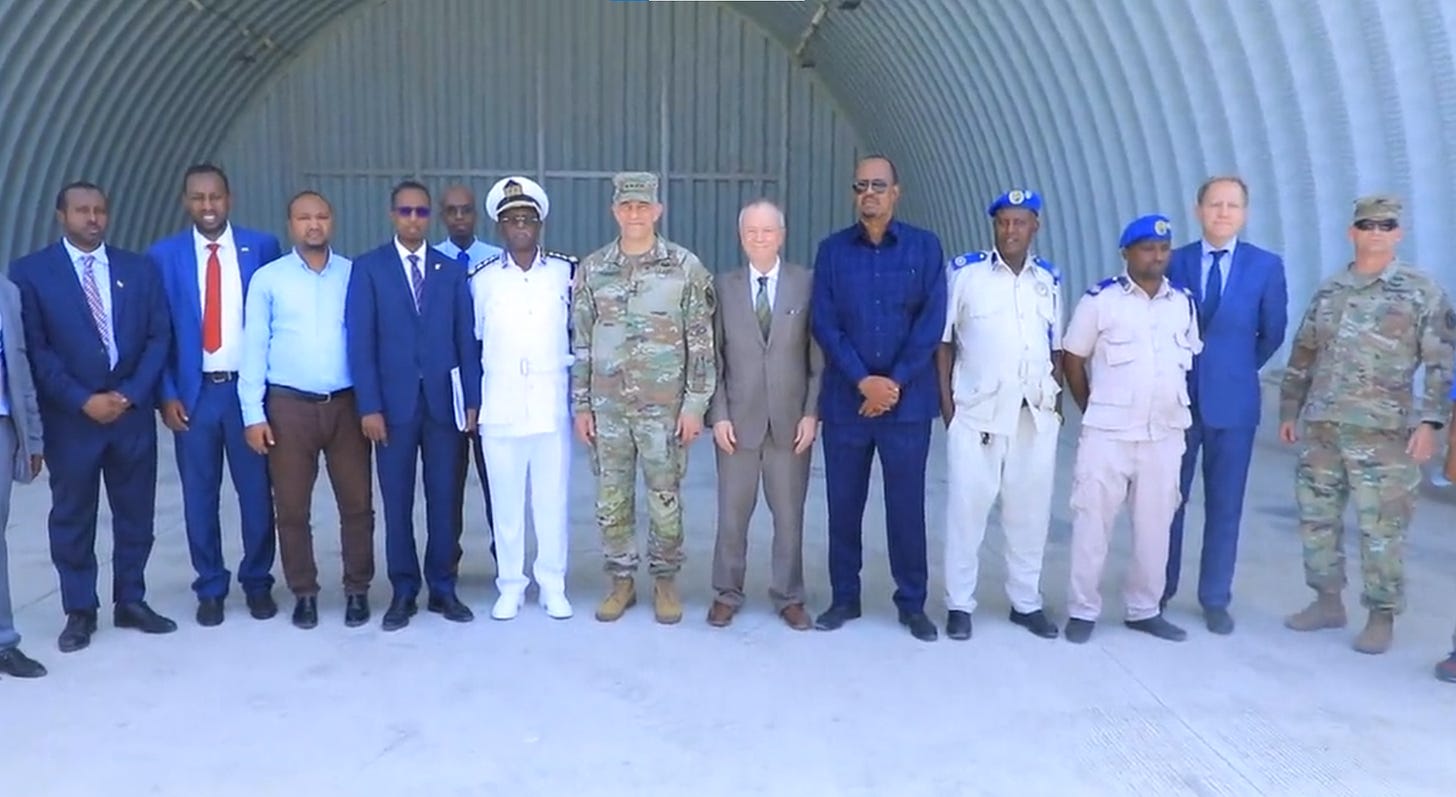
Americans and Somalilanders inside an aircraft shelter at Berbera Airport, Somaliland, 12 May 2022. In the middle are U.S. Army Gen. Stephen Townsend (camouflage uniform) and Larry E. André Jr. to his right. Video capture.
US AFRICOM, Berbera and Somaliland
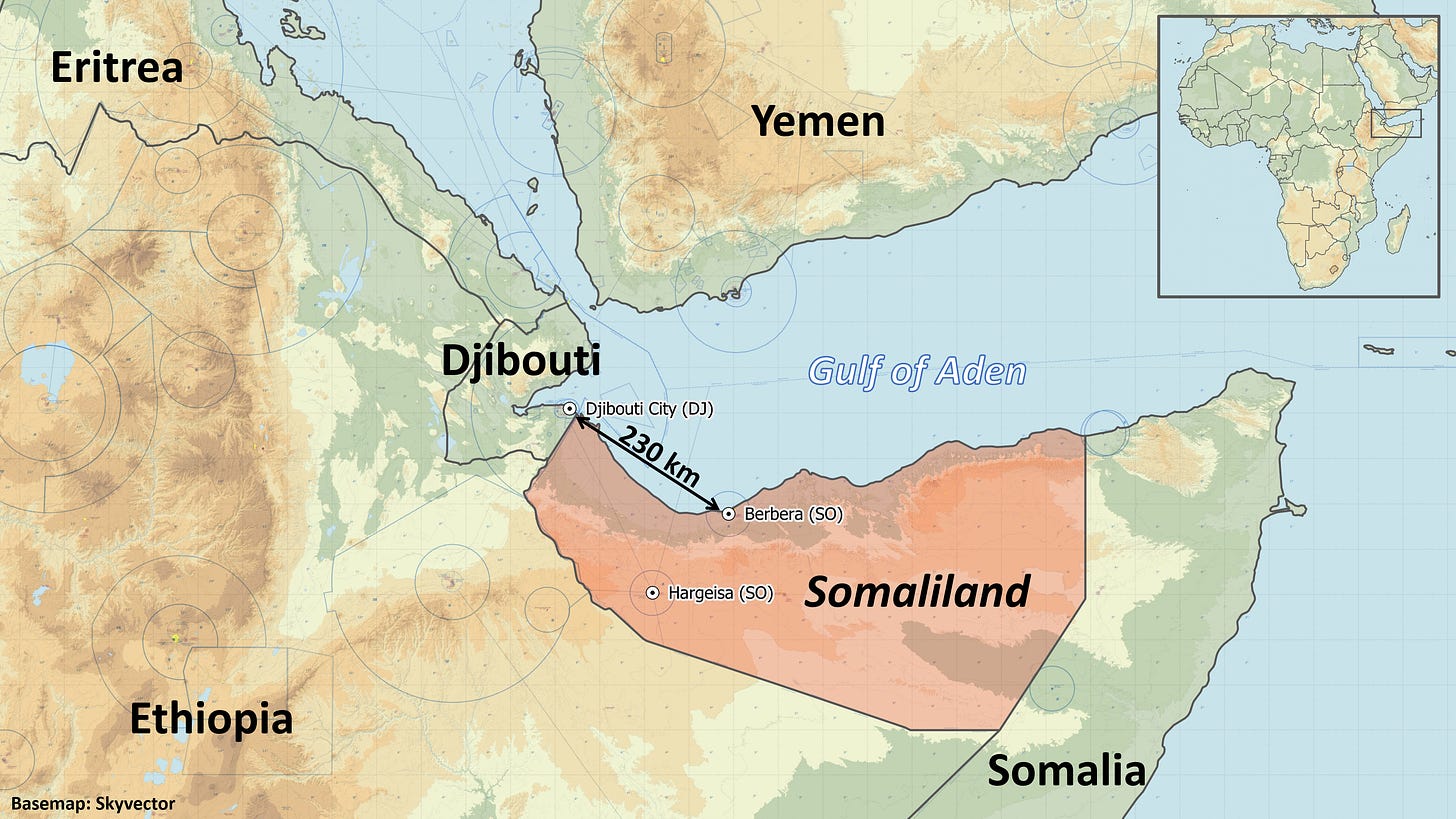
Overview of Somaliland, Somalia, Djibouti and the Gulf of Aden.
31 years ago, Somaliland broke away from Somalia and claimed independence. Even though it is a de facto state, independence was never recognized by the international community, including the United States.
According to Foreign Policy, a Somaliland delegation visited the United States in March 2022, lobbying the United States to recognize Somaliland. Although Washington made clear they were unwilling to recognize their independence, they did signal that they would like to deepen ties with Somaliland.
On 12 May 2022, a United States delegation visited Somaliland’s capital city Hargeisa, followed by a visit to Berbera, located on shores of the Gulf of Aden. I previously looked into this visit to Berbera. Besides a description of the visit, the thread attached to the tweet below contains more information about the history of the airport, so just click on the post in order to read it.
On the day of the visits, a United States Marine Corps (USMC) KC-130J reg. 169533 was tracked flying over Somaliland, including a landing and take-off at Berbera. This same KC-130J can also be seen in video footage made at the airport.
According to US AFRICOM, the meetings focused on “mutual benefits from closer U.S. cooperation with Somaliland authorities”. They add that a cooperation between “[US] AFRICOM and Somaliland’s military and coast guard will advance shared interests in regional stability, protecting vital trade routes”.
A BBC article summarizes some of the reasons why Berbera is of interest to the United States. First and foremost the airport is located on the shores of the Gulf of Aden, a major shipping route. Furthermore, it “is close to some of the world’s most unstable places, including Yemen, Somalia and Ethiopia, which has been a key US ally in the ‘War on Terror’ but is now wracked by internal conflict.”
The United States currently have a large military presence at Camp Lemonnier, which is located just south of Djibouti–Ambouli International Airport in Djibouti, sharing a runway. According to US AFRICOM, Camp Lemonnier “provides, operates and sustains superior service in support of combat readiness and security of ships, aircraft, detachments and personnel for regional and combatant command requirements; and enables operations in the Horn of Africa while fostering positive U.S.-African Nation relations”.
In recent years, Djibouti has seen an increased presence of Armed Forces from around the globe, including Japan, France, Italy and most importantly China: a Chinese Naval Base is located only about 10 km from Camp Lemonnier. In 2018, there were multiple instances of Chinese lasers interfering with U.S. military aircraft.
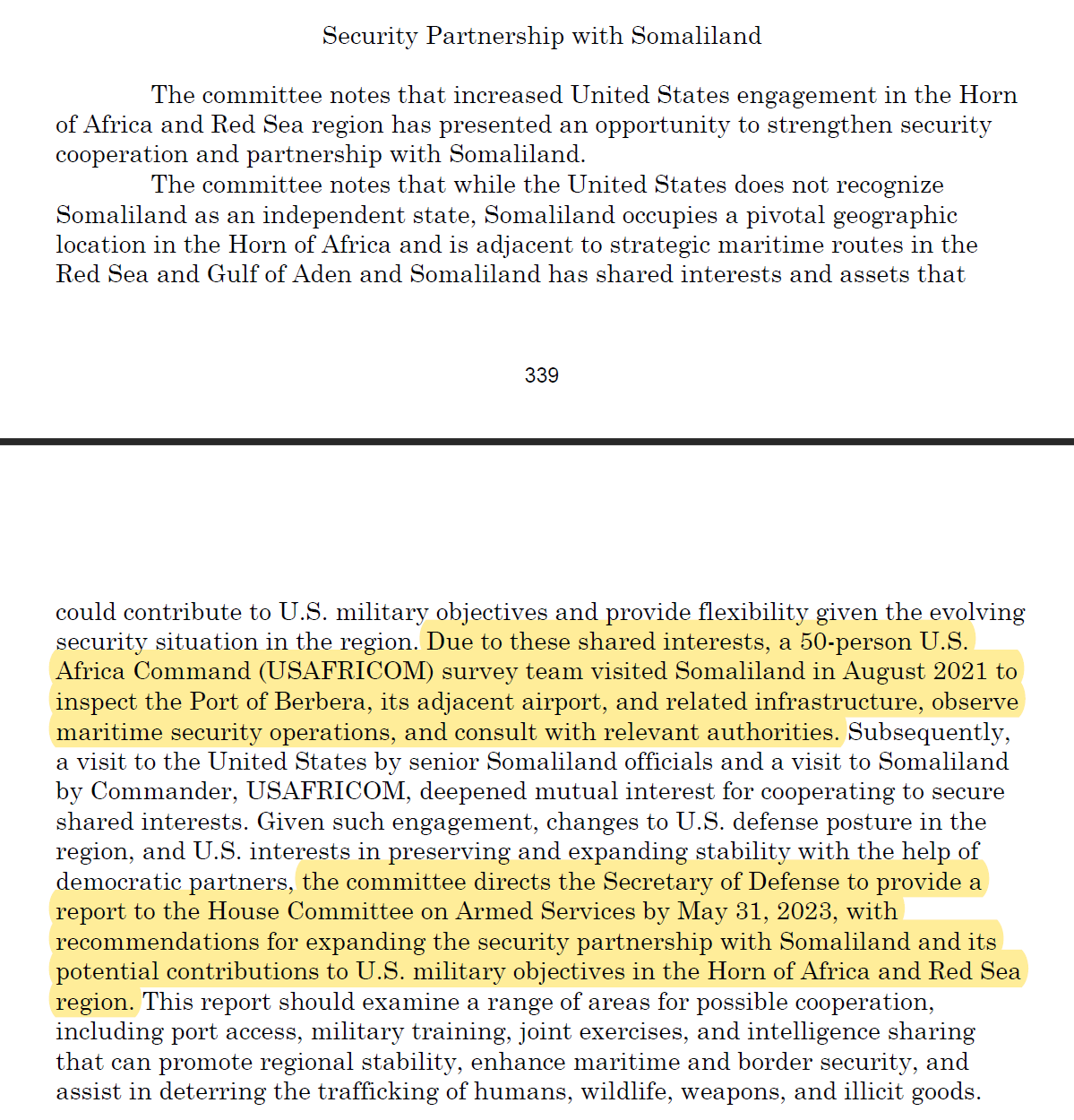
Berbera is located about 230 km southeast of Djibouti, and would offer more space and privacy for United States military operations. The United States already recognized the benefits of Berbera in 2021: In Aug 2021, a 50-person US AFRICOM survey team visited Berbera for inspection and “consult[ing] with relevant authorities”, a recent (Jun 2022) United States National Defense Authorization Act (NDAA) report states. In Dec 2021, a U.S. Congress delegation also visited Somaliland, including Berbera.
According to this recent NDAA report, the U.S. Secretary of Defense should provide a report containing “recommendations for expanding the security partnership with Somaliland and its potential contributions to U.S. military objectives in the Horn of Africa and Red Sea Region”. This report is to include “a range of areas for possible cooperation, including port access, military training, joint exercises, and intelligence sharing that can promote regional stability, enhance maritime and border security, and assist in deterring the trafficking of humans, wildlife, weapons, and illicit goods”
From all of this, it becomes very clear that the United States is showing great interest in Berbera Airport.
Recent developments
According to a Berbera News report dated 04 Jul 2022, American troops have taken full control of security at the airport. According to the report, all Somaliland staff has been sent on a 12-day holiday, and “the UAE official1 at Berbera Airport returned home”. They add that “a number of military planes” landed at Berbera on 03 Jul 2022, followed by “a large number of US planes” on 04 Jul 2022.
I have not yet been able to find evidence that these flights did actually take place. It is possible that U.S. Military aircraft would not be using ADS-B, or not even using Mode-S, for the short flights from nearby Camp Lemonnier to Berbera. This would make the flights invisible to the general public.
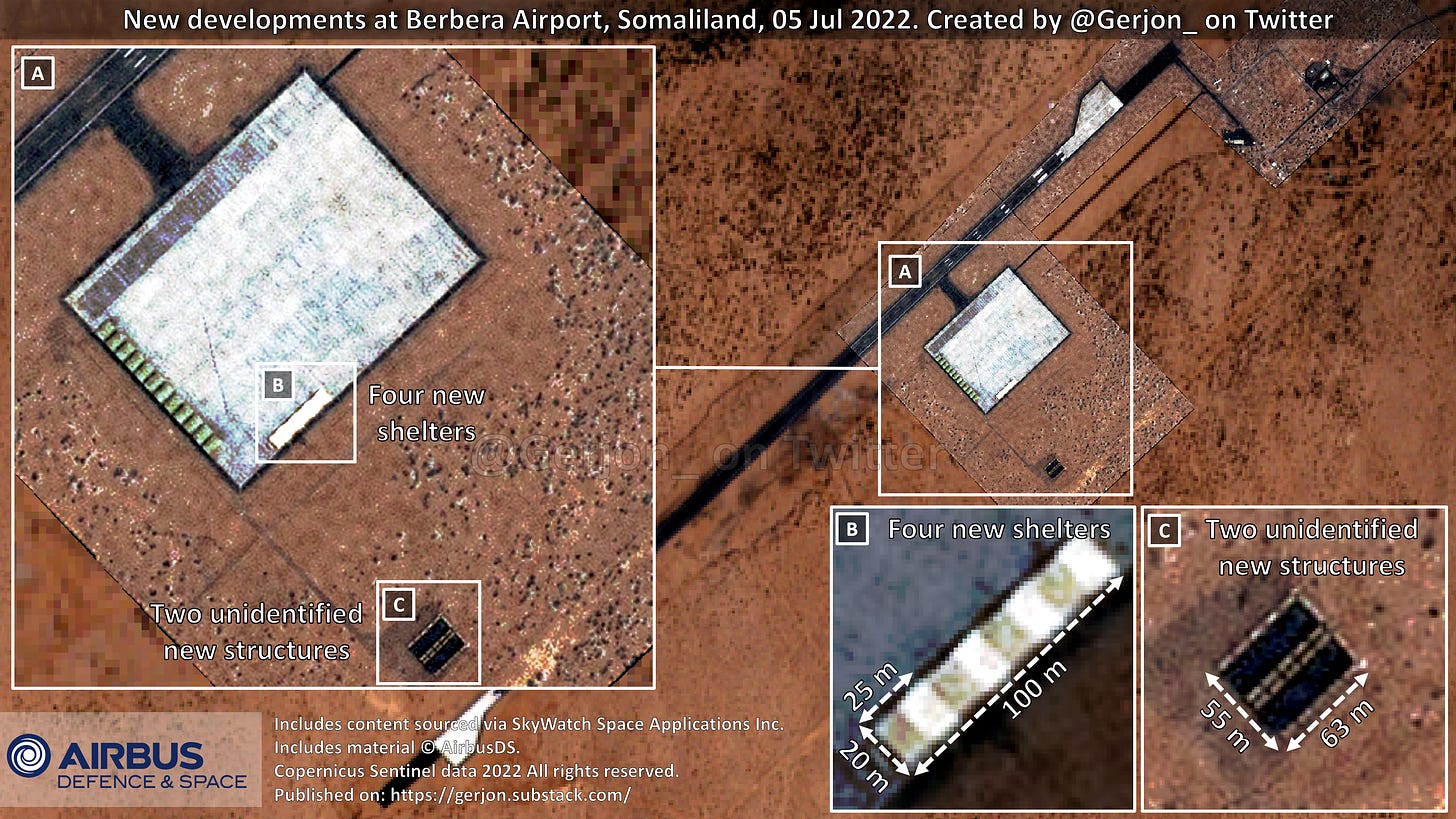
However, there are indeed signs for recent activity at Berbera Airport. Sentinel-2 satellite imagery shows that something was constructed on Berbera’s main apron in the period following 21 Jun 2022.
A closer look at this structure (using SPOT satellite imagery, dated 05 Jul 2022) reveals that this consists of four shelters or canopy buildings, perhaps similar to those of HTS Tentiq, each at a size of 20 x 25 m, or 20 x 100 m in total. Two more new and unidentified structures are located some 300 m further Southeast.
At this point in time, it remains unclear by whom and for what purpose these structures were created. However, they first appear around the same time American presence at Berbera Airport was confirmed.
Conclusions
The United States and Somaliland are developing increasingly close ties. These ties are relevant to Somaliland in their strive for international recognition of their independence. The United States on the other hand may be looking for a new base on the shores of the Gulf of Aden, to serve as a potential future alternative for the increasingly crowded Djibouti–Ambouli International Airport and Camp Lemonnier.
In the past week, unconfirmed news reports claim multiple flights to Berbera Airport and claim American presence at Berbera Airport. These claims have not yet been proven. However, they do coincide with newly developed structures identified at the airport, seen on satellite imagery. At this point in time, it remains unclear why and by whom these new structures were developed.
Future updates about Berbera Airport will be posted on my Twitter and on this blog. Various Twitter followers have notified me that they no longer see my tweets pop up in their feeds. Therefore please subscribe to this blog using the button below to make sure you don’t miss my future work.
Although my investigations take up most of my free time, all of this work is fully unpaid. Also subscribing to and reading my blog is free of charge.Subscribe
SLOW UNFELT POLITICAL CHANGES IN SOMALIA TAKING ROOT
In Mogadishu, the capital, one would note a fledgling government in operation with Villa Somalia 🇸🇴 receiving foreign dignitaries, rudimentary public institutions taking shape, world diplomatic community bringing their credentials to a Somali President. Federal Member States seem to be recovering from the onslaught of Farmajo regime and Houses of Parliament, the Upper House, in particular, has gained constitutional recognition following the fall of Nabad & Nolol anti-federalism campaign.
Despite population pessimism and cynicism that things are getting worse, one could say that there is a light at end of the tunnel that Somalia’s better days are ahead and coming up.
Somalia shares some problems with the rest of world like high energy prices and shortages of food and bottle-necks in supply chain. Severe drought is the most concern now due to failure of successive rainy seasons, combined with centuries old poor management of livestock resources and uninnovative nomadic existence of the bulk of Somalia’s population. Environmental degradation is one of the biggest calamities Somalia faces today. It is mostly man-made and partially out of ignorance and lack of protection. This has to change.
Absence of work ethics and lack of understanding of putting work hours into everyone’s daily business is another chronic issue in the way towards progress in this country. Trying to short-cut required hard work is another critical issue. Encouraging and learning the skills needed here for Somalia’s self-reliance is fatally absent. Somalia has become a Gulf state without the power of petro-dollar in terms of native population’s disability to fully participate in nation-building. Here national leadership to inspire the nation into reaching new heights towards progress is badly needed.
I think the reason is more out of traditions than personal convictions. For example, the New Year Eve is more celebrated in Europe, particularly in Russia and East European countries than their own respective national days, while Christmas 🎄 Eve is the day to look for by all family members in Western Europe and the Americas. But, that doesn’t mean that they put less importance to national days
Here in Somalia, since the overthrow of the civilian government by the Military in 1969 and rise of Islamist and secessionist groups, national holidays like the Independence Days of June 26 and July 1st are slowly fading in significance in the minds of the general public. The unilateral declaration of secession by Somalia’s North West Regions plays out in this mix. Instead, religious celebrations are becoming the only unifying factor, along other Islamic countries, marking these dates not only in faith, but also in continued tradition. When any nation collectively succeeds in the removal of foreign colonial yoke, gratitude to Allah is as important as repentance. If someone is not noting personal or national successes, certainly he or she isn’t appreciative of the blessings of Allah – and this could be interpreted as less faithful.
In the case of Somaliland, not marking June 26 would mean ignoring the sacrifices by hundreds of thousands of its people who fought against British repressive forces in Hargeisa, Berbera, Burco and other towns in the North West Somalia. It is extremely unfair not to acknowledge those who lost their lives to gain their freedoms from a colonial power, which was on the brink of even ceding Hargeisa and Zeilac like Haud and Reserved Area to the Emperial Ethiopia just before Independence. Unfortunately, today in Somaliland there are quite a few, who feel nostalgic about old colonial days of occupation as a result of indoctrination against Somali unity. Bad and unwise leaders bring about similar legacies.
Elections have consequences, and this is true to Puntland State as well. The defeat of President Said Abdullahi Deni in the recent Somalia’s presidential race in Mogadishu had impacted negatively not only on the president, but also on the entire Puntland administration and political system as a whole, including the planned one person one vote forecasts, whereby there is diminished political will to go ahead despite the pronouncements that he was committed to implementing the project of holding municipality elections.
Although President Deni has never been accused of being open to the general public and even to members of his own administration in his closed poor policy of running Puntland affairs, he is now more isolated than ever before. Nobody knows what he has been doing lately, other than he was often traveling overseas solo without any prior public announcement and any attempt to justify his over-rated trips to foreign cuntries, in particular, to Dubai and Nairobi.
Members of Puntland Cabinet are as disillusioned as the general public.The representatives of the House of Puntland Parliament are restless nowadays, only to reject the submitted list of the composition of Puntland Supreme Court by the President. The list was intended to fill in a long-time existing vacuum in Puntland judiciary. The President has used veto, however, to override the House Resolution by re-submitting the same list to the House to reconsider it at next session.
Political opposition in Puntland is slowly getting assertive following the defeat of Deni in the Federal elections, including the betrayal by his own hand-picked and funded MPs from Puntland and Jubaland.
There is anxiety and political uncertainty now in the State that worries everyone. To get out of this dilemma, Puntland political elites must get serious to embark upon political path of democratization and general elections as the only remaining option to govern.








 Warsame Policy & Media Network (WAPMEN)
You must be logged in to post a comment.