
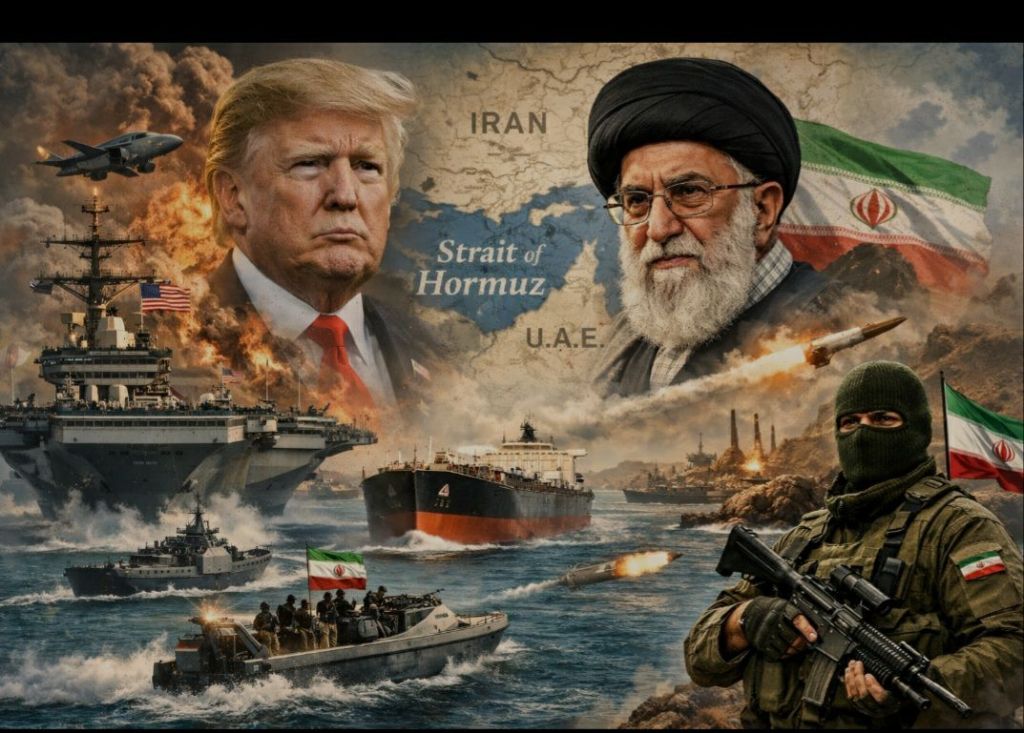
When Donald Trump threatens to blockade the Strait of Hormuz, and Iran counters with its own denial strategy, the world is not witnessing two opposing policies — it is witnessing the same weapon being pointed from opposite ends of the barrel.
The Strait of Hormuz is not just a waterway. It is the jugular vein of the global economy. And today, it is being squeezed by competing egos, strategic miscalculations, and geopolitical gambling.
This is not policy.
This is chokepoint warfare.
I. The Illusion of Difference: Blockade vs Closure
Let us strip away the propaganda.
An American “blockade”
An Iranian “closure”
Both achieve the same outcome:
Tankers stop moving
Insurance costs skyrocket
Oil supply contracts
Markets panic
The distinction is semantic — not material.
Washington will call it “freedom of navigation enforcement.”
Tehran will call it “defensive sovereignty.”
But to the rest of the world — from China to India — it is simply economic strangulation.
II. The Strategic Reality: Geography Does Not Lie
Here is where rhetoric collapses under reality.
Iran sits on the northern edge of the Strait.
It does not need a blue-water navy.
It needs:
Mines
Fast attack boats
Drones
Coastal missile systems
This is called asymmetric denial.
The United States, despite its naval superiority, faces a brutal truth:
You can patrol Hormuz.
You cannot control it without war.
And war in Hormuz is not a naval exercise — it is a global economic detonation.
III. Winners and Losers: The Real Game Behind the Noise
1. The United States — Tactical Power, Strategic Contradiction
The U.S. appears dominant. But look deeper.
Short-term gains:
Higher oil prices benefit U.S. shale producers
Strategic pressure on Iran
Long-term damage:
Alienates allies dependent on Gulf oil
Forces neutral powers to bypass U.S.-controlled systems
Exposes limits of American coercive power
A blockade that disrupts allies is not strength — it is self-inflicted isolation.
2. Iran — The Disruptor With Leverage
Iran cannot defeat the United States conventionally.
But it doesn’t need to.
Its doctrine is simple:
“If we cannot export oil, no one will.”
What Iran gains:
Leverage in negotiations
Ability to raise global costs instantly
Strategic relevance despite sanctions
What it risks:
Massive retaliation
Infrastructure destruction
Iran thrives not by winning wars — but by making war too expensive to win.
3. China — The Silent Strategic Winner
China does not shout. It calculates.
What China loses:
Heavy dependence on Gulf oil
But what it gains:
Justification to accelerate alternative supply routes
Expansion of Belt and Road energy corridors
Opportunity to position itself as a “stability broker”
While Washington and Tehran escalate, Beijing re-engineers the system quietly.
4. Gulf States — Rich, Exposed, and Vulnerable
From Saudi Arabia to United Arab Emirates:
Their wealth depends on uninterrupted exports
Their geography traps them inside the chokepoint
They cannot:
Fight Iran directly
Defy the United States openly
They are hostages of geography and alliances.
5. The Global South — The Invisible Casualty
From Africa to Asia:
Fuel prices surge
Food supply chains destabilize
Inflation explodes
Countries with no role in the conflict pay the highest price.
Hormuz is not just a Middle East issue — it is a global inequality multiplier.
IV. The Madness Question — Or Calculated Chaos?
Is this madness?
Not quite.
It is something more dangerous:
Strategic recklessness disguised as strength
Donald Trump operates on pressure, shock, and disruption.
But Hormuz is not a real estate deal or a trade negotiation.
It is a systemic risk trigger.
Saying one thing every hour is not unpredictability —
it is policy instability in a theater that demands precision.
And in chokepoint warfare, miscalculation is not gradual.
It is instant and irreversible.
V. Final Verdict: A Lose-Lose Game Disguised as Power
If Hormuz is blocked — by anyone — here is the reality:
The U.S. loses credibility
Iran risks devastation
China adapts and advances
Gulf states panic
The world economy suffers
The only true “winner” is chaos itself
Conclusion: The Strait That Exposes Power Illusions
Hormuz is revealing a brutal truth about modern geopolitics:
Superpowers can project force — but they cannot control consequences.
The idea that one actor can weaponize a global artery without triggering systemic collapse is not strategy.
It is delusion.
And in this moment, the world is not watching a carefully calibrated policy.
It is watching a high-stakes gamble with the global economy — played at the edge of a narrow strip of water no wider than a city skyline.
Support WAPMEN — the home of fearless, independent journalism that speaks truth to power across Somalia and the region. Tel/WhatsApp: +252 90 703 4081.
 Warsame Policy & Media Network (WAPMEN)
You must be logged in to post a comment.