
Take a read.
Day: June 2, 2019
EDITORIAL: THE POLITICS OF MARGINALIZATION

Garowe, June 2, 2019
Politics of marginalization of Jews in Germany didn’t work for the Fuhrer (Hitler). It didn’t work for the Military Junta of Siyad Barre. It is not working for Donald Trump against Muslims in America. It will not work either for Ahmed Madoobe or Farnaajo. That is because, historically, the politics of division and dark conspiracy against certain segments of the citizenship eventually ends up in spectacular fiasco and defeat.
Ungrateful for what Puntland had done in order to re-instate the failed state of Somalia, successive transitional regimes of Mogadishu were trying to marginalize Puntland. They tried to ignore the fact, however, that no matter how hard they try to effect their ill-wish, people of Puntland have staying power to overcome any political obstacles in the way to take the lead for better Somalia.
President Farmaajo, indoctrinated and brain-washed by the marginalization propaganda spun out during the heydays of the Junta, even tried to distance himself from members of Marehan sub-clans to give him room for consolidation of power within Hawie first, thus trying to deflect the image of Siyad Barre, even decorating Villa Somalia with the portrait of Former President, Aden Abdulle Osman (RIP), a pseudo-Hawie late politician of lower clan-lineage.
Ahmed Madoobe of Jubaland, deceived by the fallacy of the strength of Ras Gambooni Brigade, Kenyan AMISOM/KDF presence in Kismayo and his false perception that the Ogadens number more than all other Somalis put together, had ignored the political rights and represention of traditional Harti residents of Kismayo.
Thinking that he had successfully neuralized the Harti historical groupings of multiple un-related sub-clans in Jubaland (Marehan,Bajun, Galjecel, Shiikhaal and others, all coming under Harti Law, Xeer Harti, Ogadens not included based on 1925 Treaty between Harti and Ogaden, as Ogadens were limited from Afmadow), he now perceives that Farmaajo Regime in Mogadishu and Marehans are in his way to get re-elected.
Would political marginalization work for him this time? Let us wait and see.
ismailwarsame.blog
Annual subscription
$37.00
FORMAAJO’S UNSCHEDULED APPEARANCE IN ADDIS ABABA

Take a watch.
SOMALIA’S DEADLY GAME OF DRONES
Good read. Interesting. Insightful. The game is on Jubaland Election 2019.
By Prof. By PETER KAGWANJA
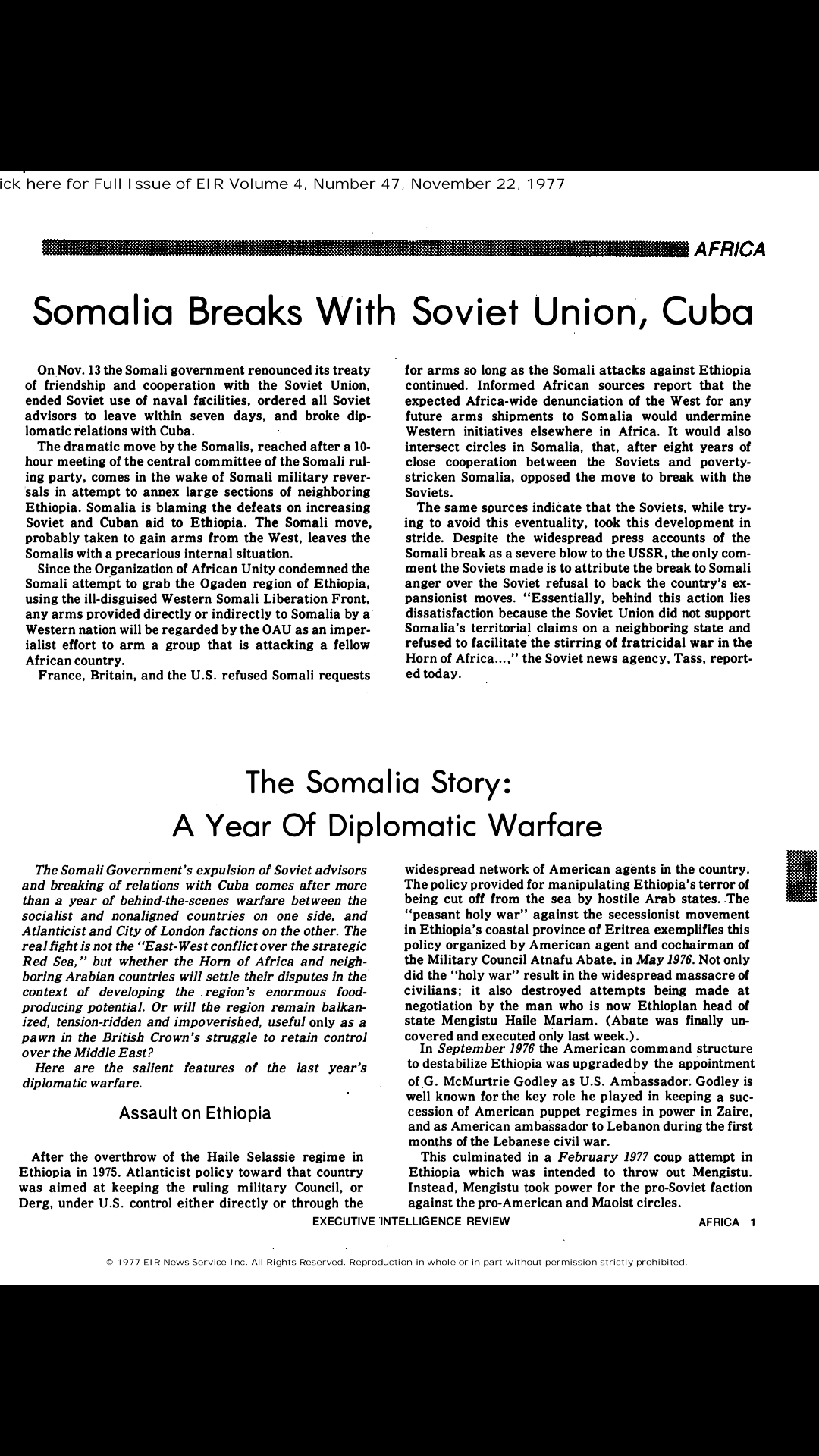
Somalia and Soviet Union: Diplomatic Break


FLASH BACK: ROOTS OF APPEARANCE OF PUNTLAND ON THE POLITICAL SCENE
-
ETHIOPIA SLAMS EGYPT OVER SOMALIA
Dec. 24, 1997 1:58 PM ETADDIS ABABA, Ethiopia (AP) _ Ethiopia accused Egypt on Wednesday of hijacking a peace process to end seven years of fighting in Somalia and claimed the agreement reached in Cairo by Somali factions could do more harm than good.The government-run Ethiopian News Agency quoted an unnamed diplomat as saying the agreement signed Monday by 26 Somali faction leaders to form a national government and end fighting could create more divisions rather than help to achieve reconciliation.Ethiopia, which had been conducting its own peace initiative for Somalia, apparently felt left out after Egypt and the Cairo-based Arab League invited 28 Somali leaders to Cairo where they came up with a deal after 41 days of negotiations at a hotel for Egyptian military officials.All but two Somali factions signed the complex power-sharing deal and agreed to a national reconciliation conference in the central Somali town of Baidoa Feb. 15 which would name the country’s first national government in seven years.“The Egyptian government has hijacked the Somali reconciliation process and as a result it has created more divisions within the Somali factions, thus seriously damaging efforts and gains of seven years of reconciliation among Somali faction leaders,” the agency quoted the diplomat as saying.The diplomat was not named but his comments were believed to reflect views of the Ministry of Foreign Affairs, which often uses the news agency to communicate government opinion.In Cairo, the Foreign Ministry made no formal comment. But a ministry official, speaking on condition of anonymity, said:“This is nonsense. We are not in the business of hijacking peace processes. These charges were not issued by the Ethiopian government, but by a Somali who is living in Addis Ababa … and the motives are clear.”© 2015 The Associated Press. All rights reserved. This material may not be published, broadcast, rewritten or redistributed. Learn more about our Privacy Policy and Terms of Use.
————————————
Postscript, August 2015: The above was, in fact, based on my article to the Ethiopian main newspaper at the time, The Ethiopian Herald. The Egyptian dplomat in Cairo was right on the source of the information. Abdullahi Yusuf and General Aden Gabyow were still in Cairo, trying to get out of Egyptian diplomatic wrestling. That was December 1997 in Abdis Ababa. Two fateful nights for the future State of Puntland would follow from that AP despatch from Addis Ababa – Ismail H. Warsame
Loading
HOW TRUTH DIED IN SOMALI POLITICAL DISCOURSE

One would wonder how this phenomenon came to be. A Muslim society strictly supposed never to lie while following its Islamic teachings and traditional culture whose cherished values include “a man’s word is as important as himself”, and to be called “a liar” was the ultimate insult to a person. A person caught in lies used to have lost credibility and good standing in the society, and presumed to have strayed from God’s right path as well.
In nomadic society, keen to listen to the latest information on resources (rain, water, grazing etc) and security, they would come to listen to the news from a visitor from distant places, but would double check first any information concerning whether the new visitor was reliable and worthy of his word. If they would find out he was not reliable, they wouldn’t mind debriefing him. That was how we were for thousands of years.
What has happened in Somali society is a case study for sociologists, anthropologists’ and other experts of human studies. As a lay man, I can share my personal observations.
There are three venues where you can gauge how truth has died in Somali politics, possibly in other areas human of endeavor:
1. Political debates online (social media), TV and other media outlets of Somali origin.
2. Live group discussions among Somalis on events happening in their country
3. The so-called Clan Spokespersons lately appearing on the political scene (Afhayenka Beellaha Hawiye, Hag, Somali Concern, armed factional organizations, some of the civil society organizations, etc. as an example).
After observing, reading, listening to and watching the contents of the efforts of these groupings, I have tried to figure out what was the root cause of this strange culture of lies and misrepresentations of facts in Somalia. Are there historical roots for now all-encompassing phenomenon?
I am finding out that national and clan politics are hugely contradictory. National politics is a new phenomenon in Somali tribal society. Central authority was born in Somalia with the colonial powers of Italy, Britain and France. The word “Somalia” rarely existed before these powers came in the late 18th and early 19th centuries. Yes, there was the word Somali, but not Somalia as we know it.
National politics in an early stage started from Sayid Mohamed Abdallah Hassan Darwiish Movement. This was the first attempt by a political figure to transcend beyond the clan lines in both Italian and British occupied Somalia. Before that moment, Somalis were clans and sub-clans. Clans or tribes had no national politics. There were no interests beyond those of the clan, whether they involve in resources or clan security.
As political parties started to appear in the urban centers of the colonies, attempts were made to bring clans together for a common cause: Political Independence. Surely, the members of the most popular political party, the Somali Youth league (SYL) knew and quickly took steps to fight clannism, which was public enemy Number One, worst than the occupying colonial powers. Clannism was the single most important obstacle to building a nation-state. They succeeded in uniting Somalis to some extent, but fell short of a long term solution to the problem. Clannism re-emerged immediately as Somalis started to self-govern. Political parties established themselves along clan lines. The old modus operandi of safeguarding clan interests took precedence in governance. Suspicion and clan-hatred took deep roots. Deception, lies and morale degradation took hold among the new rulers of Somalia. Other enemies of Somalia such as ignorance, hunger, diseases, and backwardness had been forgotten altogether. There was no vision for Somalia to be and to prosper. In the end, it collapsed and became a failed state.
Now that that had happened, are there any lessons learned for the current leaders of Somalia, if it is going to be Somalia? Some people doubt very much. Others are quite skeptical. Still others believe that we could keep trying to benefit from the past mistakes despite strong centrifugal and centripetal forces acting on the possibility of realizing a Somali “nation-state” one day.
What you see today is the growth of clan politics at macro-level in the form of regional administrations and micro-level in the shape of clan representation in central government. The mentality here is no different from of that of 18th century when there was no Central Somali Authority, except in lies and mischaracterization. It is an attempt to mislead, misrule and misappropriate. It is self-denial leading to another failure for repeating past mistakes over and over again. It is like making your past your present and future. It is actually like missing “Both Worlds”. It is denying the truth.
Ismail H. Warsame
E-mail: ismailwarsame@gmail.com
Twitter: @ismailwarsame
———————————————-Posted 29th March 2017 by Ismail Warsame Blog
Ismail Warsame Blog is uniquely and objectively devoted to political analysis, opinions, news, views, commentaries and modern history of Somalia, in general, and Puntland, in particular. The blog is associated with the former Chief of Staff of Puntland Presidency and one of its key founders (1998-2004).He worked with the Joint Secretariat of United Nations and World Bank on Somalia’s post civil war re-construction and Development Programme (RDP) under Joint Needs Assessment (JNA, 2005-2006).
LET US SET OUR PRIORITIES RIGHT
Many Somali writers, political pundits, debaters, etc ignore the fundamental comparative analysis of the nature of our society. How many countries globally are similar to Somalia in terms of societal development? Let us count some of them: Yemen, Mongolia, Mauritania, Chad, perhaps, Niger, just to point out a few. What is the common livelihood? Nomadic. Are these countries relatively much better off than Somalia today with regards to socio-economic development, besides the failed state status in some? How do you explain the common backwardness they all suffer from?
We all know that there are stages in societal development from community of gatherers, hunters to settled farmers, to industrialist/ capitalists and more complicated financial services providers, bankers and multi-national corporations.
Where are we among these stages? Can we say that our society is still in the primative stage of societal development, despite cosmetic globalization impact, starting with the most recent colonial administrations of the 19th century?
As most debaters complain, can we make a quatum leap into industrialist/capitalist society by-passing the stage of widespread settlement of the nomadic population and overnight become a sophisticated modern society of the 21st century? Are we realistic in our expectations? What are our priorities in moving forward?
Could clannism and clan politics disappear amid backwardness of thought, ideas and nomadic life suffering from continual droughts , man-made environmental degradation and natural calamities?
The Soviet ideologues used to teach that because there was a powerful Soviet Union then to help, certain developing countries could by-pass the capitalist mode of production and move on to the socialist one. We all know how it ended up.
Let us not fight each other to give excuses for our failures in understanding the nature of our society. Let us set our priorities right.
ismailwarsame.blog
 Warsame Policy & Media Network (WAPMEN)