HOW TO HANDLE CORRUPTION IN A DEEPLY CORRUPT SOCIETY

Can a deeply corrupt society be reformed? Niccolo Machiavelli, the late Italian political philosopher and author of the book, “The Prince”, believes that nothing short of revolution and radical approach could save a nation as corrupt as Somalia, Nigeria, Kenya, among others.

In the case of Puntland State of Somalia, corruption is now inbedded deeply in all spheres of life in the society that nothing less than a radical administrative clean-up can save Puntland from implosion and collapse.

To do that, the first step is tackling with corruption in the sectors of security and finance, moving steadily to house-cleaning in others as well. Make way to forming a small and lean administration by doing away all duplicating and redundant agencies and ministries in the process of radical reform before democratic elections.

The 2nd step is to embark upon the democratization process now, not in few years’ time down the road during this mandate. NOW!

ODD SOMALI STORIES

Would you exchange three hundred she-camels for two income generating public toilets in Bosaso? Kkkk. This was then an ultimate insult to the nomad-owner of the camels.
This is a true story relayed to me by a friend of mine with the nick-name “Cidlow-Carar” ( Air-chaser).
A Bosaso business entrepreneur built rows of public washrooms in Puntland’s densely populated city. He also opened a teashop nearby to serve his daily visitors. One day came a visitor, a nomad who shows off in being the sole owner of 300 she-camels in the countryside. As the proud nomad continued to frequent these convenient public facilities during his short stay in Bosaso, the entrepreneur had befriended with the dignified countryman. One day, the two men were having tea together. During the course of their discussion, the nomad started to impress the businessman on the signicance of having such immense wealth. The businessman looked at boasting nomad and offered, “Would exchange your three hundred she-camels for two of my public toilets?” The nomad got so angry that he almost slapped his interlocutor. The cool nerves of the toilet owner prevailed and saved the day.
One year later, the boastful nomad had lost all but a few camels in severe drought. They met again with public wash-rooms still in full operation, and the popular teashop joint turned into a decent city hotel. Now, the wealthy businessman reminded the nomad of that past business offer. The nomad reminded the hotel owner of that insult.
This story reminded me of a conversation I had with a Swiss expert on governance during the first year of Puntland State establishment. Swiss Government sent him to assist us in our new efforts to consolidate our regional administrative achievement. Unfortunately, I don’t recall his name. He was heavy drinker of camel milk, a habit he had picked up in Mauritania as strange as it may sound for a white European to be a habitual drinker of camel milk in Garowe, Puntland, Somalia.
One evening, the Swiss and I were having a chat over camel milk and tea at Zahra Islaan’s teashop in Garowe when our conversation turned to a discussion on the debilitating drought affecting the nomadic population at time. He asked me “why Somalis have to starve and lose their livestock in every drought? Why don’t they slaughter animals, make them dry meat, and store it in sacks before the drought and enjoy eating it during the drought?” At times, I laughed a lot.
In another story, two men were overheard, one asking the other, “Why do Somalis prefer living in dryland instead of locations with huge rainfall and fertile oasis?” The other man responded, “Somalis love raising camels, and camels can not walk on and slip in wet oasis. They just follow their camels, pursuing dry land spots all the time. That is why Somalis ended up in drought-striken dryland. ”
The moral lesson of these stories is that Somalis are not Xoolo dhaqato (farmers) but Xoolo raac (herders) and even not very good at it. For centuries of Xoolo raacnimo, they never improved. It is never too late for Somalia to plan and work out a strategy to save its nomadic population, its wealth of livestock, and, therefore, its mainstay of the economy.

ODD SOMALI STORIES

https://wp.me/p32mpX-FP

PUNTLAND ACHILLES  HEEL

Yes, an imperative reform in Puntland Administration is obvious to all and urgently needed. But, where do we start?

The sectors that had become the Achilles Heel of the State of Puntland are:
  1. Finance sector
  2. Security sector
Fix the two sectors, and Puntland would leap foward fast. These two sectors constitute half of Puntland’s entire problems.
Take first, Puntland Ministry of Finance where the management and personnel are on the same jobs for twenty years with 19th century rudimentary knowledge of financial management and that compoundedly streghtened by their chronic resistance to change, upgrading and reform. It is not an exaggeration – I worked with them as Puntland Chief of Staff at State Presidency during the first three years of Puntland foundation. How did they stay that long each one on the same job? That is their most guarded secret. What is it? The Ministry’s Top Management Team had developed and fine-tuned special skills to make sure that every incoming Puntland President and the new Minister of Finance are happy by providing them with unchecked and unaccounted for access to personal funds. But, if that is an open secret, why didn’t Puntland successive regimes do something about it? Good question! Have you heard the Somali word “Madax-ka-nool referring to Puntland givernance?” Yes, you guessed – the President is everything in Puntland. He is the country’s minister of finance and cashier-general at same time. He can buy everybody, including the members of the House of Representatives (the Parliament). Then who would check the powers of the President? You tell me. With the financial muscle of the Ministry of Finance he owns the country and its people. You would say that is an exaggeration. You are free to carry out your own enquiries and independent investigations. But, don’t forget to share your findings with me.
But, that is not all. The top management of Puntland Ministry of Finance is the main obstacle and reason why international agencies and world financial institutions are unable to assist Puntland due to Ministry’s lack of transparency and financial accountability. The Ministry keeps secret even Puntland real revenue and expenses. This has created a situation where world community doesn’t know not only how to help Puntland in development projects, budget supplements and personnel capacity-building, but also how to work with the authorities. Puntland books are closed and they are Ministry’s Top Secrets.
Reform immediately that Ministry, and people of Puntland are half free.
Take Security Sector second, and you would discover the hard facts that nobody knows, even approximately, the number of men and women working in or attached to that sector, forget about their training, quality, incapacitation, mortality or even whether the names in ghost lists exist, or ever existed. How do you allocate resources, wages, pay etc? How do organizations in the security sector could assist Puntland improve its security needs? Yes, it is easy to blame others for your failures? But abive all, how do you defend your country when your lists of forces are ghost soldiers? That is why you hear calls for clan militia support whenever Puntland security is threatened.
These are the two critical sectors that require an urgent and radical reform, but the problems described above extend to other sectors and state departments as well.

PUNTLAND YOUTH UNEMPLOYMENT

Unskilled persons are mostly unemployable in any sector of the economy in any given country or society. This is what is happening in the state of Puntland. Puntland employment situation is both sad and funny – you don’t import housemaids and hotel cleaners to a country where unemployment rate is double digit.
It will take concerted and sustainable efforts on the part of both public sector and private employers to intervene in the abysmal state of affairs to rectify the widespread youth unemployment in Puntland. Skills training also includes changing prevailing social attitudes towards employment and doing away the culture of dependence to impress youth with the dignity of having a job and the importance of financial independence. Everybody has an important role to play here: Parents, government, local NGOs to address this pressing issue.
At moment, service, construction, fishing and farming industries suffer heavily due to unavailability of locally employable natives. These industries are trying desperately to attract non-native workers from other parts of Somalia and beyond, including Kenyans, Ethiopians, Yemeni and even Indians. The situation here resembles a Gulf Arab state scenario where thousands of expatriate employees run the economy. The difference is that there is no oil here at the present, although Puntland has more wealth than oil and gas: abundance of land for farming, huge livestock, unexhaustable marine resources, not to mention about the potential for also oil, gas and precious minerals, reportedly all rare metals.
Puntland can immediately kick-start fishing, leather and salt industries with minimum capital investment, employing thousands of youth currently unemployed.
Huge opportunities exist here. It requires local awareness, vision and commitment by all concerned.

THE STORY OF DHAWEEYE

When we wrote and posted this story years ago the service was relatively new, and some overseas readers didn’t believe the story was real. We feel it is now worth reposting it. Enjoy reading it.

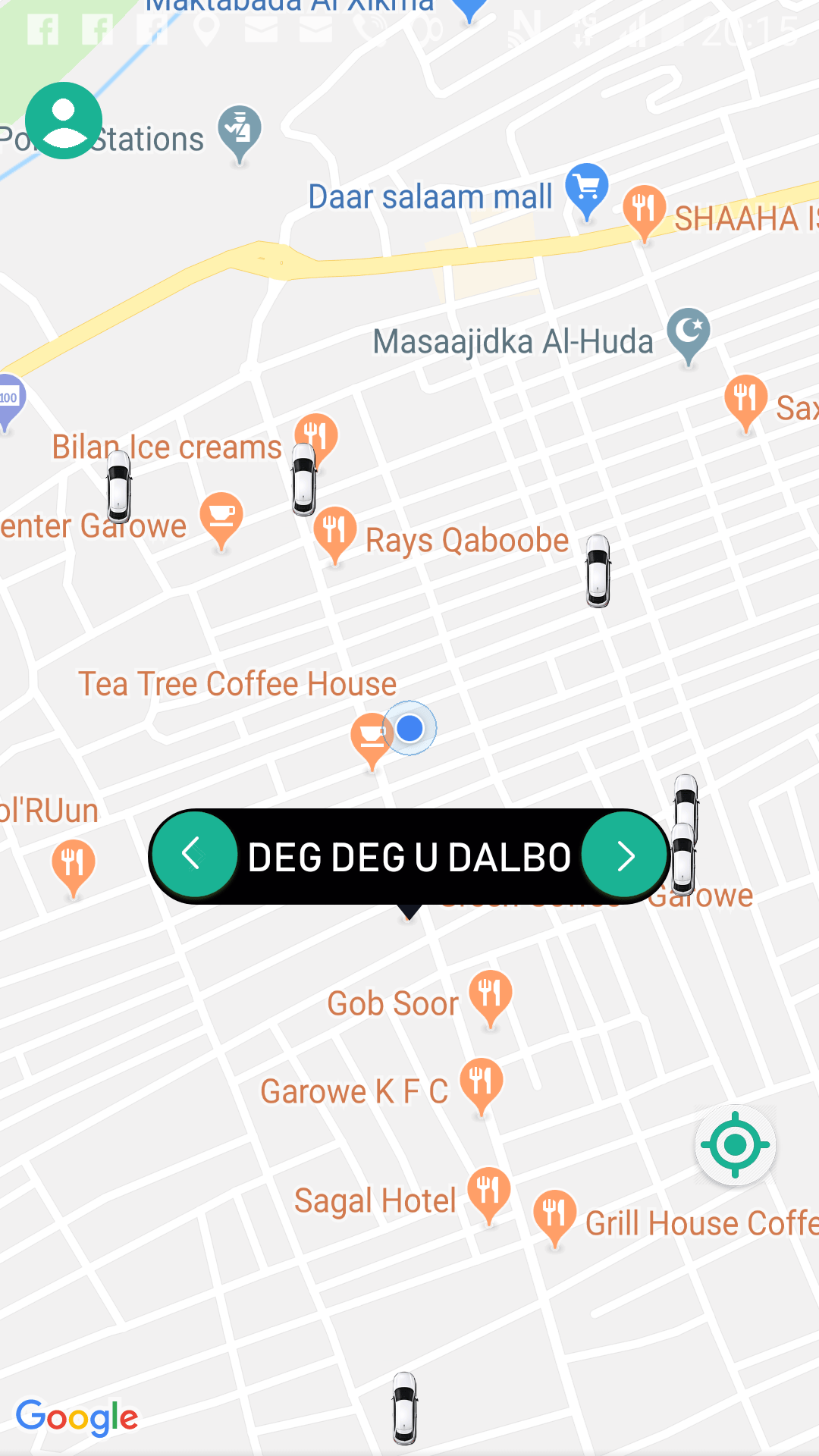
DHAWEEYE or Uber Taxi Service is a very strange phenomenon to Garaad Abdullahi Ali Eed (RIP), one of the most respected Tradional Leaders in Puntland. Garaad Eed who is staying in Garowe these days shared his experience with the new services the other day.

The Garaad wanted to go somewhere in the city in a hurry. He couldn’t wait any longer for his chauffeur- driven vehicle. He decided to take a taxi. His young helper recommended and volunteered to call an Uber service instead. The Garaad couldn’t understand the lad’s advice, but gave him the go ahead anyways with the call.

Within minutes drove in a nice and luxury medium-sized Salon to pick up the Garaad. A clean and nice looking young man was sitting behind the wheel.

Seeing how young the driver was and conscious of and concerned about his own safety and security, the Garaad had reluctantly boarded the car together with his helper.

Upfront and immediately before he drove off, the Dhaweeye kindly offered a fresh and cold bottle of camel’s milk to the Garaad. Surprised at this unexpected courtsey gesture from the strange driver, the Garaad politely declined the generous offer. The Garaad, however, felt safe and comfortable during his short journey with the new service of DHAWEEYE.

Dhaweeye or Uber service is a very convenient taxi service widely available in all major Puntland cities. There is even DhaweeyeApp downloadable on the Internet.

Welcome to globalization!

THE STORY OF DHAWEEYE

https://ismailwarsame.wordpress.com/2019/03/14/the-story-of-dhaweeye/

BEGGERS HAVE CHOICES

https://ismailwarsame.wordpress.com/2019/03/13/beggers-have-choices/

BEGGERS HAVE CHOICES

Today I happened to be in a Caffè shop in Garowe, Puntland, Somalia, enjoying a cup of cappuccino when an elderly man entered the space. He started addressing customers to solicit for his financial needs and pleas for help. It is my turn to hear him. The problem here in Somalia is that nobody has or uses local Somali Shillings as the currency had lost its value and almost its relevance in today’s Somali economy. The national currency has been replaced effectively by electronic US dollars accessed on smartphones with accounts through all major Hawillaad money transfer agencies and local telecommunication companies. It is therefore difficult, if not impossible, to assist someone in need with change from someone’s own pocket.

As a plan, I often carry on me some spare change in case I need sundry expenses like shoe-shining. So I had a bundle of Shs.So. old banknotes when the elderly begger approached me.

I was holding my phone in my right hand when I used my left hand to fish out some Somali Shilling banknotes from my left pant pocket to hand out to him. The man looked at me surprisingly without stretching out his hand towards me. Equally surprised, I asked him, “you don’t want it?” He calmly asked me, “why don’t you give me that with your right hand?”

Another man nearby who was observing my rather awkward situation jumped in to say, “he is right. Why do you give him that with the left hand?” In self-defence I asked them, “do you know whether I am left-handed?” The two were taken aback to consider my question.

BEGGERS have choices here in Somalia and they can refuse your assistance if there are strings attached to it, be well advised.

TEST YOUR OBJECTIVITY & CRITICAL THINKING

https://wp.me/p32mpX-Fg

TEST YOUR OBJECTIVITY & CRITICAL THINKING

For students of Modern Somali history, answer the following questions objectively and without bias:

1. What are the root causes of civil war in Somalia?

2. Were there official political opposition parties in Somalia before the outbreak of the civil war? If not, why not?

3. Were there a free press or media before the start of the civil war?

4. Were there ever a national debate on Somalia’s governance before the civil war and immediately after the Ogaden War of 1977-1978?

5. Why there was a need for an exile armed rebellion against Somali government of the day?

6. What is the main reason for the need of a federal constitution for the New Somalia? Why Somalis simply not re-adopt the 1960 Constitution?

7. Does a National Reconciliation Process involves in only forgiveness or more? How do you bring to the fold of a national reconciliation process the children whose parents were hurt, financially ruined, deceased or disappeared during the Civil War?

“Why don’t (you) Ethiopia & Libya unite?” Part I

https://wardheernews.com/dont-ethiopia-libya-unite/

THE MANAGEMENT OF SOMALIA’S PEACEFUL DISINTEGRATION

https://wp.me/p32mpX-jm

SOMALIA: TO BE OR NOT TO BE

I am not sure that most Somalis are giving serious thought to the threats of continued survival and existence of Somalia as a nation-state that could maintain its territorial entegrity and sovereignty within its geographical limits and location in the Horn of Africa. I suspect that we don’t see the dangers our societal divisions entail. Our weakness doesn’t lie not only in traditional clan rivalry, but now in politicized tribalism and politicized faith.

Unchecked, this would eventually lead to disentegration of Somalia as we know it and therefore invitation for foreign occupation of the land.

Check out “Warsame Magazine ” on Flipboard

Warsame Magazine

http://flip.it/q0o-uK

Odd Peoples’ Greetings

https://ismailwarsame.wordpress.com/2019/03/05/odd-peoples-greetings/

Odd Peoples’ Greetings

Different nationals of different nations and countries have different and, sometimes peculiar way of greetings. In most Western countries, people greet each other with the words close to “hello, how do you do, salute, how are you” etc. in their respective native tongues. In most Muslim, it is peace be upon you.

In the case of Somalia, there are two questions that play important roles: “War ma nabadbaa and War maxaa sheegtay” (is there peace and what is the news?).
In Malaysia, people is reportedly greet each other with the question “Did you eat today?”
In the cases of Somalia and Malaysia, perhaps there is a historical background to validate the use of these expressions.
However, in Somalia’s situation, foreigners accuse Somalis of having no culture of secrecy since their daily greetings start with debriefing each other of any news, rumours and all sorts of conspiracy theories. Some foreigners stretch this claim to the extent that Somalis cannot handle state secrets and therefore are unable to govern themselves in modern statecraft.

Other foreigners argue that the secrecy of the Somalis lies in not having secrets at all.

Whoever says what about them, Somalis will always remain true to themselves.

THE SMARTPHONE & YOUTH UNEMPLOYMENT IN SOMALIA

https://ismailwarsame.wordpress.com/2019/03/03/the-smartphone-youth-unemployment-in-somalia/

THE SMARTPHONE & YOUTH UNEMPLOYMENT IN SOMALIA

Coming to Somalia these days with a critical eye and keen observation of prevailing socio-ecinomic issues, one will notice that a smartphone alleviates the pain of youth unemployment in Somalia. Nobody has reliable statistics on youth unemployment in Puntland/Somalia, but everybody assumes it to be as high as hitting at least a double digit.

In personal crisis situations under similar conditions in other countries, youth unemployment often leads to surge in crime, violence, substance abuse and suicide.

Instead, Puntland youth, and to a greater extent, Somalia’s youth often kill the boring passage of time by use of and playing their smartphones, taking advange of free Wifi at business hotspots. One would often see crowds of young men at teashops, all busy playing their phones, oblivious to what is happening around them.

The phenomenon even extends to the older generations, whereby the former President of Puntland, Dr. Abdiweli M. Ali (Gaas) was accused of preferring playing his smartphone in the presence of even the most reverred traditional elders instead of attending and listening to them in the context of a society which has no idea of multi-tasking, whereby the former Puntland President and current Senator in Somalia’s Upper House of Parliament, Abdirahman Faroole, upon paying him a visit at his residence in Garowe recently, I noticed that he was using IPhone 7-plus, and whereby the new President of Puntland, Said Abdullahi Deni, conscious of the bitter experience of Dr. Gaas with the addictive device, puts away his phone during meetings.

The new smartphone phenomenon in Somalia gets its promotion in the extensive use of social media by the current leaders of the Federal Government, where President Farmaajo and Prime Minister Khayre are being accused of governing Somalia through the Facebook.

Governance

Check out @ismailwarsame’s Tweet: https://twitter.com/ismailwarsame/status/1101930347334373376?s=09

EPIDEMIC RAPE

Think about how many unreported rape cases and domestic abuses in Somalia. Reporting to expose such heinous crime and gross human rights violations hide in the stigma and taboo associated with the epidemic.

The problem is exacerbated by weak administration of justice and law enforcement paralysis.

Driving wrong vehicles on the right side of the road.

via Driving wrong vehicles on the right side of the road.

Driving wrong vehicles on the right side of the road.

Welcome to a country where people drive right-handed vehicles on right-hand side of the road, where there are no rules of the road and pestetrians walk along in the middle of road, where extremely only slow driving speed saves lives and minimize road accidents, where there is no need for traffic police and not necessarily a driving license and therefore no age limit to drive a vehicle.

You guessed. It is the new Somalia emerging from the ashes of the Civil War. Guess how long it will take to bring that country back on track, how much rehabilitation works to be done on youth, regulations, institutions and infrastructure?

But, don’t despair. There is light at end of the tunnel. It is just digging it out of the deep hole.