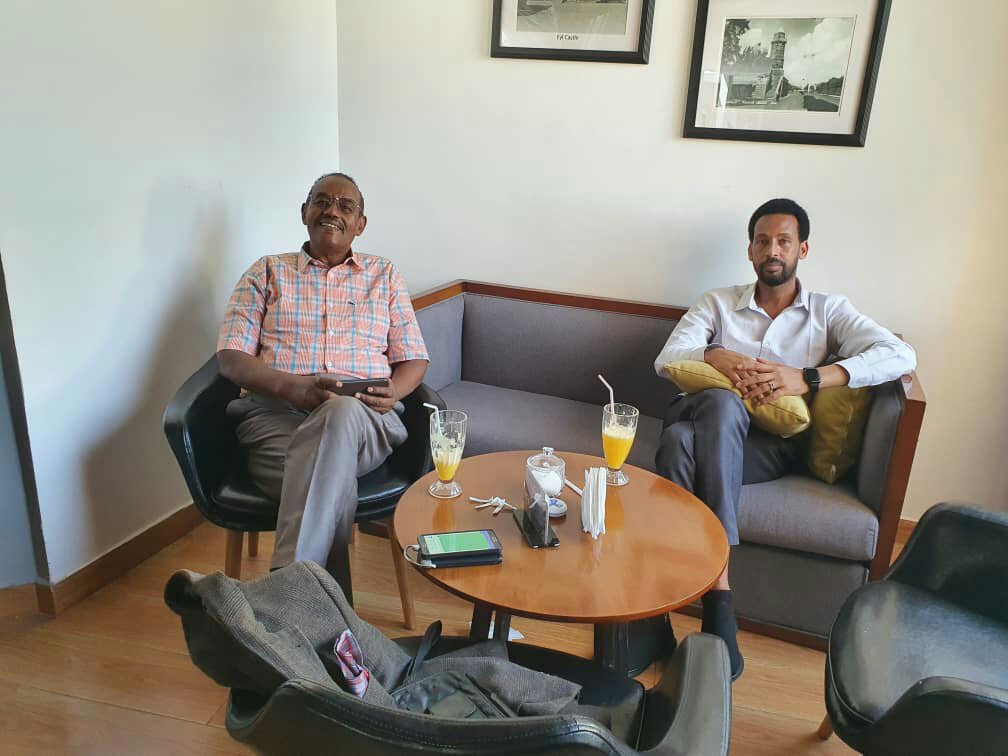
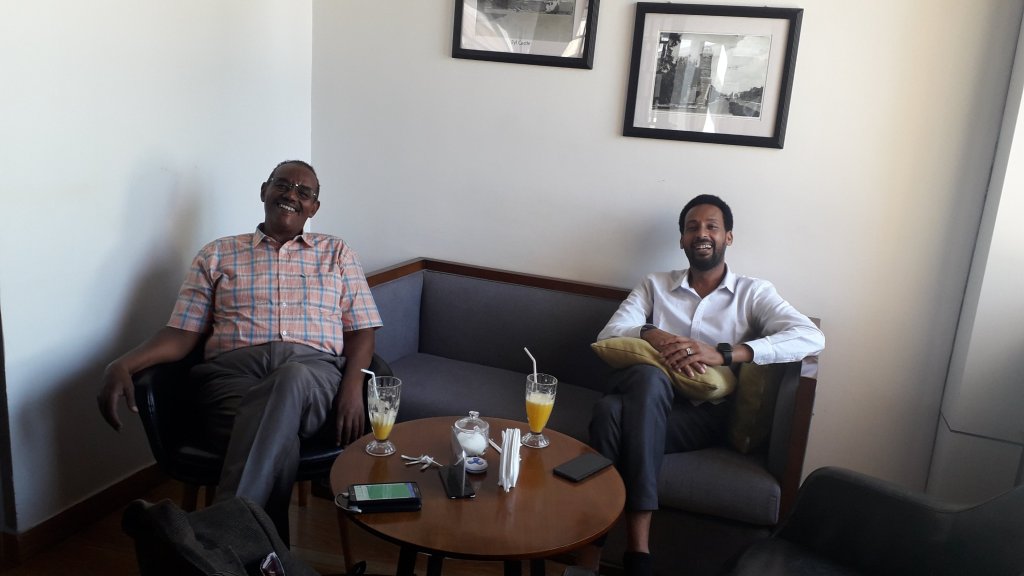
TODAY WITH MINISTER ABDIRASHID YUSUF NUR OF SOMALI STATE OF ETHIOPIA (DDS)

At Martisoor Hotel, Garowe

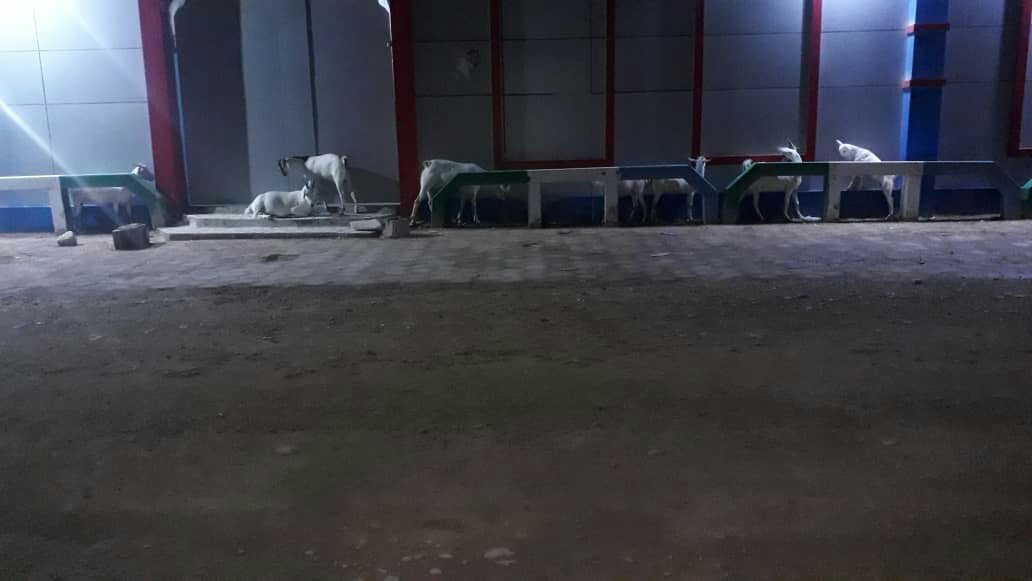
ANNOYING ANIMAL HERDS IN GAROWE TAKE OVER BUILDINGS AT NIGHT

I was driving yesterday evening along a rough road infront of Golis Telecom HQ in Garowe, when I had noticed the entire building and its surroundings were taken over by goats like hungary locusts over a field of plantation. The local government of Garowe should revise its city council membership to consider electing some persons representing the undeniable numerical superiority of herd-resident population in Puntland Capital City, unless the existing members of the City Council consider themselves as representatives of the interests of growing population of herds here.

There are either no city regulations  governing the mess that had been created by huge influx of herds into Garowe, or nobody cares to enforce such city by-laws. Now, goats loitering in Garowe City outnumber its human residents. Under these circumstances, there is a need to establish organizations for animal rights. The abusive owners of these invading herds too should lawyer up because there will be soon lawsuits against against them for turning the City into animal zoo with impunity.

There are no veterinary/medical centers in the entire city of Garowe for the welfare of huge number of goats and sheep lazily loitering at gates of every building to the inconvenience and annoyance of every citizen in town. Goats and sheep deliver their babies out in the streets with nobody caring for or looking after them. Vehicle drivers find it difficult to move around the city without crushing into flocks of herds blocking driveways and roads. Earlier, one commentator wrote that Garowe City couldn’t hire the required municipal workers for garbage collection because goats do that job for them to relieve the city of extra budget burden the City Council may otherwise allocate.

This is a dystopian world frightening every civilized person. Puntland State ought to intervene and do something about the ongoing animal cruelty, bad culture of the owners of animal herds in town, and poor job performance of the Garowe City Council in abysmally failing to regulate the chaos caused by roaming and trespassing herds.

Get your copies of these best seller books at https://amazon.com/author/ismailwarsame

Goats gathering at front gate of Golis HQ in Garowe at night

WDM YEARLY SUBSCRIPTION

Annual fee

$37.00

NOSTALGIA

Garowe, May 10, 2019 – Somali travelers from Mogadishu experience in Garowe not only personal relief and peace of mind, but also feeling of nostalgia of good old days of calm and peaceful Somalia – a part of Somalia they can move around in town round the clock without encountering any incident of inconvenience in their free exploration of life in the city.

Somalia’s Prime Minister, Hassan Ali Khayre, had tested the sweetness of peace and tranquility here when he recently had chosen to walk around the streets of Garowe, touring city hotels and restaurants to break his Ramadan fasting, chatting with customers and enjoying casual conversations with the residents of Garowe from all walks of life.

Those FGS officials of Puntland origin, whether they are members of the two chambers of Somalia’s Federal Parliament, the Cabinet or civil servants, struggle and fight for obtaining places, spaces and time to squeeze into the Federal leaders’ travel packages for occasional working and official visits to Puntland in order to re-enjoy the feeling of peace and life without the fear of bomb-blasts and threatening phone calls from mass killers and extortionists in Mogadishu.

Welcome back to Puntland, friends! Enjoy your life as it should be. Just remember one thing, you won’t make easy Benjamins here in Puntland – that could be inconvenient to some of you.

ismailwarsame.blog

PUNTLAND: TRANSITION TO DEMOCRACY

April 6, 2019
Talking Truth to Power.
PUNTLAND DEMOCRATIZATION PROCESS: OPPORTUNITIES AND CHALLENGES
Historical Background
The formation of Puntland State of Somalia in August 1998 was not a sudden development, but a culmination of a process following many community attempts in Northeastern and Northwestern Regions of Somalia, armed struggle and the Civil War aside. Cities like Galkayo, Garowe, Qardho, Bosaso, Boocame and Borama were all important venues for community meetings for reconciliation and forward thinking, eventually paving the way for the foundation of both Puntland and Somaliland administrations.
One of such community meetings was one called “Nabad & Nool” held in Garowe in 1993. Leading this conference were elders from all regions of Harti sub-clan system.
Some of the prominent clan elders of Sool and Sanaag, who had joined the Consultative and Constitutional Conferences, and helped setup Puntland State, took part in both Borama and Boocame meetings and congresses for the formal establishment of Northwest Administration (Somalia). Among them include Garaad AbdiQani Garaad Jama, Garaad Saleman Garaad Mohamed, Garaad Ismail Duale. Suldaan Said Suldaan Abdisalam had also joined the process in later stages.
In the case of Puntland, the society has deep historic roots in traditional self-government with sultanates and kingdoms in the background. Before the successful establishment of Puntland State, there were a series of failed administrative establishments in Northeastern Regions of Somalia. Among them was one led by Abdullahi King Kong in 1992 and the other by Mohamed Nur Jama (Dhigic Dhigic) in 1994. Both administrations existed, in their separate short periods, along with SSDF control of Northeastern Regions. These administrations failed due to lack of skills and capacity in governance, absence of vision and fatal misunderstanding of their leadership role as self-governing entities in the Regions. Puntland charter had decommissioned the civil war organizations of SSDF and SNDU as well as USP on the eve of Puntland foundation.
Based on this brief historical perspective and on the backdrop of failure of all Somalia’s National Reconciliation Conferences (SNRC), people of Northeastern Regions, Sool, Sanaag and Buhoodle had finally got convinced that Somalia couldn’t be reconstructed from top-down as warlords didn’t have legitimate representation as they also couldn’t agree on a united national political platform. Warlordism was their political attraction and preference in maintaining their respective fiefdoms, particularly in Banadir Region.
Puntland State was established on the notion of a “BOTTOM-UP APPROACH” or “BUILDING BLOCKS” (FEDERALISM)) as the basis for re-instating the failed Central Government of Somalia with avoidance of reviving a city-state or a dictatorship.
Delegates to the Founding Congresses, the Community Constitutional conference held in Garowe on May 15, 1998 had resolved to commit themselves to fulfilling two central objectives:
1. To create a regional state with all branches of a government representing the people of Northeast, Sool, Sanaag and District of Buhoodle.
2. To work hard towards the re-instatement and reconstruction of Somalia’s failed Central State.
The 2nd objective would become a daunting task and overly ambitious undertaking that took away most of the time and resources of the New State of Puntland. It had also impacted negatively on Puntland Democratization Process and discharge of constitutional mandate of the government in that regard.
Equally challenging was the fact that the New Administration of Puntland faced upfront serious political and economic challenges. On the one hand, it had to prove itself to be a viable regional state economically and meet the challenges of law and order as clan militias and bandits rampage the regions with their illegal checkpoints stretching along the roads and all cities entry ports. Re-constructing the New Somalia also needed leadership, role model and resources, on the other hand. That also required allocation of Puntland leaders’ time, space and travel.
The international community was split between supporting the Puntland concept of Bottom-up Approach and Top-down Approach of Somali National Reconciliation Process (SNRP).
There was a tough debate within Puntland itself on whether to leave the rest of Somalia to its own devices by focusing on Puntland development, building and strengthening its institutions only or Puntland to put in leadership and resources in re-shaping the New Somalia.
This debate is still raging on. The consensus of Puntland institutions, however, was that the New State couldn’t afford to see the slow disintegration of the Somali Republic as Mogadishu Warlords couldn’t envisage the immediate danger and existential national threat to Somalia.
CHALLENGES TO DEMOCRATIZATION DURING 3-YEAR MANDATE OF PUNLAND FIRST GOVERNMENT
In a nutshell, democratization became increasingly the improbable mission as the Puntland first government operated under tremendous difficulties and faced enormous challenges, especially in the security and economic sectors. To say the country was in humanitarian crisis is understatement. There was a huge influx of IDPs of not only persons of Northeastern origin fleeing from all war-torn urban centers of Southern Somalia, but also thousands of other Somalis coming from every corner of Somalia and in particular, from Banadir, Middle Shabelle, Jubaland , Bay and Bakool regions. The New Puntland State of Somalia was under constant threat to its security and aggression from its Southern and Northern borders. The Civil War was still raging. Jubaland was under constant military siege with General Aydiid posed to re-take Kismayo. The State Constitution was provisional and state institutions just so established were fragile and ineffective. The State infrastructure was non-existent. The Presidency, Cabinet, House of Representatives had no offices to operate, not to talk about other agencies of the State. It was almost an impossible task to run a government, let alone to think building a modicum of a government under these conditions.
Now, think of Democratization under the prevailing situation. Still, in accordance with the Article 28 of the Charter, the First Puntland Cabinet of 9 Ministers started deliberating on the possibility of holding local and general elections on the basis of one person one vote. The Cabinet has resolved to send to task two independent constitutional and electoral commissions in accordance with Article 10 (i) and 10 (ii) of the Charter for approval by the House of Representatives.
1. Constitutional Commission of 15 members proposed by the government for Parliament approval to draft Puntland new constitution and put it for a statewide referendum never materialized due to conflict and legal rankling between the branches of the government and within the House of Representatives itself
2. Electoral Commission to draft legislations and electoral laws
Each commission had its own chairperson and included some members of Puntland House of Representatives, Judiciary, Attorney General and civilians representing the interests of different regions of Puntland
Unfortunately, the Electoral Commission was formed late into the government mandate, and perhaps, it had had barely enough time to prepare. But, the Commission finally submitted their findings in a report to the Cabinet with the following conclusions:
THE FOUR BIG NOs:
1. No population census can be done on time.
2. No public disarmament can be done on time.
3. No financial resources are available
4. No secure environment for elections yet in the country.
The Cabinet had no alternative but to discuss alternatives to seek a new mandate. Two options were on the table:
To resort to the founding formula of regional clan-based representation for which there was very limited time to carry out
1. To propose an extension of institutions mandate for two more years to House of Representatives.
The Cabinet opted for the 2nd scenario. The House was deliberating on the possibility of changing of some articles in the charter like the infamous Article 34.1, 34.2, which stipulates that this couldn’t be done, when the government mandate had expired. The President of the Supreme Court declared himself President for a month pending an election of a president, and prominent elders meeting in Garowe on the issue had endorsed the Supreme Court president’s take-over based on Article 34.2. A constitutional crisis set in and the rest of story is history now.
RECOMMENDATIONS
The Transitional Charter established a transitional authority that within a mandate of three years, ending on 30 June 2001, should accomplish democratization benchmarks as is provided in Article 28 of the charter. However, that proved unrealistic and therefore unfulfilled for the following reasons:
1. To the assessment of many, there was no serious commitment and political will to democratization by all branches of Puntland Government.
2. The operating environment was not conducive to holding elections in terms of :
3. a) Security b) Resources and capacity c) Time constraints and pressure created by Somalia’s National Reconciliation Conferences d) Conflict within all branches of the government and within the legislature itself. The source of this conflict and deadlock was based on articles 34 and 35 of the Charter, especially Article 35, which stipulates that among charter articles that cannot be amended by the legislature include Article 34.2 ( See them in Somali here below).
Despite all the provisions of the Puntland Constitution, there is one persistent question in the minds of both experts and Puntland politicians alike: In a countrywide suffrage, what will be the qualitative choice and result of uninformed clannish society like that of Puntland? Does the track voting record of 66 Puntland MPs give us any confidence towards holding general elections on the basis of one person one vote? Are citizens ready to choose one candidate over another on merit without clan identification? How a general election in Puntland will differ from the existing regional clan representation? Will it have the same qualitative characteristics as the existing clan representation with even more complications and likelihood for electoral violence and breakdown of law and order? These are valid and serious questions that require serious answers and studies.
As a student of Puntland governance history, I believe that some of these questions cannot be answered without putting the experience to the test, starting with local or city council elections. It is good to remember that Somalia’s first democratic elections in 1954 got started with municipal election first.
Presentation at PDRC
by Ismail H. Warsame

THE STORY OF DHAWEEYE

When we wrote and posted this story years ago the service was relatively new, and some overseas readers didn’t believe the story was real. We feel it is now worth reposting it. Enjoy reading it.

DHAWEEYE or Uber Taxi Service is a very strange phenomenon to Garaad Abdullahi Ali Eed (RIP), one of the most respected Tradional Leaders in Puntland. Garaad Eed who is staying in Garowe these days shared his experience with the new services the other day.

The Garaad wanted to go somewhere in the city in a hurry. He couldn’t wait any longer for his chauffeur- driven vehicle. He decided to take a taxi. His young helper recommended and volunteered to call an Uber service instead. The Garaad couldn’t understand the lad’s advice, but gave him the go ahead anyways with the call.

Within minutes drove in a nice and luxury medium-sized Salon to pick up the Garaad. A clean and nice looking young man was sitting behind the wheel.

Seeing how young the driver was and conscious of and concerned about his own safety and security, the Garaad had reluctantly boarded the car together with his helper.

Upfront and immediately before he drove off, the Dhaweeye kindly offered a fresh and cold bottle of camel’s milk to the Garaad. Surprised at this unexpected courtsey gesture from the strange driver, the Garaad politely declined the generous offer. The Garaad, however, felt safe and comfortable during his short journey with the new service of DHAWEEYE.

Dhaweeye or Uber service is a very convenient taxi service widely available in all major Puntland cities. There is even DhaweeyeApp downloadable on the Internet.

Welcome to globalization!

WHY THE PORT OF GARA’AD IS NEEDED – A BRIEF PERSONAL ACCOUNT

Attention: National and international dignitaries as well as major business community will gather in Gara’ad on the shores of the Indian Ocean for the official Opening Ceremony of Gara’ad Port next week, a major Puntland community investment. The project is one of the biggest infrastructure undertakings in Africa. The host is Puntland State President, Said Abdullahi Deni. At least one thousand guests are scheduled to attend the Ceremony.

A Personal Account

It was 1997 when a delegation of now defunct National Salvation Council (NSC), the Sodare Group, led by then Co-Chairmen Abdullahi Yusuf and Ali Mahdi Mohamed, went to Mogadishu to meet with an Italian envoy sent to mediate conflicting Mogadishu Warlords of Hussein Aideed, Ali Mahdi and Late Osman Ali Ato. I was one of that 13-member strong delegation. The intention of the Italian Envoy, Senator Serri, a deputy minister of the Italian Foreign Ministry, was to re-introduce Italy’s influence to the re-emerging Somalia from the Civil War. The idea was for Italy to be ahead of everyone else in the game of influencing Somalia as a former colonial power and power broker as the country re-instates itself from the total collapse as a failed state. The Italians believed that the obstacle to Somalia’s recovery was the warring factions of Banadir Region at the time. They had money incentives to bribe the warlords into accepting an Italian-brokered deal. Ali Mahdi wanted a piece of the cake. Abdullahi Yusuf planned to foil the Italian efforts as he thought the Italian policy was wrong-headed as he believed that Somalia couldn’t be reconstructed from the Centre, but rather from “Building-Blocks” as federated states. There was a deep mistrust between Aideed and Ato since the killing of Aideed Sr. The Italian Envoy’s mission to Mogadishu ended in spectacular fiasco to the pleasure of Abdullahi Yusuf.

Back in Nairobi enroute to Italy, and commenting on the unexpected Yusuf’s presence in Mogadishu, Senator Serri called a hasty press briefing during which he declared; “We were struck by an eagle in town”.

After two weeks in Mogadishu, we returned to Addis Ababa, the Headquarters of the NSC, to prepare for a national congress to be held in Bosaso, the North-eastern Regions of Somalia. Egypt, with the help of the traditional Ethiopian foreign policy naïveté on Somalia’s internal dynamics, had successfully undermined both the NSC and IGAD efforts to hold that National Reconciliation Congress in Bosaso. One would recall the failed Somali Peace Conference in Cairo in 1997, resulting in the demise of both the Sodare Group and “Salbalaar Government” of Hussein Farah Aideed.

While in Mogadishu, we held non-stop private and public discussions with many groups, representing all walks of life. These people had two nagging questions for us to answer:

  1. “How do we participate in the planned National Reconciliation Congress in Bosaso”?
  2. “Why don’t you construct a Gara’ad Port? Bosaso Port is too far from us”.

At the time, Mogadishu Port was un-operational and closed to business. Still residents of Central Somalia thought a Gara’ad port would be very convenient for them even if Mogadishu Port were functional. At that time they were using land transport to and from Bosaso Port.

In Addis Ababa, residents from Eastern Ethiopia are land-locked as it is in the rest of the country. They were very much interested in the construction of a nearby seaport as Gara’ad.

The commercial potential of the Gara’ad Port for Somalia and Ethiopia is huge. The economic and security importance of the port in the entire region is, without doubt, very high. I strongly believe that a Gara’ad seaport would be the most convenient outlet to the Indian Ocean for the peoples of Central Somalia and Eastern Ethiopia for quick movement of goods and services along stable and secure corridor.

By Ismail Warsame

Ismailwarsame@gmail.com

@ismailwarsame

SOMALIA: UN Envoy in Puntland to discuss tropical cyclone response and forthcoming elections

Flag of Puntland since 23rd December 2009 http...
Flag of Puntland since 23rd December 2009 http://horseedmedia.net/2009/12/puntland-parlaiment-adopts-new-flag/ Deutsch: Flagge Puntlands seit 23. Dezember 2009 http://horseedmedia.net/2009/12/puntland-parlaiment-adopts-new-flag/ (Photo credit: Wikipedia)


SOMALIA: UN Envoy in Puntland to discuss tropical cyclone response and forthcoming elections.


Why Puntland State Deserves Better Presidential Candidates than Faroole and Gas

Location of Puntland State of Somalia
Location of Puntland State of Somalia (Photo credit: Wikipedia)

Puntland State of Somalia is one of the few achievements I happen to be proud of. Other Puntlanders, stakeholders and supporters in Somalia and beyond, within the Diaspora and external players today can pause for moment to imagine their social, political status and relationships with Somalia without the existence of Puntland State. While people always give the visible leader the credit for it, I had the chance to know full well that there were a few of us that made the difference in initiating its creation and playing the critical role in making it a functioning reality that changed the political landscape of Somalia for ever. This is my moral authority and basis on which I pen this short article.

Once again, Puntland State is at cross-roads and it was unfortunate that the democratization process failed abysmally. That was a great setback for the people of Puntland. Nevertheless, the State is relatively safe and has high hopes for a better future. But, to survive and progress, Puntland requires an urgent political change that the current administration cannot deliver. Faroole is a spent force and is running out of ideas, on the top of his poor domestic policies. He becomes a divisive figure and liability for Puntland despite his foreign contacts drama and superficial Diaspora perception that he is the man who can challenge the ill-advised and naïve Damul Jadid Clique in Mogadishu. To refresh up the memory of the readers of this article, Faroole was against the foundation of PuntlandState from the onset to consist of Sool, Sanaag Bari (now Haylaan), Nuguaal, Bari, Mudugh and the District of Buuhoodle (now Cayn). He was among the proponents of creating only Northeastern Regional Administration ( not even a regional state) composed of only Mudugh, Nugaal and Bari ( Karkar Region was part of Bari then). He fled to Australia in early July 1998 before the creation of Puntland State and in the last days of the Puntland Constitutional Conference to found the State when he and his colleagues failed resoundingly in their attempt to exclude Sool, Sanaag and Buuhoodle in the process.  He came back later to Somalia in early 2000s to oppose Puntland State every step of the way. For a long time he was frequenting anti-Puntland conferences and lobbies in Djbouti, Mogadishu and elsewhere. As he left the Conference, I vividly recall his departing words, on the mike, to the Late Islaan Mohamed Islaan Muse, then the Chairperson of the Constitutional congress and I quote, “Shirku waa afduubanyahay”, unquote ( The Congress is being held hostage). Following Puntland State constitutional crisis involving Supreme Court President, Yusuf Haji Nur, Jama Ali Jama and Late Abdullahi Yusuf, and as gesture for Puntland internal reconciliation, I personally persuaded the later to include Faroole in the New Puntland Cabinet as a counter-weight to the defection of Hassan Abshir Farah, then the Puntland Interior Minister, to Arta’s produced TNG of President AbdulQasim Salad Hassan. Despite his background, he was appointed Puntland Finance Minister. He became President of Puntland State due to the unpopularity of then the incumbent Puntland President, General Mohamud Hersi Muse (Boqor), bribery, intimidation of non-Majertaine MPs in Garowe and absence of capable Presidential candidates on the scene at the time. This can happen again if Puntland communities do not do their due diligence in searching and finding better alternative candidates.

The People of Puntland State are now ready for change. To effectively take part in that on-going political need and imperative for change, Traditional Elders, business community, intellectuals and any person at grass-root level has to help in selecting truly representative and worthy members of Puntland State Parliament. People who hail from Khatumo areas have the moral obligations and legitimacy too as founders of Puntland State to help in the current efforts for political change. All Puntlanders have every right and owe to their country to select and promote capable and honest patriots as presidential candidates on merit: personal integrity, character, leadership talent, experience and vision. They have to do their due diligence to get it right this time around, and peacefully. We must insure that if such a candidate wins the election, he/she must not use Puntland State as stepping stone or leverage for a national position in the Federal Government of Somalia, but willing instead to concentrate and focus on the unity, peace and socio-economic development of Puntland as his/her priority No. 1.

I know a good number of Presidential candidates have put their names forward. My assessment is that while many of the declared candidates have something to contribute, they don’t pass the test of leadership requirements needed in Puntland at this crucial moment. Puntland State deeply suffers from political stagnation, has serious governance and security problems. The country is politically polarized and unity is at stake. Economy has collapsed because of lack of sound fiscal management and absence of competition in a free market, leaders’ destructive interference in the market, nepotism and cronyism of the administration. No one among the known Presidential candidates can meet the challenges now Puntland faces.

Current political perception within Puntland Diaspora and supporters of Puntland is that there are two front runners among these candidates: They claim to be Abdiweli Hassan Ali (Gas) and incumbent President,  Abdirahman Mohamed Mohamud (Faroole). I take an exception to this artificial and cosmetic assessment of reality in Puntland. My take on them is based on my Puntland experience and reading of the prevailing political situation at home now.

Let me call a spade a spade. Dr Abdiweli’s chance in that race is extremely limited. I also suspect that Dr. Abdiweli (Gas) has other personal national goals and ambitions and Puntland is not his priority. Based on his short political life as Prime Minister of Somalia, he did little or nothing for Puntland interests, although I acknowledge that he had had a bad working relationship with Faroole that made doing business with Puntland difficult. In fact, tampering of the Provisional Federal Constitution was done under Abdiweli’s watch. He and his team ( including his right-hand Constitutional Minister, Abdi Hosh) failed to deposit the constitutional version agreed upon in Garowe I and Garowe II to Congress delegates that provisionally approved the Federal Constitution. Instead, a print-out of completely another version was distributed to the 800 Congress Delegates, including the Traditional leaders that gathered and finally approved it in Mogadishu. That was a long time before President Hassan Sh. Mohamud got elected. To sum it up, the Road Map Dr Abdiweli seems to be proud of today is faulty and had done considerable damage to Somalia’s future governance as it was detrimental to Puntland vital national interest: Federalism as safeguard against Central Dictatorship and return to a One-City Republic Status. In terms of team work and selection of aides and political advisors, he is considered the worst Prime Minister that the successive Somali Transitional Governments had ever had.

The Roadmap received help and new boost from the most unexpected source: Jubaland, a non-existent entity during the Roadmap process. The appearance of JubalandState (which, of course, PuntlandState has been working tirelessly for throughout its existence) saved the day to re-enforce the Puntland State Vision on future governance system for Somalia. This de facto establishment of Jubaland Administration, in turn, led to the overwhelming acceptance of federalism by the international community as the only viable option for Somalia’s governance. Abdiweli also did nothing to contribute to the noble cause of creating JubalandState. He was not even visible during those tough political and military fights for Jubaland. One may recall that he was a tourist and traveling guest among the Puntland Diaspora in every corner of the world on a mission without an objective beyond his personal interests. Therefore, Puntland does need a man with that profile. It is too risky to take a chance!

I strongly believe that Puntland State communities have yet to produce the right Presidential Candidates to choose and elect from, and that is a heavy responsibility for all concerned. Let us debate on it and get this done. Take a note that time is of the essence in this regard.

Puntland Elections

Flag of Puntland since 23rd December 2009 http...
Flag of Puntland since 23rd December 2009 http://horseedmedia.net/2009/12/puntland-parlaiment-adopts-new-flag/ Deutsch: Flagge Puntlands seit 23. Dezember 2009 http://horseedmedia.net/2009/12/puntland-parlaiment-adopts-new-flag/ (Photo credit: Wikipedia)

Puntland State suspends scheduled local elections. It is a serious setback for all concerned and bad news for democratization process. I hope it is a tactical retreat and not shutting the doors to democracy. The so-called opposition leaders want to maintain the status quo for years to come. They don’t know anything better. That explains their resistance to multi-party political competitions.

The Government too approaches and conducts multi-party system under suspicious manners, acting and running like a one-party fashion, compelling all officials under its influence to adhere and be loyal to the Ruling Party. This plays counter to democratic principles and freedom of choice. The Government handling of the process is full of conflicts of interest. This is one of the main reasons as to why the process hit a dead-end and loss of lives. They were not listening to those, who have enough experience on the political reality on the ground in Puntland State of Somalia. Absence of dialogue is never conducive to democratic space. This is core of the problem. My way or the highway position will not fly in Puntland. One should share ideas, solicit for ideas and consult with sincere patriots and time-tested traditional leadership.

Now it is time for the Government to start restoring trust among key players and have ample time for dialogue to build consensus, moving the political process forward. Massive media information, education on the importance of democracy, citizens’ rights and obligations, freedom of individual choice and community awareness are required. To make the right individual election choices, citizens must be informed beyond the sub-clan interests.

At moment, both sides of the debate are trying, in their own excuses and pretext, to stifle democracy. They may succeed for a short period of time, but cannot arrest the political trend in the country and expectation of world community, if Puntland was to survive as a federate State of a Federal Somalia.

The S.F.G.’s Strategy of Political Conflict

A confrontation over the form of federalism that a future Somali state would adopt is looming, as confidential sources report that the provisional Somali Federal Government (S.F.G.) is in the process of making a concerted push to control the formation of local, regional, and presumptive regional-state administrations in south-central Somalia.

The S.F.G., say the sources, is attempting to resist the early formation of a Jubbaland state in the south that would base itself on a decentralized-federal model, as Puntland has done; head off a similar process to the one in the south in the southwestern Bay and Bakool regions by placing an administration allied to it in charge there; counter the Galmudug authority in the east-central area by backing ex-warlord Abdi Qeybdid against the sitting government; and influence the leadership that will succeed the recently-deceased chair of the Ahlu Sunna wal-Jamaa (A.S.W.J.) movement, Sh. Mohamed Yusuf Hefow, that controls most of the central and east-central regions of Galgadud and Hiiraan. On each of those political fronts, the S.F.G. faces opposition, both locally and nationally by the autonomous state of Puntland, which resists the S.F.G.’s bids for control.

The S.F.G.’s Strategy of Political Conflict

By adopting a strategy of political conflict in south-central Somalia’s regions, the S.F.G.’s president, Hassan Sh. Mohamud, is attempting to solve his most pressing political problem, which is to establish the S.F.G.’s authority – dominance and control – over those regions. In the process of trying to do so, Mohamud is forcing the issue of what the state-form of Somalia will be. The options have narrowed down to two, a centralized federalism favored by the S.F.G. and its allies, and a decentralized federalism advocated by Puntland and its allies. The core political conflict in Somalia is between the S.F.G. and Puntland over state-form; the south-central regions are the arenas in which that conflict is being played out. Both the S.F.G. and Puntland are aware of the high stakes involved in their confrontation; if the S.F.G. prevails in the south-central regions, Puntland will be politically isolated and subject to pressure to abandon its autonomy, which gives it generous control over its natural resources and security policy; if Puntland is able to block the S.F.G., the latter will have had to cede significant authority over nascent regional states. The S.F.G.’s pursuit of a strategy of political conflict has turned a constitutional issue into a political power struggle.

Whether or not the S.F.G.’s strategy succeeds – and its success is highly problematic – that strategy is intelligible and follows from the power position of the S.F.G. The new federal government was to all intents and purposes imposed by the Western “donor”-powers/U.N. under veiled and explicit threats to withdraw financial support. The “donor”-powers wanted a “permanent” government established in Somalia so that they could decrease their commitment to the country and at the same time make agreements favorable to them with it.  In pursuing those aims, they ended up settling for a provisional/interim entity operating under an incomplete constitution that left the fundamental question of state-form open; absent from the constitution was a determination of centralized or decentralized federalism, and there were not yet regional states set up in south-central Somalia.

As a result of the “donor”-powers’ actions, the S.F.G. was left with the challenge of establishing its authority in the south-central regions without a constitutional basis, scant resources to buy allies in the regions, and military forces that did not extend beyond the capital Mogadishu. Under those constraints, the S.F.G. had few options; it could renounce the attempt to control the south-central regions and allow those regions substantial autonomy, which would weaken whatever (potential) power it might have; or it could do what it has chosen to do, which is to contest the forces for decentralized federalism region by region by allying with factions in each region that felt marginalized by nascent autonomous administrations with power bases independent of the S.F.G. The new federal government opted for the latter, which set up the conditions for political conflict. A source reports that the strategy of political conflict was urged upon Hassan by his inner circle of advisers from his Damul Jadid movement.

The consequences of the conflict strategy carry severe risks to stability. The divide between the forces of centralized and decentralized federalism has become confused with sub-clan rivalries within the regions, exacerbating animosities that already existed. Those rivalries have also given the revolutionary Islamist movement, Harakat al-Shabaab Mujahideen (H.S.M.), which had been pushed out of control over its most lucrative territories, an opportunity to recruit from disaffected sub-clans, and it has drawn Puntland into the fray.

The conflict strategy shows the power deficit of the S.F.G. and its efforts to rectify it. None of what the S.F.G. feels that it has had to do would have been necessary had an effective process of state-building been instituted, which would have involved a process of social-political reconciliation among Somali factions leading to a constitutional agreement to which the major factions would have signed on. That possibility was eliminated by the “donor”-powers’ actions, and that constitutes their most egregious political failure.

As a result of the “donor”-powers’ actions, the domestic Somali actors have been left to pick up the pieces. Absent political reconciliation and the trust that comes with it, the Somali domestic actors are constrained to pursue their perceived interests and attempt to make them prevail. There is no reconciliation process in place; the stage is set for sub-clan-impelled constitutional confrontation abetted by ex-warlords and revolutionary Islamists. Interpreted through the dramaturgical model in political science, a tragedy is unfolding in which the protagonists-antagonists can see nothing to do but play a zero-sum game.

The Status of the Conflict

It is too early in the conflict over the state-form that Somalia will/might take to make a grounded prediction about its outcomes. The S.F.G. has only attempted to implement its strategy of political conflict in earnest since the return of Hassan to Mogadishu in mid-February from his round of visits to the external actors with interests in Somalia. Having touched base and gotten promises of support, Hassan had to try to “deliver” on his end of the bargain, showing that he led a (potentially) effective government.

Hassan’s most important political front, which demands his immediate attention, is the south, where a convention is slated to be held on February 23 to form a Jubbaland state comprising the Lower and Middle Jubba regions and the Gedo region. Approximately 500 delegates, including elders from the three regions are expected to attend, with the S.F.G. and regional states (Ethiopia and Kenya) as observers. Up until the present, it has appeared that the Jubbaland process would issue in a regional state modeled on Puntland. The S.F.G. will try to reverse that outcome.

According to one source, Hassan’s strategy has found willing supporters among sub-clans in the south that feel disadvantaged by the dominance of Ahmed Madobe, the interim governor in Kismayo, and his Ras Kamboni militia, which is allied with Kenyan forces in the south and is mainly composed of members of the Mohamed Suber sub-clan of the Ogaden-Darod. That leaves other Ogaden sub-clans, the Majertein-Darod (with ties to Puntland), and the Marehan-Darod more or less disposed to thwart any attempt by Madobe to dominate the Jubbaland state.

Another source confirms open-source reports that ex-warlord and Marehan leader, Barre Hirale, has met with Hassan and is “on good terms with the S.F.G.”  The source says that the Marehan will “listen to Hirale if he is empowered.” Meanwhile, on February 13, Garoweonline reported that a delegation whose members are involved in forming a Jubbaland state met with Puntland’s president, Abdirahman Mohamed Farole, to discuss how “Puntland’s efforts to establish [the] Jubbalnad state could be improved.” On February 15, Garoweonline reported that Hassan and the S.F.G.’s prime minister, Abdi Farah Shirdon, who is Marehan, had split on the Jubbaland issue, with Shirdon supporting the ongoing process and Hassan attempting to undermine it.

The reports from closed and open sources present a picture in which fations in the south have not (yet) fully aligned, crystallized, and polarized around the issue of state-form, and around the S.F.G. and Puntland, with the S.F.G. itself split. The S.F.G.’s presence at the slated convention represents a concession by Hassan by virtue of his acknowledging the Jubbaland process, but it also is an opportunity for him to influence its outcome. Puntland will not be present at the convention, but it will attempt to work through its allies. How the local factions will align, insofar as they do, and how big a role the regional external actors decide to play, and on which of the sides, will determine the outcome, in addition to the efforts of Hassan and Farole.

The second front opened by Hassan in implementing his strategy of political conflict is the southwestern Bay region, dominated by the Rahanweyne clan, where an attempt to form a regional state composed of the Bay and Bakool regions was underway but had not advanced as far as it has in the southern regions. In the south, Hassan has been constrained to try to turn an ongoing process that was going against him to his favor or to subvert it, whereas in the southwest he has attempted to head off such a process before it began to function independently of the S.F.G.

Hassan moved by issuing an S.F.G. decree replacing the longtime Bay political leader and sitting governor, Abdifatah Gesey, who had been backed by Ethiopia and had forces in the region, with Abdi Hasow. Gesey resisted the S.F.G.’s action, declaring that he remained governor. According to a closed source, Ethiopia turned against Gesey and used its forces to oust him. On February 15, Garoweonline reported that Gesey had mobilized his militia and was still in the Bay region’s capital, Baidoa, whereas Hasow was out of public view. According to Garoweonline’s sources, the confrontation between Gesey and Hasow had caused the Bay administration to grind to a halt. Efforts to mediate the dispute were initiated and a delegation was sent to the region by the S.F.G.

On February 21, Garoweonline reported that Gesey was taken by S.F.G. security forces to Mogadishu after mediation efforts had failed. Sources in Mogadishu told Garoweonline that Gesey was “promised another title” in the regional government.
An indication of why Ethiopia switched sides and altered the distribution of power in favor of the S.F.G. is given in an Ethiopian government statement on February 16 concerning talks between the Somali Federal Parliament’s speaker, Mohamed Osman Jawari, and Ethiopia’s foreign minister, Tedros Adhomam, in which Jawari is reported to have urged the formulation of a “common position” between the S.F.G. and Ethiopia on the London conference on Somalia that will be held later in 2013. In return, Ethiopia promised to “work with Somalia on pushing donors to keep their promises.” Jawari then traveled to the ethnic Somali Ogaden region (Somali Regional State) of Ethiopia, where he met with regional officials and visited schools. Reports did not mention any hint that Jawari had taken up alleged human rights violations committed by Ethiopia and Ethiopian-backed militias in the Ogaden.

Just as in the south, the outcome of the face-off in Bay cannot be predicted. The S.F.G. has gained a foothold and has leverage, but it has yet to achieve the traction to push back its adversaries decisively.

A similar stand-off characterizes the situation in the Galmudug authority in east-central Somalia, where two governments dominated respectively by different sub-clans of the Hawiye claim claim the right to rule. According to a source, the S.F.G. has recognized one of the contenders – the faction led by ex-warlord Abdi Qeybdid – as the “legitimate” authority. During the past month there have been outbreaks of politically-inspired sub-clan violence in Galmudug with open sources claiming that Qeybdid’s militia is responsible for initiating the clashes. Again, as in the south and southwest, the S.F.G.’s strategy of political conflict is being implemented in Galmudug, and its outcome is uncertain.

In the central region of Galgadud and part of the Hiiraan region, the dominant A.S.W.J. movement is in the process of naming a leader to replace Sh. Mohamed Yusuf Hefow, who died in mid-February. Hefow had been in discussions with the S.F.G. to merge A.S.W.J. with it. A.S.W.J., which has several factions that support or oppose collaboration with the S.F.G. in various degrees, has now become subject, according to a source, to pressure from the S.F.G. to integrate with it on the S.F.G.’s terms. Again, the outcome is uncertain, but the S.F.G.’s push is underway. The source reports that a delegation from the federal parliament is in Galgadud, claiming that they are “consulting with local communities on extending government rule” to the region. The source says that the presence of the delegation has led to a dispute between some of the A.S.W.J.’s leadership and the S.F.G.

Assessment

One of the sources contributing to this analysis has put the S.F.G.’s/Hassan’s strategy of political conflict succinctly and precisely: Hassan is attempting to isolate some leaders and factions in each region and to empower others favorable to him. In doing so, Hassan is splitting each region politically, intervening in local conflicts and exacerbating them, and working with whoever will ally with him for whatever reason, whether it be ex-warlords, dissident clans, or factions within a movement. That is the familiar strategy of divide-and-rule, which is used by actors who cannot (Hassan) or do not want to expend the military and/or financial resources required to control the outcome of a conflict.

Hassan is playing the divide-and-rule game to extend the authority of the S.F.G. into the south-central regions, but in doing so he is carrying with him the program of centralized federalism. Puntland has yet to play its hand overtly, but it can be expected to do so if it appears that the centralized-federalist project is gaining traction and momentum. Since Hassan’s strategy necessitates opposition to its implementation by the forces that he is attempting to isolate, as it has done in each case, the path is open not only to confrontation at the local level and the re-activation of H.S.M., but to counter-moves by Puntland.

It is too early to predict whether or not Hassan will be successful, but it can be said that a political battle is looming that will overshadow all other political issues in the territories of post-independence Somalia.

Hassan’s strategy is obviously high risk and high stakes. In his best-case scenario, Hassan prevails in each south-central region and Puntland is faced with the option of compromising its autonomy or separating from south-central Somalia. Short of the best case for Hassan, “Somalia” becomes irretrievably fragmented and balkanized, or its territories become a mixture of uncoordinated regional and local forms of administration.

It is unclear whether or not the “donor”-powers understand what is happening in Somali domestic politics and, if they do, whether they are prepared to intervene and in what way. That the “donor”-powers will act decisively to try to prevent political breakdown is unlikely. The United States, for example, was prepared to support the S.F.G.’s request to have the United Nations arms embargo on it lifted, but then backtracked after European opposition and stated that it would wait for the completion of a U.N. “review”  of the desirability of taking such action. The U.S. backtrack was a blow to the S.F.G., which had expected more robust support when the U.S. recognized it.

As it stands, no actor, external or domestic, is working to avoid the impending confrontation. There is no formal process of reconciliation underway. The discourse of Somali political actors and intellectuals is not addressing the issue directly or, in some cases, at all. The external actors are silent about it. At the point at which the conflict intensifies to the degree that it is impossible for actors to ignore it, it is likely that it will be too late to resolve; this analysis is simply an early warning.

Report Drafted By: Dr. Michael A. Weinstein, Professor of Political Science, Purdue University in Chicago  weinstem@purdue.edu

Source: media


Donor Community Re-ngages Puntland Parties to Commit themselves to Holding Elections

Garowe, Puntland-Following the disagreements between the Puntland Government and the Transitional Electoral Commissions on one side and political associations on the other, on holding planned local elections in Puntland in a fair and transparent manner, or if you would, setting up a consensus platform for the rules of the road, resulting in the announcement of election boycott by UDAD, Midnimo and PDP parties, the Donor Community providing funds and technical expertise on Puntland elections, gets worried and started re-engaging parties to move the democratization process forward, according to reliable local and international sources. This is good news for Puntland and its voters to participate actively in a rare democratic process that will see inhabitants deciding the destiny of their country and an opportunity to install the government of their own making and accountable only to them. It is extremely the most important political development in the short history of Puntland and must be hailed as such.

If elections are held as planned in June of this year, based on the provisions of the Puntland Democratization Roadmap, Puntland State is set to come out of the woods and political stagnation it has been stuck throughout its existence. The Donor Community is doing a remarkable job to prevent political chaos and misuse of Donor funds, state power and resources to influence the elections’ outcome.

It is extremely important for all parties, including Puntland authorities and political associations to work with the Donor Community in this regard, for if this process fails, it will have a dramatic impact on the viability of Puntland as a Federated State in a now Federal Somalia. Fair and transparent elections are critically required to preserve the unity, peace and continuation of Puntland as the first pillar and champion of federalism in Somalia. Failure to set the example right will definitely have crucial negative influence at national level, raising renewed questions on suitability of Somalia for Federal system of governance. All Puntland stakeholders of the planned elections must be warned, advised and be very careful in moving the Democratization fairly and honestly forward.

Is Puntland is on the Brink of an Avoidable Political Conflict?

The current differences on the democratization process between Puntland authorities and opposition parties could escalate into destabilization of Puntland and gave opportunities to militants and extremists including Al-shabab now in hiding. Puntland Traditional Leadership and donor community should immediately intervene before it becomes too late to bridge the gap and mistrust between Puntland leadership and opposition political associations.

Democratization was never meant to jeopardize peace and stability in the State, but enhance people’s confidence in the process and add harmony and understanding among inhabitants. Ignored and unaddressed, this simmering political confrontation now could serve as time bomb that can explode anytime as popular protest against real or perceived Government manipulations of electoral process grow louder in the coming weeks and months. It is now about the time to intervene and mediate sides.

Already, some members of the opposition like UDAD (PPP), Midnimo, PDP and others have declared that they will be boycotting the upcoming local elections. This is a bad omen for Puntland stability and must be avoided at any cost.

These new political parties sent out letters to all local and international bodies, party to the electoral process recently and issued press releases, complaining about Government sponsorship and support for amendments, omissions by local Parliament of critical articles in the multiparty electoral laws .

A compromise arrangement has to be made to bring parties together for an agreement acceptable to all. It is in the best interests of all parties concerned to prevent hostilities and political violence.

Jubaland Close to Becoming Somalia’s Next State

Federalism in action, along the provisions of the provisional Federal Constitution of Somalia.

On the Political Stagnation of Puntland

The latest political announcements (press statements) by Puntland political parties and their petition to Puntland State President, the Electoral Commission and to some members of the international community under the heading: Resolving Local Municipality Elections Stalemate, issued in Garowe, March 21, 25, 2013, indicate either the non-existence of mutual dialogue or break-down of political discourse within the State on the best way forward for holding local government elections. A number of political parties including UDAD, Midnimo, PDP and Wadajir seem to have forged an association to challenge the Government on its latest reform proposals and planned changes in Voter IDs registration. Among other things, these new political parties demand the immediate delay of Municipal Elections in Puntland until adequate preparations are done to insure fair public participation and a new independent Electoral commission installed.

As a neutral person on the current disagreements, “stalemate” as they put it, I think it is not appropriate for me to comment on these specific documents and respective political statements surrounding these issues, despite repeated requests by members of the Puntland public to do so.

Discussing democratization process in Puntland State, however, gives me a great deal of pleasure. But, it is long overdue. It is unfortunate that Puntland State has not come out of age yet and still in the woods. In other words, Puntland has been heavily suffering far too long from political stagnation since its foundation in August 1998. Democratization in the State has never been in the good books of its successive leaders as it was never contemplated as political imperative or priority for the continued survival and sustainability of the regional administration against all imaginable upheavals of Somali clan politics and rocky relationships with the rest of Somalia.
It is extremely important to note here that rushing things of such importance and magnitude is not wise for it creates more problems and serious fatal errors in hasty fashion to feel and look good in the eyes of foreign donor community. The fate of the State hangs on it and nobody has the right to gamble at the expense of nation’s existence, public safety and regional political stability. It requires tremendous efforts, resources, thorough preparatory work and ample time to build political consensus and legal framework for the final implementation of the electoral process in fair and transparent manners.
They said commonly, “A thousand-step journey starts with first one”. Leaders of Puntland State (authority and opposition) task and obligation to their people is to make sure that ‘One First Step” towards democratization must be moved straight forward towards the right direction. The alternative spells danger and political suicide for all concerned.

How to Create a Regional State in Somalia’s Context

There are a few simple steps along the way to establish a regional state in Somali context. These are critical steps to follow for a successful conclusion of the creation of a federal state:

1. Respectful of the Federal Constitution, two or more regions must have common political, security and economic interests and must have potential to operate as a cohesive political block as well as a viable and sustainable economic unit.

2. Regions must have overwhelming grass-root support for the idea of creating their own state. These include all levels of their masses, and traditional elders at forefront.

3. A fully representative people’s congress must be held initially as Consultative Conference to resolve and agree upon:

a) Endorsement of the very idea and need for the creation of the state

b) Selection of Constitutional Committee for drafting the state’s constitution

c) Selection of Preparatory Committee for the final Constitutional Congress

d) Selection of Chairing Committee of the Constitutional Congress

e) Selection of Fund-raising and Finance Committee

f) Selection of Security Committee

g) Selection of logistics and Accommodation Committee

h) Selection of the venue of the Constitutional Congress

i) Allocation of delegates to each participating region to the Constitutional Congress for the subsequent division among clans in each region along the traditional sub-clan proportionality.

j) Creation of an atmosphere of voluntarism and regional political activism to spark off enthusiasm for urgent people’s action and personal contributions.

k) Avoidance of confrontation with central authorities in the attempt to create the state.

4. Convention of Constitutional Congress to pass the draft Constitution.

5. Setting up an independent electoral or supervisory Committee with the formulation of criteria for their mandate.

6. Election of the Chief Executive Officers (e.g. President, Vice President) if they are to be elected by the Congress.
7. Selection of members of the Legislative Council (local parliament) by the participating regions either directly by the residents or in an indirect democratic fashion by their constituencies through traditional customs to be double-checked by the Electoral Committee; Election of the Speaker and his Assistants, and immediately the Chief Executive Officers by the newly constituted Assembly if they are to be elected that way.

8. Start of regional power-sharing negotiations to form the Cabinet.

Critical mistakes to avoid:

1. When forming a regional state, never start from power-sharing approach. This is a non-starter and a recipe for failure.
2. Avoid prematurely announcing candidates for leadership and never allow anyone to put their candidacy forward until the final execution of points 1-5 above. This is the main source of division within the participants and sure factor to fail the whole idea of successfully concluding the efforts.

3. Denounce anyone seeking special clan, regional privileges or status.

3. Suppress any hints of intimidation against Congress participants. Free will of people and expression must reign supreme. Everyone must feel comfortable and feel secure and safe in the Congressional environment. Everyone must feel ownership of the state to be created.

All successful Somali regional conferences including those of Puntland, Somaliland and TFG conform to the above simple steps. All those that failed violated them by starting first with power-sharing and leadership competitions.

-End-

The world needs to adjust to new realities and reform in Somalia, says PM

Prime Minister Shirdon with Puntland President Faroole (Photo: Courtsey of Garoweonline)

His Excellency Prime Minister Abdi Farah Shirdon today urges the international community to take note of the changed situation in Somalia and adjust their policies accordingly. In a hard-hitting editorial in The National, the leading English language newspaper of the Middle East, the Prime Minister calls on Somalia’s international partners to modify their policies to fit the new circumstances of “a fledgling democracy taking the first steps of reconstruction and development”:

“For years our international relations have been conducted on a one-way basis, invariably on a humanitarian level. That model is now an anachronism and must change. We are a sovereign government… and the outside world needs to start treating us like one. It is no good criticising our lack of government capacity and then funding NGOs to execute projects while sidelining government institutions altogether. This merely perpetuates a cycle of dependence, denies us the learning experience and ensures government capacity remains limited.”

In a wide-ranging editorial entitled “Somalia replaces extremism with a programme of reform”, the Prime Minister emphasises the recent security gains that have brought Al Shabaab to its knees. “To be discussing policing, tax collection and judicial reform in Galgadud, a region that only recently was a no-go area ravaged by extremists, gives you an indication of how far we have come,” he writes, commenting on last week’s Listening Tour to the regions, in which the PM also signed a landmark deal with Ahlu Sunna Waljamaa and facilitated the establishment of local administrations.

“Only recently we could barely move safely inside our own capital.” The Prime Minister also highlights the vigorous legislative activity within the government and parliament. “Laws are the foundation of a functioning state,” he writes, noting the forthcoming parliamentary votes on legislation governing human rights reform, judicial reform, and district and regional authorities reform.

“We will also be passing legislation restructuring the police and security forces, creating specialist anti-terrorism, anti-piracy and anti-trafficking institutions, governing the Central Bank, assisting refugees and providing legal aid.”

Perhaps nowhere is reform so critical as in policing and the judiciary. “Judicial reform is one of our greatest priorities,” the Prime Minister writes. “Nothing underlines the need to reform our police and judiciary more than the decision to send a rape victim and the journalist who interviewed her to prison. Yet that regrettable verdict was a symptom, not the cause, of the problem, a lack of the rule of law.”

The Prime Minister concludes with a call for strengthened partnerships adapted to the new realities. “The need for partnerships with our international friends, which the world will see at the London Somalia Conference in May, has never been greater. We know that we cannot do it alone, but there is no turning back.”

source: AMISOM MEDIA MONITORINGPrime Minister’s Media Office

Is Carmo (Armo) National Somalia Police Academy being neglected by the Somali Federal Government?

The Armo (Carmo) National Police Academy is a Somali Federal institution invested heavily by Somalia with the help of international organizations for the purpose of training police officers at national level. A good number of police officers have graduating the school over the years. Former cadets of the academy are already active police officers in Mogadishu and Puntland State of Somalia.

The current Somali Federal Government looks neglecting that important institution despite its declared policy statements on national security as priority number one. If this were not intended as double talk, Carmo Police Academy should be fully utilyzed as important infrastructure in the country. They should not be sending cadets all the way to Uganda when they can do the same here at home.

Deficit of Public Trust in Somalia

Public Trust Deficit in
Somalia
By Ismail Haji Warsame
Oct. 02, 2012

The Presidency of the Republic does not give the expected trappings of power, the magic of the highest leadership position in the land or the glory of the Office amid distrust and absence of loyalty within the population and regions of the country. That institutional empowerment must be earned nation-wide in the hard way, and in the case of Somalia, require hard work over many years to come for the future generations of Somalia to enjoy it. If successful, the new leaders can only pave the way for restoring that missing public trust. To accept any Somali President, Prime Minister or the Speaker of the House as a leader of all the people is a long shot, given the depth of distrust developed within the communities for the past 30 odd years towards government officials, or rather any institutions of governance unfortunately. In Somalia’s today the Presidency or any position of leadership is unenviable role for a decent person to play for it requires heavy personal sacrifices few are willing to commit to.

The very idea of bottom-up approach in rebuilding Somalia is primarily based on the restoration of that missing trust before the country has central institutions. Quite a number of Somali intellectual circles and many politicians inside and outside the country, particularly in Mogadishu, do not still appreciate how important the “Building-Blocks’ concept is, as we coined the term more than a decade ago in Puntland State of Somalia, as the shortest way to heal the deep wounds caused by the civil war and abuses of the Military Government, in addition to nepotism and rigging of elections by previous civilian governments. Creation of Federal Institutions starting with the TFG Charter and current Provisional Constitution is a hard fought negotiated outcome towards rebuilding that public trust. Anybody who believes that we can have a highly centralized system of government again in Mogadishu or elsewhere in the country is either of out of touch with reality in today’s Somalia or must have his/her sanity re-examined as this dream cannot be realized in the present political conditions of Somalia. The sooner we all embrace whatever type of federalism we accept as result of a negotiated settlement, the better off we are to re-construct our country. I may add, under the current political atmosphere, having a Federal President and Prime Minister hailing from South-Central Somalia is a recipe for failure and does not meet the necessary power-sharing legitimacy to move the country forward. If proven true (I hope not), the rumors flying around these days in Mogadishu and beyond on the selection of a Prime Minister do not give me sense of optimism for Somalia to be on the mend.

 Practical intellectual thinking and bold political leadership are required to brainstorm on why Somaliland and Puntland were created in the first place. While the First went to the extreme of outright unilateral declaration of seccession, the Second did not lose hope that Somalia can be rebuilt from the ashes of the Civil War and the deficit of public trust. For the benefit of those who were not closely following major political developments in the country during the past 15 years or so, or limited/exposed to only superficial sideline debates on Somalia, Puntland State spent considerable resources including brain power to see Somalia re-instituted. This is a major political capital investment that cannot be written off without paying a heavy national price.

A simple political instinct is lacking among the intellectuals and politicians in Southern Somalia, i.e. they could not figure out that if Mogadishu is to remain the Capital City and enhance its status as attractive to the residents of Northwest and Northeast Somalia among other parts of the country, it should be subject to power-sharing. Someone cannot be expected to have both ways or as they say, “have their cake and eat it”, given what happened in that City during the vicious Civil War. Mogadishu leaders instead, for the sake of national unity, would have been smart enough to encourage others get elected to the presidency. That did not happen unfortunately despite the great expectation from the new President to deliver, and a lot of people are worried about the direction and the future of the country.

While it is not so popular to be an early pessimistic person, they say, a pessimist is a well informed optimist. Nevertheless, I have strong conviction that the best days of Somalia are still to come.


About

About the blogger

This blog is associated with the former Chief of Staff in Puntland State Presidency, 1998-2005. He also worked with the UN and World Bank Joint Secretariat for Somalia’s Re-construction and Development Program (RDP), 2005-2006, as a Zonal Technical Coordinator for Puntland and later as National Aid Technical Coordinator with the Transitional Federal Government of Somalia and European Union. He is now an independent political analyst and commentator on current issues and occasionally gives historical perspective on modern Somalia’s politics. He lives and works in Toronto, Canada. He can be reached at:

ismailwarsame@gmail.com

@ismailwarsame

A New Year message from one of the key founders of Puntland State of Somalia

Image

The idea behind the creation of Puntland State of Somalia was of two-fold:

 To bring stability, peace, harmony, organisation and good governance to the inhabitants of Northeastern Somalia, restoring, creating and delivering vital public services to the entire communities in multiple regions of the new state.

 To act and lead the way to the reinstatement and re-construction of Somalia as one of its top priorities.

 It was a creation fully supported by grass-root movement that evolved many years during the Civil War and finally boiled down to the establishment of the state as a series of Somalia’s peace and reconciliation conferences abysmally failed to restore Somalia’s central government, and emphatically couldn’t be realised it from top down,thus Puntland’s coining of the “building block” concept.

 It was based on unique approach to governance: the foundation of state based on traditional values, its historical zonal self-government experience, married with modern system of administration, and most importantly, discontinuation of  colonial legacy with regards to governance as the support of the traditional leadership took centre stage as a critical mechanism for conflict resolution and sound consultation.

 As a starting framework for its leadership legitimacy, an indirect democratic selection of legislative members was mandated by its constituency membership through deliberate and exhaustive criteria enshrined in a well prepared charter by any reputable international standards.

 here were a number of political and constitutional crisis in the short history of Puntland existence as a state. Each time Puntland State survived mainly because of its strong founding principles and historically binding evolution of people’s aspirations and wishes against the whims of its leadership of the day.

However, Puntland State has been always lacking behind in its further democratisation process, unable after more than a decade, to move forward in implementing the general election of “one man, one vote”. That is why one sees leadership crisis towards the end of each leader’s term in office.

 In exactly the same fashion, one witnesses now self-made political tension that may lead to instability and threaten to law and order. It is the same story playing out again. It is therefore self-evident that there is something seriously wrong in Puntland State governance. That has to be fixed quickly and wisely in the best interest of the people and for public good. Put aside leadership ambitions and personal interests because such inclination will serve no one in the end and endanger Puntland State peace, stability and unity. Don’t play with fire to score political points. Always keep in mind that Puntland state is the outcome of many sacrifices and irreplaceable human and economic resources.

 For the opposition, the disputed one year extension of the President’s term in office should not be the focus because the stakes are much higher here. Instead, they should be concentrating the democratisation process, while the current leadership provides an atmosphere conducive to dialogue between all stake-holders and parties, and embark upon consensus building. I may remind all of the fact that civil strife takes place when parties fail to talk to each other- in other words, in the absence of dialogue. As long as there is a debate on all issues of mutual concern,there is unlikely that conflagration could occur.

 Finally, Puntland State history showed that when there is a political crisis, there are always external actors ready to step in to further destabilise the state. We should be very careful here not to give devils and dark forces in-waiting any chance.

 In conclusion, I wish you all a Happy 2013.

 Ismail H. Warsame

Formerly Chief of Staff, Puntland State Presidency.