Here in Puntland, and to a greater extent, Somalia, on the job training is either non-existent or not a priority in public sector. Imagine members of parliament, who had no prior legal training nor had job experiences of any sort. Imagine a member of legislative assembly who doesn’t understand what his or her job is all about. What kind of legislations do you expect coming out from a house of representatives, who have no idea of what they were supposed to do? Could they differentiate their job descriptions from that of the Executive Branch? Do they know that corruption and tax evasions are among the highest crimes committed against the people and state? What do they understand about the checks and balance of power? How could they handle an abusive Executive Branch? Do they have an idea of inquiry and Question Period in parliament sessions?
Finally, why do we blame them for doing what they were doing if qualifications were not among the options for public service prior to their selection/election? What is the job of the speaker and his assistants with regards to raising legislative knowledge of members and their ethical standards?
This problem applies to other public departments as well, including the judiciary. This is a critical issue, and without addressing it, there is little hope for good governance in Somalia. Let us not kid ourselves.
FIND CONSENSUS ON PUNTLAND DEMOCRATIZATION PROCESS
There are reports, press statements and counter-press statements by Puntland political associations and NGOs on the timely holding of pilot (test) elections in some Puntland towns. The question is: Can Puntland hold both the Federal and provincial elections back-to-back (at same time)? If that can be done demonstratively, then why don’t we go ahead with these pilot elections in Eyl, Uffayn and Qardho?
Based on historical experience, this planned local election experiment will surely remain only on paper without Puntland Government pushing it. If current Puntland leader, Deni, were to get elected as President of Somalia in this forthcoming presidential election, there would be no guarantees that the next Puntland President would be in favor of multiparty democracy. This is a one-man show exercise, not a popular movement or political trend in the State as Puntland/Somalia population hadn’t been prepared for the process for many decades.
It is also important to note here that the recipients of donors’ funds like PRDC, PUNSAA, TPEC, among other non-state actors involved in the stalled democratization programs in Puntland State, are partial entities and have vested financial interests in the process and debate on the matter. The new political associations of Puntland are taking their lack of election experiences and low capacities to multi-task into account. It is a legitimate concerns.
We recommend to all parties to come together to reach at consensus on the way forward and inform Puntland Government and donor community accordingly.
North Mudugh Region and Galmudugh State are both in crisis of identity, political and traditional leadership vacuum, with elders in North Mudugh heavily politicized and predominantly absent in the Region most of the time, and political leadership in Galmudugh having no vision and in disarray because of President Qoor Qoor’s unstable temperament and shifting positions.
Geopolitics is a factor with regards to regional stability or instability, depending on a given situation. Peace-making and political harmony in the regions of Mudugh (North and South) are interlinked. The security turmoil in Galmudugh with violence from Al-shabab, its volatile leadership character and fluid relationships with Farmajo have exposed Galmudugh weaknesses, a situation that prevented them from pursuing coherent policy objectives that was being encouraged recently by Galmudugh elders and intellectuals to live in peace within and with others in the neighborhood. Galmudugh political and security disarray have geopolitical impact also on residents of North Mudugh. Destabilising factors from Farmajo Team of Puntland origin have indirect role to play in the manufactured political noises in Galkayo of late regarding the planned Federal elections. There are some residents of North Galkayo and persons of Mudugh origin now playing with fire, while jeopardizing the recent gains of the Region such as the construction of one of the biggest seaports in the African sub-region, successful security operations against Al-Shabab and planned repairs of Garowe-Galkayo Road, among other projects. This is typical Somali nomadic character that prosperity brings violence and instability to the people of Somalia.
People should wise up and learn from their past mistakes.
Tomorrow (26 August), the Security Council will convene in person for an open briefing and closed consultations on the situation in the Tigray region of Ethiopia under the “Peace and Security in Africa” agenda item. Secretary-General António Guterres will brief the Council during the open session, while Under-Secretary-General for Humanitarian Affairs and Emergency Relief Coordinator Martin Griffiths is expected to brief during the closed consultations. The meeting was requested by Estonia, France, Ireland, Norway, the UK, and the US. A representative of Ethiopia is expected to participate in the open briefing under rule 37 of the Council’s provisional rules of procedure.
The security situation in Tigray is a likely focus of tomorrow’s meeting. Although the Ethiopian government declared a unilateral ceasefire on 28 June after the Tigray Defense Forces (TDF)—a rebel military force that includes members of the Tigray People’s Liberation Front (TPLF), the region’s former ruling party—retook the Tigrayan regional capital Mekelle, violence on the ground has persisted. On 10 August, Ethiopian Prime Minister Abiy Ahmed called on all eligible civilians to join the army to fight against the forces led by the TPLF. Two days later, the Oromo Liberation Army—an armed group which seeks self-determination for the Oromo people, Ethiopia’s largest ethnic group, and is designated as a terrorist organisation by the Ethiopian government—and the TPLF announced the formation of an alliance to fight the Ethiopian government.
On 23 August, US Secretary of State Antony Blinken said that the US is concerned that large numbers of Eritrean Defence Forces have re-entered Ethiopia, after having withdrawn in June. In addition, according to international media reports, an internal memorandum by EU diplomats noted that Eritrean troops have deployed to the western part of Tigray and have taken up defensive positions with tanks and artillery. At tomorrow’s meeting, some Council members may call on Eritrean forces to withdraw from Ethiopia.
International interlocutors, including Turkish President Recep Tayyip Erdogan and Sudan’s Prime Minister Abdalla Hamdok—the current president of the Inter-governmental Authority for Development (IGAD)—have recently offered to serve as mediators between the sides to the Ethiopian conflict. However, it appears that thus far these offers have not been accepted by Ethiopia. Tomorrow, members may also be interested in hearing from Guterres about prospects for finding a mediator who will be acceptable to the conflict parties.
The dire humanitarian situation in Tigray and neighbouring regions is another likely topic of discussion at tomorrow’s meeting. According to a 19 August OCHA situation report, while “access in large areas inside Tigray is now feasible and secure”, other areas remain inaccessible. Furthermore, the report notes that insecurity along the only accessible road into the Tigray region, as well as “extended delays with clearances of humanitarian supplies”, have resulted in the provision of only a fraction of the necessary humanitarian aid. The conflict’s spill-over into Tigray’s neighbouring regions has caused increased displacement both internally and externally.
During a 19 August press stakeout, Guterres described the humanitarian situation in Ethiopia as “hellish”, with many in need and widespread destruction of infrastructure. He also expressed grave concern about the “unspeakable violence” perpetrated against women. At tomorrow’s briefing, he may reiterate some of the messages he conveyed during the press stakeout, including his call for an immediate ceasefire, the granting of unrestricted humanitarian access, and the re-establishment of public services in all affected areas. During the stakeout, Guterres further stressed that all parties need to recognise that “there is no military solution” to the conflict and called for the establishment of conditions allowing for “an Ethiopian-led political dialogue” to address the crisis. At tomorrow’s open briefing, Council members may be interested to hear from Guterres whether there has been progress on these points.
During tomorrow’s closed consultations, Griffiths is likely to provide an update on the humanitarian situation in the conflict-affected areas of Ethiopia and address the challenging conditions under which aid workers are operating. He is expected to provide details of his six-day visit to Ethiopia, which took place between 29 July and 3 August. During the visit, which was Griffiths’ first official visit since he assumed the role of Under-Secretary-General for Humanitarian Affairs in mid-July, he held a series of meetings with various Ethiopian officials, including Abiy Ahmed. Griffiths also travelled to Tigray, met with the TPLF leadership and observed the relief efforts on the ground.
On 19 August, Samantha Power, the Administrator of the US Agency for International Development (USAID), blamed the Ethiopian federal government for the insufficient delivery of aid into Tigray, noting that there is a food shortage “not because food is unavailable, but because the Ethiopian government is obstructing humanitarian aid and personnel, including land convoys and air access”. Council members may be interested to hear about what commitments Griffiths obtained during his visit and about his engagement with the various actors on improving humanitarian access since his return.
While tomorrow’s meeting will be the eighth time the Security Council has discussed the situation in Tigray since the crisis erupted in November 2020, tomorrow’s briefing will be only the second open Council session on this issue. The first five meetings were held under “any other business”. These meetings were followed by an informal interactive dialogue on 14 June and an open briefing on 2 July.
While Council dynamics on Tigray appear not to have substantially changed since the 2 July open briefing, a combination of factors may have caused a subtle shift. The lack of progress towards a negotiated ceasefire in Ethiopia, the continuing insufficient humanitarian access and the risk of a further widening of the conflict seem to have contributed to rendering the process of agreeing on having a meeting comparatively smoother than in the past. The fact that the meeting was proposed under the “Peace and Security in Africa” agenda item – which is the result of a compromise achieved between the “A3 plus one” (Kenya, Niger, Tunisia, and Saint Vincent and the Grenadines) and the proponents of the 2 July briefing – also likely made reaching agreement on tomorrow’s meeting less fraught.
During tomorrow’s meeting, many Council members are likely to echo the Secretary-General’s remarks during his 19 August press stakeout, emphasising the need for a ceasefire and unrestricted humanitarian access and calling for a political dialogue between the parties. The “A3 plus one” may also stress regional cooperation and the importance of finding “African solutions to African challenges”. During July’s open meeting, Kenya, delivering a statement on behalf of the “A3 plus one”, noted that this should involve “Ethiopian solutions starting in the order of ceasefire, humanitarian delivery, dialogue, reconciliation and responsibility”.
The European members of the Council and the US may stress the importance of investigations into violations of international humanitarian and human rights law and emphasise the need for accountability for crimes committed during the ongoing conflict. On 23 August, the US Department of Treasury imposed sanctions on the Chief of Staff of the Eritrean Defense Forces, General Filipos Woldeyohannes, for leading forces accused of committing “serious human rights abuse” in Tigray. Some members might also refer to the 11 August Amnesty International report on rape and other sexual violence in the conflict in Tigray.
China and Russia are likely to emphasise Ethiopian sovereignty and maintain that the crisis in Tigray should be understood as an internal issue. At July’s meeting, Russia expressed regret about the format of the meeting and cautioned other Council members “against using [the open meeting format] to further destabilize an already complex situation in Tigray and weaken the political position of federal authorities”.
At the time of writing, a Security Council product on Tigray is not expected. Thus far, the Council’s only product on Tigray is a press statement which was issued on 22 April.Tags: Ethiopia, Insights on Africa, Tigra
Mogadishu – Somalia’s international partners* welcome the convening of the National Consultative Council (NCC) on 21 and 22 August, and commend the regular NCC consultation towards furthering the electoral process.
We note the finalization of the Upper House elections in Puntland and South West State and the start of the process in Jubaland and Galmudug. We also note concerns that have been raised regarding the Upper House process and call on the NCC to address these issues in support of a transparent, timely, inclusive and credible process for the House of the People elections.
Recalling that 24 per cent of the Upper House seats have so far been filled by women, we call for the redoubling of efforts to achieve at least the 30 per cent quota of seats in both Houses of Parliament going to women.
We welcome the establishment of the National Electoral Security Committee and call for the resumption of meetings of the committee to ensure security arrangements are in place in all polling locations ahead of the Lower House elections and that consideration is given to women delegates, candidates and committee members security.
The partners share with the NCC and other stakeholders the belief that the integrity of the electoral process is critical for the stability of Somalia, and we therefore encourage the NCC to take the necessary steps to ensure the credible, transparent and timely completion of the electoral process.
International Partners look forward to continued partnership towards the transparent and timely implementation of the electoral process.
* African Union Mission in Somalia (AMISOM), Belgium, Canada, China, Egypt, Ethiopia, European Union (EU), Finland, Germany, Intergovernmental Authority on Development (IGAD), Ireland, Italy, Japan, Kenya, League of Arab States (LAS), Netherlands, Sweden, Switzerland, Turkey, Uganda, United Kingdom, United States, and the United Nations
They aren’t competitive as they aren’t viable business in a small city hosting occasional influx of conference participants. Given their frequent vacancy and unacceptable low occupancy, one would expect that they become competitive in their price ranges and rating. That isn’t happening.
Nowadays, they have been hit hard by frequent travels of the State President to overseas trips and Mogadishu meetings for election-related issues. There is business in Garowe to keep the hotels occupied when the President is available in town. That is what makes Garowe different from any other town in Somalia – it is exclusively political town that can’t sustain itself economically without the full presence and operations of the Government of Puntland.
To attract customers, and especially those seasonal visitors when the weather is favorable to Garowe, hotels should revisit their pricing lists and develop short and extended stay packages to draw patrons in from other parts of Somalia and neighboring countries of Kenya, Ethiopia and Djibouti. Price ranges of $15-$100 aren’t competitive in this town, given the fact that most hotels here rarely secure half-full occupancy. Recommended price range is $6 – $25.
WDM has been receiving briefings on the issue. It has been confirmed that Puntland Government had direct influence on hotel accommodations’ high prices and costs of food through heavy taxation on goods and services. Here all hotels in Garowe are struggling to stay open. Hoteliers and the two levels of the government should talk over the issue and come up with an appropriate settlement. If that doesn’t happen soon, more Garowe hotels will follow the example of EYL PLAZA to close
One the hand, it is disinformation on vaccinations with the intention to eliminate the poor and gullible people. The poor and uneducated portions of the world population have bought these untruths. That is the reason they are dying of COVID-19 en masse disproportionally even in advanced countries like Sweden, UK, USA, among others. The immigrant population there was hit harder.
On the other hand, the disinformation and conspiracies make a lot of sense for them to do so, for the world population is getting out of control. But, here again there is nothing new – stronger nations have been doing this for centuries in wars, colonization, invasions, nuclear strikes, economic blockades and outright plunders. All of the above are now made easier with new technology and globalization.
HOW TO UNDERSTAND THE NOISES SURROUNDING SOMALI LEADERS’ COMMUNIQUE ON ELECTION
People have short memories on recent developments on the issue. They fail to recall political impasses and stalemates that have degenerated just recently into violence between the opposition elements and Federal Government. A number of Mogadishu residents and security personnel got hurt or lost their lives. Signs of 1991 Civil War appeared in Mogadishu with clan militiamen occupying parts of the Capital City, threatening to storm Villa Somalia. At the time, even the leaders of Federal Member States were in disarray and at each other’s throat. There were sticking issues of Jubaland/Gedo, Hirshabelle/Hiiraan, composition of Federal electoral commission and more. Somalis alone and by themselves couldn’t resolve these problems – members of the international community had to intervene. Somali election impasse got reported to UN Security Council. The situation was getting bad and bleaker.
Yesterday’s Communique by the leaders of FMS and Prime Minister came out with unanimous decision and on consensus to hold the elections. Their decision is political rather than constitutional. It is the only option available to move Somalia forward. It is an outcome based on compromise. Somalis need to welcome it.
Dawladnima Somalia waxay ku bilaabatay iyadoo ay jiraan dagaal dariiqooyin diin huwan. Dagaalladaa diinneed iyo sokeeyee waa taaganyihiin tan iyo maanta. Iska hor imaadku wuxu soo maray dagaallo kulkulul iyo kuwo qabowba, sida kuwa ka dhex socda Ahli Sunna, Al-Shabab iyo Daacish. Hardanka dariiqooyinku wuxu si buuxda ugu fiday dhan walba ee nolashada dadweynaha Somalia. Mar haduu loolanku ku saleysanyahay diin, ma dhamaanayo. Waa dhibaato bulsho ee soojireen ah, siina gaamureysa. Waa dagaal sokeeye oo ay adagtahay in laga heshiiyo.
Sidoo kale, dawladda Somalia waxay dhaxashay, gobanimadii 1960 kadib, nabadoonno mushaari ah. Hadda waxa soo kordhay nabaddoonnadii oo siyaasadda dawliga ah ku milmay, dawlad-dhiskii Soomaaliyana gundhig adag u noqdeen, iyagoo aan u habeysnayn, aqoonta siyaasaadeed iyo maalmul dawli ahna u lahayn, oo ay ka dahsoontahay feker ka ah in maamul dawlihi u baahanyahay xirfad, karti iyo hufnaan shakhsi. Shahaado wakiil qabiil oo keli ah shaqaynweyday, iyadoo keentay burbur lagasoo kabanwaayey oo ku yimi dawladnimadii Somalia.
Somalia waxay ku danbeysay wadaado buntux la rooraaya iyo nabadoonno baarlamaan dhisaaya. Inkastoo la yiri rajada Alle lama quusto, hadana dad badan ayaa quus ah. Dadkani waxay ka taagantahay “War geela waraf ma lagu dayey”?
European nationalities, nations or countries had entered the Age of Reason often known as the Enlightenment. European intellectual movement of 17th- 18th centuries had begun to deal with issues of reason, religion, God, nature, science etc. This had become the basis for European advanced political, economic and technological progress. It is the basis for Western democratic self-government and social contract, introducing the separation of the state and religion (church) and installation of checks and balances in government (Parliament, Executive and Judiciary.)
In a different era and much earlier, from 8th century to 14th (622 -1258), there was an age called the Islamic Golden Age with the manufacture of Islamic gunpowder, among many scientic and technological achievements.
Here is Wikipedia entry of that period: [The Islamic Golden Age (Arabic: العصر الذهبي للإسلام, romanized: al-‘asr al-dhahabi lil-islam), was a period of cultural, economic, and scientific flourishing in the history of Islam, traditionally dated from the 8th century to the 14th century. This period is traditionally understood to have begun during the reign of the Abbasid caliph Harun al-Rashid (786 to 809) with the inauguration of the House of Wisdom in Baghdad, the world’s largest city by then, where Islamic scholars and polymaths from various parts of the world with different cultural backgrounds were mandated to gather and translate all of the known world’s classical knowledge into Syriac and Arabic“.]
There was steady decline since then. People of Islam got bent inward to internal bickerings and scramble for spoils of Jihad wars. Eventually strong thinkers, theorists, philosophers of Europe took over the lead to pave the way for European superiority in all fields of human endeavors. “European intellectual movement of the late 17th and 18th centuries emphasizing reason and individualism rather than tradition” played critical roles. It was heavily influenced by 17th-century philosophers such as Descartes, Locke, and Newton, and its prominent figures included Kant, Goethe, Voltaire, Rousseau, and Adam Smith.
Where do Somalis fit into the story?
The most progressive system Somalis had ever devised is tribal Customary Law (Xeer.) That is the case and we should note here to use it for reference. But, there are so many noises in the country by people who are either totally ignorant or miseducated and don’t know what they are taking about. What system of governance are they looking for? They know nothing but tribalism and they still have the instincts of primative society: Survival. Under this regime, the Xeer is the ultimate and most advanced system of self-government. Are such people equipped to critique insanely advanced system like evolution of power, decentralization, federalism, confederalism etc.? Empirically (by experience), we know most Somalis are inclined to understand either one of the following through own culture or life experiences.
Tribal Xeer (customary law);
Rule of the strongman (centralized, city-state, dictatorship).
Tribes or clans act as checks and balances of power in a shared tribal government, until a strongman or tyrannt emerges as it had happened in the country in October 1969. So, since Somalis have yet to enter the Age of Enlightenment, let us try to work out ways to improve our tribal system, and stop criticizing more advanced system of federalism. By Somali tribal standards, 4.5 is one step forward. But I warn you, I am neither saying it is good, nor I am advocating for a tribal system. But, since you are stuck in the old ways and don’t want to reason with the experiment of new governance ideas and societal transformation, you will have to deal with the 4 5.
And since nothing else, except tribalism, exists in the way of Somali native system of self-government in the history book, tell me which one of the above two rules you would prefer to live in.
How violations of its own entry visa permits had backfired on Djibouti in 1998. Two officials of then newly created Puntland State, having multiple Djibouti entry visas on Somali diplomatic passorts were denied entry into Djibouti, annulling their visas on arrival at airport. They were Hassan Abshir Farah Waraabe, the late Puntland New Minister of Interior and Ismail Haji Warsame, the New Chief of Staff at Presidency.
This diplomatic incident had impacted negatively on Djibouti-Puntland relationships, Arta Somali Peace Conference of 2000, in particular.
Ironically, the two Puntland officials were traveling with a UN delegation to deliver hostages freed at time by Puntland new authorities from pirates in the Red Sea to the French Government in Djibouti.
Later, we had learned that Djibouti authorities were annoyed by Radio France International broadcasting the news of Puntland transferring French hostages at Airport, but also they cancelled visas to prevent Puntland officials from meeting with French diplomats at embassy in Djibouti. Strangely, Puntland had no authority or influence over the French Radio newscast. but, since Djibouti was fearful and couldn’t challenge France diplomatically, they had decided to target the New Puntland Administration as a scapegoat. It was a diplomatic miscalculation. Puntland officials spent the night at airport transit hall, refusing to exit it without written apology from Djibouti authorities. They flew to Garowe onboard UN plane next morning. At the time, Puntland State was several days old.
Since 1998, Puntland- Djibouti relationships have never fully recovered.
Politicians have difficult decisions to make that is almost always incompatible with being nice or fair to all. Politicians cannot please everybody as it is practically impossible to do so. On the one hand, if a politician in power tries to show soft public image, political opponents and vast number of the population take it as weakness. On the other hand, if a politician plays taugh all the time, that politician is perceived as cruel. There is a fine line to walk here. Historically, a leader of men was considered a warrior, among multiple other characteristics.
The bulk of the population in any nation is ignorant and irrational. They are all bad in abstract thinking. Mostly, they are visual and judge things through images, not by deliberation and critical thinking. They see better such things as construction of roads, bridges etc rather than listening policy objectives and vision for the future. They mostly take things in through personal, group and tribal interests.
In terms of leadership, they hate and respect might and power equally. Being nice to them doesn’t necessarily pay dividends or political capital to a politician, but being taugh with them earns one both respect and hatred. Sometimes they want to witness awe and sheer power. As Niccolò Machiavelli advised in his 16th Century classic book, The Prince, for a politician, it is better to be feared than loved. This is the choice of a politician in a position of power or leadership. There is nothing nice about sheer power and therefore nothing nice about real politics. Administration of Justice for all is an empty expression that cannot be achieved fully in a society. The concept of justice is relative. It is good politics, though, to strive to achieve justice for as many people as possible in a society, but there is no absolute social justice for all. Be realistic.
Deceptions, lies and political manipulations etc, sometimes with good intentions, all come with the job of a politician in power. To think politics otherwise is ultimate naivety. But understand that nobody says that politics is inherently dishonest – it is just the nature of politics and being a politician, who is often confronted to decide between death and life scenarios.
The official name of Puntland is “PuntlandStateofSomalia (Dawladda Puntland ee Somalia). This is the constitutional name of the State. Those who use the term “Dawlad-gobolleedka Puntland are wrong constitutionally and administratively. I admit myself got entangled with the term a couple of times. This term crepted into adminstrations’ vocabulary by Southerners reluctant to accept federalism. Most FMS administrations blindly use the term “dawlad-gobolleed” while not knowing where it was coming from.
Puntland State departments, agencies and institutions should avoid using the term Dawladd-gobolleed with regards to FMS.
While we were at it, a number of similar lunch events were simultaneously taking place in similar spots in and around Garowe. It is also important to note here that there were limited cases of expression of anger in town by individuals or clan representatives who felt left out in this senatorial race. “Gari labo nin kama wada qosliso” (you can’t please everybody).
None of the two are democratic and remotely fair. Both are arbitrary and extremely unjust. In elders’ selection the abuse could be widespread within the society and harmful to the cherished traditional values of fair arbitration by clan elders. In the other, it could be one man’s abuse of power. At least that goes into his political and leadership CV, if he would be held accountable at appropriate timeframe. In the case of elders, there is no mechanism for removal or impeachment. The decisions of the elders in the selection process that contradict their traditional roles could have far reaching societal damages.
If you are asking me the question which option is better than the other?, I recall a question of a graduate student asking his his professor “what is the difference between totalitarian and authoritarian regimes”? The professor responded, “you are asking me how to choose bad from worst”?
However, I would say this: None of the above selections is desirable. I hate to say that critics of what is happening in this indirection election or selection aren’t concerned with the core issue of this political crisis: Reluctance of all to recognize the urgent need for general elections on the basis of 1P1V. If you don’t want to fight for your civic rights through national suffrage, then your criticism against implementing the political understanding reached at National Consultative Summit in September 17, 2020 is disingenuous.
Until Somalis are ready to go to the national polling stations and press their political establishment to conduct general elections in a free and fair fashion, election injustice will continue to prevail. When you rely only on the sense of justice and goodwill of a politician, then you don’t understand how politics works. Blame only yourself, not the leader of the day.
At last, Somalis got it right. From time immemorial they existed in communities and clans enjoying autonomous entities and freedoms that even colonial power had no recourse to dominate them. Among them, no one clan had the power to subjugate others in the neighborhood. Unlike other nations, there was no feudalism, slavery or landlordism here. They were equal partners in their respective localities. They were engaged in peaceful negotiations on issues of common interests and deviced laws that govern their behavior and invented code of conduct (Xeer.) They never tolerated tyranny in their midst. They were born free and loved their ways of life. That was natural confederalism in its primitive form.
They lost that freedom briefly under military dictatorship. They rose up against that repressive regime, causing a lot of damage as a result of their uprising against an imposition by foreign influence and ideology. Thus, at great cost, they were able to restore their lost freedoms, returning to their natural system of self-government as free people occupying the most strategic real estate in the Horn of Africa, if not in the world. They have been protecting their ocean and sea for centuries against all powerful nations and historical empires of the world. Think about it.
Federalism, or rather confederalism, has been always their system in maintaining self-reliance and Allah-given liberty and freedom of expression symbolized by unmatched prowess of poetry. Now they have reached a point of no return in their movement towards advanced confederalism, federalism. Don’t try to stand in their way.
TRADITIONAL ELDERS ARE NOW IMPEDIMENTS TO GOOD GOVERNANCE
First and foremost, statehood and governance wasn’t part of their responsibilities. It was necessary option to involve them in the immediate post Civil War Somalia with regards to peacemaking, reconciliation among warring clans, and to help in convening founding congresses for the establishment of Federal Member States. As Somalia moves away from warlordism and factional fightings, their role in politics becomes an obstacle to effective administration and good governance. Now they should be reduced to traditional roles only, urgently removed from their involvement in politics, if Somalia wants to move forward with modern statecraft.
The role of clan elders in this election cycle must be curtailed in order to elect qualified and competent members of parliament.
We could imagine and expect corrupt politicians, but we can’t tolerate corrupt traditional elders because there is no recourse to replace them by impeaching.
The infamous 4.5 Clan Power-sharing Formula for Somalia’s major tribes and minorities has been modernized lately to meet the electoral challenges at micro level, that is at regional state level. WDM has coined the term BinarySelection asthenew formula in a revised 4.5. Somalis call it “Manxiisin” or “Manxiisad (provision of bestman or bridesmaid) as in wedding ceremony. Some people call it “Marxal” (arrangement for short time marriage). The Binary Selection entails nomination of one primary election candidate by the authorities with the attachment of a secondary candidate specifically nominated not to pose real competition or winning challenge to the government sponsored primary candidate. It is done in two ways:
If you want a particular sub-clan to win the parliament seat in contest, both the primary and secondary candidates must hail from the same sub-clan.
If you want anyone from a cluster of sub-clans to win the seat, the primary and secondary candidates wouldn’t be coming from same sub-clan. That way you can rotate a parliament seat within a selected group of minority sub-clans every election year as long as the “IndirectElectionModality” based on 4.5 formula prevails in the country. With presidential nominations, many ambitious and electable candidates are eliminated from the race with no recourse for arbitration.
The pitfall of the Binary Selection is that the primary candidate picks own competitor as secondary candidate. That way the primary candidate sponsored by the regional government of the day searches to find a weak secondary candidate from his/her sub-clan that poses no election threat, and often in a pre-arranged fashion. Secondary attachment could be even a close relative or extended family member of the primary candidate. One of the reasons as to why they use manxiis or manxiisad is to prevent local corrupt parliament members to have chances to extort bribes from government- sponsored candidates. Once a secondary candidate withdraws from the race, there is no chance to demand bribes or extortion money for MP vote.
The Binary Selection of Somalia’s Indirect Electoral Process is a by- product of the 4.5. It is being applied throughout FMS. It is devoid of real competitiveness; It is deceptive and extremely unfair. This is another way to eliminate undesirable candidates from the election race altogether. Under these circumstances, think of conducting free and fair elections in Somalia. It is time to look for national salvation from holding direct general elections on the basis of world-tested one-person-one-vote democracy.
Historically, who has the greatest political impact on Somalia’s governance among its past leaders and why?
Abdullahi #Yusuf
General Mohamed Siyaad #Barre
#Sayid Mohamed Abdulle Hassan
Be objective by taking out emotions from your thinking. In other words, in regard to:
Struggle for national independence
Opposition
Policy
System of governance ( clergy, central, federal, etc) that has lasting impact on Somalia
By the way, the military government was a continuation of the 1st Republic. They only overthrew an existing government. Some people say the 2nd Republc started with TNG. Others say it started with TFG because it had characteristics different from highly centralized system of governance with the introduction of federalism.
Mohamed Abdullahi Farmajo has been losing relevance in Somali politics lately. That is because he has no moral standards to understand that staying on after his tenure in Villa Somalia had expired in February 8, 2021, would bring him only humiliation. Squattering in the people’s House without any legitimacy is beyond the pale as it is shameless to issue notes that have no authority from his current residence. No wonder he had attempted to stage a legislative coup recently to cling to power illegally.
Mohamed H. Roble is his 2nd prime minister to abandon him upon finding the guy childish and immature to comprehend the complexity of Somalia’s governance, recent troubling history of this nation and centuries old historical burdens of the nations of East Africa, the Horn of Africa, in particular. Farmajo stayed on in the Villa to experience the ultimate embarrassment today when Kenyatta has by-passed him and over his head invited caretaker prime minister Roble to Kenya’s State House.
One wouldn’t been taken aback to witness Mohamed Abdullahi Farmajo campaigning for re-election soon, for he has no feeling of shame. This was the politician elected to protect the Federal Constitution only to grossly violate it, but still dared to stay on holed up in the Villa. Only persons who need their heads examined would now attempt to re-elect him. In a normal situation he has no chance to put his name forward for election to a public office again. But people should be warned against his shenanigans while he is still holed up illegally in the presidency.
Garowe is experiencing shortages of parking spaces and hotel accommodations due to unprecedented influx of candidates, political lobbyists, clan elders, influence-peddlers and spectators of election campaigns. As far as one remembers, there have never been such huge crowds engaged in idle chatters in Garowe before. Paradoxically, they have no say in the decision-making process. Garowe is relatively a small town that cannot handle both the annoying auto- traffic jams and election campaign money that requires extraordinary lunch and dinning tables and banquet spaces, on the top of housing needs of large number of invited guests from other Puntland cities and around the world within the Puntland diaspora.
[Dear reader, while you are here, consider supporting WDMblog by subscribing to it. Send your request via WhatsApp # at +252 90 703 4081 or email at ismailwarsame@gmail.com.]
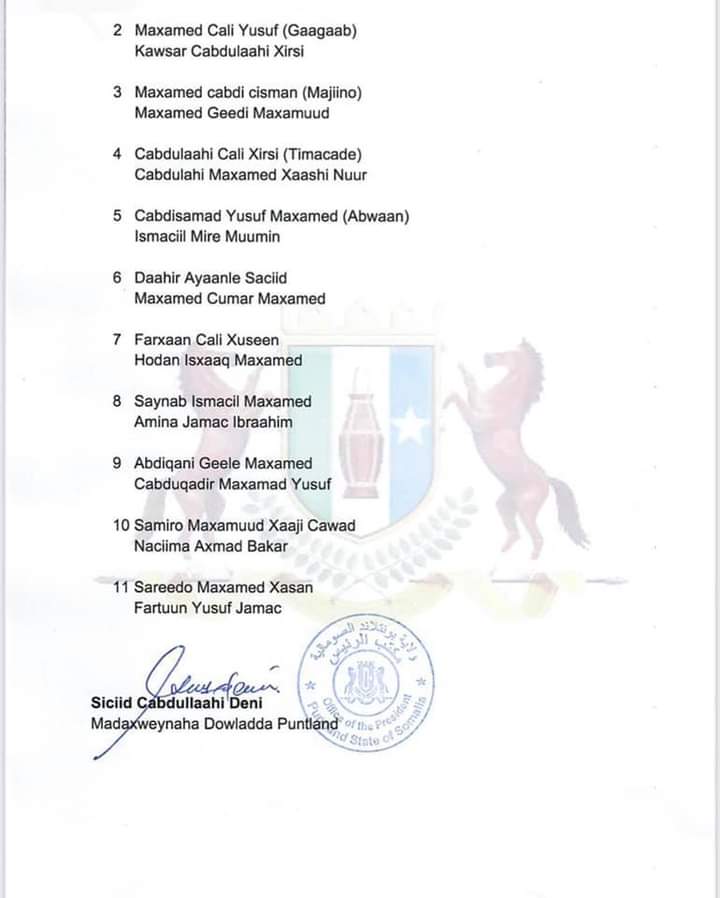
There is a great deal of anxiety here among many candidates trying to squeeze themselves into the list of 11 senators-to-be. The State President, Said Abdullahi Deni, who decides upon the fate of unprecedented number of senate aspirants, is keeping his list of names close to his chest, not allowing any leaks on his wishes or intention to come out publicly. Surprisingly, he doesn’t consult with anyone in his selection process. In business, public service and in the world of politics nobody gets a job without vetting and going through an interview. Perhaps, Somalia adheres to lower bar standards based on political loyalty only that is deduced from gossipping groups and chat sessions.
It also shows that one man can keep a secret against the backdrop of the story that Somalis have no secrecy. The news blackout by the Presidency of Puntland on the date of release of the much expected list of senator-nominees have created a situation rife with rumors and wild speculations on who would be in that elusive list. This political situation and the system in which a legislator is selected exclusively by one official begs for answers from Somali population for the sake of their continued survival in a viable nation-state.
The political tension waiting to explode into violence in Dusa-Mareb, Galmudugh, conflict in Beletweyne, Hirshabelle, and arrests of businessmen associated with candidates and banning of opposition candidates to come to Baydhaba, Southwest State, are all indicators that the prevailing electoral process in Somalia isn’t only wrong, but also too dangerous to sustain.












 Warsame Policy & Media Network (WAPMEN)
You must be logged in to post a comment.