Do you know the absence of free press is a leading contributor to the succession of bad governments, instability and failure of Somalia?
Freedom of press is a culture and institution that are essential to the survival of healthy societies. That is because without freedom of thought and expression, there is no democracy, no free choice, also there is no truth and no counter-measures to abuse of both public and private strongmen. There is no check against clan violence and fight for undeserved privileges and suppression of other people’s rights.
When you notice signs of freedom of the press, don’t take it for granted. Support it. Warsame Digital Media WDM is one of the few outlets, if not the only one, in Somalia that talks truth to power. Join it to help, share it, comment and contribute to it.
Abdullahi Yusuf, Abdullahi Faash, Abdulkadir Isbarije, Jini Boqor, Ahmed Dahir Hassan, Dahir Mire, Ercolo, Ina Kadawe, and so on. The location is Galaadi at one of SSDF Military Bases, circa 1983-1984.
What is amiss in the attitude, politics and protocol of the Speaker of Puntland House of Representatives? Is attending the inauguration of the new Mogadishu Mayor-warlord, or any mayor, a part of his protocol requirement? Does he understand the dignity and decorum of his position as the Speaker of Puntland Parliament? Is he aware of what Puntlanders expect of him? What is this freelancing attitude on the part of Puntland House Speaker?
This is a new sub-culture we had never seen before in Puntland State. In one word, it is a disgrace to the people of Puntland. What kind of house of representatives is this, one would wonder?
It is not often that one hears anything like the truth in today’s Washington, a city where the art of dissimulation has reached new heights among both Democrats and Republicans. Everyone who has not been asleep like Rip Van Winkle for the past twenty years knows that the most powerful foreign lobby operating in the United States is that of the state of Israel. Indeed, by some measures it just might be the most powerful lobby period, given the fact that it has now succeeded in extending its tentacles into state and local levels with its largely successful campaigns to punish criticism or boycotting of Israel while also infiltrating boards of education to require Holocaust education and textbooks that reflect favorably on the Jewish state.
Occasionally, however, the light does shine in darkness. The efforts by Congresswomen Rashida Tlaib and Ilhan Omar to challenge the power of the Israel Lobby are commendable and it is worth noting that the two women are being subjected to harassment by their own Democratic Party in an effort to make them be silent.
President Donald Trump, meanwhile, has attempted to make them the face of the Democrats, calling them “Jew haters” and “anti-Semites” while also further claiming that they despise the United States just as they condemn Israel. This has developed into a Trump diatribe claiming that American Jews who vote for Democrats are “disloyal.” By disloyal he meant disloyal to Israel, in a sense ironically confirming that in the president’s mind Jews have dual loyalty, which, of course, at least some of them do.
And Trump has further exercised his claim to the Jewish vote by accepting the sobriquet “King of Israel” bestowed by a demented talk radio host. As Secretary of State Mike Pompeo has already asserted that Trump’s election victory was the result of divine intervention to “save Israel from Iran,” the kingship is presumably an inevitable progression. One can only imagine what will come next.
One Democratic congressman who has apparently become fatigued by all that bipartisan pandering to Israel is Ted Lieu (image on the right) of California. Last Thursday Lieu rebuked Trump’s US Ambassador to Israel David Friedman over his support of Prime Minister Benjamin Netanyahu’s refusal to allow Tlaib and Omar to visit the West Bank where Tlaib’s grandmother lives under Israeli occupation. Friedman had issued a statement saying that the United States “respects and supports” the Israeli action. He went on to elaborate
“The Boycott, Divestment and Sanctions (BDS) movement against Israel is not free speech. Rather, it is no less than economic warfare designed to delegitimize and ultimately destroy the Jewish state. [Israel] has every right to protect its borders against those activists in the same manner as it would bar entrants with more conventional weapons.”
As Friedman was describing two thirty-something nonviolent first term congresswomen as nothing less than armed attackers about to be unleashed against the Jewish state because they support a peaceful boycott movement, Lieu apparently felt compelled to courageously respond to the ambassador, tweeting
“Dear @USAmbIsrael: You are an American. Your allegiance should be to America, not to a foreign power. You should be defending the right of Americans to travel to other countries. If you don’t understand that, then you need to resign.”
Later that day, on CNN, Lieu explained his objection to Friedman’s actions, saying
“Actually, I think he should resign because he doesn’t see to understand that his allegiance is to America, not to a foreign power. He should be defending the right of Americans to go abroad to other countries and to visit their relatives.”
The outrage from the mighty host of friends of Israel came immediately, with accusations that Lieu was accusing Friedman of “dual loyalty,” that greatly feared derogatory label that is somewhat akin to “anti-Semitism” or “Holocaust denial” in the battery of verbal munitions used to silence critics of the Jewish state. Indeed, Lieu was accused of employing nothing less than a “classic anti-Semitic” trope.
Under considerable pressure, Lieu deleted the tweet and then issued something of an apology,
“It has been brought to my attention that my prior tweet to @USAmbIsrael raises dual loyalty allegations that have historically caused harm to the Jewish community. That is a legitimate concern. I am therefore deleting the tweet.”
But the reality is, of course, that Friedman does not have dual loyalty. He has real loyalty only to Israel, which he demonstrates repeatedly by uncritically supporting everything the kleptocratic Netanyahu regime does with nary a pause to consider actual American interests. He has supported the weekly slaughter of unarmed Gazan civilians by Israeli sharpshooters, praised the bombing of Syria, pushed for the move of the US Embassy to Jerusalem, applauded the recognition by Washington of Israeli sovereignty over the Golan Heights, and is an active supporter of and contributor to the illegal Israeli settlements on the West Bank. He has even pressured the State Department into ceasing its use of the word “occupation” when describing the situation on the West Bank. It is now “disputed.” So, it is no surprise that David Friedman, formerly a bankruptcy lawyer before he became ambassador, lines up with Netanyahu rather than with two American Congresswomen who, apart from anything else, have good reasons to travel to a country that is the largest US aid recipient in order to see conditions on the ground. To put it mildly, Friedman is a disgrace and a reflection of the character or lack thereof of the man who appointed him. If he had any decency, he would resign.
There is no benefit for the United States when an American Ambassador excuses the brutality of a foreign government, quite the contrary as it makes Washington an accomplice in what are often undeniably war crimes. Even though Congressman Lieu was clearly read the riot act and made to fly right by his own party’s leadership, it took considerable courage to speak up against both Israel and an American ambassador who clearly is more in love with the country he is posted to than the country he is supposed to represent.
Of course, in never-any-accountability Washington a buffoon posing as an ambassador as Friedman does will get away with just about anything and, as the subject is Israel, there will hardly be a word of rebuke coming from anyone, to include the mainstream media. But the tweet by Lieu is nevertheless significant. Hopefully he will be among the first of many congressmen willing to put at risk their careers at times to speak the truth.
*
Note to readers: please click the share buttons above or below. Forward this article to your email lists. Crosspost on your blog site, internet forums. etc.
Philip M. Giraldi, Ph.D., is Executive Director of the Council for the National Interest, a 501(c)3 tax deductible educational foundation (Federal ID Number #52-1739023) that seeks a more interests-based U.S. foreign policy in the Middle East. Website is councilforthenationalinterest.org, address is P.O. Box 2157, Purcellville VA 20134 and its email is inform@cnionline.org. He is a frequent contributor to Global Research.
Little big man: supporters of Venezuelan President Nicolás Maduro in Caracas, May 2019Leo Correa / Redux
It has been a good decade for dictatorship. The global influence of the world’s most powerful authoritarian countries, China and Russia, has grown rapidly. For the first time since the late nineteenth century, the cumulative GDP of autocracies now equals or exceeds that of Western liberal democracies. Even ideologically, autocrats appear to be on the offensive: at the G-20 summit in June, for instance, President Vladimir Putin dropped his normal pretense that Russia is living up to liberal democratic standards, declaring instead that “modern liberalism” has become “obsolete.”
Conversely, it has been a terrible decade for democracy. According to Freedom House, the world is now in the 13th consecutive year of a global democratic recession. Democracies have collapsed or eroded in every region, from Burundi to Hungary, Thailand to Venezuela. Most troubling of all, democratic institutions have proved to be surprisingly brittle in countries where they once seemed stable and secure.
In 2014, I suggested in these pages that a rising tide of populist parties and candidates could inflict serious damage on democratic institutions. At the time, my argument was widely contested. The scholarly consensus held that demagogues would never win power in the long-established democracies of North America and western Europe. And even if they did, they would be constrained by those countries’ strong institutions and vibrant civil societies. Today, that old consensus is dead. The ascent of Donald Trump in the United States, Matteo Salvini in Italy, and Jair Bolsonaro in Brazil has demonstrated that populists can indeed win power in some of the most affluent and long-established democracies in the world. And the rapid erosion of democracy in countries such as Hungary and Venezuela has shown that populists really can turn their countries into competitive authoritarian regimes or outright dictatorships. The controversial argument I made five years ago has become the conventional wisdom.
But this new consensus is now in danger of hardening into an equally misguided orthodoxy. Whereas scholars used to hope that it was only a matter of time until some of the world’s most powerful autocracies would be forced to democratize, they now concede too readily that these regimes have permanently solved the challenge of sustaining their legitimacy. Having once believed that liberal democracy was the obvious endpoint of mankind’s political evolution, many experts now assume that billions of people around the world will happily forgo individual freedom and collective self-determination. Naive optimism has given way to premature pessimism.
If the past decade has been bad for democracy, the next one may turn out to be surprisingly tough on autocrats.
The new orthodoxy is especially misleading about the long-term future of governments that promise to return power to the people but instead erode democratic institutions. These populist dictatorships, in countries such as Hungary, Turkey, and Venezuela, share two important features: first, their rulers came to power by winning free and fair elections with an anti-elitist and anti-pluralist message. Second, these leaders subsequently used those victories to concentrate power in their own hands by weakening the independence of key institutions, such as the judiciary; curtailing the ability of opposition parties to organize; or undermining critical media outlets. (By “populist dictatorships,” I mean both outright dictatorships, in which the opposition no longer has a realistic chance of displacing the government through elections, and competitive authoritarian regimes, in which elections retain real significance even though the opposition is forced to fight on a highly uneven playing field.)
According to the new orthodoxy, the populist threat to liberal democracy is a one-way street. Once strongman leaders have managed to concentrate power in their own hands, the game for the opposition is up. If a significant number of countries succumb to populist dictatorship over the next years, the long-term outlook for liberal democracy will, in this view, be very bleak.
But this narrative overlooks a crucial factor: the legitimacy of populist dictators depends on their ability to maintain the illusion that they speak for “the people.” And the more power these leaders concentrate in their own hands, the less plausible that pretense appears. This raises the possibility of a vicious cycle of populist legitimacy: when an internal crisis or an external shock dampens a populist regime’s popularity, that regime must resort to ever more overt oppression to perpetuate its power. But the more overt its oppression grows, the more it will reveal the hollowness of its claim to govern in the name of the people. As ever-larger segments of the population recognize that they are in danger of losing their liberties, opposition to the regime may grow stronger and stronger.
The ultimate outcome of this struggle is by no means foreordained. But if the past decade has been depressingly bad for democracy, the next one may well turn out to be surprisingly tough on autocrats.
Brazilian President Jair Bolsonaro in Brasilia, July 2019Adriano Machado / Reuters
ERDOGAN’S DILEMMA
In North America and western Europe, populist leaders have gained control of the highest levers of power over the course of only the past few years. In Turkey, by contrast, Recep Tayyip Erdogan has been in power for nearly two decades. The country thus offers an ideal case study of both how populist dictators can seize power and the challenge they face when increasingly overt oppression erodes their legitimacy.
Erdogan became prime minister in 2003 by running on a textbook populist platform. Turkey’s political system, he claimed, was not truly democratic. A small elite controlled the country, dispensing with the will of the people whenever they dared to rebel against the elite’s preferences. Only a courageous leader who truly represented ordinary Turks would be able to stand up against that elite and return power to the people.
He had a point. Turkey’s secular elites had controlled the country for the better part of a century, suspending democracy whenever they failed to get their way; between 1960 and 1997, the country underwent four coups. But even though Erdogan’s diagnosis of the problem was largely correct, his promised cure turned out to be worse than the disease. Instead of transferring power to the people, he redistributed it to a new elite of his own making. Over the course of his 16 years in power—first as prime minister and then, after 2014, as president—Erdogan has purged opponents from the military; appointed partisan hacks to courts and electoral commissions; fired tens of thousands of teachers, academics, and civil servants; and jailed a breathtaking number of writers and journalists.
Even as Erdogan consolidated power in his own hands, he seized on his ability to win elections to sustain the narrative that had fueled his rise. He was the freely elected leader of the Turkish republic; his critics were traitors or terrorists who were ignoring the will of the people. Although international observers considered Turkey’s elections deeply flawed, and political scientists began to classify the country as a competitive authoritarian regime, this narrative helped Erdogan consolidate support among a large portion of the population. So long as he won, he could have his cake and eat it, too: his ever-tightening grip on the system tilted the electoral playing field, making it easier for him to win a popular mandate. This mandate, in turn, helped legitimize his rule, allowing him to gain an even tighter grip on the system.
More recently, however, Erdogan’s story of legitimation—the set of claims by which he justifies his rule—has begun to fall apart. In 2018, Turkey’s economy finally fell into recession as a result of Erdogan’s mismanagement. In municipal elections this past March, Erdogan’s Justice and Development Party (AKP) lost Ankara, Turkey’s capital, and Istanbul, its largest city. For the first time since taking office, Erdogan was faced with a difficult choice: either give up some of his power by accepting defeat or undermine his story of legitimation by rejecting the results of the election.
Erdogan chose the latter option. Within weeks of Istanbul’s mayoral election, the Turkish election board overturned its results and ordered a rerun for the middle of June. This turned out to be a massive miscalculation. A large number of Istanbulites who had previously supported Erdogan and his party were so outraged by his open defiance of the popular will that they turned against him. The AKP candidate suffered a much bigger defeat in the second election.
Having tried and failed to annul the will of the people, Erdogan now faces the prospect of a downward spiral. Because he has lost a great deal of his legitimacy, he is more reliant on oppressive measures to hold on to power. But the more blatantly he oppresses his own people, the more his legitimacy will suffer.
The implications of this transformation extend far beyond Turkey. Authoritarian populists have proved frighteningly capable of vanquishing democratic opponents. But as the case of Erdogan demonstrates, they will eventually face serious challenges of their own.
A portrait of Erdogan in Bursa, Turkey, April 2019Goran Tomasevic / Reuters
AN AUTOCRATIC FUTURE?
It is tempting to cast the stakes in the struggle between authoritarian populists and democratic institutions in existential terms. If populists manage to gain effective control over key institutions, such as the judiciary and the electoral commission, then the bell has tolled for democracy. But this conclusion is premature. After all, a rich literature suggests that all kinds of dictatorships have, historically, been remarkably vulnerable to democratic challenges.
Between the end of World War II and the collapse of the Soviet Union, for instance, dictatorships had a two percent chance of collapsing in any given year. During the 1990s, the odds increased to five percent, according to research by the political scientists Adam Przeworski and Fernando Limongi. Clearly, the concentration of power that characterizes all dictatorships does not necessarily translate into that power’s durability.
Instead of assuming that the rise of populist dictatorships spells an end for democratic aspirations in countries such as Hungary, Turkey, and Venezuela, therefore, it is necessary to understand the circumstances under which these regimes are likely to succeed or fail. Recent research on autocratic regimes suggests that there are good reasons to believe that populist dictatorships will prove to be comparatively stable. Since most of them are situated in affluent countries, they can afford to channel generous rewards to supporters of the regime. Since they rule over strong states with capable bureaucracies, their leaders can ensure that their orders are carried out in a timely and faithful manner. Since they control well-developed security services, they can monitor and deter opposition activity. And since they are embedded in efficient ruling parties, they can recruit reliable cadres and deal with crises of succession.
On the other hand, many of the countries these regimes control also have features that favored democratization in the past. They usually have high levels of education and economic development. They contain opposition movements with strong traditions and relatively established institutions of their own. They often neighbor democratic nations and rely on democracies for their economic prosperity and military security. Perhaps most important, many of these countries have a recent history of democracy, which may both strengthen popular demands for personal liberties and provide their people with a template for a democratic transition when an autocratic regime does eventually collapse.
All in all, the structural features on which political scientists usually focus to gauge the likely fate of authoritarian regimes appear finely balanced in the case of populist dictatorships. This makes it all the more important to pay attention to a factor that has often been ignored in the literature: the sources and the sustainability of their legitimacy.
BROKEN PROMISES
In the twentieth century, democratic collapse usually took the form of a coup. When feuds between political factions produced exasperating gridlock, a charismatic military officer managed to convince his peers to make a bid for power. Tanks would roll up in front of parliament, and the aspiring dictator would take the reins of power.
The blatantly antidemocratic nature of these coups created serious problems of legitimacy for the regimes to which they gave rise. Any citizen who valued individual freedom or collective self-determination could easily recognize the danger that these authoritarian governments posed. Insofar as these dictatorships enjoyed real popular support, it was based on their ability to deliver different political goods. They offered protection from other extremists. They vowed to build a stable political system that would dispense with the chaos and discord of democratic competition. Above all, they promised less corruption and faster economic growth.
In most cases, those promises were hard to keep. Dictatorships frequently produced political chaos of their own: palace intrigues, coup attempts, mass protests. In many cases, their economic policies proved to be highly erratic, leading to bouts of hyperinflation or periods of severe economic depression. With few exceptions, they suffered from staggering levels of corruption. But for all these difficulties, their basic stories of legitimation were usually coherent. Although they often failed to do so, these dictatorships could, in principle, deliver on the goods they promised their people.
Populist dictatorships are liable to suffer from an especially sudden loss of legitimacy.
This is not true of populist dictatorships. As the case of Erdogan illustrates, populists come to power by promising to deepen democracy. This makes it much easier for them to build dictatorships in countries in which a majority of the population remains committed to democratic values. Instead of accepting an explicit tradeoff between self-determination and other goods, such as stability or economic growth, supporters of populist parties usually believe that they can have it all. As a result, populists often enjoy enormous popularity during their first years in power, as Russia’s Vladimir Putin, Hungary’s Viktor Orban, and India’s Narendra Modi have demonstrated.
Once they consolidate their authority, however, populist dictators fail to live up to their most important promise. Elected on the hope that they will return power to the people, they instead make it impossible for the people to replace them. The crucial question is what happens when this fact becomes too obvious for large segments of the population to ignore.
THE VICIOUS CYCLE
At some point during their tenure, populist dictators are likely to face an acute crisis. Even honest and competent leaders are likely to see their popularity decline because of events over which they have little control, such as a global recession, if they stay in office long enough. There are also good reasons to believe that populist dictatorships are more likely than democracies to face crises of their own making. Drawing on a comprehensive global database of populist governments since 1990, for example, the political scientist Jordan Kyle and I have demonstrated that democratic countries ruled by populists tend to be more corrupt than their nonpopulist peers. Over time, the spread of corruption is likely to inspire frustration at populists’ unfulfilled promises to “drain the swamp.”
Similarly, research by the political scientist Roberto Foa suggests that the election of populists tends to lead to serious economic crises. When left-wing populists come to power, their policies often lead to a cratering stock market and rapid capital flight. Right-wing populists, by contrast, usually enjoy rising stock prices and investor confidence during their first few years in office. But as they engage in erratic policymaking, undermine the rule of law, and marginalize independent experts, their countries’ economic fortunes tend to sour. By the time that right-wing populists have been in office for five or ten years, their countries are more likely than their peers to have suffered from stock market crashes, acute financial crises, or bouts of hyperinflation.
Once a populist regime faces a political crisis, the massive contradictions at the heart of its story of legitimation make the crisis especially difficult to deal with. Initially, the political repression in which populist regimes engage remains somewhat hidden from public view. Power grabs usually take the form of complicated rule changes—such as a lower retirement age for judges or a modification of the selection mechanisms for members of the country’s electoral commission—whose true import is difficult to grasp for ordinary citizens. Although political opponents, prominent journalists, and independent judges may start to experience genuine oppression early in a populist’s tenure, the great majority of citizens, including most public-sector workers, remain unaffected. And since the populist continues to win real majorities at the ballot box, he or she can point to genuine popularity to dispel any doubts about the democratic nature of his or her rule.
This equilibrium is likely to be disrupted when a shock or a crisis lowers the leader’s popularity. In order to retain power, the leader must step up the oppression: cracking down on independent media, firing judges and civil servants, changing the electoral system, disqualifying or jailing opposition candidates, rigging votes, annulling the outcome of elections, and so on. But all these options share the same downside: by forcing the antidemocratic character of the regime out into the open, they are likely to increase the share of the population that recognizes the government for what it truly is.
This is where the vicious cycle of populist legitimacy rears its unforgiving head. As support for the regime wanes, the populist autocrat needs to employ more repression to retain power. But the more repression the regime employs, the more its story of legitimation suffers, further eroding its support.
Populist dictatorships are therefore liable to suffer from an especially sudden loss of legitimacy. Enjoying a broad popular mandate, their stories of legitimation initially allow them to co-opt or weaken independent institutions without oppressing ordinary citizens or forfeiting the legitimacy they gain from regular elections. But as the popularity of the populist leader declines due to internal blunders or external shocks, the vicious cycle of populist legitimacy sets in. Custom-made to help populist leaders gain and consolidate power, their stories of legitimation are uniquely ill adapted to helping them sustain an increasingly autocratic regime.
Anti-government protesters in Budapest, March 2019Tamas Kaszas / Reuters
A CRISIS OF POPULIST AUTHORITY?
Many populist dictatorships will, sooner or later, experience an especially serious crisis of legitimacy. What will happen when they do?
In The Prince, Niccolò Machiavelli warned that the ruler “who becomes master of a city accustomed to freedom” can never sleep easy. “When it rebels, the people will always be able to appeal to the spirit of freedom, which is never forgotten, despite the passage of time and any benefits bestowed by the new ruler…. If he does not foment internal divisions or scatter the inhabitants, they will never forget their lost liberties and their ancient institutions, and will immediately attempt to recover them whenever they have an opportunity.”
Populist dictators would do well to heed Machiavelli’s warning. After all, most of their citizens can still recall living in freedom. Venezuela, for example, had been democratic for about four decades by the time Hugo Chávez first ascended to power at the end of the 1990s. It would hardly come as a surprise if the citizens of countries that have, until so recently, enjoyed individual freedom and collective self-determination eventually began to long for the recovery of those core principles.
But if populist dictators must fear the people, there is also ample historical evidence to suggest that autocratic regimes can survive for a long time after their original stories of legitimation have lost their power. Take the twentieth-century communist dictatorships of Eastern Europe. From their inception, the communist regimes of Czechoslovakia and East Germany, for example, depended on a horrific amount of oppression—far beyond what today’s populists in Hungary or Poland have attempted so far. But like today’s populists, those regimes claimed that they were centralizing power only in order to erect “true” democracies. In their first decades, this helped them mobilize a large number of supporters.
Eventually, the illusion that the regimes’ injustices were growing pains on the arduous path toward a worker’s paradise proved impossible to sustain. In Czechoslovakia, for example, cautious attempts at liberalization sparked a Soviet invasion in 1968, followed by a brutal crackdown on dissent. Virtually overnight, the regime’s story of legitimation went from being an important foundation of its stability to a hollow piece of ritualized lip service. As the Czech dissident Vaclav Havel wrote in his influential essay “The Power of the Powerless,” it was “true of course” that after 1968, “ideology no longer [had] any great influence on people.” But although the legitimacy of many communist regimes had cratered by the late 1960s, they were able to hold on to power for another two decades thanks to brutal repression.
Populist dictatorships in countries such as Turkey or Venezuela may soon enter a similar phase. Now that their stories of legitimation have, in the minds of large portions of their populations, come to be seen as obvious bunk, their stability will turn on the age-old clash between central authority and popular discontent.
Recently, a series of writers have suggested that the rise of digital technology will skew this competition in favor of popular discontent. As the former CIA analyst Martin Gurri argued in The Revolt of the Public and the Crisis of Authority in the New Millennium, the Internet favors networks over hierarchies, the border over the center, and small groups of angry activists over bureaucratic incumbents. These dynamics help explain how populists were able to displace more moderate, established political forces in the first place. They also suggest that it will be difficult for populists to stay in power once they have to face the wrath of the digitally empowered public.
This argument, however, fails to take into account the differences in how dictatorships and democracies wield power. Whereas dictatorships are capable of using all the resources of a modern state to quash a popular insurgency, democracies are committed to fighting their opponents with one hand tied behind their back. Dictators can jail opposition leaders or order soldiers to fire into a crowd of peaceful protesters; democratic leaders can, at best, appeal to reason and shared values.
This imbalance raises the prospect of a dark future in which digital technology allows extremist networks to vanquish moderate hierarchies. Once in power, these extremist movements may succeed in transforming themselves into highly hierarchical governments—and in using brute force to keep their opponents at bay. Technology, in this account, fuels the dissemination of the populists’ stories of legitimation when they first storm the political stage, but it fails to rival the power of their guns once their stories of legitimation have lost their hold.
It is too early to conclude that the populist dictatorships that have arisen in many parts of the world in recent years will be able to sustain themselves in power forever. In the end, those who are subject to these oppressive regimes will likely grow determined to win back their freedom. But the long and brutal history of autocracy leaves little doubt about how difficult and dangerous it will be for them to succeed. And so the best way to fight demagogues with authoritarian ambitions remains what it has always been: to defeat them at the ballot box before they ever step foot in the halls of power.
Enjoy more high-quality articles like this one.
Become a subscriber.
Paywall-free reading of new articles posted daily online and almost a century of archives
Unlock access to iOS/Android apps to save editions for offline reading
Six issues a year in print, online, and audio editions
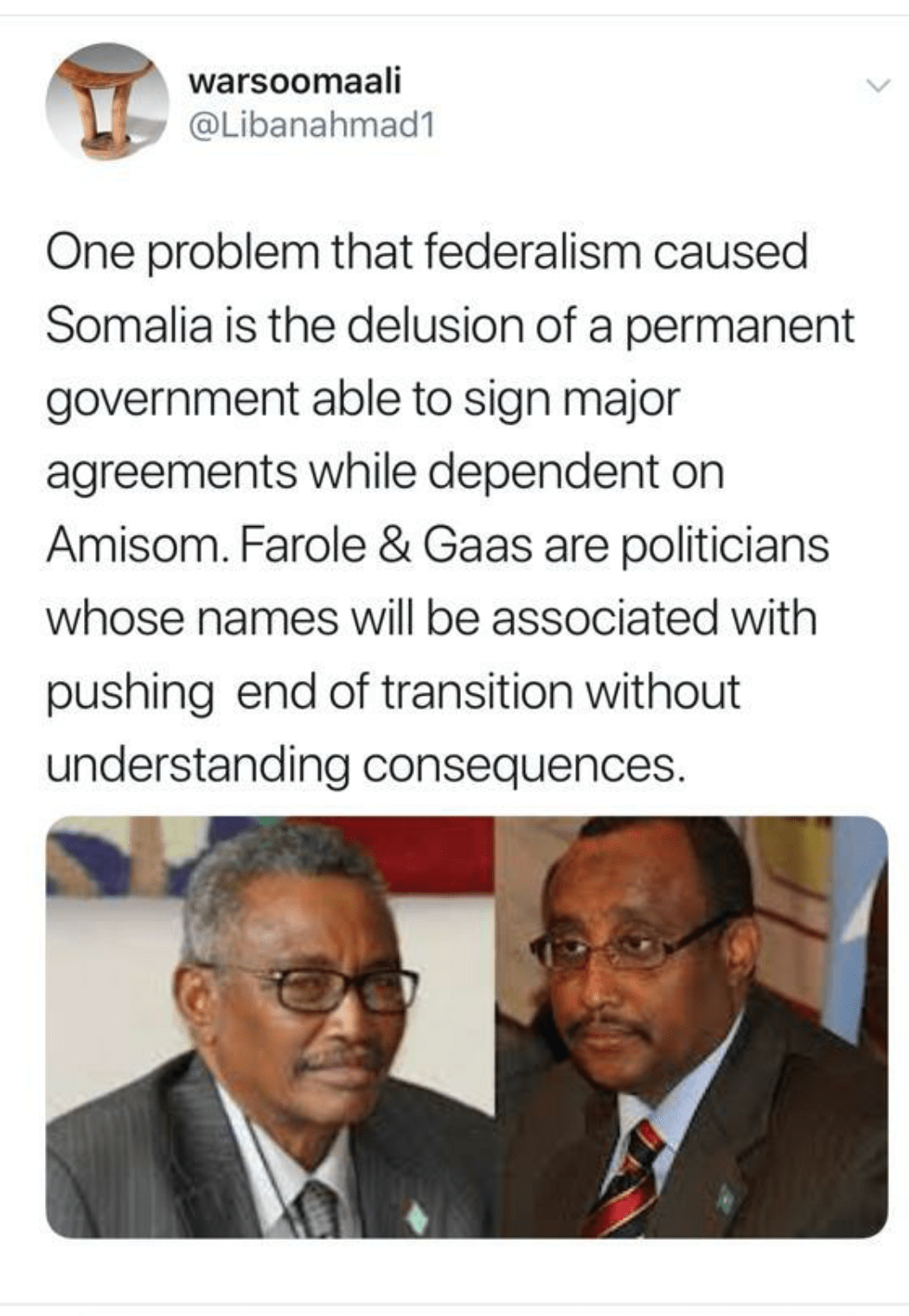
N&N fight is raging on to squeeze Jubaland Federal Member State from all sides and corners, save Kenya’s side. There are, reportedly, restrictions and sanctions being applied on aviation companies to coordinate with Mogadishu before they fly into Kismayo.
Ahmed Madoobe potential inauguration is also being undermined. Diplomatic pressure, not to recognize the outcome of recent Jubaland election, is one of the tools N&N is utilizing to deny legitimacy to Ahmed Madoobe.
So far, no other Federal Member States, save a divided Puntland Government on the issue of Jubaland election outcome, has come forward to recognize Ahmed Madoobe’s claim of election victory. This is still a developing story.
No audit, no business and no survival for financial institutions, whether they are banks, ministries of finance or any other public and private entities handling public money and wealth.
Governments dealing with foreign financial institutions on regular basis must produce audited documents to be trustworthy. Failure to honor this financial rule is to prepare for closure of the business, and that too requires audited financial statements for those who lost money, including tax-payers.
Without sound and certified financial audit and system of paper trail, there is nothing one can do to assist Puntland rudimentary financial institutions attached to the Ministry of Finance. Deni Administration must act fast to show transparency in that regard before it becomes too late to rectify the situation of Puntland financial institutions. Auditor-General and Accountant- General must be empowered and set independent. No credible audit, no financial credibility and no business.
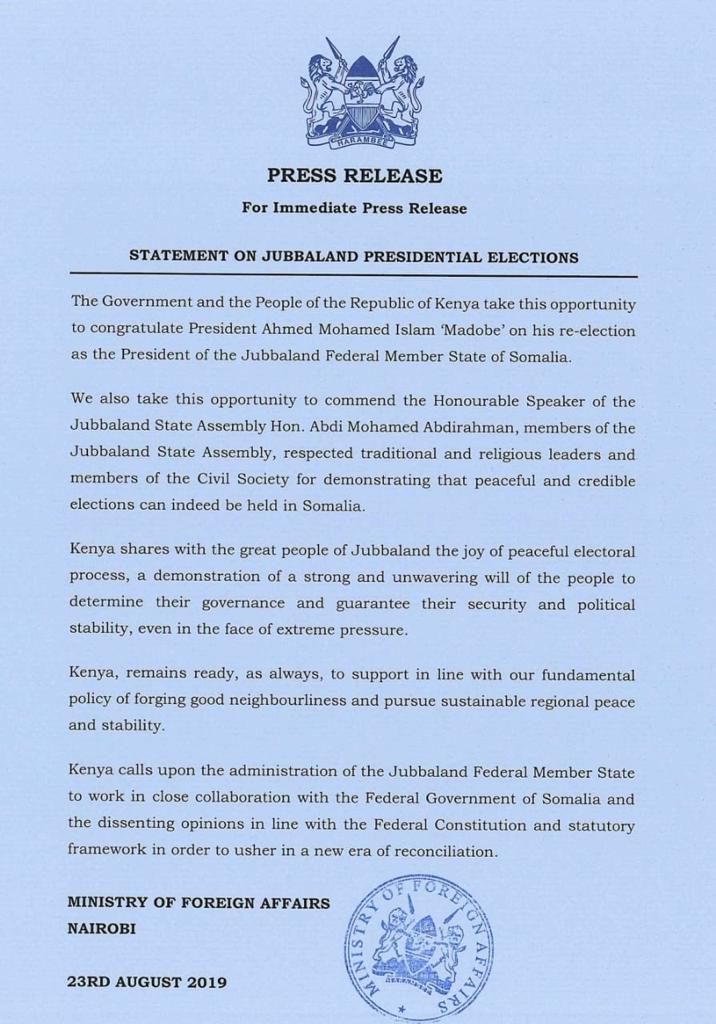
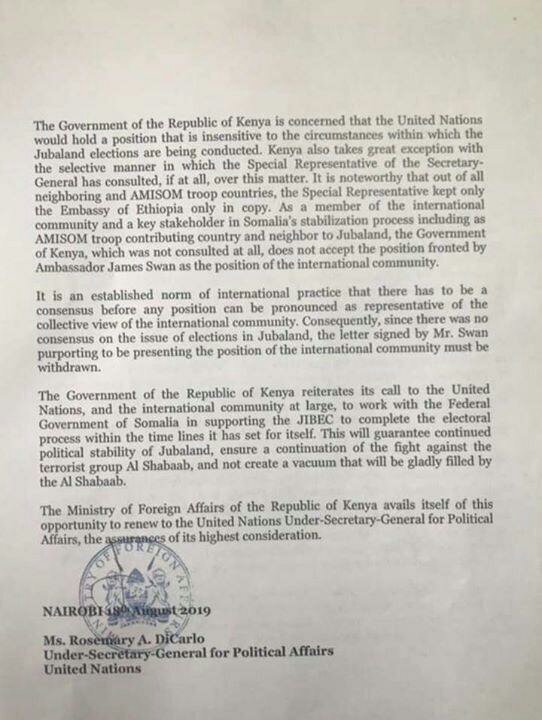
We have read the Kenyan congratulatory note on Jubaland sham elections 2019. We watched the videos of celebrating Kenyans in Eastleigh of Nairobi on the same. However, we have yet to see jubalanders welcoming the various self-elections of several power-hungry and mediocre politicians of dubious backgrounds and characters.
The tension and anxiety are increasingly high in Jubaland. There is also a triangle of three government rivalry in Jubaland: Somalia, Kenya and Ethiopia. Soon, Eritrea will join the fray. UAE and Qatar are in stiff competition to prop up their ever-willing and highly paid proxies in Somalia. Somali foreign partners are still recovering from their shell-shock condition, following the latest developments in Jubaland, and increasingly daring terrorist bomb-blasts in Mogadishu on weekly basis, causing the elimination recently of the City Mayor, Abdirahman Yarisow.
In the light of the above developments, the N&N leaders are putting more fuel to the fire on Jubaland political conundrum, which they had created in the first place, after they had messed up things in Galmudugh, Southwest State and Hirshabelle.
Handing Banadir Administration over to warlord Omar Finish, and reshuffling and replacing seasoned officers of the security sector is an indication of wrong-headed N&N strategy to command junior officers to engage in hostile military operation against Jubaland in gross violation of the laws of the land.
Both the Governments of Kenya and Ethiopia are ill-advised to interfere in the internal affairs of Somalia. Their meddling will definitely do a tremendous damage to their long-term relationships with the people of Somalia. They are better advised to exercise restraint in getting into Jubaland internal quagmire.
All should know that the N&N leaders are solely responsible for the turn of events in Jubaland and other Federal Member States. Somalia is at risking of unraveling the modest gains of the past decade. There is an urgent need for fresh thinking to freeze at least the down-turn spiraling of events.
By the end of this August, clan elders from Somalia’s Jubaland region will select a new assembly whose parliamentarians will vote for a regional president. It is accepted as a virtual certainty that the incumbent president, Ahmed Madobe, will retain his post.
After the former al-Shabaab ally seized the regional HQ of Kismayo with Kenyan troops in 2012, he has won successive elections in 2013 and 2015 – the last with94% of the parliamentary vote.In both instances, it was strongly understood that the regional assembly was installed from the beginning with his supporters.
This time around, Marehanclan eldersand the Federal Government of Somalia (FGS) again haveexpressed concernsabout the elder selection process and the integrity of the election more broadly. Madobe did himself no favors in batting down these suspicions, as a clan elder wasrecently arrestedat Kismayo airport, reportedly for not supporting Madobe’s own plans for re-election.
The Jubaland administration has taken other steps to stifle political activities of his opponents in the presidential race:
·On July 25, Jubaland “banned” federal leaders from traveling to Jubaland until the election was complete. The move is an escalation of Jubaland’s previous order that the Federal Government of Somalia (FGS) officials would not be involved in elections. The threat of overzealous involvement from the FGS is not without reason. In previous regional elections, the FGS has taken direct steps to advantage its preferred candidates. In the December 2018 SW region election, Ethiopia and the FGS conspired to arrest on dubious grounds candidate Mukhtar Robow, the ex-senior al-Shabaab leader who had received amnesty and was a frontrunner in the race.
·Also on July 25, Jubaland security forces in Kismayorounded upat least 100 youth during security operations in several neighborhoods suspected to harbor threats to the August election; these neighborhoods included Guulwade, Dalacaadda, Via Afmadow and Dalxiiska; many of the suspects were reportedly taken to Fiat prison (operation by Jubaland’s intelligence agency) for investigation.
·Since February, Jubaland forces have blocked supporters of rival candidates from greeting them at the airport on at least two occasions. One such incident in May involving candidate Abdinasir Seerar, who was Madobe’s spokesman before falling out of favor,resulted in a clashbetween Seerar’s security detail and Jubaland troops.
In this context, it is difficult to imagine a scenario in which Madobe loses the regional election. There are no signs yet that there will be popular protests that would force the regional administration to re-think its approach. Similarly, Madobe is taking all the measures he can to prevent any coalition of militias from emerging that could present an additional security threat to al-Shabaab – which only weeks ago executed a deadly hotel raid in Kismayo that shook the nation.
The more important question is whether Madobe deserves to be re-elected. Al-Shabaab still controls many rural areas and the entirety of the Middle Jubba, including the nominal capital of the region in Bu’ale. If Madobe could control the current HQ in Kismayo without African Union troops, he has taken no initiative to prove it. (Of course, there is certainly an incentive among all parties to postpone any departure from Kismayo to benefit from the lucrative –albeit illicit—trade of charcoal and sugar.)
If Madobe does indeed win the upcoming election, he ideally would divert some of his attention to regional development needs rather than the overwhelming focus on power-sharing disputes with the FGS.
The selection of Abdirashid Xidig by Jubland Opposition Group as their candidate for president symbolizes a political victory for Ahmed Madoobe and fatal defeat of N&N strategy of dividing Jubaland community.
Abdirashid Xidig has no any political or moral credibility to represent Jubland. Jubaland opposition has just made poor judgement and irreversible mistake in betting on Xidig.
The political and security fallout from this controversial election, however, will be apparent within the next days and weeks.
Postscript:
I have been watching the entire process of voting in Jubaland controversial election today at Ahmed Madoobe HQ or Side of voting. I hardly saw a single persson smiling or happy in the attending crowd, including the candidates themselves. They all looked like anxious prisoners – it was un-Somali and surreal. There was tremendous tension in the hall, seemingly ready to explode any time.
It was a difficult election never to be repeated in Somali election history.
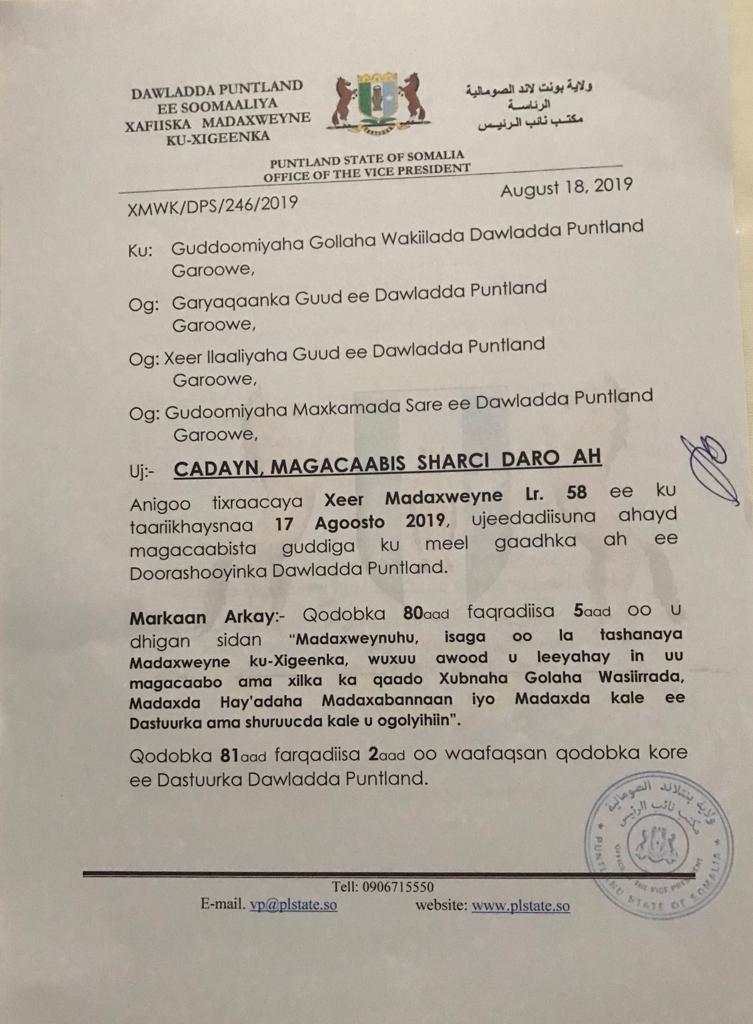
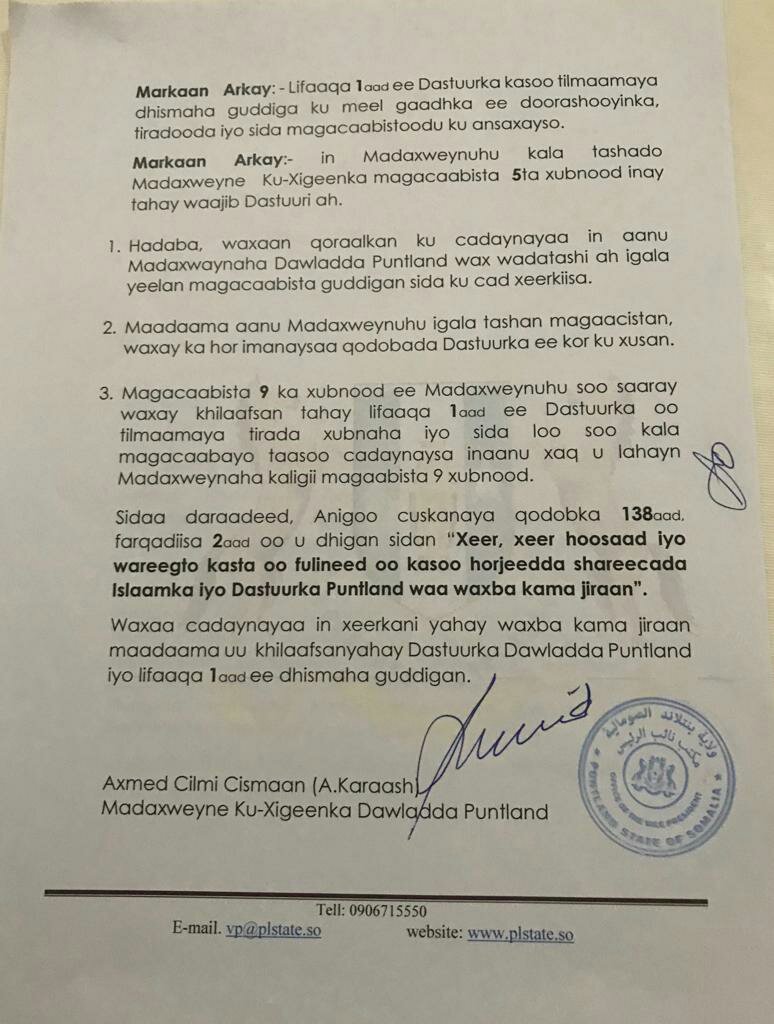
The main constitutional mandate of PUNTLAND Vice-president is to replace the State President in case and when he is incapacitated to carry on his/her duties to avoid a constitutional crisis or power vacuum.
All other duties of the vice-president in the Puntland Constitution are secondary. There is no clan-ticket or representation that gives the vice-president special or extra powers outside the constitution of the State.
The Constitution of PUNTLAND is exactly the same as that of the USA with regards to the Constitutional job descriptions of the Vice-president, who is in reality, a “Stand-by President” of the State (Baxtisuge Madaxweyne).
Often, the State President assigns or delegates him/her duties on behalf of the President and only upon the policies and instructions of the President. There is no loophole or ambiguity in PUNTLAND CONSTITUTION in that regard.
Puntland vice-president doesn’t have even to stay in Puntland to be called upon from outside the State to take over the Presidency in case the president is permanently incapacitated.
MOGADISHU (Reuters) – Kismayo airport in southern Somalia refused to allow an Ethiopian plane to land on Monday, a witness said, amid heightened tensions between the federal government and the regional leadership ahead of elections on Thursday.
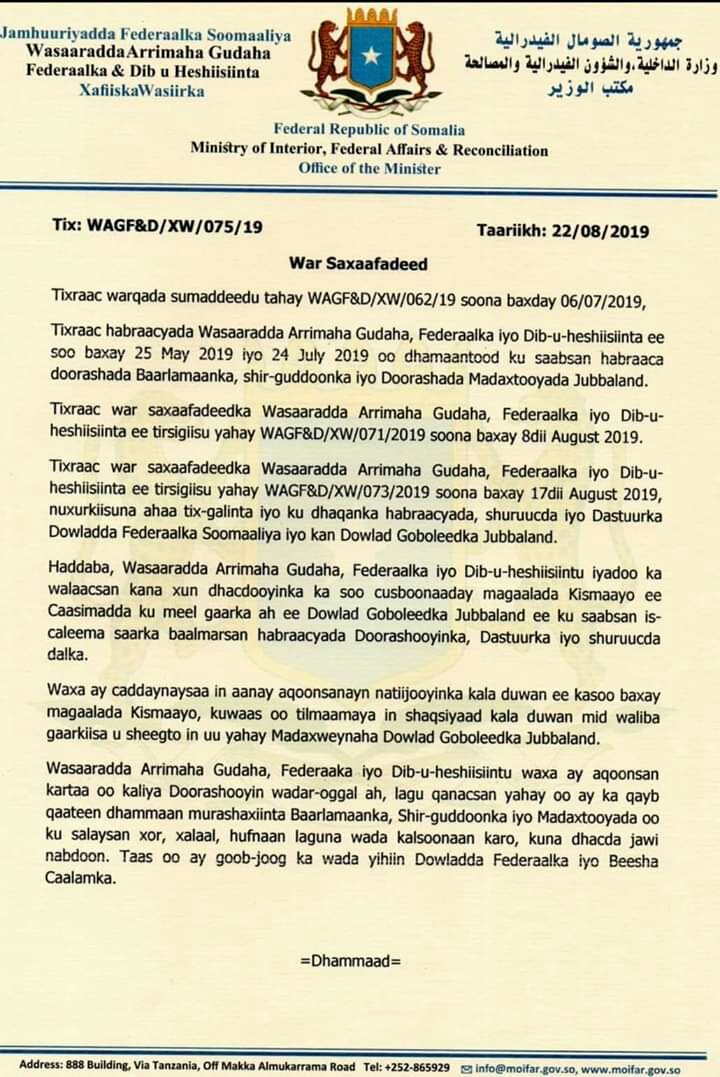
Somalia’s central government said on Saturday it would not recognize the result of an upcoming vote to elect a president of Jubbaland, a key battleground state for counter-terrorism operations, saying the candidate selection process violated the national constitution.
The Jubbaland election commission has said the vote would go ahead on Thursday.
Security analysts say the spat has the potential to cause friction between neighboring Kenya and Ethiopia, longtime allies each with significant numbers of peacekeepers in the Horn of Africa nation.
A staff member at Kismayo airport, who gave his name as Ismail, said the plane took off from Gode in southeastern Ethiopia and eventually landed in the Somali town of Baidoa. It was not certain if the plane was civilian or military.
“It wanted to land at Kismayo airport but was denied clearance because it did not send information in advance,” Ismail told Reuters by telephone.
Incumbent Jubbaland President Ahmed Mohamed Madobe, who is seeking re-election this week, is a key security partner for Kenya, while Ethiopia has grown closer to the federal government in Mogadishu in the last year.
President Said Abdullahi DENI of Puntland doesn’t behave or act like an economist, or even a businessman. From the outset of his administration, he is creating the largest government bureaucracy in the history of PUNTLAND State. He has already become the talk of the town as the biggest employer in the locality. How would he pay for this cumbersome goverment bureaucracy?
The sheer size and weight of his highly duplicated personnel leave no room for efficiency and accountability? Are these political appointments planned in the Annual Budget? Are these appointments notified to the Account-General and Auditor-General? Are these appointments discussed in Cabinet Sessions? Are these appointments being proposed by the heads of relevant government departments?
The Presidential Decrees appointing all these new officials are simplistic and poorly prepared documents, citing no references of specific articles of the Puntland Constitution, details of experience of appointees, credentials or qualifications of appointees, references to curricula vitae, job descriptions for positions or vacancies or openings to fill in. Look at latest Presidential Decrees- they read like a writing prepared by a teen-ager at first year of an intermediate school, devoid of any convincing reasons for these government appointments.
This happens when there is no an Independent Civil Service Commission.
The problem is that large government and bureaucracy lead to severe budget deficits and that, in turn, paves the way to under-development and cuts of funding to social services and public security. You cannot afford to do that under the current Somalia’s political climate and volatility.
President DENI should change course and immediately.
Consultation between Puntland President and Vice-president is not binding in decision-making just like any other advice to the President. The President doesn’t have to accept vice-president’s advice necessarily. The vice-president’s advice to President could come in different format or setting like casual conversation between the two on an issue. Once issued, the Vice-president has no case or legal basis to challenge a presidential decree. This is in accordance with both the Constitution and tradition of Puntland history of government. There is no ambiguity here.
Puntland State Presidency has no two presidents at one time. It is one office headed by the President, who is the Head of State and Government too. The Vice-president has no Executive Powers in the presence of the President. He does only what the President assigns and delegates to him.
Background of such political wrangling in Puntland is based purely on vested interests of certain clan groups and politicians to foil any Puntland attempt to proceed to democratization. They want to keep Puntland hostage to clan-quota formula.
It is time for Puntland State to break away from this hostage trap.















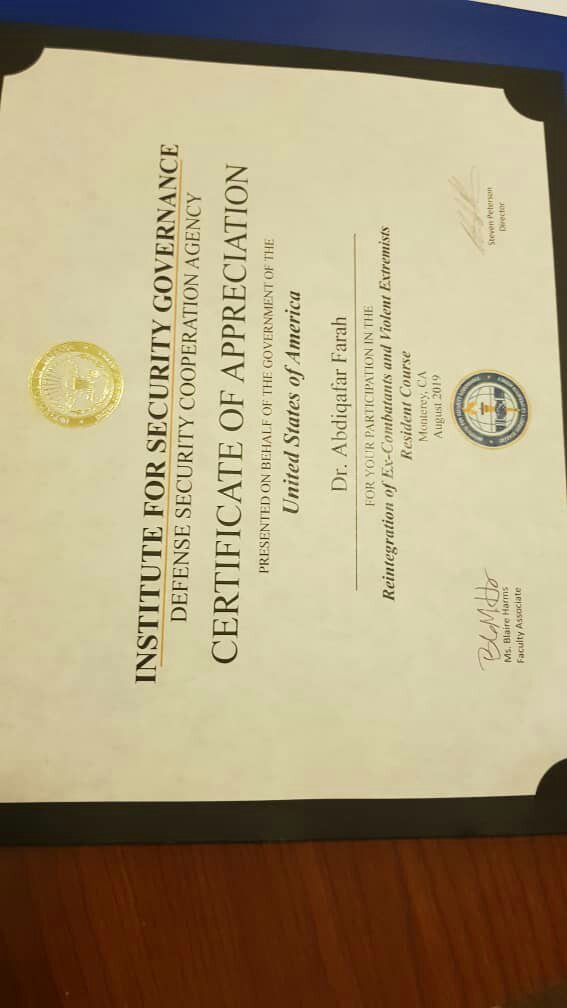
 Read more about Dr Farah at this
 Warsame Policy & Media Network (WAPMEN)
You must be logged in to post a comment.