PROVISIONAL FEDERAL CONSTITUTION OF THE SOMALI REPUBLIC

The Provisional Federal Constitution of Somalia adopted a democratic system of government with checks and balance of power between three branches of government. Federal Government of Somalia (FGS) has three levels of governance: 1. Shared level (dawladda dhexe) 2. A Federal Member State (Dawladd-Gobolleed) or FMS. 3. Local District Council (Gole deegaan). Like any other similar federal system, the first two levels have their own separate constitutions and three branches of government. Sovereignity remains with the Central Government of the Somali Republic. The system is still evolving and needs further work in harmonizing the constitutions. Formation of FMS must satisfy the requirement of unification of two regions or more to be constitutionally legitimate. A FMS has powers expanding into regions and districts within the state.

Contrary to the behavior of the Somalia’s current President, the Executive Powers of the Government rest on the Cabinet and powers of the President and Prime Minister are clearly spelled out in the Federal Constitution. The President appoints the Prime Minister, but he cannot fire him. Only the Parliament has power to fire both the President and Prime Minister.

In summary, Somali Federal Constitution is similar to that of USA. The President of a FMS is the same as the Governor of a US state, who is elected to a fixed term in Office. Similarly, in Somalia the Federal Authorities cannot fire or appoint a FMS President, in the same way US President cannot do. Political agreements between FGS and FMS are by consensus similar to the case of Canadian Federalism. In many ways, Federal Constitution has similarities with that of UK and Northern Ireland system of government with strong devolution of power to Wales, Scotland and Northern Ireland. Economic resources and fiscal responsibilities are shared by special arrangements, agreements between Central Government and Federal Member States by consensus. Unlike ethnic federalism of Ethiopia, the central authorities in Somalia have no much sway in internal affairs of FMS.

Finally, Somali Federal Constitution came about as a de facto (not de jure), following the civil war and the re-instatement of Central Somali Government accepted that reality on the ground into the Federal Constitution. It was the only way to try to restore lost trust between warring clans.

Still, some portions of Somali people believe that a form of federalism called “Confederalism” is the best option. They say Somali clans by nature are confederal entities like Darood, Hawiye, Dir etc. What suits them most is the confederalism of Swiss type, where Cantons has most powers and an elected Prime Minister (Cabinet) has the Executive Powers of the Government, while the Presidency is a rotating ceremonial role between Cantons.

Ongoing controversy on the Somali Constitution, if not resolved soon, may lead to the breakup of Somalia. It is a dangerous crossroad for Somalia’s survival as a state. Warning. Let us act now.

[This article has been updated since posting].
SOMALILAND: WDM EDITORIAL

WHY SOMALILAND FORCEFUL OCCUPATION OF LAASCAANOOD IS NOT IN ITS BEST INTEREST

The main reason Somaliland Administration stays in Sool Region is its pursuit of unilateral secession from Somalia. That attempt has now hit the rocks, and it is unlikely that will ever happen as long as people of Somalia don’t allow it. Now the meager economy of Somaliland cannot sustain prolonged forceful occupation of Sool Region with its residents struggling for peace and freedom for the long haul. firstly, the ongoing uprising in Laaska (Laascaanood) has clearly demonstrated to Somalis, and the world at large, that Somaliland is an occupying entity against the will of the residents there.

Secondly, by suppressing the uprising in Laascaanood, Somaliland has irreversibly lost its territorial claim to Sool Region based on lame excuse of long-gone British Protectorate colonial border. After all, this is Dhulbahante/Harti land. No one within the international community would entertain Somaliland quest for secession after what has happened in Laascaanood recently, unless the world is suddenly ready to recognize every tribe or clan in Africa to form own sovereign state.

Thirdly, repression against residents of Laascaanood will entail gross human rights violations for which the leaders of Somaliland Regime will be held accountable in a court of law inside, and possibly, outside Somalia.

Somaliland is, therefore, better advised to vacate Sool Region peacefully in an exercise for damage control for crimes against humanity in abusing unarmed population.

WDM EDITORIAL BOMBSHELL REVELATION

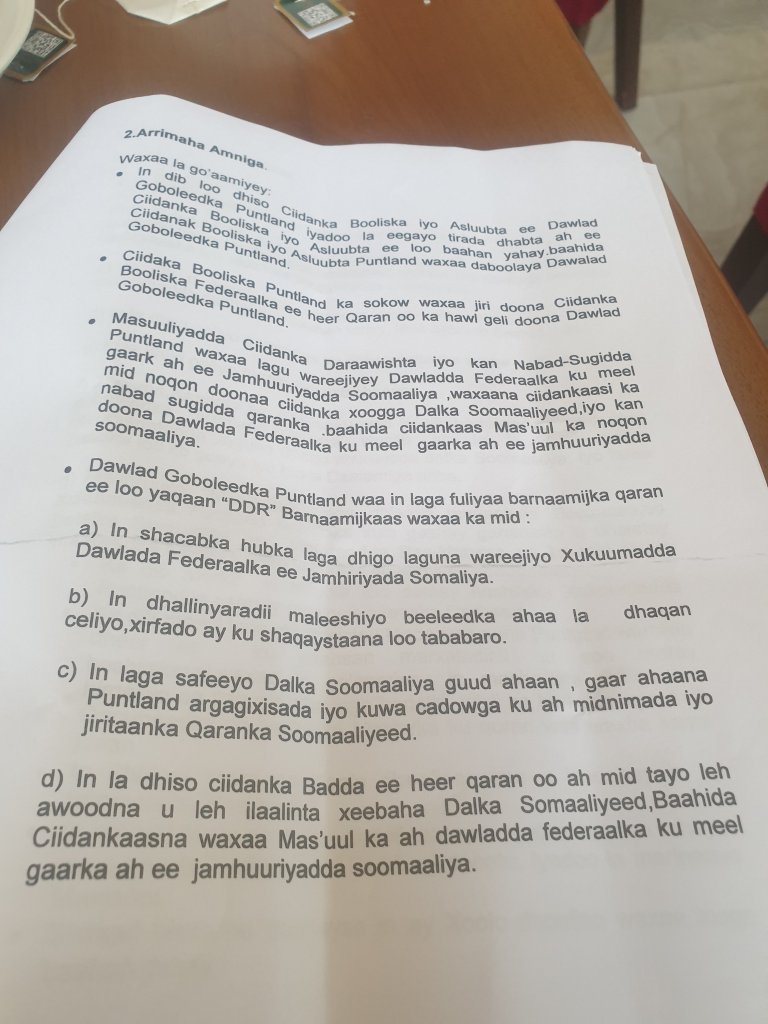
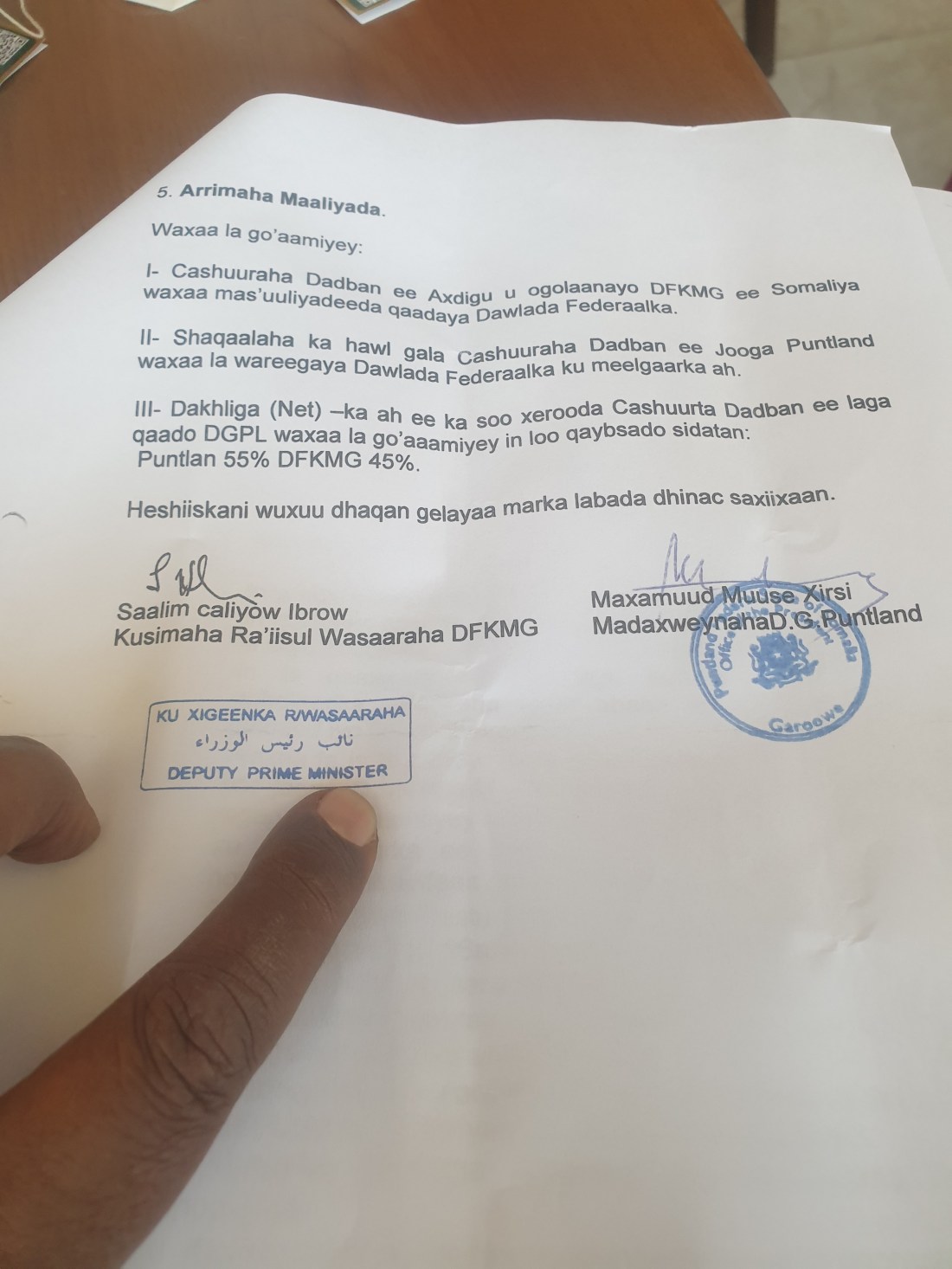
BINDING AGREEMENT BETWEEN TRANSITIONAL FEDERAL GOVERNMENT OF THE SOMALI REPUBLIC AND PUNTLAND STATE OF SOMALIA ON RESOURCES AND POWER-SHARING, INSTITUTIONAL AND CAPACITY- BUILDING

This Agreement is as valid and binding between parties today as it was in 2007. Puntland State entered into this Agreement with the Federal Government, on behalf of then existing and future FMS. There is no legal venue for FGS today to ignore this solemn undertaking. Puntland State and every FMS has the legal right to demand for implementation of this official document.

LINE UP TO CAST YOUR VOTES

Watch “SHAKIKA ISKA CUUDI” on YouTube

Watch “Xoraynta Laascaanood” on YouTube

Watch “Isaaq vs Dhulbahante” on YouTube

THE CHANGING CULTURE AND IDENTITY OF SOMALIA

Somalia has changed culturally – forget the old days of national celebrations, flag waving and song of national anthem. No talk of significance of national independence. Historical songs of patriotism are suppressed and celebrated singers are things of the past, only to be remembered by 70-year olds. The entire history of Somalia is being erased or has disappeared from national discourse and school curriculum.

Any signs of globalization and Western influence are being discouraged or eroded. Women can’t walk along the streets in towns without complete Xijab – any woman seen in public without heavy veil is automatically assumed blasphemous by the majority of population. Girls as old as five years are subjected to the strict rules of their mothers in dressing up. Fathers are bashed or looked down whenever they escort their daughters in public without following strict religious culture of today’s Somali society. The very name of Somali identity is fasting losing relevance in the country. The whole country appears to look different and disconnected from its past profile of liberal culture and religious tolerance. Time-tested traditional customs are looked down as pagan and un-Islamic. Somali society is fundamentally changing to a status of big X and cultural uncertainty.

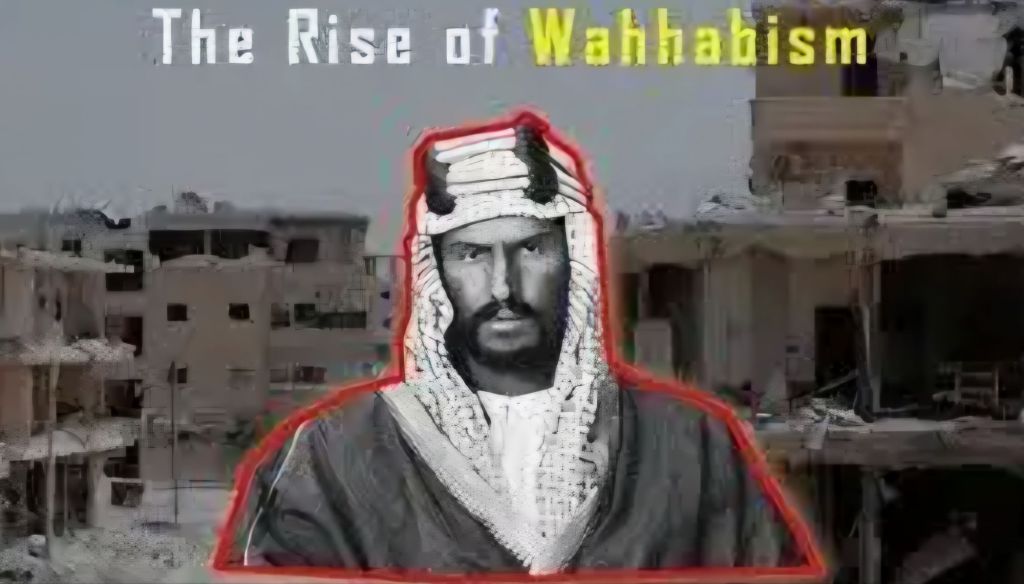
It appears that academic descriptions by many foreign scholars and travelers of Somalis and Somalia have no relevance today. New studies in anthropology and sociology are required to reflect on the rapidly changing nature of the new people being created in Somalia. Years of Wahabists’ indoctrination is almost done and successful. This has been made possible by repression of the Military Dictatorship of Siyad Barre before its final collapse in 1991, whereby the oppressed people of Somalia sought salvation in religion during his reign. Saudi Arabian Wahabism teachings, its institutions of charity organizations bent on spread of Wahabism to counter-act Iranian Shia influence in Sunny nations and opportunistic nature of Somali nomadic character had been a deadly combination of sort to transform Somalia into a nation in identity crisis, now in every aspect of life.

Deterioration of environment, livestock and fish habitat is in a state of alarm and emergency. Religious groups dismiss this man-made disaster as curse from Allah. This is another area of grave concern for the survival of life in Somalia. Public awareness and action are required to reverse the dangerous trend.

[This article has been updated since posting]

REFLECTIONS ON HISTORY OF PUNTLAND

Watch “Somalia resembles Liberia” on YouTube

ALARMING WORLD RECORD ON NEW SOMALIA

Somalia is described in world records with:

Piracy, Civil War, Terrorism, Refugees, Genocide, Al-Shabaab, ISIS, Warlords, Famine, Drought, Relief Aid, United Nations, UNHCR, Doctors Without Borders, Action Aid, World Bank, IMF, UNDP, NGOs, AMISOM, AU, Ethiopia, Kenya, Djibouti, Debt, Suicide Attacks, Money Laundering, Hawala System, Human Trafficking, Illegal Charcoal Trade, Early Childhood Mortality Rates, Mother and Infant Mortality, Open Borders, Khat Trade, No Currency Control, Zero Central Bank, No Drugs Control, Expired Food and Medicine, Heinous Business Practices, Rape, Murder, Kidnappings, No National Archive, Militias, Tribalism, Clannish, Religious Sects, High Divorce Rates, Corruption, No Accountability, lowest literacy rate in the world, illegal unreported and unregulated (IUU) fishing, foreign troops presence, bio-piracy, corruption, nepotism, capital flight, consumismerism…..

Does hearing and reading these horror attributes of Somalia as a country stimulate any chemical reactions in the minds of Somali Political elites? We doubt.

Warm reception for US Congresswoman Ilhan Omar in Garowe, Puntland,Somalia

Watch “Puntland Diaspora Summit successfully concluded in Garowe, Puntland, today” on YouTube

SOMALIA: WHY THE BEST SOLUTION TO CLAN RIVALRY ISN’T THE SOLUTION

Somalia wouldn’t be expected to become a rule-based modern state in the foreseeable future – it needs many generations of statecraft experience to outgrow persistent socio-economic realities. Clans and groups of religious infighting will always be there as long as society remains primative and unenlightened. Predominantly, opinions advocate for eradication of tribalism in Somali society. Daraawiish Movement of Sayyid Mohamed Abdulle Hassan in the 1880s1900s tried to address the issue of tribalism through religious indoctrination. It became a hard nut to crack and the problem had emancipated into a more vicious cycle of inter-clan conflict, revenge and counter-revenge. Areas he reigned and built his power-base are still reeling from historic tribal mayhem with no visible path to peaceful reconciliation -Dhulbahante, Isaak and Ogaadeen are examples of Daraawiish’s legacy permanently prone to interclan warfare. SYL (Somali Youth League), the National Political Party for independence, tried to bury “HAYB” (clan identification), only to be re-ignited and exploited by European neocolonialists of Italy, Britain and French. Emperial Ethiopia took advantage of this Somalia’s weakness. The regime of General Siyaad Barre had pretended or attempted to do away these centuries-old clan ways of nomadic life and allegiance. They failed abysmally with devastating result of vicious civil war that destroyed Somali state in the end. It is our observation and assessment that Clan Power-sharing Formula of 4.5 would stay here for a long time, even after direct popular elections. Why? It would be the only guarantee for minority political representation. We know many would disagree with our assumptions, however, time will tell.

So the best solution to the chronic tribal problem of Somalia is the policy of eliminating clan relationships once and forever. However, that has been proven unimplementable and fundamentally a mission impossible as it is also misguided and impractical.

The alternative policy to best solution to clan problems in Somalia is to work out a state policy that treats tribalism as co-existing with modern chronic diseases like diabetes, hypertension etc by devising regulations and laws to deal with it- accept the existence of the illness and treat it by medicine and diet (in this case, legislations). For instance, any person holding public office must be subjected to severe sanctions against abuses and acts of tribalism, nepotism and corruption. There must be laws as well in the private sector regulating and addressing crimes committed in the name of clan allegiances.

All what we are saying here is, let us learn managing our clan system in better ways, humanely and fairly until we grow out of it.

TALKING TRUTH TO POWER IN UNDEMOCRATIC AND TRIBAL CONTEXT

This book by a veteran Somali
political writer Ismail Haji
Warsame can be bought from Amazon of different countries, Barnes & Noble, Apple, Scribd, Smashwords and many other large bookstores of the world and digital libraries.
It is in two volumes,
each costing $11.99. The books
are excellent sources of
information on contemporary
Somali political history. It could
be used as a learning tool in
essay and English
composition writing for students
in high schools, colleges and
universities. This book could be
useful for Somali politicians and
foreign diplomats as well as
researchers on Somalia.

REMEMBERING THE UNSUNG AND FORGOTTEN HEROES OF LABAATAN JIRROW

https://ismailwarsame.blog/2016/11/29/remembering-the-unsung-and-forgotten-heroes-of-labaatan-jirrow/

ON THE CONTINUING SAGA OF GARA’AD PORT

Opening Ceremony

EXPOSING IMPORTANCE OF FUTURE GARA’AD PORT FOR LANDLOCKED ETHIOPIA TO LATE PREMIER MELEZ ZENAWI

In 1999, interacting with late premier of Ethiopia, Melez Zenawi, on the economic and security importance of still to be built Gara’ad Port was an eye-opener for him. The late Puntland President and I came to his office at Arati-Killo in Addis Ababa one day on appointment. At his campound gate, there were only two security guards. The campound seemed deserted with no visible security detail, unlike presidential buildings of most Somali leaders in Villa Somalia and capital cities of the Federal Member States. At door we were met by a sole office worker. We went through a narrow passage with a number of closed doors on each side, presumably offices, until we reached a sitting place where the premier was waiting for us. Melez was chain-smoking his cigarette brand of Rothmans, I noticed, while Yusuf was unusually nervous as he indicated that by his constant scratching on the edge of the sofa. I put my hand over his to stop him scratching persistently.

During a little chit-chat, Melez asked Mr Yusuf, “tell me about your cousins”. Yusuf responded, “you know Generals Gabyoy and Morgan better than I do, for you interacted with them when TPLF was a rebel organization based in Mogadishu during Siyad Barre regime, and you and I know how General Omar Haji Masale misbehaved during Somali Talks in Cairo in 1997”.

We started talking business. Melez was a good listener and habitually never interrupts someone, based on my earlier encounters with him. Among our priorities for discussion included our plan to construct Gara’ad Port on the shores of the Indian Ocean in Mudugh Region of Puntland. Somehow, Melez sounded that he heard about our desire to have a seaport there, but he seemed not to have paid any attention before. He looked concerned about Eritrean issue and frictions with Isaiah Afewerke.

Abullahi Yusuf explained to Melez how would-be Gara’ad Port could become a game-changer in terms of Ethiopian economy and marine transport needs, especially for Eastern Ethiopia. Mr Yusuf briefed him that in the event Ethiopia wanted to pump Shilabo gas through pipes to tankers at sea, there are three routes, the shortest and most secure of which would be Gara’ad Port. The route to Gara’ad Port passes through Darood sub-clans while the routes to Berbera and Obbiyo pass through multiple Somali sub-clans, who were traditionally antagonistic to each other. The operation of gas pumps have to consider safety as a priority. Melez had warmed up to the idea of Ethiopia having an alternative and safer sea-route to the Indian Ocean. Ethiopia should now take advantage of the newly built Gara’ad Port. They should invest in the construction of well-built highways to Gara’ad Port.

WHY THE PORT OF GARA’AD IS NEEDED – A BRIEF PERSONAL ACCOUNT

https://ismailwarsame.blog/2018/08/13/why-the-port-of-garaad-is-needed/

INTEREST IN POLTICAL PARTICIPATION BY RESIDENTS OF SOMALI REGIONS

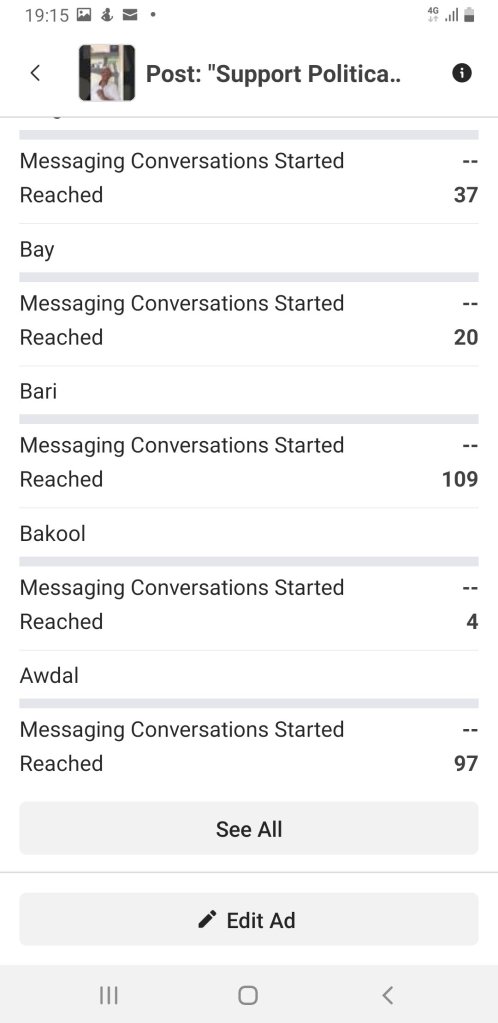
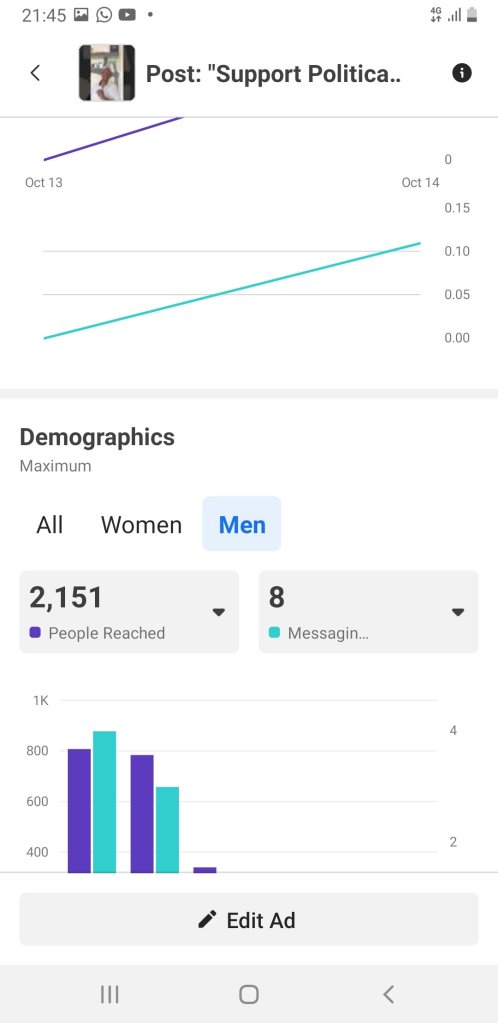
Warsame Digital Media WDM has conducted a survey through the Facebook to test interest in politics among the demographics in all regions of Somalia. Methodology: Release of a video clip directed at Somalia’s constituencies only. It was a Youtube video clip broadcasted through the social media. The clip wasn’t framed as normal survey, but a podcast reminding population to support political associations and parties in order to insure the independence of these organizations to survive, compete in the political arena and make government authorities accountable.

We believe that the result of watching rate to this video reflects upon participation and interest in Somali politics, on the top of many other factors of interest to researchers .

Based on the number, age and gender, residents of Banadir, Waqooyi Galbeed (Sonaliland) and Bari (Puntland) came out respectively first. The lowest rate came from Gedo, Bay, Bakool and Hiiraan. The rest of the regions are in-between. Read here the result of test:

https://ismailwarsame.blog/2022/10/15/interest-in-politics-along-age-and-gender-and-by-region/

INTEREST IN POLITICS ALONG AGE AND GENDER AND BY REGION. WDM TEST

Watch “Support Political Associations to be viable Political Parties” on YouTube

Watch “Musuqmaasuq dhan waraaqa ah ee siyaasiinta iyo hawlwadeenna Koonfur Somalia” on YouTube

FEDERAL MEMBER STATES ARE EXPERIENCING AN ERA OF ILLEGAL POWER GRAB AND EXTENSIONS

WDM EDITORIAL

Anti-democratic extensions of mandate is becoming fashionable in most Federal Member State (FMS) in Somalia. The Federal Government of Somalia (FGS) is reticent about the new political shenanigans by the heads of FMS. Silence on the illegal power grab could be interpreted as conniving with the power abuses in the FMS. Somaliland, which had never re-elected its Upper House in more than three decades and only twice in the Lower House, constitutes the most undemocratic entity and leads the pack of power grabbers in Somalia, followed by Jubaland, Galmudugh, Southwest and Hirshabelle. In the case of Somaliland, the Upper House (Guurti) has just extended its legislative mandate to yet another five-year term, thus becoming a parliament for life, and Somaliland, the mother of all mandate extensions. The President has extracted two-year term extension for himself by creating artificial constitutional crisis in Somaliland. Other FMS have opted for constitutional manipulations to prolong their stints and lives of misrule.

In Puntland State, public debates are raging in towns between supporters and opponents of democratic transition. Here at least the government isn’t talking about mandate extension. There are people among the debaters, though, who say cynically or in good faith that the idea behind One Person One Vote planned in Puntland State, is to seek extension of current administration’s term to finish up the process. They say the taste of pudding is in the eating. Until that happens, let us keep the faith to see these elections through.

Watch “Role of Puntland Youth in Council Elections” on YouTube

Watch “The importance of Council Elections in Puntland” on YouTube

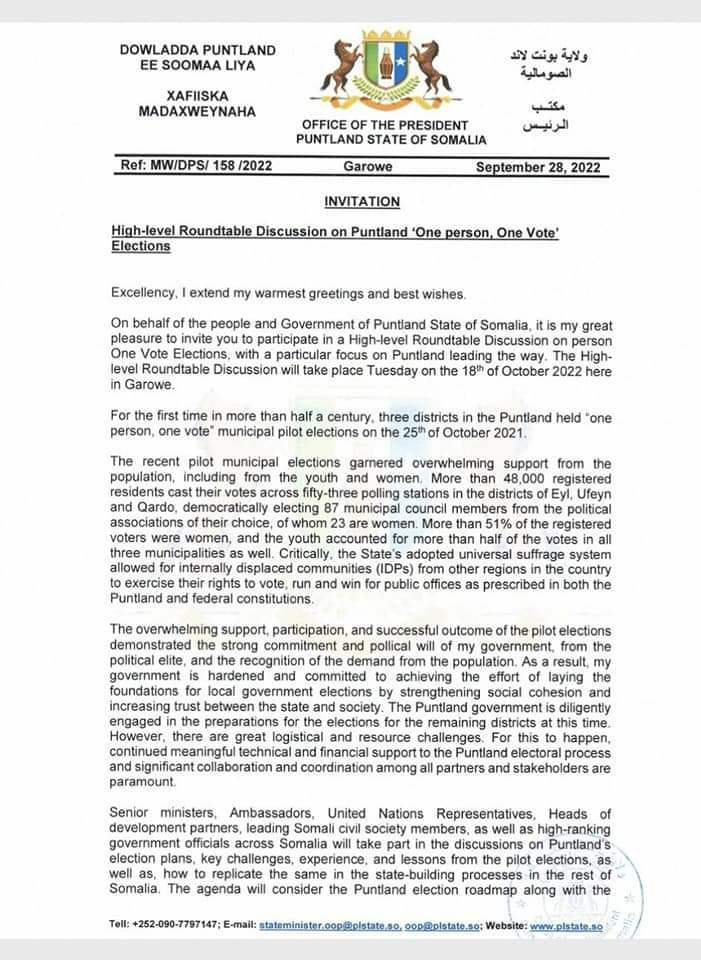
ROUNDTABLE DISCUSSIONS ON PUNTLAND FORTHCOMING ELECTIONS

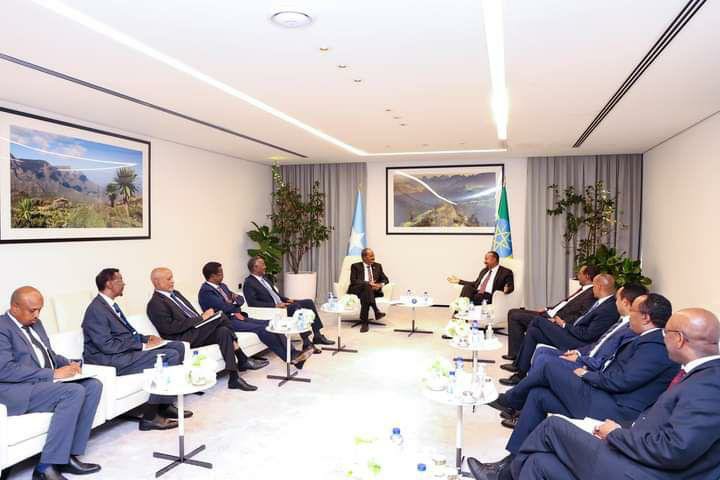
COMMUNIQUE ISSUED ON ABYI’S OFFICE LETTERHEAD

Somali-Ethiopian Communique on Ethiopian Prime Minister’s Letterhead

Watch “Different Regions of Somalia have Different Development Needs” on YouTube

PUNTLAND DOESN’T INVOKE ITS BARGAINING CHIP WITH FGS

Kindly review this article:

Ununiform development needs in Somalia is a reality on the ground, and those regions still in humanitarian or recovery stages couldn’t be allowed to hold back those which are in development stage, when considering aid distribution and technical assistance programs. Peace and stability must be the criteria to gauge development needs.

https://ismailwarsame.blog/2022/09/28/peace-and-stability-must-be-criteria-for-development/

HAUNTING POLITICAL IMAGE OF SOMALIA’S PRESIDENT HASSAN SHEIKH MOHAMUD

Picture of the Day: Only Foreign Minister Abshir Huruse stands out as an odd man in the crowd of HSM in Addis Ababa today.

PEACE AND DEVELOPMENT

يجب أن يكون السلام والاستقرار معايير التنمية.

حافظ على السلام لتعيش بسلام.  يدفع.  عندما أنشأنا دولة بونتلاند في الصومال في أغسطس 1998 ، على الرغم من أن المناطق الشمالية الشرقية كانت مستقرة نسبيًا باستثناء مودوغ ، كانت هناك إقطاعيات فرعية من العشائر ومقاتلين عشائريين مهددين والعديد من نقاط التفتيش غير القانونية على طول الطرق والطرق السريعة الرئيسية ، على رأس العناصر الدينية المتطرفة مثل آل.  – اتحاد الاسلامى.  قامت ولاية بونتلاند ، من خلال السلطة الأخلاقية والتشريعية ، بإزالة هذه العناصر من الفوضى المجتمعية في غضون فترة زمنية قصيرة.  عاد السلام الكامل والممتع إلى المناطق الشمالية الشرقية من الصومال.  من الحالة الإنسانية إلى الانتعاش والتنمية ، انتقلت بونتلاند إلى وضع الحكم الذاتي وتقديم الخدمات العامة ، بغض النظر عن مدى شعور الناس بعدم الرضا ، بناءً على توقعاتهم من حكومة مراوغة ، في أعقاب حرب أهلية شرسة في تاريخ  هذه الأمة المضطربة.
قارن سيناريو بونتلاند بتلك المناطق الصومالية التي لا تزال تعاني من العنف والأزمات الإنسانية.  هناك ، لا أحد يتحدث عن مرحلة التعافي من الحرب الأهلية.  لا يزالون بحاجة إلى تدخل إنساني.
خلال تقييم الاحتياجات المشتركة لفرقنا (JNA) مع الأمم المتحدة والبنك الدولي في 2005-2006 ، اكتشفنا أن أجزاء مختلفة من الصومال تحتاج إلى مناهج إنمائية مختلفة.  كان استنتاجنا أن بونتلاند وأرض الصومال قد انتقلتا إلى مرحلة التنمية بينما كانت بقية الصومال في الغالب في مرحلة إنسانية.  لا تزال احتياجات التنمية غير المعلوماتية في الصومال حقيقة واقعة على الأرض ، ولا يمكن السماح لتلك المناطق التي تمر بمرحلة إنسانية أو مرحلة التعافي بعرقلة تلك التي هي في مرحلة التنمية ، عند النظر في توزيع المساعدات وبرامج المساعدة الفنية.  يجب أن يكون السلام والاستقرار معيارين لقياس احتياجات التنمية

PEACE AND STABILITY MUST BE CRITERIA FOR DEVELOPMENT

Keep the peace to live in peace. It pays. When we established Puntland State of Somalia in August 1998, although Northeast Regions were comparatively stable save Mudugh, there were sub-clan fiefdoms and menancing clan militiamen and numerous illegal checkpoints all along the roads and main highway, on top of religious extremist elements like Al-Itihad Al-islaami. Puntland State, through moral and legislative authority, had cleared up these elements of societal anarchy within a short period of time. Full and enjoyable peace returned to Northeastern Regions of Somalia. From humanitarian situation to recovery and development, Puntland had moved forward to the status of self-government and delivery of public services, no matter how unsatisfied people felt, based on their expectations from an elusive government, following a vicious civil war in the history of this troubled nation.

Compare Puntland scenario with those Somali regions which are still experiencing violence and humanitarian crisis. There, nobody is talking about recovery stage from the Civil War. They still need humanitarian intervention.

During our Teams’ Joint Needs Assessment (JNA) of Somalia with the United Nations and World Bank in 2005-2006, we had discovered that different parts of Somalia needed different development approaches. Our conclusion was that Puntland and Somaliland had moved to development stage while the rest of Somalia was mostly in humanitarian stage. Ununiform development needs in Somalia is still a reality on the ground, and those regions in humanitarian or recovery stages couldn’t be allowed to hold back those which are in development stage, when considering aid distribution and technical assistance programs. Peace and stability must be the criteria to gauge development needs.

WHY PEOPLE OF PUNTLAND SHOULD SEIZE THIS VOTING OPPORTUNITY

WDM EDITORIAL

Aren’t you still tired and fed up of being told that your member of Parliament would be picked up by your clan elder? How would you allow your Puntland State President to continue to be selected by a group of unrepresentative 66 persons in your so-called parliament? By continuing to accept this kind of unaccountable and unrepresentative government, you risk losing the hope and future of your kids, existing generation, or even Puntland self-government. If you don’t change, you will have no rights to blame others for your misfortunes because of failure in your civic responsibilities. Once you skip the opportunity to vote and make a difference in your life and others’, you abandon all your rights as a full citizen.

In my opinion, after many trials and errors, Puntland State is now posed to make history in introducing One Person One Vote to the State and Somalia, starting with elections of District Councils. Make sure you contribute to the process and play your important role as responsible resident of Puntland State of Somalia. Good luck!

Puntland Government Press Release

The Ministry of Fisheries and Marine Resources of Puntland Government expresses its deep concern regarding the minutes from the meeting on 21/9/2022 between the Federal Minister of Fisheries & Marine Resources and foreign ambassadors, in which the Minister of Fisheries stated that he “does not recognize any license that is not issued by the Federal Ministry of Fisheries”, and threatened, “whoever is engaged in fishing activities with a license granted by the Federal Member States will be on the list of those who are accused of illegal fishing”. 

Puntland Government wishes to highlight that the above statement contradicts the constitution and the following political agreements:

1. Article 44 of the Constitution of the Federal Republic of Somalia stipulates that the distribution of natural resources shall be negotiated by the Federal Government of Somalia and its member states through a constitutional framework. 

2. The Baidoa Convention held on February 2nd 2018, Article 2; Paragraph B, confirms that the Federal Member States (FMS) have the authority over anything below 24 nautical miles.

3. The Addis Ababa Agreement held on March 22nd 2019, Article 3, states that the revenue generated from below 24 nautical miles will be managed by the Federal Member States.  

4. The Constitution of Puntland State, Article 3; Section 3 states that foreigners who are granted a permit from Puntland Government are allowed to fish between 12-24 nautical miles. 

Therefore, such reckless statement from the Minister of Fisheries & Marine Resources of the Federal Government could incite political instability, plunge the country into further division and jeopardize the economic future of the fishing sector as a whole.

In conclusion, we call on the officials of the Federal Ministry of Fisheries of Somalia to retract for his unsubstantiated statement, and honor the previous agreements and consultations between the Federal Government of Somalia and Puntland Government.


Watch “Shirkii Carta, Djibouti, Puntland, Somalia” on YouTube

HOW PUNTLAND HAD SAVED DJIBOUTI FROM UNION WITH ETHIOPIA

WHY SOMALIA IS HARD TO RUN

The political slogan by President Hassan Sheikh Mohamud (HSM), “Somalia in peace with itself and with the rest of the world” was too good to be true. It was inconsistent with both the political character and past deeds of the Somali leader. To have a nation in peace with itself, especially in the case of Somalia, means to me that political leaders must be chosen by the people. That is the first condition, I believe, to secure national peace. You can’t maintain peace, harmony and trust when leaders come to power through manipulations, corruption, interest groups and religious Tariqa. You can’t earn trust of your citizens, if you are known to be greedy and out there to accumulate wealth through corruption and misuse of public office.

Now, think of discussing resources-sharing with such politicians symbolized by President Hassan Sheikh Mohamud. Whether it is fiscal federalism or equitable and fair management of petroleum and other mineral resources, it would look and sound like debating with General Mohamed Farah Aydid on re-instating the failed state of Somalia. HSM and his political constituency aren’t yet ready to share the spoils of Somali state, no matter what system of governance Somalis agreed upon. It is winner takes all -a zero-sum game in political and clan rivalry.

Only recently it was the meeting in Mogadishu of finance ministers of FGS and FMS, failing to reach consensus on fiscal federalism due to the political interference by the Federal President. In HSM’s style of leadership and in direct violation of the Federal Constitution, the Cabinet and Prime Minister don’t exist. The only obstacle to HSM’s absolute power is the existence of Federal Member States. How would he then share resources and power with them? This is the basis for Puntland State argument on the brewing dispute on petroleum management with the administration of President HSM. This is also one of the key factors making Somalia hard to run.

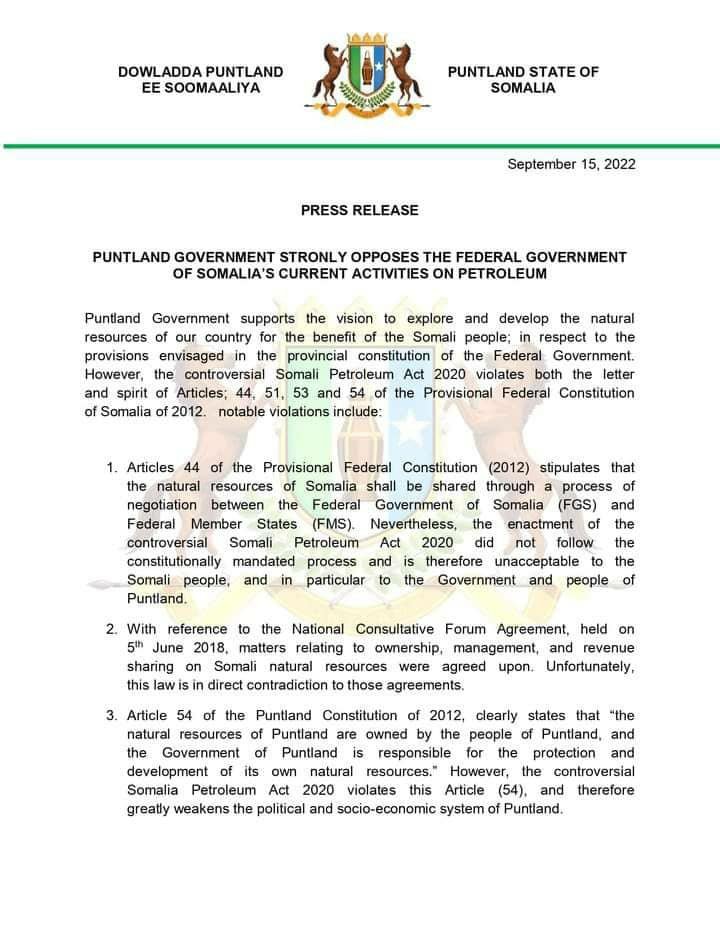
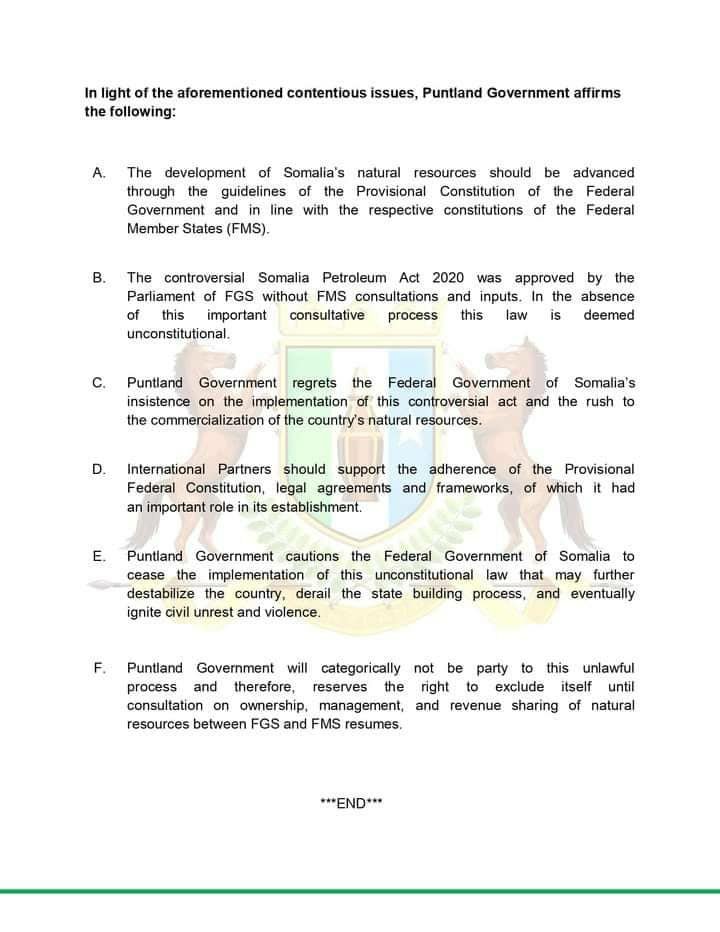
PUNTLAND RESPONDS TO SOMALIA’S UNILATERAL MISMANAGEMENT AND ABUSES OF PETROLEUM RESOURCES

Puntland response