No Justice, No Peace: Al-Shabaab’s Court System

No Justice, No Peace: Al-Shabaab's Court System

56 year old Hussein inherited land southwest of Mogadishu, Somalia. Having been a public servant prior to 1991, when he found himself in a land dispute over that same land, he did what any public servant would do: he took the case to court. Spending nearly 27,000 US dollars in the highly corrupt judicial system, he lost the initial trial and attempted to appeal the case. He still had hope for due process.

Then, the other party attacked his house. The police shot and killed two of his aunts while they tried to save their home. Soon after, his appeal stalled in court.  Two years later, with his appeal still unaddressed, Hussein did the unthinkable. He took his case to Al Shabaab, a violent terrorist group that operates a shadow government in the country.

His story is far from unique: Hussein is just one of thousands who has had to turn to Al Shabaab in a country without justice.

The Situation in Somalia

Described as “the most failed state,” Somalia lacks a unified government. Since the collapse of Mohamed Siad’s authoritarian regime in 1991, Somalia has struggled to establish a government. Although nominally run by President Hassan Sheik Mohamud, who served as chief executive from 2012-2017, and was reelected in a much-delayed election in May 2022, much of the country isn’t under government control: Al Shabaab controls nearly 70% of South and Central Somalia. In the areas under its control, Al Shabaab conducts all the basic functions of a normal government: it taxes residents, offers security, and even provides welfare to needy populations. Through taxation, Al Shabaab brings in some 15 million dollars a month–almost as much as the legitimate Somali government. Somalia’s actual government, meanwhile, is consistently rated as one of the most corrupt countries in the world and relies heavily on international assistance to survive. The minister of Hirshabelle put it bluntly: “We have two governments. … They control more and generate more funds than us”.

Despite international efforts to counter its rise, Al Shabaab has thrived in the Horn of Africa. As such, while the Somali government remains corrupt, discriminatory, and otherwise untrusted, more people flock to Al-Shabaab. A 2018 study on recruited members of Al Shabaab found that, increasingly, the group’s messaging towards youth emphasized injustice and power abuse issues. A full two-thirds of recruited members say they joined because of clan discrimination, government corruption, or economic reasons. Given the struggles of the government in Somalia, it is unsurprising that Al Shabaab has gained a foothold in the Somali judicial system.

Al Shabaab’s “Justice”

Utilizing a combination of Xeer, the traditional legal system in Somalia, and Sharia law, a form of Islamic law, Al Shabaab has established a network of courts across the country. These “shadow courts” handle a wide variety of disputes. Somali researcher Hussein Yusuf Ali notes that Al Shabaab responds to a variety of needs for justice, especially arguments over natural resources, commercial disagreements, and accusations of clan discrimination. Land disputes are also frequently handled by Al Shabaab: one resident of Baido estimates that “80% of land disputes are taken to Al Shabaab and perhaps 20% go to formal courts.” Al Shabaab courts even handle issues of extortion, clan discrimination, corruption, and unlawful arrests, meaning Al Shabaab may prosecute government and law enforcement agents as well as civilians.

Even in areas officially controlled by the government, Somalia’s justice system is as dysfunctional as the government itself. Corrupt, fractured, and lacking the power to enforce its decisions, the judicial system rarely provides justice. The US State department described Somalia’s justice system as one where “impunity generally remained the norm,” and decisions are heavily influenced by clan based politics and corruption.

To fill this vacuum, Al Shabaab has become an arbiter of justice–not necessarily because the public actually supports the terrorist group, but because there is no other option. Aweys Sheikh Abdullah, who was a judge in the Banadir regional court from 2016-2018 told reporters that people turn to Al Shabaab because courts involve a “long process which can take years without the case proceeding, backlog resulting from lack of enough judges at the court and costly legal fees.”

Many Somalis see Al Shabaab’s courts as neutral, unbiased institutions which provide a free platform for arbitration. Those from minority clans, who are often wary of being discriminated against by government judges, are enticed by this promise of neutrality to use Al Shabaab. In government courts, one lawyer from Hodan said, “many people fear being killed if they bring their cases before courts. Some people are silenced. Some others receive death threats, which could later force them to withdraw their cases. For minority groups, they might face all those threats and risks with the addition that they have no powerful allies to help them.”

This, among other reasons, is why thousands now turn to Al Shabaab–even those living under government control–to adjudicate their disputes. Residents of Mogadishu, the government controlled capital, travel to nearby Al Shabaab areas to settle disputes. By some anecdotal accounts, even policemen and military officials are known to seek justice from Al Shabaab instead of the government.

Al Shabaab also has the power to enforce its decisions, while decisions by government courts are largely unenforceable. Al Shabaab’s courts successfully enforce their rulings by using threats of violence to do so. If someone does not comply, they risk the robbery, injury, or death of themselves and their loved ones. Residents of Bariire in Somalia reported that they have been forced to watch public executions, amputations, and more as a means to intimidate residents.  While barbaric, this violence ensures respect for the institution–something which the government courts lack.

Al Shabaab’s draconian punishments highlight a frightening truth about the group: despite gaining legitimacy as a pseudo-government, Al Shabaab is just as violent, radical, and dangerous as ever. In the year 2021 alone, the organization killed more than 550 civilians. Al Shabaab has been accused of crimes against humanity, has conscripted child soldiers, and continues to exploit and abuse those under its control. It is no surprise that the people of Somalia, even those who may rely on the court system, want Al Shabaab gone.

Despite the group’s violence, interviews with lawyers, clan elders, and government officials indicate that Al Shabaab’s “reputation for lower levels of corruption,” lack of bias in the court (in that it is seen as not discriminating along clan lines), and ability to enforce court rulings (often through violence) have earned the group respect. Juxtaposed against the government courts, Al Shabaab is now seen as less corrupt and less discriminatory than government courts. In turn, Al Shabaab derives much of their power from a purported moral high ground, which they manage to achieve even in the face of barbaric human rights violations.

Legitimacy and Government

Al Shabaab’s shadow courts are only a case study of their larger strategy to delegitimize the government and take its place. After all, this is not the first time that Al Shabaab has sought to take over the role of the fragile government.

Following the 2017 drought in Somalia, as the government floundered, Al Shabaab began handing out food and water aid to impoverished farmers. More recently, Al Shabaab established COVID-19 healthcare centers in response to the pandemic, and has even established schools and programs to send fighters to universities abroad to receive education.

Doling out these goods and services, Al Shabaab has built its power on the inability of the government to provide for its people. The failures of the Somali government to bring about adequate justice and rule of law created the conditions for Al Shabaab to make its own courts, just as the failure of all governments offers an opportunity for Al Shabaab to rise to power.

Alexus G. Grynkewich, Commander of the US 9th force, describes this type of strategy as “welfare as warfare”, where a terrorist group provides services, humanitarian aid, or security in order to erode the legitimacy of the existing government. This hearts and minds approach helps counteract the violent, oppressive image of Al Shabaab that many Somalis have, thus making the group seem like a more benevolent ruling force.

If this strategy sounds familiar, that’s because it is: the practice of welfare as warfare is a tried and true means for terrorist groups to gain support and legitimacy. The Taliban employed this model for years, running a similar Sharia based court system in Afghanistan. One expert described Al Shabaab as a junior varsity version of the Taliban: like the Taliban, Al Shabaab operates courts, collects taxes, and provides aid to the public. This justice system, which legitimized the Taliban in the eyes of the public and gave the terrorist group valuable experience in running a country, likely helped contribute to the Taliban victory in Afghanistan in August 2021.

Also like the Taliban, Al Shabaab is pairing its legal efforts with a targeted propaganda campaign meant to make the government seem weak and ineffective. In 2021, Al Shabaab released a six part documentary about the failures of the Somali president, advocating for Sharia as a solution. Unlike typical terrorist propaganda, Al Shabaab’s documentary, which it marketed as “objective,” focuses on political problems rather than only radical ideology. Since then, another 12 part documentary about the problems of the Somali constitution has been released.

Without a functioning judicial system, Al Shabaab’s claims that the government is ineffective are more easily accepted across Somalia. The mere existence of a parallel legal system in Somalia, especially one run by a group who explicitly hopes to overthrow the existing government, shows that the Somali state is unable to uphold rule of law.

Al Shabaab courts have become more brazen too. The courts sometimes work directly with clans and elders, and are overturning already decided government cases. Al Shabaab even warns those under its control from stepping foot in government courts, threatening civilians that do so.

Ultimately, Somalia is trapped in a dangerous cycle: an illegitimate government is the but-for cause of Al Shabaab’s courts. Yet Al Shabaab’s courts also contribute to the perception of illegitimacy, while helping to resolve legitimate concerns that the government has not adequately handled.

The Road Ahead

Thankfully, the Somali government has begun paying attention to the issue: President Mohamud has put Al Shabaab’s courts at the center of his counterterrorism strategy in the past few weeks, declaring a war on the system. In September, Somali forces attacked an Al Shabaab-run courtroom in Basra near Mogadishu, the first such operation to specifically target the shadow judicial system.

The federal government has even fomented a clan uprising against Al Shabaab, weaponizing Somalia’s powerful clan militias. In previous administrations, authorities refused to provide government support to the clan militias, allowing Al Shabaab to consolidate control over clan territories. This novel approach to clan militias is already working. Just last week, 40 towns in the Hirab region were liberated from Al Shabaab rule with the help of the Macawisley militia.

This new strategy is vastly superior to a proposed military-only approach to Al Shabaab. A hyper-militarized counterterrorism strategy in Somalia risks killing and radicalizing civilians, shutting down potential negotiations, and will likely result in retaliatory escalation by all parties. While military operations may temporarily clear Al Shabaab out of a town, they do not solve the underlying problem relating to the lack of effective governance in the area. This makes it easy for Al Shabaab to fill the void in services once again.

In fact, using only military force to fight Al Shabaab, now that it operates as a pseudo-state in many areas, may even be counterproductive: because Al Shabaab is the provider of goods and services, attacks on the group risk disrupting vital governance, aid, and public services, leaving vulnerable communities in the lurch. Without a wider political strategy, military escalation will keep Somalia entrenched in conflict.

Additionally, instead of relying on bombing and raids, since Al Shabaab currently has a weakened military, the Somali government should seize this opportunity to build informal channels for peace and demobilization negotiations. The government should start at the local level, leveraging any connections it has to the group. The appointment of  Mukhtar Robow, an ex-Al Shabaab leader turned government official, to the ministry of religion last month could give the government the credibility it needs with Al Shabaab to establish locally mediated negotiations. While there is a long-term goal for peace, in the short term negotiations about a ceasefire, halting bombings, and protecting civilians would be a significant step in the right direction.

The Somali government must beat Al Shabaab at its own game: as long the public sees Somalia’s judicial system as untrustworthy and corrupt, there will always be a demand for Al Shabaab and its courts. Therefore, Somalia must also take steps to address the corruption and costs in its legal system. A study of Somalis found that high costs were the largest access barrier to government courts. On top of this, Al Shabaab’s ability to enforce its court decisions is why the group is so successful in the legal field: the USAID study on Somalia concluded that the ability to enforce decisions swiftly is the largest “pull factor” of Al Shabaab’s courts. As one respondent put it with regards to the government system, “justice depends on your pockets.” Stronger anti-corruption regulations, assistance from the international community in lowering legal fees, and out-of-court arbitration options could go a long way towards lowering costs. However, for a country facing immense turmoil and violent terrorism, reforming the justice system will not be easy.

Somaliland, a breakaway region of Somalia, could also be a potential model for judiciary reform. Although Somaliland faces corruption, bias, and a lack of resources within its judicial system, it is consistently seen as more effective than the courts in the rest of the nation. Part of an “increasingly capable government,” the justice system in Somaliland still has a long way to go, but is a far better alternative than the current Somali equivalent. Somali leaders might be well served by working with Somaliland officials to reform their courts.

For almost two decades, Somalia has fought Al Shabaab on the battlefield. As the conflict moves to the courtroom, success seems uncertain: The country’s future is precarious, its government and justice system weak, and its people under attack by a violent terrorist group. The world has largely given up on Somalia.

But it is the constant struggle of the Somali people to bring justice, governance, and peace to their country which proves that Somalia is not a lost cause. Growing local resistance against Al Shabaab, demands for improvements to the government, and the peaceful transition of power this summer are all hopeful signs for the country.

It is past time for the government to rise to the goals of its people: President Mohamud has the opportunity now to fight Al Shabaab, build the government, and bring justice to the Somali people. So far, he has risen to the challenge. If he can maintain his momentum, and help the Somali government win the battle for judicial reform and create a comprehensive approach to counterterrorism, the country stands a chance against Al Shabaab. The fight for the future of Somalia has just begun.

[Courtesy to Havard International Review, HIR]
WDM EDITORIAL

WHY PEACE IS IMPORTANT TO ALL IN PUNTLAND STATE

Media reports in Puntland State indicate that a group of politicians and former government officials are reportedly raising and mobilizing clan militiamen from Nugaal Region against current Administration of President Said Abdullahi Deni. If true, this could be another violent chapter to destabilize the State and disrupt peaceful development and democratization of Puntland State. Such a scenario must be avoided by all at any cost. It doesn’t benefit anyone. Based on WDM assessment, majority of the residents of Puntland support democratization, and any opposition to the notion of direct elections will fail. Besides, for a revolt to succeed, it must have a credible leader and popular support. This attempt has none.

Look back at short history of Puntland – no one, who first started violence through armed rebellion, had ever been successful, while counter-offensives against violators of peace had been always victorious. There must be reason for this historical fact. It is the residents of Puntland State that made possible for the gains of the regions to continue and be sustainable. Repeat, nobody had ever gained from violence in Puntland, be warned.

[This editorial has been updated since posting.]

PEACE AND DEVELOPMENT

يجب أن يكون السلام والاستقرار معايير التنمية.

حافظ على السلام لتعيش بسلام.  يدفع.  عندما أنشأنا دولة بونتلاند في الصومال في أغسطس 1998 ، على الرغم من أن المناطق الشمالية الشرقية كانت مستقرة نسبيًا باستثناء مودوغ ، كانت هناك إقطاعيات فرعية من العشائر ومقاتلين عشائريين مهددين والعديد من نقاط التفتيش غير القانونية على طول الطرق والطرق السريعة الرئيسية ، على رأس العناصر الدينية المتطرفة مثل آل.  – اتحاد الاسلامى.  قامت ولاية بونتلاند ، من خلال السلطة الأخلاقية والتشريعية ، بإزالة هذه العناصر من الفوضى المجتمعية في غضون فترة زمنية قصيرة.  عاد السلام الكامل والممتع إلى المناطق الشمالية الشرقية من الصومال.  من الحالة الإنسانية إلى الانتعاش والتنمية ، انتقلت بونتلاند إلى وضع الحكم الذاتي وتقديم الخدمات العامة ، بغض النظر عن مدى شعور الناس بعدم الرضا ، بناءً على توقعاتهم من حكومة مراوغة ، في أعقاب حرب أهلية شرسة في تاريخ  هذه الأمة المضطربة.
قارن سيناريو بونتلاند بتلك المناطق الصومالية التي لا تزال تعاني من العنف والأزمات الإنسانية.  هناك ، لا أحد يتحدث عن مرحلة التعافي من الحرب الأهلية.  لا يزالون بحاجة إلى تدخل إنساني.
خلال تقييم الاحتياجات المشتركة لفرقنا (JNA) مع الأمم المتحدة والبنك الدولي في 2005-2006 ، اكتشفنا أن أجزاء مختلفة من الصومال تحتاج إلى مناهج إنمائية مختلفة.  كان استنتاجنا أن بونتلاند وأرض الصومال قد انتقلتا إلى مرحلة التنمية بينما كانت بقية الصومال في الغالب في مرحلة إنسانية.  لا تزال احتياجات التنمية غير المعلوماتية في الصومال حقيقة واقعة على الأرض ، ولا يمكن السماح لتلك المناطق التي تمر بمرحلة إنسانية أو مرحلة التعافي بعرقلة تلك التي هي في مرحلة التنمية ، عند النظر في توزيع المساعدات وبرامج المساعدة الفنية.  يجب أن يكون السلام والاستقرار معيارين لقياس احتياجات التنمية

PEACE AND STABILITY MUST BE CRITERIA FOR DEVELOPMENT

Keep the peace to live in peace. It pays. When we established Puntland State of Somalia in August 1998, although Northeast Regions were comparatively stable save Mudugh, there were sub-clan fiefdoms and menancing clan militiamen and numerous illegal checkpoints all along the roads and main highway, on top of religious extremist elements like Al-Itihad Al-islaami. Puntland State, through moral and legislative authority, had cleared up these elements of societal anarchy within a short period of time. Full and enjoyable peace returned to Northeastern Regions of Somalia. From humanitarian situation to recovery and development, Puntland had moved forward to the status of self-government and delivery of public services, no matter how unsatisfied people felt, based on their expectations from an elusive government, following a vicious civil war in the history of this troubled nation.

Compare Puntland scenario with those Somali regions which are still experiencing violence and humanitarian crisis. There, nobody is talking about recovery stage from the Civil War. They still need humanitarian intervention.

During our Teams’ Joint Needs Assessment (JNA) of Somalia with the United Nations and World Bank in 2005-2006, we had discovered that different parts of Somalia needed different development approaches. Our conclusion was that Puntland and Somaliland had moved to development stage while the rest of Somalia was mostly in humanitarian stage. Ununiform development needs in Somalia is still a reality on the ground, and those regions in humanitarian or recovery stages couldn’t be allowed to hold back those which are in development stage, when considering aid distribution and technical assistance programs. Peace and stability must be the criteria to gauge development needs.

Chasing Mirages Across Somalia

 Abukar Arman. 5 years ago

somalia

Hopelessness is a dangerous dead-end. As with people, nations need a sense of hope to exist and deal with the inevitable challenges confronted throughout their development and existence. But that sense of hope must be grounded on reality; otherwise, it turns into delusion.

With the so-called election being around the corner in Somalia, it is fair to say that this systematically eroding nation is in the thick of that season of delusional self-assurance. Positive change is inevitable without making any change in method and mindset.

Many candidates are lined up to replace the de facto President, Hassan Sheikh Mohamud, whose term has ended on September 10th, who is enjoying an extension without mandate, who himself is a candidate. The Parliament is sidelined as in 2011 right before the transitional period came to an end. Worse, there is no Constitutional Court to judicially arbitrate.

These candidates, by and large, have only one thing in common: the conviction that “The president must go.” This sentiment which resonates with the majority of Somalis has ironically rendered any substantive inter-candidate debate on critical issues unnecessary, at best.

Most seem confident that a replacement would automatically bring about the direly needed change to repair brokenness and rectify ills. However, history reminds us of successive disappointments that resulted from such false assumption in the past decades.

Governance by Tourism

Four years ago, I have privately counseled and publicly cautioned that the newly elected President was bound to fail if his government does not provide direly needed public services, make genuine reconciliation and transparency to end corruption his top priorities. And fail, he did.

Against this backdrop, President Mohamud has been expanding his authority by issuing unconstitutional decrees that are intended to become part of the policies shaping the electoral process. His effective tactics worked like this: He would issue a decree that clearly overreaches the legislative authority of the Parliament, and then swiftly, before any public outcry or any candidate could react, IGAD and UNSOM would issue their respective congratulatory statements. Implementation ensues.

Meanwhile, in order to present a façade of legitimacy, the coopted Speaker of the Parliament is granted a symbolic seat at the so-called National Leadership Forum. The NLF is an IGAD concocted and international community supported political sham that grants a handful of regional actors and government officials with clear conflict of interest the exclusive political authority to decide Somalia’s existential fate. Make no mistake; this can only lead into a never-ending process of transitioning out of transition, bloodshed and perpetual dependency.

Smoke-screened by this political theatrics, the reinvention of President Mohamud is smoothly underway. He is in effective hands of professional image-makers who are capable of making miserable failures look like exemplary successes. In this recent article with all dramatic visual and sound effects, President Mohamud, the man under whose watch Ethiopia got a blank check to run the Somali political affairs and al-Shabaab became more lethal than ever before, claims to have a new plan to restore security and defeat that terror group.

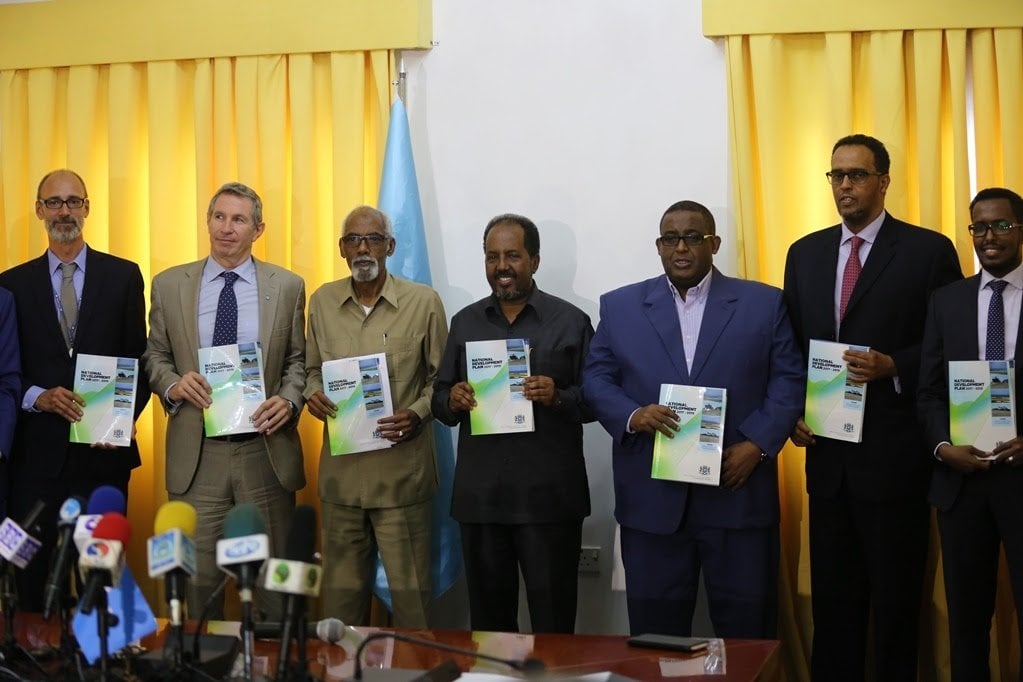
On their part, the Council of Ministers has completed the National Development Plan or the cosmetically enhanced version of the cash-sucking New Deal Somali Compact 52 days before their term expired. The subsequent political fanfare by the advocates of status quo was hardly surprising.

Never mind that the current leadership are yet to designate national currency and are yet to address how having US dollar, the Ethiopia’s Bir, and Kenya’s Shilling–the national de facto currencies—contribute to inflation and make life economically unbearable for the average Somali. People are led to believe that these same leaders whose ‘national budget’ is made of salaries and operation costs, who are yet to set up a single government-funded clinic or feeding and housing centers for the nearly one million internally displaced persons (IDPs) in Mogadishu alone, are set to improve the Somali per capita income and reduce poverty.

Meanwhile, suits are pressed, shoes are shined and suitcases are packed. The Somali leadership team is anxiously waiting for the next great conference being convened somewhere across the seas.

Coercive Institutionalization of clan federalism

Ever since certain members of the political elite accepted that clan-based federalism is a viable governance system; that false narrative has neither faced serious scrutiny nor serious setback. Well, at least not until the government, IGAD, and UNSOM have at various times attempted to lure, pressure, and coerce the traditional leaders of Hiiraan to merge into an arbitrary union with Middle Shabelle and immediately form a federal-state before the upcoming election. Apparently this trio has forgotten Hiiraan’s historical reputation as the womb of Somali patriotism.

So, Hiiraan became ‘Laf dhuun ku taagan’ or the ‘bone that stuck in the throat’ of the trio and a major setback against the political formula engineered to make the reconstitution of the Somali state impossible, and inter-clan perpetual enmity and bloodshed the political order.

Which of the Presidential Candidates might be the right one?

In identifying the right person, it is critical to establish criteria through which each candidate could be evaluated. None should be granted advantage based on name recognition, clan affiliation, or cash cushion. Election or selection should be criteria-based:

– Does he or she have a clear vision, grand strategy and a viable implementation plan to help him or her shake up the current externally manipulated political order?

– Is he or she willing to cut the umbilical cord of dependency and spearhead a nation willing to mainly rely on itself?

– Is he or she willing to put genuine reconciliation, public service and transparency on top of his or her priority list?

– Is he or she willing to pushback against IGAD & UNSOM diktats and accept the fact that the authority to govern comes from the people, and that he who grants you that authority can also take it away from you?

– Does he or she recognize the existential importance of having one or two strategic partners instead of an array of states and interest groups of conflicting interests?

If these criteria seem too difficult to meet, rest assured, they are. No one should be misled to believe otherwise.

Sowing Before Harvesting

The succeeding president and government will not make substantive change so long as they do not put genuine reconciliation, followed by constitutional convention that addresses all critical issues ignored by the current counterfeit document, at the top of their priority list.

The new constitution must overhaul the political order of the day. It may acknowledge the social relevance of clan structure but must declare in no uncertain terms the separation of clans and state and ensure that clans have no political authority and that clan-based distribution of political power is done with. In their very nature, clans promote exclusive rights and perpetual zero-sum strife against other clans.

Somalia may not get a candidate who meets every aspect of the criteria but it cannot afford not to raise the bar. It is time for the public to demand accountable leaders with transformational vision. It is time to resist getting intoxicated with political rhetoric. It is time to end the mirage-chasing game.

Categories: Horn of Africa

Tags: electionsEthiopiaHassan Sheikh MohamudIGADpeaceShabaabSomaliaTerrorismUNSOM

Federalism, a Guarantor of Peace among Somali Clans

By Ismail Warsame

February 6, 2013

Nowadays and for while during the past two decades, Somali thinkers, writers and politicians were keenly debating on best way forward for Somalia’sgovernance and political arrangements Post-Civil War. This debate is extremelycrucial for the survival of Somalia as a country as well as a strong cohesive nation-state.

While many among debaters were and are still sincerelyl ooking for best possible governance system (s) and pros and cons of each ofthe “Menu of options”, a few of them continue to ignore the status quo (current Somalia’s political situation) dismissing it as sidetrack and unimportant clannish nuisance or refuse to acknowledge the extent ofpublic mistrust following the vicious civil war involving heinous crimes of ethnic cleansing, mass murder, forceful and illegal landing-grabbing, plunder of both public and private wealth and barbaric destruction of national heritageand state archives in Mogadishu and elsewhere.

In my humble opinion, any politician of conscience at any level of government (President, Cabinet and parliament members) whose political power base had committed such grave and gross human rights abuses, national robbery, national betrayal and treason should apologize to the nation and resign immediately. If that is not forthcoming, it would be mean that the civilwar is still technically on, and there is no guarantee that history would not repeat itself. Such politicians have no moral legitimacy to govern until they come clear and publicly accept their personal and power-base responsibilities for what happened in Somalia during the Barre regime and following the final collapse of Somalia’s central state in 1991. Somalis, please be warned. One should never entertainwith the idea to translate the recent US recognition of the current Somali Government as a victory of one faction over others in theCivil War, and again attempt to misuse state resources to try to subjugate others. That would be a futile exercise and would unfortunately hasten the disintegration of Somalia as we know it. It is the expectation of all Somalis from the world community to watch out any signs for the repetition of that sad saga.

During the past ten years we witness multiple self-proclamations of regional federal mini-states such as Makhir State,Khatumo State,Awdal State,Galgamud State, Hibin and Heeb State, Asania State,Ras Asayr Stateamong many others. With keen observation, one would realize that those self-proclamations were characteristically peaceful and surprisingly did not spark off any clan fighting with the unique exception of Khatumo, rightly resisting aggressive occupation of its territory by “Somaliland”militia. Why? This could be a case-study; of all clan wars in the country, the self-proclaimed federal mini-states brought relative peace to their respective constituencies.  In my opinion, one ofthe main reasons for such peaceful environment within for all sub-clan systemsis the fact that their constituencies see themselves as equal stake-holders inthat mini-entity (state), which acts as the accepted and shared mechanism for conflicts resolution and constitutes common interest for all. Logically and practically, one would therefore take note of this new development to expand the concept to a national level in Somalia’s long journey to restore lost trust among its people and regions.

For historical prerspective, a few months after we had established the Puntland State of Somalia in August 1998, a sub-sub-subclan among the inhabitants of coastal Indian Ocean Mudugh town of Gara’ad andsurrounding areas including the District City of Jeriiban unilaterally announced the creation of Coastal State, declaring its independence fromPuntland State, following sub-clan grievances regarding their expected share inthe newly constituted Puntland Parliament. That grievance was actually proved to be the mistake or intentional concession of their allocated Parliament seatto another sub-clan in Mudugh Region by their local traditional elder. The subclan members opposed the move by the elder. To address the issue and resolveit, a delegation led by the Late State President, Abdullahi Yusuf Ahmed and meincluded, went to the District and met with all stake-holders. One of the first questions we asked our interlocutors was: “How many sub-subclans belong to orcreated the Coastal State, and how many regions are there in the proclaimed entity?” The audience looked at each other,and surprisingly, the answer was obvious. The District belonged to the larger Mudugh Region and even most of the inhabitants of the Jeriiban District alone via their representatives did not belong to and were not party to the “Coastal State”. That was the end of the story. I believe, Coastal State was the first unviable mini-state created in Somalia.

The lesson we learned from that experience was that a statewhether it is a national or regional must enjoy the trust of all its constituencies to survive, safeguard its unity, develop and prosper in peace and harmony. Anyone aspiring to see the Somalia he or she wants or imagines must take this lesson seriously into account.

Those Somali writers debating on federalism lately almostall of them ignore the fundamental reason for the debate itself on the issueand failed to find the answers to two critical questions:

What is the main reason that has brought us here to debate on Somalia’s governance options?

How would you restore trust of the people nation-wide in a central authority when people of Somalia have not yet officially and technically ended the Civil War in the absence of comprehensive national reconciliation given what happened?

President Hassan, in athoughtful, prepared and defiant speech to the Somali Diaspora in his recentvisits to US and Belgium says openly, “ if you look back on what happenedyesterday, you lose the opportunities of today”, thus dismissing outright any possibility for accountability for crimes of mass murder, crude human rights abuses, robbery and plunder of personal and public properties. With such a vision for Somalia,forget about reconciliation and peaceful conflict resolutions!

Finally, I am aware that many Somalis would like to give thecurrent government in Mogadishu the benefit of the doubt and wish her to succeed in the best interest of the entire nation. To those I say the taste of pudding is in the eating. Anyone who helps Somaliare cover from its present predicament will be highly appreciated and undoubtedly recognized.

https://amazon.com/author/ismailwarsame

CHANGING TIMES BROUGHT ABOUT BY PEACE AND COMMERCE

A commercial sign of an Abyssinian barber shop in Garowe, Somalia. Times have changed lately.

https://amazon.com/author/ismailwarsame

NOSTALGIA

Garowe, May 10, 2019 – Somali travelers from Mogadishu experience in Garowe not only personal relief and peace of mind, but also feeling of nostalgia of good old days of calm and peaceful Somalia – a part of Somalia they can move around in town round the clock without encountering any incident of inconvenience in their free exploration of life in the city.

Somalia’s Prime Minister, Hassan Ali Khayre, had tested the sweetness of peace and tranquility here when he recently had chosen to walk around the streets of Garowe, touring city hotels and restaurants to break his Ramadan fasting, chatting with customers and enjoying casual conversations with the residents of Garowe from all walks of life.

Those FGS officials of Puntland origin, whether they are members of the two chambers of Somalia’s Federal Parliament, the Cabinet or civil servants, struggle and fight for obtaining places, spaces and time to squeeze into the Federal leaders’ travel packages for occasional working and official visits to Puntland in order to re-enjoy the feeling of peace and life without the fear of bomb-blasts and threatening phone calls from mass killers and extortionists in Mogadishu.

Welcome back to Puntland, friends! Enjoy your life as it should be. Just remember one thing, you won’t make easy Benjamins here in Puntland – that could be inconvenient to some of you.

ismailwarsame.blog