Somalia at the Brink: Possible Responses if Mogadishu Falls to Al-Shabab

Introduction

Somalia stands at a perilous crossroads, as the threat of Mogadishu—the nation’s capital and symbolic center of governance—being overrun by Al-Shabab militants grows increasingly imminent. Al-Shabab, a jihadist group aligned with al-Qaeda, has persistently destabilized Somalia through guerrilla warfare, terror attacks, and the establishment of parallel administrations in rural regions. Should Mogadishu fall, it would mark not just a territorial setback, but a profound political, military, and psychological blow to the fragile Somali state. This essay explores the possible responses Somalia might undertake in such a scenario, including internal government reactions, regional and international interventions, civilian responses, and long-term strategic recalibrations.

1. Immediate Government and Military Response

Evacuation and Relocation of Government Apparatus:
If Mogadishu is lost, the Somali federal government (SFG) would likely relocate its operations to a more secure city, such as Baidoa, Beledweyne, or Garowe. The movement would aim to preserve continuity of governance and maintain diplomatic lines with the international community. Such a move would also be aimed at preventing a total collapse of state authority.

Counteroffensive Plans:
The Somali National Army (SNA), supported by regional state forces, would likely plan an immediate counteroffensive to retake the capital. This could involve conventional assaults, urban warfare tactics, and the solicitation of emergency support from international partners, particularly the African Union Transition Mission in Somalia (ATMIS), Turkey, and the United States.

Emergency Powers and Martial Law:
The government may invoke emergency powers or martial law, suspending normal governance structures to focus on security operations. This might include curfews, increased surveillance, and rapid conscription of local militias into government-aligned forces.

2. Regional and International Involvement

ATMIS (now AUSSOM) Reinforcement:
The African Union, under pressure from regional stakeholders such as Kenya, Ethiopia, and Uganda, may reinforce its presence in Somalia. This could involve deploying more troops or extending ATMIS’s mandate beyond its scheduled withdrawal. A fall of Mogadishu would rekindle fears of regional spillover, prompting action even from reluctant neighbors.

U.S. and Turkish Involvement:
The United States, which has conducted drone strikes and advisory missions in Somalia, may escalate its direct involvement. Similarly, Turkey, which has trained Somali forces and established significant influence in Mogadishu, might increase its support through intelligence sharing, equipment, and strategic guidance.

UN and Humanitarian Agencies:
The UN would likely ramp up humanitarian aid and may consider imposing sanctions or arms embargoes to prevent further destabilization. Humanitarian corridors might be negotiated to allow the evacuation of civilians and the delivery of aid.

3. Civilian Reaction and Internal Displacement

Mass Exodus from Mogadishu:
A takeover by Al-Shabab would trigger a massive wave of internally displaced persons (IDPs), overwhelming nearby towns and refugee camps. The humanitarian toll would be severe, with shortages of food, shelter, and medicine. International agencies would struggle to cope with the sudden influx.

Resistance Movements:
In historically resistant neighborhoods, local militias and civilians may form spontaneous resistance groups. This could lead to prolonged urban warfare within Mogadishu itself, turning it into a battlefield similar to other war-torn capitals like Aleppo or Kabul.

Potential Ethnic and Clan Fallout:
Given Somalia’s complex clan dynamics, a power vacuum or perceived favoritism could spark inter-clan conflict, especially if Al-Shabab’s takeover is seen as benefiting or facilitated by certain groups.

4. Long-Term Strategic Shifts

Political Realignments:
The fall of Mogadishu could force a renegotiation of Somalia’s federal structure. Regional states like Puntland or Jubaland may push for greater autonomy or even threaten secession, arguing that the central government failed to maintain national integrity.

Rebuilding from the Periphery:
If the capital is lost, the SFG might adopt a “periphery-first” strategy, rebuilding legitimacy from regional strongholds and gradually attempting to retake the capital through alliances with local power brokers.

Dialogue with Militants?
Though controversial, a devastating loss might prompt discussions—either directly or through intermediaries—about negotiating with elements of Al-Shabab. Such talks would likely focus on ceasefires or humanitarian access, not political recognition.

Cyber and Media Warfare:
Losing the physical capital would prompt an ideological war. The government and its allies might intensify propaganda campaigns to counter Al-Shabab’s narrative, using social media, religious leaders, and diaspora engagement.

Conclusion

The fall of Mogadishu to Al-Shabab would be a catastrophic turning point for Somalia, reverberating across East Africa and the wider international community. Yet it would not necessarily signify the end of the Somali state. The resilience of Somalia’s regional structures, the capacity for guerrilla resistance, and the potential for international support all suggest that the nation could recalibrate and respond—albeit through hardship. The key to survival and eventual recovery would lie in unity, strategic foresight, and the unwavering commitment of Somalis and their allies to reclaim their capital, their sovereignty, and their future.

Insecurity in Mogadishu and the Periodic Exodus of Federal Politicians and Employees

Mogadishu, Somalia’s capital, has long been a symbol of both resilience and chaos. For years, its residents have endured a relentless cycle of violence fueled by Al-Shabab insurgency, clan-based vendettas, and business-related revenge killings. This toxic environment has earned the city the grim moniker of a “hell on earth,” a reality that even the nation’s highest-ranking officials seem unable to withstand. Recent waves of Federal Government politicians and employees, including parliamentarians, ministers, and security escorts, fleeing to regions like SSC-Khatumo—a budding regional administration in northern Somalia—highlight a troubling pattern: Mogadishu’s insecurity is not only destabilizing daily life but also paralyzing governance, driving periodic exoduses that undermine public trust and institutional legitimacy.

The Security Crisis in Mogadishu

At the heart of Mogadishu’s turmoil lies the entrenched presence of Al-Shabab, an extremist group that continues to launch brazen attacks on government installations, hotels, and civilians. Despite sustained military campaigns, the group retains the capacity to strike with impunity, turning streets into battlegrounds and sowing fear among residents. Compounding this threat are clan-driven conflicts and revenge killings, often rooted in competition for resources or political influence. Business disputes, too, escalate into violence, as powerful actors resort to armed force to settle scores. For Federal officials, navigating this landscape means living under constant threat—a reality that has rendered Mogadishu increasingly ungovernable. Even President Hassan Sheikh Mohamud has faced criticism for his frequent travels, interpreted by many as an attempt to escape the capital’s dangers.

Historical Precedent: Puntland as a Refuge

The phenomenon of officials seeking respite outside Mogadishu is not new. For years, Puntland, a semi-autonomous state in northeastern Somalia, served as a sanctuary for politicians and bureaucrats weary of the capital’s volatility. Its relative stability, bolstered by local governance structures and geographic distance from Al-Shabab’s strongholds, made it a pragmatic escape route. However, this reliance on Puntland also underscored the Federal Government’s fragility, revealing a leadership more focused on survival than systemic reform.

The Rise of SSC-Khatumo as a New Haven

Recently, SSC-Khatumo has emerged as an alternative refuge. This region, which declared its autonomy in 2023 after decades of territorial disputes, offers a combination of strategic remoteness and nascent governance. For Federal officials, it represents not only a safer space but also a political opportunity. By engaging with SSC-Khatumo, Mogadishu’s elites may aim to strengthen federal alliances or legitimize their authority in contested areas. However, the optics of high-profile visits—such as Prime Minister Hamse Abdi Barre’s anticipated trip—risk being perceived as performative. Critics argue that these delegations prioritize photo-ops over substantive engagement, doing little to address the root causes of displacement.

Public Perception and Governance Implications

The exodus of officials has deepened public cynicism. To ordinary Somalis, the spectacle of leaders fleeing their posts reinforces a narrative of abandonment. Many view these trips as indulgent escapes rather than legitimate efforts to stabilize the country. This perception erodes trust in institutions already weakened by corruption and inefficiency. Moreover, the absence of key decision-makers from Mogadishu disrupts governance, delaying critical policies and security strategies. The psychological impact is equally dire: when leaders appear unwilling to share in the hardships of their citizens, it breeds disillusionment and apathy.

Conclusion: A Cycle in Need of Breaking

The periodic influx of Federal politicians and employees into regions like SSC-Khatumo is a symptom of Mogadishu’s unaddressed security decay. Until the government confronts Al-Shabab’s insurgency, mediates clan conflicts, and strengthens judicial mechanisms to curb impunity, such exoduses will persist. Sustainable solutions demand more than fleeting visits to safer regions; they require comprehensive security reforms, inclusive dialogue, and economic investments to dismantle the conditions breeding violence. For Somalia’s leaders, the choice is clear: either continue escaping Mogadishu’s chaos or commit to transforming it into a city worthy of their presence. The latter path, though arduous, is the only way to halt the cycle of fear and flight—and to restore hope in a nation weary of both.

Recurring Governance Failures in Somalia: A Cycle of Division and Instability

Introduction
Somalia’s political landscape has been marred by cyclical governance failures since the collapse of General Siad Barre’s military regime in 1991. Despite transitioning to a federal structure, successive governments, including President Hassan Sheikh Mohamud’s current administration, have repeated historical mistakes by sidelining national reconciliation and political inclusivity. This essay examines how these governance lapses—exacerbated by centralization, constitutional violations, and foreign interference—undermine Somalia’s fight against extremism and jeopardize its fragile state-building process.


Historical Context: Authoritarianism and Clan Fragmentation
The Barre regime (1969–1991) entrenched authoritarianism, suppressing dissent and manipulating clan divisions to maintain power. Its collapse plunged Somalia into civil war, fragmenting the nation along clan lines. Post-1991 efforts to restore stability, including the transitional governments of the 2000s, failed to address deep-seated grievances. The 2012 Provisional Federal Constitution (PFC) aimed to decentralize power through federalism but has been inconsistently implemented, perpetuating mistrust between Mogadishu and regional states.


The Recurring Failure of Reconciliation
A persistent flaw in Somali governance is the elite’s reluctance to prioritize national reconciliation. Power struggles among political actors, often rooted in clan loyalties, have taken precedence over inclusive dialogue. For instance, the 2017 electoral process, which marginalized opposition voices, and the violent aftermath of the 2021 delayed elections highlight this trend. Such exclusionary tactics mirror Barre’s playbook, fostering resentment and cyclical violence.


Mohamud’s Centralized Governance: “We Will Stop to Await Anybody”
President Hassan Sheikh Mohamud’s second term (2022–present) has intensified centralization. His dismissal of federal member states’ perspectives—exemplified by clashes with Puntland and Jubaland over resource management and security—reflects a top-down approach. By marginalizing opposition groups and regional leaders, Mohamud risks alienating critical stakeholders. His declaration, “We will stop to await anybody,” epitomizes this unilateralism, undermining the PFC’s federal principles and deepening intergovernmental rifts.


Security Implications: Fractured Unity Amidst Extremist Threats
Al-Shabab and ISIS remain potent threats, controlling swathes of territory and exploiting governance vacuums. Effective counterterrorism requires coordination between federal and state authorities, yet Mogadishu’s strained relations with regional governments have led to fragmented military efforts. For example, Jubaland’s resistance to federal interference in its local security operations and elections has weakened offensives against Al-Shabab. Meanwhile, Somalia’s reliance on the African Union Transition Mission in Somalia (ATMIS, now AUSSOM)) underscores the inadequacy of its nascent security forces, a vulnerability exacerbated by political disunity.


Constitutional Violations and Federalism Disputes
The PFC envisions a balance of power between Mogadishu and federal states, but its provisional status allows ambiguous interpretations. Recent controversies, such as the central government’s unilateral amendments to electoral laws and control over foreign aid, violate the PFC’s spirit of power-sharing. States like Puntland have responded by declaring autonomy, signaling a crisis of confidence in the federal project. These disputes hinder consensus on critical issues, including the constitution’s finalization and resource distribution.


Foreign Interference: Complicating Sovereignty
Somalia’s fragility has invited foreign actors to pursue competing interests. Ethiopia, Kenya, Turkey, and the UAE have invested in infrastructure, military bases, and political alliances, often exacerbating internal divisions. For instance, UAE support for certain regional leaders contrasts with Turkish backing of Mogadishu, creating parallel power centers. Such interference undermines national sovereignty and distracts from inclusive state-building.


Conclusion: Toward Inclusive Governance
Somalia’s path to stability demands breaking the cycle of exclusion. President Mohamud must prioritize dialogue with federal states and opposition groups, adhering to the PFC’s federal framework. International partners should condition support on inclusive processes rather than backing factions. Only through genuine reconciliation and shared governance can Somalia neutralize extremism, reduce foreign dependency, and achieve lasting peace. The alternative—a continuation of centralized, divisive politics—risks perpetuating the very crises that have plagued the nation for decades.


Final Reflection
Somalia’s governance challenges are a testament to the dangers of repeating past mistakes. Learning from history requires courage to embrace inclusivity, uphold the rule of law, and prioritize national unity over narrow interests. The stakes—a sovereign, stable Somalia—could not be higher.

WDM BREAKING NEWS

WDM EDITORIAL

Two days ago few men calling themselves the NCC gathered in a dark room in Mogadishu with the intention of hijacking the entire agenda of Somali Peace and National Reconciliation Process (SPNRP), wiping out shamelessly with the stroke of a pen any modest gains of the people of Somalia for the past three decades. Their targets for elimination were all federal framework, constitutional arrangements, institution-building and any modicum of transitional agreements to put out the fire of the civil war in order to reconstruct Somalia anew.

For this moment in time, Somali people are now suddenly realizing that this portion of NCC men were almost all either active participants in the civil war as militiamen and insurgents themselves, or they were assistants and students of militia and extremist commanders. Suddenly, this realization becomes surreal and unfathomable.

In trying to turn the clock back in Somalia to the old days of mayhem and state failure intentionally or unintentionally, these men have discarded all norms of this fledgling Federal Government and its Federal Member States. Ironically, these men want to bury their dirty deeds and disservice in a rubber-stamp parliament approval with corruption, cronyism and under-hand manipulations. Would it work for them this time once again? Stay tuned.

Postscript: If there is any silver lining in their ugly prouncements, it is the statement that Somalis must go to the election polls, an an impossible task to implement in most of the regions they claim to govern. This is the result of psychological and political impact that recent earth-shattering Puntland State Council Elections might have on them.

ANOTHER LOOK AT SOMALI FEDERALISM

Garowe, May 14, 2023

By ISMAIL HAJI WARSAME

ON FEDERALISM

When political opponents say that Puntland State is the mother of federalism, people of Puntland think that they are being praised and recognized for the State’s tremendous sacrifices in men, material and minds in founding the 2nd Somali Republic, the current Federal Republic of Somalia (First Somali Republic existed from 1960-1991). In fact, what protagonists are saying here is that Puntland alone came up with unpractical federal concept that was not applicable nationwide. Sadly also, the history of who had spear-headed in salvaging Somalia from total disintegration and its disappearance from the world map, following the Civil War, had been hidden and buried in the same way that the history of self-government, sultanates and kingdoms that existed in Puntland regions long before European colonial powers came to Somalia, were buried to be never told in Somalia’s political and history narratives. We were made to believe that the history of the struggle of the people of Somalia to be free and own their state and government started from Derwish leader Sayid Mohamed Abdulle Hassan. That was how Siyad Barre was formulating Somali history for twenty-one years in power with iron fist.

Now, let us come back to our today’s theme: Federalism

Is Somalia’s federalism de facto or de jure? Was federalism a part of public debate in Somalia from 1960-1991? Other than the rise of SSDF as opposition movement against military regime and a small elements of intellectuals and former politicians from Digil&Mirifle before independence (inugu federaal fadnee?), was there any public awareness of desire for federalism? Was federalism imposed on Somali people by laws of government? Could someone do something to prevent it from happening at that time? Can anyone do something today to eliminate it from Somalia’s political discourse, body politic and laws of the land? What are the political consequences or the legacy of the Civil War? Isn’t the failure of the Somali State resulting in de facto “federalism” a part of Somali political narrative and outcome of the Civil War? Are the root causes of the Civil War still addressed? What guarantees in Somalia’s political and security situation today do we have to ensure that yesterday’s political blunders wouldn’t be repeated?

It is noteworthy to remind Somali people that

  1. Federalism and its variety of confederalism finds relevance in Somalia’s traditional clan society where most clans are more bonded by federation than by blood lineages. The infamous 4.5 clans are confederate clans. Most clans in Somalia are social constructs for strengthening them numerically for common protection. Nowadays, Somali Clan confederates are lately used for securing political edge in power-sharing rivalry.
  2. Still some shamelessly propagate that Somalia’s Federalism was derived or adopted from ethnic Ethiopian federalism. Knowing historical facts about national efforts of re-instating Somali State after its failure in January 1991, and having participated in most national reconciliation process, I confirm that Ethiopian involvement in the drafting of Somalia’s governance holds no water. Some Somalia’s constituencies were demanding federal system long before independence. It is a fallacy to interpret Somali federalism that way. It is just another anti-federalist tactics to unravel the modest gains of the Federal System and discredit its supporters. Unfortunately, many gullible Somali citizens bought this dangerous falsehood.
  3. Another misinformation is that Puntland State is part of Southern Somalia. That is the same as the notion that SSC is part of Somaliland now, given colonial history. Puntland State is located geographically in Northeast and parts of Northwest regions of Somalia and colonial borders had lost relevance after the Act of Union of 1960 forming the Somali Republic.
  4. Finally, Mogadishu and Hargheisa have same misleading policy on Puntland State: They propagate that Puntland is part of Southern Somalia and SCC is part of Somaliland. This is neither true nor acceptable to us.

The situation on the Somalia’s “Debt Relief” is worse than you think. Interest payments or “Debt Servicing” on Somalia’s Sovereign Debt is paid by the people of Somalia, including those in Puntland State. It is paid from portions of bilateral and international donations. The Central Government divides these donations into two portions, one going to debt Somalia’s servicing, and the other portion is further subdivided, small amounts of which are thrown to FMS in the same way you throw pieces of meat or fish at lunch table to the cats, and the bulk of it is burned in Mogadishu and used for non-stop international travels of President Hassan Sheikh Mohamud. People of Puntland are among those paying these big-ticket expenditures.

Make no mistake. “Fiscal Federalism” you hear about these days is being negotiated and conducted under these abnormal situation. Don’t expect any fair distribution of resources any time soon, if this course of action is maintained.

Legislations and institution-building are runaway power abuses and corruption. Best examples are recent laws of NISA, Petroleum, and Fishery, just to name a few. Who passes these laws in Federal Parliament, by the way? Yes, by the federal parliament representatives of Puntland State, among others, because if they don’t conform to the political dictations of Southern leaders, they wouldn’t be safe in Mogadishu. 

Now, tell me how Puntland State could work with Mogadishu Regime, which respects no agreements and laws of the land with total disregard to the governance system most Somalis agreed upon? This gives you an idea on what is happening between FGS and Puntland State.

 People say let us complete the Federal Constitution. More questions arise here:

 The question is whose constitution is it? 

  1. Is it a national constitution or a constitution of South Central Somalia? 
  2. Where does Somaliland stand here? 
  3. Are we talking about negotiations between South and North Somalia again, after a constitution for South Central Somalia is passed with potential Puntland State unwise consent?
  4. Where do Puntland’s SSC Regions stand here? 
  5. What about one and half region state in Central Somalia supposed to be an “Interim administration”, but now having the same rights and status as Puntland State? 
  6. What about other mini-states whose headquarters are located in or operating from Mogadishu, challenging Puntland State at Madasha Qaranka, and Mogadishu Regime is using them against Puntland State’s legitimate concerns? 
  7. In conclusion, would Puntland State past MOUs and agreements with the Central Government since 2009 need ratification by Puntland constitutional bodies?

I leave you with these questions to ponder.

 However, I warn you that the struggle between pros and cons of federalism will go on until one side wins the game. Keep fighting.

CONCLUSIONS

To reiterate, federalism is a de facto or force majeure that happened in Somalia following the vicious Civil War in the country. Puntland Vision from 1998 and TFG of Somalia Charter recognized this historical and socio-economic facts on the ground in Somalia.

Is the notion that federalism couldn’t function or isn’t feasible in Somalia holds truth? Could you improve this debate further to argue that this claim wasn’t consistent with historical facts and reality on the ground?

Since TFG of Somalia, the country had four presidential mandates: Sharif Ahmed, Hassan Sheikh Mohamud (HSM) 1.0, Mohamed Abdullahi Farmaajo and HSM 2.0? Tell me one of them, who had spent time making federalism work in Somalia? If you want to build a house, and do not move to realize the dream, would it be built by itself? These past and present Somali federal leaders were either undermining or trying to dismantle it. In other words, they were not converts of federalism. That is why opponents of federalism were quick to denounce federalism as incompatible for Somali culture and it couldn’t function well in Somalia. This is a fallacy. Federalism is a reality on the ground in Somalia. Puntland State is a living example that federalism does work in Somalia.

However, there is a vicious cycle in Federal Member States too. Federalism meant to decentralize authority or power to Elected District councils (remember federal government is three levels: FGS, FMS and District Councils).  This never happened before Puntland State. That is good news for federalism in Somalia.

But federalism has many forms. There are asymmetrical, confederal and other forms of federalism. However, it takes two to a tango (single person doesn’t play dhaanto by himself/herself). Whom to talk to on this issue, if Mogadishu governments aren’t ready or interested. They are also against democratization and will of the people. There is one political position of Somaliland Administration I used to admire in my past political experience: “Whom to talk to in Southern Somalia?” This situation still holds true to Mogadishu political situation. Are there political space and environment in Mogadishu today to talk about fiscal federalism, common security architecture and federal legislations in parliament not sensitive to the concerns of FMS?

WDM EDITORIAL BOMBSHELL REVELATION

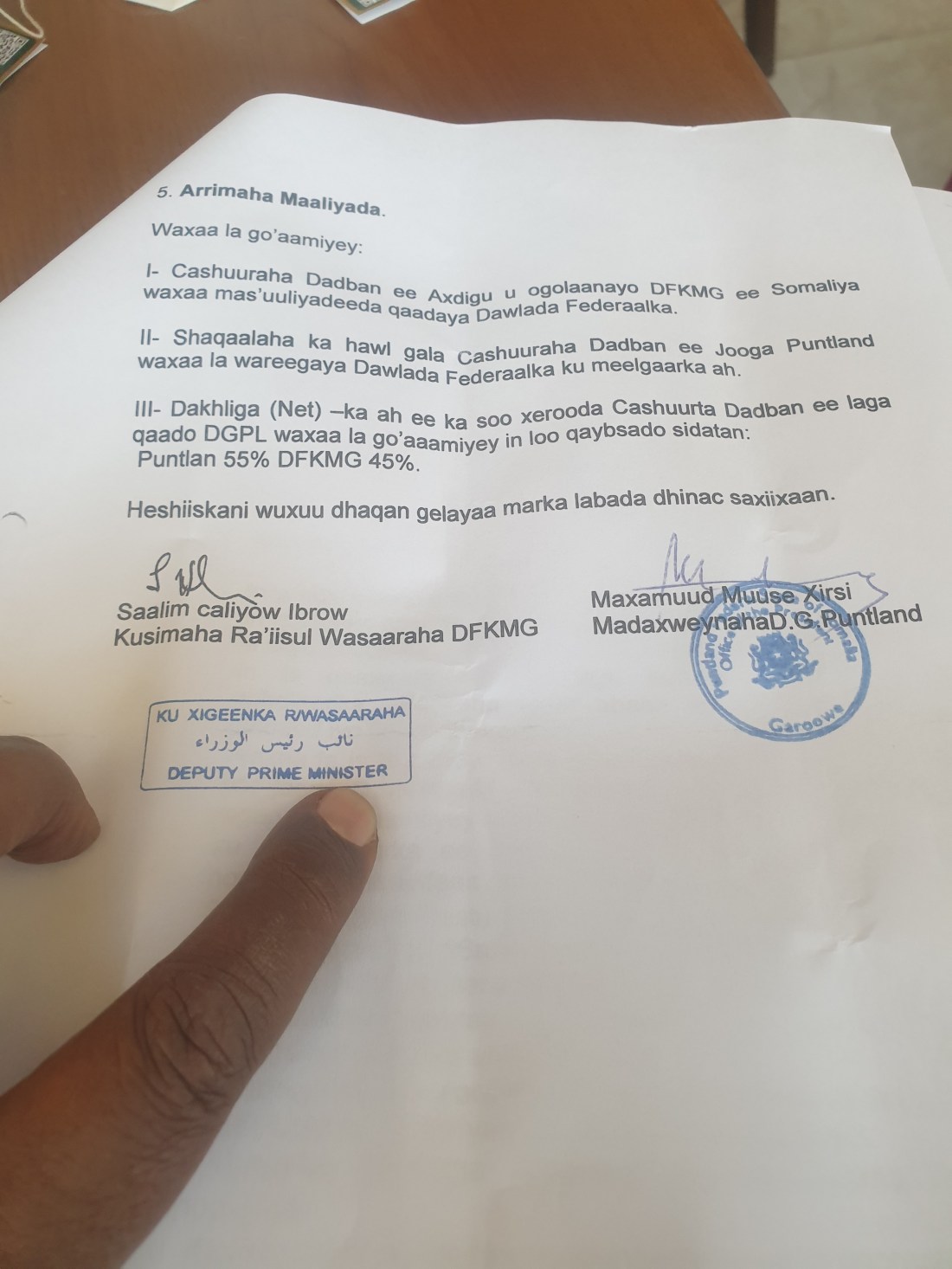
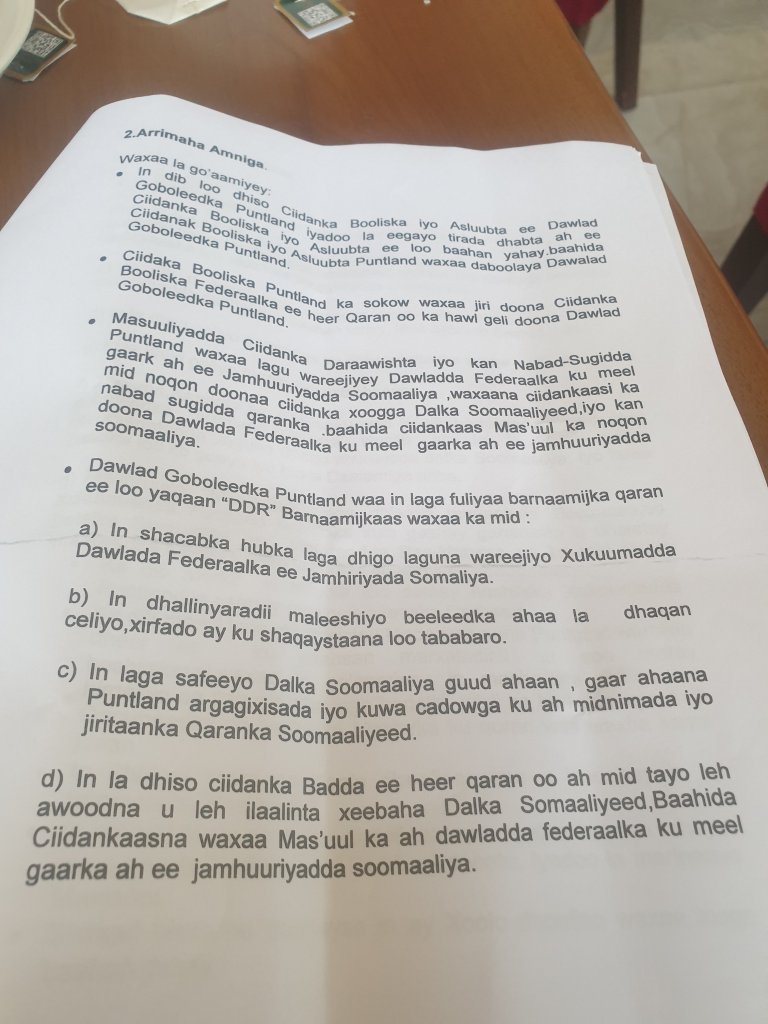
BINDING AGREEMENT BETWEEN TRANSITIONAL FEDERAL GOVERNMENT OF THE SOMALI REPUBLIC AND PUNTLAND STATE OF SOMALIA ON RESOURCES AND POWER-SHARING, INSTITUTIONAL AND CAPACITY- BUILDING

This Agreement is as valid and binding between parties today as it was in 2007. Puntland State entered into this Agreement with the Federal Government, on behalf of then existing and future FMS. There is no legal venue for FGS today to ignore this solemn undertaking. Puntland State and every FMS has the legal right to demand for implementation of this official document.

BREAKING NEWS: US SECURITY WARNING

OCTOBER 6, 2022

Location: Somalia

Event: Security Situation

The U.S. Embassy in Mogadishu continues to closely monitor the security situation in the city of Mogadishu, including Aden Adde Airport. The U.S. Embassy in Mogadishu introduced travel restrictions for U.S. government personnel in Mogadishu for the immediate future, including outside the international campus and UN compound.

The U.S. Embassy reminds the public of Somalia’s Travel Advisory , which states that terrorists continue to plot kidnappings, bombings, and other attacks in Somalia.  Attacks may occur with little or no warning, targeting airports and seaports, government buildings, hotels, restaurants, shopping areas, and other areas that attract large crowds and are frequented by Westerners, as well as government, military, and Western convoys.  Methods of attack can include car bombs, suicide bombers, individual attackers, and mortar fire, among others.  Terrorist attacks involving the indiscriminate use of explosive devices and other weapons can take place anywhere in Somalia at any time without warning.

Actions to Take: 

  • Exercise vigilance at events, places of worship, and locations with large crowds.
  • Review your personal security plans.
  • Have evacuation plans that do not rely on U.S. government assistance.
  • Be aware of your surroundings.
  • Monitor local media for updates.

Assistance:

DANGEROUS SIGNALS AND UNCONFIRMED REPORTS ON ARMS DISTRIBUTION TO MOGADISHU RESIDENTS TO FIGHT ALSHABAB

If true, that is a dangerous move by the Administration of President Hassan Sheikh Mohamud. There are world efforts to curtail small arms, especially in areas of civil conflicts like Somalia. Release of arms to non-state combatants is a recipe for civil war and disaster. This was what had happened in Somalia. This is what is happening in Ethiopia today in its conflict with TPLF. In developing countries, the right to bear arms must exclusively be reserved to the state security apparatus. Here in Somalia, you can’t fight Alshabab by distributing more arms to the civil population without risking widespread violence again. By doing this, you do more harm. In war-torn countries like Somalia, arms should be confiscated instead of issuing more to the general public. Mogadishu and other towns are full already of huge amount of arms, ammunition, and even battle-wagons (technicals).

Reports from Mogadishu, though unsubstantiated, are alarming. If true, nobody is safe there. There could be renewed civil war and violence that would make Alshabab menace look like a minor security inconvenience.

In his previous stint in Villa Somalia, President Mohamud had been accused of being behind the incident of break-in then into arms cache at presidency.

SECURITY STATUS QUO IN MOGADISHU IS UNSUSTAINABLE

WDM EDITORIAL

Residents of Mogadishu and fledgling Federal Government of Somalia have been coexisting with extremist groups and various religious Tariqas for decades now. You can’t fight back against these extremists when the society itself is split along religious lines, when the government is headed by one of those religious sects (Damul-Jadid), the rank-and-file of the security forces are infiltrated by terrorists or recruited mainly from a few subclans from the vicinity of Banadir Region, with mistrust caused by Civil War still fresh in the minds of people, and Federal officials and administrators are being intimidated by Al-Shabab and ISIS on daily basis.

Unless there is a serious commitment on the part of impowered Judiciary (judges, police, secret services) with sound public policy behind them to address the epidemic of Al-Shabab and underlining problems of government security apparatus, Mogadishu and rest of the country will coexist with another government by the extremists, who are bent to take over the country and beyond in the same way Taliban have been projecting, and eventually succeeded.

Alshabab, Alqaeda and ISIS are no different from other historical Mafia groups. They coexist with corrupt societies and compromised security personnel. Since they thrive in intimidating members of the general public, they extort money and new recruits..

World community can’t help out Somalia in this fight in the absence of Somali authorities ready to get rid of the menace of terrorism from their own land.

HOW I WAS INTRODUCED TO CHINA

My father passed away in De Martini Hospital on the southern seashore of Mogadishu in 1968. He withdrew his last breath, while I was holding his hand at his death bedside. Hovering and standing over me were the late Prime Minister of Somalia 🇸🇴, Abdirizak Haji Hussein and Mr Yassin Nur Hassan Bidde, the late Interior Minister at the time. In attendance was a Chinese physician trying his best to save my father’s life, who was suffering from malaria. At that moment, the ministers were contemplating and discussing on the possibility of evacuating my father to a better medical facilities in the People’s Republic of China 🇨🇳. My father’s medical situation brought together a former prime minister, who was leading a strong political opposition to the government of the day, and the minister of Internal Affairs of the administration then. Tragically, my father died prematurely before he was airlifted to China. Following his death, I was devastated, depressed and sick for a week. At the time, I was in school.

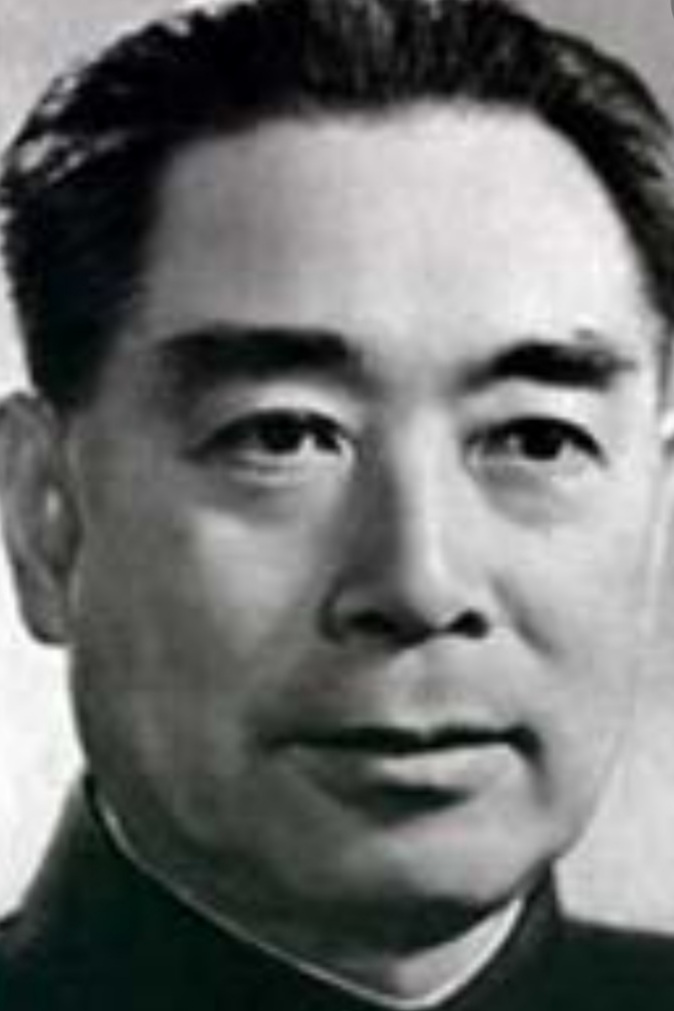
Earlier in my childhood, in 1964 to be exact, I do recall the visit of Zhou En Lai, the first and late Chinese Premier, in Mogadishu. I was a kid with some members of my family among the crowd at airport, welcoming the Premier. I vividly remember Zhou En Lai speaking in Chinese at Airport reception. What I found remarkable was the fact that a Somali interpreter of Mandarin suddenly appeared on the stage. It was hilarious. Somali singers sang a song right there: “Zhou Lai ha jiroo cadowgii ha jabee” ( Let Zhou Lai long live, let his enemies perish.)

Since then, I had the opportunity to learn a lot about the Soviet Union, China and other countries of the left from the late Secretary-General of the Somali Democratic Union (SDU), a leftist political party popularly known in Somali political history as the “Great” (a term standing for greater Somalia), Mr. Yusuf Osman Samater (Bardacad). Bardacad was a good friend of my former Boss, the late President of Puntland and Transitional Federal Government of the Somali Republic, Abdullahi Yusuf. That was an extra education on the top of myself winning a scholarship to the Soviet Union immediately after leaving high school.

[This article was edited a bit since posting.]

( photo courtesy to Wikipedia)

WDM EDITORIAL

THE PRECARIOUS STATE OF SOMALI AFFAIRS

Current political crisis in Mogadishu could degenerate into violence. The political confrontation between the leaders of the Federal Government could lead into disarray and unraveling of public institutions, massive displacement of residents and pull-out or evacuation of members of the international community. Only cool heads and common sense to understand and appreciate the potential danger could save the situation.

Tribal incitements reminiscent of 1990s insurrection would make the matter worst. Removing stubborn leaders by mob force would lead to destruction of Somali State again. Law and order in the Capital must be maintained at any cost. Mohamed Abdullahi Farmaajo must put all his cards on the table and accept whatever cooler heads advise him to do now. He must realize that he has no presidential mandate to govern and could remain in Villa Somalia only quietly until elections are held in the country. He can’t afford to rock the boat. He should listen to the deep public concerns about his illegal occupation of the presidency. He must see the writing on the wall that he has no further political future in Somalia, and should try to save whatever might have remained of his reputation. There is a zero chance that he could continue to stay on any longer by political manipulations or force. It is in his best interest to go away quietly. That way he spares his country too from the experience of more troubles. Let the Caretaker government hold elections peacefully.

On the top, read the Somali Doctrine https://ismailwarsame.blog/2020/07/14/the-somali-doctrine-2/

https://amazon.com/author/ismailwarsame

WDM EDITORIAL

HOW TO UNDERSTAND THE NOISES SURROUNDING SOMALI LEADERS’ COMMUNIQUE ON ELECTION

People have short memories on recent developments on the issue. They fail to recall political impasses and stalemates that have degenerated just recently into violence between the opposition elements and Federal Government. A number of Mogadishu residents and security personnel got hurt or lost their lives. Signs of 1991 Civil War appeared in Mogadishu with clan militiamen occupying parts of the Capital City, threatening to storm Villa Somalia. At the time, even the leaders of Federal Member States were in disarray and at each other’s throat. There were sticking issues of Jubaland/Gedo, Hirshabelle/Hiiraan, composition of Federal electoral commission and more. Somalis alone and by themselves couldn’t resolve these problems – members of the international community had to intervene. Somali election impasse got reported to UN Security Council. The situation was getting bad and bleaker.

Yesterday’s Communique by the leaders of FMS and Prime Minister came out with unanimous decision and on consensus to hold the elections. Their decision is political rather than constitutional. It is the only option available to move Somalia forward. It is an outcome based on compromise. Somalis need to welcome it.

https://https://amazon.com/ismailwarsame

SO, HERE WE COME AGAIN

By Ismail Warsame
Opinion Columnist

Editor’s Note

Puntland members of the outgoing Federal Parliament have been pouring lately into Garowe hotels, each one seeking another chance to remain and represent Puntland in Mogadishu. They face huge challenges to get renominations this time around, partly because of their poor performance and abysmal legislative records in Mogadishu, not to mention about their incompetence and proven misrepresentation of their constituencies. There are wild stories of sub-clan infightings among them, and some were reported to have been bragging about how they have succeeded in marginalizing the political chances of certain sub-clans in some regions of Puntland. These are the  kind of representations Puntland had been able to send to Mogadishu. This story is as sad as it gets. The problem lies mainly in the lack of strategic policy formulation of the State of Puntland towards promoting Puntland local and national interests.

Puntland outgoing members of the Federal Lower House were among those who had participated in the recent illegal attempt to extend the mandate of Mohamed Abdullahi Farmajo to two more years as President of Somalia. When doing this, they all knew that their constituency, Puntland, was against that unconstitutional extension. Regardless of their ill-advised course of action, they have come here to campaign for re-election. That is because they know that there is no accountability for wrong-doing in Somalia’s corrupt/tribalistic political system – there is no shame here.

Kindly read the article below to understand deeper the core of the problem:

PUNTLAND REPRESENTIVES ARE FOOTBALL TEAM WITHOUT COACH

Garowe, April 17, 2019

Puntland is a state [twenty-three -edited] years old with people as old as the Pharaohs of Ancient Egypt, but have no strategic plan towards Somalia or how to deal with the rest of Somalia. An Amazing story to tell, you would say. Puntland successive governments had never thought of its urgent need and constitutional mandate to work out a permanent state strategic plan good for the thinking and operations of every Puntlander in Somalia and worldwide to follow and keep in mind for generations to come: be it a member of the Federal Institutions or Puntland officials attached to a foreign or international entities or an individual living or working in a global village. It is really a common sense to do so if she cares about the well-being and progress of the state, her people and position in Somalia and beyond.
Do the federal officials and MPs representing Puntland in Mogadishu have a strategic plan to follow on Somalia and Puntland issues? How does Puntland government expect them to operate, under which guidelines other than the constitutions and their individual gut feelings do they carry out their mission, tasks and responsibilities?
Sending Puntland Representatives to Mogadishu without a plan of action, thinking or guidelines is like sending Puntland Football Team to Mogadishu without a coach. To use my friend Abdi’s football analogy, “It is like sending a team of untrained Puntland camel boys to play ball in Mogadishu”.
Moreover, Puntland State is also a mother having kids there, who has properties and interests in other regional states of Somalia as well. How would our representatives in Mogadishu, Kismayo, Baydhaba and Dusa-Mareb takle with issues of common and Puntland interest? What are the Puntland channels of communication with those supposed to be looking after her interests in those regions? Is Puntland operating blindly in the dark, or she has no idea of what I am talking about?
On the internal affairs, you would say, there is nothing wrong with Puntland State except it is caught up and locked in bad governance that prevents her from moving foward in building strong state institutions, not to mention about her playing a leading role in Somalia’s reconstruction efforts.
That is good as long as you think that good governance includes elimination of corruption and changing the permanent perception by some of its constituent regions that it is a state dominated by a few privileged clans, doing away its persisting vulnerability to insecurity and lack of economic expansion and business investment, low and poor quality of education and skills training, absence of constructive engagement with the leaders of fedgling Federal Government.
Reasonable Puntlanders are OK with this thinking. But, is that all Puntland State and her people could do to build a bright future for her next generations?
I would say with confidence that Puntland State is frozen in time and space. Let me give you some examples. Puntland Government has the same salary scale for its personnel as we started 23 years ago. Puntland Government uses the same clan/regional power-sharing arrangements for the selection of members of the House of Representatives as we launched it 23 years ago. Puntland Government fell back to rely on clan militia forces for its security, which we had moved away 23 years ago. 23 years ago Puntland had an independent judiciary, independent parliament, independent auditor-general and independent accountant-general. None of above Puntland institutions of government are independent today. It is a big deal and alarming facts to ignore. This is a critical factor, among many, that Puntland President has absolute executive powers in the absence of checks and balance (Madax-ka-Nool).
What to do about the situation? Good question! Let us debate objectively without any attempt to spin. Let me start with my take of things here with a by-line from Garowe. First of all, let us find out areas we can begin work right away:

  1. To fight corruption and maintain law and order, restore the independence of those institutions cited above.
  2. Have a competent, transparent and independent public service commission right away.
  3. Establish state strategic advisory board or commission that act as government think tank or experts on working out strategic plan for Puntland.
  4. Puntland regional clan power-sharing arrangements for indirect selection/election had hit dead-end. Let us begin democratization process right away, starting.with local elections first.
  5. Streamline state departments to eliminate redundancy, duplications and inefficiency. Make a smaller government by cutting down cumbersome bureaucracy.
  6. Know that the Finance and security sectors are the Achelles Heels of Puntland State.
    The current Administration of President Said Abdullahi Deni is on the spot and hot seat to deliver on his election promises to avoid the bad legacy of his predecessor. People of Puntland have no alternative but to rise up against corruption and mal-administration of their public affairs. They have to meet the challenges of the moment.
    Finally, it was said by others before us, who too had been there that people get the leaders they deserve. This insight and wisdom is still true as it was then. People may give their leaders initially the benefit of the doubt, but not a free hand to a politician to do whatever he wishes to without making sure that he or she must be held accountable to the people individually and collectively.
    One good thing about the people of Puntland is that they never give a 2nd chance to their leader, let alone a bad one. If President Said Abdullahi Deni wants to come back to power in Puntland, he could so by popular vote through democratization process starting right now. [This article has been updated since posting in April 17, 2019.]

Read also https://ismailwarsame.blog/2019/05/24/puntland-reps-vs-ssc-reps-in-constituency-representation/

CEREMONY: MOGADISHU AIRPORT SUMMIT

WHY MOST SOMALI POLITICAL MEETINGS FAIL

Experiences have shown that most Somali meetings end up in failure for the simple reason of putting the cart before the horse – they address the elephant in the room first, before they deliberate on and agree upon the principles and setup of a system under which they would operate.

What is that elephant in the room? It is leadership. For successful talks, leadership should be treated as blank spaces to fill in at conclusion. Starting with a leadership contest is a recipe for collapse of the meeting, based on Somali experience – any conference that started with leadership competition had failed. Formation of Federal Member States didn’t start with leadership rivalry – this came up much later in the deliberations.

Enter the National Consultative Summit now taking place at Mogadishu Afysione. Some observers are already worried. They see jockeying for power is now underway. This is on the top of the issues in the electoral impasse begging for quick resolutions. However, fierce campaigns for presidential aspiration are overshadowing the objectives of the Summit – bridging the gaps in the electoral process.

Prime Minister Roble was enjoying a modicum of unity from Hawiye Presidential Candidates until now, for the fear that their disunity helps Farmajo’s chances. But, Farmajo knows full well that Hawiye unity is fake, and he is working day and night to sow seeds of doubt and disarray in the ranks and file of Hawiye Co. Farmajo’s proxies like Qoor Qoor are already busy blasting clannish bombshells within Hawiye in a series of highly loaded tribal dinners and meetings, on the sideline in Mogadishu. These tribally charged meetings by Sacad politicians would act as harbinger for what is coming up in retaliation by other sub-clans of Habargidir, to be followed by similar fragmentations of Mudullood Hawiye. These are bad omens for the electoral process.

One thing is sure, however, collapse of this Summit isn’t an option. No matter how going gets taugh, Somalis and international community wouldn’t allow this to happen this time around. There is no room for failure. The sticking issues in the electoral process should be resolved quickly and in this session.

Stay tuned for more comments and critical analysis.
In the meantime, have your say.

GLOBALIZATION IN SECURITY CHECKS – UNCONVENTIONAL TOOLS INTRODUCED TO SOMALIA

Why Puntland State Deserves Better Presidential Candidates than Faroole and Gas

Location of Puntland State of Somalia
Location of Puntland State of Somalia (Photo credit: Wikipedia)

Puntland State of Somalia is one of the few achievements I happen to be proud of. Other Puntlanders, stakeholders and supporters in Somalia and beyond, within the Diaspora and external players today can pause for moment to imagine their social, political status and relationships with Somalia without the existence of Puntland State. While people always give the visible leader the credit for it, I had the chance to know full well that there were a few of us that made the difference in initiating its creation and playing the critical role in making it a functioning reality that changed the political landscape of Somalia for ever. This is my moral authority and basis on which I pen this short article.

Once again, Puntland State is at cross-roads and it was unfortunate that the democratization process failed abysmally. That was a great setback for the people of Puntland. Nevertheless, the State is relatively safe and has high hopes for a better future. But, to survive and progress, Puntland requires an urgent political change that the current administration cannot deliver. Faroole is a spent force and is running out of ideas, on the top of his poor domestic policies. He becomes a divisive figure and liability for Puntland despite his foreign contacts drama and superficial Diaspora perception that he is the man who can challenge the ill-advised and naïve Damul Jadid Clique in Mogadishu. To refresh up the memory of the readers of this article, Faroole was against the foundation of PuntlandState from the onset to consist of Sool, Sanaag Bari (now Haylaan), Nuguaal, Bari, Mudugh and the District of Buuhoodle (now Cayn). He was among the proponents of creating only Northeastern Regional Administration ( not even a regional state) composed of only Mudugh, Nugaal and Bari ( Karkar Region was part of Bari then). He fled to Australia in early July 1998 before the creation of Puntland State and in the last days of the Puntland Constitutional Conference to found the State when he and his colleagues failed resoundingly in their attempt to exclude Sool, Sanaag and Buuhoodle in the process.  He came back later to Somalia in early 2000s to oppose Puntland State every step of the way. For a long time he was frequenting anti-Puntland conferences and lobbies in Djbouti, Mogadishu and elsewhere. As he left the Conference, I vividly recall his departing words, on the mike, to the Late Islaan Mohamed Islaan Muse, then the Chairperson of the Constitutional congress and I quote, “Shirku waa afduubanyahay”, unquote ( The Congress is being held hostage). Following Puntland State constitutional crisis involving Supreme Court President, Yusuf Haji Nur, Jama Ali Jama and Late Abdullahi Yusuf, and as gesture for Puntland internal reconciliation, I personally persuaded the later to include Faroole in the New Puntland Cabinet as a counter-weight to the defection of Hassan Abshir Farah, then the Puntland Interior Minister, to Arta’s produced TNG of President AbdulQasim Salad Hassan. Despite his background, he was appointed Puntland Finance Minister. He became President of Puntland State due to the unpopularity of then the incumbent Puntland President, General Mohamud Hersi Muse (Boqor), bribery, intimidation of non-Majertaine MPs in Garowe and absence of capable Presidential candidates on the scene at the time. This can happen again if Puntland communities do not do their due diligence in searching and finding better alternative candidates.

The People of Puntland State are now ready for change. To effectively take part in that on-going political need and imperative for change, Traditional Elders, business community, intellectuals and any person at grass-root level has to help in selecting truly representative and worthy members of Puntland State Parliament. People who hail from Khatumo areas have the moral obligations and legitimacy too as founders of Puntland State to help in the current efforts for political change. All Puntlanders have every right and owe to their country to select and promote capable and honest patriots as presidential candidates on merit: personal integrity, character, leadership talent, experience and vision. They have to do their due diligence to get it right this time around, and peacefully. We must insure that if such a candidate wins the election, he/she must not use Puntland State as stepping stone or leverage for a national position in the Federal Government of Somalia, but willing instead to concentrate and focus on the unity, peace and socio-economic development of Puntland as his/her priority No. 1.

I know a good number of Presidential candidates have put their names forward. My assessment is that while many of the declared candidates have something to contribute, they don’t pass the test of leadership requirements needed in Puntland at this crucial moment. Puntland State deeply suffers from political stagnation, has serious governance and security problems. The country is politically polarized and unity is at stake. Economy has collapsed because of lack of sound fiscal management and absence of competition in a free market, leaders’ destructive interference in the market, nepotism and cronyism of the administration. No one among the known Presidential candidates can meet the challenges now Puntland faces.

Current political perception within Puntland Diaspora and supporters of Puntland is that there are two front runners among these candidates: They claim to be Abdiweli Hassan Ali (Gas) and incumbent President,  Abdirahman Mohamed Mohamud (Faroole). I take an exception to this artificial and cosmetic assessment of reality in Puntland. My take on them is based on my Puntland experience and reading of the prevailing political situation at home now.

Let me call a spade a spade. Dr Abdiweli’s chance in that race is extremely limited. I also suspect that Dr. Abdiweli (Gas) has other personal national goals and ambitions and Puntland is not his priority. Based on his short political life as Prime Minister of Somalia, he did little or nothing for Puntland interests, although I acknowledge that he had had a bad working relationship with Faroole that made doing business with Puntland difficult. In fact, tampering of the Provisional Federal Constitution was done under Abdiweli’s watch. He and his team ( including his right-hand Constitutional Minister, Abdi Hosh) failed to deposit the constitutional version agreed upon in Garowe I and Garowe II to Congress delegates that provisionally approved the Federal Constitution. Instead, a print-out of completely another version was distributed to the 800 Congress Delegates, including the Traditional leaders that gathered and finally approved it in Mogadishu. That was a long time before President Hassan Sh. Mohamud got elected. To sum it up, the Road Map Dr Abdiweli seems to be proud of today is faulty and had done considerable damage to Somalia’s future governance as it was detrimental to Puntland vital national interest: Federalism as safeguard against Central Dictatorship and return to a One-City Republic Status. In terms of team work and selection of aides and political advisors, he is considered the worst Prime Minister that the successive Somali Transitional Governments had ever had.

The Roadmap received help and new boost from the most unexpected source: Jubaland, a non-existent entity during the Roadmap process. The appearance of JubalandState (which, of course, PuntlandState has been working tirelessly for throughout its existence) saved the day to re-enforce the Puntland State Vision on future governance system for Somalia. This de facto establishment of Jubaland Administration, in turn, led to the overwhelming acceptance of federalism by the international community as the only viable option for Somalia’s governance. Abdiweli also did nothing to contribute to the noble cause of creating JubalandState. He was not even visible during those tough political and military fights for Jubaland. One may recall that he was a tourist and traveling guest among the Puntland Diaspora in every corner of the world on a mission without an objective beyond his personal interests. Therefore, Puntland does need a man with that profile. It is too risky to take a chance!

I strongly believe that Puntland State communities have yet to produce the right Presidential Candidates to choose and elect from, and that is a heavy responsibility for all concerned. Let us debate on it and get this done. Take a note that time is of the essence in this regard.

The Stunt Document of Jubba

Map of Jubaland State of Somalia
Map of Jubaland State of Somalia (Photo credit: Wikipedia)


The obvious contradictions in the rushed agreement between Jubbaland and Federal Government of Somalia show that the talks have actually collapsed, and heads of the international community there and Ethiopian Leaders could not face the failure for their own sake. The stakes were even higher for them than the negotiating parties. They had to bring a lot of pressure to bear on the parties to save face by producing a signed paper and a photo opportunity for the occasion.The result is a confusing document which creates more problems and itself a source of future conflicts and everlasting tension in the region for all concerned. One thing is sure. Jubaland constitution and the conference that produced it were not acknowledged, consistent with FGS earlier position, but they had to swallow the fact that they won’t have their way unless they face the reality on the ground in Jubba and negotiate with Ahmed Madobe as the de facto Head of the three regions. That is the only plausible outcome of Addis Talks. It is one step forward and two steps back, in my opinion.http://allafrica.com/stories/201308290096.html


allAfrica.com: Somalia: Jubaland Gains Recognition After Intense Bilateral Talks in Ethiopia
allafrica.com


allAfrica.com: Somalia: Jubaland Gains Recognition After Intense Bilateral Talks in Ethiopia

allafrica.com

allAfrica: African news and information for a global audience


The S.F.G.’s Strategy of Political Conflict

A confrontation over the form of federalism that a future Somali state would adopt is looming, as confidential sources report that the provisional Somali Federal Government (S.F.G.) is in the process of making a concerted push to control the formation of local, regional, and presumptive regional-state administrations in south-central Somalia.

The S.F.G., say the sources, is attempting to resist the early formation of a Jubbaland state in the south that would base itself on a decentralized-federal model, as Puntland has done; head off a similar process to the one in the south in the southwestern Bay and Bakool regions by placing an administration allied to it in charge there; counter the Galmudug authority in the east-central area by backing ex-warlord Abdi Qeybdid against the sitting government; and influence the leadership that will succeed the recently-deceased chair of the Ahlu Sunna wal-Jamaa (A.S.W.J.) movement, Sh. Mohamed Yusuf Hefow, that controls most of the central and east-central regions of Galgadud and Hiiraan. On each of those political fronts, the S.F.G. faces opposition, both locally and nationally by the autonomous state of Puntland, which resists the S.F.G.’s bids for control.

The S.F.G.’s Strategy of Political Conflict

By adopting a strategy of political conflict in south-central Somalia’s regions, the S.F.G.’s president, Hassan Sh. Mohamud, is attempting to solve his most pressing political problem, which is to establish the S.F.G.’s authority – dominance and control – over those regions. In the process of trying to do so, Mohamud is forcing the issue of what the state-form of Somalia will be. The options have narrowed down to two, a centralized federalism favored by the S.F.G. and its allies, and a decentralized federalism advocated by Puntland and its allies. The core political conflict in Somalia is between the S.F.G. and Puntland over state-form; the south-central regions are the arenas in which that conflict is being played out. Both the S.F.G. and Puntland are aware of the high stakes involved in their confrontation; if the S.F.G. prevails in the south-central regions, Puntland will be politically isolated and subject to pressure to abandon its autonomy, which gives it generous control over its natural resources and security policy; if Puntland is able to block the S.F.G., the latter will have had to cede significant authority over nascent regional states. The S.F.G.’s pursuit of a strategy of political conflict has turned a constitutional issue into a political power struggle.

Whether or not the S.F.G.’s strategy succeeds – and its success is highly problematic – that strategy is intelligible and follows from the power position of the S.F.G. The new federal government was to all intents and purposes imposed by the Western “donor”-powers/U.N. under veiled and explicit threats to withdraw financial support. The “donor”-powers wanted a “permanent” government established in Somalia so that they could decrease their commitment to the country and at the same time make agreements favorable to them with it.  In pursuing those aims, they ended up settling for a provisional/interim entity operating under an incomplete constitution that left the fundamental question of state-form open; absent from the constitution was a determination of centralized or decentralized federalism, and there were not yet regional states set up in south-central Somalia.

As a result of the “donor”-powers’ actions, the S.F.G. was left with the challenge of establishing its authority in the south-central regions without a constitutional basis, scant resources to buy allies in the regions, and military forces that did not extend beyond the capital Mogadishu. Under those constraints, the S.F.G. had few options; it could renounce the attempt to control the south-central regions and allow those regions substantial autonomy, which would weaken whatever (potential) power it might have; or it could do what it has chosen to do, which is to contest the forces for decentralized federalism region by region by allying with factions in each region that felt marginalized by nascent autonomous administrations with power bases independent of the S.F.G. The new federal government opted for the latter, which set up the conditions for political conflict. A source reports that the strategy of political conflict was urged upon Hassan by his inner circle of advisers from his Damul Jadid movement.

The consequences of the conflict strategy carry severe risks to stability. The divide between the forces of centralized and decentralized federalism has become confused with sub-clan rivalries within the regions, exacerbating animosities that already existed. Those rivalries have also given the revolutionary Islamist movement, Harakat al-Shabaab Mujahideen (H.S.M.), which had been pushed out of control over its most lucrative territories, an opportunity to recruit from disaffected sub-clans, and it has drawn Puntland into the fray.

The conflict strategy shows the power deficit of the S.F.G. and its efforts to rectify it. None of what the S.F.G. feels that it has had to do would have been necessary had an effective process of state-building been instituted, which would have involved a process of social-political reconciliation among Somali factions leading to a constitutional agreement to which the major factions would have signed on. That possibility was eliminated by the “donor”-powers’ actions, and that constitutes their most egregious political failure.

As a result of the “donor”-powers’ actions, the domestic Somali actors have been left to pick up the pieces. Absent political reconciliation and the trust that comes with it, the Somali domestic actors are constrained to pursue their perceived interests and attempt to make them prevail. There is no reconciliation process in place; the stage is set for sub-clan-impelled constitutional confrontation abetted by ex-warlords and revolutionary Islamists. Interpreted through the dramaturgical model in political science, a tragedy is unfolding in which the protagonists-antagonists can see nothing to do but play a zero-sum game.

The Status of the Conflict

It is too early in the conflict over the state-form that Somalia will/might take to make a grounded prediction about its outcomes. The S.F.G. has only attempted to implement its strategy of political conflict in earnest since the return of Hassan to Mogadishu in mid-February from his round of visits to the external actors with interests in Somalia. Having touched base and gotten promises of support, Hassan had to try to “deliver” on his end of the bargain, showing that he led a (potentially) effective government.

Hassan’s most important political front, which demands his immediate attention, is the south, where a convention is slated to be held on February 23 to form a Jubbaland state comprising the Lower and Middle Jubba regions and the Gedo region. Approximately 500 delegates, including elders from the three regions are expected to attend, with the S.F.G. and regional states (Ethiopia and Kenya) as observers. Up until the present, it has appeared that the Jubbaland process would issue in a regional state modeled on Puntland. The S.F.G. will try to reverse that outcome.

According to one source, Hassan’s strategy has found willing supporters among sub-clans in the south that feel disadvantaged by the dominance of Ahmed Madobe, the interim governor in Kismayo, and his Ras Kamboni militia, which is allied with Kenyan forces in the south and is mainly composed of members of the Mohamed Suber sub-clan of the Ogaden-Darod. That leaves other Ogaden sub-clans, the Majertein-Darod (with ties to Puntland), and the Marehan-Darod more or less disposed to thwart any attempt by Madobe to dominate the Jubbaland state.

Another source confirms open-source reports that ex-warlord and Marehan leader, Barre Hirale, has met with Hassan and is “on good terms with the S.F.G.”  The source says that the Marehan will “listen to Hirale if he is empowered.” Meanwhile, on February 13, Garoweonline reported that a delegation whose members are involved in forming a Jubbaland state met with Puntland’s president, Abdirahman Mohamed Farole, to discuss how “Puntland’s efforts to establish [the] Jubbalnad state could be improved.” On February 15, Garoweonline reported that Hassan and the S.F.G.’s prime minister, Abdi Farah Shirdon, who is Marehan, had split on the Jubbaland issue, with Shirdon supporting the ongoing process and Hassan attempting to undermine it.

The reports from closed and open sources present a picture in which fations in the south have not (yet) fully aligned, crystallized, and polarized around the issue of state-form, and around the S.F.G. and Puntland, with the S.F.G. itself split. The S.F.G.’s presence at the slated convention represents a concession by Hassan by virtue of his acknowledging the Jubbaland process, but it also is an opportunity for him to influence its outcome. Puntland will not be present at the convention, but it will attempt to work through its allies. How the local factions will align, insofar as they do, and how big a role the regional external actors decide to play, and on which of the sides, will determine the outcome, in addition to the efforts of Hassan and Farole.

The second front opened by Hassan in implementing his strategy of political conflict is the southwestern Bay region, dominated by the Rahanweyne clan, where an attempt to form a regional state composed of the Bay and Bakool regions was underway but had not advanced as far as it has in the southern regions. In the south, Hassan has been constrained to try to turn an ongoing process that was going against him to his favor or to subvert it, whereas in the southwest he has attempted to head off such a process before it began to function independently of the S.F.G.

Hassan moved by issuing an S.F.G. decree replacing the longtime Bay political leader and sitting governor, Abdifatah Gesey, who had been backed by Ethiopia and had forces in the region, with Abdi Hasow. Gesey resisted the S.F.G.’s action, declaring that he remained governor. According to a closed source, Ethiopia turned against Gesey and used its forces to oust him. On February 15, Garoweonline reported that Gesey had mobilized his militia and was still in the Bay region’s capital, Baidoa, whereas Hasow was out of public view. According to Garoweonline’s sources, the confrontation between Gesey and Hasow had caused the Bay administration to grind to a halt. Efforts to mediate the dispute were initiated and a delegation was sent to the region by the S.F.G.

On February 21, Garoweonline reported that Gesey was taken by S.F.G. security forces to Mogadishu after mediation efforts had failed. Sources in Mogadishu told Garoweonline that Gesey was “promised another title” in the regional government.
An indication of why Ethiopia switched sides and altered the distribution of power in favor of the S.F.G. is given in an Ethiopian government statement on February 16 concerning talks between the Somali Federal Parliament’s speaker, Mohamed Osman Jawari, and Ethiopia’s foreign minister, Tedros Adhomam, in which Jawari is reported to have urged the formulation of a “common position” between the S.F.G. and Ethiopia on the London conference on Somalia that will be held later in 2013. In return, Ethiopia promised to “work with Somalia on pushing donors to keep their promises.” Jawari then traveled to the ethnic Somali Ogaden region (Somali Regional State) of Ethiopia, where he met with regional officials and visited schools. Reports did not mention any hint that Jawari had taken up alleged human rights violations committed by Ethiopia and Ethiopian-backed militias in the Ogaden.

Just as in the south, the outcome of the face-off in Bay cannot be predicted. The S.F.G. has gained a foothold and has leverage, but it has yet to achieve the traction to push back its adversaries decisively.

A similar stand-off characterizes the situation in the Galmudug authority in east-central Somalia, where two governments dominated respectively by different sub-clans of the Hawiye claim claim the right to rule. According to a source, the S.F.G. has recognized one of the contenders – the faction led by ex-warlord Abdi Qeybdid – as the “legitimate” authority. During the past month there have been outbreaks of politically-inspired sub-clan violence in Galmudug with open sources claiming that Qeybdid’s militia is responsible for initiating the clashes. Again, as in the south and southwest, the S.F.G.’s strategy of political conflict is being implemented in Galmudug, and its outcome is uncertain.

In the central region of Galgadud and part of the Hiiraan region, the dominant A.S.W.J. movement is in the process of naming a leader to replace Sh. Mohamed Yusuf Hefow, who died in mid-February. Hefow had been in discussions with the S.F.G. to merge A.S.W.J. with it. A.S.W.J., which has several factions that support or oppose collaboration with the S.F.G. in various degrees, has now become subject, according to a source, to pressure from the S.F.G. to integrate with it on the S.F.G.’s terms. Again, the outcome is uncertain, but the S.F.G.’s push is underway. The source reports that a delegation from the federal parliament is in Galgadud, claiming that they are “consulting with local communities on extending government rule” to the region. The source says that the presence of the delegation has led to a dispute between some of the A.S.W.J.’s leadership and the S.F.G.

Assessment

One of the sources contributing to this analysis has put the S.F.G.’s/Hassan’s strategy of political conflict succinctly and precisely: Hassan is attempting to isolate some leaders and factions in each region and to empower others favorable to him. In doing so, Hassan is splitting each region politically, intervening in local conflicts and exacerbating them, and working with whoever will ally with him for whatever reason, whether it be ex-warlords, dissident clans, or factions within a movement. That is the familiar strategy of divide-and-rule, which is used by actors who cannot (Hassan) or do not want to expend the military and/or financial resources required to control the outcome of a conflict.

Hassan is playing the divide-and-rule game to extend the authority of the S.F.G. into the south-central regions, but in doing so he is carrying with him the program of centralized federalism. Puntland has yet to play its hand overtly, but it can be expected to do so if it appears that the centralized-federalist project is gaining traction and momentum. Since Hassan’s strategy necessitates opposition to its implementation by the forces that he is attempting to isolate, as it has done in each case, the path is open not only to confrontation at the local level and the re-activation of H.S.M., but to counter-moves by Puntland.

It is too early to predict whether or not Hassan will be successful, but it can be said that a political battle is looming that will overshadow all other political issues in the territories of post-independence Somalia.

Hassan’s strategy is obviously high risk and high stakes. In his best-case scenario, Hassan prevails in each south-central region and Puntland is faced with the option of compromising its autonomy or separating from south-central Somalia. Short of the best case for Hassan, “Somalia” becomes irretrievably fragmented and balkanized, or its territories become a mixture of uncoordinated regional and local forms of administration.

It is unclear whether or not the “donor”-powers understand what is happening in Somali domestic politics and, if they do, whether they are prepared to intervene and in what way. That the “donor”-powers will act decisively to try to prevent political breakdown is unlikely. The United States, for example, was prepared to support the S.F.G.’s request to have the United Nations arms embargo on it lifted, but then backtracked after European opposition and stated that it would wait for the completion of a U.N. “review”  of the desirability of taking such action. The U.S. backtrack was a blow to the S.F.G., which had expected more robust support when the U.S. recognized it.

As it stands, no actor, external or domestic, is working to avoid the impending confrontation. There is no formal process of reconciliation underway. The discourse of Somali political actors and intellectuals is not addressing the issue directly or, in some cases, at all. The external actors are silent about it. At the point at which the conflict intensifies to the degree that it is impossible for actors to ignore it, it is likely that it will be too late to resolve; this analysis is simply an early warning.

Report Drafted By: Dr. Michael A. Weinstein, Professor of Political Science, Purdue University in Chicago  weinstem@purdue.edu

Source: media


London conference awaits ‘vision to take Somalia forward’

Somali president expected to present plans for rebuilding military, police and justice systems, as civil society calls on nascent government to empower women and provide jobs

Part of Somalia‘s plans involve building credible military and police forces to ensure peace. Photograph: Reuters

On Tuesday next week, the UK hosts yet another big conference on Somalia, bringing together officials from 50 countries and organisations, including the UN, African Union and International Monetary Fund.

The most significant difference from last year’s London event is that instead of a tottering and discredited transitional regime, Somalia now has a fully fledged government, led by Hassan Sheikh MohamudElected last September, the 57-year-old professor and activist is the first leader chosen inside Somalia since the 1991 overthrow of president Siad Barre, which sowed the seeds for the country’s descent into chaos.

Next week’s gathering can be seen as a concerted attempt to bolster the Somali government‘s legitimacy as it seeks to rebuild the country after more than two decades of conflict. The conference will be co-chaired by Mohamud and David Cameron, the UK prime minister, and its main aim is to signal international support for Somalia as the new government sets out its vision. But in a setback to the UK, Somaliland, which broke away from Somalia in 1991, refused British entreaties to attend on the grounds that it would not have been treated as equal to the Somali government. Somali officials, however, are upbeat.

“We hope the international partners will support Somalia’s implementation of its plans and priorities,” Nuradin Dirie, a presidential adviser, speaking from Mogadishu, the Somali capital, says. “We will be presenting plans for rebuilding the military, the police, the justice and public financial management systems. It is a vision of a political process to take Somalia forward.”

There may be some announcements of financial commitments, but those are expected to come at an EU-hosted conference in Brussels in September. Somalia will be very much on the international agenda this year. It will feature in meetings of the G8 group of industrialised countries, and the Tokyo international conference on African development, culminating in the Brussels meeting on the new deal for fragile states.

The new deal – strongly backed by countries recovering from conflict such as Timor Leste and Liberia – seeks to put poor countries in the driving seat on development strategy rather than donors. At its core are five peace- and state-building goals: legitimate and inclusive politics; security; justice; economic foundations (jobs); and revenues and services. The thinking is that unless aid focuses on peace, money will go to waste. Somalia has enthusiastically embraced the approach and now wants donors to back its plans.

Britain – which has pledged to spend £80m this year and next on aid – is on board. It has voiced support for the new deal, which seeks to align donor funds with the priorities of the recipient country, and has emerged as a strong cheerleader for the new Somali government. Last week, Britain reopened its embassy in Mogadishu, the first EU country to do so since Barre’s overthrow. Turkey is committing diplomatic and financial resources.

Somalia needs all the international support it can get. Although security has improved since al-Shabaab militants were driven out of Mogadishuby Amisom peacekeepers, the group continues to kill.

Ban Ki-moon, the UN secretary general, this week expressed concern that the Islamist insurgents seem to be targeting Somalia’s legal system, after the Somali deputy state attorney, Ahmed Malim Sheikh Nur, was killed by gunmen as he was leaving a mosque after Friday prayers. The threat posed by al-Shabaab explains the urgency behind the government’s efforts to build a credible military and police to deal with hardcore elements who remain implacably opposed to reconciliation.

The Somali government says it will welcome dialogue with those who turn their backs on violence. “The doors are open to those who renounce violence [to] be part of the political process and we will take every step to include people,” Dirie says, adding that the president and prime minister want to rebuild the security infrastructure to provide law and order.

While noting the importance of peace- and state-building, civil society representatives, who attended events in London in the runup to the conference, say it is important to maintain development, particularly after the 2011 famine in which nearly 260,000 people died.

“Although the drought has ended, we need to build capacity to prepare for future emergencies, we need to invest in farming and livestock,” Aydrus Daar, executive director of Wasda, an NGO that works in the Horn of Africa, says. “There are short-term recovery projects but no three- to five-year programmes.”

Fartuun Adan, executive director of the Elman peace and human rights centre in Mogadishu, urged the Somali government to embrace civil society. “We have lots to contribute, we have been working in Somalia for the past 22 years, whereas the government is very new in its job,” she says, adding that the government should do its utmost to empower women and ensure enough jobs.

Abdirashid Duale, chief executive of Dahabshiil, a remittances company, who will take part in an investment conference following the event in London, is confident there will be jobs as Somalia rebuilds. “The young generation in Somalia is where the future lies and yes there will be jobs,” he says, “because we need people to build airports, electricity systems and infrastructure.”

Laura Hammond, senior lecturer at the School of Oriental and African Studies, however, says it is important not to get carried away with expectations. “The new government is a real gift to the international community and much better than it was expecting,” she says.

“But there is a danger of letting euphoria cloud our judgment. I hope people are patient enough with it and yet able to hold it to account, although international engagement has to be on Somali terms. That will be part of shoring up the government’s legitimacy.”

Source: The Guardian, UK.

Somali Government Welcomes Recognition of World Communities

Prime Minister welcomes G8 recognition of progress in Somalia

13 Apr – Source: Prime Minister’s Media Office 

His Excellency Prime Minister Abdi Farah Shirdon today welcomed the G8 statement in London praising recent progress in Somalia and emphasizing the international community’s continued support for the country.

“The Somali government has worked hard to entrench the recent progress on the political, security, economic and humanitarian fronts that we have made with the support of our international partners and I am immensely heartened to see the G8’s vote of confidence. We know we have a long way to go and we cannot make it alone but there is no turning back.”

In a statement issued in London today, “G8 Foreign Ministers welcomed the significant progress made in Somalia over the past 18 months on security, political transition and humanitarian conditions… G8 Ministers underlined the need for continued early international support to the new Somali Government.”

The G8 also pledged its political support as Somalia is set to re-engage with international financial institutions of the World Bank, International Monetary Fund and the African Development Bank.

“I am encouraged by the lead taken by the UK to support efforts to re-engage with the IFIs and the longer term process that may lead to arrears clearance. Without this we will not be able to receive sustained support from these organisations. And we understand the reciprocal obligations on us of strengthening the accountability and transparency of our public financial management systems. We look forward to making progress on this and many other critical issues at the London Conference on 7 May.”


PM hails IMF recognition of Somali government as milestone towards economic recovery

13 Apr – Source: Prime Minister’s Media Office 

His Excellency Prime Minister Abdi Farah Shirdon said the International Monetary Fund’s decision to recognise the Somali government after a break of 22 years is “a major milestone in the country’s long road to economic recovery”.

On Friday the IMF recognised the federal government of Somalia, paving the way for the resumption of technical assistance, policy advice and ultimately – subject to arrears clearance – borrowing rights. The Prime Minister welcomed the news as the latest in a series of developments supporting the government’s policy of strengthening relations with its international partners.

“The President is in Turkey today for talks with Somaliland, while I am returning from a visit to Djibouti, Uganda and Burundi. In less than a month we will be attending the Somalia Conference in London. The truth is that we are rejoining the community of nations and we must continue to demonstrate, both to Somalis and the world, that we justify this newfound confidence. There is much hard work ahead.”

The IMF said its decision was “consistent with broad international support and recognition of the Federal Government,” since His Excellency President Hassan Sheikh Mohamud took office last September. “The new administration has since enjoyed considerable support, including from the United Nations, the African Union, the European Union, the Organization of Islamic Cooperation, and many IMF member countries,” the Fund added.

Before Somalia can borrow from the Fund it must first clear outstanding arrears of approximately $352m. This issue will be at the heart of discussions at the forthcoming Somalia Conference in London on 7 May.


Source: AMISOM Monitoring Services

Bombs and Gun Battle Kill at Least 16 in Somali Capital

Published: April 14, 2013

MOGADISHU (Reuters) – At least 16 people were killed as two car bombs exploded outside the law courts in Somalia’s capital Mogadishu and gunmen stormed the building on Sunday, before a gun battle erupted with security forces besieging the compound, witnesses said.


A large blast hit an area near Mogadishu airport hours later, residents said.

It was not immediately clear who carried out the attacks, but al Shabaab militants linked to al Qaeda have claimed responsibility for a number of suicide bombings in Mogadishu this year.

“About seven well-armed men in government uniform entered the court today as soon as a car bomb exploded at the gate. We thought they were government soldiers,” said Aden Sabdow, who works at the mayor’s office adjacent to the court.

“There are many government officials inside the court which has been busy these days,” he said.

“Armed men entered the court and then we heard a blast. Then they started opening fire. We do not know the number of casualties,” said Hussein Ali, who works at the courts.

Somali forces arrived and besieged the court compound and there was a second blast while shots continued to ring out.

Reuters reporters counted 16 bodies, some of them in uniform, some not, around the compound, but it was not clear how many of them were government soldiers, attackers, or civilians.

Later, a car bomb exploded at a building housing Somali intelligence along the road to the airport as Turkish and African Union (AU) vehicles were passing, police and witnesses said. Government forces then opened fire and blocked the road.

“The car bomb exploded near the gate of a building housing the Somali security. AU and Turkish cars were also passing there. We are still investigating the target and casualties,” Qadar Ali, a police officer told Reuters.

Britain warned on April 5 it believed “terrorists are in the final stages of planning attacks in Mogadishu”.

In control of much of the capital Mogadishu between 2009 and 2011, al Shabaab has been forced out of most major cities in central and southern Somalia by African Union peacekeepers.

But the hard-line Islamist group has hit back with a series of bomb attacks. In early April, a bomb went off outside the headquarters of Somalia’s biggest bank, Dahabshiil’s, wounding at least two people hours after al Shabaab ordered the company to cease operations in areas under its control.

Last month, al Shabaab claimed responsibility for suicide car bomb targeting a senior Somali security official which killed at least 10 people in central Mogadishu. The security official survived the attack, the city’s deadliest this year.


Sources: The New York Times

Jubaland Close to Becoming Somalia’s Next State

Federalism in action, along the provisions of the provisional Federal Constitution of Somalia.

What hope for peace? Greed, grievance and protracted conflict in Somalia

Posted by Managing Editor for YaleJournal.org • April 2, 2013  

by Tuesday Reitano*


Introduction

2013 might just be Somalia’s year.  A confluence of events – the successful end of the political transition, the formation of a promising new government headed by a new guard of civil society leaders, and the rollback and significant weakening of the militant terrorist group al Shabaab – offers the best hope for a peace that Somalia has had in decades.  But the challenges remain immense, and recent achievements can be easily reversed.   Without an effective central government since 1991, parts of the country have been torn apart by decades of conflict, chronic poverty, inequality, food insecurity, and public health challenges.  State institutions, where they exist, are a patchwork of colonial legacies that were never fit for the purpose of governing a sovereign state and delivering services to its people.

Any analysis that attempts to identify the underlying and precipitating causes of conflict in Somalia wades into turbulent waters.  There are numerous competing narratives and differing interpretations of a complex and contentious twenty-year conflict.  What is clear, however, is that the best chance of sustaining the peace in Somalia will be through ensuring the legitimacy of leadership and by addressing some underlying causal dynamics.

 Understanding the drivers of conflict in Somalia

The root causes of the Somalia crisis can be traced to three phenomena: colonialism, Cold War politics, and the Barre dictatorship, perpetuated by a combination of both greed and grievance.  The interaction of these forces in the post-colonial state ushered in the clan conflict of the 1980s and the two decades of perpetual violent anarchy that followed.

Two other actors that have been drivers in the conflict in Somalia are the criminal elements in the country and radical ideologies.  Somalia’s extended coastline, – the longest in Africa – its strategic location as the gateway to the Gulf States, and the poor government controls have made the country very vulnerable to trafficking, smuggling and organised crime.  The United Nations Office on Drugs and Crime (UNODC)[1] observed that established trafficking routes in the Horn of Africa expand elastically to smuggle or traffic all manner of illicit goods from people to weapons to illicit drugs.  Somalia further serves as a quasi-free-trade zone with its neighbours, most notably Kenya, on a wide range of licit and contraband goods that, despite being smuggled, are still cheaper than buying domestically.  Local criminal networks are quick to facilitate these kinds of illicit activities for any product for which a buyer can be found, and have used funds to infiltrate key trade and political sectors, using violence and intimidation to safeguard criminal activities.   For these groups, which in some cases include powerful provincial leaders, armed militia groups, and business elites, there has been a vested interest in perpetuating conditions of lawlessness and disorder.

Al Shabaab, the extremist ideology that splintered off of the Ethiopian-funded Union for Islamic Courts movement at the beginning of the Millennium, has become the largest and most powerful Somali militia force in the country, controlling much of the South and, up until 2011, Mogadishu.  Up until this time, Somalia’s civil war had been largely free from radical ideologies, but al Shabaab’s on-going insurgency against the African Union Mission in Somalia (AMISOM) has been the main source of armed conflict in the last five years[2].  However, the goals and actual grievances of al Shabaab are unclear, and have become more so since the self-proclaimed terrorist group has increased its international linkages to al Qaeda and other foreign extremist groups[3].  While on paper the group subscribes to the same long-term goals as international al Qaeda (namely global jihad), in reality al Shabaab leaders have focused on Somali priorities, evicting AMISOM and deposing the former Transitional Federal Government (TFG), and the agendas of international figures remains opaque[4]. This seems to suggest that while ideological extremism has been suggested to be a primary driver in the conflict in Somalia, in fact it is less ideology than control over strategic locations which may be at play here.

 What hope for peace?

The perceived legitimacy of the state and its ability to provide security and deliver services to its people are absolutely critical to building a peaceful society.  Furthermore, having robust legitimacy in place will decrease the likelihood that insurgent, terrorist or militant groups will attract mass support[5].  It is for this reason that the recent election of the new government may prove to be the key to breaking the protracted conflict, moving Somalia down the path to peace, security and development.

The selection of the three most pivotal positions in government – the President, Vice President and the Speaker of the Parliament – was, in part, the result of a civic mobilization by a coalition of “constructive elites” associated with the establishment of universities, schools, hospitals, charities, and businesses in Mogadishu over the past twenty years.  Analysts consider it a positive indication that the 2012 Government of Somalia is being built around prominent civil society figures who have stayed in the region and who are part of network of civic and private sector actors with a real interest in promoting peace and governance,[6] as opposed to members of the old TFG guard.   As emphasised at the high-level London Conference on Somaliain February 2012, ensuring peace dividends for the population, and introducing basic services into areas liberated from Al-Shabaab will be an important tool to reinforcing the new government’s position.

The protracted conflict in Somalia should also be understood as part of an inter-related web of conflicts that blight the Horn of Africa.  Over the past two decades, external actors have frequently and increasingly been central protagonists in Somalia’s armed violence.  This has taken numerous forms – international peace enforcement, protection forces, occupying armies, proxy wars, covert operations, smuggling of both commodities and illicit goods across borders, and as the source of policies or development resources that have inadvertently fuelled local conflicts.[7]  There is little doubt that the actions of these external actors, whether positively or negatively intentioned, will continue to have considerable impact on the future of Somalia and the success of its state-building transition.


In particular, the on-going competing interests of neighbouring powers Ethiopia and Kenya continue to play out within Somalia’s borders, with financial interests coming quickly to the fore.  A recent article in The Economist highlighted the growing unrest in the recently liberated port of Kismayo in South-Central Somalia.  Formerly a bastion and primary resource generator for Al-Shabaab, the port was liberated by AMISOM in September 2012 and “is now run by a chaotic security committee on which Kenyans, Ethiopians and several competing Somali factions joust.  A presidential delegation from Mogadishu, Somalia’s capital … was turned away when it tried to visit.”  Kenyans are jockeying with local militia for control of the port (which generated an estimated $50 million in taxes under Al-Shabaab), as well as for the stockpile of illicit charcoal (estimated in the region of $40 million), in what threatens to become another episode in the Somali conflict.

As a potentially more positive example, the role of the diaspora as they engage with post-conflict Somalia is a variable in the country’s stability.  Somalia has a very large, dynamic, and dedicated diaspora community.  $1.3-2 billion are remitted into the country annually,[8] equivalent to approximately one third of the country’s GDP.  Analysts who have examined the role of diaspora in conflict have broadly concluded that, historically, countries with large diaspora show a greater propensity towards armed conflict.[9]  Indeed, the Somali diaspora has played a role in both fuelling armed conflict and supporting the peace in the past,[10] and is likely to continue to do so as the diaspora dominates large swathes of Somalia’s political and civic life, including the central government, provincial governments, Al-Shabaab, business communities and civil society groups.[11]

Similarly, while the international community seeks to support Somalia’s transition and to provide humanitarian relief and development dividends to its people, lessons must be learned from the past.  Since Barre, the delivery, distribution of aid in Somalia has been a flashpoint for conflict.  One of the most notorious cases was Operation Provide Relief, an airlift of 48,000 tonnes of food aid by the United States in 1992, which attracted armed militia from across the region and resulted in 80 per cent being looted and more than 200,000 famine related deaths.[12]  Every effort should be made by the international community to ensure that the injection of external resources does not provoke conflict and exacerbate instability, and the growing presence of emerging donors such as Turkey and China will need to be monitored.

To avoid the new government being overwhelmed and marginalizedby international aid, funding should be channelled through legitimate state institutions in such a way that it builds local and national capacity to deliver services and maintain the rule of law.[13]  Given the incredibly weak capacity of Somali institutions, some innovative solutions may be required.  For example, a new trust fund established jointly by the British and the Danish, the “Somaliland Development Fund”, takes a shared governance and fund management model that will support the provincial government to meet its developmental priorities, improve service delivery capacity and support public financial management reforms, whilst at the same time ensuring transparency, accountability and limited international oversight.[14]  The OECD International Network on Conflict and Fragility (INCAF) is piloting an approach by which national and international partners enter into “transition compacts” as a modality to better align international financial support to country-specific priorities and strengthen mutual accountability.

The quiet success of the provincial governments of Somaliland and Puntland in managing conflict and shifting into relative stability has offered insights into what a more universal model of state-building might look like.  Somali communities in these provinces have developed an impressive array of informal systems to manage and mitigate conflict, and to provide citizens with modest levels of security and stability.[15]  These have been most effective and resilient when built around hybrid coalitions of clan elders, women’s groups, professionals, clerics and business people.  To offer one noteworthy example, community pressure has served to eject pirates from some coastal towns in Puntland.  This coalition-based approach has also proven its utility in overcoming clan politics.  The analogy of the “wagon train” was used by a senior EU official in an interview with the author in Hargeisa in May 2012, describing significant infrastructure investments that have been made even in contested areas, with all clans and factions paying a share, so that no single group would “shoot down the wagon train”.  The potential for this kind of collaborative, mutually advantageous coalition turns clan politics from a zero-sum game into a positive sum game, and thus can and should be harnessed at the national level to create a compact towards a more stable future.

The most ubiquitous source of conflict management in Somalia is customary law, or xeer, which is applied and negotiated by traditional clan elders and dedicated peacemakers and, much like the examples given above, relies on a principle of collective responsibility.[16] In an effort to build state institutions and accelerate Somalia’s road to development, the international community needs to use caution in imposing modern civil law.  Traditional community structures have legitimacy that derives from people’s shared beliefs and traditions, rather than from Western state models. Therefore, reinforcing support to such community structures and processes can help to safeguard against peace spoilers, and also prevent the growth of weak transitional state structures with the potential for greater corruption and exploitation by criminal actors and vested interests.

 Conclusion

This analysis of conflict drivers and potential for peace-building concludes that while there is good reason to have hope for a brighter future for Somalia, this transition period will be characterised by enormous ambiguity, uncertainty and potential for a reversion to conflict.  The willingness of both local and external actors to act in good faith and with a common purpose will be crucial to building a culture of trust and transparency.

The cornerstone of the debate rests with the new government, and whether they can break the greed-grievance cycle perpetuated by the governments that have gone before.  If they can remain committed, and are empowered, to build a genuinely open, accountable and citizen-centric set of state institutions, then this might indeed be Somalia’s year.

— Scott Ross was lead editor of this article.

 *Tuesday Reitano is an Assistant Director at STATT, a boutique consulting firm that specialises in fragile states and transnational threats.  She is a senior research associate at the Institute of Security Studies, and has ten years of experience as a policy expert within the United Nations.   She is currently focused on research on the impact of organised crime on democratic governance and statehood across Africa, as well as globally.


Somalia: A Government Failing at its own Peril

BY FAISAL A. ROBLE  03/23/2013 

Preface

Somalis could aptly capture the disappointment with Hassan Sheikh Mohamoud’s administration in the following proverb: “Dha’do roob noqonwaayday!” and a fittingly comparable Indian saying goes “Clouds come floating into my life, no longer to carry rain or usher storm….,”

One must wonder why conditions in Mogadishu and adjoining southwestern regions of Somalia are descending back to anarchy and to a renewed conflict.  One may also wonder why all the fanfare orchestrated in the month of February when Somalia’s new leader, Hassan Sheikh Mohamed, visited the US and Europe so quickly dissipated.  Yet, most Somalis suspect that policy makers in WashingtonD.C. and its proxy country in the Middle East – the kingdom of Qatar – were hasty to declare “mission accomplished” in the long conflict of Somalia.

If indeed true, that would have been good news to be welcomed by Somalis – a population so hungry for peace, development and security in their own backyard.  But it was not meant to be so.  As matter of fact, the month of February, 2013 could go into the annals of the history of this troubled country as the month when hope for lasting reconciliation and a new history making among the country’s disparate clans was thrown into oblivion.  As such, there is a credible fear the adage of “clouds floating into our life, but no longer carrying rain”could be the true fate of the nation in the lurking. 

The government of Hassan Sheikh Mohamoud, who has been eroding whatever little is left of Somalia’s cohesion and coexistence, is responsible for, in the words of Dr. Weinstein, the production of a “renewed conflict” between the center and the regions.

A novice in politics who enjoys deep roots in religious radicalism (Africa Confidential, October 2012), Hassan Sheikh took power in September of 2012.  At the outset, his lack of experience worked in his favor, because, as often noted by those who elected him in September of 2012, he was perceived as the lesser of two evils (between him and the former President Sheikh Sharif).  In a sense he is a man without history and without paper trail.

Alas, a Somali scholar who spent with Hassan Sheikh (almost three days of a grueling session in Djibouti in 2010) said this:  “for three hard working days of deliberations and discourse, Hassan said nothing.  All that was feasible in his face was that he came across as a man of tremendous anger and partisanship.”

Despite some cosmetic gains, most often orchestrated by donors who are anxious to hand over Somalia’s affairs and make her leaders responsible for their citizens’ protection and management, Hassan Sheikh’s policies so far bear truth to this cogent observation by one of Somalia’s prominent academics.

Let us skin off the layers of the ongoing dismantling of the tangible gains Hassan Sheikh Mohamoud’s predecessors so far made and the rapid dissention to the abyss of conflict.

Jubbaland:  The residents of Jubbaland had seen enough terror, occupation and wanton bloodshed in the hands of militia commanded by the late Aidid Farah, who is alleged to have introduced into Somali political culture what Dr. Lidwein calls “clan cleansing.”

They have also suffered multiple invasions by the allied forces of Jubbland valley (Dooxada Juba) encouraged and funded by the first transitional government, headed by Abdi Qasim (Qasim is now a close advisor to Hassan Sheikh).  The longest occupation of the region has been under the forces of Al-Shabab.

In 2008, a new chapter ushered in Jubbaland where a grass roots effort was launched to establish a local administration that would tackle invading outsiders and possibly put security matters in the hands of locals (this effort was based on an earlier effort carried out by the United Nations in 1993). The objective was to empower local folks not only to govern themselves, but to also protect and provide for their security.  This was advised by a theory that combines the tools of local governance and grass roots approach to neighborhood protection.

Instead of joining and promoting this noble effort, the government of Hassan Sheikh Mohamoud made its number one national policy to fight and dismantle the gains so far registered in this region.  By doing so, he deliberately violated key Sections of the provisional Federal Constitution of Somalia, including but not limited to Sections of Articles 48, 49, and 47. Worse, he used divisive languages and politics of wedge that eroded the prestige of his own office.

The very perception that the President of Somalia is painted with such an ugly picture as “tribalist,” or “vendetta carrying USC cadre,” makes him an irrelevant of a leader with no national appeal.  Unless he shows some significant and immediate mending of relations with all sections of the Somali communities, his administration is looking for a rocky future ahead.

For a potential amelioration of the situation and perhaps the only way to save his presidency, a must–study lesson to him in this respect would be the recent agreement  reached between Puntland and his own Prime Minister, Saacid Farah, a more calm and conciliatory figure.

Somaliland:  Somaliland had declared a unilateral secession from the rest of Somalia in 1991 on the ashes of Somalia’s failed state.  It is recalled that Barre’s regime exacted an unforgettable massacre against the Issaq population in the region.

The hope for meaningful talks on the nagging question of Somaliland’s unilateral secession, and the resolution to the conflict in Khatumo, was dashed first by mismanaging the talks, and finally by the immature request by this government to lift the 20 year-old arms embargo.

A lasting reconciliation between Somaliland with Mogadishu requires trust-building and Mogadishu recognizing the limits to its power.  It would also require finding reputable ways to give Khatumo leaders a prominent role in the talks for they are major stakeholders in the outcome.

The search for more arms and weapons for Mogadishu-commanded militia army, the so-called “Somali National Army (SNA)” is in total contradiction to the spirit of fostering genuine and productive talks with Somaliland and the resolution to the question of secession.  The conflict in Somalia is not due to lack of arms, but more arms in the wrong hands in southern Somalia at a time of heightened insecurity and tangible suspicion of Mogadishu by the regions.

On March 17, 20013, only weeks after the UN’s lifting of arms embargo on Somalia, massive amounts of ammunitions, rifles (AK47s) and other weapons  were “stolen” from the presidential palace of Hassan Sheikh Mohamoud.  Whether or not the loss of such a huge amount of weapons was the design of an inside job is beside the point.  The lesson here is that Somalia is still awash with weapons, particularly Mogadishu, and most of it is in the wrong hands.

Moreover, Hassan Sheikh Mohamoud’s government does not have the right infrastructure and legal capacity to keep weapons from falling into the wrong hands.  Thus, peaceful communities in Somaliland, Puntland, and Jubbaland are not comfortable with weapons flying all over.

Return of Terror/Anarchy to Mogadishu: On March 19, 2013, the New York Times  carried a front-page story about Al-Ahabab resuming its aggressive acts of terrorizing the residents of Mogadishu. This is one of a series of troubling signs of the deterioration of Hassan Sheikh’s administration.  Despite his premature and uninitiated over-pledging pronouncement to the nation that his three top priorities are “security, security, security,” the nation is less secure now than six months.  Security is slipping out of hand; dead bodies continue to turn up in Mogadishu’s dark alleys as if we were experiencing a de javu of the days of extreme anarchy.

About ten days ago, the corpses of six civilians with their hand and legs cuffed together were dumped by government soldiers in to the city’s allies.  Rape cases are not abated, despite the international attention received by the rape of a Somali woman, only because of a human rights advocate from Europe who refused to let the issue get buried under the rhetoric of the President as a “friend of women.”

Moreover, Somalia’s equal opportunity critic and cartoonist, Amin Amir, had recently posted at aminarts, a serious of cartoons reflecting the Somali sentiment; the disposition of Mogadishu becoming a “one-clan city;” pressure for the immediate return of “stolen or looted properties” is building up; prisoners freed out of government jails in a freak way, and massive amounts of weapons stolen from the government’s depot located at the presidential campus.  If the worsening conditions are not arrested, the euphoric welcome extended to this President is soon to be replaced with despair and a potential demise to the modicum of gains so far registered.

Baydhabo region:  Who thought that millions of Somalis would worry at the very news of Ethiopia’s leaving Bydhabo region?  Local and international news media is awash with concrete information that as soon as Ethiopians pulled out of Xudur, a prominent town within the Bydhabo region, Al-Shabab easily overran the ragtag militia soldiers reporting to Mogadishu.

It is also reported that, if reinforcement is not given to the AMISOM troops stations in Baydhabo, Al-Shabab is poised to recapture the regional seat of the Digil Mirigle coalition.

Is the comeback of the Al-Shabab, therefore, simply a military question, or an indication that Hassan Sheikh Mohamoud’s government is losing the faith of the Somali people at-large?

There is some truth to the argument that his imprudent conflict with the leadership of IGAD, with his neighbors who through unfortunate circumstances hold sway on Somalia, particularly in the area of security, and with the officers of the United Nations Office for Somalia (UNOS) is partially a cause to the faltering security conditions in the southwestern regions of the country.

Unfortunately, the main reason why security is deteriorating in Mogadishu and in Southwestern regions is a function of bad internal politics.  Since assuming power, the government’s domain has been narrowing and it lost faith with Puntland, Somalialnd, Jubbaland, and to some extent the Digil Mirifle coalition.  The recent brouhaha over the rights of Galmudug to form its state, which could have been discussed in private chambers and the clashes in Marka, also further eroded this government’s grip on the nation’s affairs.

Whereas his government was supposed to reach out to all section of the Somali society, Hassan Sheikh arrogantly narrowed his power base to a coalition representing some members of his clan and that of his religious group, Dumjadid.

While writing this piece I reached out to my good friend, Said Samatar, a prominent historian and an authority on Somali political culture and asked him what good could Hassan Sheikh have done at the outset to get this time right?

This is what he said:

Hassan Mohamed should have put on his Maawis (Somali garb), wrap his Shaaland, and carry his Bakoorad (cane); with that take a tour consisting of a coalition of Hawiye elders to Puntland, Jubbaland, Bay, Bakol, and Somaliland; meet and great those elders, give a peace and justice overtures; let the Hawiye elders convey the message that their son is ready to respect Somali Xeer and mutual respect to each other.

In one of his speeches to the Somali Diasporas  Hassan Mohamoud prematurely and triumphantly announced that the role of the elders is finished.  Considering how deeply he sinking in so many fronts, particularly with security slipping out of his hands, one is tempted to give a try to Said Samatar’s traditionalist approach to interject a dose of optimism and hope to the faltering search for peace in Somalia.  After all, the government and the land belong to the people of Somalia and it is their responsibility to fix it.

Source: Wardheernews.com

Is Carmo (Armo) National Somalia Police Academy being neglected by the Somali Federal Government?

The Armo (Carmo) National Police Academy is a Somali Federal institution invested heavily by Somalia with the help of international organizations for the purpose of training police officers at national level. A good number of police officers have graduating the school over the years. Former cadets of the academy are already active police officers in Mogadishu and Puntland State of Somalia.

The current Somali Federal Government looks neglecting that important institution despite its declared policy statements on national security as priority number one. If this were not intended as double talk, Carmo Police Academy should be fully utilyzed as important infrastructure in the country. They should not be sending cadets all the way to Uganda when they can do the same here at home.

Correspondence Corner

Dear Fernandez,

To answer your questions, inquiries on personal background are relevant because in the Somalia of today, and as a result of the most vicious civil war in its history, objectivity in political analysis becomes an issue. Emotions usually play out into Somali authors’ essays and descriptions of events in the country. Although Somalis are patriarchal in their lineages, my mother is Northerner while father is from Central Somalia regions. I was born in Northern Somalia and raised in Mudugh Region ( Galkayo) of Central Somalia and Banadir Region (Mogadishu) of Southern Somalia. I finished formal education (High School) in Mogadishu. I went overseas for higher learning and trained as Mechanical Engineer with Masters Degree in thermal power engineering. Since then, I have been acquiring other skills as well, including public administration and political science.

Since I was raised mostly in Mogadishu, I am deeply connected to Southern Somalia too. My political constituency is PuntlandState of Somalia in the North Eastern Somalia though. I therefore consider myself as someone having broad multi-clan background. I am not sure whether that makes sense to you.

I travel a lot in Europe, North America and East Africa and therefore I cannot say I am stationed in one place. My e-mail address, ismailwarsame@gmail.com, however, is permanent if someone wants to reach out to me. Right now, I am in Garowe, Puntland, Somalia.

With regards to your question on whether Somalia can become a Federal state, I attach my relevant views on the subject expressed in these articles found both in; http://Wardheernews.com and http://imailwarsame.com

The Way Forward for Somalia

Kismayo Solution: The South-West State of Somalia

The Current Status, Goals and Vision of the Transitional Federal Government

Public Trust Deficit in Somalia

Federalism, a Guarantor of Peace among Somali Clans

Self-Governance Options for Somaliland

Hope and Lessons in Somalia

Outside View: Building a Secure Somalia

TFG Top Priorities as Expressed by the President

Somalia, Foreign and International Conspiracy

AYA Response to Riyale’s Provocations

AYA Memo on Escalating Conflict in Somalia’s Northern Regions

Letter to Prime Minister Berlusconi

Other articles of interests are

NATTCO Mandate

EU and Africa Guiding principles for Cooperation

ICG London Meeting

UN 2006 Security and Humanitarian Report on Somalia

Ambassador’s Report Back

UN Arms Embargo Monitoring Group Report

TFG and ICU

Presidential Briefing at ICG Meeting

Diplomatic Briefing

European Union Policies on Multilateral issues

SACB Secretariat

Somalia Aid Coordinating Body (SACB) Guiding Principles

Basis for European Union-Somalia Relationship

SACB Addis Declaration on Somalia

Declassified briefing to the European Union member states by the Author

Safarkii Dheeraa ee Wiilka Reer Miyiga

The Long Journey of the Nomadic Boy

Don’t get high on Khat (aka Kat, Qat, Chat); It is not worth it

In addition, there is a Provisional Federal Constitution to be adhered to by Somalia’s leadership as well as the basis for governance for new Somalia. Respecting that Constitution by all is the basis for restoring trust among people of Somalia.

I am not so sure if I understood well your question regarding the role of religion in Somalia. However, I must say that there are two permanent factors in the country.

1. Clan

2. Islam (in the form of Somali traditional Sunni sect).

Islamic religion in Somalia is now experiencing deep crisis as the new adherents of Saudi Wahabism make their presence felt and forcefully imposed upon the population, hence extremism and radicalism resulted in the creation of Al-Shabab, Al-Itihad, Al-Takfir, Al-Islah, among others of fundamentalist Islam. Wahabism now is a political and religious force to be reckoned with. You may be aware that Saudi Arabia has been extending religious scholarships to a huge number of Somali youths for decades. When these graduates came back to Somalia, the resulting effect is devastating for the stability of the country and religious harmony. That is the main source of the current religious intolerance never recorded in the history of religion in Somalia.

I hope this will give you a brief introduction to the “state of the union” in Somalia.

Regards,

Ismail

Dear Ismail

It is a pleasure to contact you and I appreciate your qick answer.

I found your blog through a Somali news site, named Wardheer News. An article signed by you and look up in the web who you are, and I found your blog. That`s all. It has been my first contact with the blog but it will not be, for sure, the last one.

I guess you are living in America (US or Canada), Aren’t you? Sorry for asking some personal questions. Are you a national Somali?, if so where are you or your family coming from in Somalia?, and, finally, which is your family clan?

My tow first (non personal) questions is basics and difficult. It is about the future of Somalia.

– Will Somalia be a real Federal state?

– Is Islam more than the nationalistic idea what is going to unify Somalia?

I have watched out about this three aspects of (name of the city omitted for privacy reasons). I am leaving the country before Summer what is a wise decission I took…

Thnaks in advance. Best regards.

Fernandez (name of the sender modified for privacy protection)

Updated

Kat (aka Qat, Chat, Khat) is Grave National Security Threat to Somalia

image001Courtsey of Wikipedia

 If Somalia is to survive as a nation-state and having at least a normal functioning government with even average bureaucratic operations, it must urgently find effective solutions to the epidemic of Kat addiction among its population as a national priority. The problem is more than socio-economic issue. It is a grave national security threat as well.

 In the summer of 1997, I was a member of a delegation of the now defunct National Salvation Council (the NSC, aka Sodare Group) from Addis Ababa, Ethiopia, to Mogadishu, Somalia. The delegation members included NSC Co-chairmen, Ali Mahdi Mohamed and Abdullahi Yusuf Ahmed as well as Council members that included Mohamud Mohamed Guled (Gacmadheere), Duuliye Sare Abdi Osman Farah among others. We numbered about 13 men and one female. We were on our way to meet with an Italian delegation led by then Deputy Foreign Minister for Africa, Senator Serri, who was about to visit Mogadishu for the sole purpose of mediating between disputing Mogadishu warlords despite many other problems of Somalia. The vision of the Italian delegation on solving Somalia’s predicament was not beyond the Banadir Region at that particular time.

Abdullahi Yusuf’s intention in the mission was to disrupt the Italian visit (which he did successfully) while Ali Mahdi’s was to win over the Italian favor against Hussein Aidiid and Osman Ali Atto.

We made a two-day stop-over in Djibouti. The Prime Minister of Djibouti then, Barkat Gourad Hamadou, honored us with a lavish luncheon with tender baby-goat’s meat and other delicacies of Djibouti at his residence. After the lunch, we were taken to a large and well furnished room with an Arabic seating with soft cushions specifically designed for long-time session in comfort for Kat indulgence, gossiping experience, news and secrets debriefing under the “high” influence of the stuff. In front of every person a bazooka-like wrapping was placed and a  large silver tray full of the tools of the trade: A big and tall golden tea thermos, crystal glasses, shining and engraved tea-mugs, various branded cold soft drinks in plastic Coca Cola –type bottles and commercially distilled water in gravines with swimming crystal clear ice-rocks, all to be consumed in the breezing air-condition of the room- an artificial weather hide-out from the environment of burning heat of the City of Djibouti.

After a few chit-chats, Prime Minister Hamadou noticed that none of the members of our delegation was using the stuff as they were all non-chewers, at least, at that period of time. The Prime Minister was a bit annoyed and asked: “Why are you in civil war then, if there is nothing to fight for?” I guess we spoiled the daily indulgence session for our generous, high-level Djibouti host. Luckily, the conversation didn’t break up as we a had had a lot to discuss on Somalia, Somalia-Djibouti past and future relationships and the Horn of Africa, in general.

During those few years, I discovered, in separate sessions, that Ismail Omar Gheleh, the current President of Djibouti, was pondering about his desire to join his tiny country with Ethiopia as he was desperately convinced that Djibouti would not survive on its own. There was  rampant corruption in the seaport operations, the main revenue generating enterprise besides the high spending men of the French legionnaires at Djibouti night clubs. The City of Djbouti was on the verge of being taken over by the influx of Ethiopians, who needed no immigration papers to come in. It was only Puntland help in 1999 to commit him to Somalia’s National Reconciliation process, encouraging him to take it over from Ethiopia, an AU and IGAD Mandated Country for Somali National Reconciliation Process. President Abdullahi Yusuf convinced President Daniel arab Moi of Kenya to support President Ismail Omar Ghueleh to play the role. It was undoubtedly a diplomatic success that pushed Ethiopia aside from the Somali issues.  One may guess already why Ethiopia was not happy with President Yusuf lately. The second help came to Djibouti from post-9/11 World Order. Besides God’s wish, it was only these two factors that saved Djibouti from voluntary union with Ethiopia. Unfortunately, he betrayed Puntland State during the initial phases of the Arta Conference, a rift that eventually undermined the TNG of Abdulkassim Salad Hassan to pave the way for holding Embagati (Kenya) all inclusive and broad-based Somali National Conference and finally, the establishment of the Transitional Federal Government of the Somali Republic (TFG) in 2004, transforming it into the Somali Federal Republic in 2012.

Suddenly, the Prime Minister shared with us the socio-economic devastation Kat consumption has been causing on Djibouti at the time. He informed us that Djibouti was paying Ethiopia a hundred thousand US dollars daily, and that was only the portion of the payments that goes though from bank to bank. Think about residents who buy the stimulant on their own from individual Chat traders on the top of train and air passengers who also bring sacks of the green leaves to their families, relatives and friends in Djibouti cities.

On a number of occasions, I stopped over in Djibouti for a short stay. On multiple times, arriving at Djibouti International Airport, I used to see popular demonstration-like commotion at the gates of the airport-population rushing to the airport when Kat cargo delivery from Ethiopia is delayed for only a few hours. One would see custom and passport control officers whose mouths are asymmetrically filled with Qat and chewing it on the job. Think about the officers’ mental judgment and decision-making capability under the influence of the hyper-leaves at country’s highly sensitive and main border entry point.

The situation is even worse in Somalia with a few millions of US dollars spent every day on the habit. With no credible fiscal statics available, the country may be fast sinking into public and personal bankruptcy. A failed state desperately trying to recover from decades of civil war and total collapse of public services and institutions, has also population wholly consumed by the epidemic of daily Chat use, effectively destroying the socio-economic fabric of its society, abysmally curtailing manpower productive hours and bringing havoc to family livelihoods and relationships while it is also at same sometime constitutes an instigator and main source of corruption and loose social morals. A country with the geographical size larger several times than Italy or UK with porous long borders with Ethiopia and Kenya requires alert and non-Chat chewing security personnel and efficient bureaucracy.

The irony is that Somalis nowadays like to talk about safeguarding their sovereignty and territorial integrity, while at sometime allowing their neighbor states to dump poisonous addictive Kat to their citizens, drain their economy, disable their manpower and threaten their vital national security interests. Think about the real double-talk and double standard with a proverbial ostrich attitude!

Somalia has to come up with a solution to the menace of the Qat. While fully it is understandable that it is tough to try to ban the habit outright, at least a committee of experts should be immediately setup to study the problem and submit recommendations to competent bodies for, at minimum, regulating it and eventually outlawing it. Massive public education and media programs relating to its dangerous hazards to personal and public health should be initiated and launched immediately to stop the spread of the habit to young generation. Somalia cannot afford to continue to ignore its greatest, silent killer of its productive members of the society and the gravest national calamity posed by Kat trade. Please wake up!

Deficit of Public Trust in Somalia

Public Trust Deficit in
Somalia
By Ismail Haji Warsame
Oct. 02, 2012

The Presidency of the Republic does not give the expected trappings of power, the magic of the highest leadership position in the land or the glory of the Office amid distrust and absence of loyalty within the population and regions of the country. That institutional empowerment must be earned nation-wide in the hard way, and in the case of Somalia, require hard work over many years to come for the future generations of Somalia to enjoy it. If successful, the new leaders can only pave the way for restoring that missing public trust. To accept any Somali President, Prime Minister or the Speaker of the House as a leader of all the people is a long shot, given the depth of distrust developed within the communities for the past 30 odd years towards government officials, or rather any institutions of governance unfortunately. In Somalia’s today the Presidency or any position of leadership is unenviable role for a decent person to play for it requires heavy personal sacrifices few are willing to commit to.

The very idea of bottom-up approach in rebuilding Somalia is primarily based on the restoration of that missing trust before the country has central institutions. Quite a number of Somali intellectual circles and many politicians inside and outside the country, particularly in Mogadishu, do not still appreciate how important the “Building-Blocks’ concept is, as we coined the term more than a decade ago in Puntland State of Somalia, as the shortest way to heal the deep wounds caused by the civil war and abuses of the Military Government, in addition to nepotism and rigging of elections by previous civilian governments. Creation of Federal Institutions starting with the TFG Charter and current Provisional Constitution is a hard fought negotiated outcome towards rebuilding that public trust. Anybody who believes that we can have a highly centralized system of government again in Mogadishu or elsewhere in the country is either of out of touch with reality in today’s Somalia or must have his/her sanity re-examined as this dream cannot be realized in the present political conditions of Somalia. The sooner we all embrace whatever type of federalism we accept as result of a negotiated settlement, the better off we are to re-construct our country. I may add, under the current political atmosphere, having a Federal President and Prime Minister hailing from South-Central Somalia is a recipe for failure and does not meet the necessary power-sharing legitimacy to move the country forward. If proven true (I hope not), the rumors flying around these days in Mogadishu and beyond on the selection of a Prime Minister do not give me sense of optimism for Somalia to be on the mend.

 Practical intellectual thinking and bold political leadership are required to brainstorm on why Somaliland and Puntland were created in the first place. While the First went to the extreme of outright unilateral declaration of seccession, the Second did not lose hope that Somalia can be rebuilt from the ashes of the Civil War and the deficit of public trust. For the benefit of those who were not closely following major political developments in the country during the past 15 years or so, or limited/exposed to only superficial sideline debates on Somalia, Puntland State spent considerable resources including brain power to see Somalia re-instituted. This is a major political capital investment that cannot be written off without paying a heavy national price.

A simple political instinct is lacking among the intellectuals and politicians in Southern Somalia, i.e. they could not figure out that if Mogadishu is to remain the Capital City and enhance its status as attractive to the residents of Northwest and Northeast Somalia among other parts of the country, it should be subject to power-sharing. Someone cannot be expected to have both ways or as they say, “have their cake and eat it”, given what happened in that City during the vicious Civil War. Mogadishu leaders instead, for the sake of national unity, would have been smart enough to encourage others get elected to the presidency. That did not happen unfortunately despite the great expectation from the new President to deliver, and a lot of people are worried about the direction and the future of the country.

While it is not so popular to be an early pessimistic person, they say, a pessimist is a well informed optimist. Nevertheless, I have strong conviction that the best days of Somalia are still to come.


Somalia, Foreign Aid and International Conspiracy

The story of Somalia’s tragedy is too complex to summarize in a few pages. What I learned though in the course of the past two decades is the fact that when a country breaks up in the way the Somali State failed, it is too hard, if not impossible, to reconstruct it and put it back together again. That is because such a failure creates thousands of well-paid jobs and other beneficial opportunities for a huge number of expatriates or international aid workers and foreign diplomats. It does not take rocket science to figure out that those international employees and their decision-makers would not be acting against their own self-interests in order to see Somalia back on its feet again with all their goodwill intentions and humanitarian intervention. There is no incentive for this to happen. This is the first and most serious obstacle Somalis has to deal with to get Somalia back on track. The second biggest problem is Somalis themselves in abysmally failing to put their acts together by understanding that they are in peril and fatal danger of losing not only their sovereignty but also their country. This is the core of Somalia’s problem today.

Some, including these foreign expatriates and governments, would argue that the second problem is the crux of the issue as to why Somalis can not have their country back. That is true too as long as our people do not take responsibility for their own failure and are always quick to blame others for their misfortune and misery they have created onto themselves. Listen with purpose to Somali group debates, the so-called Fadhi-Ku-Dirirka (lazy losers’ shouting clan/personal debates), in coffee and teashops and amateur Radio and TV panel discussions and ever multiplying clan fox-hole websites. You notice that nobody is talking about the big picture of “Somalia first” and putting any political differences or clannish self-interests aside at the moment to save the nation as priority number one. After all that has been happening in Somalia for the last few decades, isn’t that a double tragedy? Some may conclude that Somalis are a punch of feuding clans that can not agree to have a nation-state, and therefore, under such circumstances, two scenarios are plausible:
Let neighbour states take over the country by dismembering it and dividing it among themselves.
Allow foreign re-occupation of the country until Somalis are ready and fit to govern themselves.
We should never give a chance that to happen at any cost. At moment, fieriest diplomatic lobby, intrigues and direct military intervention under the disguise of flashing out Al-Shabbab, another menace resulting from our too long inaction in the vacuum, perhaps also as a punishment for our collective sins and betrayal of our country, are ongoing to opt for the first scenario. Painful as it is, this is the same country whose pilots were flying supersonic jet fighters and producing the best neuro-surgeons decades ago and famous for holding first free and fair democratic elections in Africa.
Following the Ogaden War of 1977-1978 and as fallout of the lost war with the proliferation of clan-based and violent armed opposition fronts, huge refugee camps had been created in various parts of Southern Somalia. In reality, the Capital, Mogadishu, had been transformed to a big camp for refugees and internally displaced people, IDPs. With the influx of unlimited food aid from international donors at that time, residents ceased to buy food at markets altogether as it is readily available to have anyway. Even households of government officials had it delivered to their families. The result had been catastrophic, with local produce wiped out and bringing farmers to refugee camps as well. The citizens of the whole country had been reduced to mere beggars of foreign handouts. What had happened next was that the law of jangle of the fittest was ushered in and whatever left of the Somali State was up for grabs and Somalia irreversibly became a country nobody owns, leave alone someone to defend it from the imminent collapse. As the regulatory bodies disappeared, unscrupulous traders broke all rules of decency and lost moral compass to sell anything and everything Somalis owned to the highest bidder. Somalia went nuts and out of control. To understand why the Somali Civil War could not be contained, particularly in Mogadishu, one should appreciate the nature of the conflict. First, it is a family feud that will last for centuries in many forms and levels. Secondly, it is economic conflict in which a few greedy business criminals do not want it stopped to prevent the establishment of regulatory bodies of a government at any cost to avoid paying taxes. Theirs is: Deny any administration, regional or central to set up the rules of the road for their trade. Chaos, killings, and trade in expired food, medicine, and export of everything Somalis owned and adored for centuries are the only acceptable norms for their businesses to thrive. Take note that it was not the warlords, Islamic courts, and even Al-Shabab that kept the conflict in Mogadishu running so long. It is the Mogadishu new business tycoons and merchants of death and destruction that made it impossible to bring about law and order in Mogadishu.
International Conspiracy and Regional Power Play
As the Somali State finally collapsed with the disappearance of all public institutions without an exception in the height of the Civil War, Western donor countries under the framework of the international community devised economic and political plans for Somalia to fill in the power vacuum in the country. These plans are elaborate and act as a case study on neo-colonialism after the end of the Cold War. It would require volumes of books and extensive research to write on this particular subject.
In 1993, representatives of all countries interested in Somalia under the umbrella of OAU/IGAD/Partners with international Western humanitarian organizations gathered to discuss how to handle Somalia. Ironically, the venue of this gathering was Addis Ababa, Ethiopia. To make a long story short, the participants resolved to set up the infamous “Somali Aid Coordinating Body, SACB (search for how limited this name is in the Google entries), The SACB, an Exclusive Club of Western humanitarian organizations, UN agencies, European Union agencies (EC) and international NGOs. The SACB devised the following two serious documents:
WORKING WITH RESPONSIBLE SOMALI AUTHORITIES (implying here there is no authority in the country, amounting to merely working with clan leaders and local NGOs, possibly with Somaliland, Puntland State did not exist at that time).
SACB CODE OF CONDUCT (their internal regulations dealing with Somalis).
By the creation of this unresponsive, unapproachable, and invisible governing body for Somalia, The SACB, and Somalia’s sovereignty on land, air, and sea had been effectively taken over. All humanitarian aid assistance, monetary or material from donor countries must be channeled through the agencies of the UN, European Union and INGOs, who have the sole discretion and authority to allocate aid distribution as they wish without any input by or accountability to Somalis. To this day, no member country is allowed to unilaterally extend assistance to Somalia. An exception is Turkey, which does not fit into this framework and whose recent unilateral assistance to Somalia sparked off competition to do something about Somalia to preempt China’s growing and expanding influence in Africa The old SACB approach on Somalia continues to this day with different names like recent CMC (Coordination and Monitoring Committee setup to camouflage SACB as TFG appeared on the Somali political scene in 2004) with the same modus operandi. To call a spade a spade, SACB became the real Somali Government operating from luxury homes and executive suites in Nairobi while the report cards of the hundreds of its privileged expatriate employees show they are working inside war-torn Somalia on the most expensive life insurance coverage on earth for them and families. That is why we see signals and hear voices nowadays from individual Western countries that aid to Somalia would be channeled to “international agencies” and spelling that out once again after the election of the new Somali leaders in August this year. Perhaps the New Somali President knows better how to deal with them, having worked with these agencies for a long time. An extensive network of local NGOs mostly ran and operated by one man/one woman with a bag and laptops have been established in every corner of the country. Most of these local agencies do not follow the rules of associations and societies to be accountable to the Board of Directors, have secretaries of treasuries, the constitution, and mission to avoid duplication of the same activities by others Without their knowledge, many of these local NGOs (Non-Governmental Organizations) are the sources of information gathering for the “International Somali Government” based in Nairobi. These NGOs sometimes come under different fancy names as Non-State Actors (NSAs), Civil Societies, Non-For-Profit Organizations, Stake-holders and so on with the intention to avoid helping the establishment of effective Somali Government and in that way perpetuate the power vacuum in the country to justify the role of SACAB to the donor community and their tax-payers.
Welcome to the era of neo-colonialism, where Somalia is a rather blatant example of the “New World Order”. Or, rather, the Somali case is a direct rule by foreign powers. This unmasked way of running Somalia exposes the extent of the depth of the problem in Third World countries today and sheds light on Western political expectations from “Arab Spring” uprisings.
Every year, these international agencies compile what they call “Consolidated Humanitarian Aid Appeal For Somalia” amounting to hundreds of millions of dollars on behalf of Somalia. From various sources of their addressees, I had the unique privilege to see first hand and disturbed by the stunning Cover Letters enclosed with these “Humanitarian and Development Appeals. Cover letters addressed to foreign Western donors read, and I quote:
“ON BEHALF OF THE SOMALI PEOPLE” and continue to this day ignoring any Somali political leadership, institution (even “Responsible Authorities”).

It is equally important to note here that the European Union has been transformed into a collective body politic in the course of its existence in regards to its foreign aid to 3rd World countries (Developing Countries). To prevent unilateral aid by individual member countries to emerging markets and countries and avoid duplication of such assistance on shopping list by the leaders of developing countries, a document or an agreement called The Paris Declaration on Aid Effectiveness had been produced in February, 2005, effectively controlling who gets what and on what European terms are applicable to a specific country or block of countries. Since Somalia is not signatory to any accord after Lome’ (Togo) Convention of 1975-1989 on Trade and Aid between ACP (African, Caribbean and Pacific) and European Community countries, including Cotonou (Benin) Accord, its role and interests have been mandated and taken over by a small unit of individuals within European Commission Delegation to Kenya, called The Somali Unit, acting practically and effectively as the National Authorizing Officer (NAO) for Somalia, the very function a Somali Officer would have played if there were a government in Somalia.
Has anyone heard Italy, a longtime colonial power of Southern Somalia, producing a single initiative to help find solutions to Somalia’s predicament? Italy always claims in world forums on Somalia to have the exclusive rights of the Somali issues on the basis of being a former colonial power and legitimate authority to listen to and be respected with regards to Somalia while at the same has nothing to show for in deeds. Italy understood well that once her initiative on Somali peace and reconciliation fails, she will lose all credibility in the eyes of other powers and will be immediately out of the picture in Somalia. Italy’s strategy was reduced to sabotaging other powers’ help in resolving the Somali problem. Her political position has been quite detrimental to Somalia’s national interests and prolonged the agony of the Somali people.
How Other States Rate in the Somali Saga
On the Arab front, Somalia is a predominantly suuni liberal religious society. Over many years, however, the Saudis have been engaged in extending religious scholarships to thousands of Somali youths to indoctrinate them in their Wabi version, undeniably responsible for the current religious upthe country. This has created religious crises and conflicts within the community unrecorded before in the history of Somalia. People in Somalia now suffer a crisis of identity with regards to their religion (even crisis of attire and clothing as strange foreign fashion of Afghani, Pakistani and Arab tribal origin are imposed on them).
Sheikhdoms in the Gulf were pouring fuel into the fire in Somalia by paying Zakka to the extremist groups on an individual basis and through religious charities. Egypt, a country that has been boasting to have strong historical ties with Somalia, could not even provide safe passage within its territory to Somali refugees fleeing civil war. Yemen, with its meagre resources and its own severe tribal problems, has been overwhelmed by Somali refugees, many of whom had perished in the high seas of the Red Sea trying to reach it borders. In short, the Arabs have been disappointing to Somalis in their time of need. Ironically, it is only them that can extend meaningful assistance without strings attached to any decent administration in Somalia, but that is only if the country has a government that became difficult to achieve for decades.
Djibouti played more than its capacity with regards to the spoils of the Somali Sate by putting herself in the shoes of her mother Somalia at League of Arab States. Since the fall of the Somali Central Government, it has been hosting a number of improvised Somali reconciliation meetings to enhance its role among other power players in the region.
Kenya is a country that got the most benefit out of the Somalia’s misery as the HQ of the “International Somali Government” (foreign diplomats and expatriate aid workers of the donor community with hundreds of millions of dollars ear-marked for Somalia spent in Nairobi alone). Speak about the huge capital flight from Somalia, remittances from Somali Diaspora and investment and entrepreneurial talents shaping up Kenya as the East African business hub, not to mention about a broken and desperate people trying to calm their nerves with plane loads of stimulant drug mira (khat), another curse in the Somali tragedy, from Nairobi in exchange for cold cash dollars.
With regards to Ethiopia, a major issue of Somali foreign policy, everybody seems to have an opinion and knows better. Here, I would limit myself by saying that Somalis are forgiving, but Ethiopia has to choose only one of these two options:
Be a peaceful, friendly neighbour and regional ally by trying to help heal past wounds and reverse the historical burden between the two brotherly peoples. Ethiopia has to stop running Somali affairs from Addis Ababa and instruct its diplomats in foreign capitals to immediately cease their traditional diplomatic lobby undermining Somali unity It has to stop infiltrating into Somali society and bullying Somali leaders with its power plays.
Be an enemy in the region the Somalis have to deal with and risk losing all chances of being trusted ever again.
Eritrea seems to be more sincere and sympathetic to Somali cause than Ethiopia, but its rivalry with Ethiopia via proxy war has been causing havoc to ordinary Somalis in Southern Somalia.
Nevertheless, it would be rather mean not to recognize that the above-mentioned states and organizations have been doing something good as well that had saved lives, lessened pain, and suffering among the general population.
In conclusion, Somalia will rise up again, hopefully in my lifetime, and when it does, we will be stronger than ever before to be a force of good to reckon with.
By Ismail Haji Warsame
E-Mail: ismailwarsame@gmail.com