Eradicating Corrupt Leadership in Africa: The Path to Freedom and Prosperity

Introduction
Africa, a continent brimming with potential, grapples with a pervasive challenge: corrupt leadership. The legacies of Thomas Sankara of Burkina Faso and contemporary figures like Ibrahim Traoré underscore the transformative power of ethical governance. While Sankara’s revolutionary policies in the 1980s prioritized anti-corruption and social justice, Traoré’s recent rise highlights ongoing aspirations for accountability. This essay advocates for dismantling systemic corruption through democratic means, emphasizing the role of informed electorates, institutional reforms, and civic mobilization to usher Africa toward lasting freedom and prosperity.

Legacy of Visionary Leadership
Thomas Sankara, often called “Africa’s Che Guevara,” demonstrated that integrity and political will can drive change. During his brief tenure, he slashed government salaries, redistributed land, and invested in education and healthcare. Similarly, Ibrahim Traoré’s rhetoric against foreign exploitation and corruption resonates with youth and activists. However, their ascendancy through non-democratic means reveals a critical tension: sustainable progress requires systemic change, not just charismatic leaders. Sankara’s assassination and Traoré’s contested legitimacy remind us that enduring reform demands institutional, not personal, solutions.

The Corrosive Impact of Corruption
Corrupt leadership stifles development by diverting resources from critical sectors like healthcare and infrastructure. According to the African Union, corruption costs the continent over $148 billion annually, perpetuating poverty and inequality. Entrenched elites manipulate electoral systems, entrenching patronage networks that undermine democracy. Citizens, disillusioned by empty promises, often succumb to apathy or protests, as seen in recent uprisings in Sudan and Zimbabwe. The cycle of corruption and repression traps nations in stagnation leading to state failure. Somalia is the shining example of this African illness, necessitating urgent action.

Democratic Solutions: Voting Out Corruption

  1. Free and Fair Elections: Strengthening electoral commissions and enforcing transparency in voting processes are vital. Countries like Ghana and Botswana have shown that credible elections, monitored by civil society and international observers, can ensure peaceful transitions.
  2. Informed Electorate: Civic education empowers citizens to demand accountability. Mobile technology and grassroots campaigns, such as Nigeria’s #NotTooYoungToRun movement, can engage youth and combat voter apathy.
  3. Institutional Reforms: Anti-corruption agencies must operate independently, with prosecutorial power. Rwanda’s digitization of public services reduced bureaucratic graft, proving that systemic checks work.

Civil Society and Media as Watchdogs
Vibrant civil society organizations and a free press are bulwarks against tyranny. Investigative journalists, like Kenya’s John-Allan Namu, expose graft, while movements like #EndSARS in Nigeria mobilize public dissent. Social media amplifies marginalized voices, though governments often retaliate with repression. International partnerships, such as the African Peer Review Mechanism, can bolster local efforts without undermining sovereignty.

Challenges and Risks
Electoral fraud, voter intimidation, and disinformation campaigns persist. In nations like DR Congo, leaders cling to power by stifling opposition. Moreover, military coups—though sometimes popular—risk cyclical instability, as seen in Mali and Burkina Faso. True change requires patience: rebuilding trust in democracy is a marathon, not a sprint.

Case Studies: Lessons from Success
Botswana’s sustained democracy and low corruption levels stem from strong institutions and civic pride. Mauritius, ranking first in Africa for democracy, combines economic openness with robust welfare programs. These examples prove that cultural shifts toward accountability are achievable through persistence.

Conclusion
Africa’s journey to prosperity hinges on rejecting corruption and embracing participatory governance. While figures like Sankara and Traoré symbolize the hunger for change, lasting solutions lie in empowering citizens, reforming institutions, and upholding democratic principles. By voting out corrupt leaders and demanding transparency, Africans can reclaim their future—transforming the continent’s potential into tangible progress. The road is arduous, but collective resolve can turn the tide, ensuring freedom and prosperity for generations to come.
MEMO FOR THE SOMALI OPPOSITION (FEDERAL MEMBER STATES, OPPOSITION ELEMENTS, AND PERSONS ASPIRING LEADERSHIP ROLES)

The main issues in Somalia are corruption, abuse of power, unilateral decisions on elections, and lack of consultation with federal member states. Steps to tackle with these serious problems could include:

1. Strengthening anti-corruption measures: Maybe creating or empowering an independent anti-corruption body. But if the government itself is corrupt, how would that happen? Maybe with international help or civil society pressure.

2. Promoting accountability: Ensuring that the executive, legislative, and judiciary are separate and can check each other. If the President is controlling all three, that’s a big problem. Maybe supporting the judiciary’s independence, but how?

3. Electoral reforms: The President is pushing for one person one vote elections, but without proper consultation. Maybe advocating for inclusive dialogue with federal states to agree on electoral processes. This could involve regional leaders, civil society, etc.

4. Civil society and media: Supporting these groups to raise awareness and hold the government accountable. But if the government is oppressive, this might be risky. Maybe international support for these groups?

5. International pressure: Engaging the African Union, UN, or other international bodies to mediate or pressure the government to reform. Sanctions or conditional aid?

6. Legal avenues: If the constitution is being violated, maybe challenging the President’s actions in court. But if the judiciary isn’t independent, that might not work.

7. Public mobilization: Organizing peaceful protests or campaigns to demand change. But this could lead to crackdowns, so safety is a concern.

Possible steps could be:

– Building coalitions among federal member states to present a united front against unilateral decisions.

– Engaging international mediators to facilitate dialogue between the federal government and states.

– Supporting independent media and civil society to document and expose corruption and abuses.

– Lobbying for international actors to tie aid to governance reforms and anti-corruption measures.

– Working within the legal framework, if possible, to challenge unconstitutional actions.

But also, ensuring that any actions taken are peaceful and within the law to avoid escalation.

Another angle is electoral reform. If the President is pushing for one person one vote without proper consultation, maybe advocating for a more inclusive process that involves all stakeholders to ensure the elections are free and fair. This could prevent the consolidation of power.

Additionally, addressing corruption might require both top-down and bottom-up approaches. For example, creating transparency in government contracts, public financial management reforms, and citizen oversight committees.

But in a situation where the administration is resistant, these steps might face pushback. So maybe starting with smaller, achievable goals to build momentum.

Also, considering the role of parliament. If the legislative branch is co-opted, maybe working with opposition members or those willing to push back against executive overreach.

In summary, the answer should outline a combination of domestic efforts (strengthening institutions, civil society, legal challenges, federal-state dialogue) and international engagement (pressure, conditional aid, mediation). It’s important to emphasize peaceful, inclusive, and legal methods to avoid further instability.

Addressing the challenges posed by the current Somali administration requires a multifaceted approach that combines domestic resilience and international engagement. Here’s a structured strategy to handle the situation:

1. Strengthening Domestic Institutions and Accountability

  • Independent Anti-Corruption Mechanisms: Advocate for the establishment or reinforcement of an independent anti-corruption commission, possibly with international oversight, to investigate and prosecute corruption cases. Transparency in public finances and contracts is crucial.
  • Judicial Independence: Support legal reforms and training for judges to ensure judiciary autonomy. International legal bodies or NGOs could provide technical assistance and monitor judicial processes.

2. Inclusive Electoral Reforms

  • Federal-State Dialogue: Encourage a nationally inclusive dialogue involving federal member states, civil society, and opposition groups to agree on credible electoral frameworks. Regional organizations like the African Union (AU) or IGAD could mediate.
  • One Person One Vote (1P1V) with Safeguards: While 1P1V is a democratic ideal, ensure its implementation includes checks (e.g., independent electoral commissions, international observers) to prevent manipulation.

3. Empowering Civil Society and Media

  • Protect Civic Space: Provide training and resources to journalists and activists to safely expose abuses. International donors could fund platforms for citizen reporting and whistleblower protections.
  • Public Awareness Campaigns: Use radio, social media, and community networks to educate citizens on their rights and hold leaders accountable.

4. Coalition-Building and Federalism

  • Unite Federal Member States: Strengthen collaboration among federal states to form a united front against unilateral decisions. This could involve joint statements or coordinated negotiations with Mogadishu.
  • Decentralization Advocacy: Push for constitutional adherence to power-sharing, ensuring states retain autonomy over local governance and resources.

5. International Pressure and Support

  • Conditional Aid and Sanctions: Lobby international partners (e.g., EU, UN, US) to tie financial aid to governance reforms, anti-corruption progress, and inclusive elections. Targeted sanctions on corrupt officials may deter abuses.
  • Diplomatic Mediation: Engage the AU, UN, or regional actors to facilitate dialogue between the federal government and stakeholders, ensuring compliance with Somalia’s provisional constitution.

6. Legal and Peaceful Resistance

  • Constitutional Challenges: Oppose unilateral actions through legal avenues, such as petitions to Somalia’s courts or regional human rights bodies, if domestic systems are unresponsive.
  • Peaceful Mobilization: Organize nonviolent protests, strikes, or advocacy campaigns, ensuring coordination with security stakeholders to minimize risks.

7. Long-Term Structural Reforms

  • Public Financial Management: Implement transparent budgeting and procurement systems, with citizen oversight committees.
  • Civic Education: Invest in programs to build political literacy, fostering a populace that demands accountability.

Conclusion

Sustainable change requires patience and collaboration. Prioritize incremental gains—such as small anti-corruption wins or localized dialogues—to build momentum. Balancing internal grassroots efforts with strategic international partnerships can create pressure for reform while minimizing instability. The goal is to restore trust in governance through inclusivity, transparency, and adherence to the rule of law.

THE ELUSIVE REGIME OF DEMOCRACY

My understanding of democratization is that there is no better alternative to it. It is an arbitration of conflict between political opponents to avoid violence and harm in the society and to themselves and supporters. As far as corruption is concerned, this is where strong institutions and rule of law come in. Checks and balance could be elusive, if the public institutions are weak and the executive branch takes advantage.

There could be more, but I strongly believe that where there is no freedom of press and independent judiciary, there can be no democracy for only these two public institutions can reign in corruption and abuses of power.

Freedom of the press cannot thrive in any given country without people understanding and supporting it. You can’t have successful independent media among non-readers and mostly illiterate or semi-illiterate citizens. People with no culture of readership and curiosity can’t have democracy. You can’t also have an independent judiciary in a poor society where judges are hired with little or no pay.

You also need to teach civic education in schools. People should consume quality information and learn facts and history. You can’t do that without people developing the habit of readership.

Here, we don’t have to seek the ideal situation of good governance, but to start the process towards a long journey. You can’t do that without continuity-based governance and preserving historical records.

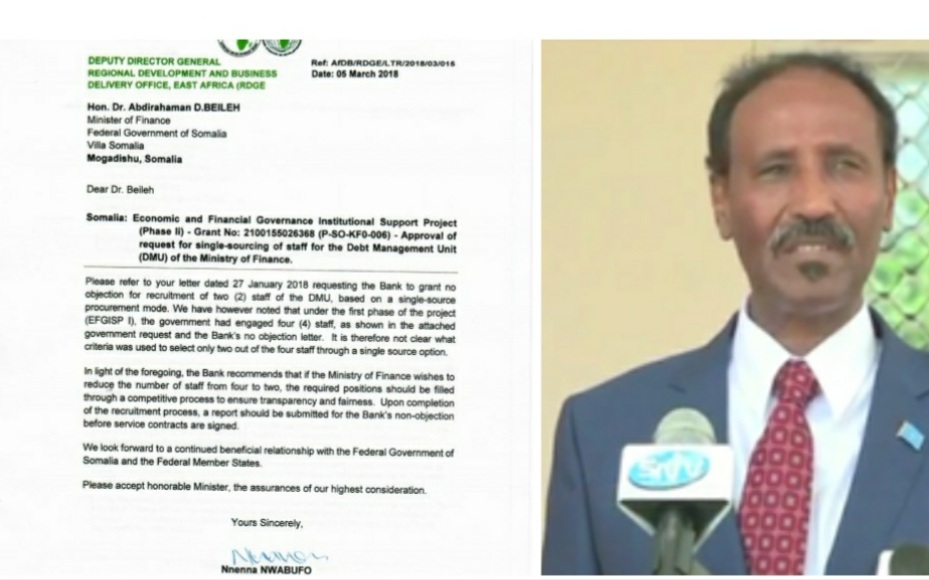
DR ABDIRAHMAN BEYLE: THE SOMALI PRINCE OF CORRUPTION, NEPOTISM AND PUBLIC THEFT

According to the people in the know, Somali Federal Minister of Finance, Dr Abdirahman Beyle, has turned the department into his clan enclave with 80-90% of the ministry staff drawn on nepotism. Taking advantage of corrupt nature of his former bosses and Somali politicians, he is reported to have amassed huge personal fortune, while perfecting the art of theft and looting of public wealth, by creating special accounts for him and his bosses for plunder of public funds, which had never been accounted for in the government budget. Beyle is reported to have built skyscrapers in Hargeisa, using looted public funds.

Beyle’s corrupt adventures and nepotism have no limits to the extent that he even tried to insert his clan members in international financial institutions like Africa Development Bank, on behalf of Somalia, to forget the hundreds of thousands of dollars he gifted to a fellow clan member as the later was appointed Somali Ambassador to Canada, a man named Dhimbil and a former minister of the secessionist Somaliland. Once secured these large sums of money, Mr Dhimbil had trafficked a dozen of his kids from two marriages to Ottawa in Canada. With nowhere to accommodate such huge number of family members, he had to seek large property to rent. The situation had attracted the attention of the Canadian authorities to warrant an investigation into the matter. Diplomatic reports said that his diplomatic immunity has now been suspended, pending to the installation of a new Somali government.

This scandal unnoticed by Somali government had ended up in Ambassador’s family seeking asylum in Canada, with the host government sending a diplomat note of protest to the Somali government complaining about lack of operating funds for Somalia’s mission. The Ambassador was reported shamelessly begging for handouts from the Canadian Somali community there.

Somali Federal Parliament and some legal authorities have been recently looking into the matter of Dr Beyle’s mal-administration and mismanagement of Finance Department’s funds. Whether they have legal strengths to have him accountable is yet to be seen.

For laughter, watch the video below:

A SAD STORY OF ELECTION CORRUPTION IN SOMALIA, PUNTLAND

Reliable news source has relayed to this blog,WDM, a tragic story on Puntland election corruption in 2018. The story narrates that a titled elder at the time approached a man to request for lending a car on the eve of Puntland Presidential Election. The elder didn’t want to use his car for fear of being identified. The elder took four newly elected Puntland MPs in the loaned car and visited every presidential candidate that night. When he failed to return the car to the owner for the following next four days with his phone unreachable, the owner started searching for the whereabouts of the elder. When, finally, the elder had been located, he confessed to the man that on the eve of Puntland Election 2018, the elder and his accompanying four MPs were at door steps of one of the vice presidential candidates when the morning prayer was called for from Garowe mosques.

The tragedy is that this story holds true everywhere in Somalia, while Mogadishu is considered the town worse hit by the epidemic of runaway political corruption. Mind you, this wasn’t an isolated story, but a typical one in the scale of widespread corruption in politics.

Somalia adios!

https://amazon.com/author/ismailwarsame

WHY SICK PUNTLANDERS GO TO HARGEISA AND MOGADISHU

https://ismailwarsame.blog/2019/03/22/why-sick-puntlanders-go-to-hargeisa-and-mogadishu/

HOW TO HANDLE CORRUPTION IN A DEEPLY CORRUPT SOCIETY

https://ismailwarsame.blog/2019/03/17/how-to-handle-corruption-in-a-deeply-corrupt-society/