About the blogger:
This blog is associated with the former Chief of Staff in Puntland State Presidency, 1998-2004. He also worked with the UN and World Bank Joint Secretariat for Somalia’s Re-construction and Development Program (RDP), 2005-2006, as a Zonal Technical Coordinator for Puntland and later as National Aid Technical Coordinator with the Transitional Federal Government of Somalia and European Union. He is now an independent political analyst and commentator on current issues and occasionally gives historical perspective on modern Somalia’s politics. He lives and works in Toronto, Canada. He can be reached at: ismailwarsame@gmail.com
The reading world is delighted to have https://ismailwarsame.blog as an open and unbiased media outlet that covers Somali and regional issues without fear or favor with objective critical analysis. The Blog Stats were lately sky-rocketing. Comments are positive as well as critical. We are pleased to hear from you and very much welcome your inputs and advice.
We encourage you to take advantage of the promotional annual subscription of US 37 dollars. Soon, all articles and entries of critical nature will be scrambled, allowing access to subscribers only.
UK is here to stay with the European Union until acceptable legal separation is obtained. This follows another humiliating defeat for Prime Minister Boris Johnson in the house of Lords today.
In an opposing view, a colleague has a different legal take. “As reckless as the statement [Minister Awad’s] might seem, I think it is prudent and smart way to show that you respect the ICJ Court. The statement does not say otherwise, but that the Somali Government welcomes the two month postponement. In addition, Somalia will have a say, if Kenya later requests further unnecessary and uncalled extention, which I think Kenya will do it [again].
Basically, Kenya wants to exhaust all options before the Court proceedings restart. In my opinion, the two months Kenya received is not enough time to mobilize expert team that could prepare, familiarise and handle the case. There are thousands of documents to read and understand before the team goes in front of the Court in order to argue and defend the [Kenya’s] case. It is a huge case. I think this extension is not the last one. Kenya will seek more time.
Imagine if Kenya comes back and says that it is unable to get an expert team that is willing to take case. That does not mean that Kenya is not abusing the system and wasting the Court’s time and resources, because they are. What Somalia needs to think is “what next”. Kenya will do everything that is possible to undermine the process”
Ciise Dhoolawaa contributed to this article and provided the legal expertise on the issue.
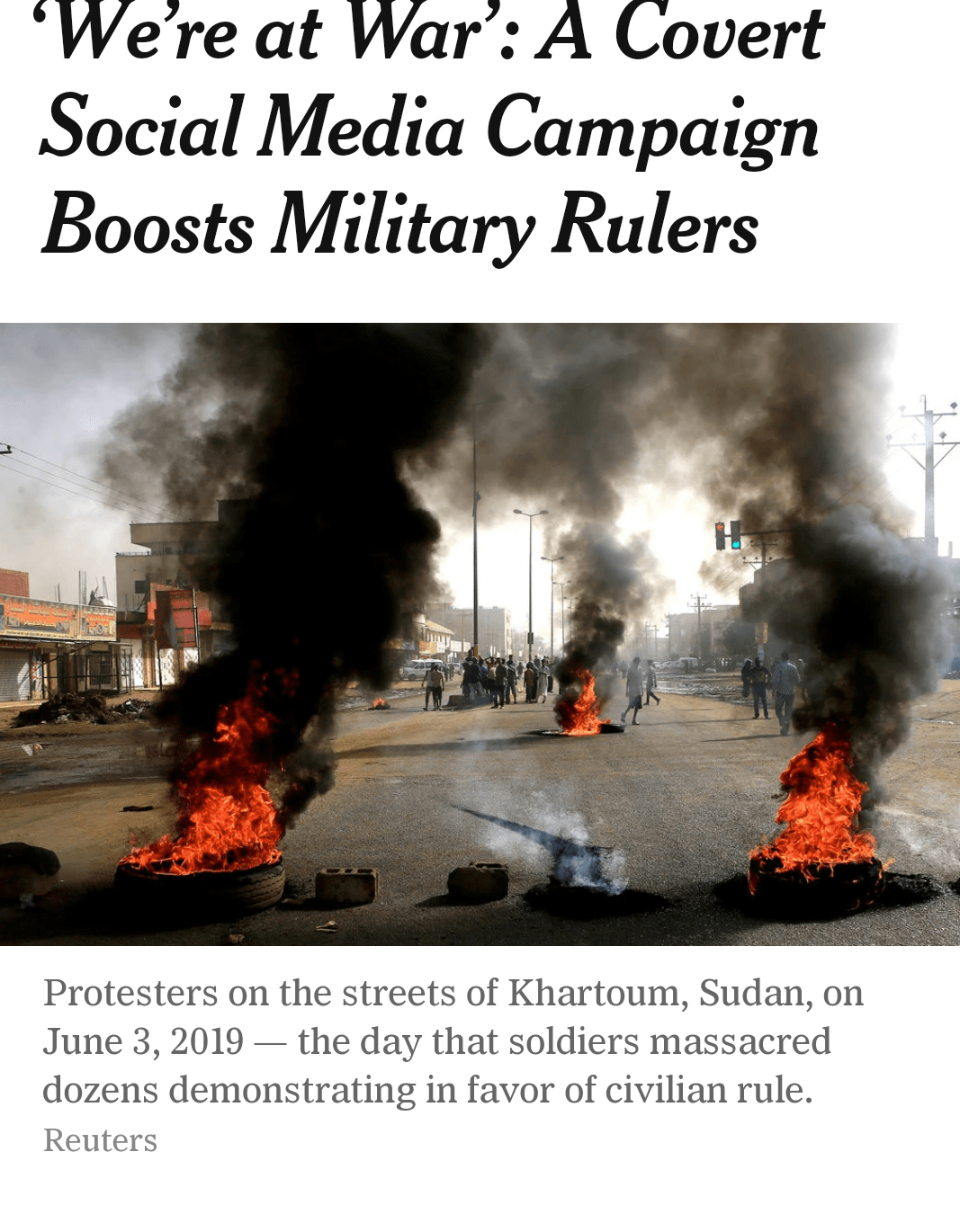
CAIRO — Days after Sudanese soldiers massacred pro-democracy demonstrators in Khartoum in June, an obscure digital marketing company in Cairo began deploying keyboard warriors to a second front: a covert operation to praise Sudan’s military on social media.
The Egyptian company, run by a former military officer and self-described expert on “internet warfare,” paid new recruits $180 a month to write pro-military messages using fake accounts on Facebook, Twitter, Instagram and Telegram. Instructors provided hashtags and talking points.
Since the ouster of President Omar Hassan al-Bashir in April, new employees were told, protesters had sown chaos in Sudan. Their demands for democracy were premature and dangerous. Order had to be restored.
“We’re at war,” an instructor told the new employees. “Security is weak. The army has to rule for now.”
Covert influence campaigns have become a favored tool of leaders in countries like China and Russia, where manipulation of social media complements strongarm tactics on the streets. In the Middle East, though, those campaigns are being coordinated across borders in an effort to bolster authoritarian rule and douse the kind of popular protests that gave rise to the Arab Spring in 2011.
The secretive Egyptian effort to support Sudan’s military on social media this summer by the company in Cairo, New Waves, was just one part of a much bigger operation that spanned the Middle East and targeted people in at least nine Middle Eastern and North African countries, according to Facebook.
Sudanese soldiers during a mass protest in Khartoum in June.CreditEbrahim Hamid/Agence France-Presse — Getty Images
The campaign was exposed on Aug. 1 when Facebook announced that it had shut down hundreds of accounts run by New Waves and an Emirati company with a near-identical name. Working in concert, the two companies used money, deception and fake accounts to leverage their audience of almost 14 million Facebook followers, as well as thousands more on Instagram.
In an interview, a Facebook spokesman said the company had not found sufficient evidence to link the operation to the governments of Egypt or the United Arab Emirates. But there were many hints of such a link.
The New Waves owner, Amr Hussein, retired from the Egyptian military in 2001 and described himself on his Facebook page as a “researcher on internet wars.” He is a vocal supporter of Egypt’s authoritarian leader, President Abdel Fattah el-Sisi, and has publicly campaigned in support of Mr. el-Sisi’s draconian crackdown on internet freedoms.
His company operates from a military-owned housing project in eastern Cairo where employees are warned not to speak to outsiders about their work.
Its messages are a mirror image of the foreign policy objectives of Egypt, the United Arab Emirates and Saudi Arabia — a powerful axis that has wielded immense influence across the Middle East since 2011, bolstering authoritarian allies or intervening in regional wars.
The internal workings of New Waves were described by four people with knowledge of the company who spoke on the condition of anonymity because of the sensitivity of the matter with the Egyptian authorities.
Facebook said the Egyptian and Emirati companies worked together to manage 361 compromised accounts and pages with a reach of 13.7 million people.CreditStephen Lam/Reuters
Responding to Facebook’s accusations, Mr. Hussein, the owner of New Waves, called the company “liars” and denied any links to the Emirates. “I don’t know what you are talk about,” he wrote in a text message, calling Facebook “not fair.” He declined to comment further.
Two former New Waves employees did not respond to requests for comment.
Sudanese activists who noted a surge in pro-military social media activity over the summer said they were unsurprised to learn of the campaign.
“There have been so many fake accounts,” said Mohamed Suliman, a Boston-based engineer allied with Sudan’s protest movement. “Fake news is a real source of danger for Sudan. If there is ever a counterrevolution, one of the regime’s main tools will be social media.”
Facebook said the Egyptian and Emirati companies worked together to manage 361 compromised accounts and pages with a reach of 13.7 million people. They spent $167,000 on advertising and used false identities to disguise their role in the operation.
Their posts gave a boost to the Libyan warlord Khalifa Hifter, who counts Egypt and the United Arab Emirates among his staunchest allies, praised the United Arab Emirates and slammed the wealthy Persian Gulf state of Qatar, a sworn enemy of the Saudis, Egyptians and Emiratis.
Other messages talked up the Saudi-led war in Yemen and promoted independence for Somaliland — a key objective of the Emirates as it jockeys for influence and lucrative contracts in the Horn of Africa.
A Saudi-led airstrike in Dhamar, Yemen, on Sunday. Some Facebook messages talked up the Saudi-led war in Yemen and promoted independence for Somaliland.CreditAgence France-Presse — Getty Images
The website of the Emirati company, Newave, which shut down after Facebook named it on Aug. 1, listed its business address as a government-owned media complex in Abu Dhabi.
A customer service agent at the complex, Twofour54, said Newave had a registered capacity of 10 employees and named its general manager as Mohamed Hamdan al-Zaabi. Emails and phone calls to the company went unanswered.
In Cairo, recruits to the New Waves operation targeting Sudan were told their job was to create “balance” between the military and protesters on social media.
“We’re doing something very big, very important here,” one trainer said. “In the past wars were conducted with weapons. Now it’s through social media.”
Egypt, Saudi Arabia and the United Arab Emirates were the main supporters of the Sudanese generals who seized power in April. The Saudis and Emiratis offered $3 billion in aid while Egypt provided diplomatic support.
Sudan’s vibrant social media space, though, has been harder to control.
Since the first protests against Mr. al-Bashir in December, protest leaders have used the internet to mobilize demonstrations, to circumvent official censorship and to attract support from global celebrities like the pop star Rihanna.ImageGen. Mohamed Hamdan and his notorious Rapid Support Forces paramilitary unit posted pictures on Facebook of him cooking and calling for higher wages for teachers, to soften his image.CreditAshraf Shazly/Agence France-Presse — Getty Images
Within hours of the massacre of civilians in Khartoum on June 3, the military’s first act was to shut down the internet in Sudan. Then it turned to social media to try and soften its harsh image.
Accounts run by Lt. Gen Mohamed Hamdan and his notorious Rapid Support Forces paramilitary unit showed him cooking meals and addressing rallies, highlighting his demands for higher teachers’ wages. Sudanese activists petitioned Facebookto shut down those accounts, accusing the company of giving a free platform to a potential war criminal.
Facebook declined to act because the Rapid Support Forces had become a “state actor,” a Facebook press officer said. General Hamdan is now a leading figure in the power-sharing government, which began taking shape this week with the formation of a new cabinet.
ADVERTISEMENT
In April, however, Facebook investigators started to scrutinize New Waves as part of the tech giant’s global drive to shut down what it calls “coordinated inauthentic behavior” on its platform.
Sudanese democracy advocates had also noticed something awry: a stream of pro-military posts on Twitter written under false names, often using photographs of prominent activists or musicians. They identified the tweets as fake, they said, through Arabic language tics that suggested they had been written by non-Sudanese.
For example, tweets rendered the word “Sudan” in the feminine, while Sudanese write it in the masculine.ImageA screen grab of the facebook page of Rapid Support Forces paramilitary unit in Sudan. A Facebook press officer said the company did not intend to take down the Rapid Support Forces pages because the group had become a “state actor.”Creditfacebook
The New Waves operation had echoes of the Egyptian state’s approach to controlling online debate. Under Mr. el-Sisi, Egypt has blocked over 500 websites and introduced laws that criminalize criticism of the government on social media, which Mr. el-Sisi has described as a threat to national security.
Online critics are frequently jailed in Egypt. On July 7, a dual American-Egyptian citizen, Reem Mohamed Desouky, was arrested on arrival at Cairo airport with her 13-year-old son. Officials confiscated Ms. Desouky’s phone, scrolled through her Facebook posts and charged her with using social media to undermine Egypt.
She is being held at Qanatir prison outside Cairo; her son has returned to the United States.
Between 2015 and 2017, Mr. Hussein, the owner of New Waves, wrote a column for al-Bawaba, a pro-military newspaper. Last fall he fronted a public awareness campaign warning Egyptians of the dangers of social media.
“From 2011 onward it’s been a war of social media,” Mr. Hussein said in an interview with a pro-state television channel in which he cited the Nazi dictum “the bigger the lie, the more people will believe it.”
Executives at New Waves and its Emirati sister company went to considerable lengths to hide their role in the Middle East influence campaign, Facebook said. They obtained fake accounts to administer Facebook pages that purported to be news sites about nine countries, including Sudan, Somalia, Kuwait and Libya.
The pages often featured genuine posts about real news or light entertainment items like cartoons, interspersed with fake items that followed a common theme.
The Sudan Alyoum (Sudan Today) Facebook page linked to a news website of the same name that published 17 articles between this May and August accusing the Muslim Brotherhood of conspiring to overthrow Sudan’s Transitional Military Council, and 60 other articles supporting General Hamdan’s leadership.
Facebook shared its findings with Twitter, which has taken down the New Waves account. Twitter declined to comment except to say it had removed several accounts related to Sudan.
In an interview in July, Mr. Hussein claimed New Waves had just one client, a state-run theater production called Opera Bent Araby. He is vocal about social media, he said, because Middle Eastern society is “special.”
“I talk about the dangers not only in Egypt — in all our world,” he said.
Last Friday, Mr. Hussein declined to speak further. “I have nothing for you,” he wrote in a text. “Please forget me.”
“Recognition of Puntland Secondary School Certificate:
• The Puntland secondary school certificate shail be in form and format equivalent
to the one issued by the Ministry of Education of the Federal Government
• The said certificate shail clearly show the Somali National emblem and the name
of the Federal Government of Somalia. Likewise. it shall have the name of
Puntland State and that of the Ministry of Education and Higher Education of
Puntland.
• The Federal Government of Somalia recognizes the certificate of Puntland cited
in this agreement as per above.
• The FGS shail officially write to the Government of Sudan and any other parties
of interest. clarifying that the FGS recognizes the centralized examinations
administered by Puntland” – excerpts from 2014 Agreement between the FGS and Puntland.
MOGADISHU, Somalia, 04 September, 2019 – Somali Journalists Syndicate (SJS) strongly condemns the orders of blockage of two leading news websites in Somaliland and Puntland and calls both authorities to refrain from harassing independent journalists.
On Tuesday 03 September, 2019, Hargeisa-based Marodi Jeh Regional Court ordered the blockage of independent news website Hadhwanaag.ca following a request from the police asking the internet service providers to block the news site. The court document reviewed by Somali Journalists Syndicate (SJS) mentions articles and series of interviews published by Hadhwanaag News, which allege misuse of public money by the Governor of the Central Bank of Somaliland, Ali Ibrahim Jama (also known as Baghdadi) as the reason of the order of the blockage.
Further, the management of Hawdhwanaag News was also summoned to the Office of Somaliland’s Attorney General for questioning, according to Ahmed Nasir Farah, the website’s Editor-in-Chief.
Separately, in Puntland State, the Minister of Information, Ali Hassan Ahmed (also known as Sabarey) on Tuesday ordered internet companies to block the independent news website Puntlandtimes.com. The order was made during a press conference in Garowe by Minister Sabarey following a news report which the Puntland Times allegedly reported civil servants’ protest at the Puntland Ministry of Information on 26 and 27 August, 2019 over unpaid salaries and Minister Sabarey’s name was mentioned.
Puntland Times Editor, Farah Abdukadir Geylan told Somali Journalists Syndicate (SJS) that two days before the order of the blockage, he received a phone call from the Minister of Information Ali Sabarey who threatened with arrest.
“It is very worrying that authorities in Somaliland and Puntland are blocking news websites deemed critical to them and threatening journalists. Such orders are acts of censorship and infringement on the freedom of the press and denial of the public’s right of access to information,” Abdalle Ahmed Mumin, Secretary General of the Somali Journalists Syndicate (SJS) said.
Somali Journalists Syndicate (SJS) reminds authorities that it is the rights of the journalists to report about issues of public interest, including to investigating wrongdoings of government officials without fear or reprisal.
“We call the telecommunication companies to turn down the orders to block the two news websites of Hadhwanaag News and Puntland Times,” Abdalle Ahmed Mumin, Secretary General of the Somali Journalists Syndicate (SJS) adds.
Yes, GAROWE Mayor could have done a much better job, if only there were not some influencial residents in his way, and these are not the owners of herds of annoying and wandering City goats and collectors of loose cats in town, but politicians, merchants, security forces and influence peddling folks in Garowe. They are putting road-blocks on the mayor’s way to badly needed reforms in the City against the backdrop of clannish mentality on jobs, land/property and culture.
Until those socio-economic impediments are removed, there is little any Garowe Mayor could do before his term in office is up again to go through the traditional two-sided sub-clan rotation with no consideration for the civic rights of other residents in town, a capital city modeling after Mogadishu.
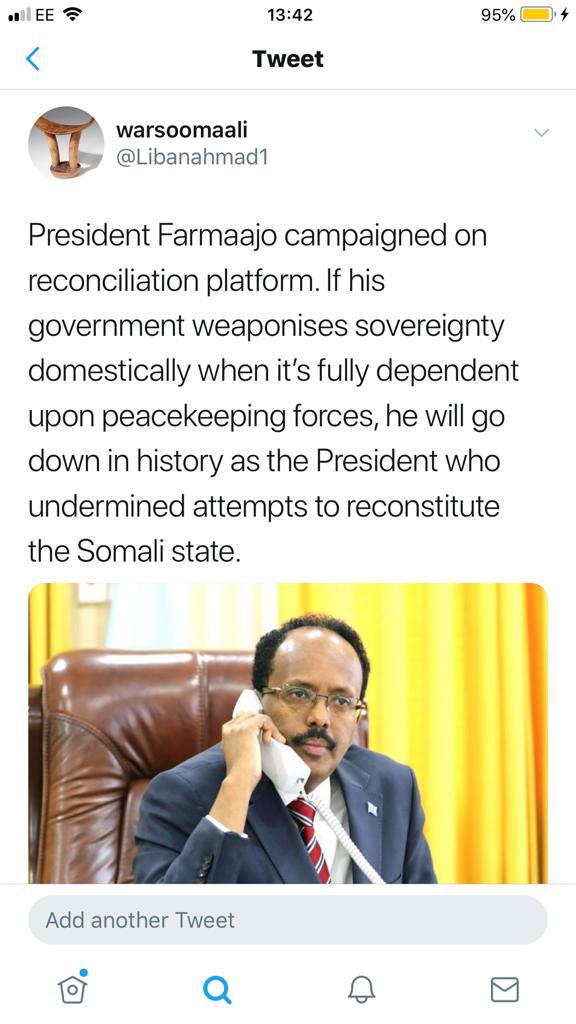
Puntland students now begin to understand that it wasn’t Godax Barre alone denying them of deserved and rightful scholarships, but the entire N&N regime led by Farmaajo and Khayre, resolving to isolate Puntland students.
While doing this, Farmaajo wants your vote in 2020 ill-planned General Election. Wise up!
A few of young folks are commenting this article while they are totally misinformed about the issue. There were not centralized national exams in entire South-central Somalia before. They tried this year to organize one amid leaks, outright sale of exams to the highest bidder in the marketplace, on the top of theft.
Puntland have been conducting common exams for many years. Now N&N Regime want Puntland students to take part in these sham exams, and punish them for not participating in this public disgrace, thus denying them of their rightful share of national scholarships. Get the facts straight first before you comment on this particular issue.
This is also a reminder that, under the Federal Constitution, social services delivery like Education Sector, comes under the jurisdiction of the Federal Member States. The FGS has no business to interfere, but to help the FMS in this regard.
WERE YOU AWARE OF THIS?
“Recognition of Puntland Secondary School Certificate:
• The Puntland secondary school certificate shail be in form and format equivalent
to the one issued by the Ministry of Education of the Federal Government
• The said certificate shail clearly show the Somali National emblem and the name
of the Federal Government of Somalia. Likewise. it shall have the name of
Puntland State and that of the Ministry of Education and Higher Education of
Puntland.
• The Federal Government of Somalia recognizes the certificate of Puntland cited
in this agreement as per above.
• The FGS shail officially write to the Government of Sudan and any other parties
of interest. clarifying that the FGS recognizes the centralized examinations
administered by Puntland” – excerpts from 2014 Agreement between the FGS and Puntland.
Ismail Warsame responded: While this guy have some arguments to make, he shows his shallow knowledge of how federalism came to be in Somalia. Just ask him whether Federalism is defacto or dejure? If it is defacto caused by the Civil War, then nothing short of another war can destroy it. That scenario, barring political destabilization, is unlikely. Having said that, the complaint against vices of unitary government and regional underdevelopment because of it, precedes even the Civil War.
All Farmaajo is doing will come to a nought because it is not based on today’s reality of Somalia. Yes, he had done harm, but in the end he will fail.
Mogadishu, Somalia — As Somalia struggles to stabilize after decades of civil war, foreign powers are quietly waging a shadowy campaign to dismantle its fragile federal system. At the heart of this scheme lie Turkey and Qatar, two nations leveraging financial clout, ideological extremism, and historical paranoia to impose a centralized authority beholden to their interests—with President Mohamed Abdullahi “Farmaajo” serving as their chief proxy.
Turkey’s Obsession with Centralization: A Legacy of Fear Turkey’s vehement opposition to federalism is rooted in its own existential anxieties. The collapse of the Ottoman Empire—a trauma etched into the nation’s psyche—and modern fears of Kurdish separatism have cemented Ankara’s obsession with centralized control. “Turkey views any form of decentralization as a prelude to fragmentation,” explains Dr. Leyla Ahmed, a regional analyst. “Its support for a unitary government in Somalia isn’t about stability—it’s about replicating its own authoritarian model abroad.” This paranoia extends to Somalia’s Federal Member States (FMS), which Turkey perceives as obstacles to its economic ambitions. By propping up Mogadishu’s central government, Ankara ensures preferential access to Somalia’s ports, resources, and military contracts. Critics argue that Turkish “investments,” like the $50 million embassy compound and training of Somali forces, are less about aid and more about entrenching influence.
Qatar’s Toxic Alliance: Arab Nationalism and Extremist Ideals Qatar’s role is equally insidious. Doha’s blend of pan-Arab nationalism and patronage of Islamist groups has bred a hostility toward federalism, framed as both treasonous and blasphemous by its extremist allies. The Gulf state’s funding of Muslim Brotherhood-linked factions in Somalia aligns with its broader strategy to undermine pluralism, replacing it with a homogenized, Qatar-friendly governance. “Federalism empowers regional identities—something Qatar’s ideological partners see as a threat to their vision of a monolithic Islamic state,” says Omar Hassan, a researcher at the Sahan Institute. This alignment has turned Qatar into a bankroller of destabilization, funneling “unaccountable cold cash” to silence dissent and coopt political actors.
Farmaajo’s Puppet Regime: The Turkish-Qatari Nexus President Farmaajo’s administration has become a conduit for this anti-federalist agenda. His government’s aggressive efforts to sideline FMS leaders—cutting off revenue streams, withholding aid, and deploying intelligence operatives—mirror the playbook of his foreign backers. Key to this strategy are two figures: Fahad Yasin, head of Somalia’s National Intelligence and Security Agency (NISA), and Afyare Elmi, a Qatar-based academic. Yasin’s controversial policy paper, Puntland: Preferential Treatment in the Union or Secession, openly advocates for dismantling federalism, urging Mogadishu to strong-arm Puntland into submission. Elmi, meanwhile, provides intellectual heft to Qatar’s agenda, framing decentralization as a “Western plot” incompatible with Somali unity.
Puntland Under Siege: The Last Federal Bulwark Puntland, Somalia’s oldest and most stable FMS, now faces unprecedented pressure. Reports suggest Turkish and Qatari operatives have infiltrated political circles, stoking internal divisions to weaken its autonomy. “Puntland is in the crosshairs,” warns Puntland Senator Fatima Jibril. “Their goal is to collapse our institutions so Mogadishu—and Ankara—can seize control.” Some analysts urge Puntland to temporarily disengage from Mogadishu until the power struggle subsides. Others propose a more radical solution: transitioning to a confederal system, granting regions greater sovereignty to resist external manipulation.
A Call to Action: Sovereignty at Stake The Turkish-Qatari meddling represents not just a threat to Somali federalism, but to the nation’s very sovereignty. “This isn’t about helping Somalia—it’s about recolonizing it under a puppet regime,” asserts former diplomat Abdiwali Mohamed. As Mogadishu escalates its war on federalism, the international community remains conspicuously silent. For Somalia’s regions, the choice is stark: succumb to foreign-dominated centralization or fight for a decentralized future. The survival of Somali democracy may hinge on the answer.
Warsame Digital Media is an independent outlet covering Horn of Africa politics. Follow us for in-depth investigations at @ismailwarsame/www.ismailwarsame.blog
The notion that Villa Somalia operates better under Hawiye leadership is not only misleading and misinforming, but it is also as false as it is dangerous. It didn’t work well under the warlords of Ali Mahdi and General Aydiid. It worked far worse under Abdulqaasim Salad Hassan. It didn’t fare better under Sheikh Sharif Ahmed and Hassan Sheikh Mohamud presidency.
Villa Somalia came back to live only under the Late President of Transitional Federal Government (TFG). Don’t misrepresent the facts and history.
The complicated problems of revenge killings among Hawiye, settling scores, predatory business practices, the culture of physical elemination of business and political competitors among them in Mogadishu and crimes against human rights and humanity by the perpetrators of Civil War, had created a karma situation that neither Mogadishu nor Mogadishu politician would ever rise up again successfully. Wishful thinking is delusional and waste of precious time.
Read this article to understand more about this issue:
“Oct. 02, 2012
By Ismail H. Warsame
The Presidency of the Republic does not give the expected trappings of power, the magic of the highest leadership position in the land or the glory of the Office amid distrust and absence of loyalty within the population and regions of the country. That institutional empowerment must be earned nation-wide in the hard way, and in the case of Somalia, require hard work over many years to come for the future generations of Somalia to enjoy it. If successful, the new leaders can only pave the way for restoring that missing public trust. To accept any Somali President, Prime Minister or the Speaker of the House as a leader of all the people is a long shot, given the depth of distrust developed within the communities for the past 30 odd years towards government officials, or rather any institutions of governance unfortunately. In Somalia’s today the Presidency or any position of leadership is unenviable role for a decent person to play for it requires heavy personal sacrifices few are willing to commit to.
The very idea of bottom-up approach in rebuilding Somalia is primarily based on the restoration of that missing trust before the country has central institutions. Quite a number of Somali intellectual circles and many politicians inside and outside the country, particularly in Mogadishu, do not still appreciate how important the “Building-Blocks’ concept is, as we coined the term more than a decade ago in Puntland State of Somalia, as the shortest way to heal the deep wounds caused by the civil war and abuses of the Military Government, in addition to nepotism and rigging of elections by previous civilian governments. Creation of Federal Institutions starting with the TFG Charter and current Provisional Constitution is a hard fought negotiated outcome towards rebuilding that public trust. Anybody who believes that we can have a highly centralized system of government again in Mogadishu or elsewhere in the country is either of out of touch with reality in today’s Somalia or must have his/her sanity re-examined as this dream cannot be realized in the present political conditions of Somalia. The sooner we all embrace whatever type of federalism we accept as result of a negotiated settlement, the better off we are to re-construct our country. I may add, under the current political atmosphere, having a Federal President and Prime Minister hailing from South-Central Somalia is a recipe for failure and does not meet the necessary power-sharing legitimacy to move the country forward. If proven true (I hope not), the rumors flying around these days in Mogadishu and beyond on the selection of a Prime Minister do not give me sense of optimism for Somalia to be on the mend.
Practical intellectual thinking and bold political leadership are required to brainstorm on why Somaliland and Puntland were created in the first place. While the First went to the extreme of outright unilateral declaration of seccession, the Second did not lose hope that Somalia can be rebuilt from the ashes of the Civil War and the deficit of public trust. For the benefit of those who were not closely following major political developments in the country during the past 15 years or so, or limited/exposed to only superficial sideline debates on Somalia, Puntland State spent considerable resources including brain power to see Somalia re-instituted. This is a major political capital investment that cannot be written off without paying a heavy national price. A simple political instinct is lacking among the intellectuals and politicians in Southern Somalia, i.e. they could not figure out that if Mogadishu is to remain the Capital City and enhance its status as attractive to the residents of Northwest and Northeast Somalia among other parts of the country, it should be subject to power-sharing. Someone cannot be expected to have both ways or as they say, “have their cake and eat it”, given what happened in that City during the vicious Civil War. Mogadishu leaders instead, for the sake of national unity, would have been smart enough to encourage others get elected to the presidency. That did not happen unfortunately despite the great expectation from the new President to deliver, and a lot of people are worried about the direction and the future of the country.
While it is not so popular to be an early pessimistic person, they say, a pessimist is a well informed optimist. Nevertheless, I have strong conviction that the best days of Somalia are still to come”
Now that the recent Djibouti Agreement between Galmudugh President Ahmed Du’ale Haaf and his Dusamareb political partner, Sunna -wal-Jamaacah led by Premier Sheikh Shakir has been revoked, all previous political arrangements between the two factions are in tatters and irreconcilable.
That is because Sheikh Shakir Group has just switched their allegiance to the leaders of the Federal Government at expense of Haaf, betraying the warlord when he needed them most against Prime Minister Hassan Ali Khayre.
Haaf had temporarily found himself in no man’s land as he had escaped from Dusamareb on the eve of Khayre’s arrival in town, and he couldn’t enter Caado without negotiating his way through with his other rival faction leaders of the broken Galmudugh Parliament in Caado. He finally got allowed to enter Caado with the understanding that he had lost politically. That realization brought him to his sense and had accepted the inevitable that election is the only way out for all competing parties.
But, the dust has not settled down yet in Galmudugh conundrum as election campaigns got started, and as usual, those who have deeper pockets and financial backing of Villa Somalia have bigger chance to win.
Galmudugh has additional legitimacy complications of not fulfilling the Federal Constitutional requirements to qualify for regional state status, failing short of having territory of at least two regions.
Dadweynaha Soomaaliyeed waa lagala taliyey arrimaha ka jira ama ka dhacaya dalka. Hadda iyo hadhowba ma eedayn karaan odayaal iyo aqoonyahannaba. Ma oran karaan saa mamoodeen.
Khataraha jira iyo faragelinta shisheeyeba xoog ayaa looga faalooday. Burburka ku socda heshiisyadii dastuuriga ahaa ee qaran waa looga digay. Umad kala qaybsan in ayen qaran xoogan dhisan karin waa loo sheegay
Nidaamka federaalku in uu yahay awoodda keli ah ee Soomaaliya haatan isku haya waa lagu wacyigeli. Weerarka ku socda nidaamka awood-baahinta dalka in uu isugu biya-shubanayo kala dir Soomaliya waa lagala dardaarmay
Hadda iyo hadhow yaan la is-eersan oo lays-haaraamin hadii aan si wadajir ah wax loo wadaqabsan, dhiilooyinka jira iyo kuwa soo socdana wadajir looga hortagin.
Akhri, oo ka bogo degelka sida toos ah, hagarla’aan iyo hufnaan ku caanbaxay: Warsame Digital Media WDM https://ismailwarsame.blog
Do you know the absence of free press is a leading contributor to the succession of bad governments, instability and failure of Somalia?
Freedom of press is a culture and institution that are essential to the survival of healthy societies. That is because without freedom of thought and expression, there is no democracy, no free choice, also there is no truth and no counter-measures to abuse of both public and private strongmen. There is no check against clan violence and fight for undeserved privileges and suppression of other people’s rights.
When you notice signs of freedom of the press, don’t take it for granted. Support it. Warsame Digital Media WDM is one of the few outlets, if not the only one, in Somalia that talks truth to power. Join it to help, share it, comment and contribute to it.
Abdullahi Yusuf, Abdullahi Faash, Abdulkadir Isbarije, Jini Boqor, Ahmed Dahir Hassan, Dahir Mire, Ercolo, Ina Kadawe, and so on. The location is Galaadi at one of SSDF Military Bases, circa 1983-1984.
What is amiss in the attitude, politics and protocol of the Speaker of Puntland House of Representatives? Is attending the inauguration of the new Mogadishu Mayor-warlord, or any mayor, a part of his protocol requirement? Does he understand the dignity and decorum of his position as the Speaker of Puntland Parliament? Is he aware of what Puntlanders expect of him? What is this freelancing attitude on the part of Puntland House Speaker?
This is a new sub-culture we had never seen before in Puntland State. In one word, it is a disgrace to the people of Puntland. What kind of house of representatives is this, one would wonder?
It is not often that one hears anything like the truth in today’s Washington, a city where the art of dissimulation has reached new heights among both Democrats and Republicans. Everyone who has not been asleep like Rip Van Winkle for the past twenty years knows that the most powerful foreign lobby operating in the United States is that of the state of Israel. Indeed, by some measures it just might be the most powerful lobby period, given the fact that it has now succeeded in extending its tentacles into state and local levels with its largely successful campaigns to punish criticism or boycotting of Israel while also infiltrating boards of education to require Holocaust education and textbooks that reflect favorably on the Jewish state.
Occasionally, however, the light does shine in darkness. The efforts by Congresswomen Rashida Tlaib and Ilhan Omar to challenge the power of the Israel Lobby are commendable and it is worth noting that the two women are being subjected to harassment by their own Democratic Party in an effort to make them be silent.
President Donald Trump, meanwhile, has attempted to make them the face of the Democrats, calling them “Jew haters” and “anti-Semites” while also further claiming that they despise the United States just as they condemn Israel. This has developed into a Trump diatribe claiming that American Jews who vote for Democrats are “disloyal.” By disloyal he meant disloyal to Israel, in a sense ironically confirming that in the president’s mind Jews have dual loyalty, which, of course, at least some of them do.
And Trump has further exercised his claim to the Jewish vote by accepting the sobriquet “King of Israel” bestowed by a demented talk radio host. As Secretary of State Mike Pompeo has already asserted that Trump’s election victory was the result of divine intervention to “save Israel from Iran,” the kingship is presumably an inevitable progression. One can only imagine what will come next.
One Democratic congressman who has apparently become fatigued by all that bipartisan pandering to Israel is Ted Lieu (image on the right) of California. Last Thursday Lieu rebuked Trump’s US Ambassador to Israel David Friedman over his support of Prime Minister Benjamin Netanyahu’s refusal to allow Tlaib and Omar to visit the West Bank where Tlaib’s grandmother lives under Israeli occupation. Friedman had issued a statement saying that the United States “respects and supports” the Israeli action. He went on to elaborate
“The Boycott, Divestment and Sanctions (BDS) movement against Israel is not free speech. Rather, it is no less than economic warfare designed to delegitimize and ultimately destroy the Jewish state. [Israel] has every right to protect its borders against those activists in the same manner as it would bar entrants with more conventional weapons.”
As Friedman was describing two thirty-something nonviolent first term congresswomen as nothing less than armed attackers about to be unleashed against the Jewish state because they support a peaceful boycott movement, Lieu apparently felt compelled to courageously respond to the ambassador, tweeting
“Dear @USAmbIsrael: You are an American. Your allegiance should be to America, not to a foreign power. You should be defending the right of Americans to travel to other countries. If you don’t understand that, then you need to resign.”
Later that day, on CNN, Lieu explained his objection to Friedman’s actions, saying
“Actually, I think he should resign because he doesn’t see to understand that his allegiance is to America, not to a foreign power. He should be defending the right of Americans to go abroad to other countries and to visit their relatives.”
The outrage from the mighty host of friends of Israel came immediately, with accusations that Lieu was accusing Friedman of “dual loyalty,” that greatly feared derogatory label that is somewhat akin to “anti-Semitism” or “Holocaust denial” in the battery of verbal munitions used to silence critics of the Jewish state. Indeed, Lieu was accused of employing nothing less than a “classic anti-Semitic” trope.
Under considerable pressure, Lieu deleted the tweet and then issued something of an apology,
“It has been brought to my attention that my prior tweet to @USAmbIsrael raises dual loyalty allegations that have historically caused harm to the Jewish community. That is a legitimate concern. I am therefore deleting the tweet.”
But the reality is, of course, that Friedman does not have dual loyalty. He has real loyalty only to Israel, which he demonstrates repeatedly by uncritically supporting everything the kleptocratic Netanyahu regime does with nary a pause to consider actual American interests. He has supported the weekly slaughter of unarmed Gazan civilians by Israeli sharpshooters, praised the bombing of Syria, pushed for the move of the US Embassy to Jerusalem, applauded the recognition by Washington of Israeli sovereignty over the Golan Heights, and is an active supporter of and contributor to the illegal Israeli settlements on the West Bank. He has even pressured the State Department into ceasing its use of the word “occupation” when describing the situation on the West Bank. It is now “disputed.” So, it is no surprise that David Friedman, formerly a bankruptcy lawyer before he became ambassador, lines up with Netanyahu rather than with two American Congresswomen who, apart from anything else, have good reasons to travel to a country that is the largest US aid recipient in order to see conditions on the ground. To put it mildly, Friedman is a disgrace and a reflection of the character or lack thereof of the man who appointed him. If he had any decency, he would resign.
There is no benefit for the United States when an American Ambassador excuses the brutality of a foreign government, quite the contrary as it makes Washington an accomplice in what are often undeniably war crimes. Even though Congressman Lieu was clearly read the riot act and made to fly right by his own party’s leadership, it took considerable courage to speak up against both Israel and an American ambassador who clearly is more in love with the country he is posted to than the country he is supposed to represent.
Of course, in never-any-accountability Washington a buffoon posing as an ambassador as Friedman does will get away with just about anything and, as the subject is Israel, there will hardly be a word of rebuke coming from anyone, to include the mainstream media. But the tweet by Lieu is nevertheless significant. Hopefully he will be among the first of many congressmen willing to put at risk their careers at times to speak the truth.
*
Note to readers: please click the share buttons above or below. Forward this article to your email lists. Crosspost on your blog site, internet forums. etc.
Philip M. Giraldi, Ph.D., is Executive Director of the Council for the National Interest, a 501(c)3 tax deductible educational foundation (Federal ID Number #52-1739023) that seeks a more interests-based U.S. foreign policy in the Middle East. Website is councilforthenationalinterest.org, address is P.O. Box 2157, Purcellville VA 20134 and its email is inform@cnionline.org. He is a frequent contributor to Global Research.
Little big man: supporters of Venezuelan President Nicolás Maduro in Caracas, May 2019Leo Correa / Redux
It has been a good decade for dictatorship. The global influence of the world’s most powerful authoritarian countries, China and Russia, has grown rapidly. For the first time since the late nineteenth century, the cumulative GDP of autocracies now equals or exceeds that of Western liberal democracies. Even ideologically, autocrats appear to be on the offensive: at the G-20 summit in June, for instance, President Vladimir Putin dropped his normal pretense that Russia is living up to liberal democratic standards, declaring instead that “modern liberalism” has become “obsolete.”
Conversely, it has been a terrible decade for democracy. According to Freedom House, the world is now in the 13th consecutive year of a global democratic recession. Democracies have collapsed or eroded in every region, from Burundi to Hungary, Thailand to Venezuela. Most troubling of all, democratic institutions have proved to be surprisingly brittle in countries where they once seemed stable and secure.
In 2014, I suggested in these pages that a rising tide of populist parties and candidates could inflict serious damage on democratic institutions. At the time, my argument was widely contested. The scholarly consensus held that demagogues would never win power in the long-established democracies of North America and western Europe. And even if they did, they would be constrained by those countries’ strong institutions and vibrant civil societies. Today, that old consensus is dead. The ascent of Donald Trump in the United States, Matteo Salvini in Italy, and Jair Bolsonaro in Brazil has demonstrated that populists can indeed win power in some of the most affluent and long-established democracies in the world. And the rapid erosion of democracy in countries such as Hungary and Venezuela has shown that populists really can turn their countries into competitive authoritarian regimes or outright dictatorships. The controversial argument I made five years ago has become the conventional wisdom.
But this new consensus is now in danger of hardening into an equally misguided orthodoxy. Whereas scholars used to hope that it was only a matter of time until some of the world’s most powerful autocracies would be forced to democratize, they now concede too readily that these regimes have permanently solved the challenge of sustaining their legitimacy. Having once believed that liberal democracy was the obvious endpoint of mankind’s political evolution, many experts now assume that billions of people around the world will happily forgo individual freedom and collective self-determination. Naive optimism has given way to premature pessimism.
If the past decade has been bad for democracy, the next one may turn out to be surprisingly tough on autocrats.
The new orthodoxy is especially misleading about the long-term future of governments that promise to return power to the people but instead erode democratic institutions. These populist dictatorships, in countries such as Hungary, Turkey, and Venezuela, share two important features: first, their rulers came to power by winning free and fair elections with an anti-elitist and anti-pluralist message. Second, these leaders subsequently used those victories to concentrate power in their own hands by weakening the independence of key institutions, such as the judiciary; curtailing the ability of opposition parties to organize; or undermining critical media outlets. (By “populist dictatorships,” I mean both outright dictatorships, in which the opposition no longer has a realistic chance of displacing the government through elections, and competitive authoritarian regimes, in which elections retain real significance even though the opposition is forced to fight on a highly uneven playing field.)
According to the new orthodoxy, the populist threat to liberal democracy is a one-way street. Once strongman leaders have managed to concentrate power in their own hands, the game for the opposition is up. If a significant number of countries succumb to populist dictatorship over the next years, the long-term outlook for liberal democracy will, in this view, be very bleak.
But this narrative overlooks a crucial factor: the legitimacy of populist dictators depends on their ability to maintain the illusion that they speak for “the people.” And the more power these leaders concentrate in their own hands, the less plausible that pretense appears. This raises the possibility of a vicious cycle of populist legitimacy: when an internal crisis or an external shock dampens a populist regime’s popularity, that regime must resort to ever more overt oppression to perpetuate its power. But the more overt its oppression grows, the more it will reveal the hollowness of its claim to govern in the name of the people. As ever-larger segments of the population recognize that they are in danger of losing their liberties, opposition to the regime may grow stronger and stronger.
The ultimate outcome of this struggle is by no means foreordained. But if the past decade has been depressingly bad for democracy, the next one may well turn out to be surprisingly tough on autocrats.
Brazilian President Jair Bolsonaro in Brasilia, July 2019Adriano Machado / Reuters
ERDOGAN’S DILEMMA
In North America and western Europe, populist leaders have gained control of the highest levers of power over the course of only the past few years. In Turkey, by contrast, Recep Tayyip Erdogan has been in power for nearly two decades. The country thus offers an ideal case study of both how populist dictators can seize power and the challenge they face when increasingly overt oppression erodes their legitimacy.
Erdogan became prime minister in 2003 by running on a textbook populist platform. Turkey’s political system, he claimed, was not truly democratic. A small elite controlled the country, dispensing with the will of the people whenever they dared to rebel against the elite’s preferences. Only a courageous leader who truly represented ordinary Turks would be able to stand up against that elite and return power to the people.
He had a point. Turkey’s secular elites had controlled the country for the better part of a century, suspending democracy whenever they failed to get their way; between 1960 and 1997, the country underwent four coups. But even though Erdogan’s diagnosis of the problem was largely correct, his promised cure turned out to be worse than the disease. Instead of transferring power to the people, he redistributed it to a new elite of his own making. Over the course of his 16 years in power—first as prime minister and then, after 2014, as president—Erdogan has purged opponents from the military; appointed partisan hacks to courts and electoral commissions; fired tens of thousands of teachers, academics, and civil servants; and jailed a breathtaking number of writers and journalists.
Even as Erdogan consolidated power in his own hands, he seized on his ability to win elections to sustain the narrative that had fueled his rise. He was the freely elected leader of the Turkish republic; his critics were traitors or terrorists who were ignoring the will of the people. Although international observers considered Turkey’s elections deeply flawed, and political scientists began to classify the country as a competitive authoritarian regime, this narrative helped Erdogan consolidate support among a large portion of the population. So long as he won, he could have his cake and eat it, too: his ever-tightening grip on the system tilted the electoral playing field, making it easier for him to win a popular mandate. This mandate, in turn, helped legitimize his rule, allowing him to gain an even tighter grip on the system.
More recently, however, Erdogan’s story of legitimation—the set of claims by which he justifies his rule—has begun to fall apart. In 2018, Turkey’s economy finally fell into recession as a result of Erdogan’s mismanagement. In municipal elections this past March, Erdogan’s Justice and Development Party (AKP) lost Ankara, Turkey’s capital, and Istanbul, its largest city. For the first time since taking office, Erdogan was faced with a difficult choice: either give up some of his power by accepting defeat or undermine his story of legitimation by rejecting the results of the election.
Erdogan chose the latter option. Within weeks of Istanbul’s mayoral election, the Turkish election board overturned its results and ordered a rerun for the middle of June. This turned out to be a massive miscalculation. A large number of Istanbulites who had previously supported Erdogan and his party were so outraged by his open defiance of the popular will that they turned against him. The AKP candidate suffered a much bigger defeat in the second election.
Having tried and failed to annul the will of the people, Erdogan now faces the prospect of a downward spiral. Because he has lost a great deal of his legitimacy, he is more reliant on oppressive measures to hold on to power. But the more blatantly he oppresses his own people, the more his legitimacy will suffer.
The implications of this transformation extend far beyond Turkey. Authoritarian populists have proved frighteningly capable of vanquishing democratic opponents. But as the case of Erdogan demonstrates, they will eventually face serious challenges of their own.
A portrait of Erdogan in Bursa, Turkey, April 2019Goran Tomasevic / Reuters
AN AUTOCRATIC FUTURE?
It is tempting to cast the stakes in the struggle between authoritarian populists and democratic institutions in existential terms. If populists manage to gain effective control over key institutions, such as the judiciary and the electoral commission, then the bell has tolled for democracy. But this conclusion is premature. After all, a rich literature suggests that all kinds of dictatorships have, historically, been remarkably vulnerable to democratic challenges.
Between the end of World War II and the collapse of the Soviet Union, for instance, dictatorships had a two percent chance of collapsing in any given year. During the 1990s, the odds increased to five percent, according to research by the political scientists Adam Przeworski and Fernando Limongi. Clearly, the concentration of power that characterizes all dictatorships does not necessarily translate into that power’s durability.
Instead of assuming that the rise of populist dictatorships spells an end for democratic aspirations in countries such as Hungary, Turkey, and Venezuela, therefore, it is necessary to understand the circumstances under which these regimes are likely to succeed or fail. Recent research on autocratic regimes suggests that there are good reasons to believe that populist dictatorships will prove to be comparatively stable. Since most of them are situated in affluent countries, they can afford to channel generous rewards to supporters of the regime. Since they rule over strong states with capable bureaucracies, their leaders can ensure that their orders are carried out in a timely and faithful manner. Since they control well-developed security services, they can monitor and deter opposition activity. And since they are embedded in efficient ruling parties, they can recruit reliable cadres and deal with crises of succession.
On the other hand, many of the countries these regimes control also have features that favored democratization in the past. They usually have high levels of education and economic development. They contain opposition movements with strong traditions and relatively established institutions of their own. They often neighbor democratic nations and rely on democracies for their economic prosperity and military security. Perhaps most important, many of these countries have a recent history of democracy, which may both strengthen popular demands for personal liberties and provide their people with a template for a democratic transition when an autocratic regime does eventually collapse.
All in all, the structural features on which political scientists usually focus to gauge the likely fate of authoritarian regimes appear finely balanced in the case of populist dictatorships. This makes it all the more important to pay attention to a factor that has often been ignored in the literature: the sources and the sustainability of their legitimacy.
BROKEN PROMISES
In the twentieth century, democratic collapse usually took the form of a coup. When feuds between political factions produced exasperating gridlock, a charismatic military officer managed to convince his peers to make a bid for power. Tanks would roll up in front of parliament, and the aspiring dictator would take the reins of power.
The blatantly antidemocratic nature of these coups created serious problems of legitimacy for the regimes to which they gave rise. Any citizen who valued individual freedom or collective self-determination could easily recognize the danger that these authoritarian governments posed. Insofar as these dictatorships enjoyed real popular support, it was based on their ability to deliver different political goods. They offered protection from other extremists. They vowed to build a stable political system that would dispense with the chaos and discord of democratic competition. Above all, they promised less corruption and faster economic growth.
In most cases, those promises were hard to keep. Dictatorships frequently produced political chaos of their own: palace intrigues, coup attempts, mass protests. In many cases, their economic policies proved to be highly erratic, leading to bouts of hyperinflation or periods of severe economic depression. With few exceptions, they suffered from staggering levels of corruption. But for all these difficulties, their basic stories of legitimation were usually coherent. Although they often failed to do so, these dictatorships could, in principle, deliver on the goods they promised their people.
Populist dictatorships are liable to suffer from an especially sudden loss of legitimacy.
This is not true of populist dictatorships. As the case of Erdogan illustrates, populists come to power by promising to deepen democracy. This makes it much easier for them to build dictatorships in countries in which a majority of the population remains committed to democratic values. Instead of accepting an explicit tradeoff between self-determination and other goods, such as stability or economic growth, supporters of populist parties usually believe that they can have it all. As a result, populists often enjoy enormous popularity during their first years in power, as Russia’s Vladimir Putin, Hungary’s Viktor Orban, and India’s Narendra Modi have demonstrated.
Once they consolidate their authority, however, populist dictators fail to live up to their most important promise. Elected on the hope that they will return power to the people, they instead make it impossible for the people to replace them. The crucial question is what happens when this fact becomes too obvious for large segments of the population to ignore.
THE VICIOUS CYCLE
At some point during their tenure, populist dictators are likely to face an acute crisis. Even honest and competent leaders are likely to see their popularity decline because of events over which they have little control, such as a global recession, if they stay in office long enough. There are also good reasons to believe that populist dictatorships are more likely than democracies to face crises of their own making. Drawing on a comprehensive global database of populist governments since 1990, for example, the political scientist Jordan Kyle and I have demonstrated that democratic countries ruled by populists tend to be more corrupt than their nonpopulist peers. Over time, the spread of corruption is likely to inspire frustration at populists’ unfulfilled promises to “drain the swamp.”
Similarly, research by the political scientist Roberto Foa suggests that the election of populists tends to lead to serious economic crises. When left-wing populists come to power, their policies often lead to a cratering stock market and rapid capital flight. Right-wing populists, by contrast, usually enjoy rising stock prices and investor confidence during their first few years in office. But as they engage in erratic policymaking, undermine the rule of law, and marginalize independent experts, their countries’ economic fortunes tend to sour. By the time that right-wing populists have been in office for five or ten years, their countries are more likely than their peers to have suffered from stock market crashes, acute financial crises, or bouts of hyperinflation.
Once a populist regime faces a political crisis, the massive contradictions at the heart of its story of legitimation make the crisis especially difficult to deal with. Initially, the political repression in which populist regimes engage remains somewhat hidden from public view. Power grabs usually take the form of complicated rule changes—such as a lower retirement age for judges or a modification of the selection mechanisms for members of the country’s electoral commission—whose true import is difficult to grasp for ordinary citizens. Although political opponents, prominent journalists, and independent judges may start to experience genuine oppression early in a populist’s tenure, the great majority of citizens, including most public-sector workers, remain unaffected. And since the populist continues to win real majorities at the ballot box, he or she can point to genuine popularity to dispel any doubts about the democratic nature of his or her rule.
This equilibrium is likely to be disrupted when a shock or a crisis lowers the leader’s popularity. In order to retain power, the leader must step up the oppression: cracking down on independent media, firing judges and civil servants, changing the electoral system, disqualifying or jailing opposition candidates, rigging votes, annulling the outcome of elections, and so on. But all these options share the same downside: by forcing the antidemocratic character of the regime out into the open, they are likely to increase the share of the population that recognizes the government for what it truly is.
This is where the vicious cycle of populist legitimacy rears its unforgiving head. As support for the regime wanes, the populist autocrat needs to employ more repression to retain power. But the more repression the regime employs, the more its story of legitimation suffers, further eroding its support.
Populist dictatorships are therefore liable to suffer from an especially sudden loss of legitimacy. Enjoying a broad popular mandate, their stories of legitimation initially allow them to co-opt or weaken independent institutions without oppressing ordinary citizens or forfeiting the legitimacy they gain from regular elections. But as the popularity of the populist leader declines due to internal blunders or external shocks, the vicious cycle of populist legitimacy sets in. Custom-made to help populist leaders gain and consolidate power, their stories of legitimation are uniquely ill adapted to helping them sustain an increasingly autocratic regime.
Anti-government protesters in Budapest, March 2019Tamas Kaszas / Reuters
A CRISIS OF POPULIST AUTHORITY?
Many populist dictatorships will, sooner or later, experience an especially serious crisis of legitimacy. What will happen when they do?
In The Prince, Niccolò Machiavelli warned that the ruler “who becomes master of a city accustomed to freedom” can never sleep easy. “When it rebels, the people will always be able to appeal to the spirit of freedom, which is never forgotten, despite the passage of time and any benefits bestowed by the new ruler…. If he does not foment internal divisions or scatter the inhabitants, they will never forget their lost liberties and their ancient institutions, and will immediately attempt to recover them whenever they have an opportunity.”
Populist dictators would do well to heed Machiavelli’s warning. After all, most of their citizens can still recall living in freedom. Venezuela, for example, had been democratic for about four decades by the time Hugo Chávez first ascended to power at the end of the 1990s. It would hardly come as a surprise if the citizens of countries that have, until so recently, enjoyed individual freedom and collective self-determination eventually began to long for the recovery of those core principles.
But if populist dictators must fear the people, there is also ample historical evidence to suggest that autocratic regimes can survive for a long time after their original stories of legitimation have lost their power. Take the twentieth-century communist dictatorships of Eastern Europe. From their inception, the communist regimes of Czechoslovakia and East Germany, for example, depended on a horrific amount of oppression—far beyond what today’s populists in Hungary or Poland have attempted so far. But like today’s populists, those regimes claimed that they were centralizing power only in order to erect “true” democracies. In their first decades, this helped them mobilize a large number of supporters.
Eventually, the illusion that the regimes’ injustices were growing pains on the arduous path toward a worker’s paradise proved impossible to sustain. In Czechoslovakia, for example, cautious attempts at liberalization sparked a Soviet invasion in 1968, followed by a brutal crackdown on dissent. Virtually overnight, the regime’s story of legitimation went from being an important foundation of its stability to a hollow piece of ritualized lip service. As the Czech dissident Vaclav Havel wrote in his influential essay “The Power of the Powerless,” it was “true of course” that after 1968, “ideology no longer [had] any great influence on people.” But although the legitimacy of many communist regimes had cratered by the late 1960s, they were able to hold on to power for another two decades thanks to brutal repression.
Populist dictatorships in countries such as Turkey or Venezuela may soon enter a similar phase. Now that their stories of legitimation have, in the minds of large portions of their populations, come to be seen as obvious bunk, their stability will turn on the age-old clash between central authority and popular discontent.
Recently, a series of writers have suggested that the rise of digital technology will skew this competition in favor of popular discontent. As the former CIA analyst Martin Gurri argued in The Revolt of the Public and the Crisis of Authority in the New Millennium, the Internet favors networks over hierarchies, the border over the center, and small groups of angry activists over bureaucratic incumbents. These dynamics help explain how populists were able to displace more moderate, established political forces in the first place. They also suggest that it will be difficult for populists to stay in power once they have to face the wrath of the digitally empowered public.
This argument, however, fails to take into account the differences in how dictatorships and democracies wield power. Whereas dictatorships are capable of using all the resources of a modern state to quash a popular insurgency, democracies are committed to fighting their opponents with one hand tied behind their back. Dictators can jail opposition leaders or order soldiers to fire into a crowd of peaceful protesters; democratic leaders can, at best, appeal to reason and shared values.
This imbalance raises the prospect of a dark future in which digital technology allows extremist networks to vanquish moderate hierarchies. Once in power, these extremist movements may succeed in transforming themselves into highly hierarchical governments—and in using brute force to keep their opponents at bay. Technology, in this account, fuels the dissemination of the populists’ stories of legitimation when they first storm the political stage, but it fails to rival the power of their guns once their stories of legitimation have lost their hold.
It is too early to conclude that the populist dictatorships that have arisen in many parts of the world in recent years will be able to sustain themselves in power forever. In the end, those who are subject to these oppressive regimes will likely grow determined to win back their freedom. But the long and brutal history of autocracy leaves little doubt about how difficult and dangerous it will be for them to succeed. And so the best way to fight demagogues with authoritarian ambitions remains what it has always been: to defeat them at the ballot box before they ever step foot in the halls of power.
Enjoy more high-quality articles like this one.
Become a subscriber.
Paywall-free reading of new articles posted daily online and almost a century of archives
Unlock access to iOS/Android apps to save editions for offline reading
Six issues a year in print, online, and audio editions
N&N fight is raging on to squeeze Jubaland Federal Member State from all sides and corners, save Kenya’s side. There are, reportedly, restrictions and sanctions being applied on aviation companies to coordinate with Mogadishu before they fly into Kismayo.
Ahmed Madoobe potential inauguration is also being undermined. Diplomatic pressure, not to recognize the outcome of recent Jubaland election, is one of the tools N&N is utilizing to deny legitimacy to Ahmed Madoobe.
So far, no other Federal Member States, save a divided Puntland Government on the issue of Jubaland election outcome, has come forward to recognize Ahmed Madoobe’s claim of election victory. This is still a developing story.


 September 7, 2019
 https://ismailwarsame.blog












 Warsame Policy & Media Network (WAPMEN)
You must be logged in to post a comment.