
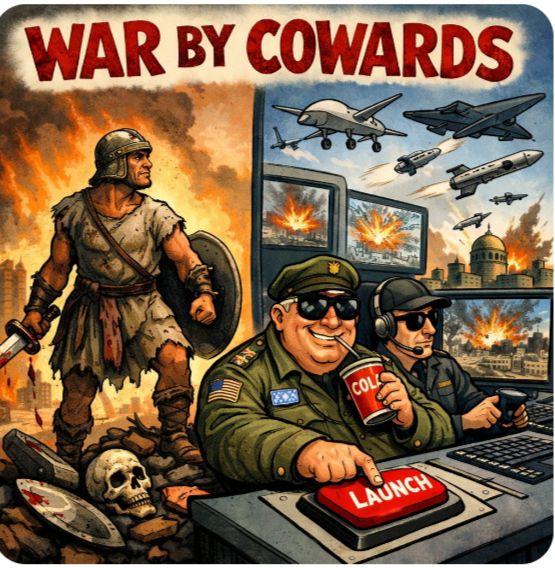
In ancient times, war demanded courage. Men stood face to face with their enemies, swords drawn, spears raised, and daggers ready. War was brutal, but it had limits. A warrior could see the whites of his enemy’s eyes. Bloodshed was real, immediate, and personal. A man who went to war understood the risks—his life against another’s.
Today, war has become something else entirely.
The unfolding confrontation between the United States and Israel on one side and Iran on the other represents the modern face of warfare: a war conducted not by soldiers facing each other on the battlefield, but by machines flying across continents—missiles, drones, satellites, stealth bombers, and algorithms.
This is not war as the world once knew it.
This is war by remote control.
The Age of the Flying Machine
In the modern era, war is increasingly fought from a safe distance. Pilots sit thousands of miles away. Drone operators stare at screens in air-conditioned rooms. Missiles are launched from ships or aircraft far beyond the reach of retaliation.
The human element has been removed.
The political leaders who order such attacks do not march into battle. They do not see the destruction they unleash. They do not smell the smoke of burning cities or hear the cries of the wounded.
Technology has turned war into something deceptively simple:
press a button, release a missile, watch the explosion on a screen.
The temptation is obvious.
When killing becomes easy, war becomes easier to start.
The Cowardice of Distance
The current conflict illustrates a painful reality: neither the United States nor Israel can realistically invade Iran by land. Iran is too large, too mountainous, and too populous for any occupying force to control.
So the war is fought through technology.
Airstrikes.
Cruise missiles.
Long-range drones.
Cyber warfare.
But distance changes the psychology of war. Leaders begin to believe they can wage war without consequences. They assume machines can substitute for strategy and that technology can replace diplomacy.
This is the illusion of modern warfare.
Machines make destruction easier—but they do not make war controllable.
The Dangerous Temptation of Technology
Technology has introduced a dangerous moral hazard in global politics.
In the past, a leader had to think carefully before sending thousands of soldiers into battle. The political cost was immense. The human loss was visible. The economic burden was devastating.
But with drones and missiles, the calculus changes.
A leader can launch strikes without mobilizing armies.
Without public debate.
Without parliamentary approval.
Without facing the immediate consequences.
War becomes seductively convenient.
And convenience is the enemy of wisdom.
From Spears to Hypersonic Missiles
Human history shows that every technological leap in warfare expands the scale of destruction.
Spears became rifles.
Rifles became machine guns.
Machine guns became bombs.
Bombs became nuclear weapons.
The world moved from battlefield combat to the terrifying reality of industrialized annihilation.
When warriors fought with swords and spears, the damage—however brutal—was limited. Entire civilizations were not erased overnight. Cities were not vaporized in seconds.
Modern weapons change everything.
A single missile can destroy a city block.
A swarm of drones can cripple infrastructure.
A nuclear warhead can erase millions of lives in minutes.
Human civilization now possesses the power to destroy itself faster than it can reason.
The Nuclear Shadow
The greatest danger in the war involving Iran, Israel, and the United States is not the missiles already flying.
It is the shadow hanging behind them.
Nuclear weapons.
Once technological warfare escalates beyond control, the line between conventional and nuclear conflict becomes frighteningly thin. A desperate state facing defeat may reach for the ultimate weapon.
History has shown repeatedly that wars rarely unfold according to the neat plans of generals or politicians.
They spiral.
They escalate.
They consume everything in their path.
War Without Thinking
Modern technology has created a terrifying paradox.
Human beings have never been more educated, more technologically advanced, or more scientifically sophisticated. Yet the political wisdom needed to restrain these destructive tools has not evolved at the same pace.
We have created machines capable of destroying the planet—but we still think like tribal warriors.
The result is a civilization armed with god-like weapons and child-like political judgment.
The Real Question
The real question facing the world today is not whether technology can win wars.
Technology can destroy anything.
The real question is whether humanity has the wisdom to restrain the temptation of easy destruction.
If the war involving Iran, Israel, and the United States teaches anything, it is this:
When war becomes too easy to start,
it becomes almost impossible to stop.
——-
Support WAPMEN — the home of fearless, independent journalism that speaks truth to power across Somalia and the region.
Tel/WhatsApp: +252 90 703 4081.
 Warsame Policy & Media Network (WAPMEN)