
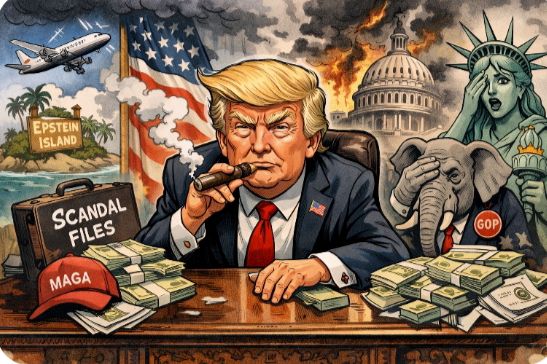
History is rarely kind to empires that lose their moral compass. Power alone cannot sustain legitimacy. Wealth cannot disguise rot forever. And propaganda cannot permanently bury scandal. When the ruling elite becomes morally bankrupt, the decay eventually spills into public view.
The latest revelations surrounding the Epstein Files have done precisely that. What was once whispered in corridors of power has erupted into a scandal that stains not only individuals but the credibility of the entire American political establishment.
At the center of the storm sits Donald Trump, the President of the United States, whose name again appears in the dark orbit of Jeffrey Epstein, the disgraced financier whose network of influence once stretched across politics, wealth, and celebrity culture.
The implications are staggering.
This is not merely a scandal about personal morality. It is a crisis of legitimacy for a superpower that has long lectured the rest of the world about governance, democracy, and ethical leadership.
The Empire of Hypocrisy
For decades, Washington has positioned itself as the global referee of morality.
American presidents lecture Africans about corruption.
They lecture Asians about transparency.
They lecture Middle Eastern governments about human rights.
But today the world is witnessing the spectacle of a president entangled in the shadow of one of the most notorious sex-trafficking scandals of modern times.
If even a fraction of what is emerging from the Epstein files proves true, the damage to America’s moral authority will not simply be temporary embarrassment. It will be a structural humiliation.
The United States once justified its global leadership through three pillars:
Economic dominance
Military power
Moral legitimacy
The first two may still stand.
The third is collapsing before our eyes.
Projection Politics: When Accusation Becomes Confession
There is a psychological phenomenon in politics known as projection—when leaders loudly accuse others of the very moral failures they fear may exist within themselves.
For years, Trump built much of his political identity by attacking immigrant communities in the United States. Mexican migrants were branded criminals. Venezuelan migrants were portrayed as infiltrators. Somali immigrants were frequently depicted as dangerous outsiders threatening American society.
These were not simply policy disagreements about immigration. They were moral indictments. Entire communities were portrayed as carriers of crime, corruption, and social decay.
But with the resurfacing of the Epstein scandal, critics increasingly argue that these accusations now look less like political strategy and more like psychological projection.
Populist politics requires a villain. When societies experience anxiety or economic stress, demagogues often manufacture enemies. Immigrants become convenient scapegoats because they lack political power.
Trump mastered this formula.
Mexicans were accused of bringing crime.
Venezuelans were framed as ideological threats.
Somali refugees were portrayed as security risks.
Yet the irony is now impossible to ignore.
The communities that Trump vilified consist largely of ordinary workers, students, entrepreneurs, and families contributing to American society. Meanwhile, the Epstein scandal suggests that moral corruption—if it exists—may have been thriving not among immigrants, but within the privileged elite circles of wealth and power.
When the mirror suddenly turns toward the accuser, the political narrative collapses.
A Political System Fully Exposed
What makes this scandal even more explosive is that it does not stop with Trump.
The Epstein network has always hinted at something far deeper: a disturbing intimacy between wealth, political influence, and elite privilege.
This is why the revelations have shaken both parties in Washington.
Democrats cannot celebrate too loudly.
Republicans cannot pretend ignorance.
Figures across the American establishment once moved within Epstein’s social orbit. Billionaires attended his gatherings. Politicians flew on his aircraft. Celebrities socialized in his mansions.
Now the question is unavoidable:
How deep does this rot go?
The spectacle unfolding in Washington resembles less a democracy confronting wrongdoing and more a political class nervously watching Pandora’s box crack open.
MAGA and the Crisis of Loyalty
The Make America Great Again movement now faces a profound moral paradox.
Its identity has long been built on the claim that it represents a rebellion against corrupt elites. Trump himself rose to power by portraying Washington as a swamp that needed draining.
But what happens when the man holding the pump is discovered to be swimming in the same water?
The MAGA movement now confronts an uncomfortable choice:
Defend the man — or defend the principle.
So far, loyalty appears to be winning.
But loyalty is a fragile substitute for legitimacy.
The View from the Rest of the World
Across the globe, American rivals are watching with quiet amusement.
In China, state media will have no shortage of material to mock Western claims of moral superiority.
In Russia, the scandal will reinforce a narrative long promoted by Vladimir Putin: that Western democracy is little more than theatrical illusion.
Across Africa, Asia, and the Middle East, leaders who once endured American lectures about governance now ask a simple question:
Who exactly is qualified to lecture whom?
Satire of a Superpower
Imagine the scene.
A nation with the world’s largest military.
A nation with the world’s most powerful financial system.
A nation that sends democracy envoys across the globe.
Yet the man sitting in the Oval Office is defending himself against scandals tied to a convicted sex trafficker whose private island became a symbol of elite depravity.
It would be comedic if it were not tragic.
The Romans once believed their empire would last forever.
Until corruption hollowed it from within.
Is This the Beginning of the Imperial Decline?
Empires rarely collapse in a single dramatic moment. They decay slowly through the erosion of institutions, credibility, and public trust.
What makes the Epstein scandal particularly corrosive is not merely its moral ugliness. It is the growing sense that the American political system appears incapable of confronting elite misconduct within its own ranks.
When justice becomes selective, the public loses faith.
When leaders escape accountability, legitimacy disappears.
And when legitimacy disappears, power becomes naked force.
No empire survives that transition for long.
The Final Irony
The ultimate irony of the American moment is this:
The country that once proclaimed itself the beacon of democracy now finds itself explaining scandals that resemble the very oligarchic corruption it once condemned elsewhere.
The lesson is universal.
Power without morality eventually devours itself.
And if the Epstein files continue to unfold as explosively as they have begun, historians may one day look back on this moment not simply as a scandal—but as a warning sign that the moral foundations of the American empire had begun to crumble.
——-
Support WAPMEN — the home of fearless, independent journalism that speaks truth to power across Somalia and the region.
Tel/WhatsApp: +252 90 703 4081.
 Warsame Policy & Media Network (WAPMEN)