
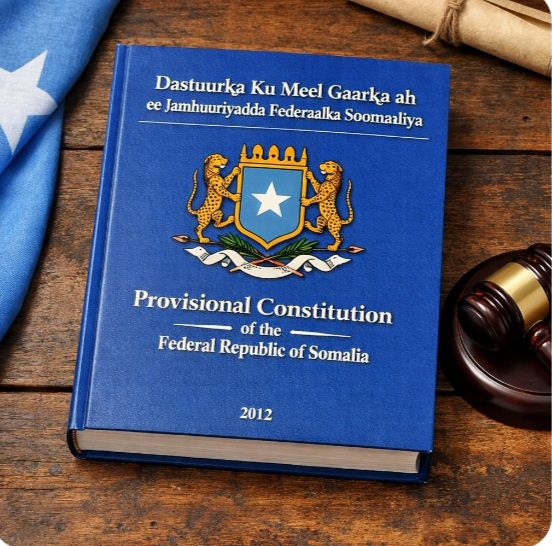
In every functioning republic, a constitution is the highest covenant between a state and its people. It is not a private memo drafted in the corridors of power, nor a partisan manifesto imposed by a temporary administration. It is a national contract forged through consensus, trust, and legitimacy.
What Somalia is witnessing today under President Hassan Sheikh Mohamud is the exact opposite.
Instead of a constitutional process anchored in national dialogue, the country is being dragged into a manufactured constitutional crisis—one built on parliamentary boycotts, vote-buying allegations, intimidation, travel bans on legislators, and the open rejection of the process by federal member states such as Puntland and Jubaland.
This is not constitutional reform.
This is constitutional coercion.
A Constitution Without Consensus
The 2012 Provisional Federal Constitution was born out of one simple principle:
consensus among Somalis after decades of civil war.
It was imperfect, unfinished, and provisional—but it carried one crucial virtue: it was collectively owned.
Today that fragile national understanding is being dismantled.
President Hassan Sheikh Mohamud has pushed forward amendments without political agreement, without federal consensus, and without the participation of dissenting members of parliament who were either boycotting the process or reportedly intimidated into silence, or banned outright from participating in parliament debate and sessions.
A constitution imposed in such an atmosphere loses its moral authority the moment the ink dries.
No amount of parliamentary arithmetic can compensate for the absence of national legitimacy.
Parliament Under Siege
Perhaps the most disturbing dimension of this crisis is the treatment of members of the Federal Parliament of Somalia.
Reports of restricted travel, intimidation, and political pressure on legislators have turned Somalia’s parliament into something resembling a controlled chamber rather than a deliberative institution.
A parliament that cannot debate freely cannot produce legitimate constitutional change.
A vote taken under fear is not democracy.
It is procedural theatre.
And when elected representatives are prevented from traveling to their constituencies or expressing dissenting views, the message becomes unmistakable:
This process is about control, not consensus.
Federalism Under Assault
The Somali federal system was designed as a political compromise after the catastrophic collapse of the state in 1991.
Federal member states such as Puntland and Jubaland were not administrative provinces created by Mogadishu; they were foundational pillars of the federal compact.
Yet both administrations have refused to endorse the constitutional amendments, warning that the process violates the spirit and letter of federal cooperation.
This rejection is not a minor political disagreement.
It represents a fracture in the constitutional order itself.
A federal constitution that key federal states refuse to recognize becomes a document without territory.
The Illusion of Victory
Inside Villa Somalia, the presidential palace, officials may celebrate what they perceive as a political victory.
But constitutional victories achieved through coercion are always temporary illusions.
History is merciless in this regard.
From Africa to Eastern Europe to Latin America, every constitution imposed without broad political consent eventually collapses under the weight of resistance.
Somalia will not be the exception.
A constitution is not enforced by police raid of parliament chamber, or intelligence services.
It survives only when citizens believe it belongs to them.
A Crisis Without a Clear Exit
Somalia now stands at a dangerous crossroads.
A constitution rejected by federal states, disputed by opposition figures, and passed under a cloud of controversy creates a legal vacuum that threatens the entire political system.
Questions now hang over the country’s future:
Which constitution governs Somalia today?
Will federal states recognize the amended text?
Can elections be organized under a constitution that major stakeholders reject?
The truth is uncomfortable but unavoidable:
No one knows how this crisis will end.
But One Thing Is Certain
One fact, however, is already clear.
Constitutions imposed through intimidation, vote buying, and unilateralism do not endure.
They collapse under the weight of political reality.
The Somali people have endured dictatorship, civil war, and state collapse. They know better than anyone the price of power without legitimacy.
And they will not accept a constitution written without them, imposed over them, and enforced against them.
The tragedy is that Somalia did not have to arrive at this moment.
It was brought here by a leadership that mistook political maneuvering for nation-building.
But constitutions are not political trophies.
They are the foundations of a state.
And foundations built on coercion do not hold.
They crack.
They fracture.
And eventually—inevitably—they collapse
——
Support WAPMEN— the home of fearless, independent journalism that speaks truth to power across Somalia and the region. Tel/WhatsApp: +252 90 703 4081.
 Warsame Policy & Media Network (WAPMEN)