The Politics of the Spotlight: Why Farmaajo Is Different

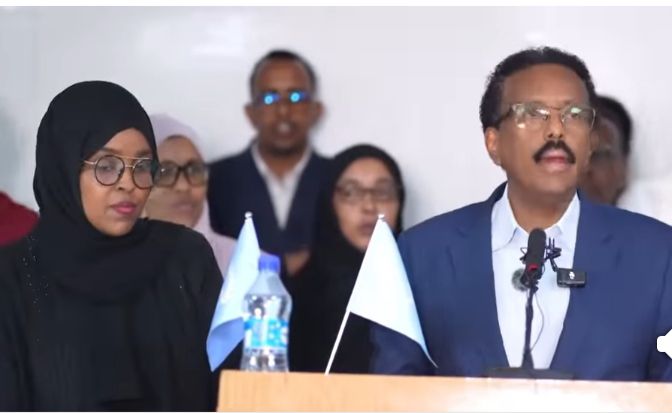
Farmaajana sharing the spotlight and praising a member of Parliament


In Somali politics, the spotlight is a dangerous thing. Most politicians guard it like a jealous king guards his throne. They hoard it. They monopolize it. They suffocate it.
The spotlight, in the hands of most Somali leaders, is not illumination—it is private property.
But every now and then, a political figure appears to understand something that others do not: leadership is not about standing alone in the light; it is about letting others stand beside you.
That, perhaps, is what distinguishes former Somali President Mohamed Abdullahi Farmaajo from many of the political actors roaming the corridors of Villa Somalia today.
The Politics of Ego
Somali political culture is not known for humility. Quite the opposite.
A typical Somali political gathering resembles a royal court:
One man speaks.
Everyone else nods.
Credit flows upward.
Blame flows downward.
Cabinet ministers become invisible.
Members of parliament become decorative furniture.
Civil servants become shadows.
And the leader—always the leader—claims every success as personal genius.
This culture has produced generations of politicians who behave as though Somalia is not a republic but a private inheritance passed from ego to ego.
The Unusual Scene
The photograph above tells a small but revealing story.
Instead of dominating the stage alone, Farmaajo stands beside a member of parliament and publicly praises her integrity. His message is simple but radical in Somali politics:
She refused to be bribed.
Imagine that.
In a political system where bribery is whispered about like a seasonal rain—predictable, expected, and rarely condemned—a politician is praising honesty.
Even more unusual, he is not claiming the moral credit himself.
He is sharing the spotlight.
The Rare Currency of Integrity
Somalia’s political economy has developed a strange inflation. Not of money—but of corruption.
Bribery is discussed casually.
Political loyalty is purchased like livestock in a market.
Votes are traded like commodities.
In such a system, integrity becomes rare—almost exotic.
So when a member of parliament refuses a bribe, it becomes news. And when a former president publicly celebrates that refusal, it becomes something even rarer:
A political culture moment.
Why This Matters
Leadership is not measured only by power.
It is measured by what a leader celebrates.
If a leader celebrates loyalty, the system becomes tribal.
If a leader celebrates money, the system becomes corrupt.
If a leader celebrates fear, the system becomes authoritarian.
But if a leader celebrates integrity—even in small gestures—the system gains something precious:
Moral oxygen.
And Somalia’s suffocating political atmosphere desperately needs oxygen.
The Satirical Reality
Of course, satire demands honesty.
One honest politician does not clean a corrupt system.
One speech does not rebuild institutions.
One moment of praise does not erase the structural rot in Somali politics.
But symbolism matters.
Because Somalia today suffers from a strange political epidemic:
Leaders who believe the state exists only to enlarge themselves.
Against that backdrop, a leader who shares the spotlight—even briefly—looks almost revolutionary.
A Lesson Somali Politics Should Learn
The real test for Somali politics is not who occupies Villa Somalia.
The real test is whether leaders can do something very simple:
Allow others to shine.
Because nations are not built by one man standing in the light.
They are built by many people standing in it together.
And perhaps that is the quiet message in this photograph.
A leader who does not fear the spotlight being shared.
In Somalia’s political theatre, that alone is already a rare performance.


Support WAPMEN— the home of fearless, independent journalism that speaks truth to power across Somalia and the region.
Tel/WhatsApp: +252 90 703 4081.
The Constitutional Trap: How Villa Somalia Quietly Recognised Somaliland


In politics, the most dangerous decisions are not always the loudest ones. Sometimes they are hidden quietly inside legal clauses — buried deep in constitutional amendments that few people read, but whose consequences can reshape the destiny of a nation.
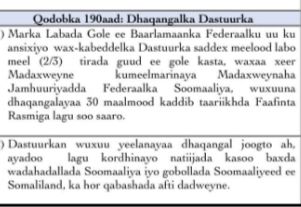
That appears to be exactly what has happened with Article 190, Section (2) of President Hassan Sheikh Mohamud’s unilateral amendments to the Provisional Federal Constitution.
The clause reportedly states:
“This Constitution does not apply to the Somaliland regions.”
This is now being circulated widely in political circles — then Somalia has just crossed a constitutional Rubicon without debate, without consensus, and without national consultation.
In plain language, the Federal Government of Somalia may have just constitutionally recognised Somaliland’s separation.
And astonishingly, some of the loudest applause for these amendments came from leaders who may not yet understand what they have endorsed.
A Constitution Is Not a Personal Notebook
A constitution is not a personal notebook where a president scribbles whatever he wishes.
It is the supreme political covenant of a nation, adopted through broad national consensus and meant to bind all citizens equally.
The 2012 Provisional Federal Constitution was itself the product of fragile compromise after two decades of civil war. It represented the collective effort of Somalis to rebuild a state while keeping the door open for unresolved issues — including Somaliland’s status.
That delicate balance required consultation, consensus, and national dialogue.
Instead, what Somalia is witnessing today is something else entirely:
constitutional engineering by presidential decree.
Members of parliament who objected to the process have been:
suspended from sessions
politically isolated
effectively prevented from participating in constitutional debate.
A constitution amended under such circumstances loses its legitimacy before the ink even dries.
The Hidden Recognition
Let us examine the logic of Article 190 (2).
If a constitution explicitly states that Somaliland regions are not subject to the constitution, then two legal implications follow immediately:
The Federal Republic of Somalia no longer claims constitutional jurisdiction over those territories.
The Somali state acknowledges a separate political authority governing those regions.
In other words, Somalia has constitutionally excluded part of its own territory.
That is not merely decentralisation.
That is not federalism.
That is de facto recognition.
Such a decision cannot be made quietly by a single administration or a compliant parliamentary bloc. It is a matter that should require:
a national referendum
negotiations with Somaliland
consultation with all Federal Member States
consensus across the Somali political spectrum.
None of this has happened.
The Irony of SSC-Khaatumo’s Applause
Perhaps the most tragic irony of this constitutional maneuver lies in the reaction of SSC-Khaatumo le

aders.
These leaders have recently struggled — at enormous human cost — to free themselves from Somaliland’s administration and seek recognition within the Federal Republic of Somalia.
Yet some of them have applauded the very constitutional amendments that may now remove Somaliland regions from the jurisdiction of the Somali constitution.
If Article 190 (2) is implemented as written, the implications are stark:
The Federal Constitution does not apply to Somaliland territories.
SSC-Khaatumo territories are historically classified within those same regions.
The question therefore becomes unavoidable:
Under which constitution would SSC-Khaatumo exist?
This is the political trap hidden inside careless applause.
Villa Somalia’s Dangerous Precedent
Even beyond the Somaliland issue, the broader danger is the precedent being established.
If one administration can unilaterally amend the constitution to redefine the territorial scope of the Somali state, then tomorrow another administration can amend it again to:
dissolve federalism
extend presidential mandates
abolish regional autonomy.
A constitution manipulated by executive power ceases to be a constitution.
It becomes a political weapon.
And once that door opens, no leader will be able to close it again.
The Silence of the International Community
Equally troubling is the silence of Somalia’s international partners.
For years they have preached:
constitutional order
rule of law
inclusive governance.
Yet today they appear strangely passive while the foundational document of Somali statehood is rewritten through procedural shortcuts and political intimidation.
If the constitution can be altered in this manner, then the entire post-2012 political settlement collapses.
And with it collapses the fragile architecture holding Somalia together.
The Road to Constitutional Chaos
Somalia now faces a stark choice.
Either:
Restore constitutional legitimacy by annulling unilateral amendments and returning to the 2012 consensus framework,
or
Continue down a path where the constitution becomes a tool of temporary political power, producing endless cycles of crisis.
History has already taught Somalis what happens when leaders attempt to impose political settlements without national agreement.
It leads not to stability — but to fragmentation.
A Nation Cannot Be Amended Like a Paragraph
President Hassan Sheikh Mohamud may believe he is reshaping Somalia’s political architecture.
But constitutions are not engineering blueprints to be redesigned by one administration.
They are the collective contract of a nation.
Break that contract — and the state itself begins to unravel.
Somalia has already paid a catastrophic price for political arrogance once before.
It would be tragic if the country were now walking toward the same cliff again — this time through the pages of its own constitution.

—–
Support WDM — the home of fearless, independent journalism that speaks truth to power across Somalia and the region.
Tel/WhatsApp: +252 90 703 4081