
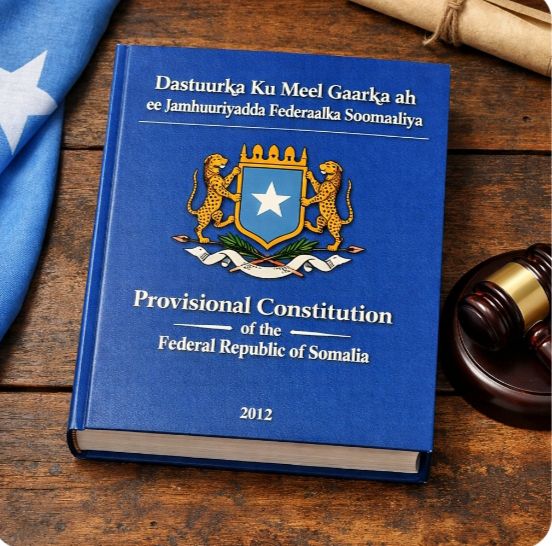
There are many ways to dismantle a state.
You can wage war.
You can loot the treasury.
You can invite foreign powers to carve the country into spheres of influence.
Or—if you are more sophisticated—you can amend the Constitution without consensus and call it reform.
That, dear readers, is the dangerous political experiment currently unfolding in Somalia under President Hassan Sheikh Mohamud.
A Constitution Is Not a Party Manifesto
A constitution is not a campaign document.
It is not a policy memo drafted by presidential advisers.
It is not a government circular issued from Villa Somalia.
A constitution is fundamentally a political compact—a national agreement negotiated among competing interests, regions, communities, and political forces.
Somalia’s 2012 Provisional Federal Constitution was born from exactly such a compromise. It emerged from years of negotiations aimed at ending civil war and reconstructing a collapsed state. It may not be perfect, but it is the only political consensus document Somalis possess today.
That consensus is the foundation of Somalia’s fragile federal order.
Without consensus, the Constitution becomes merely paper.
The Mohamud–Barre Paradox
Under what many critics now sarcastically describe as the Mohamud–Barre administration, a strange paradox has emerged.
Members of Parliament—elected representatives of the Somali people—have reportedly been excluded from parliamentary sessions because they oppose unilateral constitutional amendments.
Pause and consider the absurdity of this situation.
Lawmakers are being barred from lawmaking because they disagree with how the law is being changed.
If satire were fiction, this would qualify as comedy.
But this is not satire—it is political reality.
Even more troubling are reports that some of these MPs have been subjected to restrictions affecting their ability to travel or return to their constituencies. When elected representatives face limitations on their movement because of political dissent, the problem ceases to be procedural.
It becomes constitutional.
Amendment Without Consensus Is Imposition
The defenders of unilateral amendments often hide behind parliamentary arithmetic.
“Yes,” they argue, “Parliament has the authority to amend the Constitution.”
That statement is technically true—but politically misleading.
Constitutional amendments in fragile federations cannot simply be numerical exercises. They require broad political consensus among federal member states, opposition forces, and national stakeholders.
Otherwise amendments cease to be amendments.
They become impositions.
And impositions in Somali politics have historically produced only one outcome: Civil war and fragmentation.
The Dangerous Arithmetic of Power
The logic currently unfolding in Villa Somalia appears to be simple:
Exclude dissenting MPs.
Secure a numerical majority.
Pass amendments.
Declare victory.
But legitimacy cannot be manufactured through arithmetic.
A majority created by exclusion, coercion, or intimidation does not strengthen institutions—it weakens them.
Somalia’s federal system was created precisely to prevent domination politics from re-emerging. If the executive branch begins redesigning the constitutional framework without consensus, the federal compact itself begins to erode.
And once that erosion begins, it rarely stops politely.
History’s Unforgiving Memory
President Hassan Sheikh Mohamud is not a novice politician. He understands Somalia’s political history. He knows how fragile institutional legitimacy remains after decades of collapse.
He also knows that unilateral constitutional engineering rarely survives the test of political reality.
Somali politics has a long memory.
Attempts to impose national frameworks without consensus have historically led to resistance from federal states, opposition movements, and broader society.
This pattern has repeated itself too many times to ignore.
Satire Meets Tragedy
Imagine explaining the current situation to future generations:
“We amended the Constitution by banning MPs who opposed the amendments.”
They would laugh.
Until they realized it actually happened.
A constitution survives not because it exists on paper but because political actors respect the spirit of compromise that created it.
Remove that spirit, and the document loses its authority.
The Road Ahead
If this trajectory continues, three serious consequences are likely:
First, the legitimacy of federal institutions will erode.
Citizens will view constitutional amendments as political maneuvers rather than national agreements.
Second, tensions between the federal government and federal member states will intensify.
States will resist changes imposed without their participation.
Third, executive overreach will become normalized.
Once dissenting MPs can be sidelined, the line between governance and coercion becomes dangerously thin.
Somalia cannot afford that trajectory.
Final Word
A constitution is not a toy for temporary power.
It is not clay for presidential ambition.
It is the fragile backbone of a recovering state.
If the current leadership believes unilateral amendments can replace consensus politics, history suggests otherwise.
In Somalia, political overreach rarely consolidates power.
It fractures it.
And once fractured, the cost of repair is always higher than the cost of restraint.
————
Support WAPMEN — the home of fearless, independent journalism that speaks truth to power across Somalia and the region. Tel/WhatsApp: +252 90 703 4081.
 Warsame Policy & Media Network (WAPMEN)