
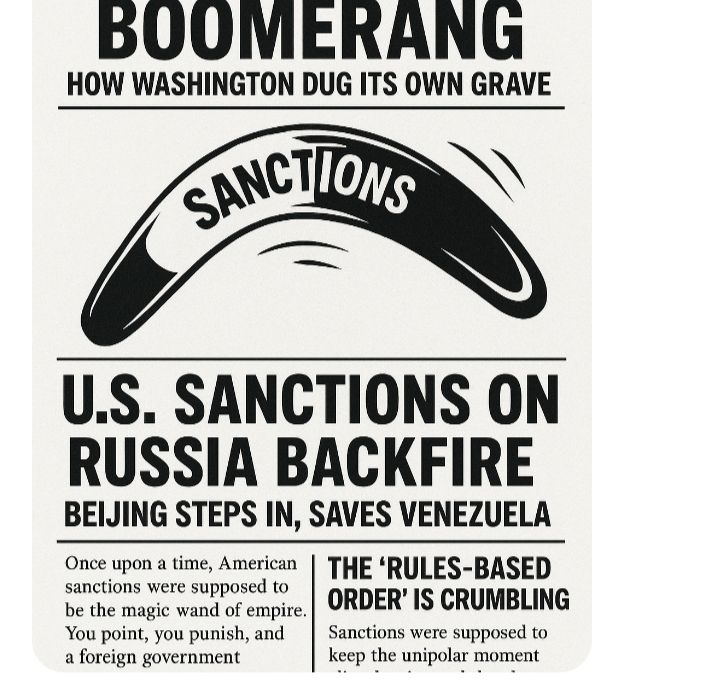
Once upon a time, American sanctions were supposed to be the magic wand of empire. You point, you punish, and a foreign government trembles into submission. Cuba? Starved. Iraq? Crippled. Iran? Crushed. That was the Washington fantasy. But the 21st century is not the 1990s—and now the magic wand has snapped in the sorcerer’s hand.
Take Venezuela: America’s sanctions were meant to suffocate the oil state into regime change. Instead, the patient didn’t die—it found a Chinese doctor with endless pockets and a taste for oil. Beijing swooped in, oil-for-loans in hand, bypassing the almighty dollar and wiring life support into Caracas. Result? Venezuela may be limping, but it is still standing. China got the energy it craved. And the U.S. got nothing—except the bitter taste of sanctions blowing back like a shotgun fired backwards.
And Venezuela is no isolated mishap. Russia was supposed to collapse under sanctions after Ukraine. Remember the predictions of a “ruble in rubble”? Instead, the ruble wobbled, then stabilized; Moscow rerouted oil and gas eastward, strengthening its axis with China, India, and the so-called “Global South.” The sanctions hurt Europe far more than Russia—German factories paying triple for energy, while Moscow laughed its way into yuan settlements and BRICS expansion.
Everywhere Washington swings the sanctions hammer, cracks appear not in its enemies but in its own global dominance. Iran found new partners in Beijing; Africa, long treated as a sanctions playground, now courts Russian and Chinese investment without Washington’s permission slip. The “rules-based order” has become a punchline, a club where the U.S. writes the rules and everyone else stops showing up.
The deeper truth is this: sanctions were supposed to keep the unipolar moment alive, but instead they have accelerated its funeral. By weaponizing the dollar, America forced the world to search for alternatives—and alternatives they have found. Yuan-denominated oil, BRICS currency talks, barter systems, parallel banking networks: the architecture of a multipolar order is being built brick by brick, financed ironically by the failures of American policy.
So yes, Washington still loves to preach about “sanctioning rogue states.” But the rogues are adapting, and the empire is eroding. What was meant as punishment has become an apprenticeship in resilience for America’s rivals. While the U.S. ties itself in knots of overreach, Beijing and Moscow stroll into the gaps with oil contracts, infrastructure deals, and no sermons attached.
The end result? The sanctions regime is no longer a weapon of power—it is the obituary notice of U.S. hegemony. Washington wanted to crush Venezuela, Russia, Iran, and beyond. Instead, it taught them how to survive without it. That is not strategy—it’s suicide by arrogance.
 Warsame Policy & Media Network (WAPMEN)