
By WDM Political Desk
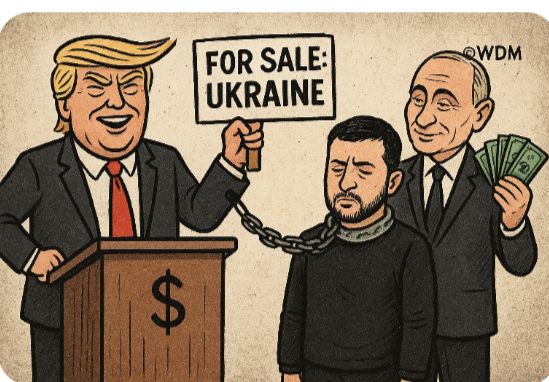
Donald Trump, once again, summoned European leaders to the White House as if he were a circus master calling his performers to line up for the evening show. This time the star attraction was President Volodymyr Zelensky of Ukraine, reluctantly standing beside Trump in what looked like a family portrait of a very dysfunctional household.
Trump, notorious for turning high-stakes geopolitics into cheap reality TV, avoided repeating last February’s debacle with Zelensky—not out of wisdom, but out of sheer self-interest. Two reasons drove him this time:
First, Trump needed to show Vladimir Putin that he has “control” over Zelensky. To Trump, Ukraine is not a sovereign nation, not a battlefield of survival, not a bleeding edge of European security—it is just a bargaining chip, a poker card to trade away slices of Ukrainian territory in exchange for Russian favors. He dreams of calling Putin on live television and boasting: “Look Vlad, I made your boy sit down quietly. Where’s my deal?”
Second, Trump’s everlasting obsession: the Nobel Peace Prize. Obama got one for breathing air in the Oval Office, and that burns Trump’s ego daily like acid. He wants the same, even if it means auctioning Ukraine’s sovereignty on the Nobel Committee’s altar. “Nobel Prize! Nobel Prize!” is Trump’s mantra—he craves it like a toddler screaming for candy in a supermarket.
But Europe is not fooled. Macron, Scholz, Rutte, Meloni, and the rest flew in not to humor Trump but to chain themselves around Zelensky. They know the game: if Ukraine falls, Russia won’t stop at Kyiv—it will march to Warsaw, Berlin, Paris, and maybe even Brussels. Trump may play diplomat, but Europeans know he is dangling Ukraine as bait while sharpening the knife under the table.
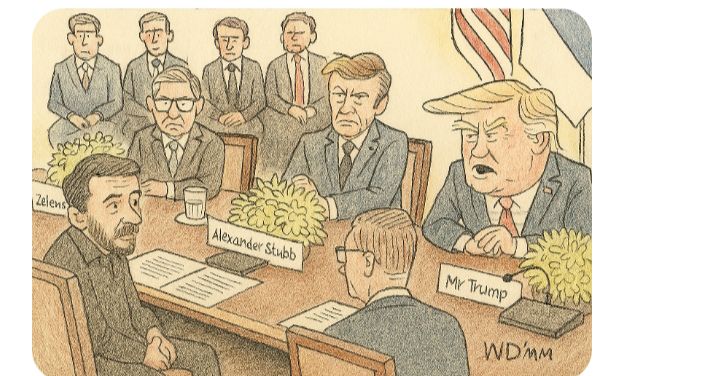
The tragicomic scene at the White House was clear:
Trump puffing his chest, grinning like a salesman desperate to close a deal.
Zelensky, trapped in a photo-op he didn’t want, surrounded by allies who looked more like bodyguards shielding him from Trump than partners in peace.
European leaders, smiling stiffly for cameras while whispering in each other’s ears: “God save us if this maniac sells Ukraine to Moscow.”
History will remember this summit not as diplomacy but as a pawn shop negotiation where Trump tried to trade Ukrainian land for personal glory. Europe left Washington more worried than when they arrived—because the real threat is not only Russia’s tanks, but also Trump’s hunger for applause, prizes, and Putin’s approval.
Trump wants to be crowned peacemaker. Instead, he looks like a desperate broker selling Europe’s security for a Nobel medal.
 Warsame Policy & Media Network (WAPMEN)