
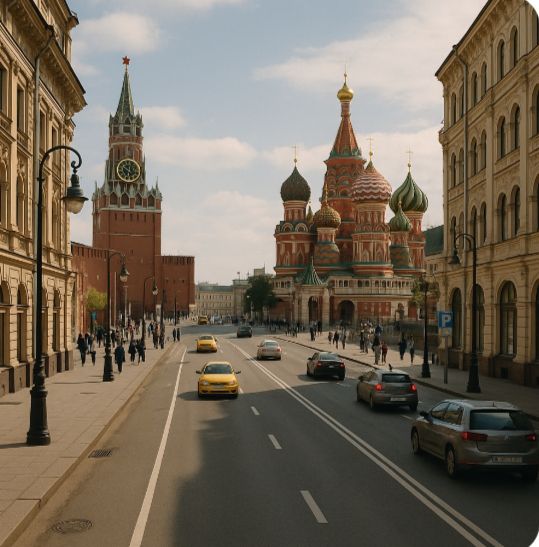
I arrived in Moscow in the autumn of 1985 (date imagined for privacy), a scholarship student from the Global South, carrying more than just a suitcase—I carried the idea that I was about to see socialism at its peak. The Soviet Union was, after all, a sverkhderzhava—a superpower—capable of defeating fascism, launching Sputnik, and standing toe-to-toe with America. I imagined a land of efficient planning, abundance, and ideological confidence.
But on my very first week, I stepped into a univermag (department store) and saw the truth: three lonely jars of pickled cabbage on an otherwise empty shelf. The shop smelled faintly of boiled beets and cheap soap. Outside, babushkas in headscarves sold sunflowers seeds by the paper cone, and queues snaked around the block for kolbasa (sausage) that might or might not arrive that day.
It was the first crack in the marble statue I’d built in my head.
Life in the Obshaga
My dormitory—the obshaga—was a towering concrete block in the grey sprawl of a mikrorayon (Soviet housing district). The hallways smelled perpetually of cabbage soup and cigarette smoke. Four of us shared a room the size of a pantry, furnished with creaky metal beds, a wobbly table, and a communal wardrobe that seemed older than Lenin.
The bathroom was down the corridor, shared by an entire floor. Hot water was a rumor more than a reality, and we learned to take po-kovboyski (“cowboy-style”) showers—quick splashes of cold water before running back to our rooms. At night, we gathered in the komnata otdykha (common room), where the walls were plastered with faded posters of Soviet heroes and a sagging couch hosted endless debates about Marx, Brezhnev, and football.
Foreign students—Africans, Asians, Latin Americans—were treated with a mix of curiosity and caution. Many Soviet students were warm and eager to make friends, but some whispered that we were inostrantsy (“foreigners”) with suspicious freedoms.
The First Pair of Levi’s
One evening, my Indian roommate returned from a trip abroad wearing Levi’s 501s—deep indigo, sharp creases, the unmistakable copper rivets. The reaction was electric. Soviet students ran their fingers over the fabric like it was gold thread. One offered his “khozyaistvenny” (utility) wristwatch in trade. Another asked if he could just wear them for one day—just to be seen in them.
These were more than pants—they were defitsit (scarce goods), symbols of the West’s abundance and individuality. I later learned they could fetch a month’s salary on the black market. In Moscow’s chernyy rynok (black market) near Izmailovsky Park, whispers of “Levi’s, Marlboro, gum” passed between strangers like spy codes.
The Gum That Made Me Popular
Chewing gum—zhevatel’naya rezinka—was my accidental weapon of soft power. My family sent me a care package from home with several packs of Wrigley’s Spearmint. I didn’t think much of it until I unwrapped one in the university cafeteria.
It was as if I had taken out bars of gold. Students leaned in, eyes wide. “Is that… American?” one whispered, glancing around as if the KGB might burst in. I handed out a few sticks, and my popularity soared. People chewed slowly, savoring every minute. Some washed their gum at night to “renew” the flavor. One girl told me she planned to keep hers until New Year’s Eve.
From then on, whenever I walked through campus, I’d hear my name called from across the quad, followed by, “Hey, do you have more gum?”
Moscow Streets and Forbidden Music
By day, Moscow was a mosaic of contradictions. The grandeur of Red Square, with Lenin’s Mausoleum and the bright onion domes of St. Basil’s, stood in sharp contrast to the endless lines of concrete apartment blocks in the suburbs. The wide prospekty (avenues) were flanked by giant propaganda billboards—smiling workers, tractors, and slogans like “Nasha tsel – kommunizm!” (“Our goal is communism!”).
But at night, the city changed. In the obshaga, radios were tuned carefully to forbidden stations—Voice of America, Radio Free Europe—through a hiss of static. I’ll never forget the night my Soviet friend Sasha invited me to his room. He pulled a thin, translucent disc from under his bed. It wasn’t vinyl—it was an old chest X-ray, cut into a rough circle, with grooves scratched into it. He placed it on the turntable, and the crackling strains of The Beatles’ Let It Be filled the room.
We sat in silence, barely breathing. That music—illegal, foreign—felt dangerous yet liberating. Sasha whispered, “They tell us this is capitalist poison… but it feels like truth.”
The Real Weakness
I had come believing the Soviet Union’s strength lay in its tanks, rockets, and ideology. But what I saw was that its real vulnerability was human desire—the longing for choice, color, and self-expression. No matter how many speeches the Party gave, they couldn’t make a pair of stiff, shapeless Soviet trousers feel like Levi’s. They couldn’t make “Soviet gum” taste like Wrigley’s, or a state-approved folk choir stir the heart like a Beatles song.
By the time I left Moscow, I could see the cracks widening. The young people I knew still loved their country, but the queues, the shortages, the dullness—they no longer felt like sacrifices for a greater cause. They felt like proof that somewhere else, life was simply better.
Years later, when the Soviet Union collapsed, I wasn’t surprised. I had already seen the quiet revolution. It didn’t come with tanks in the streets—it came with smuggled jeans, chewing gum, and music on bones.
History, I learned, can be toppled not only by bombs or revolutions, but also by a single stick of gum and a forbidden song.
[This is based on a true story].
 Warsame Policy & Media Network (WAPMEN)