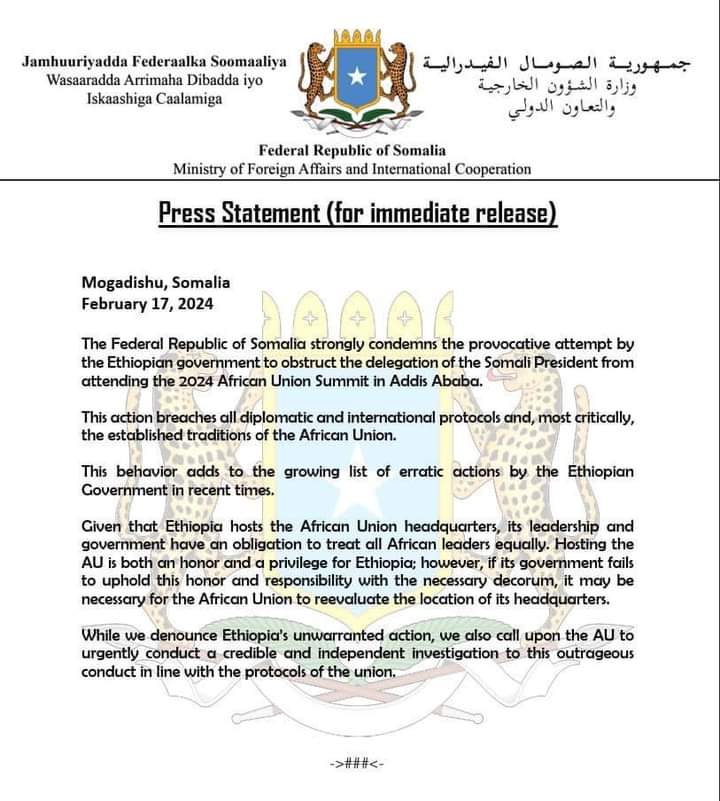
WHAT COULD HAVE TRANSPIRED BEHIND THE NEWS IN ADDIS ABABA?

WDM analysis on the diplomatic incident in Addis Ababa between the Somali delegation and Ethiopian security personnel on the eve of 37th Ordinary Annual Session of the AU could be deduced this way: It looks that Prime Minister Ahmed Abiy has tried to meet with Somali President Hassan Sheikh Mohamud to discuss on issues of tension in relations between the two countries, including the recent Ethiopia’s infamous MOU with Northwest Administration of Somalia (Somaliland) under the mediation of Ismail Omar Ghuelleh. It seems that Abiy was annoyed by Mohamud’s outright rejection to discuss them with Abiy, and most probably has ordered his security services to restrict the movements of Somali delegation, preventing them from engaging in diplomatic interactions with other AU leaders. On the top of this diplomatic breach by Ethiopia, the Somali delegation, because of the deteriorating relations with the host country, has declined the services of Ethiopian VIP Security Protection, and opted for using their own accompanying Somali personnel instead. That too further infuriated the Ethiopians.

Such diplomatic restrictions sometimes occur when a host nation receives a delegation from a hostile foreign power or one they have war with. This incident isn’t unique. Americans restrict Cuban, North Korean and Iranian delegations in New York City all the time at UN General Assembly sessions.

In this case, what has happened afterwards was explained adequately by the Somali President, Hassan Sheikh Mohamud, himself.

Postscript.

While item No 5 of AU 37th Ordinary Annual Session states in its resolutions on February 17-18th the following:

  1. EXPRESSES DEEP CONCERN over the ongoing tension between the Federal
    Democratic Republic of Ethiopia and the Federal Republic of Somalia, following the
    signing of a Memorandum of Understanding (MoU) between Ethiopia and the northern
    region of Somalia (Somaliland) on 1 January 2024 and its impact on peace, security
    and stability of the region; REAFFIRMS its strong commitment and support for
    preserving the unity, territorial integrity, independence and sovereignty of all Member
    States, including those of the Federal Republic of Somalia and the Federal Democratic
    Republic of Ethiopia; and therefore, CALLS ON the two countries to de-escalate and
    engage in meaningful dialogue towards finding a peaceful resolution of the matter.[Note the bold text with the insertion of Ethiopian name indicates Ethiopian influence in drafting the resolution].

[This post was edited after posting].

ETHIOPIAN SHENANIGANS HAVE NO LIMITS

BREAKING

https://x.com/radiodaljir/status/1758537392330244107?t=8PZRXJW4cTyUrIjyQjFw8g&s=09

BREAKING NEWS

By SomaliDigest (Courtesy)

“General Gordon Camp Attacked by Al-Shabab Infiltrator
A deadly assault within the General Gordon camp in Mogadishu by an Al-Shabab infiltrator targeting UAE military instructors underscores the ongoing challenges of security infiltration in Somalia. The attack resulted in the loss of six officers, highlighting vulnerabilities in the vetting and security protocols. The incident, involving an attacker from a unit recently trained abroad, illustrates the complex issue of internal threats and the pressing need for enhanced security measures. This breach of security within a key military training establishment not only signifies a loss of trust but also calls for a rigorous reevaluation of the recruitment, training, and vetting processes to prevent future infiltrations by extremist elements.

UAE-Somalia Relations: Mixed Reactions to Attack
The response to the attack on UAE trainers in Mogadishu has revealed a spectrum of reactions among Somali political figures, reflecting the intricate interplay of national and regional geopolitics affecting Somalia’s security landscape. Divided opinions within the Somali parliament underscore the complexities of foreign military involvement in Somalia, with some condemning the attack and others questioning the legitimacy of the UAE’s presence. This incident highlights the broader geopolitical rifts, particularly the Gulf Crisis’s impact on Somali politics and its alignment with either Qatar or the UAE. Despite the controversy, the UAE’s significant role in supporting the Somali National Army, especially amidst the ongoing ATMIS drawdown, remains a critical element in Somalia’s strategy for maintaining post-ATMIS security and stability.

Al-Shabab Infiltration Widespread in Mogadishu
The recent attack by an Al-Shabab infiltrator on UAE trainers in Mogadishu highlights the complex threat the group poses to Somalia’s security. This incident, involving a “former” operative turned elite security member, underscores significant vulnerabilities within the government’s vetting and rehabilitation processes. Coupled with the discovery of Al-Shabab members within Mogadishu’s government, these events reveal a deep-rooted infiltration strategy aiming to destabilize from within. The Somali government’s struggle against this sophisticated insurgency is further complicated by internal political distractions, diluting focus from essential security reforms and counter-terrorism efforts”.

THE CULTURAL SONG-POWER OF THE PEOPLE OF SOMALIA

https://x.com/EIshmael_/status/1758253455251038215?t=P8AtNhYr1dt1G0vKBJFraw&s=09

[Courtesy].

International Commercialization of Somalia’s Security Services

WDM EDITORIAL

Somalia is known to have established one of the strongest national armies in Africa during the 1970s. This achievement was made possible when the Soviet Union secured exclusively a “Friendship Treaty” to build Somalia’s National Army. Since the formation of the Federal Government following the Civil War, there has been a continuous increase in the number of security contracts between many foreign powers and Mogadishu’s successive regimes. The training and recruitment of Somali soldiers by multiple international actors has prevented the establishment of an ideologically cohesive national army or security apparatus that truly represents the defense and security needs of this country. Instead, ideologically opposing units of the army are being created. Whether they are being trained by the USA, Britain, Turkey, Uganda, UAE, Eritrea, Qatar, Egypt and even Ethiopia, one can argue that they are not reliable Somali army units. We often hear of clashes between different units trained by various foreign countries. Obviously, this poses a problem for Somalia in terms of achieving a national army that can effectively combat extremists or meet the security needs of the country as a whole.

Even more troublesome is the fact that recruitment for the national army and other security services, including intelligence and police, is mainly drawn from the Banadir Region and its surrounding areas. This leads to the production of sub-clan forces, which is a national problem that is difficult to rectify in order to establish security forces with a national character. More alarming is the fact that most army, police and intelligence services conduct recruitment from former Al-Shabab and clan militia. There is also widespread infiltration of extremist elements not only into the security services but also throughout government departments.

This practice of relying on multiple foreign powers to train our security services must stop, and measures to streamline our security needs must be implemented immediately.

[This article was edited after posting].

SET THE RECORD STRAIGHT

https://www.facebook.com/share/p/a37QRrSAgHwSWYxF/?mibextid=2JQ9oc

Puntland Options

ON THE FEDERAL CONSTITUTIONAL REFORM/COMPLETION NOW AND THEN. WHO IS AT FAULT HERE?

President Hassan Sheikh Mohamud before his 2nd term
President Deni in 2014

Note each of above presidents was vying for presidential power then. Judge their actions and conduct when in power now.

POLITICAL, GOVERNANCE AND SECURITY STALEMATE IN SOMALIA

Do you notice any movement in the topics mentioned above? The indirect elections in Puntland State have been completed. However, there has been no progress in the promised democratization process by the President-elect. Reports suggest that the President has not been present at his office since his re-election in January 2024. President Hassan Sheikh Mohamud and SFR Speaker of Parliament, Aden Madoobe, are tampering with the Federal Constitution in their efforts to recreate a “City-State”, which was the source of Somalia’s Civil War that has been ongoing for over two decades. Despite President HSM growing his beard and changing his hairstyle to symbolize the fight against extremists in rural areas, AL SHABAB is more assertive than ever. Even armed foreign guests are susceptible to its pervasive influence, not just in Mogadishu. There is no significant activity in other FMS after the Puntland elections. Leaders of these states, whose terms in office are ending, are trying to replicate Puntland’s successful experiment of re-electing a regional leader like Puntland President Said A Deni. In their quest for political survival, some of them may face public rejection and violent opposition, leading to further insurgency and destabilization in their respective regions. All signs point to an ungovernable Somalia under the leadership of Federal President HSM. Meanwhile, Somalis tend to rely on wishful thinking, hoping that things will improve without putting in the hard work needed to enhance their chances of survival as a functional country. Consequently, each new leader’s appointment only creates more wishful thinkers among the general public and apparent ruling elites, hoping to align with the new regime and enjoy the “honeymoon” period. It is a vicious cycle that is difficult to break free from. Do not expect personal or national achievements without investing effort and time into them. Abandon the culture of wishful thinking.

Barring economic and financial calamities, a government must deliver salaries and wages regularly on time. Period.

WHY FEDERAL CONSTITUTIONAL AMENDMENT IN SOMALIA IS NECESSARY

WDM EDITORIAL


The Provisional Federal Constitution is obviously dysfunctional and prone to abuse by the Executive. As things stand now, the Federal President took for himself all the powers of the Cabinet – turning the constitutional position of Prime Minister subservient to Villa Somalia. The President is utilizing the weakness and contradictions in the Provisional Constitution in order to exercise one man show. Other people are stuck in the notion that the Constitution is unfinished or incomplete, and until that is done away, nothing moves forward. This is frustrating to all concerned. President Hassan Sheikh Mohamud is, perhaps, justified to move the needle in this constitutional stalemate, in other words, shake things up. However, the President is handling the issue in the wrong way – this is a fundamental national document that requires extensive debates and wider consultations throughout the nation and in all constituencies. It requires time and a lot of public efforts devoid of foreign interferences and meddling beyond constitutional expertise.

By-passing consultations or inputs at constituencies’ level is a dangerous move to unravel the modest gains of two decades through ceasefire of the Civil War, formation of the 2nd Somali Republic and international recognition of the Federal Institutions. Rushing legislations through rubber-stamp parliament will lead to civil unrests and renewed clan confrontations, seeds of new civil wars and mistrust in the central institutions. Let us sober up now and do the right thing right.

‐———————-

While you are here, we request for your support in subscribing to WDM by submitting your annual reader subscription fee of $37 to Sahal account number at +252 90 703 4081 (WhatsApp) or EVCPLUS at 252 611 588 388. You can also use your PayPal account or inter-bank transaction at ismail.warsame@yahoo.ca. Please don’t forget to send us your WhatsApp number to receive WDM articles directly.

PRESIDENT HASSAN SHEIKH MOHAMUD (MSH): DO AND DON’TS

WDM EDITORIAL

Do:

1. Unify FMS to take common policy stance on national governance issues;

2. Build national army and security agencies drawing from all regions of the country;

3. Develop common and consensual economic framework for entire country;

4. Have standard regulations for public servants and service;

5. Eliminate nepotism and cronyism in government appointments and hiring of personnel and perceptions of that nature;

6. Respect 4.5 clan power-sharing formula on merit basis, until the time comes that we are able to do it away;

7. Follow the Provisions of the Federal Constitution and respect the checks and balance of power therein;

8. Consult widely on major legislations and decision-making;

9. Build strong public institutions that last;

10. Establish streamlined, efficient and supported Somali diplomatic embassies.

11. Fight corruption, Alshabab, ignorance, hunger and diseases.

12. Be mindful of government duplications of services, wastefulness and overspenditures.

Don’t:

1. Engage in confrontations with FMS;

2. Support sub-clan based initiatives and projects;

3. Disrespect fine Somali traditions and culture and but enhance them;

4. Shy away from being a proud Somali President for all.

SOMALI LYRICS: SELECTION OF THE MONTH

Somali lyrics.

[Courtesy].

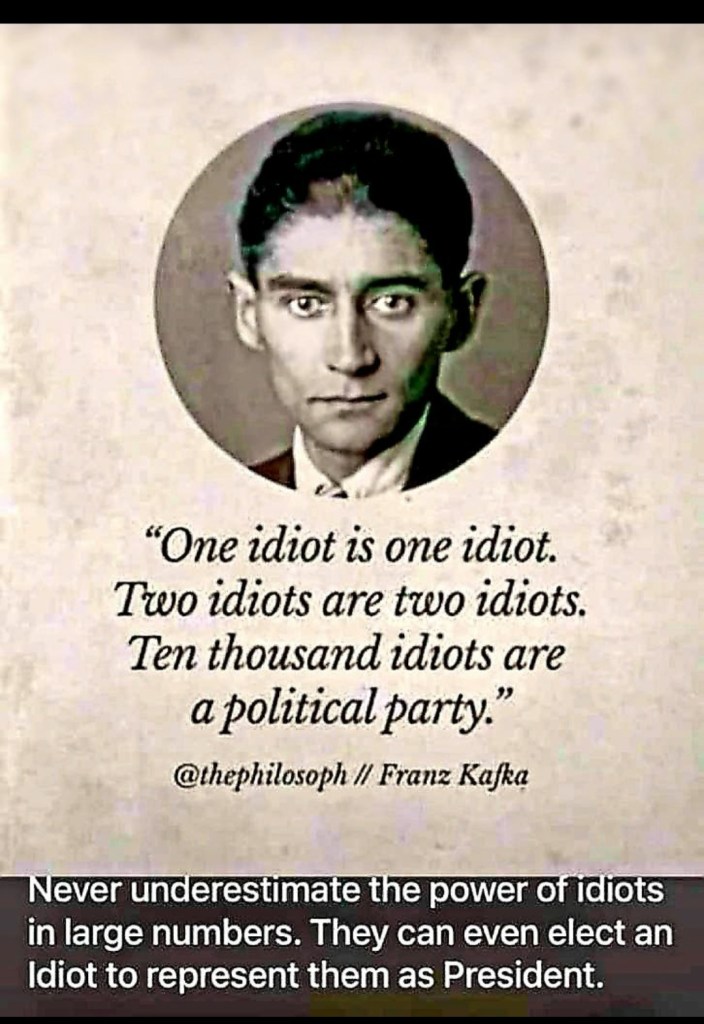
“NEVER UNDERESTIMATE THE POWER OF LARGE NUMBER OF IDIOTS”

أهمية قمة غاروي المزمعة للحكم في الصومال


منذ إنشاء الجمهورية الصومالية الثانية بعد الحرب الأهلية الطويلة، لم يكن من الممكن تحقيق الاستقرار في المؤسسات العامة.  وذلك لأن قادة الصومال في مرحلة ما بعد الحرب الأهلية لم يتمكنوا من وضع سياسات عامة متماسكة تعتمد على المصالحة الوطنية، كما لم يتمكنوا من التوصل إلى رؤية وطنية للصومال الجديد المتصور.  يعتقد الكثيرون أن البلاد لا تزال منخرطة تقنيًا في استمرار الحرب الأهلية بوسائل أخرى.  هل ستفتح قمة جاروي صفحة جديدة في التخلص من إرث ذلك التاريخ الحزين في عصر جديد من النهضة الوطنية؟  ويشتهر الزعماء السياسيون الصوماليون بصوتهم العالي في الدعوة إلى المصالحة الوطنية، دون أن يتبع ذلك سوى القليل من الإجراءات الملموسة.  إذا كان الأمر كذلك، فستكون فرصة ضائعة أخرى.
إن ما هو على المحك الآن هو بقاء الدولة الصومالية كدولة ديمقراطية فاعلة خالية من تهديدات التطرف والفساد الوبائي وسوء الإدارة.  إن ما أصبح على المحك الآن هو وحدة الصومال كدولة قادرة على البقاء تتمتع بضمانات قوية لسلامة أراضيها وسيادتها الوطنية.  ولا يمكن تحقيق ذلك والحفاظ عليه دون اللحمة الوطنية والمواطنة.  وهذا يتطلب قيادة نكران الذات وتضحيات شخصية من جانب الجميع.  هل نستطيع مواجهة تحديات عصرنا؟
ونطالب بمؤسسات عامة تستجيب لاحتياجات وهموم شعبنا.  نحن نطالب بتقديم خدمات عامة موثوقة.  نحن نطالب بتعليم جيد وفي متناول الجميع.  ونطالب باحترام حقوق الإنسان وسيادة القانون.  ونطالب بالتعبئة الجماهيرية من أجل الوعي المجتمعي والمواطنة الصالحة.  ويجب أن يكون الصومال دولة قومية قوية بين الأمم.  إننا نطالب بمحاسبة الموظفين العموميين، وفي المقام الأول، من المكلفين بإدارة الشأن العام.  ولا يستطيع الصوماليون تحقيق هذه الأهداف دون انتخاب قادتهم السياسيين في انتخابات وطنية.  إن الديمقراطية فوضوية، ولكن ليس هناك بديل.

THE SIGNIFICANCE OF PLANNED GAROWE SUMMIT FOR SOMALIA’S GOVERNANCE

WDM EDITORIAL

Since the creation of 2nd Somali Republic after the prolonged Civil War, public institutions couldn’t be stabilized. That is because the post-civil war Somalia’s leaders couldn’t devise a coherent public policies based on national reconciliation as they couldn’t come up with national vision for the New Somalia envisioned. Many believe that the country is still technically engaged in the continuation of the Civil War in other means. Would Garowe Summit open a new page in doing away the legacy of that sad history in a new epoch of national renaissance? Somali political leaders are famous for loud voice for national reconciliation with little concrete actions following. If that would be the case, it will be another lost opportunity.

What is at stake now is the existential survival of Somali state as a functioning democracy free from threats of extremism, epidemic corruption and mal-administration. What is at stake is unity of Somalia as a viable state with strong safeguards for its territorial integrity and national sovereignty. This cannot be done and maintained without national cohesion and citizenship. This would require selfless leadership and personal sacrifices on the part of everybody. Can we the meet the challenges of our time?

We demand public institutions responsive to the needs and concerns of our people. We demand reliable public services delivery. We demand quality education accessible to all. We demand respect for human rights and rule of law. We demand mass mobilization for community awareness and good citizenship. Somalia must be a strong nation-state among nations. We demand accountability from public servants, first and foremost, from those entrusted with running public affairs. Somalis cannot achieve these goals without electing their political leaders in a nationwide suffrage. Democracy is messy, but there is no alternative.