There are obvious reasons for political crises and stalemates in the country. But the main culprit is about not learning from the Somali character by both unsophisticated, unlearned native politicians, and diplomats of our International Partners. The Somali man responds negatively to threats and coercion. Historically, any meaningful collective act was attained through negotiations and consensus-building. No amount of marginalization and deprivation would compel this man to bend to servitude by another human being. To earn his goodwill, one has to recognize him as equal with full dignity. This is a fundamental truth about Somali anthropology. Read the experts on the issue – Sayyid Mohammed Abdulle Hassan, Abdi Sheikh Abdi, Richard Burton, I. M. Lewis, B W. Andrewiezky, Enrico Cerulli, among quite a few more.
Moreover, what complicated Somali political impasse further is the most ignored fact that Somalis went the wrong way to national reconciliation process, following a vicious civil war – a topic still considered a taboo. That means we are still in self-denial and no system or remedy is in place to right a wrong. Think about people’s trust-level in national or shared public institutions.
Enacting or rushing legislative bills through known corrupt parliament without proper consultations and public debates wouldn’t bring Somalis together. States would fight against what they perceive as centralist policies and dictatorial power grab. If you assume that Somalia has had an accepted Central Authorty, you have already missed the point.
Finally, Somalia’s Achilles Heels are Alshabab, ISIS, other extremists, and economic and financial cartels. But, worse than Alshabab is the epidemic of corruption, diseases and ignorance.
In the meantime, our International Partners would continue to urge for dialogue to resolve disputes. But, until the contentious issues are studied and properly addressed, we will go on doing business as usual. Thus, we shall all risk losing Somalia again. It is time to get real and serious about continued and potential survival of this nation.
56 year old Hussein inherited land southwest of Mogadishu, Somalia. Having been a public servant prior to 1991, when he found himself in a land dispute over that same land, he did what any public servant would do: he took the case to court. Spending nearly 27,000 US dollars in the highly corrupt judicial system, he lost the initial trial and attempted to appeal the case. He still had hope for due process.
Then, the other party attacked his house. The police shot and killed two of his aunts while they tried to save their home. Soon after, his appeal stalled in court. Two years later, with his appeal still unaddressed, Hussein did the unthinkable. He took his case to Al Shabaab, a violent terrorist group that operates a shadow government in the country.
His story is far from unique: Hussein is just one of thousands who has had to turn to Al Shabaab in a country without justice.
The Situation in Somalia
Described as “the most failed state,” Somalia lacks a unified government. Since the collapse of Mohamed Siad’s authoritarian regime in 1991, Somalia has struggled to establish a government. Although nominally run by President Hassan Sheik Mohamud, who served as chief executive from 2012-2017, and was reelected in a much-delayed election in May 2022, much of the country isn’t under government control: Al Shabaab controls nearly 70% of South and Central Somalia. In the areas under its control, Al Shabaab conducts all the basic functions of a normal government: it taxes residents, offers security, and even provides welfare to needy populations. Through taxation, Al Shabaab brings in some 15 million dollars a month–almost as much as the legitimate Somali government. Somalia’s actual government, meanwhile, is consistently rated as one of the most corrupt countries in the world and relies heavily on international assistance to survive. The minister of Hirshabelle put it bluntly: “We have two governments. … They control more and generate more funds than us”.
Despite international efforts to counter its rise, Al Shabaab has thrived in the Horn of Africa. As such, while the Somali government remains corrupt, discriminatory, and otherwise untrusted, more people flock to Al-Shabaab. A 2018 study on recruited members of Al Shabaab found that, increasingly, the group’s messaging towards youth emphasized injustice and power abuse issues. A full two-thirds of recruited members say they joined because of clan discrimination, government corruption, or economic reasons. Given the struggles of the government in Somalia, it is unsurprising that Al Shabaab has gained a foothold in the Somali judicial system.
Al Shabaab’s “Justice”
Utilizing a combination of Xeer, the traditional legal system in Somalia, and Sharia law, a form of Islamic law, Al Shabaab has established a network of courts across the country. These “shadow courts” handle a wide variety of disputes. Somali researcher Hussein Yusuf Ali notes that Al Shabaab responds to a variety of needs for justice, especially arguments over natural resources, commercial disagreements, and accusations of clan discrimination. Land disputes are also frequently handled by Al Shabaab: one resident of Baido estimates that “80% of land disputes are taken to Al Shabaab and perhaps 20% go to formal courts.” Al Shabaab courts even handle issues of extortion, clan discrimination, corruption, and unlawful arrests, meaning Al Shabaab may prosecute government and law enforcement agents as well as civilians.
Even in areas officially controlled by the government, Somalia’s justice system is as dysfunctional as the government itself. Corrupt, fractured, and lacking the power to enforce its decisions, the judicial system rarely provides justice. The US State department described Somalia’s justice system as one where “impunity generally remained the norm,” and decisions are heavily influenced by clan based politics and corruption.
To fill this vacuum, Al Shabaab has become an arbiter of justice–not necessarily because the public actually supports the terrorist group, but because there is no other option. Aweys Sheikh Abdullah, who was a judge in the Banadir regional court from 2016-2018 told reporters that people turn to Al Shabaab because courts involve a “long process which can take years without the case proceeding, backlog resulting from lack of enough judges at the court and costly legal fees.”
Many Somalis see Al Shabaab’s courts as neutral, unbiased institutions which provide a free platform for arbitration. Those from minority clans, who are often wary of being discriminated against by government judges, are enticed by this promise of neutrality to use Al Shabaab. In government courts, one lawyer from Hodan said, “many people fear being killed if they bring their cases before courts. Some people are silenced. Some others receive death threats, which could later force them to withdraw their cases. For minority groups, they might face all those threats and risks with the addition that they have no powerful allies to help them.”
This, among other reasons, is why thousands now turn to Al Shabaab–even those living under government control–to adjudicate their disputes. Residents of Mogadishu, the government controlled capital, travel to nearby Al Shabaab areas to settle disputes. By some anecdotal accounts, even policemen and military officials are known to seek justice from Al Shabaab instead of the government.
Al Shabaab also has the power to enforce its decisions, while decisions by government courts are largely unenforceable. Al Shabaab’s courts successfully enforce their rulings by using threats of violence to do so. If someone does not comply, they risk the robbery, injury, or death of themselves and their loved ones. Residents of Bariire in Somalia reported that they have been forced to watch public executions, amputations, and more as a means to intimidate residents. While barbaric, this violence ensures respect for the institution–something which the government courts lack.
Al Shabaab’s draconian punishments highlight a frightening truth about the group: despite gaining legitimacy as a pseudo-government, Al Shabaab is just as violent, radical, and dangerous as ever. In the year 2021 alone, the organization killed more than 550 civilians. Al Shabaab has been accused of crimes against humanity, has conscripted child soldiers, and continues to exploit and abuse those under its control. It is no surprise that the people of Somalia, even those who may rely on the court system, want Al Shabaab gone.
Despite the group’s violence, interviews with lawyers, clan elders, and government officials indicate that Al Shabaab’s “reputation for lower levels of corruption,” lack of bias in the court (in that it is seen as not discriminating along clan lines), and ability to enforce court rulings (often through violence) have earned the group respect. Juxtaposed against the government courts, Al Shabaab is now seen as less corrupt and less discriminatory than government courts. In turn, Al Shabaab derives much of their power from a purported moral high ground, which they manage to achieve even in the face of barbaric human rights violations.
Legitimacy and Government
Al Shabaab’s shadow courts are only a case study of their larger strategy to delegitimize the government and take its place. After all, this is not the first time that Al Shabaab has sought to take over the role of the fragile government.
Following the 2017 drought in Somalia, as the government floundered, Al Shabaab began handing out food and water aid to impoverished farmers. More recently, Al Shabaab established COVID-19 healthcare centers in response to the pandemic, and has even established schools and programs to send fighters to universities abroad to receive education.
Doling out these goods and services, Al Shabaab has built its power on the inability of the government to provide for its people. The failures of the Somali government to bring about adequate justice and rule of law created the conditions for Al Shabaab to make its own courts, just as the failure of all governments offers an opportunity for Al Shabaab to rise to power.
Alexus G. Grynkewich, Commander of the US 9th force, describes this type of strategy as “welfare as warfare”, where a terrorist group provides services, humanitarian aid, or security in order to erode the legitimacy of the existing government. This hearts and minds approach helps counteract the violent, oppressive image of Al Shabaab that many Somalis have, thus making the group seem like a more benevolent ruling force.
If this strategy sounds familiar, that’s because it is: the practice of welfare as warfare is a tried and true means for terrorist groups to gain support and legitimacy. The Taliban employed this model for years, running a similar Sharia based court system in Afghanistan. One expert described Al Shabaab as a junior varsity version of the Taliban: like the Taliban, Al Shabaab operates courts, collects taxes, and provides aid to the public. This justice system, which legitimized the Taliban in the eyes of the public and gave the terrorist group valuable experience in running a country, likely helped contribute to the Taliban victory in Afghanistan in August 2021.
Also like the Taliban, Al Shabaab is pairing its legal efforts with a targeted propaganda campaign meant to make the government seem weak and ineffective. In 2021, Al Shabaab released a six part documentary about the failures of the Somali president, advocating for Sharia as a solution. Unlike typical terrorist propaganda, Al Shabaab’s documentary, which it marketed as “objective,” focuses on political problems rather than only radical ideology. Since then, another 12 part documentary about the problems of the Somali constitution has been released.
Without a functioning judicial system, Al Shabaab’s claims that the government is ineffective are more easily accepted across Somalia. The mere existence of a parallel legal system in Somalia, especially one run by a group who explicitly hopes to overthrow the existing government, shows that the Somali state is unable to uphold rule of law.
Al Shabaab courts have become more brazen too. The courts sometimes work directly with clans and elders, and are overturning already decided government cases. Al Shabaab even warns those under its control from stepping foot in government courts, threatening civilians that do so.
Ultimately, Somalia is trapped in a dangerous cycle: an illegitimate government is the but-for cause of Al Shabaab’s courts. Yet Al Shabaab’s courts also contribute to the perception of illegitimacy, while helping to resolve legitimate concerns that the government has not adequately handled.
The Road Ahead
Thankfully, the Somali government has begun paying attention to the issue: President Mohamud has put Al Shabaab’s courts at the center of his counterterrorism strategy in the past few weeks, declaring a war on the system. In September, Somali forces attacked an Al Shabaab-run courtroom in Basra near Mogadishu, the first such operation to specifically target the shadow judicial system.
The federal government has even fomented a clan uprising against Al Shabaab, weaponizing Somalia’s powerful clan militias. In previous administrations, authorities refused to provide government support to the clan militias, allowing Al Shabaab to consolidate control over clan territories. This novel approach to clan militias is already working. Just last week, 40 towns in the Hirab region were liberated from Al Shabaab rule with the help of the Macawisley militia.
This new strategy is vastly superior to a proposed military-only approach to Al Shabaab. A hyper-militarized counterterrorism strategy in Somalia risks killing and radicalizing civilians, shutting down potential negotiations, and will likely result in retaliatory escalation by all parties. While military operations may temporarily clear Al Shabaab out of a town, they do not solve the underlying problem relating to the lack of effective governance in the area. This makes it easy for Al Shabaab to fill the void in services once again.
In fact, using only military force to fight Al Shabaab, now that it operates as a pseudo-state in many areas, may even be counterproductive: because Al Shabaab is the provider of goods and services, attacks on the group risk disrupting vital governance, aid, and public services, leaving vulnerable communities in the lurch. Without a wider political strategy, military escalation will keep Somalia entrenched in conflict.
Additionally, instead of relying on bombing and raids, since Al Shabaab currently has a weakened military, the Somali government should seize this opportunity to build informal channels for peace and demobilization negotiations. The government should start at the local level, leveraging any connections it has to the group. The appointment of Mukhtar Robow, an ex-Al Shabaab leader turned government official, to the ministry of religion last month could give the government the credibility it needs with Al Shabaab to establish locally mediated negotiations. While there is a long-term goal for peace, in the short term negotiations about a ceasefire, halting bombings, and protecting civilians would be a significant step in the right direction.
The Somali government must beat Al Shabaab at its own game: as long the public sees Somalia’s judicial system as untrustworthy and corrupt, there will always be a demand for Al Shabaab and its courts. Therefore, Somalia must also take steps to address the corruption and costs in its legal system. A study of Somalis found that high costs were the largest access barrier to government courts. On top of this, Al Shabaab’s ability to enforce its court decisions is why the group is so successful in the legal field: the USAID study on Somalia concluded that the ability to enforce decisions swiftly is the largest “pull factor” of Al Shabaab’s courts. As one respondent put it with regards to the government system, “justice depends on your pockets.” Stronger anti-corruption regulations, assistance from the international community in lowering legal fees, and out-of-court arbitration options could go a long way towards lowering costs. However, for a country facing immense turmoil and violent terrorism, reforming the justice system will not be easy.
Somaliland, a breakaway region of Somalia, could also be a potential model for judiciary reform. Although Somaliland faces corruption, bias, and a lack of resources within its judicial system, it is consistently seen as more effective than the courts in the rest of the nation. Part of an “increasingly capable government,” the justice system in Somaliland still has a long way to go, but is a far better alternative than the current Somali equivalent. Somali leaders might be well served by working with Somaliland officials to reform their courts.
For almost two decades, Somalia has fought Al Shabaab on the battlefield. As the conflict moves to the courtroom, success seems uncertain: The country’s future is precarious, its government and justice system weak, and its people under attack by a violent terrorist group. The world has largely given up on Somalia.
But it is the constant struggle of the Somali people to bring justice, governance, and peace to their country which proves that Somalia is not a lost cause. Growing local resistance against Al Shabaab, demands for improvements to the government, and the peaceful transition of power this summer are all hopeful signs for the country.
It is past time for the government to rise to the goals of its people: President Mohamud has the opportunity now to fight Al Shabaab, build the government, and bring justice to the Somali people. So far, he has risen to the challenge. If he can maintain his momentum, and help the Somali government win the battle for judicial reform and create a comprehensive approach to counterterrorism, the country stands a chance against Al Shabaab. The fight for the future of Somalia has just begun.
To start with, there is weak collective ownership in Somalia among the native people – nobody seems to care about it beyond selfish individual interests. Its leaders seem to practice the king’s motto: “after me the deluge“. Now Somalis have become transnational in their existence – they are split and scattered all over the world, while holding no allegiance to any one country. They are fast becoming the new ever wandering gypsies. State regulations or any societal rules irrite them. Nobody can predict what will become of them. Their Capital City, Mogadishu, hosts foreign troops and none of its residents seem to care or mind. National pride and culture are quickly losing relevance. Their focus is now on social media entertainment and destructive bashing of each other in never ending and fruitless clannish warfare. In the process, they have produced tireless and unscrupulous internet clan warriors determined to secure Google clicks by equally wandering and gullible followers. Fake news and forged documents reign supreme in their malicious and destructive internet sites. Lately, interested and self-centered Somali politicians have been taking advantage of Somalia’s misery, exploited by rumor-mongers and shameless site owners. Terms like CBB (Cayayaan Baraha Bulshada) were specifically coined for these faithless groups of Somali origin sitting behind lethal internet-connected laptops and desktops in Western countries, contributing to their decadence. Depression and loneliness have drive young Somali beauties living in the Western world into nightmares and obscenity in unregulated cyberspace and on the information highway. It is frightening situation.
At home, terrorist groups and religious fanatics believe they have reached the ultimate power of controlling an entire nation, easily reaping protection money and exercising free reign in racketeering.
Somalia’s neighbors are nervous and afraid of the menace happening at their doorsteps. They have run out of other options but to contain Somalia by keeping their troops there. And as long as Western nations are paying the bills, they can tolerate the occasional murders of some of their soldiers by Al-Shabab and ISIS.
Those among the international community who wish Somalia well should act as catalysts for change.
Until Somalis learn to change their attitudes and ways of life by collectively and individually belonging to a country of their own and take care of it, they are likely to be doomed.
With meagre economic resources and limited fighting men, Somaliland is engaged in losing adventures in violence in Sool Region. 1st, it wouldn’t be able to subdue restive population moving forward. 2nd, it has irreversibly damaged its illusionary secessionist attempts. 3rd, it has lost irrevocably any remaining good standing within the international community, harming any working relationships with still remaining international and non-profit organizations operating out of Hargeisa. By its unprovoked violence in SSC regions, Somalilad has decimated its commerce and trade with the rest of Somali regions in Somalia and Ethiopia. That way Somaliland has turned its territories into dystopia.
HOW TO SALVAGE THE SITUATION
Hargheisa should either proceed to immediate arrangement of ceasefire in SSC regions, and hold talks with politicians and leaders in Laascaanod on its speedy forces’ withdrawal, or brave for crushing defeat, humiliation and subsequent unraveling of Somaliland pipe dreams of securing unilateral independence.
CONCLUSION
By mercilessly engaging in war crimes and crimes against humanity in SSC regions, Hargheisa has lost any previously doubtful moral compass to negotiate with its Somalia’s counterparts on the future governance arrangements.
Preface by Abdirashid Ali Sharmarke, Prime Minister (January 1962)
SINCE the Somali Republic became an independent State on the first of July, 1960, the Government has become increasingly aware of the need for the publication of an authoritative guide to its border problems and their origins, in view of the friendly interest, particularly among other African nations, which these problems have aroused. We Somalis occupy the eastern ‘horn’ of Africa, the largest, single homogeneous area in the continent. The country consists, for the most part, of scant pastures and two rivers, and has been the playground of international politics for many years. Our country was divided and sub-divided by Euro-Abyssinian colonialism in the last two decades of the 19th Century. The value of our land was not the motive for annexation because the complexities of our pastoral life offered no inducement to the intruders who were more favoured in this respect than ourselves, for they already possessed an abundance of rich and fertile land in temperate zones. The aims of annexation, which are analysed in succeeding pages, were dictated by selfish policies which the colonial powers concerned found it expedient to pursue without regard to the interests of the Somali people. Our misfortunes do not stem from the unproductiveness of our soil, nor from a lack of mineral wealth. These limitations on our material well-being were accepted and compensated for by our forefathers from whom we inherited, among other things, a spiritual and cultural prosperity of inestimable value: the teaching of Islam on the one hand and lyric poetry on the other. Moreover, our forebears developed techniques of animal husbandry which have not been easy to improve upon and applied their ingenuity to the total utilization of the few natural resources available to them. By their skills we live today, and, with the generous assistance of wealthier nations, we shall lay new foundations, in accordance with our liberal and democratic Constitution, for the spiritual and material enrichment of future Somali generations. No! Our misfortune is that our neighbouring countries with whom, like the rest of Africa, we seek to promote constructive and harmonious relations, are not our neighbours. Our neighbours are our Somali kinsmen whose citizenship has been falsified by indiscriminate boundary ‘arrangements’. They have to move across artificial frontiers to their pasture lands. They occupy the same terrain and pursue the same pastoral economy as ourselves. We speak the same language. We share the same creed, the same culture and the same traditions. How can we regard our brothers as foreigners? Of course we all have a strong and very natural desire to be united. The first step in this direction was taken in 1960 when the Somaliland Protectorate was united with Somalia. This act was not an act of ‘colonialism’ or ‘expansionism’ or ‘annexation’. It was a positive contribution to peace and unity in Africa and was made possible by the application of the principle of the right to self-determination. We adhere most rigidly to this principle which is linked to our pledge in Article VI of our Constitution that we shall promote ‘by legal and peaceful means the union of Somali territories’.
It started with the name of the Somali State in 1970s. The government was then anything but democratic. Nevertheless it was called the Somali democratic Republic. Now it is Federal Republic of Somalia more by de facto than de jure. Successive Mogadishu Federal Administrations were trying to behave in the same way as the dictatorship of Somali Democratic Republic, albeit they had no capacity and institutions to implement their centralist policies by force of repression, fortunately or unfortunately, based on your perspective.
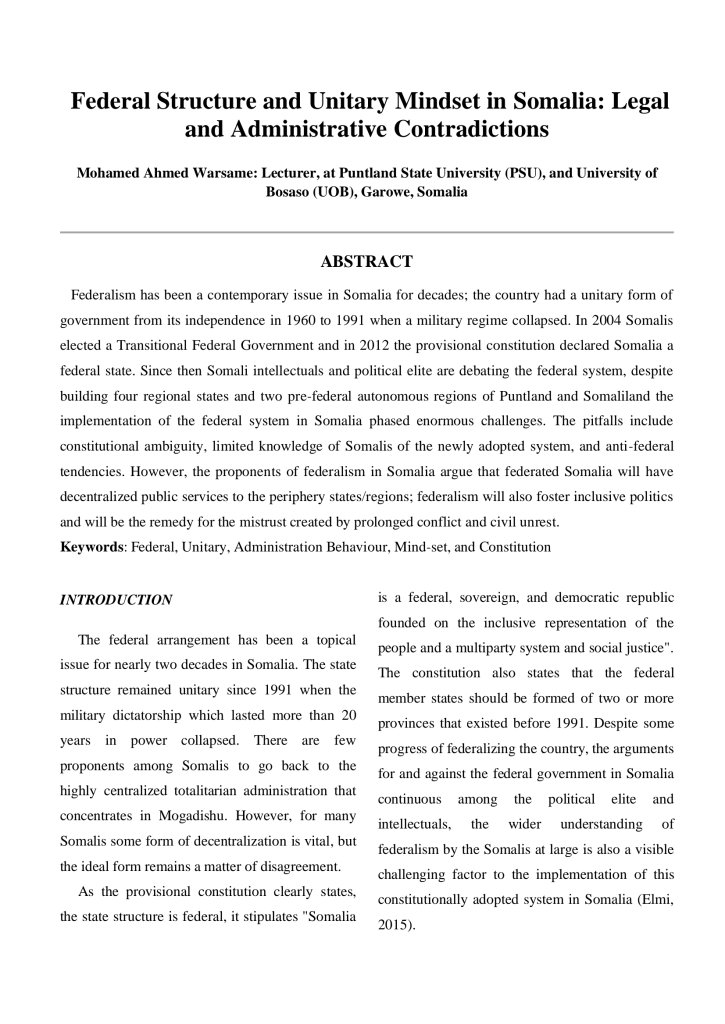
The latest governance system agreed upon by all Somalis is federal, however, it is sad that it is being misinterpreted by many as weakening Somalia’s state, even to the extent of dismembering the country. That is extremely dangerous propaganda. It neither reflects on the political realities in Somalia nor on experiences in many federal countries in the world. On the contrary, Somalia is much stronger with different levels of democratic government.
Another lethal propaganda by anti-federalist forces is the question they pose as to how many presidents Somalia could have at the same time. This an attempt to discredit and ridicule the heads of Federal Member States, some even suggesting that they should be called regional governors. They ignore the fact that each FMS had come into existence as a result of a union of two or more regions – a political situation quite different from the era when a regional governor was appointed by the central government for a particular region. They also dismiss the fact that federalism entails doing away with old political cliches and habits of past bad rulers of Somalia. Anti-federalist forces are advocating for the repeat of the same mistakes and abuses of power that led Somalia’s state failure in the first place. That is unacceptable to many Somalis.
Federalisn and its variety of confederalism finds relevance in Somalia’s traditional clan society where most clans are more bonded by federation than by blood lineages. Dir, Hawiye, Digil & Mirifle etc are confederate clans. Most clans in Somalia are social constructs for strengthening them numerically for common protection. Somali Clan confederates are lately used for securing political edge in power-sharing rivalry.
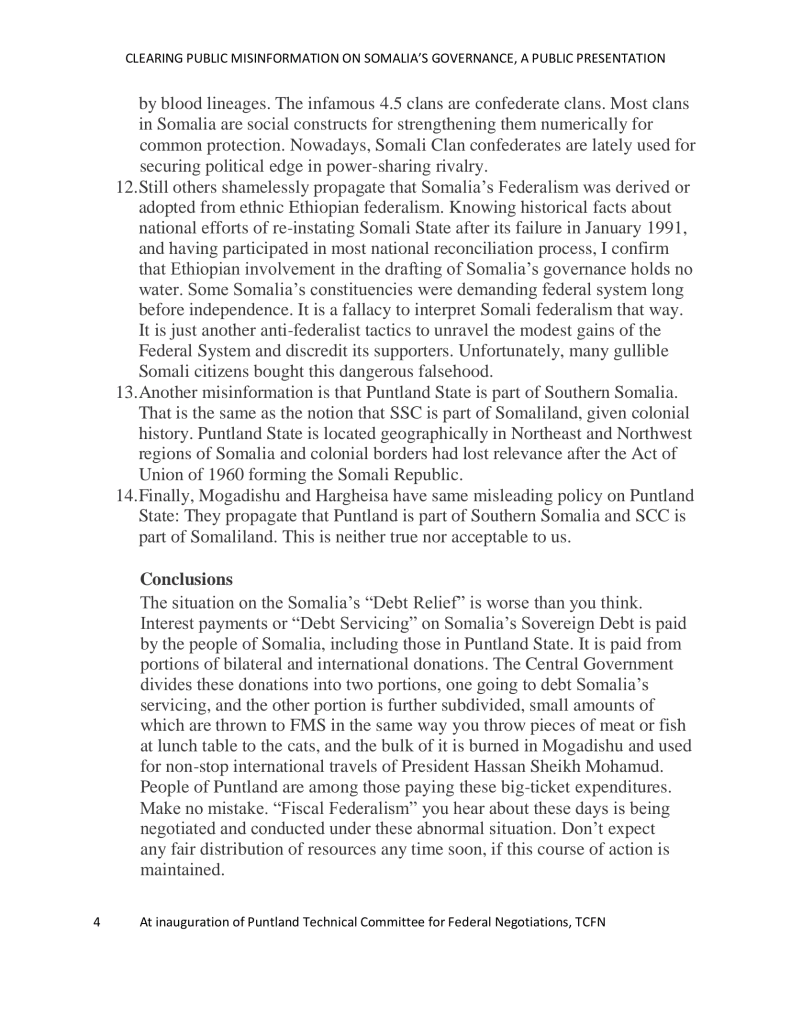
Still others shamelessly propagate that Somalia’s Federalism was derived or adopted from ethnic Ethiopian federalism. Knowing historical facts about national efforts of re-instating Somali State after its failure in January 1991, and having participated in most national reconciliation process, Ethiopian involvement in the drafting of Somalia’s governance holds no water. It is a fallacy. It is just another anti-federalist tactics to unravel the modest gains of the Federal System and discredit its supporters. Unfortunately, many gullible Somali citizens bought this dangerous falsehood.
I am afraid the struggle between pros and cons of federalism will go on until one side wins the game. Keep fighting.
Now that Puntland Technical Committee for Federal Negotiations (TCFN) is back in Garowe, there are a few events that have made an impact on our assessment of the journey to Bosaso and will be reflected on our experience.
1. An event of Bosaso Development Vision 2030 held by Puntland Presidency on March 6 2023 about non-involvement of Puntland Government in the aggressive war waged by Somaliland against civilian population of Laascaanood. That was a major political statement by President Said Abullahi Deni on Somaliland Administration’s violence in Sool Region.
2. Guided tour of Bosaso Seaport under expansion – an important construction project underway that would make a big difference in Puntland infrastructure capacity and economic expansion.
3. A meeting TCFN held with Puntland President Said Abdullahi Deni at his Residence in Bosaso in which important topics related to both Puntland State and Federal Affairs were deliberated and a meeting of minds were attained.
4. A meeting of TCFN and some cabinet members of Puntland Government to exchange views on current issues of Somalia’s political landscape and state of affairs were conducted and brainstormed. Consensus of views on existing political realities in Somalia emerged in this important get-together with Puntland key cabinet members.
Stay tuned for further deliberations from Puntland Technical Committee for Federal Negotiations (TCFN).
The Technical Committee For Federal Negotiations has had an important and constructive meeting with President Said Abdullahi Deni and his team of key ministers last night at his Residence in the Puntland Red Sea Port City of Bosaso. Great ideas on moving the State forward has been explored. It was focused deliberation of issues and Puntland immense potential for development, a politically mature and candid debate ensued in the discussion. A review of TCFN operational performance and potential contribution to state-building and Somalia’s governance in general were among the topics covered. President Deni was shining in his open tackling with the issues of Puntland State and Federal Government.
Earlier in the day, TCFN with the Minister of Finance had toured Bosaso Port and saw first hand commendable Port expansion in progress. It is huge understanding and already the construction company had made noticeable portions of the project. TCFN found satisfaction in talking to the project managers and site engineers. Real work is underway here for all to see.













 Warsame Policy & Media Network (WAPMEN)
You must be logged in to post a comment.