SANAD CUSUB OO FARXADLEH

https://m.facebook.com/story.php?story_fbid=10227246524216935&id=1473969186

Garacad project is what Africa needs

https://www.standardmedia.co.ke/opinion/article/2001432936/garacad-project-is-what-africa-needs

GARO WUXUU SALKA KU HAYO ISQABADKA FARMAAJO IYO ROOBLE

https://m.facebook.com/story.php?story_fbid=10227225580493355&id=1473969186

WARBIXIN

BOSASO INCIDENT: BREAKING NEWS

Digniin Hore

UNTOLD FACTS OF PUNTLAND HISTORY

  1. Puntland Security Force (PSF) isn’t military units for a family, but Puntland State anti-terrorist forces.
  2. Sons of late Osman Diyaano had inherited a golden spoon in their mouth, knowing nothing about the tremendous efforts and struggle to secure USA assistance for the creation of PSF in a provisional state not recognised by any state or government in the world.
  3. Those opposing Diyaano sons now, and who are currently in power in Puntland State were then against the stability of Northeast Regions and foundation of Puntland State, some of its current ministers even participated in extemist violence against the people of Northeast Regions. They were under the spell and deranged mind of terrorist Hassan Dahir Aweys.
  4. On Faroole, Abdiweli Gaas and Omar Abdirashid: a) Faroole wanted to destroy the Founding Congresses of Puntland in 1998, and when failed, he had fled to Australia. There are still multiple eyewitnesses in Garowe now of his desperate campaigns and attempts to foil Puntland Constitutional Congress then.

b) Gaas have been insulting the founding leaders of Puntland State by dismissing them as alcoholics.

c) Omar Abdirashid was an unknown quantity until recently, only to exploit the brand name of his late father, particularly from among sub-clans of Abgaal and Sa’ad Habargidir.

This is the hidden political history of Puntland State to fresh up your minds for context of the ongoing Bosaso military standoff.

Maxay tahay ujeedada shaqaaqada Bosaso?

WDM BREAKING NEWS

It is historically important to note that these titled elders, who have issued this document represent exactly the same sub-clans in Bari Region that rose against Puntland President then, Abdullahi Yusuf, exactly for the same reasons for power struggle in 2000-2001.

https://ismailwarsame.blog/2021/12/08/wdm-breaking-news-13/

WDM BREAKING EDITORIAL

A ceasefire announced in Bosaso, Puntland, on military standoff between Puntland forces must be made permanent. A negotiated settlement must include transfer of military hardware and personnel to Puntland Government. Puntland current Government must show flexibility and restraint in handling the issue. It isn’t about my way or the highway. Bosaso residents impacted by the armed violence must get help in re-building their lives.

IN THE END YOU HARVEST WHAT YOU SOW

WDM BREAKING NEWS

Farmajo-Roble Administration is engaged in destabilization of Puntland State. Under the financial incentives and guidance by the highest officials of the Federal Government including Prime Minister Roble with the knowledge and advice of Mohamed Abdullahi Farmajo, more than four million dollars were transferred recently via Puntland middle men and businesses to the commanding officers of the PSF involved in the Bosaso current standoff, according to reliable news sources.

The new development will have negative impact on Roble-Deni working relationships, including the issue of holding elections in Somalia. Current Baydhaba consultations between FGS and FMS will act as a litmus test for the two men’s working relationships.

It isn’t the first time the Central Government of Somalia had tried to undermine Puntland State stability.

WEALTHY NIGERIA AND SOURCES OF ITS POVERTY

Take a listen:

Click this link. https://fb.watch/9XpboN6Tej/

Why power attracts the wrong kind of people

Image without a caption

By Rachel Kleinfeld

Rachel Kleinfeld is a senior fellow at the Carnegie Endowment for International Peace. Her most recent writing is “The Rise of Political Violence in the United States,” in the Journal of Democracy.November 19, 2021 at 8:00 a.m. EST3

Why do bad people so often gain power? Why do we let them? And can anything be done to ensure that leaders are better people? These are the seminal questions Washington Post columnist Brian Klaas seeks to answer in “Corruptible: Who Gets Power and How It Changes Us.”Get the full experience.Choose your plan

The need is acute: Autocracy is on the march. Democracies have been dying — largely at the hands of their own elected leaders — for the last 15 years. Take Narendra Modi, who won reelection as prime minister of India in 2019, only to arrest politicians across Kashmir, clamp down on the independence of courts and businesses, and challenge the citizenship of many Muslim Indians. The world’s largest democracy was downgraded to “partly free” in Freedom House’s rankings last year. The same trajectory is afflicting democracies around the world, including Hungary, a country that Tucker Carlson has offered as a positive model for the United States.

Leaders anointed as reformers frequently start well but end badly. Ethiopia’s prime minister, Abiy Ahmed, was awarded the Nobel Peace Prize in 2019, a year into his tenure, for making peace with Eritrea but is now starving hundreds of thousands of his citizens to bring a restive region to heel.

Why do so many leaders become authoritarian, violent or corrupt?

With a deft literary hand, Klaas describes how positions that offer power and possibilities for enrichment feature incentives that attract the wrong sort of people, through headings like “How Our Shoulders Shaped Society” and a cascade of stories — about the authoritarian leader of a homeowners association, a “megalomaniac janitor,” a “cannibal emperor” and the Doraville, Ga., police department’s M113 armored personnel carrier. His warnings would be more disturbing were they not delivered with such verve. Being so entertained, we can lose sight of the fact that police agencies whose recruitment ads feature military tanks and violent SWAT teams, and presidential roles with low oversight and heady possibilities for procurement contracts for family members, are going to pull the expected kinds of people into the recruitment pool. Meanwhile, while narcissistic psychopaths are rare, they are drawn to power and are very good at using charisma, manipulation and intimidation to get it. So they are overrepresented in leadership positions.

But we must also blame ourselves. The stone-age minds of voters evolved for eons to deal with hunter-gatherer societies but have been forced to address modern politics for only an evolutionary nanosecond. Klaas shows how ancient instincts reward height and overconfidence. Our poorly suited psychology also makes us prefer members of our own group — however unqualified — to far more able “outsiders.” Hence the importance New Yorkers attach to whether their leaders eat pizza correctly. Particularly when countries have broken into two opposing teams, this stone-age rule of thumb works against good leadership. As Milan Svolik has shown, voters claim to love democracy, but they love their own side just a little more — and a multitude of small choices that help one’s party can hurt democracy and lead to its degradation.

The unintended consequences of bad people seeking power and the public rewarding them explain why voters often throw the bum out — only to elect someone even worse. This poses a major problem for anti-corruption efforts, which too often shine light on sleaze and assume that voters will take it from there. In Italy, after judges in the “Clean Hands” campaign found corruption in all the major political parties, media magnate Silvio Berlusconi ran as an outsider. In his years in office, he curbed the country’s fight against the mafia and changed laws to save his business empire from legal scrutiny and himself from jail time. In Brazil, “Operation Car Wash” similarly uncovered graft across the political spectrum, ushering Jair Bolsonaro into power — now he’s under investigation for potential money laundering in his acquisition of Brazil’s coronavirus vaccine.

In 2016, about 70 percent of Americans believed that the economy was rigged against ordinary people and that the system unfairly worked for wealthy elites. When such sentiments are high, voters often look to wealthy candidates who, they assume, don’t need to enrich themselves. Many Americans voted for Donald Trump hoping he would “drain the swamp.” But corruption isn’t determined by need. Trump’s administration added more ooze to the quagmire.

Well-designed systems, Klaas claims, can rein in bad individuals. Diplomats from countries lacking the rule of law, for instance, regularly flouted parking rules in New York City when they had diplomatic immunity. But as soon as New York started to enforce traffic violations, the worst offenders cleaned up their acts quickly. Enforcement is crucial.

Another lesson is the importance of deepening and broadening competition. In the village of Stebbins, Alaska, “every [police] officer — every single one — had been convicted of domestic violence. . . . How could that have happened?” Klaas asks. “The Stebbins residents who were qualified didn’t apply.”

Yet Klaas, an associate professor at University College London, fails to bring his deep understanding of global politics to bear on the really tough problems. His stories offer ample tactical tweaks, such as improving recruitment to make jobs more attractive to better people, or rotating leadership posts and using randomized integrity tests focused on those at the top to catch those who can do the most harm.

His ideas are pitched at a level suited to business boardrooms. But for anyone seeking political improvements, Klaas sidesteps the hard questions. If a system is attracting a disproportionate share of corrupt politicians, they must be good at seducing voters, and voters reelect them. So how do you attract better people and get them elected? Moreover, Klaas ignores how dangerous it is to be an honest leader in a dishonest world. How can a country keep good leaders safe if they are surrounded by a bevy of vested interests keen to see them depart? What would it be like to be the one nonviolent cop in Stebbins? Klaas also overlooks anti-corruption campaigns, though his findings provide good reasons that their efforts should expand beyond exposing wrongdoing to recruiting more honest (and maybe tall) candidates and convincing voters of their worth.

A FLIGHT TO NOWHERE

I was not in that flight to Jowhar in that early evening when planes couldn’t land there. But, I was in Nairobi, communicating on Thuraya satphone with Mayor of Jowhar, Mohamed Habeeb (Mohamed Dheere), throughout the evening. Dheere had been arranging enough cars with headlights blazing to light up the entire runway. I agree it was a risk flight too. There was no way Yusuf could return to Kenya as he was deemed extra burden on Kenyans having two presidents in town, blocking their streets traffic when moving around. Remember at time no aircraft could land in any of Somali airports at night, perhaps, Hargeisa ( I am not so sure), which was no go for Yusuf.
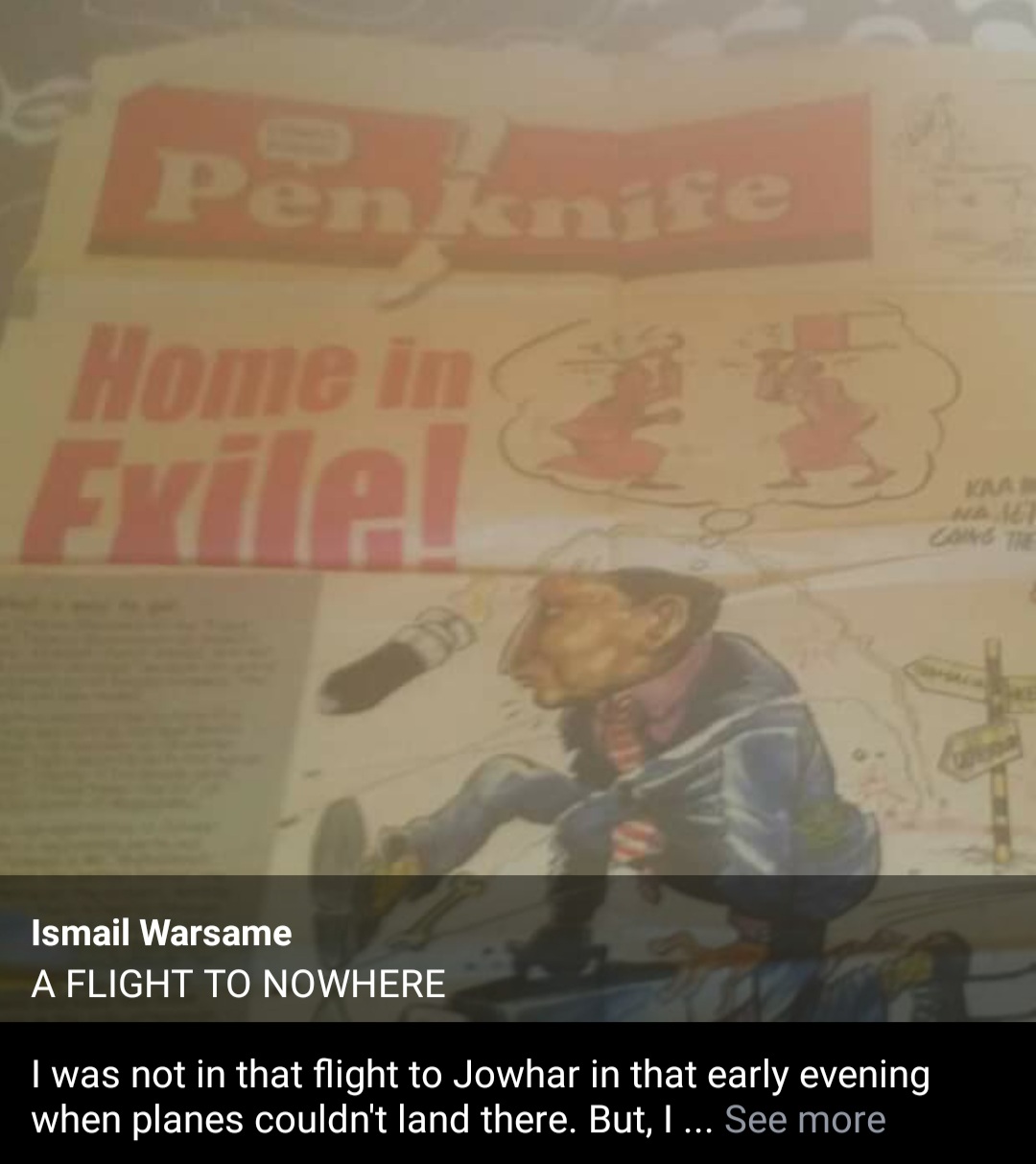
It was a mistake done by the organizers of the President’s trip to Jowhar, making such a delay to fly into Jomo Kenyatta Airport. I could confirm President Kibaki had been at Airport throughout the day with Yusuf, waiting for that flight to take the later to Somalia. Why such a delay had occurred? Later I learned that a merchant of Qat had persuaded the trip organizers that he would pick up Yusuf in the same day after he transports Qat to Somalia. Such a mess and poor judgment. Also recall I was not with TFG at the time. In fact, I was communicating with Mohamed Dheere on the trip on my own to help out. It was me who informed Dheere that the President’s plane had landed in Djibouti, to his much needed relief. ( Below is a cartoon by Penknife, Sunday Nation on the occasion. It is dated June 19, 2005. I have been keeping it in possession since then). In the Cartoon President Kibaki of Kenya saying bye bye, you overstayed here. No home in exile!

Caught in a Political Crossfire, U.S.-Trained Somali Commandos Suspend Fight Against Islamic State.

With American forces gone, a skirmish breaks out over one of Somalia’s elite counterterrorism units.

By

Michael M. Phillips
World Street Journal.

Dec. 10, 2021 9:08 am ET

NAIROBI—A Somali commando unit trained by Central Intelligence Agency operatives and U.S. Navy SEALs has become so entangled in local political power struggles that it has ceased operations against the Islamist militants it was created to fight.

Until last year, the 600-strong Puntland Security Force had reported directly to U.S. forces and was largely independent of Somali government control. But now the unit, the main force combating Islamic State’s Somali affiliate, ISIS-Somalia, has abandoned the front lines and returned to its headquarters in the northeastern port of Bosaso, overlooking the Gulf of Aden, according to U.S. officials and Somalis familiar with the situation.

The troops have dug defensive positions around their headquarters building in a standoff with forces loyal to the state president of Puntland, a semiautonomous region, who is trying to bring the unit under his control.

The unit has also halted missions against al-Shabaab, al Qaeda’s local franchise and the most powerful insurgent group in Somalia.

“Already they have vacated all of their front-line positions, and ISIS and al-Shabaab have free rein to move around and expand—nobody’s stopping them,” said Mohamed Mubarak, a Somali political analyst and executive director of an anticorruption charity, marqaati.
U.S. military and diplomatic officials are worried about the impasse, which undermines the post-Sept. 11 American strategy of enlisting elite local forces to fight extremist groups in Africa, the Mideast, South Asia and elsewhere around the world.

“One of our key concerns for this kind of intragovernmental fight is the ability of ISIS-Somalia, especially in Puntland, and al-Shabaab across the country, to generate forces and expand operations,” said a U.S. official familiar with the situation.
Somalia is one of the oldest fronts in the sprawling U.S. campaign against Islamist militants that followed the Sept. 11 hijackings.

The CIA began building up the Puntland force in 2002, amid concerns that al Qaeda elements were operating in East Africa.
President George W. Bush deployed a small number of U.S. troops to Somalia in 2007 to combat the rise of al-Shabaab. President Barack Obama ordered drone strikes against the group’s leaders. Initially, President Donald Trump intensified airstrikes and built the U.S. presence in the country to 500 Navy SEALs, Army Green Berets, Marine Corps Raiders and other troops. But the month before he left office, Mr. Trump withdrew American forces and relocated them to neighboring bases in Djibouti and Kenya.

U.S. commandos make periodic trips into Somalia to train local forces.
The Pentagon has been reviewing U.S. troop deployments around the world for almost a year. President Biden has yet to announce whether he will send American forces back into Somalia on a permanent basis.

The U.S. alliance with the unit that became the Puntland Security Force began shortly after the Sept. 11 attacks. At first, CIA agents paid and trained the fighters—“two Americans and a bag of cash,” in the words of one Puntland Security Force veteran. About a decade ago, Navy SEALs took over the mission of training and supervising the unit.

The Americans taught combat driving, sniper, reconnaissance and other skills. The U.S. sent FBI agents to teach crime-scene analysis.

U.S. commanders considered the Puntland Security Force one of its most reliable and effective allies in a chaotic country riven along clan, political, regional and ideological fissures.
“This is one of the few professional forces in all of Somalia,” said Mr. Mubarak.

After the U.S. withdrawal last year, however, the unit’s status was ambiguous. It was no longer an American asset, but it didn’t exactly belong to the central government in Mogadishu or the state government in Puntland either.

The Americans took away the unit’s U.S.-made rifles, sniper rifles, machine guns and night-vision gear, and left it with U.S.-supplied weapons from the former Eastern Bloc countries, according to the Puntland Security Force veteran.

“They armed. They equipped. They trained heavily. And they left,” he said. “Since they left it’s been like a vacuum.”

In some ways the unit resembles a family business. The majority of soldiers are from the same Osman Mohamud sub-clan. The original commander gave way to his son, who in turn gave way to his brother, the latest commander, Brig. Gen. Mohamud Osman, known by the nickname Diyaano.

After the U.S. pulled its support, the family picked up some of the unit’s expenses, the unit veteran said.

Unlike some other military outfits in Somalia, the Puntland Security Force largely steered clear of politics and focused on fighting Islamic State and al-Shabaab.

That changed, however, on Nov. 24, when Said Abdullahi Deni, the president of Puntland state, issued a decree dismissing Gen. Mohamud. Mr. Deni named an ally as the new commander, a man unpopular in the ranks of the Puntland Defense Force, according to the unit veteran.
Gen. Mohamud refused to surrender his command. On Nov. 26 the Puntland Security Force issued a statement suggesting that the soldiers didn’t trust the man Mr. Deni wanted to put in charge. “We will continue to defend our people and our land,” the statement said.
Through an intermediary, Gen. Mohamud declined to be interviewed.

Mr. Deni flooded the streets with troops loyal to him. “Deni brought in a lot of firepower to Bosaso to threaten them basically,” said Mr. Mubarak.

Asked for comment, Mr. Deni’s spokesman referred The Wall Street Journal to the president’s written statements.

Gen. Mohamud responded by summoning hundreds of his own troops from their outposts, where they had been fighting al-Shabaab and Islamic State, according to people close to the situation. They dug foxholes around the headquarters building. Schools in the neighborhood closed for a few days amid escalating tensions, although there have been no reports of actual violence, according to the people familiar with the developments.

As the standoff continued into this week, half a dozen clan elders—influential figures in Somali society—stepped in to mediate. On Tuesday, the elders announced their proposed solution: Gen. Mohamud would give up his post, but retain the unit’s weapons, vehicles and headquarters building. The government should provide back pay to the soldiers and personal security to Gen. Mohamud.

This time it was the president who balked, issuing a statement rejecting the elders’ proposal and calling upon Gen. Mohamud to surrender his command, his weapons, his vehicles and his headquarters. The unit, the government official said, belonged to the state, not the commander.

“The government of Puntland is strongly committed to safeguarding the peace and stability of Puntland with respect to the rule of law and constitutional legitimacy,” Mr. Deni’s administration said.

American officials have watched the standoff with concern. The chargé d’affaires at the U.S. Embassy in Mogadishu spoke twice with Mr. Deni, pressing him to find a peaceful way out of the impasse, according to a senior U.S. diplomat in Mogadishu.

“Generally we are urging that forces of any sort in Somalia refrain from getting involved in politics,” the senior U.S. diplomat said. “We urge all security forces to focus on fighting violent extremist organizations like al-Shabaab and ISIS-Somalia.”

Write to Michael M. Phillips

NO SHAME FOR SOMALI POLITICIANS/ BEGGERS

WDM BREAKING NEWS

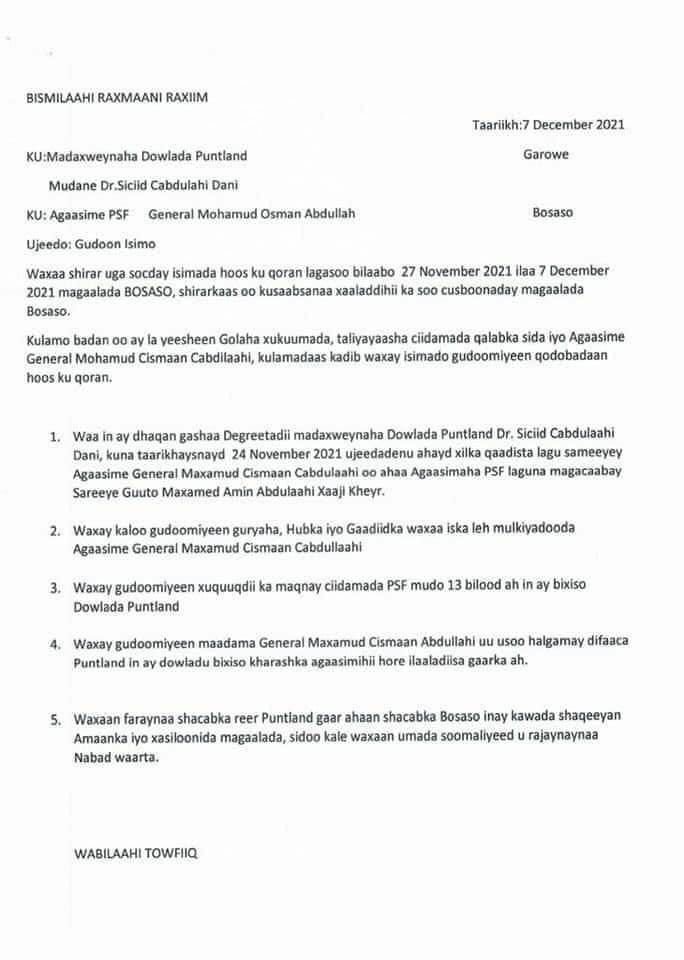
The undersigned traditional elders have issued a statement forfeiting their role in peace-making and conflict resolution. Instead, they put more fuel to the fire. Their partial recommendations to the Puntland Government is flatly unacceptable. It is an offer designed for Puntland Government to reject outright.

These titled #elders in #Bari Regions of #Puntland State have proved to be a party to Bosaso standoff. They have finally lost any credibility for the good of Puntland.

It is historically important to note that these titled elders, who have issued this document represent exactly the same sub-clans in Bari Region that rose against Puntland President then, Abdullahi Yusuf, exactly for the same reasons for power struggle in 2000-2001.

EXCERPTS FROM “SOMALIA IN SEARCH OF STATEHOOD”

AN ESSAY ON THE STATE, CLANNISM AND NATIONALISM

By Ismail H Warsame

AUTHOR’S CONVICTION ON THE SUBJECT MATTER UNFRONT

“The name Somalia as a united entity is relatively a new term, following the beginning of colonial administrations in the country. Clannism in Somalia isn’t the core problem of state building, but a symptom of system vulnerability in governance in regulatory fashion: For example, the separation of state and clan allegiance in public service in the same manner the Western World managed to do on the separation of the state and the church is the way forward. Here you can keep your clan belonging, but don’t mix it with public service. It would be a violation of the state law if you do it. Therefore, there is a mismanagement and lack of regulations on the clan system in Somalia. Tendency in Somalia’s governance to tyranny and dictatorship is fear of losing state control, on the top of selfish interests on the part of the leaders of the day, clan rivalry and self-preservation. Anti-decentralization or anti-federalism is a paranoid of losing central state power. Under these fears, stakeholders in national matters are unnecessary nuisance to central authorities. Nationalism means distraction from difficult issues of nation-building and necessary national development projects expected of state leaders. Patriotism, promotion of Somalia’s cause and learning Somali history aren’t encouraged. Power-sharing is misused to weaken meritocracy and competence, leading to the consolidation of a client state and patronage in public service. Checks and balance of power between branches of the government is perceived in Somalia as a power struggle and a threat to those in executive positions”.

INTRODUCTION

Writing Talking Truth to Power in Undemocratic and Tribal Context, Articles of Impeachment and HAYAAN, The Long Journey of the Nomad Boy (Safarkii Dheeraa Ee Wiilka Reer Miyi), has convinced me that the subject needs further writing and deeper analysis. Hence the title “Somalia In Search of Statehood, An Essay on the State, Clannism and Nationalism, was conceived. Much has been written on the subject, but these works were either produced by foreign writers with limited understanding of Somali culture (literature and language) or by native minority writers whose motivation was to expose their grievances against majority rule to advocate for minority rights in the country. The first group of writers were not adequately informed, but the 2nd group couldn’t escape bias in the subject in their exposition. Both couldn’t adequately reflect on the true picture of what went wrong in Somali politics. Foreign anthropologists and historians of I M Lewis type on the subject were influenced by colonial legacy in the country.

There is another group of Somali writers, the diaspora. This group is mostly remnants and survivors of the Somali Civil War. They subliminally believe in strong central government. They interpret devolution of power and federalism as foreign instigations and manufacture with the intention to weak the Somali State. They don’t recognize that federalism is a de facto reality rather than de jure following a vicious Civil War that ended up in clan cleansing in Mogadishu, the Capital City, and elsewhere in the country. They blame Ethiopia for establishing ethnic federalism in that country and managing to replicate it in Somalia, using proxy agents of Somali warlords and politicians. Predominantly, these diaspora writers either had grown up and lived under the iron-fist of the Military Regime of Siyad Barre or had influenced the younger generations in the diaspora. Many of them avoid travel to Somalia and the few who come don’t venture out beyond the Centre of what is wrong now in Somalia, Mogadishu, where law and order is a thing in the distant past and their yardstick to evaluate current situation of Somalia. They have lost sense of reality elsewhere in the country.

But, most dangerous of all are the ignorant masses who see different heads of state and government of the Federal Member States as something strange and symbol of what was wrong in Somalia as they hear or see strong nation-states around Somalia. They don’t recall that Somali State had failed and to put it back together it was needed to restore trust among warring clans via decentralized or autonomous regions, the Federal Member States (FMS). Now FMS isn’t cast on stone – they could change over time in a negotiated fashion as the central authority stands on its feet again and expands its influence throughout the country”. Federalism in Somalia could be a temporary arrangement. But, what isn’t acceptable anymore is return to city-state status in Mogadishu”.

THE NATURE OF SOMALI STATE AND GOVERNANCE

The state and Somalia itself are nothing more than a collection of confederal clans and sub-clans. This state as a central entity is a legacy and by-product left behind by colonial powers of Europe, namely Italy, Britain and France –Britain being the biggest offender among them and share-holder, occupying 2/5th of Somali territory. As mostly nomadic as they were, they were hard to be governed and less technology the colonial administrators possessed, the less cultural impact and subjugation they had on the nomads, with limited success on the docile farming communities of southernmost Somalia. Nevertheless, they left the country in a seemingly free country, although they had secured in their place loyal a bureaucracy behind. The vision of Somali Youth League (SYL) was effectively undermined by neo-colonialism methods of cultural domination among the bureaucracy left behind. Education sector barely met the needs of literacy for a backward country with a small population of 100% illiterate. Soon a few Somali graduates from educational institutions other than Italian found themselves unable to adjust and fit into the Italian-made bureaucracy as they return home. Prime Minister Abdirisaq Haji Hussein’s famous joke, “from Sagaara Doox to PhD”, adequately explains the educational gap and scale of ignorance that existed. The colonial statecraft imported continued to function, initially with the assistance of colonial expatriates as technical experts. Nothing changed in country’s governance, and eventually even the bureaucracy inherited from foreign powers was overthrown in a coup by the country’s security forces, recruited under the supervision of various foreign powers (Italy, Soviet Union, Britain, Egypt, and Iraq, among others). The leaders of the military coup were even more confused than the politicians they replaced with different military training acquired from numerous different foreign countries with competing ideological and economic interests in Somalia. The entire country continued to be in a state of permanent confusion. Corruption and cronyism became the modus operandi in the poorest country in the world, with unexploited natural resources believed to be in abundance. Ideological fight within each sector spared no one. Religious sectarianism funded and promoted by Saudi Arabia, other Gulf States, Egypt and even Iran, spread like wildfire. Everything dear to Somali culture and fine traditions had been suffering from lack of protection. Vulnerable portions of the society like children, women and minorities were targeted by unscrupulous entities, groups, individuals of both local and foreign origins. The country was invaded by International NGOs, using local agents, which they called non-state actors (NSA), to fill in the power vacuum, and turned them into human intelligence gathering centers. The military coup of 1991 made the situation even worse, introducing mass arrests, torture chambers and indoctrination centers. As a result, unruly clannish rebellions against the regime succeeded in toppling the junta with no replacement in its place other than mobs and mob culture, especially South-central Somalia.

Since Somalia is still searching for legitimate and responsible authorities, it is unable to come up with innovative ideas on governance of its own other than federalism or confederalism. However, there is still an uphill battle facing the new governance system. Why confederalism? Here is why:

Terms or names like Hawiye, Digil, Mirifle, Raxanweyn, Isaak, JareerWeyn, Dir, and even the country’s name Somalia, have no common ancestral relations as individual groups. Each of these names are political and social constructs for reasons beyond the scope of this short article. Paradoxically, these confederal tribes are now resisting to apply the term to the collective name of “Somalia”. Whom are they kidding?

Now, two junior researchers from ill-gotten and privately misappropriated SIMAD College in Mogadishu, illegally acquired, owned and operated by former Somali President Hassan Sheikh Mohamud, AbdiNor Dahir and Ali Yassin Sheikh Ali, have just used their first professional work to denounce federalism as inapplicable to Somali governance, fraudulently disregarding the fact that Somalia is a confederation of tribes, and thus ignoring this fundamental truth in Somali governance that lie in the state failure and entire predicament of Somalia as a country and nation-state.
These junior researchers from SIMAD even dared to call Puntland and Somaliland as children born out-of-wedlock in the federation in the sense that they were established before Galmudugh and Hirshabelle Federal Member States. Abdinor Dahir and Ali Yassin Sheikh Ali, in a pseudo-research paper called Federalism in Post-Conflict Somalia, have come up with half-truths: https://doi.org/10.1080/13597566.2021.1998005

Nowadays, since most Hawiye scholars try not to come out openly against federalism due to the fact that it was enshrined in the Provisional Federal Constitution, and that their Hawiye constituencies are now parts of the federation, they find the term “Decentralization” fashionable as way of resisting federalism, confederalism or anything outside “city-state”.

SOMALI NATIONALISM

In Somali politics, the term and spirit of nationalism was used as a rallying cry for the struggle for national independence from colonial powers of Europe and Ethiopia. Somali politicians had had no vision or strategy beyond attainment of freedom and unification of all parts of the country under colonial rule. There were no friends of Somalia cultivated among powerful nations to help in the fight for unification. This is where former Somali leaders abysmally failed the nation. This is where lack of formal schooling, ignorance and nomadic pride as deadly combinations had been proven fatal in the case of Somalia, unfortunately.

CONFEDERAL SYSTEM IS NOT NEW TO SOMALIA, BUT SOLIDLY BUILT INTO ITS TRIBAL FABRIC


Terms or names like Hawiye, Digil, Mirifle, Raxanweyn, Isaak, JareerWeyn, Dir, and even the country’s name Somalia, have no common ancestral relations as individual groups. Each of these names are political and social constructs for reasons beyond the scope of this short article. Paradoxically, these confederal tribes are now resisting to apply the term to the collective name of “Somalia”. Whom are they kidding?

Now, two junior researchers from ill-gotten and privately misappropriated SIMAD College in Mogadishu, illegally acquired, owned and operated by former Somali President Hassan Sheikh Mohamud, AbdiNor Dahir and Ali Yassin Sheikh Ali, have just used their first professional work to denounce federalism as inapplicable to Somali governance, fraudulently disregarding the fact that Somalia is a confederation of tribes, and thus ignoring this fundamental truth in Somali governance that lie in the state failure and entire predicament of Somalia as a country and nation-state.
These junior researchers from SIMAD even dared to call Puntland and Somaliland as children born out-of-wedlock in the federation in the sense that they were established before Galmudugh and Hirshabelle Federal Member States. AbdiNoor Dahir and Ali Yasin Sheikh Ali, in a pseudo-research paper called Federalism in Post-Conflict Somalia, have come up with half-truths: https://doi.org/10.1080/13597566.2021.1998005

Nowadays, since most Hawiye scholars try not to come out openly against federalism due to the fact that it was enshrined in the Provisional Federal Constitution, and that their Hawiye constituencies are now parts of the federation, they find the term “Decentralisation” fashionable as way of resisting federalism, confederalism or anything outside “city-state”.

WDM EDITORIAL

SOMALIA’S SHAM ELECTIONS RISK RENEWED CIVIL WAR

WHAT is happening in Somalia now is holding fixed parliament elections before our eyes, discarding any notion that we had learned anything from the mayhem of three decades of turmoil and statelessness. A failed state still means nothing to most Somalis, based on my personal observations.

At moment, we are at brink of a renewed civil war. If we don’t step back, that could herald the end of Somalia as we knew it. It looks with more certainty that we won’t have a 2nd chance this time around, if we don’t stop Federal election shenanigans immediately. We have never seen a history of such sham elections, where the entire command and directors of intelligence service (NISA) of a country had conspired to steal an election with the help and consent of a Head of State and Head of Government. This is beyond serious development. It is a felony.

Shall we continue sleepwalking along this trajectory of doom, or hold back to survive? This decision is ours only, and no one else to blame for our stupidity.

NISA CANDIDATES TO SOMALIA’S PARLIAMENT

SOMALI HISTORY

Due to the frequency of shipwrecks in the treacherous seas near Cape Guardafui, the British signed an agreement with sultan Osman Mahamuud of the Majeerteen Sultanate, which controlled much of the northeastern Somali seaboard during the 19th century. The agreement stipulated that the British would pay annual subsidies to protect shipwrecked British crews and guard wrecks against plunder. The agreement, however, remained unratified, as the British feared that doing so would “give other powers a precedent for making agreements with the Somalis, who seemed ready to enter into relations with all comers.”[5]
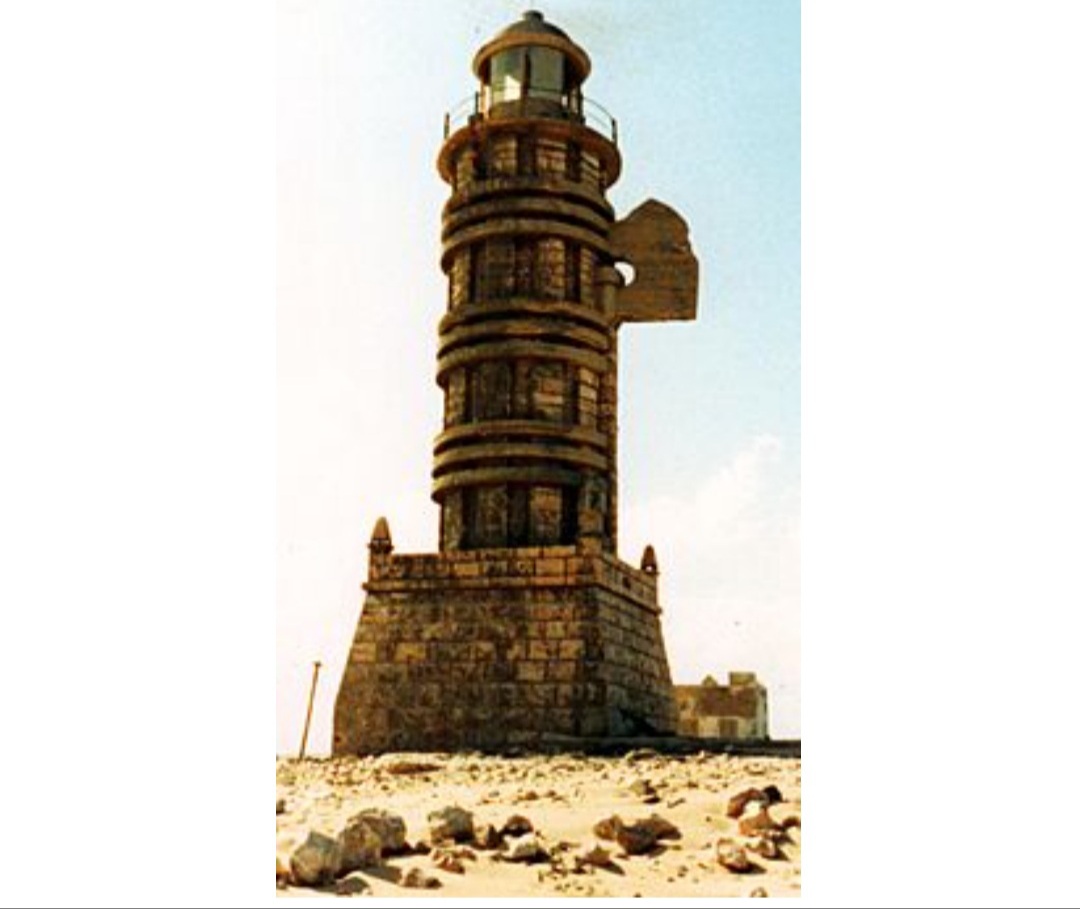
Sultan Yusuf Ali Kenadid of the Sultanate of Hobyo, which also controlled a portion of the coast, later granted concessions to an Aden-based French hotel proprietor and a former French Army officer to construct a lighthouse in Cape Guardafui. Capital for the project was raised by a firm in Marseilles, but the deal subsequently fell through.[6]

(Courtesy: Wikipedia)