How an intelligence officer’s disappearance in Somalia has ripped the government apart

Washingtonpost article (courtesy).

By Rachel Chason and Omar Faruk Today at 1:38 p.m. EDT

NAIROBI — The disappearance of a young intelligence officer in Somalia has led to a rapidly escalating power struggle between the president and prime minister that has torn the government apart and potentially gives new openings to al-Qaeda-linked militants.

Details of what happened to Ikran Tahlil Farah, a 25-year-old cybersecurity analyst, are still murky. But her abduction led President Mohamed Abdullahi Mohamed on Thursday to suspend the powers of the prime minister, who has accused him of obstructing justice in Tahlil’s case.

The political showdown risks becoming a security crisis, experts say, and has blown up any pretense that Somalia’s federal government is functioning. That could strengthen the hand of al-Shabab — which Somalia’s government has been fighting for years, aided by billions of dollars in security support from the United States.Story continues below advertisementnull

“Anytime you have this level of political infighting, it benefits al-Shabab in so many ways,” said Omar Mahmood, senior Somalia analyst at the International Crisis Group. “This narrative paints into everything they say about the federal government. That it is ineffective, weak, divisive and provides nothing to the public. And it is hard to argue against that.”

Implications of the back-and-forth between the president, known by his nickname, Farmaajo, and Prime Minister Mohamed Hussein Roble rippled Friday across international borders. The president’s office accused neighboring Djibouti of illegally detaining the former head of the National Intelligence and Security Agency, Fahad Yasin, as he tried to board a flight to Mogadishu. Roble suspended Yasin — who is known as the president’s right-hand man — earlier this month in connection with Tahlil’s disappearance.

Djibouti’s foreign minister rejected the assertion by Somalia’s government, saying it was meant to “create confusion and drag Djibouti into Somalia internal challenges and crisis.”Story continues below advertisementnull

The events were just one example of increasing tensions that could risk further delaying an already slow-moving election process, Mahmood said. The elections involve committees of sub-clan elders convened around the country to elect members of Parliament, which then elects the president. Only 37 of the 330 open seats, including the presidency, have been filled, he said. The president is currently serving more than seven months past his term.

“It’s time to start talking about more punitive measures from the international community to keep everyone in line before the election,” Mahmood said.

Among officials in Washington, there has been increased concern about the situation in Somalia since February, when gunfire broke out on the streets of the capital, Mogadishu, after the president did not hold scheduled elections. That raised questions about the depth of Somalia’s political instability — and about whether U.S. strategy needs to shift.

But there have been few changes to U.S. policy since the Trump administration ordered the removal of 700 U.S. soldiers from the country, with the United States continuing to support military operations in the region against al-Shabab.

Al-Shabab controls the majority of Somalia’s interior and has about 10,000 active fighters in the country, experts believe, with a much larger network of supporters. An attack it launched in Kenya last year killed one U.S. service member and two American private contractors, according to a U.S. military statement. But the biggest risk al-Shabab poses, experts say, is to residents within Somalia and to its neighbors in the region, where attacks are regular.

Biden’s top intelligence official said Monday that the greatest terrorism threat to the United States does not come from Afghanistan but from countries including Somalia, Yemen, Syria and Iraq.

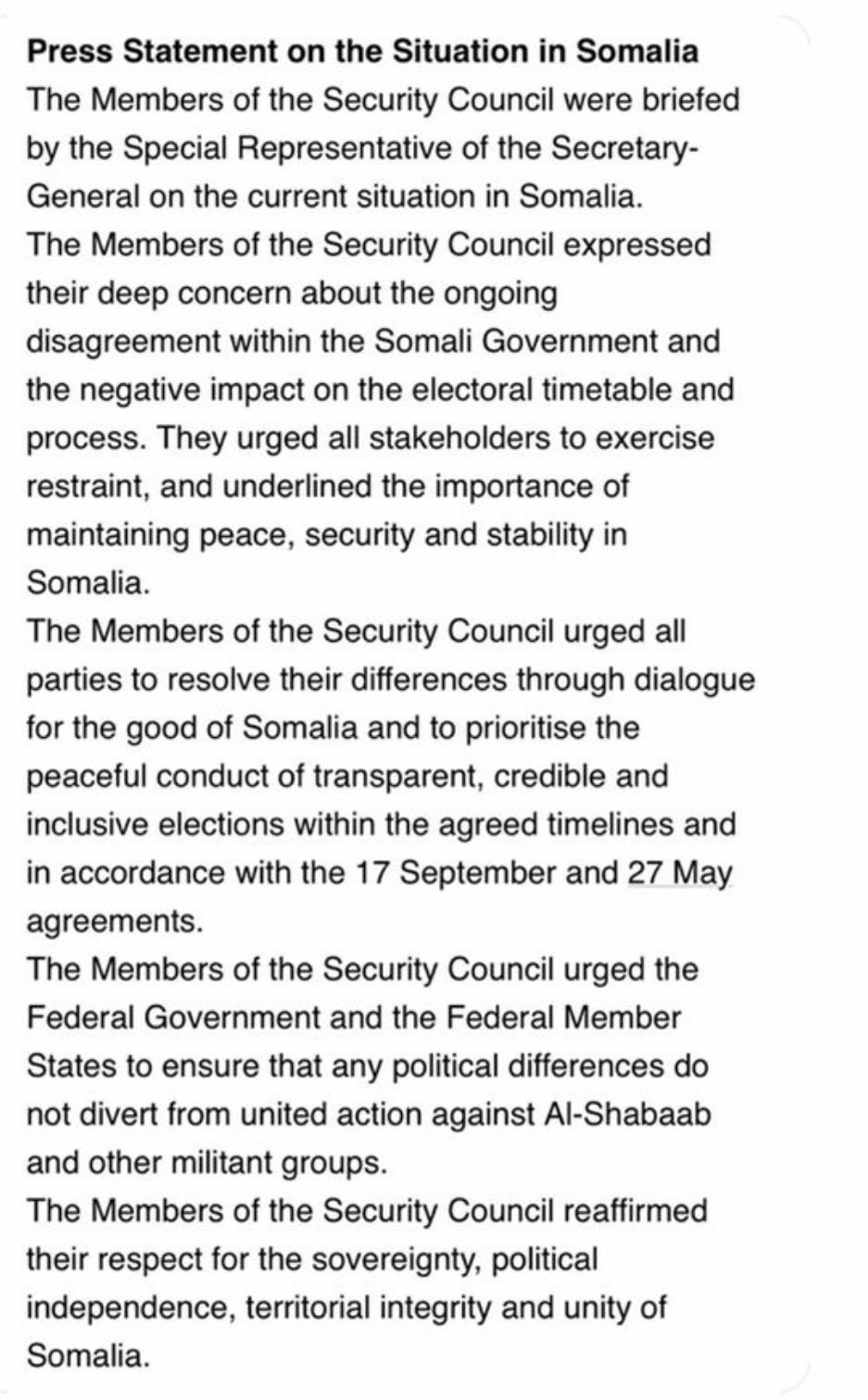
Members of the U.N. Security Council released a statement Saturday expressing “deep concern about the ongoing disagreement within the Somali Government and the negative impact on the electoral timetable and process.”

‘If I don’t pay, they kill me’: Al-Shabab tightens grip on Somalia with growing tax racket

Rep. Michael McCaul (Tex.), the ranking Republican on the House Foreign Affairs Committee, said he is closely monitoring current political divisions within Somalia and “deeply concerned about the trajectory of the country.”

“With the withdrawal of U.S. forces from Somalia and an emboldened al-Qaeda network from the continued debacle in Afghanistan, al Shabaab is surely taking notes,” McCaul said in a statement. “They remain a dangerous and capable threat to U.S. interests and the homeland. Unfortunately, years of support to the Somali armed forces and billions of dollars of assistance has barely moved the needle toward lasting stability in the country.”

Facing intense pressure from the West after the violence in February and April, including threats of sanctions from Secretary of State Antony Blinken, Somalia’s president — once a Department of Transportation administrator in Buffalo — backed down and agreed to hold elections. Roble was tapped to lead the process in May.

It was not too long afterward — on June 26 — that the analyst Tahlil was abducted, said her mother, Qali Mohamud Guhad, in an interview. The last time she spoke with her daughter was via a WhatsApp call that night, Mohamud said. Tahlil told her that she was going to see the security chief Yasin, who she said had been calling her all day.

The intelligence agency announced in early September that an investigation found that al-Shabab had killed Tahlil. But the terrorist group quickly denied it, saying it takes responsibility for attacks on intelligence officers and did not kill her.

Mohamud said she is still holding out hope that her daughter is alive somewhere in captivity. She said she does not know why Tahlil was abducted, but noted that her daughter had information about soldiers from Somalia who were rumored to have been sent by the government to fight in Ethiopia, which has been one of the many political weak spots for Somalia’s president.

Somalia’s politicians strike a last-minute deal, but fears of conflict remain high

Mohamud personally met this month with Roble, who she said assured her that he would take the steps necessary to achieve justice.

Roble’s decision to suspend Yasin — over the objections of the president — reportedly led this month to a brief military standoff, after each selected a different person to lead the intelligence agency. Roble’s spokesman, Mohamed Ibrahim Moalimuu, said in an interview Saturday that he views the president’s suspension of his powers as unconstitutional and that the prime minister is committed to seeing the elections through.

“The more [the president] stays and keeps doing these illegal and unconstitutional behaviors, the closer we get to a civil war,” said Ismail Osman, a former NISA deputy chief, who is based in Washington.

Matt Bryden, director of Sahan Research, a Somalia-focused think tank, said that al-Shabab’s strength is always in inverse proportion to the weakness of its adversaries.

“It fills a vacuum,” he said. “And this is a protracted vacuum.”

Faruk reported from Mogadishu.
UK statement on the political crisis in Somalia

Press release

Vicky Ford, Minister for Africa, has issued a statement about the escalating political crisis in SomaliaFrom:Foreign, Commonwealth & Development Office and Vicky Ford MPPublished18 September 2021

Minister for Africa, Vicky Ford said:

The UK is deeply concerned by the escalation of the current political crisis in Somalia. The situation threatens to undermine the credibility of Somalia’s leadership and risks the safety and future of the Somali people.

It is vital that Somalia’s leaders refrain from unilateral actions that could deepen political tensions, including any further public statements and personnel announcements which could increase the risk of violence.

We urge that all stakeholders maintain peace to avoid any risks to Somalia’s stability and security. Likewise, it is important that Somalia’s security forces remain focused on countering the common threat of Al Shabaab, who stand to gain from this ongoing political crisis. As champions of the debt relief efforts, the UK also urges the de-politicisation of Somalia’s finances to protect the gains made through the process.

This is a moment for statesmanship, restraint and compromise. We look to Somalia’s leaders to engage in meaningful mediation and to agree ways forward that de-escalate the situation and restore the focus on the priority of conducting peaceful elections, as agreed on 27 May, without further delay. Somalia needs effective governance. The continued failure to move quickly towards elections will increase insecurity and exacerbate the grave humanitarian challenges the country is facing.

A continued deterioration in the situation leading to further electoral delays will have a substantial impact on the legacy of Somalia’s leaders.

Media enquiries

Email newsdesk@fcdo.gov.uk

Telephone 020 7008 3100

Contact the FCDO Communication Team via email (monitored 24 hours a day) in the first instance, and we will respond as soon as possible.

UN SECURITY COUNCIL: PUT UP OR SHUT UP

House of Cards in Villa Somalia

white and blue game cards on blue and white table

Source: Sigmund 2020

ANALYSIS René Brosius 17 September 2021

In April 2021, after Somalia was on the brink of civil war, it seemed for a long time that the solution would be found in a tough (s)election process. The May 27, 2021 agreement and Prime Minister Roble’s timetable presented at the end of June stipulated that this process would be completed by October 10, 2021. A new president would then also be elected by the new deputies of both chambers by the end of the year. With just over a month to go before the end of this deadline, events in Mogadishu are coming to a head. In order to grasp the significance and impact of these upcoming events, the protagonists must be introduced once again: 

(1) Mohamed Abdullahi Mohamed (“Farmajoo”) came to the presidency with great sympathy in February 2017. However, his tenure has been marked by increasing political violence and a politicization of the security and army apparatus. Although there has been modest economic growth, little progress is visible in the areas of state-building, political freedoms, anti-corruption, or democratization. He is considered an ally of Ethiopian Prime Minister Abiy Ahmed and Eritrea’s autocratic president, Isayas Afewerki. With other neighbours, conflicts have been repeatedly reported. Conflicts that triggered breaking points in diplomatic relations. In the spring of 2021, his attempt to extend his term by two years provoked considerable opposition both in Somalia itself and among international partners.

(2) Fahad Yasin, was until recently head of the notorious NISA intelligence agency and is considered a close confidant of the president. After the largest terrorist attack in the country’s history, on October 14, 2017, with nearly 600 dead, the intelligence service was initially disbanded and shortly thereafter reconstituted with presidential loyalists. Fahad Yasin is considered the mastermind of the strategy of using violence, intimidation, and pressure on individuals as political tools. This included the targeted recruitment of employees of certain clan affiliations to secure loyalties. NISA has since evolved to be an uncontrollable force in the country. Al Shabab has never claimed responsibility for the devastating attack in 2017. Suspicions suggest that this only served as a smokescreen to reorganize the intelligence service at the time as well as Somalia’s entire security apparatus accordingly. Fahad Yasin is also considered Qatar’s representative in Somalia. He is said to have ties to Al Shabab and Al Qaeda. Many political assassinations claimed by Al Shabab, such as the assassination of the former mayor of Mogadishu, Abdirahman Osman (“Yerisow”), were only possible through insider knowledge. As a result, rumors of cooperation between NISA and the terrorist organization have surfaced time and again.

(3) Ikraan Tahliil, (was) a young woman from Mogadishu who was considered highly gifted in mathematics as a child. She was recruited early by NISA and trained in cybersecurity. It is said about her that she had no concerns with the new direction of the intelligence agency. She quickly made a career for herself, arguably gaining information about intelligence activities that made her a danger to Fahad Yasin and other top regime officials, such as the background of certain assassinations. This was followed by her flight to Great Britain. After apparently threatening her family, she returned to Mogadishu in late June 2021. After a brief visit with her family, relatives report, she was picked up by a high-ranking NISA employee in an official vehicle. After that, her trace was lost. The parents put pressure on the public and worried about the fate of their daughter. Calls for an independent investigation were made. Two months later, in early September, Radio Mogadishu (a pro-government station) announced, without further background, that she had been murdered by Al Shabab. This account was followed by widespread public scepticism, especially on social media. How could an experienced intelligence officer have been abducted and murdered from one of Somalia’s most secured buildings – the NISA headquarters? Shortly after the radio reports, Al Shabab also denied having anything to do with the young woman’s disappearance.

(4) Prime Minister Mohamed Hussein Roble is formally the head of government and thus also the chief executive. After former Prime Minister Hassan Ali Khaire was unexpectedly dismissed without prior political debate in July 2020, Farmajoo appointed the politically completely unknown Roble, a man from the Swedish diaspora, as the new prime minister on September 23, 2020. Judging by his past actions, he seems committed to a prompt and transparent election. He is supported by the opposition in this. He has repeatedly been said to have presidential ambitions, though he has always expressed the opposite view. On one of his conspicuously frequent visits abroad, he recently said that he could not be a neutral mediator in the elections if he ran himself. He is seen as a reconciler with neighbouring Kenya and also strikes more moderate tones with regard to Somaliland and Saudi Arabia.

A lot has happened between these actors in the last two weeks. After public protest regarding the alleged death of Ikraan Tahliil did not die down, Roble set a 48-hour deadline for the head of NISA to personally brief him on the background of the case. After 24 hours, Fahad Yasin then published an open letter in which he made a counter-proposal. He suggested reporting to the Presidential Security Council instead. It was not the intelligence chief’s first disrespect for the prime minister. When Roble removed Deputy Intelligence Chief Abdullahi Kulane a few weeks ago for intimidating opposition politicians on behalf of the government and being responsible for various acts of violence within the country, Fahad Yasin promptly appointed him as his personal security advisor. It was an affront that called into question the prime minister’s authority. Immediately after the counterproposal, Roble therefore dismissed Fahad Yasin and appointed a new intelligence chief. Farmajoo, whose term expired Feb. 8, 2021, strongly criticized this decision, calling it unconstitutional – also on social media. After initially trying to keep his confidant Fahad Yasin in office, he later appointed him his personal security adviser and promoted the NISA chief of Mogadishu, who was loyal to him, as the new Somali intelligence chief. He published this decree via also the official account of the Somali Chancellery, Villa Somalia (413,246 followers). These two political counter-positions physically clashed at NISA headquarters. While the headquarters was surrounded by Farmajoo loyalists to prevent the prime minister-appointed chief from entering, Robles’ supporters took control inside the building, according to media reports. Concern is high that there will be fighting between government forces. The opposition, as well as some states, support the prime minister’s actions. So do large parts of the cabinet. After some ministers declared that they were loyal to the prime minister, Roble took advantage of this moment to dismiss another of the president’s confidants, the minister of security (interior minister).On September 9, 2021, he instructed the Minister of Finance to disburse all payments from public budgets, including funds provided by the IMF, only after prior approval by the Prime Minister’s Office.

1 Month Before the Elections

With just over a month to go before the elections, the country is therefore once again on the brink of armed conflict. Not so much between the opposition and the government, as was the case in April 2021, but the split appears to be running amidst the government. If the goal of either side was to make the situation as confusing as possible, it has succeeded very well. Outsiders, such as the international community, find it difficult to comprehend the moves of the individual actors, and the comments are correspondingly thin-lipped. On the prime minister’s credit side, despite these events, the upper house elections in Puntland, Jubaland, Galmudug and South West State have already been completed, and the elections in Hir Shabelle and for Somaliland seats will be concluded shortly. What impact this will have on the electoral process for the lower house and the support of each presidential candidate is unclear. One can assume, however, that in many places the actual political course has already been set with the upper house elections in mind, and that the lower house elections can be realized much more quickly. In Mogadishu itself, however, the situation has intensified. If Roble prevails, Farmajoo seems significantly weakened politically. With Fahad Yasin, he loses his eyes and ears as well as his arsenal of threats. In addition, he loses the ability to appeal to and mobilize his still quite numerous supporters in the military and security apparatus through the usual chains of command. He and his supporters also appear to have lost access to finances, one of the most important instruments in Somali political practice, especially with regard to the loyalty of the security forces. 

While now the president’s (remaining) supporters argue that the prime minister was originally given the power to organize only the election and therefore there is something unconstitutional about his behaviour, the prime minister’s supporters take the position that only with this power can the ongoing disruptive manoeuvres on the part of Villa Somalia be prevented and the elections properly conducted. The point, they say, is to prevent continued negative influence on the elections and thus not to jeopardize the credibility of the incoming government. However, the whole skirmish is more than just about who has the real power in the country. It is also a bit about the soul of the country. Is it permissible to have a power in the country, NISA, that can get away without a judicial process even in targeted killings? An experience the country has had over decades of Siad Barre’s dictatorship. The appointment of those responsible as advisors to the government currently serves primarily to protect them from prosecution. Thus, part of the conflict is also the question of whether the case of Ikraan Tahliil will be investigated by a military court or whether-as Farmajoo has suggested-there should only be a compensation payment to the family to prevent a public investigation. Already, the first voices are being raised to prevent a possible departure/escape of those responsible, including Farmajoo, so that his reign can be judicially reviewed. These voices are matched by other cases being brought all over the country, such as against those responsible for the kidnapping of the Islamist and then candidate for state-president of South West State, Mukhtar Robow. The latter has reportedly been held without trial in house arrest in Mogadishu since 2018. Several people were killed in the demonstrations against this detention. If one wants to find something positive in this situation, it is ultimately these reflexes to the rule of law that make one optimistic. Should Somalia succeed in electing a new and accepted government, the population and also the (clan-) system would have proven resilient to autocratic structures-despite all prophecies of doom. The international community should honor this fact accordingly.