4.5 clan system ( to which Federal Member States and Federal Government belong)
Al-Shabab and other religious groups
International Community and Somalia’s foreign partners ( who bankroll AMISOM and other security firms).
Peace-making and stabilization of Somalia critically depend on these forces.
The difficulty lies in bringing these forces to talk for peace. Victory of one over others is inconceivable, if not impossible. To defeat Al-Shabab requires the other two forces to sincerely agree to work together as a team. So far there is a discount in that regard. Failing to secure such cooperation makes makes it difficult, if not impossible, to remove the obstacles along the way to re-build a viable nation-state in Somalia. Let us acknowledge and accept the realities on the ground. That would need national/international comprehensive plan of action to seriously meet the challenges of the time. The alternative is wishy-washy that goes nowhere and waste resources and energy for everybody. Forthcoming elections alone, though necessary, wouldn’t resolve the existing governance and security situation.
I am in Garowe, the Capital City of Puntland State of Somalia, staying in one of the decent hotes in town. In the hotel, I am annoyed by mosquito bites at night. I therfore opted for using mosquito net. This morning I woke up at 7 am. I had to come out of the hotel to renew my circulation permit for my 4-wheel drive vehicle. Soon I found myself in the hotel campound. The ground looked wet or strangely sweating. Visibility was almost zero. I asked someone whether it was raining overnight. He said, “not at all”.
I quickly got out of the hotel campound gate to get into the vehicle. The windshield was covered with fog and dew. I used wipers to clear my view. Most people walking around were school students going to classes. They seemed to be shivering with cold, but unproperly dressed for the foggy wheather, instinctively thinking that it would get very hot before mid-day – a correct guess as it turned out.
I drove straight to the Ministry of Transport to find out the gate at campound was closed. The watchman told me that there was no electric power at Ministry, but he could let me in to find out that myself. I agreed and drove into the campound to find out many dust-covered and obviously long time ago abandoned motor-vehicles filling up one-third of the Ministry’s campound space. A few old men, supposedly retired from Somalia’s civil service idly loiterred around. Three young men were sitting on plastic chairs in the middle of the campound , busy with their smartphones. The doors to the offices were open, but there was no movement of people. By this time it was 8 am, but the Ministry seemed lifeless. I approached to the young men and I asked them, “How could I renew road stamp? “There is no electric power to do that”, one of them said. “Are you expecting the power to be back”, I asked. “No” said one man. “What is my option?”, I asked. “You should go to a check-point outside the city to try to get your sticker”, advised one man.
I drove to an entry check-point at Westend of the city on the highway to Galkayo. Ministry Office of on-land Taxation is located in badly cramped and poor squater-like huts. There is one office with inscription: Xafiiska Canshuurraha Berriga. I went inside to find two guys sitting on chairs at opposite side of a wooden table, playing cards at 8:15 am and a teenager behind a dust-covered computer monitor.
“Do you issue sticker-stamps for vehicles?”, I asked. “Yes, we do”, said the older guy playing cards. “Show your papers to that boy”, he directed. I handed my older receipts to the boy. ‘Ow! You owe money! He exclaimed. “Yes, I know. That is why I came here in the first place”, happy that here they have at least electric power and access to a computer terminal. While the teenager was processing my papers I looked around in the room. There were mattresses, dirty and coloured bedsheets pushed towards back-wall of the room and behind the plastic chairs at two computer-terminals. There was a counter before the computers.
Finally, I happily paid off my dues and was off driving back to the City.
There is a lot to do in Puntland, and most importantly, to carry out deep administrative reforms and civil service capacity-building.
Somali President Mohamed Abdullahi Mohamed, shown in London in 2017. (Jack Hill/Reuters)By Max BearakFeb. 26, 2021 at 4:36 p.m. EST
NAIROBI — In a meeting late Thursday, Somalia’s prime minister persuaded opposition leaders to postpone mass anti-government protests and apologized for violence last week that targeted candidates in an election that was meant to take place this month but has been delayed indefinitely.Support our journalism. Subscribe today.
Somalia is in a protracted constitutional crisis, with opposition leaders claiming that President Mohamed Abdullahi Mohamed — commonly known by his nickname “Farmajo” — has overstayed his mandate. Tensions spiked on Friday last week, leading to exchanges of gunfire on the streets of the capital, Mogadishu, and heightening fears that the election dispute could spiral into civil conflict.
Thursday’s meeting did not yield a new date for the election, and Farmajo, who has become an increasingly controversial figure, was not directly involved in the agreement.
While Somalia’s Western backers heralded the deal negotiated by Prime Minister Mohamed Hussein Roble as a step in the right direction, security officials said the potential for conflict remains high. Security forces are under increasing pressure to take sides amid deepening political divisions.
“As long as there’s no political agreement, we’re in a phase where we have no idea what will happen regarding how the different armed forces will react if there is sudden violence,” said Jihan Abdullahi Hassan, a former senior adviser to Somalia’s defense minister.
Somalia has an array of military units, some of which are professionalized, federally controlled and trained by foreign advisers, while others are more closely aligned with regional governments that have been at odds with the administration in Mogadishu over how elections should be held.
Efforts to bring all armed forces under federal control have succeeded in streamlining payrolls, instituting codes of conduct and restructuring military leadership, but they have not erased underlying divisions, Hassan said.
“It’s a predicament,” she said. “The forces are not nationally integrated yet — they are close, but they are not there yet. We cannot allow them to slide back into political or clan rivalries.”
In Mogadishu, the mood Thursday was tense. The city was choked with traffic as roads were closed ahead of the protests planned for Friday and residents stocked up on essentials, fearing the demonstrations would be met with bullets. Under Thursday night’s deal, the opposition agreed to delay the protests for 10 days.
Somalis protest the government and the delay of the country’s election in Mogadishu on Feb. 19. (AP)
Earlier this week, the president of one of Somalia’s regions, Puntland, recounted in a widely viewed speech how Farmajo had boasted to him about having enough armed forces behind him to stay in power as long as he wanted.
While a constitution introduced in 2012 sets out guidelines for the creation of a constitutional court that would adjudicate disputes between Somalia’s member states, as well as potential presidential impeachment proceedings, neither Farmajo nor his predecessor took the necessary steps to create the court.
Some within the security establishment have started to speak out about what they perceive as Farmajo’s inclination to use various branches of the security forces to quell any opposition to him.
“No opposition has said, you have to shoot the president. But on the president’s side, we have been asked to act strongly against the opposition,” said an aide to Somalia’s police commissioner, who spoke on the condition of anonymity because he was not authorized to speak to the media.
A former top army commander, Mohamed Ali Barise, was more blunt in his assessment.
“Farmajo sees the armed forces and intelligence services, and even police, as a personal instrument to achieve his own ends,” he said. “Since he came to power, he has been trying to install like-minded officers, even his extended family and clan members, in higher-ranking positions. Our hopes are with wise officers who will refuse — but no doubt they will be chased away, fired, isolated, may even risk their life to do that.”
An official in the special forces unit that is widely considered Somalia’s most effective, known as Danab, which is trained by U.S. Special Operations forces, said its top commander had been asked by Farmajo to relocate some of its troops to Mogadishu ahead of last week’s protests, but the request was turned down. The official spoke on the condition of anonymity to frankly discuss a politically sensitive issue.
Other special forces units, known as Gorgor and Haramaad, both trained by the Turkish military, were deployed last week in Mogadishu, he said.
Last month, the U.S. military completed the withdrawal of about 700 personnel who were based in Somalia largely as part of a training mission but who occasionally participated in ground raids on targets suspected to belong to al-Shabab. The al-Qaeda-affiliated militant group controls much of rural southern Somalia and has contributed to the country’s persistent instability.
The political crisis will distract the country’s security apparatus from its efforts against al-Shabab, analysts said, potentially creating an environment in which the group could operate more freely and regain territory it lost to the government over the past decade.
If a political agreement remains elusive, “the unity of effort in the war on terror will be lost, and we will continue to witness the strengthening of al-Shabab,” said Mohamed Mubarak, executive director at the Hiraal Institute, a Somali think tank.
Both Farmaajo and the Union were looking for facesaving: a) Farmaajo is suffering from legitimacy problem and had committed constitutional and civil rights violations. He was desperate for a temporary way out of the political pressure. He got more than he expected as the Union inadvertently recognized his legitimacy to continue to occupy Villa Somalia.
b) The Union has been made incompetent and paralyzed to mount effective opposition in Mogadishu to Farmaajo. They had realized that the Union presidential candidates were more unpopular than Farmaajo. They couldn’t marshal enough popular resistance to the political and security manipulations of Farmaajo. They desperately needed to avoid exposing their weaknesses in Mogadishu in confronting Farmaajo and Fahad Yassin’s security apparatus. In their desperate need for facesaving, the Union candidates had to sacrifice their Puntland and Jubaland allies and threw them under the bus, perhaps, even without realizing it.
Despite the temporary relief of political tension in Mogadishu for now, the political challenges for both fronts aren’t over before the run-up to the election. It is now Puntland and Jubaland administrations, who have to face Farmaajo’s reckless ambitions to remain in Villa Somalia, regardless of his constitutional mandate expiring in February 8, 2021 – an unprecedented legal situation that would have have deep implications on future Somalia’s governance.
The IC and Somalia’s International Partners get relief or facesaving too in whenever cosmetic agreements and deals in Somalia is released to media for international consumption, thus alleviating their donor communities’worries. Pretending to respecting Somali sovereignty, they now opt to be extremely diplomatic and go soft on Farmaajo, thus ignoring his problems of constitutional legitimacy and abuses of power on the part of Villa Somalia.
We had had that fight with regards to income tax from the staff of international organizations in Puntland during the first three years of oùr administration’s mandate. During the course of our argument, we had divided staff into locally hired and internationals. It was a bitter argument and wasn’t resolved at that time. I don’t know about the situation now. However, we learned that the only country in the world that collects income taxes from the Internationals is the United States on principle, but returns these collected taxes by IRS back to the Internationals without any deductions. Here, UN managers argued the same international regulations cover even the locally hired staff in Puntland ( which I doubt). The problem is even bigger than collecting income taxes – Puntland is not allowed to ask for accountability for funds allocated to Puntland from the donor community.
To give you an idea of level of our fight with these international organizations, Puntland is the only country in the entire world that had expelled the UN And EC/EU from Puntland and didn’t allow them back to the State for six months, until they had signed a code of conduct and cooperation with Puntland.
GAROWE, Somalia (Reuters) – Somalia’s president, whose four-year term expired this month, should not take part in talks aimed at resolving a dispute that has caused a delay in choosing a new head of state, two of Somalia’s five regional governments said on Sunday.
Parliament had been due to make a choice on Feb. 8, but this was delayed because new lawmakers have yet to be picked while opponents of President Mohamed Abdullahi Mohamed, who is seeking a second term, accuse him of packing his supporters into the regional and national boards who choose the legislators.
The delay has stoked tensions in the Horn of Africa nation that was ripped apart by civil war and which is still battling an insurgency by al Shabaab, an Islamist group that frequently launches attacks in Mogadishu and elsewhere.
The government of Jubbaland, one of Somalia’s five regions, said the president’s term had expired and he should be excluded from any talks on the dispute.
“He should not have a role in the process of election in order for all political stakeholders to have confidence in it,” Jubbaland’s state house said in a statement.
A second state, Puntland shared similar sentiments.
“We are not going to a conference with Farmajo…” its president Said Abdulahi Deni said in a televised speech.
The constitution allows the head of state to continue in post until a new president is picked, if parliament approves. But experts say the president, by staying on, risks upsetting the delicate power balance between rival clans and regions that is at the heart of the nation’s political reconstruction effort.
The central government spokesman did not immediately respond to calls or emails seeking comment.
The president held a meeting on Sunday with the prime minister and presidents of the Hirshabele, Galmudug and South West states, as well U.N. representatives and Mogadishu’s mayor.
The meeting was reported by the state-run Somalia News Agency. The Facebook page of the president’s office said it was a preliminary meeting, without saying when more talks would be held.
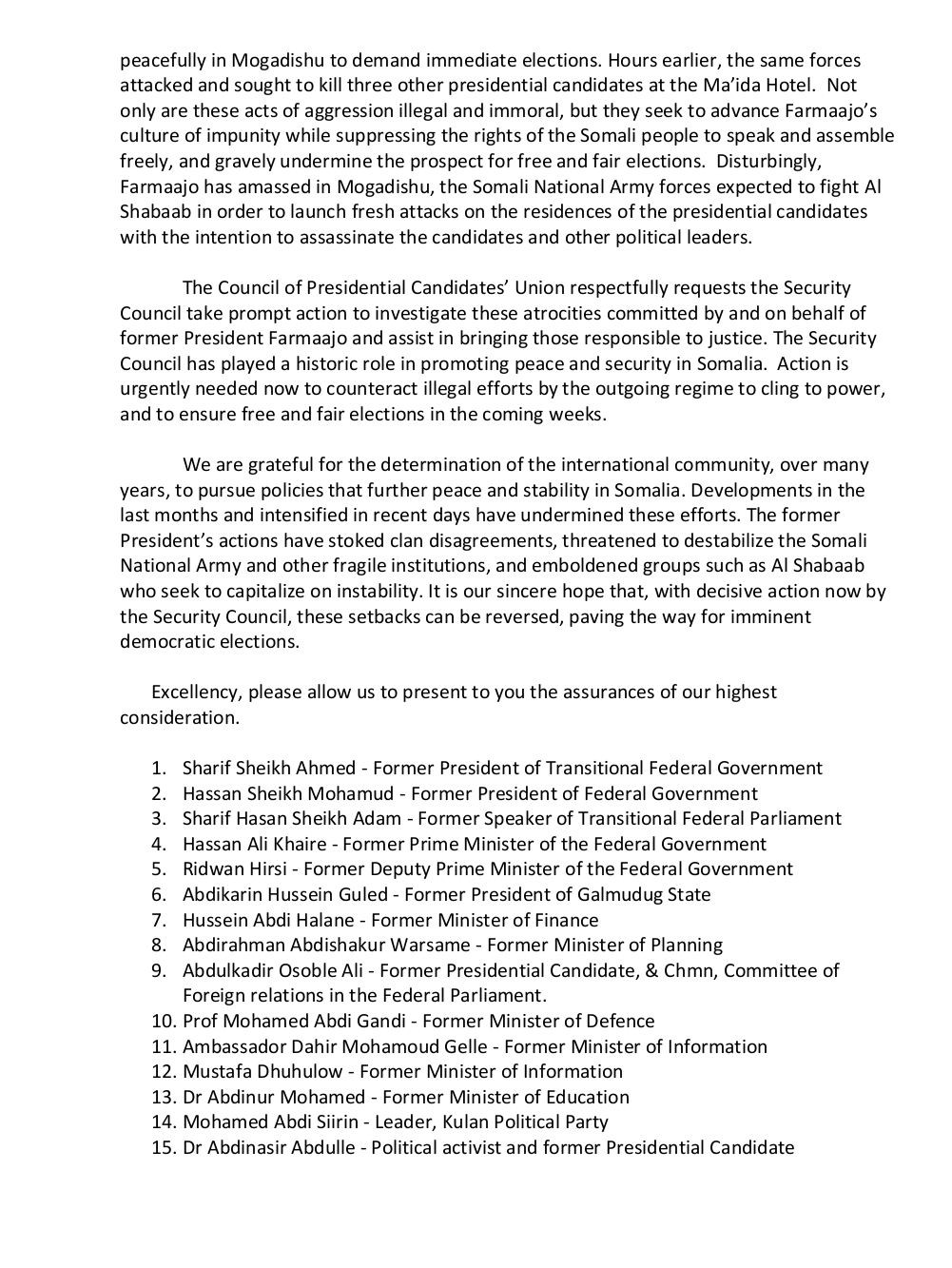
An alliance of opposition parties said in early February they would reject any attempt to extend Mohamed’s term, calling a national council of lawmakers, opposition leaders and civil society to rule until a successor was chosen.
Government troops and opposition supporters exchanged gunfire in Mogadishu on Friday during a protest over the delayed vote. Rival presidential candidates have called for more protests until a new head of state is chosen.
Somalia had planned to hold elections to pick a president and lawmakers, its first direct vote since civil war erupted in 1991. But delays in preparations and al Shabaab attacks meant this was replaced by an indirect vote in which lawmakers are picked by selected elders and others.
Reporting by Abdiqani Hassan; Additional reporting by Abdi Sheikh in Mogadishu; Writing by George Obulutsa; Editing by Edmund Blair
Madame President, Distinguished Members of the Council,
Thank you for this opportunity to once again update the Council on the situation in Somalia.
I am pleased to appear jointly with my dear colleague, Ambassador Francisco Madeira, Special Representative of the Chairperson of the African Union Commission. Let me take this opportunity at the beginning of this session to pay tribute to the commitment and sacrifice of AMISOM forces in Somalia since 2007 alongside courageous Somali Forces.
Today’s meeting of the Council is timely in view of the significant developments in Somalia in recent weeks, and even days. Growing political tensions threaten Somalia’s state-building progress and even security unless they are resolved through dialogue and compromise in the interest of the country. Unfortunately, instead we are seeing increased brinkmanship, pressure tactics, and tests of strength that can only heighten risks.
The political standoff among key Somali leaders has blocked the implementation of the electoral model agreed by the Federal Government of Somalia President and Federal Member State leaders on 17 September 2020. This model was formally endorsed by both houses of Parliament and supported by all other major political actors, but implementation is in dispute. I will return to this point.
Tensions over electoral implementation have now been compounded by questions raised by some political figures over the legitimacy of the president’s mandate following the expiry of his constitutional term on 8 February. The Government cites an October parliamentary resolution permitting the President to remain, but this is contested by others.
Meanwhile, on the morning of February 19, a day of protests announced by the opposition Council of Presidential Candidates, several violent incidents were reported. Although full details are unconfirmed, these incidents reportedly included armed exchanges between government security personnel and security teams employed by the opposition, as well as recourse to live fire by government forces to disperse protestors.
Public communication from key leaders has become increasingly polemical and confrontational, revealing the frustration, mistrust, and sense of grievance felt by many.
Hence, this is a tense moment in Somalia, as both rhetoric and actions are escalating.
Madam President,
In light of the above, let me briefly recap recent efforts to move forward with the implementation of the 17 September electoral model.
At the invitation of the Federal Government, FGS and FMS leaders met in Dhusamareb from 2 to 6 February, and made progress but reached no final agreement on the contentious issues, namely: the composition of the electoral management bodies; the modalities for selecting representatives from “Somaliland” in federal institutions; and the management of elections in the Gedo region of Jubaland State.
Subsequently, the Federal Government convened a technical committee of senior ministers from the FGS and FMS, who met in Baidoa from 15 to 16 February. The Committee announced that it had arrived at technical solutions for the contentious issues, it reaffirmed commitment to the 30 per cent women’s quota in the electoral process, and it noted the need for a revised but short new electoral calendar.
On the basis of the Committee’s work, the Federal Government called for a FGS-FMS leaders’ summit to be held in Mogadishu from 18 to 19 February. Yet, events of recent days have disrupted these plans, and the leaders of Jubaland and Puntland have so far regrettably declined to join the FGS and other FMSes for a summit. Along with other partners, we continue efforts to understand and address the concerns of these two leaders so that they may join the process to advance the 17 September agreement.
In view of this worrying impasse, in recent days I have worked closely, alongside other regional and international partners, to engage FGS and FMS leaders, key political figures, and civil society representatives to urge a way forward based on dialogue and compromise in the national interest. The message from partners has been clear that there should be no partial elections, no parallel processes, and no unilateral actions by Somali leaders. Such approaches would only lead to greater division and the risk of confrontation.
Madam President,
Let me be clear: I remain convinced that the consensus-based 17 September model offers the best available option to proceed quickly to an electoral process for selection of members of parliament, senators, and the president. This would minimize further delays in Somalia’s four-year transition cycle, ensure that the chosen national leaders have a clear mandate and are widely accepted, and allow the country to turn its attention from the current political competition to other vital national priorities in the interest of the people.
When a politician doesn’t foresee any accountability for his illegal activities, including not only trying to stay in power after his constitutional mandate had expired, but also using brute force to crush dissent, talking about elections or democracy is unrealistic. Under this circumstances, revolt and rebellion unfortunately become the alternative. What had happened in Mogadishu on February 19th could herald a trend and the new normal in current Somalia’s political conundrum. The country has turned again to the brink of pending disaster.
In these armed clashes, the opposition forces were engaged in provocations too by forcefully occupying parts of security perimeter of the country’s presidency under the command of clan militia warlords, and opposition leaders moving into hotels nearby it just before the start of armed confrontations. Some observers believe that the demonstrators intended to converge at and celebrate in Villa Somalia would they had succeeded in chasing out Mr. Farmaajo as they did with General Siyaad Barre in January 1991.
Last night’s speech by Puntland President in Garowe had exposed an alarming political and security situation in the country. It is not yet too late to take action and prevent looming mayhem in Somalia and beyond.
All parties have to show restraint and pull back from the brink. Friends of Somalia have a role to play in helping mitigate this renewed escalation of political conflict and saving the hard-fought modest gains of Somali political process post-Civil War.
By Warsame Digital Media WDM
This article has been updated since it posting early today.
SOMALIS SHOULD BLAME THEMSELVES FOR MAKING THEIR OWN DICTATORS
When the Military Junta led by General Siyad Barre overthrew the civilian government of Somalia in October 1969, the General was so timid that he could not inform the nation of the coup d’état that had just taken place, according to the late prominent elder and businessman Ali Barre ( Cidi Libaax). One day in the 1980s Ali Barre told me that in the early days after the Military takeover, he patted on the shoulders of Siyad Barre and encouraged him, “to speak to the people bravely like a man”. History is full of similar stories from Stalin to Mussolini to all petty and big dictators in history. Dictators, therefore, are not born, but created by their own people. In the case of Somalia, there is a popular cliché in the native language, “wax la salaaxo,madaxxaa ugu sareeya” (meaning literally the human head is the highest point someone can reach out and fondle”). In Somali setting, it means nobody is to be satisfied with the decisions and rulings of pertinent officials, bodies, departments and institutions until someone has the opportunity to go all the way to the Chief Executive Officer of the government, in most cases, the President. Based on my personal experience,everyone in the country, every Somali visitor from other parts of world,including the members of the large Somali Diaspora, seek to see the guy at top for whatever personal or mundane reasons they may have in mind. Some even bring foreign interested persons along with them to quickly secure their access to the President or Prime Minister. Failure to secure that opportunity is extremely disappointing to them. There is only 24 hours in a day and it is humanly impossible for everyone to meet with the President. Think about the enormous,unnecessary and extra burden on a Somali political leader, his offices and staff. Think about the acrimony and hatred that surround these offices, the inherent and chronic personal complains, false and unjust accusations against the staff and security personnel, influence peddling, the bribery and corruption practices the enterprise creates in the process. Unfortunately, in Somalia the positions of the President, Prime Minister, and Chief of Staff, Protocol or Public Relations Officers are the worst jobs in the world for any decent person has to seek and accept. I could recall bitter experiences during my tenure as the Chief of Staff and I have the scars to show. Although I paid high prices at personal level, there is no doubt and nobody can deny that I had the greatest impact and made enormous difference in confronting this dilapidating Somali political culture in Puntland State of Somalia as the constituency finally accepted my approach to government operations and decision-making process. Under these crushing, cruel and painful working conditions,one cannot expect like other normal countries to produce a good Head of State or Government. That way Somalis turn their leaders into authoritarian devils overnight by bestowing them the powers of the final say on everything. That way they disable the functions of other public institutions of government while at the same they whine about bad governance and dictatorship. They must learn the hard reality that they cannot have both ways. The powers of the any public servant including the President, Prime Minister and other officers must be respected, not worshipped. Instead, they must be constantly challenged. Leaders must be compelled to fight for popular support, not the other way round. Only that way people of Somalia can help themselves prevent dictatorship and have the opportunity to choose better leaders and maintain good governance. Do not create unaccountable,monstrous authoritarian leaders, please! That is one of the best ways you can really and positively contribute to a better Somalia. In another related story, once upon a time people elected a man to be their leader for a fixed term in office. At the end of the term, the man wanted re-election to another term. People told him that he had not done well to deserve re-election. He told them, “how come!? I have been doing successfully what you had elected me for – meeting with you all my time”. Other related articles: The Way Forward for Somalia Public Trust Deficit in Somalia Federalism, a Guarantor of Peace among Somali Clans Hope and Lessons in Somalia Outside View: Building a Secure Somalia TFG Top Priorities as Expressed by the President Somalia, Foreign and International Conspiracyismailwarsame.blog@ismailwarsame
Somalia Briefing and Consultations On Monday (22 February), Security Council members will discuss the situation in Somalia in an open videoconference (VTC). A closed VTC is scheduled to follow. Special Representative and head of the UN Assistance Mission in Somalia (UNSOM) James Swan, AU Special Representative Francisco Madeira and EU Managing Director for Africa Rita Laranjinha are expected to brief. Council members may issue press elements at the conclusion of the meeting. The meeting is likely to focus on Somalia’s delayed elections and the steps being taken to safeguard the country’s political stability and security situation given the current state of political upheaval. The failure to elect a president by the 8 February deadline endorsed by the country’s parliament has now precipitated a constitutional crisis and resulted in violence. Swan is likely to brief the Council on the rapidly evolving political and security situation since he last briefed Council members under “any other business” on 9 February. During that meeting, which had been requested by the UK, Swan apparently updated members on a series of political disputes between the Somali Federal Government, led by President Mohamed Abdullahi Mohamed “Farmajo”, and leaders from two of the country’s federal member states, Puntland and Jubaland. According to a 17 September 2020 agreement, parliamentary elections were to be held from 1 to 27 December and presidential elections on 8 February. (Given the logistical and security challenges of holding direct elections, a modified indirect electoral process was agreed to last year. This system allows clans’ delegates to choose members of the lower house of parliament, which in turn chooses the president.) The parliamentary elections had to be postponed, amid claims that Farmajo should not be allowed to run for another term based on long-standing precedent as well as accusations that he had attempted to bypass Somalia’s electoral laws by installing loyalists to polling committees charged with coordinating the parliamentary elections. This postponement, in turn, prevented the country from organising the presidential elections. The presidential elections were slated to be held by 8 February, the day that Farmajo’s term expired, in accordance with Somalia’s constitution. Subsequently, several opposition groups and the Council of Presidential Candidates Union—which is made up of 14 leading political figures and candidates running against Farmajo—declared that they no longer recognised Farmajo’s legitimacy, stating that they “w[ould] not accept any form of mandate extension through pressure”. Instead, they proposed that a Transitional National Council be established to help usher the country through this crisis and establish an electoral transition. After discussing Somalia during “any other business” on 9 February, Security Council members issued press elements, welcoming efforts made by the leaders of the federal government and the federal member states to “find agreement on the implementation of the 17 September electoral model” but expressed concern that the dialogue had yet to yield an agreement. Council members called on Somalia’s leaders to resume dialogue and work urgently to find a consensus for how to proceed with the elections. Since December, there have been several attempts at dialogue between the parties to address the electoral delays; UNSOM, for its part, continues to offer its good offices to overcome the impasse and has facilitated meetings between the diplomatic community and Somali political leaders. Council members will be keen to learn more about the mission’s facilitation efforts and the current state of the dialogue. There have been some notable developments in this regard in recent days. On 16 February, Somali Foreign Minister Mohamed Abdirizak announced that a meeting of a technical committee representing Somalia’s federal government and federal member states had reached agreement on a number of technical issues pertaining to the organisation of elections, though details of the agreement were not released. The following day, UNSOM released a joint statement with Somalia’s international partners welcoming the agreement. Council members will likely want to know more details about the agreement and how it may contribute to resolving the country’s current electoral stalemate. While an official statement from Somalia’s presidential office (and media reports) suggested that a meeting between Farmajo and representatives of Somalia’s federal states was to be organised in Mogadishu on 18 and 19 February to discuss the electoral crisis, at the time of writing, there are no indications that this meeting occurred. Meanwhile, overnight from 18 to 19 February, violent clashes took place in Mogadishu, with opposition leaders claiming that a hotel where they were staying had been attacked by government forces. On 19 February afternoon, government forces fired on hundreds of demonstrators who were protesting the elections delay. An explosion at Mogadishu’s airport was also reported. UNSOM subsequently issued a statement, calling for restraint by all parties and noting that the violence “underscore[s] the urgent need for federal government and federal member state leaders to come together to reach political agreement” to implement the 17 September electoral arrangement. In addition to the recent electoral-related instability, Somalia’s overall security situation remains volatile. Several high-profile Al Shabaab attacks have occurred so far in 2021, including a 31 January attack on a hotel in Mogadishu that killed ten people and an 8 February roadside attack on Somali National Army (SNA) forces that killed at least eight soldiers. Council members may express concerns that the recent violence could affect SNA activities and imperil Somalia’s efforts against Al Shabaab. Given the deterioration in the security situation and the scheduled adoption by the Council of a resolution extending the mandate of the AU Mission in Somalia (AMISOM) on 25 February, Council members will also be interested to hear from Swan about Somalia’s ongoing fight against Al Shabaab, as well as progress on the Somalia Transition Plan—a roadmap adopted in 2018 that laid out the steps for Somalia to assume full responsibility for its own security. The Secretary-General’s 17 February report on Somalia notes that the Somalia Transition Plan has been finalised, permitting operational planning to commence with a view to implementing the country’s security transition by the end of 2021. Council members will want to be updated on the status of the plan, and in light of the current political deadlock, how delays in its approval by the Somali federal government could affect its implementation.
I do recall a true story that took place in Gara’ad during General Cadde mandate of Puntland, when in the height of severe draught, a large delegation from international humanitarian organizations went to the town on fact-finding and assessment mission. In Gara’ad the mission members were fed with incredibly delicious sea-foods rarely available in the best supplied five-star luxury hotels. These expatriates were puzzled by the fact that residents were crying for humanitarian intervention for their basic needs when abundance of these delicacies were within their reach locally and at their shores. Ignorance and lack of basic survival skills are reasons for hunger and diseases in Somalia. They are the root-causes of poverty in Somalia. Paradoxically, it is rare, if non-existent, to see schools specializing in studies of animal husbandary, fishery, agriculture, irrigation, reforestation, protection of environment etc. It seems that dark and invisible enemies of the people of Somalia are at work to disable them for life. This is happening because of poor leadership in all walks of life and in all fields of human endeavors.
Commentators on Somalia’s federalism are to be commended for their tireless efforts to express their views and experiences on the issue. Writers like colleague @Abukar_Arman are leaders in denouncing federalism. They, however, can’t consider and appreciate the other side of the debate – the advantages the system offers in Somali context: restoration of public trust, decentralization of power, regional self-reliance, peace-making among Somali clans, prevention of city-state tyranny, efficient delivery of public services, residents’ ownership of regional state entities, etc.
Make no mistake, federalism is not a fixed system that has a set of rules to follow. Like democracy, it has inherent difficulties and messy governing problems. Even advanced nations built on federal systems experience continual frictions between states and with the central federal governments. It is an involving system getting improved over time. People adopt this system for reasons. Somalis, who lived under bitter and harsh dictatorship and vicious civil war have lingering fears and worries about the repeat of their bad experiences in Somali governance. They temporarily opted for federalism despite its difficulties. The system is enshrined in a solemn post-civil charter and provisional constitution. Why don’t you respect their wishes and let the system work. And, by the way, do you have any other ideas to contribute to improve the system rather than critizing it relentlessly?
Both men tried to fight the constitution, its federalist chapter, in particular. The only difference is that HSM was learning quickly the impossible tasks of his challenges, while Farmaajo is too dumb to study the situation and learn from recent history. Farmaajo believed in the regional powers of Abyi Ahmed of Ethiopia and Isias Afewerk of the State of Eritrea, the most unlikely teachers for a Somali student of government.
I am neither a medical doctor nor a psychiatrist, but I suspect that Farmaajo has sort of mental disabilities, possibly autism, occuring in his younger years. I reported earlier that Farmaajo was running neither the government as a prime minister of Somalia, nor the state as president. Some readers thought I was exaggerating. As prime minister, he relied heavily on Abdiweli Mohamed Ali Gaas, later, on Hassan Ali Khayre and Fahad Yassin Haji Dahir. That is the reason both seemed all-powerful.
I urge others to study the issue for medical and historical purposes.
Electronic money makes people and owners of businesses too lazy to handle physical Somali Shilling banknotes. That is why you see store owners and public transit drivers refuse to accept payment in Shillings. It is one thing to complain about rapid inflation, it is completely another wanton desire to refuse to offer services in good faith. This is the legacy of many years’ use of air money without first studying its negative impact on the future of transactions.
The phenomenon will herald havoc in the lives of ordinary residents and lead to financial and economic crisises in Somalia. We better do something before it becomes too late.
After the 1st and 2nd World Wars, some Europeans and their regions ended up under occupation by different countries and regimes. That was one of the factors why wars were waged in the first place.
Since then numerous studies were launched to find out the best way forward to resolve the problem of partitioned ethnic communities in Europe. They found out that in democratic countries nationalism doesn’t play a positive role in the political process and in a free society and market economy, all residents have fair share for progress and nation-building. Today we see some of previously occupied regions and territories in France, Italy, Germany etc doing far better in economic terms than the rest of other constituencies within same country.
What is important here is that Kenya and Ethiopia have to learn from history and treat their respective citizens equally and fairly. That is the way to resolve any territorial disputes with Somalia and remove ethnic tensions within.
The problem with the 4.5 formula lies not in the idea of power-sharing itself, but in how it was designed and applied—especially the allocation of parliamentary seats among sub-clans. Many Somalis argue that the injustice began at the Mbagathi Conference (2002–2004), where questionable concessions were made to accommodate sub-clan demands in the hope of easing internal conflicts. What was intended as a temporary compromise became entrenched. Sub-clans have since treated those allocations as permanent entitlements, while others remain excluded from Somalia’s fragile political settlement.
This is why Somalis continue to complain about the 4.5 system. Unless Somalia regains stability and achieves the capacity to hold a free and fair national election, the issue will remain unresolved.
How the Formula Emerged
To understand today’s controversy, one must revisit how the 4.5 concept was first introduced during the long and troubled reconciliation process (see also An Open Letter to the New Members of the Somali Parliament).
Following the collapse of the Somali central government in 1991, certain southern clans claimed both victory in the civil war and the largest share of the national population. These claims, however, were not backed by reliable statistics or census data. Warlords in Mogadishu, who dominated the capital at the time, aggressively promoted this narrative within international diplomatic and humanitarian circles. Mogadishu’s symbolic weight as the “one-city state” gave their claims influence abroad.
As Somalia fractured into clan enclaves and de facto decentralized rule, reconciliation efforts began in Mogadishu, Nairobi, and Djibouti. All failed, deepening the political vacuum.
The Sodere Initiative
In 1996, the National Salvation Council (NSC)—known as the Sodere Group—was formed in Ethiopia at the initiative of the late Somali President Abdullahi Yusuf Ahmed. While receiving medical treatment in London, Yusuf asked me to draft his letter to Ethiopian Prime Minister Meles Zenawi, requesting Ethiopia’s support in hosting reconciliation talks. Zenawi responded positively, leading to the formal creation of the Sodere Group.
The NSC was led by a Central Committee and Executive Branch with five co-chairmen: Abdullahi Yusuf, Osman Atto, Abdulkadir Soobe, General Aden Gabyow, and Ali Mahdi. It brought together most major and minor Somali political fronts—except Somaliland and the Salbalaar faction.
By 1997, NSC members agreed to convene a national congress in Bosaso (now Puntland State of Somalia) to establish a broad-based government. Even tents for the meeting were purchased by the OAU/IGAD partners. But the Bosaso Congress was sabotaged, notably with Egyptian interference. The core challenge remained: how to distribute delegates fairly among clans.
To resolve this, Hawiye and Darood leaders met in Sodere in early 1997. They turned to the only credible Somali census—conducted by the UN in the 1950s—which showed Darood at 38% and Hawiye at 22%. In the spirit of reconciliation, Darood agreed to give Hawiye equal representation despite the numbers.
Soon after, Digil-Mirifle leader Abdulkadir Soobe requested equal status with Hawiye. Darood leaders accepted, and the same courtesy was later extended to the Dir clan. The remainder of Somalia’s population was labeled “others,” equating to half a major clan.
The Cairo Conference and the Birth of 4.5
In late 1997, the Cairo Conference brought the NSC and Salbalaar factions together. While Egypt’s hidden agenda sabotaged Bosaso’s prospects, the Cairo meeting left two legacies:
1. The collapse of both the NSC and Salbalaar.
2. Agreement in principle to adopt federalism as Somalia’s future governance model—an idea long championed by the SSDF.
The 4.5 formula itself was applied for the first time at the 2000 Arta Conference in Djibouti, forming the basis of President Abdulqassim Hassan’s government.
Conclusion
The 4.5 system is far from ideal, and many Somalis see it as unjust. Yet, until Somalia recovers its sovereignty, stability, and ability to conduct democratic elections, the formula may be an unavoidable political compromise.
As a nation, we must not lose sight of the larger goal: building a secure, viable, democratic, and prosperous Somalia. If 4.5 is a bitter medicine on that journey, perhaps we must swallow it—eyes closed—until a better alternative becomes possible.
By Ismail Haji Warsame Former Chief of Staff, Puntland Presidency; participant in Somali national reconciliation processes since 1995. Based in Toronto, Canada. : ismailwarsame@gmail.com
After many years of trials and errors in creating the 2nd Somali Republic on the ashes of the first, following a vicious clan warfare dubbed “Civil War”, the now defunct National Salvation Council, better known as Sodare Group after the name of Ethiopian City of Sodare, was established in 1996. All Somali political/militia factions, with the exception of Hussein Caydiid, the son of late General Mohamed Farah Caydiid, joined the group. The group was chaired and led by five co-chairmen, namely Abdullahi Yusuf, General Gabyow, Osman Ali Caato and Soobe – all heavyweight militia commanders and participants of the Civil War. Only Col.Yusuf opposed the Regime of Siyaad Barre before its fall in January 1991. At the time Ethiopia was a designated country by the Organization of African Unity OAU (later AU) and IGAD, to handle Somali National Reconciliation and Peace Process.
The Sodare Group had captured quickly the imagination and support of the international community through their representatives and diplomats in Addis Ababa. This recognition and support had enabled the Group to make executive decisions to convene a congress in peaceful Northeastern Port City of Bosaso, scheduled for 1997.
Preparations for would-be national congress started in earnest. IGAD bought and transported Conference tents and equipment to Bosaso. Various Sodare Group delegations went to different countries to solicit for Congress support. One delegation led by Abdullahi Yusuf went to Yemen, and under its auspices sought visits to Gulf States. While the delegation was still in Sanca, officials from Ethiopian foreign Ministry had conveyed a message to them to return to Addis Ababa immediately. When they asked why, they were informed that Egypt intended to convene a meeting in Cairo with the participation of “Salbalaar”, Hussein Caydiid’s faction. Big diplomatic mistake on the part of the Ethiopian, who never understood Somalia as they pursue diametrically opposing national interests. It was also an extremely naive for Ethiopians to be so gullible to trust Egyptians, who wanted to sabotage Bosaso Conference. How did that happen?
Egypt, through its intelligence services, and by then its chief officer by the name of Calaa, had maintained contact with and influence over both Caydiid and Cali Mahdi throughout the course of the civil war. Hussein Caydiid was their man in Mogadishu. Cali Mahdi then was an important man as co-chairman of Sodare Group.While Mahdi was in Mogadishu at that particular time to prepare his community for Bosaso Congress, Egyptian Security Chief, Calaa, met him there, to persuade him attending Cairo meeting. Mahdi accepted the invitation and phoned up co-chairman and rotational current monthly chairman of the Group, Soobe, in Addis Ababa, advising him to expect a call from Calaa and to accept his invitation to Cairo on behalf of the Council. While all these were happening, Abdullahi Yusuf and his delegation were still in Sanca, preparing to return to Ethiopia to discuss on the issue.
Ethiopia had pressed the Group to go to Cairo meeting. To make a long story short, Egypt succeeded in dividing Sodare Group, thus sabotaging the Bosaso Congress. As a result, both Sodare Group and Salbalaar Faction of Hussein Caydiid had collapsed and ceased to exist.
IGAD had re-collected tents and Conference equipment from Bosaso and returned to IGAD Secretariat in Djibouti. Later, these tents and materials were used in Carta Somali Conference of 1999-2000.
The failure of Cairo Talks and undermining of Bosaso Congress had convinced some important political figures of Northeastern Regions (now Puntland) to re-think the national reconciliation strategy in order to spearhead the foundation of a 2nd Somali Republic. These leaders had invented and pioneered the theory of “Bottom-up” or “Building-blocks ( Federal Member States); hence, the creation of Puntland State of Somalia, an historically important First Pillar for the Federal Republic of Somalia.
In conclusion, many people say that it was Egypt that sabotaged Bosaso Congress in 1997. While I don’t argue with that assertion, it was mainly the fault of Ethiopia under the misleading and unwise advice by officials of its foreign ministry, and in particular, Dr Takeda Alemu, then the deputy foreign minister.
Author. Warsame Digital Media at https://ismailwarsame.blog Annual Subscription $37 Contact/WhatsApp +252:90 703 4081 Email: ismailwarsame@gmail.com



 Warsame Policy & Media Network (WAPMEN)
You must be logged in to post a comment.