It s hard for someone outside United States to contemplate of a political leader getting away with so many alleged wrong-doings in a country bragging so much about the rule of law and democracy, and calling itself a shining beacon on the hill, yet defending and justifying brazen lies and grotesque abuses of power. Yes, I get that Trump has been a bad guy throughout his adult life, who, with money and white privileges, escaped accountability. But I can’t fathom millions of smart people falling into his whims, regardless of the harm they inflict on their nation by bending their consciousness and moral compass. It is not plausible to dismiss the phenomenon as political polarization alone, for the stakes are too high and extremely dangerous to let it go, and assume America would remain America and run business as usual.
I do recall a story in which a student once asked a history teacher as to why millions of highly intelligent German people blindly followed a corporal called Hitler. The teacher paused a bit to answer the question, then asked the student: “How many Hitlers were there in Germany at the time?” Surprised, the student responded, ” Only one Hitler”. “Wrong”, the teacher told the student. “Hitler had duplicated himself into millions more in German society.” I am afraid history is repeating itself elsewhere before our eyes, and if history is of anything to go by, nations rise and fall when political figures like Donald Trump appear on the scene once in a while, and citizens let their guard down. It is happening now in the USA.
Supporters of Trump’s shenanigans argue that bringing Trump to justice was a disgrace to US reputation. Others see this happening as American justice and public institutions rightly fighting back. In this case, one would say the taste of pudding is in the eating. But, let us wait to read how history would record Donald J Trump.
As a long time observer of US politics, I must admit that I have become increasingly ambivalent towards USA. It started during the unfolding drama of Donald J Trump in which he was twice impeached and investigated by Special Counsel, Robert S Mueller III. Trump got the last laugh in all cases and eventually nearly succeeded to “make America Great Again” (MAGA) by winning 2020 election. An obviously criminal former President difficult to bring him to justice, by neither the Congress nor by DOJ (Department of Justice). As if that was not enough crime for Trump, he went on to overthrow the US Government and almost succeeded decapitating it in a violent MAGA riot at Capitol in January 6, 2021. As if that was not enough crime for him, he refused to concede his election defeat, and to add an insult to US injury, he stole government top secret upon evacuating the White House on January 20, 2021 for his successor, Joe Biden, and now, nobody knows to whom he has passed them.
Donald J Trump has proved what cannot happen in most democracies can take place in the US: Violent coup. It means America is so fragile that they can produce not only a dictator, but a fascist leader worse than Hitler armed with dangerous modern weapon and nuclear warheads.
America is extremely important for the safety of humanity and world security. Those who don’t understand this reality, don’t know the potential dangers to their lives, if power falls to demagogues and deranged figures like Donald J Trump.
Russia is equally dangerous country and President Putin, though friendly with Trump, understood quite well that another hostile US leader could seize power and threaten Russia, this time with NATO at its borders. This makes Putin mad, causing him panic to push Russian security buffer zones further into Ukraine. It isn’t a war game. There is a potential for nuclear escalation and mutual annihilation.
The world is watching whether America can save itself from tyranny and Rise of Fascism Again (ROFA).
Various sources of information including satellite imagery now suggest this increased partnership may be starting to take shape. In this blog post, I will summarize some aspects of the relationship between the United States and Somaliland and explain why I think this cooperation may be taking shape.
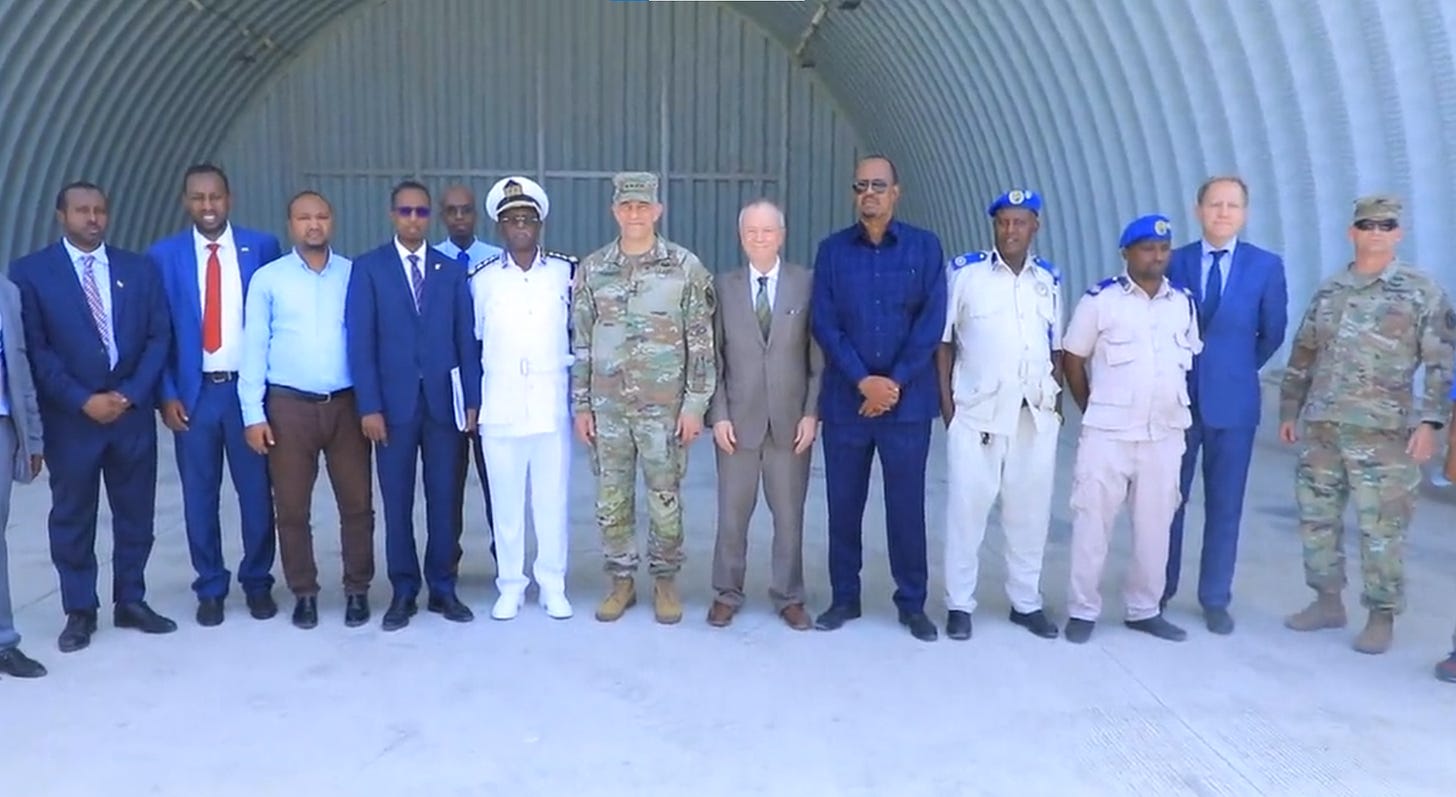
Americans and Somalilanders inside an aircraft shelter at Berbera Airport, Somaliland, 12 May 2022. In the middle are U.S. Army Gen. Stephen Townsend (camouflage uniform) and Larry E. André Jr. to his right. Video capture.
US AFRICOM, Berbera and Somaliland
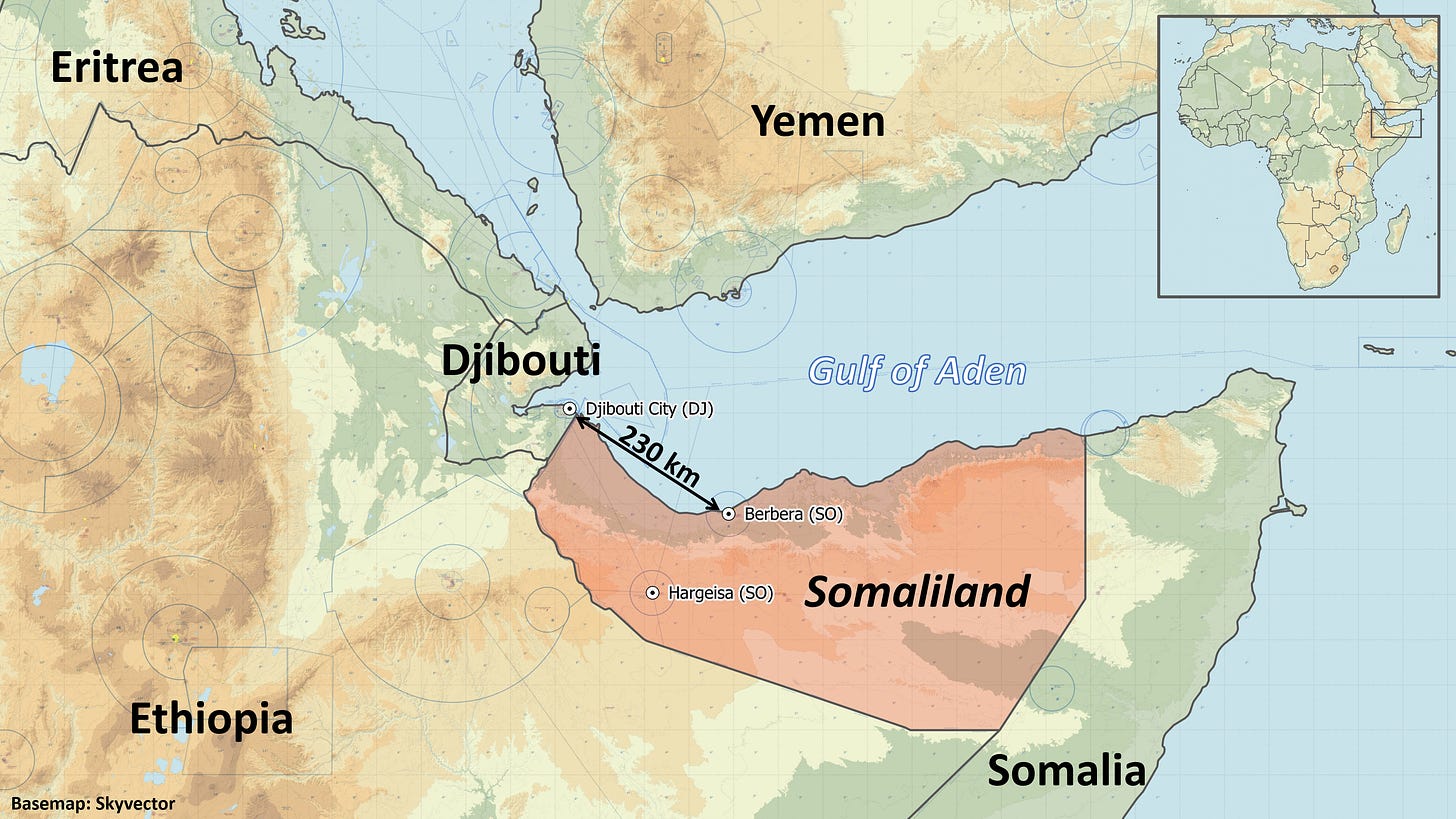
Overview of Somaliland, Somalia, Djibouti and the Gulf of Aden.
31 years ago, Somaliland broke away from Somalia and claimed independence. Even though it is a de facto state, independence was never recognized by the international community, including the United States.
According to Foreign Policy, a Somaliland delegation visited the United States in March 2022, lobbying the United States to recognize Somaliland. Although Washington made clear they were unwilling to recognize their independence, they did signal that they would like to deepen ties with Somaliland.
On 12 May 2022, a United States delegation visited Somaliland’s capital city Hargeisa, followed by a visit to Berbera, located on shores of the Gulf of Aden. I previously looked into this visit to Berbera. Besides a description of the visit, the thread attached to the tweet below contains more information about the history of the airport, so just click on the post in order to read it.
On the day of the visits, a United States Marine Corps (USMC) KC-130J reg. 169533 was tracked flying over Somaliland, including a landing and take-off at Berbera. This same KC-130J can also be seen in video footage made at the airport.
According to US AFRICOM, the meetings focused on “mutual benefits from closer U.S. cooperation with Somaliland authorities”. They add that a cooperation between “[US] AFRICOM and Somaliland’s military and coast guard will advance shared interests in regional stability, protecting vital trade routes”.
A BBC article summarizes some of the reasons why Berbera is of interest to the United States. First and foremost the airport is located on the shores of the Gulf of Aden, a major shipping route. Furthermore, it “is close to some of the world’s most unstable places, including Yemen, Somalia and Ethiopia, which has been a key US ally in the ‘War on Terror’ but is now wracked by internal conflict.”
The United States currently have a large military presence at Camp Lemonnier, which is located just south of Djibouti–Ambouli International Airport in Djibouti, sharing a runway. According to US AFRICOM, Camp Lemonnier “provides, operates and sustains superior service in support of combat readiness and security of ships, aircraft, detachments and personnel for regional and combatant command requirements; and enables operations in the Horn of Africa while fostering positive U.S.-African Nation relations”.
In recent years, Djibouti has seen an increased presence of Armed Forces from around the globe, including Japan, France, Italy and most importantly China: a Chinese Naval Base is located only about 10 km from Camp Lemonnier. In 2018, there were multiple instances of Chinese lasers interfering with U.S. military aircraft.
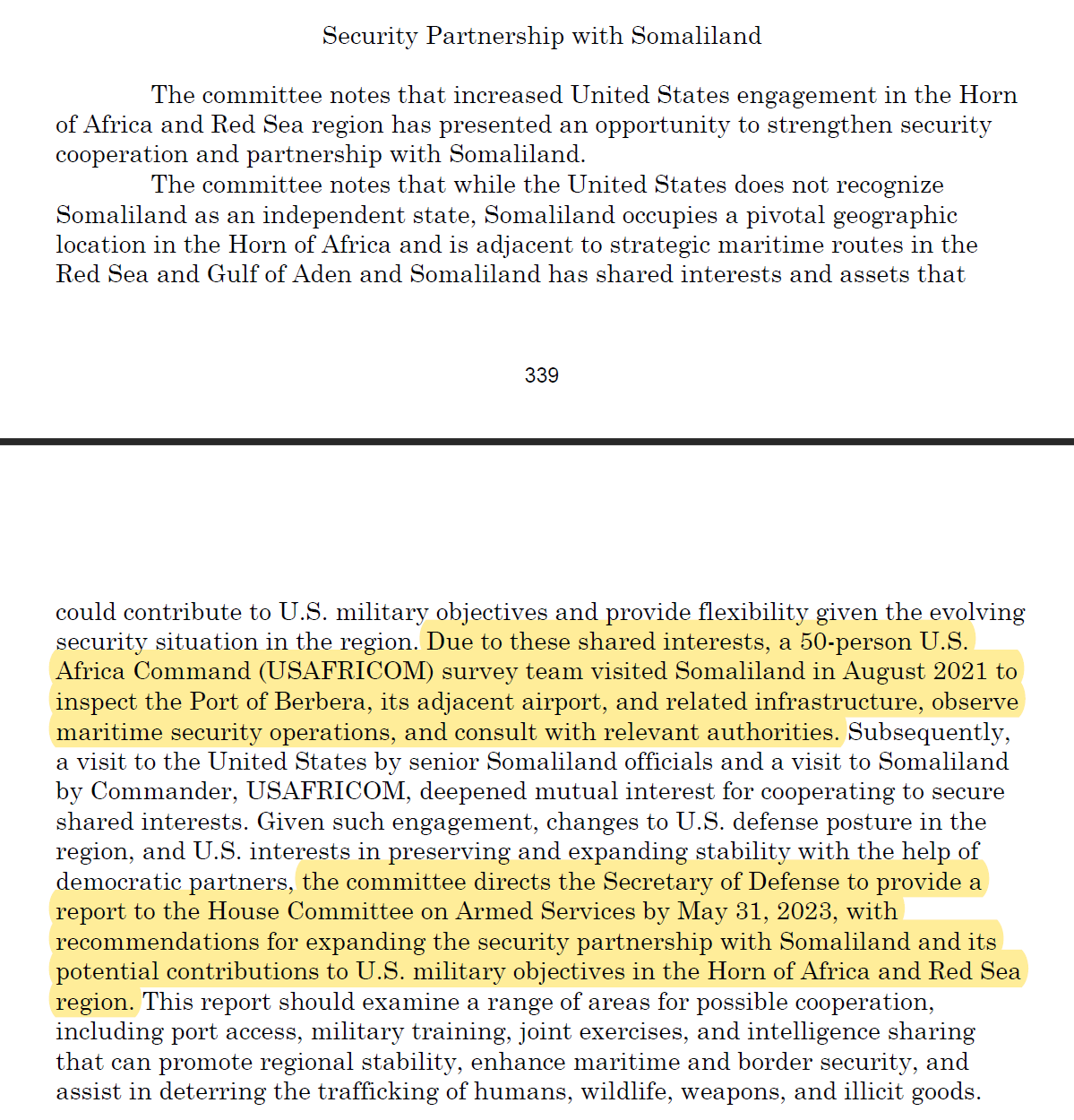
Berbera is located about 230 km southeast of Djibouti, and would offer more space and privacy for United States military operations. The United States already recognized the benefits of Berbera in 2021: In Aug 2021, a 50-person US AFRICOM survey team visited Berbera for inspection and “consult[ing] with relevant authorities”, a recent (Jun 2022) United States National Defense Authorization Act (NDAA) report states. In Dec 2021, a U.S. Congress delegation also visited Somaliland, including Berbera.
According to this recent NDAA report, the U.S. Secretary of Defense should provide a report containing “recommendations for expanding the security partnership with Somaliland and its potential contributions to U.S. military objectives in the Horn of Africa and Red Sea Region”. This report is to include “a range of areas for possible cooperation, including port access, military training, joint exercises, and intelligence sharing that can promote regional stability, enhance maritime and border security, and assist in deterring the trafficking of humans, wildlife, weapons, and illicit goods”
From all of this, it becomes very clear that the United States is showing great interest in Berbera Airport.
Recent developments
According to a Berbera News report dated 04 Jul 2022, American troops have taken full control of security at the airport. According to the report, all Somaliland staff has been sent on a 12-day holiday, and “the UAE official1 at Berbera Airport returned home”. They add that “a number of military planes” landed at Berbera on 03 Jul 2022, followed by “a large number of US planes” on 04 Jul 2022.
I have not yet been able to find evidence that these flights did actually take place. It is possible that U.S. Military aircraft would not be using ADS-B, or not even using Mode-S, for the short flights from nearby Camp Lemonnier to Berbera. This would make the flights invisible to the general public.
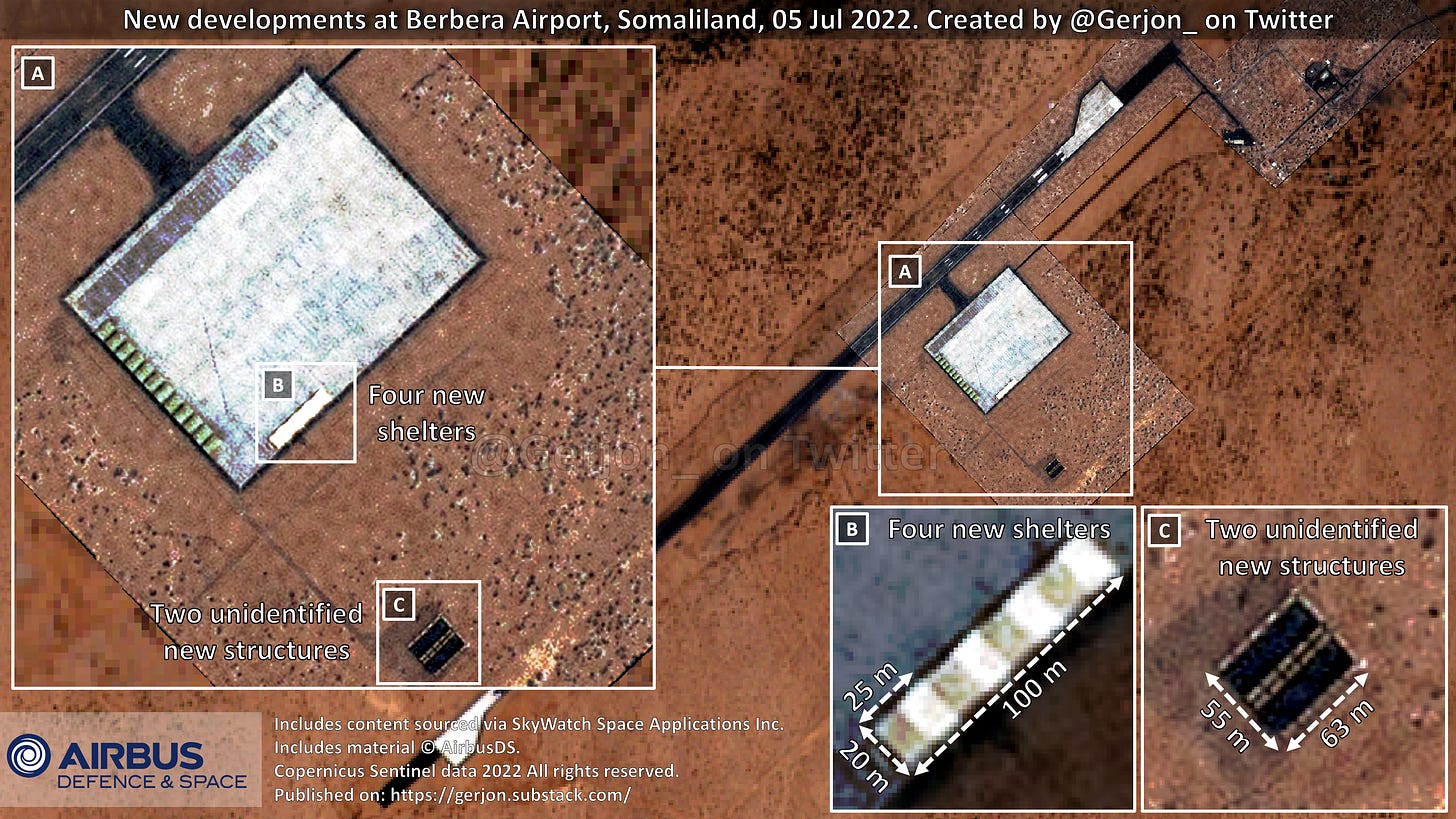
However, there are indeed signs for recent activity at Berbera Airport. Sentinel-2 satellite imagery shows that something was constructed on Berbera’s main apron in the period following 21 Jun 2022.
A closer look at this structure (using SPOT satellite imagery, dated 05 Jul 2022) reveals that this consists of four shelters or canopy buildings, perhaps similar to those of HTS Tentiq, each at a size of 20 x 25 m, or 20 x 100 m in total. Two more new and unidentified structures are located some 300 m further Southeast.
At this point in time, it remains unclear by whom and for what purpose these structures were created. However, they first appear around the same time American presence at Berbera Airport was confirmed.
Conclusions
The United States and Somaliland are developing increasingly close ties. These ties are relevant to Somaliland in their strive for international recognition of their independence. The United States on the other hand may be looking for a new base on the shores of the Gulf of Aden, to serve as a potential future alternative for the increasingly crowded Djibouti–Ambouli International Airport and Camp Lemonnier.
In the past week, unconfirmed news reports claim multiple flights to Berbera Airport and claim American presence at Berbera Airport. These claims have not yet been proven. However, they do coincide with newly developed structures identified at the airport, seen on satellite imagery. At this point in time, it remains unclear why and by whom these new structures were developed.
Future updates about Berbera Airport will be posted on my Twitter and on this blog. Various Twitter followers have notified me that they no longer see my tweets pop up in their feeds. Therefore please subscribe to this blog using the button below to make sure you don’t miss my future work.
Although my investigations take up most of my free time, all of this work is fully unpaid. Also subscribing to and reading my blog is free of charge.Subscribe
AFTERMATH OF ISRAELI AIRSTRIKES ON GAZA CITY (AP PHOTO/KHALIL HAMRA)
Impossible problems tend to inspire outlandish solutions. The Israel-Palestine conflict is a case in point: just consider the Uganda Scheme (the early-1900s proposal to create a Jewish homeland in Africa) or former political adviser Jared Kushner’s more recent but equally absurd attempt to buy off the Palestinians with a little cash.
The Biden administration should keep the history of such gambits — and the fact that all of them failed — in mind this week as pressure mounts to intervene in the fighting.
It’s easy to understand why leaders around the world want the United States to do something: the skirmish between Israel and Hamas has already killed more than 227 Palestinians and 12 Israelis, trashed Gaza’s decrepit infrastructure, sparked the country’s worst intercommunal violence since the 1930s, and torpedoed the formation of a historic Israeli left-right-Arab governing coalition to replace Israeli Prime Minister Benjamin Netanyahu following the recent election.
Horrible as the situation is, however, getting too involved now would still be a mistake for Washington. While the two sides can be convinced to hit pause, there’s only one way to actually solve their fundamental dispute: a two-state solution. And that’s not on the cards any time soon.
Elephant in the room
The notion that a two-state solution — the creation of an actual, viable country called Palestine alongside a physically secure Israel — is the only way to finally resolve this very long, very bloody conflict may seem obvious. But it bears restating because it’s a truth all key leaders — in Israel, the US, the Palestinian Authority (PA), and the broader Arab world — have recently forgotten or simply ignored.
Let’s start with Netanyahu. For years, he has tried to convince Israeli voters only he can protect them — whether from war, terrorism, or the coronavirus — and safe behind their walls, they could disregard the Palestinian question while enjoying their comfortable prosperity.
Once a grudging supporter of the two-state option, more recently Netanyahu has tried to sideline and diminish the salience of the Palestinian question in Israel’s national debate while focusing instead on bolstering his country’s vibrant economy, vaccinating its citizens, and normalising ties with Arab states.
Under former president Donald Trump, the US worked hard to facilitate this agenda. The Abraham Accords, which established formal relations between Israel and Bahrain, Morocco, Sudan, and the United Arab Emirates, were premised on the belief these and other Arab countries had come to care more about their own economies and security than they did about solidarity with the Palestinian cause.
And as 2020’s diplomatic breakthroughs showed, Netanyahu and Trump read the region right. After standing by the Palestinians for many years — during which the PA rejected one deal after another — Arab officials in the Gulf and North Africa had decided they were no longer willing to put that issue ahead of their own priorities. At the same time, they’d become increasingly frightened by Iran and recognised the fact that their enemy’s enemy could prove an enormously powerful asset and ally in this regional cold war.
Preserving power
Even Palestinian leaders effectively abandoned independence and the two-state solution. Although Mahmoud Abbas, the PA’s president, still nominally supports it, he’s now sick, 85 years old, and 16 years into a four-year term — and so far more concerned with preserving his own power than he is about making peace.
As for Hamas, it’s never cared about resolving the conflict. What it wants, instead, is to use an eternal armed struggle to justify its oppressive, undemocratic rule and corruption.
As the Biden administration now fields ever-louder calls from Europe, the United Nations, and left-leaning members of the Democratic Party to intervene, its decision-making should incorporate the hard truth that there’s only one way to really resolve the fundamental battle between Israel and Palestine — and none of the key parties are interested in making the sacrifices such a deal would entail.
Meanwhile, Biden should keep two lessons from the 20th century in mind. The first is as countries from Ireland to Israel to India to Indonesia have shown, the desire for national self-determination can’t be ignored or suppressed forever — no matter how much dominant powers may try to do so. The second truth, however, is combatants rarely if ever make peace before they’re ready — no matter how much outsiders push and cajole them.
That doesn’t mean Biden should do nothing. Israel has already accomplished its primary goals: degrading Hamas’s military capacity and reestablishing deterrence by reminding the Palestinians it will respond ferociously to any provocation. More fighting will just cause more carnage and more misery without achieving other strategic objectives. So it’s time for Washington to start pushing for a ceasefire, as Biden did yesterday on a call with Netanyahu.
As it does, however, Washington should be realistic about the limits it’s likely to achieve and should avoid the temptation — so seductive to past US presidents — to get drawn into a larger peace process. While the two sides can be pressured into holstering their guns for now, their underlying conflict will drag on until their fundamental grievances are addressed.
The only plausible way to do that is with a two-state settlement. But neither side has the capacity or is in the mood to strike such a deal right now — no matter how much Washington or other outside powers might wish they would.
Jonathan Tepperman is Foreign Policy’s former editor-in-chief. He tweets at @j_tepperman.








 Warsame Policy & Media Network (WAPMEN)