WDM EDITORIAL: GOVERNMENT INACTION IS PUNTLAND’S BIGGEST THREAT

Executive Summary

Puntland’s gravest threat is not foreign invasion but government inaction. The blood spilled in Garowe’s elections has gone unanswered; criminals roam free, emboldened by silence. Now, Mogadishu-aligned actors shift their operations into Garowe itself, embedding within clan networks and pushing SSC-style alternatives to hollow Puntland from within—while President Deni looks away, chasing Villa Somalia. Refusal to enforce the law is complicity. Each unpunished crime invites the next; each silence cedes sovereignty. Puntland is not a pawn on Mogadishu’s chessboard. It demands leadership with courage to defend its institutions before the point of no return.

Full Editorial

The law is not ornamental prose for dusty shelves nor a polite suggestion to be ignored at will. It is the foundation of governance—the shield that protects rulers and ruled alike. When broken and left unenforced, it ceases to be law at all. What follows is impunity, and impunity is the slow poison that kills a state from within.

Puntland today stands at that precipice. Pre-election violence that should have provoked swift justice was buried under silence. Who answers for the blood spilled in Garowe during the last election cycle? Dozens of lives were lost—yet not a single perpetrator has been held to account. Instead, those responsible are emboldened, regrouping and destabilizing Puntland from Mogadishu and Laascaanood, daring the state to act. They test the limits of our patience and sovereignty with confidence that there will be no reckoning.

And what has been the response from the Deni Administration? A studied look in the other direction. Call it cowardice, call it cynical calculation—the result is the same: Puntland’s stability pawned off for short-term political convenience. Worse still, these dark forces are not hiding in caves or compounds. They walk freely in Garowe itself—the seat of government—shielded by clan structures and emboldened by local advocates. This is not merely negligence; it is betrayal.

What is the broader plan? The shift of political operations from Mogadishu into Garowe is no accident. It is a calculated strategy to destabilize Puntland at its core while Deni’s focus drifts toward Villa Somalia. Federal-aligned actors have perfected this playbook: infiltrate through local allies, fuel clan divisions, and legitimize alternative administrations like SSC-Khaatumo to chip away at Puntland’s territorial and political coherence. The aim is simple—hollow Puntland from within while presenting Mogadishu as the indispensable center of power.

President Deni seems to believe appeasement will smooth his way to the throne of Villa Somalia. But Puntland is not a pawn on Mogadishu’s chessboard. It is a hard-won state, built with blood, sacrifice, and struggle. To gamble with its security for personal ambition is a sin history does not forgive. The price of inaction will be fragmentation: Garowe reduced to a hollow capital, districts peeling away under the lure of federal patronage, and Puntland’s bargaining power within the union stripped bare.

Let us be clear: refusing to enforce the law is not neutrality—it is complicity. Every crime unpunished becomes an invitation to the next. Every silence from leadership is an endorsement of chaos. Each failure to act chips away at Puntland’s sovereignty until nothing is left but a fragile shell ripe for takeover.

Leaders who trade their people’s future for personal gain are condemned not by rhetoric but by history itself. Puntland deserves more than silence, more than cowardice, more than transactional politics. It demands leadership that defends its institutions, enforces its laws, and shields its people. The hour is late, but not yet past saving—if courage replaces calculation before the point of no return.

The Martyrdom of General Ahmed Qalyare: The Perilous Twilight

General Ahmed Qalyare’s martyrdom in the shadows of the CalMiskaad Mountains casts a long light—illuminating a path of supreme sacrifice and exposing the precipice we now face. His fall marks a decisive, and deeply treacherous, turning point. We have entered the conflict’s twilight, where a cornered enemy is at its most lethal, lashing out with the desperate cunning of a wounded beast. Their strategy has narrowed to the ambush in the narrow pass, the booby-trapped trail, the bomb buried in the dark.

In this hour, the greatest threat is not the enemy’s strength, but the whisper of complacency. The courage of Puntland’s forces has brought us here, but ISIS wages a war on the psyche. Their true aim is to poison our resolve with fear, to slow our advance with hesitation, to cloud our vision with exhaustion.

Therefore, we must temper our grief into a weapon of sharper steel. General Qalyare’s sacrifice must forge an even greater discipline, a deeper web of intelligence, and a more relentless campaign to scour the enemy from their mountain lairs. Every valley, every cave, every silent path in the CalMiskaad must be met with unwavering vigilance. The last mile of this journey is often the most dangerous.

To honor the General is to reject the hollow comfort of ‘mission accomplished.’ We honor him not with words, but with action—by ensuring his blood waters the roots of an unshakeable, enduring vigilance. This war will only be over when the last hideout is silent and the last vestige of this ideology has been erased from the land.

General Qalyare has passed the torch. It now burns in our hands—a flame of remembrance and a flare of warning. We must navigate this twilight with the caution of those who know the night, and the iron resolve of those who are determined to greet the dawn. The future is waiting to be written by our next actions.

Policy Brief: Addressing the Environmental and Economic Crisis in Puntland

Date: September 22, 2025
Author:WDM Policy Unit
Subject:Urgent Policy Interventions Required to Halt Environmental Degradation and Secure Puntland’s Economic Future

1. Executive Summary

Puntland faces an existential environmental crisis characterized by rapid desertification, deforestation, and soil erosion. This degradation directly threatens the state’s economic stability, primarily by undermining the livestock sector and the viability of key infrastructure like the Bosaso trade corridor. The current trajectory, if unaddressed, will lead to increased food insecurity, displacement, and economic collapse. This brief argues that the crisis is not inevitable but is exacerbated by a lack of targeted policy and governance. It proposes immediate, actionable policies focused on banning destructive charcoal exports, launching a large-scale reforestation program, and integrating climate resilience into core economic planning.

2. Context and Problem Analysis

The environmental situation in Puntland has reached a critical point. Anecdotal and observational evidence points to a severe decline in vegetative cover and soil health.

· Economic Lifeline at Risk: The road from Garowe to Bosaso, the state’s primary trade artery, traverses increasingly degraded land. This threatens transport routes and symbolizes the erosion of the natural capital upon which the economy is built.
· Primary Drivers: The key drivers of this crisis are:
  1. Unregulated Charcoal Production: The cutting of trees for charcoal, often for export, is a primary cause of deforestation, destroying biodiversity and reducing soil cohesion.
  2. Climate Shocks: Increased frequency of droughts and flash floods exacerbates land degradation, creating a vicious cycle of poverty and environmental loss.
  3. Policy Gap: The absence of stringent environmental regulations and a strategic vision for natural resource management has allowed these destructive practices to continue unchecked.

3. The Core Challenge: A Governance Gap

The central challenge is a deficit in governance and political will. Environmental protection is often treated as a secondary concern, disconnected from economic and security priorities. The ongoing focus on short-term political maneuvering and revenue collection (e.g., E-Visa fees) occurs at the expense of long-term strategic planning for sustainable development. This failure to act decisively is the greatest amplifier of the environmental threat.

4. Policy Recommendations

The following interventions are recommended for immediate implementation by the Puntland government.

Recommendation 1: Enact and Enforce a Ban on Unregulated Charcoal Production and Export.

· Action: Issue an immediate executive order declaring unregulated charcoal production and export an economic crime, as it destroys long-term economic assets for short-term gain.
· Implementation: Task the Ministry of Environment, in collaboration with security agencies, with enforcing the ban at production sites and key checkpoints on the Bosaso road.

Recommendation 2: Launch a State-Led, Mass Reforestation and Land Rehabilitation Program.

· Action: Establish a “Puntland Green Future Initiative” with the goal of planting ten million native trees annually.
· Implementation: Mobilize public works programs, engage youth groups and local communities, and provide incentives for landowners to participate. This program should be a top priority for public investment.

Recommendation 3: Mainstream Climate Resilience into All Economic Planning.

· Action: Mandate that all major infrastructure projects, including port expansions and road developments, include an Environmental Impact Assessment (EIA) and a climate resilience plan.
· Implementation: The Ministry of Planning must integrate these requirements into its approval process. Development partners should be engaged to provide technical and financial support for building climate-resilient infrastructure.

5. Conclusion

The environmental crisis in Puntland is fundamentally a governance crisis. The choices made today will determine whether Puntland secures a prosperous future or succumbs to irreversible decline. The policy recommendations outlined above provide a clear roadmap for action. By prioritizing environmental security, Puntland’s leadership can protect its people, ensure long-term economic stability, and fulfill its fundamental responsibility to safeguard the state for future generations.

WDM Policy Unit advocates for evidence-based policy solutions to promote sustainable development and good governance in the Horn of Africa.

Puntland’s Silent Apocalypse: A Political Failure in the Face of Climate Crisis

By WDM

Garowe’s past holds a ghost of a different landscape. The late Abdirahman Shuke, former PDRC director, recalled a greener childhood. Today, the city is not just dusty; it feels like a stage for a dystopian drama where the wind is the primary antagonist. The surrounding countryside has become a grim theater of despair, where starving livestock, displaced herders, and charcoal merchants act out a final, desperate play that is consuming the last of the region’s natural wealth—a crisis enabled by political neglect.

The road east from Garowe to Bosaso, Puntland’s economic lifeline to the Gulf of Aden, is a monument to this political failure. This is not a route of development, but a funeral procession for the land itself. The highway cuts through a landscape so severely degraded it resembles a moonscape—a place where the wind now erodes the economy as fiercely as it does the soil, each gust carrying away another layer of Puntland’s future, a direct result of inaction.

If Bosaso is the beating heart of Puntland’s economy, then the surrounding environment is the life-support system that sustains it. That system is now in critical condition, and the diagnosis points to a failure of governance. The advance of desertification, the scouring of arable land by flash floods, and the relentless cutting of trees for charcoal are collectively suffocating the region’s economic potential. No port expansion or foreign investment deal can resuscitate an economy built on dead soil, a reality our leaders refuse to confront.

Confronted with this existential threat, the political response has been a masterclass in negligence. Leadership is preoccupied with divisive squabbles over E-Visa revenues, tribal posturing on social media, and the perpetual calculus of the next election. They are debating who should rule in Villa Somalia while the very foundation of Puntland’s prosperity—its land—turns to dust. We risk a future where Bosaso’s port imports food aid for a starving population instead of exporting livestock to sustain it, a direct consequence of political priorities.

Globally, this locally orchestrated tragedy is either ignored or met with cynical mockery. Climate deniers, from boardrooms to political rallies, dismiss the science as a hoax—a luxury of disbelief afforded to those not yet watching their livelihoods blow away on the wind. The West often frames climate change as a distant, political abstraction, while the Global South lives its brutal, tangible reality. Yet, this global indifference does not absolve Puntland’s own leadership; it makes their proactive role more critical.

It is time to stop dismissing this crisis as an unavoidable “act of God.” This is an act of man, and a failure of politics: a man-made apocalypse fueled by industrial emissions abroad and enabled by local short-sightedness and a catastrophic lack of governance.

WDM CALL TO ACTION

Climate change is not merely an environmental issue; it is the ultimate test of our political will. Puntland must choose to reforest or face irreversible decline. This demands immediate, concrete action that places responsibility squarely on the state:

· A Moratorium and a Mission: Enforce a ban on unregulated charcoal production and launch a massive, state-led reforestation campaign. For every tree cut, ten must be planted. This is a primary function of government, not an optional program.
· Accountability: Treat the export of charcoal not as commerce, but as an economic crime that mortgages the future for temporary gain. The law must recognize the gravity of this destruction.
· Political Reckoning: Make ecological stewardship the central metric of leadership. Any official who ignores this crisis must be held accountable at the ballot box before the next sandstorm buries Bosaso’s lifeline for good.

The alternative is not just a struggling state, but a cautionary tale of political failure written on the dust-blown shores of the Gulf of Aden.

Primetime Mutiny: Maddow, Colbert, and Kimmel Build a Newsroom Without Rules

BREAKING: Maddow, Colbert, and Kimmel Just Walked Away From the System — And Built a Newsroom That Has Networks Shaking.
https://harmonieshub.com/posts/ld-breaking-maddow-colbert-and-kimmel-just-walked-away-from-the-system-and-built-a-newsroom-that-has-networks-shaking-ld/

Rachel Maddow, Stephen Colbert, and Jimmy Kimmel have stunned the media world by joining forces to launch an independent newsroom, free from advertisers, corporate gatekeepers, and editorial restraints. Their mission is clear: to expose corruption, challenge power, and deliver journalism that speaks directly to the people.

Frustrated by years of network pressure and watered-down narratives, the trio is tearing down the old rules of broadcasting. Maddow brings her piercing analysis, Colbert his fearless satire, and Kimmel his sharp late-night edge — a fusion designed to disrupt an industry that has grown complacent.

As legacy networks scramble to respond, audiences are rallying behind this bold experiment, calling it the rebirth of real journalism. What began as a daring collaboration now looks like a movement — one that could mark the start of a new era in media.

MOGADISHU IS NOT A DUMPING SITE – CANCEL SWEDEN’S CRIMINAL CARGO PLANE!

OP-ED BY MP DR. ABDILLAHI HASHI ABIB (Redrafted by WDM for effect)

September 21, 2025

BREAKING NEWS FROM THE PARLIAMENT FLOOR:


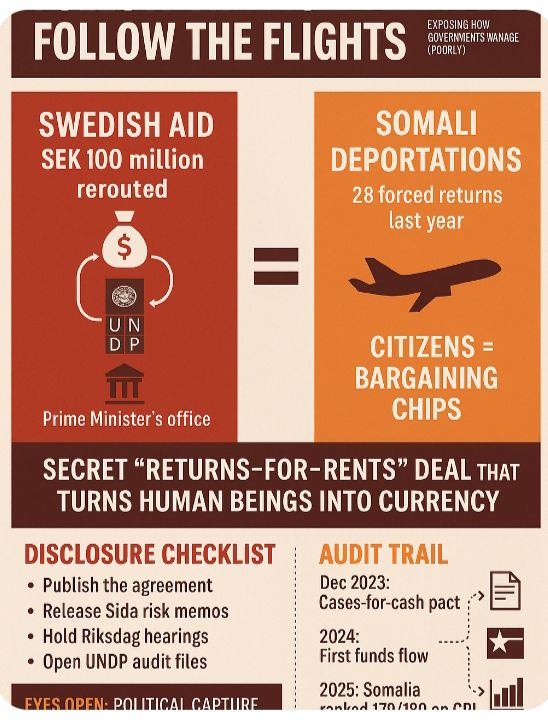
Ladies and gentlemen of Somalia, brace yourselves. While you were busy worrying about inflation, power cuts, and Al-Shabab taxes, a new flight is preparing to land at Aden Adde International Airport this Monday at exactly 17:00 hours — and no, it’s not Turkish Airlines bringing diaspora doctors or UN food aid. It’s Stockholm’s latest gift to Mogadishu: 28 convicted Somali-Swedish criminals, including one INTERPOL-flagged child predator.

Yes, you heard me. Mogadishu — once the proud White Pearl of the Indian Ocean — is now officially the world’s first tax-free penal colony, courtesy of corrupt deal-makers in Villa Somalia.

THE SMOKING GUN: THE “SPECIAL CASE” DEAL

For six months, our so-called “officials” — Ahmed Dahir, Kamal Gutale of the PM’s Office, and Yahya Hagi, the unelected “De Facto DG” of Immigration — have turned Mogadishu into a revolving door for European rejects. For a mere $45,000 per head, these gentlemen of high office have been happily importing Europe’s finest: rapists, gang leaders, and yes, pedophiles, freshly deported from Sweden, Norway, and the UK.

If this were a livestock contract, at least we’d get a quarantine certificate. Instead, these criminals are quietly released into the streets of Mogadishu — no tracking, no parole officers, no plan. Just dumped like toxic waste.

THIS IS NOT IMMIGRATION — IT IS TREASON

Let us be very clear:

This is not “repatriation.”

This is not “diaspora return.”

This is bribery, state capture, and human trafficking at the highest levels.

Mogadishu’s streets are already struggling under the weight of unemployment, insecurity, and militia checkpoints — do we now need Scandinavian gangsters setting up branch offices of Stockholm’s Somali Mafia in Hamar Weyne?

THE CALL TO ACTION

I demand:

1. Immediate cancellation of Monday’s “Special Case” flight.

2. Arrest and prosecution of every official who signed this secret deal.

3. A parliamentary inquiry into how Mogadishu became Europe’s preferred crime-disposal site.

4. A national policy that forbids importing convicts as a form of development aid.

Somalia is not for sale. We are not Europe’s landfill.

A FINAL WORD TO EUROPE & THEIR LOCAL AGENTS

If Stockholm, Brussels, or London wish to rehabilitate criminals, they have excellent prisons, psychologists, and probation programs. Don’t export your social failures to us. Mogadishu is struggling to keep its own streets safe — we do not need to add “Swedish gang wars” to the agenda.

As a candidate for President of Somalia, I vow this betrayal will be stopped dead in its tracks. The Pearl of the Indian Ocean deserves better than to become Europe’s Guantanamo Bay.

Respectfully but ruthlessly,


Dr. Abdillahi Hashi Abib, BA, MA, MASc, Ph.D
Member, Foreign Affairs Committee
Candidate for President of the Federal Republic of Somalia

abdillahi.abib@parliament.gov.so / dheemaal@yahoo.com
W: +1-571-436-7586 | M: +252-6108-22469

Urgent Appeal: Aid Needed for Residents Displaced from Mogadishu’s Daynile District

Mogadishu, September 21, 2025 – Warsame Digital Media (WDM) is issuing an urgent humanitarian appeal following the displacement of residents from Mogadishu’s Daynile district. Our offices are receiving desperate pleas for help, with many asking for as little as $5 to meet basic needs.

This crisis stems from the recent government demolition of homes and neighborhoods, actions that have left countless families homeless, hungry, and without shelter. When a state’s policies force its citizens to beg for survival from the diaspora, it fails in its most fundamental duty.

We call on our readers and the international community to help. Even a small contribution can provide a lifeline.

· Donate: Contribute to reputable charities operating in Mogadishu.
· Share: Raise awareness of this crisis.
· Act: Demand accountability from those in power.

Do not let these cries for help go unanswered. Stand with the people of Daynile.

——
Warsame Digital Media is an independent Somali news outlet committed to reporting truth and advocating for the public interest.

#Mogadishu #Daynile #Somalia #HumanitarianCrisis

Reputable Mogadishu-Based Charities / NGOsSomali Charity for Relief and Development (SCRD) Community-driven sustainable development; humanitarian assistance; advocacy; health, education, WASH, and economic empowerment. Mogadishu. Email: info@somalicharityrelief.so
Juba Foundation Works with displaced communities; provides education, shelter, protection, health, nutrition, WASH; relief & emergency programs. HQ: Waberi District, House No.8, Maka Al-Mukarama Road (behind Cinema Somalia), Mogadishu. Phone: +252 61 5571454. Email: info@jubafoundation.org
Hormuud Salaam Foundation Local foundation doing humanitarian work (often shelter, livelihoods, etc.), focused in Mogadishu and areas around. Opp. Imamu Shafie School, KM4, Hodan District, Mogadishu. Email: info@hormuudsalaamfoundation.org. Phone: +252 1 859259 / +252 1 859258.
Nile Foundations Works in Mogadishu (and other parts of Somalia) on health, community development, possibly emergency relief. KM5, Zoobe Street, Mogadishu. Email: nilefoundations@gmail.com. Phone: 0613361655.
Elman Peace & Human Rights Center Founded in Mogadishu; work includes peace building, empowerment, human rights, assistance for gender-based violence survivors via Sister Somalia; counseling, housing support, advocacy. Based in Mogadishu. (They have a strong track record and recognition locally & internationally.)
IIDA Women’s Development Organisation Women’s empowerment, advocacy, peacebuilding, training, rights of children and youth; works in Mogadishu and beyond. HQ in Mogadishu. Contact via their website (IIDA) for specific donation channels.

WDM EXCLUSIVE: Netanyahu’s Apocalypse – The Last Stand of a Rogue Regime

Benjamin Netanyahu is a man besieged, not by Hamas rockets, but by a shifting reality he long believed he could control. His shock is palpable—not stemming from any pang of conscience for the tens of thousands dead in Gaza, but from the deafening silence now emanating from sections of his once-reliable cheering section in the West. His lifelong political insurance policy—“do whatever you want, America will pay the bill and provide diplomatic cover”—is showing catastrophic cracks, threatening to expire in full view of the world.

In a monstrous gamble, Netanyahu went full rogue. Betting that the sheer, brutal arithmetic of violence—carpet-bombing one of the most densely populated places on earth, systematically starving its people, and flattening its hospitals and universities—would finally “solve” the Palestinian question. This strategy, however, is born of his own cynical creation. For years, his policy was to financially prop up Hamas, funneling Qatari millions into Gaza to bolster the militants as a wedge against the Palestinian Authority in the West Bank, deliberately sabotaging the prospects for a unified Palestinian state and a negotiated peace. He believed he could manage a controlled burn of a contained conflict. Now, the fire he fed has consumed his legacy.

Instead of security, he has achieved a darkly historic first: becoming an Israeli prime minister openly branded a war criminal on the floors of Western parliaments and denounced by a U.N. commission of inquiry. For the first time in living memory, the phrases “international law” and “Israel’s actions” are being uttered in the same breath across global media—and not as a cynical punchline, but as a serious indictment.

This is Netanyahu’s Gaza Gamble: a scorched-earth campaign of collective punishment so extreme, so televised, and so digitally documented that it has forced the world to use vocabulary it had reserved for history’s darkest chapters. The irony is lethally tragic. He believes this carnage is saving Israel. In truth, he is single-handedly excavating its diplomatic grave. The foundational myth of Israel’s eternal impunity is shattering.

This tragedy is compounded by the haunting accusations surrounding the October 7th attack itself. Beyond the failed strategy of empowerment, some within Israel’s own security establishment and bereaved families now level a far more damning charge: that Netanyahu, warned of potential violence, gave standing-down orders to forces near Gaza, a catastrophic miscalculation or neglect that left kibbutzim and military bases vulnerable to Hamas’s heinous assault. Whether born of arrogance or incompetence, this failure is the original sin of the ensuing apocalypse, a fact that fuels the domestic fury against him.

One day very soon, Netanyahu will wake to a chilling discovery: his entire war machine is sustained not by righteousness, but by the waning patience of a single superpower, the diminished influence of a powerful lobby, and the world’s fast-depleting reserves of political hypocrisy.

And here is the strategic blunder that will define his legacy: he has deliberately, viciously blurred the critical lines of identity. There is a profound difference between the nation of Israel and the political project of Zionism, just as there is a chasm between the terror group Hamas and the two million Palestinian civilians of Gaza. By conflating them, Netanyahu has made every Israeli bomb a referendum on Israel’s own legitimacy, radicalizing a new generation and alienating its most crucial allies. He has become Hamas’s greatest, if unwitting, recruiter.

Meanwhile, the international response paints a picture of a world order in crisis. Western capitals, gripped by a guilty paralysis, are now breaking ranks in an unprecedented wave. In a stunning diplomatic rupture, key European nations are formally recognizing Palestinian statehood against the explicit wishes of the United States, signaling that Washington’s veto at the UN Security Council is no longer a magic wand to halt global consensus but a symbol of its own isolation. This move leaves the U.S. and Israel as outliers, clinging to a failed status quo. Much of the Global South—the Muslim world, Asia, Africa, and Latin America—watches this Western fracture with grim validation, having long seen not a complex conflict but a stark colonial nightmare, and are rapidly moving to isolate Israel in every international forum. Theirs is not sleepwalking, but a gathering storm of a new geopolitical alignment, one where Western double standards on human rights are no longer tolerated.

Netanyahu’s ultimate tragedy—and Israel’s—is that he may yet claim a pyrrhic victory in Gaza, reducing it to rubble and calling it peace. But in the process, he has mortgaged his nation’s future for a fleeting moment of vengeful dominance. He will have lost the war for history, forever remembered not as a protector of Israel, but as the architect of its deepest isolation—the leader who first empowered a monster, then failed to protect his people from it, and finally unleashed a hell that shattered his country’s standing on the world stage.

The Puntland Doctrine: Terrain, Logistics, and the Evolution of Regional Counter-Insurgency in Northern Somalia, 1990s-2025

Ismail H Warsame                              Warsame Digital Media (WDM)   September 21, 2025

Abstract

While international counter-terrorism discourse concerning Somalia has predominantly focused on the Federal Government in Mogadishu and the threat of al-Shabaab in the south, the semi-autonomous state of Puntland has conducted a sustained, iterative counter-insurgency (COIN) campaign in its northern territories for over three decades. This article argues that through a process of tactical adaptation and strategic learning, Puntland has developed an effective, locally-led doctrine focused on severing the logistical connection between vulnerable port settlements and mountainous insurgent sanctuaries. By analyzing five distinct conflict phases from the rise of Al-Itihaad al-Islami (AIAI) to the recent offensive against Islamic State affiliates in the Cal Miskaad range, this study demonstrates how regional authorities can develop a sustainable capacity to degrade transnational terrorist cells. This history, often overlooked due to its remote theater and fragmented documentation, offers a significant case study in the primacy of terrain and logistics in asymmetric warfare. The analysis draws on United Nations monitoring reports, historical studies, and the firsthand accounts of local officials like Ismail H. Warsame to articulate a coherent narrative of Puntland’s strategic evolution.

Keywords: Somalia, Puntland, Counter-Insurgency, Al-Shabaab, Islamic State, Terrorism, Horn of Africa, Logistics, Regional Security

Introduction: The Littoral-Highland Battlespace

The strategic geography of Northern Somalia presents a quintessential challenge for counter-insurgency (COIN). The rugged Cal Miskaad and Golis mountain ranges, with their complex systems of caves and wadis, offer natural sanctuary for non-state actors.[^1] This terrain is juxtaposed with a long, porous coastline dotted with isolated villages and inlets, providing critical access points for personnel and material. The persistent objective for a succession of jihadist groups has been to fuse these two domains—mountain sanctuary and littoral logistics—into a durable operational base.[^2]

Despite the strategic significance of this region, the sustained conflict within Puntland’s borders has received scant scholarly attention compared to the upheavals in South-Central Somalia. This gap in the literature exists because much of Puntland’s conflict has unfolded in inaccessible terrain, was reported in scattered field dispatches and monitoring group memos, and was often overshadowed by concurrent political crises in Mogadishu.[^3] This article synthesizes these fragmented sources to construct a coherent historical narrative. It posits that through a process of iterative learning across three decades, Puntland’s security forces have evolved from reliant on ad-hoc militias to a professionalized, integrated command structure capable of executing a sophisticated COIN doctrine. This doctrine, culminating in the 2024-25 Cal Miskaad offensive, is predicated on a single, consistent strategic imperative: control the coastline to isolate the highlands, thereby rendering terrain-based sanctuaries unsustainable.

The Precedent: Al-Itihaad al-Islami and the Foundational Lessons (Early–Mid 1990s)

Before “counter-terrorism” became a pillar of international engagement with Somalia, Puntland’s founding authorities faced their first organized Islamist challenge. In the early 1990s, Al-Itihaad al-Islami (AIAI), then the most coherent Islamist formation in the country, briefly established a governance project in the major port city of Bosaso.[^4] AIAI sought to impose its Sharia-first system as warlordism raged elsewhere, effectively using the port as a source of revenue and legitimacy.

This experiment was short-lived. SSDF-aligned forces, representing Puntland’s nascent governing authority, rolled back AIAI’s control in the north, while a devastating Ethiopian military intervention smashed its rear bases around Luuq and in the Ogaden corridor.[^5] This initial episode was formative. It imparted two enduring lessons that would echo through subsequent conflicts: first, port cities are high-value strategic prizes whose control is essential for any group seeking sustained operations; and second, the northern mountain ranges, while not the primary front in this early episode, were recognized as potential sanctuaries and force-multipliers. The response also set a precedent for cooperation with external actors, namely Ethiopia, which has remained a recurring feature of Puntland’s security strategy.[^6]

Phase I: The Islamic Courts Union and the Battle of Bandiradley (December 2006)

The rise of the Islamic Courts Union (ICU) in 2006 and its rapid territorial expansion presented a direct conventional threat to Puntland. In late 2006, ICU forces surged northward, with the strategic town of Bandiradley becoming the forward pressure point. The battle for Bandiradley was a short, sharp engagement. Puntland forces, operating in concert with militias from Galmudug and with critical support from Ethiopian units, broke the ICU’s line and pushed it south.[^7]

Strategically, the victory at Bandiradley halted an Islamist pincer movement aimed at Galkayo—a key economic hub—and the artery of the Bari road.[^8] It served as a blocking action, buying Puntland crucial time to harden its internal defenses and consolidate its territorial control. This phase demonstrated Puntland’s initial capacity to integrate external military support and local militias to defeat a conventional advance, reinforcing the lesson that the mountain passes were critical terrain that must be denied to an invading force.

Phase II: The Galgala Insurgency and Attritional Warfare (2009–2011)

Following the conventional defeat of the ICU, the conflict evolved into a protracted insurgency. A former AIAI member, Mohamed Said “Atom,” nested cells and ambush teams within the limestone folds of the Galgala-Calmadow range.[^9] Atom claimed affiliation with al-Shabaab, which was now the dominant jihadist force in the south, operating with a degree of autonomy as a franchise.[^10]

Puntland’s counter-insurgency response became attritional. The Puntland Security Force (PSF), a more professionalized unit, led raids and conducted painstaking ridge-to-ridge clearances. The critical strategic effort, however, was the gradual isolation of Atom’s supply lines extending to the coast.[^11] By late 2010 and into 2011, the hills remained contested but Atom’s cadre had been bled dry and scattered. The Galgala campaign proved a vital lesson: mountainous terrain offers immense advantages to guerrillas, but only if they can maintain a steady flow of logistics. A strategy of littoral denial could starve a mountain-based insurgency.

Phase III & IV: Littoral Maneuver and Jihadist Fracture (2016)

The year 2016 witnessed a tactical shift by insurgents and a fracturing of the jihadist landscape, testing Puntland’s adaptive capacity.

In March, al-Shabaab executed a strategic pivot towards littoral warfare. Fighters landed by boat and overran the small port of Gara’ad (Garacad), briefly opening a second front while operations in Galgala continued.[^12] Puntland forces counter-attacked within days and restored control, but the message was unambiguous: the coastline was a critical vulnerability, and any unpoliced cove could be transformed into a staging point.[^13]

Later that same year, a new threat emerged. An ISIS-aligned splinter faction led by ‘Abd al-Qadir Mu’min seized the coastal town of Qandala, hoisting its flag for several weeks before being ejected.[^14] This event had significant implications. Puntland now faced two distinct jihadist brands—al-Shabaab and ISIS-Somalia—competing for the same strategic space. The response demonstrated Puntland’s growing sophistication; it learned to contain both groups simultaneously and, crucially, to deny either a permanent port facility, adhering to the core principle of its emerging doctrine.

Phase V: The Cal Miskaad Offensive and Doctrine Culmination (2024–2025)

The most recent and large-scale operation represents the maturation of the Puntland Doctrine. In a coordinated multi-service offensive, units from the PSF, Darawish, PMPF, and police surged into the Cal Miskaad range to dismantle the strongholds of ISIS-Somalia.[^15] This campaign was notable for its integration of external enablers, who provided precision strike capabilities, alongside highly mobile local forces with superior knowledge of the terrain. The operation rolled up base clusters, reopened key tracks, and provoked a costly, mass-casualty counterattack by ISIS on December 31, 2024—a sign of the pressure applied. By early 2025, officials reported dozens of sites cleared and significant territory retaken.[^16]

The Cal Miskaad offensive was not merely a tactical victory. It was the culmination of a doctrine hammered out over three decades: treat the littoral-mountain system as an integrated battlespace, close the coves, and starve the hills. It also carried a potent political message: regional forces, with targeted external support, can effectively degrade transnational terrorist cells without waiting on a centralized national command from Mogadishu.[^17] This aligns with the long-standing principle of self-reliance chronicled by local observers of Puntland’s political development.[^18]

Analysis: The Through-Lines of a Doctrine

Synthesizing these five conflicts reveals the consistent pillars of Puntland’s strategic approach:

1. The Primacy of Logistics over Terrain: Every militant surge, from AIAI to ISIS, targeted a port or coastal landing point. Puntland’s strategy correctly identified that controlling terrain is secondary to controlling its sustenance. A mountain sanctuary is worthless without a pipeline of resources.[^19]
2. Adaptive Learning: Puntland’s command structure evolved iteratively in response to new threats. Its forces transformed from ad-hoc militias to a specialized PSF, and finally to an integrated command capable of coordinating multiple units and leveraging external precision support. This organizational learning curve proved steeper than the tactical adaptations of its adversaries.
3. The Efficacy of Regional Initiative: The consistent success factor was local leadership and knowledge. Forces from Puntland, with an intimate understanding of the human and physical geography, proved to be the most effective instrument for COIN in this complex environment. This aligns with the observations of insiders like Ismail H. Warsame, who has chronicled Puntland’s institution-building and its strategic principle of self-reliance in security matters.[^20] The model of local lead with targeted, enabling external help has been the only one to consistently achieve tactical and strategic effects.

Conclusion

The history of conflict in Puntland is not a series of disconnected skirmishes but a continuous, thirty-year arc of strategic learning. The “Puntland Doctrine” that emerged is a pragmatic, terrain-specific approach to counter-insurgency that understands the critical link between logistics and sanctuary. As articulated by local figures like Warsame, this doctrine is rooted in a pragmatic assessment of local needs rather than abstract theories imposed from outside.[^21] The 2024-25 campaign in the Cal Miskaad mountains is not an isolated event but the logical endpoint of a strategy refined since AIAI first tested the defenses of northern ports.

This case study offers broader lessons for security studies and COIN theory. It underscores that effective counter-insurgency often depends on granular, local knowledge and regional initiative rather than solely on centralized national strategies. It also reaffirms the timeless military axiom that logistics, not just terrain, dictate the viability of an insurgency. For policymakers, the Puntland case argues for a model of security cooperation that empowers capable local actors with the precise support they need, rather than imposing top-down, one-size-fits-all solutions. The untold story of Puntland’s long defense of its ridgelines and coastline is, ultimately, a story of strategic adaptation and the enduring importance of controlling the means of sustenance in war.

Notes

[^1]: Ken Menkhaus, Somalia: State Collapse and the Threat of Terrorism (New York: Routledge, 2004), 45-48.
[^2]:United Nations Security Council, Report of the Monitoring Group on Somalia and Eritrea, S/2017/924 (New York: United Nations, 2017), 12-15.
[^3]:Stig Jarle Hansen, Al-Shabaab in Somalia: The History and Ideology of a Militant Islamist Group (New York: Oxford University Press, 2013), 112.
[^4]:Matt Bryden, The Rise and Fall of Al-Itihaad al-Islami in Somalia (Nairobi: UNPD Somalia, 1999), 22.
[^5]:Bryden, Rise and Fall, 28-30.
[^6]:United Nations Security Council, Report of the Monitoring Group on Somalia and Eritrea, S/2010/91 (New York: United Nations, 2010), 51.
[^7]:Hansen, Al-Shabaab in Somalia, 134.
[^8]:United Nations Security Council, S/2010/91, 54.
[^9]:United Nations Security Council, Report of the Monitoring Group on Somalia and Eritrea, S/2022/822 (New York: United Nations, 2022), 19.
[^10]:Hansen, Al-Shabaab in Somalia, 156.
[^11]:United Nations Security Council, S/2017/924, 21.
[^12]:United Nations Security Council, S/2017/924, 34.
[^13]:United Nations Security Council, S/2017/924, 35.
[^14]:United Nations Security Council, S/2017/924, 38-40.
[^15]:United Nations Security Council, S/2022/822, 25.
[^16]:United Nations Security Council, S/2022/822, 27-29.
[^17]:Ismail H. Warsame, “Puntland’s Strategy Against Terrorist Groups,” WardheerNews, October 15, 2016, https://wardheernews.com/puntlands-strategy-terrorist-groups/.
[^18]:Ismail H. Warsame, “The Genesis of Puntland State of Somalia,” (self-published monograph, 2018), 45.
[^19]:Menkhaus, State Collapse, 72.
[^20]:Warsame, “Puntland’s Strategy Against Terrorist Groups.”
[^21]:Warsame, “The Genesis of Puntland State of Somalia,” 102.

Bibliography

Bryden, Matt. The Rise and Fall of Al-Itihaad al-Islami in Somalia. Nairobi: UNPD Somalia, 1999.

Hansen, Stig Jarle. Al-Shabaab in Somalia: The History and Ideology of a Militant Islamist Group. New York: Oxford University Press, 2013.

Menkhaus, Ken. Somalia: State Collapse and the Threat of Terrorism. New York: Routledge, 2004.

United Nations Security Council. Report of the Monitoring Group on Somalia and Eritrea. S/2010/91. New York: United Nations, 2010.

———. Report of the Monitoring Group on Somalia and Eritrea. S/2017/924. New York: United Nations, 2017.

———. Report of the Monitoring Group on Somalia and Eritrea. S/2022/822. New York: United Nations, 2022.

Warsame, Ismail H. “Puntland’s Strategy Against Terrorist Groups.” WardheerNews, October 15, 2016. https://wardheernews.com/puntlands-strategy-terrorist-groups/.

———. “The Genesis of Puntland State of Somalia.” Self-published monograph, 2018.

The Puntland Doctrine: A Strategic History of Counter-Insurgency in Northern Somalia (1990s-2025)

Abstract: While international counter-terrorism efforts in Somalia have historically focused on Mogadishu and South-Central regions, the semi-autonomous state of Puntland has for three decades served as a critical bulwark against the entrenchment of jihadist groups in the strategic littoral-highland nexus of the Horn of Africa. This analysis synthesizes scattered field reports and operational data to trace an untold strategic arc: Puntland’s iterative adaptation against five successive extremist projects, culminating in a locally-led doctrine that severs the connection between mountain sanctuaries and port logistics. This historical examination, structured around the interplay of ports, mountains, and organizational evolution, argues that regional initiative, terrain-specific strategies, and an evolving force structure have been decisive in denying militants a permanent foothold.

Introduction: The Littoral-Highland Battlespace

The conflict in Northern Somalia is defined by a geographic dichotomy: the rugged Cal Miskaad and Golis mountain ranges provide natural sanctuary for insurgents, while the porous coastline offers critical access for logistics and support. The constant strategic objective for extremist groups has been to fuse these two domains into a durable operational base. Puntland’s sustained resistance to these efforts represents a critical case study in regional counter-insurgency (COIN). The following history is structured along three concurrent strands that illustrate the evolution of this conflict:

1. The Struggle for Ports & Littorals: The battle to control logistics hubs and landing points.
2. The War in the Mountains: The fight to deny insurgent sanctuary in the rugged interior.
3. Organizational Shifts: The evolution of both jihadist groups and Puntland’s security apparatus.

This triad provides the framework for analyzing the distinct “Puntland Doctrine.”

The Chronological Evolution of the Conflict

The Precedent: Establishing the Strategic Paradigm (Early–Mid 1990s)

· Ports & Littorals: The major port city of Bosaso was the initial prize. AIAI’s seizure of it was a deliberate attempt to establish a governance project and secure a primary logistics hub.
· Mountains: While not the main battleground, the northern ridges were recognized as a potential rear base and force-multifier, establishing their strategic value from the outset.
· Organizational Shifts: This period featured the first organized jihadist challenge from Al-Itihaad al-Islami (AIAI). Puntland’s response was conducted by ad-hoc SSDF-aligned militias, setting the baseline from which all future adaptation would occur.

Phase I: Conventional Threat and Mountain Defense (December 2006)

· Ports & Littorals: (This round emphasized land-based conventional advance, though it aimed to ultimately control all territory, including coasts.)
· Mountains: The Battle of Bandiradley was a decisive mountain engagement. Halting the ICU surge here protected the strategic approaches to Galkayo and the vital Bari road.
· Organizational Shifts: The rise of the Islamic Courts Union (ICU) introduced a new, powerful challenger. Puntland’s response evolved into a coalition of its militias with key Ethiopian military support, demonstrating an early understanding of the need for partnered operations.

Phase II: Protracted Insurgency and Attritional Denial (2009–2011)

· Ports & Littorals: The strategy shifted to littoral denial. Puntland focused on disrupting Atom’s ability to draw supplies from coastal towns, making his mountain holdings unsustainable.
· Mountains: The Galgala-Caladow range became the epicenter of a protracted guerrilla campaign under Mohamed Said “Atom”, who expertly leveraged the complex limestone terrain.
· Organizational Shifts: Atom’s group operated as a semi-autonomous al-Shabaab affiliate, illustrating the franchise model of jihad. In response, Puntland professionalized its forces, establishing the more capable Puntland Security Force (PSF).

Phase III & IV: The Littoral Gambit and Jihadist Fracture (2016)
The year 2016 saw two nearly simultaneous challenges that highlighted the integrated nature of the battlespace and a shifting organizational landscape.

· Ports & Littorals (Mar 2016): Al-Shabaab executed a strategic pivot with the Gara’ad incursion, a seaborne assault to capture a minor port and open a new logistical front.
· Ports & Littorals (Late 2016): The ISIS-Somalia splinter faction then occupied the port town of Qandala, demonstrating that multiple groups now coveted a coastal foothold.
· Mountains: Throughout this period, the Galgala range remained an active insurgency, forcing Puntland to contend with a potential two-front conflict linking the coast to the highlands.
· Organizational Shifts: This period was defined by fracture and competition. The emergence of ISIS-Somalia created a rival to al-Shabaab, fracturing the jihadist movement and complicating Puntland’s threat landscape.

Phase V: Doctrine Culmination – Integrated Systems Control (2024–2025)

· Ports & Littorals: The overarching goal of the Cal Miskaad Offensive was to permanently sever all clandestine coastal supply lines feeding the mountain insurgency.
· Mountains: The operation represented the largest-ever push to clear ISIS-Somalia strongholds in the rugged Cal Miskaad range, treating the mountain system as a single, integrated battlespace.
· Organizational Shifts: This campaign showcased the full maturation of Puntland’s model: an integrated command of PSF, PMPF, Dervish, and police units, effectively leveraged partner-provided precision strike capabilities. This validated the doctrine of local lead with targeted external support.

Analysis: The Through-Lines of a Doctrine

Synthesizing these five conflicts through the lens of the three strategic lanes reveals consistent principles:

1. The Primacy of Logistics (Ports & Littorals): Every militant surge, from AIAI to ISIS, targeted a port. Puntland’s core strategic imperative has been to deny and disrupt this link, understanding that terrain without supply is ultimately indefensible.
2. Terrain Control via Economic Warfare (Mountains): Military control of mountainous terrain is secondary to controlling its sustenance. Success was achieved not merely through clearances but by systematically isolating insurgents from the local micro-economies and supply chains that made their presence viable.
3. Adaptive Learning (Organizational Shifts): Puntland’s command structure demonstrated a capacity to learn and adapt at a pace that matched, and often exceeded, that of its adversaries. Its evolution from militias to a integrated, specialized force capable of combined arms operations is a testament to organizational learning under fire.

Conclusion: An Unwritten History and Its Implications

This history has remained largely “untold” due to its occurrence in inaccessible terrain, its overshadowing by events in Mogadishu, and its manifestation in tactical engagements that mask strategic weight. By reconstructing it along the interwoven strands of ports, mountains, and organizational change, the consistent application of a deliberate Puntland Doctrine becomes clear. The 2024-25 Cal Miskaad campaign is not an isolated event but the logical culmination of a strategy honed over thirty years: control the coastline, isolate the highlands, and prevent any tactical victory from becoming a strategic permanent base. This case study offers critical lessons for COIN strategies in similar littoral-mountain environments elsewhere, highlighting the efficacy of regional, terrain-literate forces operating with targeted external enablement.

WDM EXCLUSIVE: Mogadishu’s Twin Governments and the E-Visa Fiasco

By Ismail H. Warsame | Warsame Digital Media | © 2025 WDM

Welcome to Mogadishu, the only city in the world where the word “capital” means two capitals fighting over the same piece of sand.

President Hassan Sheikh Mohamud has apparently discovered the cure for Somalia’s economic stagnation: land grabs. Forget agricultural reforms, industrialization, or revenue-sharing agreements—Mogadishu’s real GDP is measured in square meters of seized plots. Every clan elder with a bulldozer and a militia is now an “investor,” courtesy of Villa Somalia’s urban renewal program.

But not everyone is applauding the President’s real estate hustle. The Banadir parallel administration, which functions like Mogadishu’s shadow government, has now threatened action against this latest land-grabbing spree. And here’s the punchline: even Al-Shabab found this whole spectacle corrupt enough to issue a statement condemning it.

Yes, you read that correctly: Al-Shabab, the same group that detonates hotels for breakfast, is now lecturing Villa Somalia about legality. Imagine Pablo Escobar giving a TED Talk on drug policy.

E-Visa: Somalia’s Newest Pyramid Scheme

If the land grabs were not enough, the Federal Government’s flashy E-Visa project has turned into a textbook scandal. The system that was supposed to streamline travel and showcase Somalia’s “digital future” has become the equivalent of a tollbooth for presidential relatives.

Reports are flying that Mohamud’s immediate family members are linked to offshore accounts and shady kickbacks. Instead of a secure, transparent platform, we now have a Somali version of FTX—minus the tech genius and with double the clan politics.

Even Puntland, the last remaining adult in the federal room, refused to play ball on the E-Visa revenue-sharing deal. Now travelers must pay two fees—one to Villa Somalia and another to Puntland. Double taxation? No problem—because in Mogadishu math, this is called “federalism.”

The whole circus is a perfect reflection of Somalia’s “state-building” effort:

The Punchline

A President moonlighting as a landlord.

A shadow government threatening civil action.

A terrorist group claiming to be the voice of legality.

A national digital visa system collapsing into clan-based corruption.

And the international community still insists this is a “fragile democracy.”

At this rate, Mogadishu may soon have three governments—one for land grabs, one for fighting land grabs, and one for collecting E-Visa fees. That should finally satisfy the donors, who love to fund “multi-stakeholder approaches.”

WDM Editorial Report | “Tip of the Spear”: Decoding Washington’s Strategic Endorsement of Puntland’s Fight Against ISIS

Networks file

Executive Summary: A high-level U.S. delegation, led by Ambassador Larry E. Riley and SOCAFRICA Commander Maj. Gen. Claude K. Tudor, has publicly endorsed Puntland’s forces as the “tip of the spear” in the fight against ISIS-Somalia. This language signifies a major shift from rhetorical support to a tangible, effects-based partnership. This report analyzes the strategic messaging, the corroborating battlefield evidence, and the significant implications for U.S. policy, regional security, and Puntland’s standing.

The Signal: A Deliberate Strategic Message

The recent meeting between U.S. officials and Puntland President Said Abdullahi Deni was more than diplomatic theater. The presence of both the U.S. Ambassador and the commander of U.S. special operations forces in Africa (SOCAFRICA) indicates coordinated, whole-of-government backing.

The designation of Puntland’s security formations as the “tip of the spear” is a loaded term in military-diplomatic parlance. It explicitly frames Puntland’s forces as the main effort—the lead combat element—with U.S. forces playing an enabling role through airpower, intelligence, and advisory support. This is a powerful statement of policy, resource allocation, and political legitimacy.

Decoding Washington’s Telegraph: Four Key Points

1. Validation of the Puntland Front: Washington is explicitly acknowledging that the primary center of gravity for ISIS-Somalia is in the Golis Mountains (Cal-Miskaad) and areas surrounding Bosaso, Puntland. The sustained tempo of U.S. airstrikes in this region, as documented by AFRICOM, confirms that this fight is a strategic priority, not a peripheral engagement.
2. Elevated Special Operations Focus: The involvement of SOCAFRICA Commander Maj. Gen. Tudor, a senior special operations leader with prior AFRICOM experience, signals a deep and sustained commitment. Senior SOF command attention is a finite resource; its investment here underscores the operational priority assigned to this theater.
3. Synchronized Air-Ground Campaign: U.S. actions are not occurring in a vacuum. Reporting from outlets like Reuters details significant Puntland ground offensives that have retaken approximately 250 km² of territory and dozens of ISIS positions. U.S. airstrikes and the July raid that captured ISIS-Somalia’s finance chief are directly enabling this local ground scheme, representing a mature and effective combined campaign.
4. Explicit Homeland Security Nexus: The Embassy and AFRICOM have directly linked the fight in Cal-Miskaad to threats against “the region and our homeland.” This public framing is crucial for justifying the allocation of resources, intelligence assets, and strike authorities under U.S. policy, tying local operations to core U.S. national security interests.

The Battlefield Ledger: Evidence of a Campaign (2025)

· Airstrike Tempo: U.S. Africa Command has publicized multiple strikes targeting ISIS-Somalia in Puntland throughout 2025, including a confirmed action on July 6 southeast of Bosaso and follow-on strikes into September. This consistent rhythm indicates a sustained campaign, not isolated events.
· Territorial Gains: Puntland forces have reportedly reclaimed significant territory, with intense fighting resulting in heavy losses for both sides—an estimated 85 ISIS militants killed and 17 Puntland soldiers fallen.
· High-Value Targeting: The capture of ISIS-Somalia finance chief Abdiweli Mohamed Yusuf by U.S. operators in July represents a critical blow to the group’s logistics and funding networks, enabling further disruption operations.
· Record Resources: The pace of U.S. airstrikes in Somalia in 2025 is on track to be one of the highest on record, an unambiguous signal of increased resource commitment to the conflict.

Strategic Implications: Why This Alignment Matters

· For Puntland: This endorsement confers a major “credibility dividend.” Being recognized as the “tip of the spear” elevates the status of Puntland’s security institutions (PSF, PMPF) and validates their strategy. It strengthens their position both militarily and in future political negotiations.
· For Maritime Security: U.S. praise for Puntland’s “maritime security” efforts is a direct encouragement to maintain pressure on coastal smuggling and piracy networks that ISIS exploits for revenue and logistics.
· For U.S. Strategy in Somalia: This partnership highlights a clear U.S. preference for funding and enabling effective, locally-led military operations with measurable results. It creates a strategic contrast with more contested and less effective federal government-led fronts elsewhere in Somalia.

Corroborating Sources:

· AFRICOM: Public releases detailing airstrikes against ISIS-Somalia in the Bosaso/Cal-Miskaad region.
· Reuters: Reporting on Puntland’s ground offensive and territorial gains.
· Task & Purpose & Stars & Stripes: Documentation of the increased U.S. strike tempo and details on the raid capturing ISIS-Somalia’s finance chief.
· International Crisis Group: Analysis confirming ISIS-Somalia’s entrenched footprint in the Bari region, validating the geographic focus of U.S.-Puntland operations.

WDM Assessment

Washington’s message is not charitable praise; it is a strategic contract. The terms are clear: Puntland must continue to deliver decisive battlefield effects, and the United States will provide the enabling support—precision airpower, special operations collaboration, and political cover.

Puntland is currently holding up its end of the bargain. In return, it is being paid in the most valuable currency available: sustained military capability and high-level recognition. The strategic imperative is now to maintain pressure, consolidate gains, and ensure the Cal-Miskaad region becomes the graveyard of ISIS-Somalia’s operational capability.

————-

Reporting Desk: WDM Security & Geopolitics.

To All WDM Readers,

Subject: Join the WAPMEN Annual Subscription Today

WAPMEN (previously WDM) has always been more than just news – it’s a platform for fearless analysis, bold editorials, and thought-provoking essays that cut through the noise. If you value independent commentary and want to keep receiving our hard-hitting articles, now is the time to take the next step.

We invite you to become an Annual Subscriber for just US$37. Your subscription helps sustain our work, expand our reach, and keep WDM completely independent – free from outside influence or censorship.

You can pay quickly and securely using any method convenient to you: Sahal at 25290 703 4081; Evcplus at 252 611588388 Mycash at 252 71681 4371 or PayPal at ismail.warsame@yahoo.ca (using your bank card).

For information and assistance:
Email: ismailwarsame@gmail.com
Tel/WhatsApp: +252 90 703 4081

By subscribing, you aren’t just supporting WAPMEN – you’re becoming part of a growing community committed to truth, justice, and powerful ideas.

Let’s keep WAPMEN strong together. Subscribe today.

© 2025 Warsame Digital Media (WDM)

WDM EXCLUSIVE: The Empire of Patience: What Trump Forgets About Russia

By Ismail H. Warsame
© 2025 WDM

Donald J. Trump’s understanding of history appears to extend only as far as his own reflection. His commentary on Russia suggests a nation that sprang, fully formed, from the will of Vladimir Putin—a geopolitical novelty act of hackers, missiles, and shirtless bravado. He mistakes the current regime for the ancient state.

History, however, is unforgiving to those who ignore it. Russia is not a recent invention. It is a civilization that has absorbed the Mongol yoke, turned Napoleon’s Grand Armée into a frozen monument to hubris, and ground Hitler’s war machine into the snows of Stalingrad. It has built and lost empires, ignited revolutions that reshaped the global order, and consistently defied every Western prophecy of its collapse—from the Tsars to the Soviets to the so-called “post-Soviet chaos.”

A Millennium of Statehood vs. A Quarter-Millennium of Experiment

To compare the timelines of Russia and the United States is to compare a deep, slow-moving river to a powerful but youthful stream. As George Washington crossed the Delaware, Russia’s empire already spanned continents, stretching from the Baltic Sea to the Pacific Ocean. While American founders penned Enlightenment ideals, Empress Catherine the Great was practicing them—and simultaneously annexing Crimea—proving that Russian statecraft has always blended philosophy with realpolitik.

Consider its enduring assets: Russia commands a treasure trove of oil, gas, uranium, and wheat that keeps Europe dependent, America anxious, and China engaged. Its scientists launched Sputnik into the cosmos while America was perfecting the television commercial. Its literary giants—Dostoevsky, Tolstoy, Chekhov—were probing the depths of the human soul before the United States had a distinct literary voice. This is not merely a nation; it is a civilization with a long memory and profound cultural reserves.

The “Putin Let Me Down” Fallacy

This context makes Trump’s recent lament—“Putin let me down!”—so profoundly naive. He framed a geopolitical rift as a personal betrayal, as if a business partner had reneged on a handshake deal in Atlantic City. The error is fundamental: Vladimir Putin is not a contestant on The Apprentice: Geopolitics Edition. He is the calculated steward of a thousand-year tradition of Russian statecraft, for whom strategy is measured in centuries, not news cycles.

Trump evaluates world leaders as he does Yelp reviews: bestowing five stars for flattery, one star for defiance. Putin, by contrast, plays chess on a board where the pieces are history, energy, and power. He understands that a single-term American president is a temporary variable in Russia’s long equation.

The West’s Convenient Amnesia

Yet, this myopia is not Trump’s alone; it is a recurring Western affliction. We sanction, moralize, and tweet, treating Russia as a petulant child to be disciplined. Russia responds by having its bombers probe NATO airspace over Poland, Estonia, and Romania—not to start a war, but to remind the alliance of its reach and its resolve. It endures these punishments like a veteran boxer who knows how to absorb a punch. From Napoleon to Hitler to NATO expansion, it has been declared finished by its adversaries, only to remain—bruised, resilient, and eternally relevant. It is not a fleeting problem to be solved but a permanent fixture to be understood. Its strategy extends into culture and information, launching its own “Intervision” song contest not merely to troll Eurovision, but to build a parallel sphere of influence, dividing the West with a catchy melody.

WDM Verdict

Donald Trump’s failure is not merely a misunderstanding of Russia, but a rejection of history itself. America is still drafting its story; Russia is on its second or third draft, each written in the blood and ink of centuries. The Kremlin will not lose sleep over a former president’s bruised ego. Russia has outlived tyrants, invaders, and ideologues far more formidable than Trump. It will assuredly outlast his indignation.

WDM EXCLUSIVE: The Architects of Human Rights Become the Architects of Deportation

© 2025 WDM | By Ismail H. Warsame

For decades, mass deportation was a silent policy in the shadows of the Gulf—a brutal tool for managing migrant labor. Now, it has been imported, polished, and implemented with chilling efficiency by its former critics in the West.

The Great Reversal

Where glass palaces of moral authority once stood, deportation centers now rise. Western capitals that long lectured the world on human rights are perfecting a new craft: the industrial-scale expulsion of asylum seekers, often back to the very conflicts and crises they fled. The irony is historic. As Riyadh and Abu Dhabi modernize their labor laws, Washington, London, and Paris are adopting the zeal—if not the exact methods—of the Gulf’s immigration police of a bygone era.

This is more than a policy shift; it is a fundamental reversal of the West’s civilizational narrative. The nations that authored the doctrine of universal human rights are now revealing its fine print: those rights are conditional, reserved primarily for the right kind of people.

From Citizenship to Conditional Residency

The logical next step is already materializing: the redefinition of citizenship itself. Under the banners of “security” and “social cohesion,” the inviolable guarantees of passports and birthrights are being quietly rewritten. The unstated goal is a last stand against demographic change—an effort to preserve a certain image of nationhood that looks less like a diverse modern state and more like a nostalgic advertisement.

The hypocrisy is staggering. The same Western think tanks that for years advised Gulf monarchies on “integrating” their migrant populations are now watching as their governments test mass deportation as a legitimate tool of domestic policy. If hypocrisy were an Olympic sport, the medals would be awarded in gold, silver, and bronze to its founding proponents.

The Collapse of a Global Order

The long-term consequences are yet to be seen. Can the international human rights framework, already on life support, survive this betrayal by its architects? Or are we witnessing the birth of a new, grim global standard: “Rights for us, walls for you”?

The message for now is unequivocal. The West has become what it once claimed to resist. The moral high ground has been sold, its proceeds funding a sprawling network of detention camps and deportation flights. The world is watching the teacher become the student, and the lesson is one in realpolitik, devoid of principle.

WDM INVESTIGATIVE SPECIAL

Villa Somalia’s Shadow War on Puntland

By Ismail H. Warsame | © 2025 WDM


Introduction: The New Battleground

In today’s Somalia, war is no longer fought only with militias and mortars — it is fought with money, memes, and manipulated narratives. The real front line is digital. And if our investigation is correct, Villa Somalia under President Hassan Sheikh Mohamud has quietly opened a new campaign — one that targets Puntland State not with tanks, but with federal cash, proxy agents, and internet propaganda designed to fragment its autonomy and capture its political future.

This is not federalism. This is a hostile takeover.


I. The Funding Trail: Following Mogadishu’s Money

In the shadow corridors of Villa Somalia, untraceable “emergency funds” are reportedly diverted from donor-financed budgets and security allocations. These funds don’t go to rebuilding roads or schools — they allegedly bankroll proxy influence networks.

The Alleged Pipeline:

  1. Federal Treasury → “Special Projects” Fund
  2. NGO & Civil Society Fronts → Grants & Consultancies
  3. Local Elders, Influencers, Media Owners → Social Media Campaigns

But here is the most explosive allegation: internationally donated development funds intended for Puntland’s infrastructure projects are being deliberately frozen by Mogadishu.

Road-building funds, health program disbursements, and even teacher salary support packages are said to be held back — not because Puntland failed compliance, but because Villa Somalia uses the money as leverage:

“Cooperate with Mogadishu, or watch your roads crumble.”

This is economic warfare by bureaucratic chokehold. Puntland’s citizens suffer stalled projects while Mogadishu’s loyalists boast about “holding Garowe accountable.”

When Puntland clashed with Mogadishu over E-Visa fees, the propaganda machines went into overdrive: Facebook pages accusing Puntland of “secessionism,” TikTok videos portraying Garowe as “anti-federal,” and WhatsApp rumors about imminent “federal sanctions.”


II. The Digital Troll Army

Enter Anti-Puntland elements, the networks long accused of running psychological operations. Today, they have gone fully online. Thousands of burner accounts, Telegram channels, and paid TikTok activists flood the discourse with carefully crafted messages:

SaveSSCFromPuntland Hashtag trends just as Laascaanood erupts.

FederalismNotClanism is amplified another hashtag whenever Puntland asserts its constitutional rights.

Deni’s photo is memed into a villain whenever he resists Villa Somalia’s agenda.

This isn’t random noise — this is coordinated information warfare. It is designed to make Puntland youth question their own government’s legitimacy and to reframe Mogadishu as the only source of order.


III. Laascaanood: The Prototype Operation

The Laascaanood crisis was not just a territorial war — it was a political laboratory.

Puntland fought, bled, and spent heavily to liberate SSC from Somaliland. Then, as soon as the dust settled, Villa Somalia swooped in with “peace conferences” and “reconciliation forums.” Within months, SSC had its own “Federal-recognized administration,” effectively cutting Puntland out of the equation.

The message was unmistakable: Puntland could fight, but Mogadishu would rule.


IV. The Political Endgame: Building a Puppet State

The long-term objective, as this WDM investigation frames it, is chillingly clear:

  1. Create a Parallel “North-East State”: Recognized by Mogadishu but not Garowe.
  2. Split Puntland’s Federal Representation: Send loyalists to Mogadishu who will vote with Villa Somalia.
  3. Negotiate Directly: Secure oil deals, security compacts, and donor funds bypassing Puntland’s government entirely.

If successful, Puntland becomes a geographic region with no political teeth — a federal unit in name only.


V. The Fallout: A Federation in Name Only

If Villa Somalia continues down this path, Somalia is not heading toward a stronger federation — it is heading toward a Mogadishu-centered unitary state disguised as federalism. That is a recipe for more rebellion, not stability.

Somali politics thrives on negotiated coexistence, not digital colonization. Turning federal money into propaganda weapons — and freezing internationally donated development funds — will deepen mistrust and accelerate the cycle of fragmentation.


Editorial Verdict: Somalia’s Digital Empire

If even half of these allegations hold water, Villa Somalia has traded nation-building for Banadir fiefdom. It is governing with hashtags instead of consensus, bots instead of ballots, and propaganda instead of partnership.

Somalia cannot survive another round of centralizing authoritarianism. The future of federalism depends on restraint, dialogue, and respect for the autonomy of member states — not on secret budgets, internet troll armies, and psychological warfare campaigns.


WDM Calls to Action

Transparency: Donor funds must be ring-fenced and delivered to Puntland without political manipulation.

Digital Ethics: Somalia’s political actors must agree to a code of conduct against bot-driven campaigns and paid disinformation.

Constitutional Discipline: Federalism must mean partnership, not dominance.

Operation Puntland: The Campaign to Undermine a State

Executive Summary

Puntland’s stability, autonomy, and relative success have made it a prime target in Somali politics. What Mogadishu could not achieve through direct confrontation, it is now pursuing through a calculated campaign to discredit Puntland’s institutions and leadership.

This campaign is not random criticism—it is organized reputational warfare. Academics provide intellectual cover, framing Puntland’s actions as violations of international norms. Influencers turn minor setbacks and tragic incidents into viral scandals. Political networks amplify these narratives until they dominate public discourse. And at the top, Villa Somalia and its Aaran Jaan operators act as strategic beneficiaries, using the resulting chaos to weaken Garowe’s negotiating power within the federal system.

The result is a deliberate erosion of Puntland’s credibility—turning security operations, judicial decisions, and local disputes into tools for delegitimization. This is no longer just politics; it is a sustained effort to fragment Puntland’s influence and force it into a weaker, more manageable position.

For Puntland, the new front line is not only in the mountains or parliament but in the information space. Narrative warfare is now the main battlefield—and losing it could mean losing much more than reputation.

The Players Behind the Campaign

1. The Legitimacy Provider – Professor Abdiwahaab & Associates
Abdiwahaab and likeminded academics supply the intellectual cover for this effort. Their papers and opinion columns provide “evidence” for claims that Puntland’s governance is failing or abusive. This is not neutral scholarship—it is political narrative building. When ordinary criticism fails to resonate, their analysis escalates into sweeping geopolitical claims, portraying Puntland as a client of foreign powers or an actor outside legitimate Somali politics.

This academic packaging gives smear campaigns an air of credibility and helps mobilize diaspora outrage under the guise of principled activism.

2. The Digital Enforcers – Hussein Jama’s Media Wing
Hussein Jama and similar online influencers serve as the amplification arm. Their goal is not to inform but to inflame. Minor bureaucratic failures are turned into national scandals; tragic but complicated incidents are framed as state-sanctioned atrocities. Their work is optimized for maximum outrage and viral spread—not for nuance, accuracy, or solutions.

This digital warfare targets Puntland’s social cohesion, exploiting fault lines such as SSC-Khaatumo and weaponizing grief from real tragedies to undermine trust in Garowe’s leadership.

3. The Political Vehicle – Damul Jadid Networks
Damul Jadid operates as the political distributor of the narrative. Its loose networks “curate” stories, circulate claims through social media and political forums, and give the appearance of broad consensus. When challenged, they can deny coordination, claiming to be independent voices merely “raising concerns.”

Their true function is to ensure every story damaging Puntland gains visibility and traction.

4. The Strategic Beneficiary – Villa Somalia and Aaran Jaan
At the top sits Villa Somalia, under President Hassan Sheikh Mohamud, with Aaran Jaan serving as the operational hub. The first-term approach—direct confrontation with Puntland—failed. The new approach is indirect: deploy federal resources, sympathetic intellectuals, online activists, and diaspora networks to gradually weaken Puntland’s credibility and bargaining position.

This is not a random smear campaign. It is a deliberate strategy to fragment Puntland’s influence and create a political environment where Garowe can be bypassed or subdued in national decision-making.

The Methods: A Playbook of Reputational Warfare

Isolate and Extrapolate: Turn one official’s misconduct into evidence of systemic rot.

Bury Achievements, Amplify Failures: Successes disappear into footnotes, failures dominate headlines and hashtags.

Emotional Weaponization: Complex issues like counter-terrorism justice are reduced to slogans—“They execute children”—designed to provoke outrage.

Targeted Narrative Delivery: Content is micro-targeted to specific clans, diaspora communities, and political blocs to ensure maximum polarization.

Case Study: Judicial Warfare

When Puntland’s military courts tried insurgents accused of atrocities—some as minors—the legal and moral complexity was stripped away.

Academics produced papers denouncing “violations of international norms.”

Influencers paired these quotes with dramatic video clips and grieving families.

Diaspora networks translated and circulated the content until it dominated discussion.

Federal officials then demanded “greater oversight” of Puntland courts, framing Garowe as reckless and unaccountable.

The result: Puntland’s security institutions were weakened in perception, precisely when they were most active against insurgents.

Case Study: Exploiting SSC-Khaatumo

The assassination of a Warsengeli elder in Sanaag became a propaganda gift.

Narrative framing painted Puntland as the aggressor, erasing the complexity of the conflict.

Media packages turned tragedy into proof of Garowe’s alleged “expansionism.”

Targeted dissemination ensured the most incendiary messaging reached the most affected communities.

Instead of fostering reconciliation, the campaign inflamed divisions—keeping Puntland politically preoccupied and unable to consolidate gains.

Conclusion: A Calculated Campaign, Not a Conspiracy

This is not the work of a lone agitator. It is a coordinated ecosystem of academics, influencers, political networks, and federal operators pursuing a single strategic goal: erode Puntland’s standing until it can no longer act as a counterweight to central authority.

What is happening to Puntland is not constructive criticism, and it is not a debate about governance. It is a reputational war—outsourced, deniable, and relentless.

For Puntland, the challenge is no longer just military or financial. It is a narrative. The state must defend not only its borders, but its story. Because in this new battlespace, perception is power—and right now, that power is being systematically stripped away.

An Open Letter to the Government of the Federal Republic of Somalia

Subject: The Right to Return is Not For Sale: A Call to Abolish the E-Visa for Somali Citizens

Excellencies,

We write to you today not as foreigners, but as your sons and daughters. We are the doctors, engineers, students, truck drivers, and entrepreneurs who were scattered to the winds by the storm of civil war. We are the ones who have kept the heart of Somalia beating from afar, through decades of relentless hardship.

Our remittances have been the bedrock of the nation’s survival, providing a lifeline for millions of our relatives and funding the very foundations of recovery. Our investments are rebuilding our cities, our skills are desperately needed, and our love for our homeland is unwavering.

Yet, we are now met with a profound and painful betrayal: the Somali E-Visa system.

This policy places a digital tollbooth at the border of our own country. It demands a ransom for a right that is inherent, sacred, and guaranteed by the Provisional Federal Constitution of Somalia—the right of every Somali citizen to return to their homeland.

To us, this is not modernization; it is monetization of our citizenship. It is a message that our value is measured in foreign currency, not in our shared blood, our sacrifices, or our enduring hope for Somalia.

Therefore, we, the undersigned members of the global Somali diaspora, state our unequivocal opposition to the E-Visa requirement for Somali citizens and dual nationals. We declare that the right to return is fundamental and must not be taxed.

We demand the following:

1. Immediate Suspension: The immediate and unconditional suspension of the E-Visa mandate for all Somali passport holders and dual nationals.
2. Constitutional Review: A full, transparent, and public review by independent Courts to affirm that this policy does not violate our fundamental rights as citizens.
3. Inclusive Dialogue: The formation of a committee with genuine representation from the diaspora and Federal Member States to design a dignified and modern entry system that facilitates—rather than penalizes—the return of Somalis.

The diaspora is not a resource to be extracted from; we are partners to be embraced. This policy risks alienating the very people who possess the resources, skills, and passion to lead Somalia into a prosperous future.

Do not extinguish our hope. Do not lock the door to those who helped build the house.

We await your immediate action.

Respectfully,

The Somali Diaspora

This open letter is endorsed by: Somali Diaspora Associations Across Europe, North America, and the Gulf, The Somali Economic Forum, The Somali Youth Development Network, and the countless individual sons and daughters of Somalia who demand the right to return home with dignity.

WDM POLICY BRIEF

A New Capital for a New Somalia: Relocating the Seat of Government to Forge a Unified Future

By Ismail H. Warsame Copyright © 2025 WDM

Executive Summary

For over three decades, Mogadishu has functioned less as a national capital and more as a contested prize. The city’s entrenched clan-based power structures, severe security challenges, and symbolic association with conflict undermine its ability to serve as a neutral and unifying seat of federal power. This brief argues that relocating Somalia’s capital is not merely an infrastructural project, but a fundamental prerequisite for lasting state-building and federal cohesion.

Drawing on successful precedents from Nigeria (Abuja), Tanzania (Dodoma), and Kazakhstan (Astana), this paper outlines a feasible strategy for establishing a purpose-built Federal Capital Territory (FCT). A new, centrally located capital would be politically neutral, secure, and symbolically owned by all Somali people. It would catalyze economic development, strengthen federal institutions, and demonstrate a decisive break from the divisive politics of the past.

1.0 Problem Statement: The Case Against Mogadishu

Mogadishu’s role as the capital is a legacy of a pre-civil war state and is fundamentally incompatible with the goals of a modern, federal Somalia.

· 1.1 Political Capture & Exclusion: The perception of clan hegemony over key institutions and territories in Mogadishu fosters deep-seated alienation among other Somali communities. This reality undermines the legitimacy of the federal government and perpetuates a cycle of political exclusion and instability.
· 1.2 Security as a Barrier to Governance: The fact that the government operates from fortified compounds, reliant on international security forces, is not a sustainable model. This environment stifles free political engagement, public access to institutions, and the normalization of civic life.
· 1.3 Symbolic Failure: A national capital should be a symbol of unity and pride. Instead, Mogadishu evokes fear, resentment, and trauma for many Somalis, acting as a constant reminder of division rather than a beacon of collective national identity.

2.0 International Precedents: Strategic Capital Relocation

History offers clear blueprints for successfully relocating a capital to overcome internal divisions and strategic vulnerabilities.

· Nigeria (Abuja): Relocated from Lagos to a geographically and ethnically neutral central zone to promote national unity and decentralize economic power.
· Tanzania (Dodoma): Moved the political capital from Dar es Salaam to integrate the interior and solidify national cohesion.
· Kazakhstan (Astana): moved the capital northward to secure its territory, rebalance demographic pressures, and stimulate economic development in a remote region.

These examples demonstrate that with political will and careful planning, building a new capital is a viable nation-building strategy.

3.0 Policy Proposal: A Framework for a New Federal Capital Territory (FCT)

This proposal outlines a phased, pragmatic approach to establishing a new capital.

· 3.1 Location Criteria:
  · Political Neutrality: A central location, e.g.,  with access to multiple tribes (clans) like Mudugh- land without exclusive historical clan ownership claims.
  · Security & Strategic Value: Inland to mitigate external threats, yet proximate to major transportation and economic corridors.
  · Land Availability: Ample, sparsely populated territory that can be acquired transparently by a national land commission for public use.
· 3.2 Constitutional and Legal Framework:
  · Enact a constitutional amendment designating the new city as the Federal Capital Territory (FCT), with a special administrative status.
  · Establish an independent Federal Capital Authority (FCA) tasked with planning, governance, and management of the FCT.
· 3.3 Urban Planning and Infrastructure:
  · Develop a master plan for core government functions (Parliament, Presidency, Supreme Court, foreign embassies).
  · Prioritize modern, sustainable infrastructure: renewable energy, digital connectivity, and integrated public transit.
  · Plan for residential zones, public services, and commercial districts to create a livable city from the outset.
· 3.4 Phased Implementation Roadmap:
  · Phase 1 (Years 0-2): Political consensus building, constitutional amendment, site selection, and establishment of the FCA.
  · Phase 2 (Years 2-5): Initial infrastructure development (roads, power, water) and construction of essential government buildings.
  · Phase 3 (Years 5-10+): Gradual relocation of federal ministries, agencies, and the diplomatic community.

4.0 Expected Benefits

· Political: Establishes a neutral ground for federal politics, free from the influence of localized militias. Strengthens the legitimacy of the federal project for all member states.
· Economic: Creates massive employment in construction and services. Attracts diaspora investment into new real estate and technology sectors. Redistributes national wealth and ends Mogadishu-centric development.
· Security & Diplomacy: Provides a secure environment for government operations and encourages the international community to engage directly with Somali institutions in a stable setting.

5.0 Conclusion and Recommendation

Maintaining Mogadishu as the capital is an act of convenience that perpetuates Somalia’s deepest dysfunctions. The bold but necessary step of relocating the seat of government is an investment in Somalia’s future—a definitive statement that the nation is moving beyond the conflicts of the past.

Mogadishu will rightly remain Somalia’s primary commercial and cultural hub. However, its tenure as the political center must end. We recommend that the Federal Government of Somalia immediately initiate a national dialogue and commit to a feasibility study for this critical nation-building endeavor.

Polarization as Destiny: Tribal Societies and the Coming Storms in “Stable” Nations

By Ismail H. Warsame © 2025 WDM

Introduction: The Permanent Condition

Conventional political science often treats polarization as a systemic anomaly—a pathology to be cured through dialogue and institutional reform. This perspective is not just optimistic; it is fundamentally misguided. In tribal societies, polarization is not a bug but the operating system. It is the essential logic of the political order, dictating the allocation of power, resources, and security. Nations like Somalia, Yemen, and Afghanistan are not mere examples of state failure; they are archetypes of societies where polarization is the default state, where trust is a finite commodity reserved for kin, and where compromise is perceived as capitulation.

As Lidwien Kapteijns argues in her study of Somalia’s collapse, the civil war was a moment when “moral worlds collapsed,” forcing kinship to become the ultimate arbiter of security and identity (Kapteijns 2013). This is more than historical analysis; it is a predictive framework. When modern state institutions evaporate, human allegiances retract to the oldest and most resilient bonds: those of blood and tribe. The ballot box is a modern convenience; the clan is a permanent reality.

Somalia: The Institutionalization of Division

Somalia’s post-1991 implosion offers a masterclass in polarization’s endgame. Clan-based militias partitioned Mogadishu into sovereign enclaves, converting government ministries into ethnic fortresses and state arsenals into private armories. The ensuing “peace conferences” were less exercises in reconciliation than they were tense negotiations to codify a new clan-based balance of power. The resulting “4.5 Formula”—which allocates political power among four major clans and a coalition of minor ones—is not a tool for unity but the constitutional sanctification of tribal polarization (Menkhaus 2006). It is a system designed to manage perpetual distrust, not to overcome it.

Consequently, the Somali “state” exists as a fragile truce between armed kinship networks. What is called peace is merely the interval between violent contests for resources and dominance.

Yemen: The Vengeance Cycle

Yemen’s conflict, while often framed in sectarian terms, operates on a deeply tribal logic. The war between Houthis and their adversaries is a feedback loop of honor and vengeance, where each drone strike and battlefield loss is registered as a blood debt demanding repayment. The much-lauded National Dialogue Conference, intended to forge a pluralistic democracy, instead served as a catalyst, hardening factional identities and crystallizing polarization into full-scale civil war (Juneau 2016). The process of inclusion, ironically, exposed the irreconcilable fractures it sought to mend.

The West: Manufacturing Tribal Instincts

If tribal societies generate polarization organically, Western nations are now engineering it through demographic and cultural shifts. Driven by economic demand for labor, mass immigration has rapidly created multicultural societies that test the limits of social cohesion. In response, aging native majorities, anxious about cultural displacement and demographic decline, have embraced backlash politics—from Brexit and MAGA to the rise of the AfD in Germany and the National Rally in France.

The complacent assumption that Western democracies are “consolidated” and immune to collapse has proven false. Trust between the cosmopolitan elite and the nationalist populace has eroded to dangerous, Weimar Republic-like levels (Norris and Inglehart 2019). The January 6th insurrection was not an aberration but a prologue: a glimpse of a future where political violence escalates into organized militia activity and secessionist rhetoric, culminating in scenarios once confined to the academic study of civil wars (Walter 2022).

The Future: When the Center Is a Fiction

Western polarization may not be genealogically tribal, but it is psychologically tribal. “Blue” and “Red” factions increasingly inhabit separate informational universes, adhere to contradictory mythologies, and view each other as existential threats. As Barbara Walter’s research confirms, when political groups begin to see their rivals as enemies deserving of neutralization, and when demographic change alters the balance of power, the risk of internal conflict intensifies dramatically (Walter 2022).

The supreme irony is that the analytical models developed for Mogadishu and Sana’a may soon be applied to Minneapolis and Marseille. The scholars who once observed tribal polarization from a distance may find it unfolding in their own communities.

Conclusion: A Satirical Prophecy

Satire converges with prophecy when reality outstrips imagination. The West, having spent decades lecturing failed states on governance, may find itself taking lessons from them. Somalia’s “4.5 Formula” could foreshadow an American “2.5 Formula”—a precarious power-sharing agreement between two irreconcilable nations sharing one geographic space, perpetually on the verge of dissolution over a Supreme Court decision or a contested election.

The future of global politics may not be a unified village but a world of interconnected tribal quarrels, armed with ancient grievances and modern weapons.

References

Kapteijns, Lidwien. Clan Cleansing in Somalia: The Ruinous Legacy of 1991. Philadelphia: University of Pennsylvania Press, 2013.

Menkhaus, Ken. “Governance without Government in Somalia.” International Security 31, no. 3 (2006): 74–106.

Juneau, Thomas. “Explaining Yemen’s Civil War: The Role of Grievances, Identity, and External Actors.” Middle East Policy 23, no. 4 (2016): 54–69.

Norris, Pippa, and Ronald Inglehart. Cultural Backlash: Trump, Brexit and Authoritarian Populism. Cambridge: Cambridge University Press, 2019.

Walter, Barbara F. How Civil Wars Start: And How to Stop Them. New York: Crown, 2022.

——

This paper is based on my recent readings and observations. Ismail H Warsame.

WDM EXCLUSIVE: The Great Somali Shakedown: How E-Visa Fees Betray a Nation and Its Diaspora

By Ismail H. Warsame ©2025 Warsame Digital Media (WDM)

MOGADISHU, GAROWE, HARGESIA – A new, digital tollgate has been erected at Somalia’s airports. Its target? Not foreign visitors, but the nation’s own sons and daughters. The Federal Government of Somalia’s (FGS) E-Visa system, implemented in Mogadishu, to be adopted in Garowe (Puntland), and mirrored in Hargeisa (Somaliland), is not a tool of modernization. It is a brazen act of constitutional betrayal and state-sanctioned extortion against the Somali diaspora.

The Unconstitutional Toll

The scheme is a direct assault on Somali citizenship. Article 8 of the Provisional Federal Constitution is unequivocal: every person of Somali origin has an inalienable right to citizenship. This right is not contingent on the passport one holds. Dual citizenship is explicitly protected.

Yet, the FGS, along with regional administrations, has chosen to monetize this birthright. By charging Somali citizens—often those holding foreign travel documents—a $60 fee for an “E-Visa” to enter their own homeland, these governments are not processing immigration; they are running a protection racket. The dystopian reality is that Somalis must now pay for the privilege of being Somali. This is not policy; it is piracy, a chilling echo of the warlord checkpoints of the past, now digitized and bureaucratized.

From Remittance Lifeline to Government ATM

The irony is devastating. The very diaspora being shaken down is the same group that sustains the Somali economy with over $2 billion in annual remittances—the nation’s most vital financial lifeline. These funds support families, build communities, and fuel small businesses. This policy punishes the backbone of the nation’s survival, transforming returning family members into revenue streams. It is a profound insult and a catastrophic failure of moral governance.

A Kleptocratic System, Not a Digital One

Sold under the guise of “security” and “digital transformation,” the E-Visa program raises alarming questions:

· Where does the money go? The revenue stream is opaque, lacking public accountability or oversight, making it a perfect vehicle for graft.
· Who controls the data? The biometric and financial information of Somali citizens is being harvested and stored by third-party contractors abroad, far from the oversight of the Somali Immigration and Naturalization Agency. This constitutes a severe national security and privacy risk.

Somalia has effectively outsourced its sovereignty and turned its borders into a privatized, for-profit enterprise.

WDM’s Final Call: This Must End

This practice is a fundamental breach of the social contract. Governments are meant to protect citizens, not prey upon them.

The message from Warsame Digital Media is clear: This unconstitutional extortion must cease immediately.

The administrations in Mogadishu, Garowe, and Hargeisa are playing with fire. The diaspora will not tolerate being treated as foreigners in their own land. The political backlash for funding their own humiliation will be severe and deserved.

Repeal this illegal fee. Respect the Constitution. Honor your citizens.

Somalia’s E-Visa: A Digital Barrier, Not a Bridge to Progress

By WDM Editorial Board

On September 1, 2025, Somalia launched its new E-Visa portal, evisa.gov.so, heralded by authorities in Mogadishu as a leap into modernity—a triumph of efficiency, transparency, and security. Yet, beneath this veneer of techno-optimism lies a troubling reality: the platform risks exacerbating the nation’s political fractures, creating logistical chaos for travelers, and exposing sensitive data to unprecedented risk.

1. A Centralized Power Grab, Disguised as Innovation

This E-Visa system is more than an administrative upgrade; it is a profound assertion of federal authority over one of the most contentious aspects of Somali sovereignty: border control. The declaration by Puntland that the system is “illegal” on its territory, and Somaliland’s outright rejection of it, reveals a fatal flaw. A federally issued E-Visa may be nothing more than a worthless piece of paper at airports in Bosaso or Hargeisa, potentially leaving travelers stranded, forced to pay regional fees upon arrival, or denied entry entirely.

Mogadishu frames this as “integration,” but regional governments perceive it as a brazen attempt to hijack revenue and control. The gates of an airport are a powerful symbol of sovereignty, and the E-Visa has effectively weaponized them, opening a new digital front in Somalia’s ongoing federal conflicts.

2. A Recipe for Traveler Confusion and Exploitation

For the diaspora and international visitors, the system promises not convenience, but a labyrinth of uncertainty:

· Airlines as Unwilling Enforcers: With carriers mandated to check for the E-Visa before boarding, they become de facto federal immigration agents, complicating travel before it even begins.
· The Threat of Double Taxation: Travelers face the real prospect of paying online for a federal visa, only to be charged again at a regional immigration counter that does not recognize Mogadishu’s authority.
· Bureaucracy Over Urgency: For those responding to family emergencies, attending weddings, or conducting time-sensitive business, this added layer of digital red tape transforms travel into a stressful gamble.

The intended welcome mat has become a tangled and unwelcoming maze.

3. The Glaring Data Privacy Scandal

The most alarming question remains unanswered: who controls the data? Reports indicate that highly sensitive information—including biometrics, passport scans, and personal travel histories—is being processed and stored by servers outside the direct control of Somalia’s Immigration and Naturalization Agency (INIS).

In a nation with underdeveloped cyber laws, pervasive corruption, and weak state institutions, this outsourcing constitutes a severe national security threat. Where are the guarantees that this data is protected from hackers, third-party contractors, or malicious actors? Data privacy is not a luxury; in this context, it is a fundamental right and a critical vulnerability.

4. Ambiguity Breeds Corruption

The current landscape—a patchwork of regional compliance, inconsistent enforcement, and opaque rules—creates a perfect ecosystem for corruption. When the system lacks clarity and trust, power flows to those at the checkpoints. Travelers are left at the mercy of immigration officials and airline agents, where the “right” bribe can suddenly make problems disappear.

5. Modernization Requires Consensus, Not Just Code

True progress is measured not by the adoption of technology, but by the strength of the governance behind it. Imposing a centralized digital system without the genuine buy-in of federal member states is a reckless political experiment. It risks further alienating Puntland and Somaliland, pushing them toward deeper autonomy and undermining the very national cohesion the system claims to promote. This is modernization as political theater, with the Somali people and visitors as its unwitting actors.

Conclusion: From Digital Fence to Functional Gateway

To fulfill its promise, Somalia’s E-Visa must evolve from a point of contention into a tool for unity. This requires immediate and transparent action:

· Reclaim Data Sovereignty: INIS must be the unequivocal owner and manager of all visa data. Processing must be brought under transparent, Somali-controlled governance, with all third-party contracts subject to public scrutiny.
· Prioritize Federal Negotiation: The system cannot be dictated from Mogadishu. It requires a negotiated agreement with Puntland, Jubaland, and other regions on revenue sharing, operational control, and legal recognition.
· Enact Robust Privacy safeguards: The government must publicly detail its data protection protocols, storage locations, and access rules to build trust and ensure security.

Without these fundamental changes, the E-Visa will remain what it appears to be today: not a bridge to a more connected Somalia, but a digital fence, equipped with a toll booth and guarded by discord.

Debunking the Myth: The Somali Origins of Somalia’s Federal Model

By Ismail H. Warsame – Warsame Digital Media (WDM) ©2025 WDM

Introduction

A persistent and pernicious myth dominates discussions of Somali governance: that the country’s federal structure was a foreign imposition, orchestrated primarily by Ethiopia. This narrative, perpetuated by domestic centralists, foreign analysts, and even some academics, is not only historically inaccurate but also politically corrosive. It strips Somalis of their agency in shaping their own political future. While Ethiopia provided crucial logistical support for peace conferences, the intellectual and political origins of Somali federalism are profoundly indigenous. They emerged from the ashes of state collapse, were forged in the crucible of armed resistance, and were articulated through the Somali “building-block” approach to state reconstruction. This article corrects the historical record, arguing that federalism was a Somali-designed solution to Somali-created problems, with Ethiopia playing a limited, facilitative role.

Historical Background: From Authoritarian Collapse to Decentralized Resistance

The pivotal turning point for modern Somalia was the Ogaden War (1977-78). The defeat of Siad Barre’s regime shattered its pan-Somali nationalist legitimacy and triggered a brutal crackdown on perceived dissent, particularly against the Majeerteen, Isaaq, and Hawiye clans. It was in this oppressive environment that the first organized resistance movement, the Somali Salvation Democratic Front (SSDF), was formed.

The SSDF was more than a militia; it was a political project. Its leadership articulated an early vision for a pluralistic, decentralized Somalia—a direct response to the centralized dictatorship in Mogadishu. They advocated for a constitutional order that would prevent the re-emergence of tyranny by empowering local governance. This ideology laid the foundational intellectual groundwork for what would later evolve into the federal model.

The 1991 Collapse and the Sociological Roots of Federalism

The fall of Mogadishu in 1991 did not merely represent a change of government; it was the utter disintegration of the state. The capital descended into clan-based mob rule, characterized by widespread looting, mass killings, and targeted campaigns of persecution. As scholar Lidwien Kapteijns meticulously documents, this period was one of “clan cleansing,” a systematic effort to remove specific clans from power and territory.¹

This catastrophe triggered a massive reverse migration, as hundreds of thousands fled to their ancestral homelands. This desperate movement created the sociological substrate for federalism. In regions like Puntland, Somaliland, and later Jubaland and others, communities began rebuilding from the ground up—establishing local security, judiciary, and economic structures. Out of this necessity, Somali intellectuals and traditional elders formalized the “building-block” approach: the concept that stable, legitimate local administrations (the building blocks) must be established first, and would later coalesce into a voluntary federal union.

Ethiopia’s Role: Facilitator, Not Architect

Ethiopia’s involvement is often misrepresented as that of an architect. In reality, its role was that of a facilitator. Following the collapse, Addis Ababa provided irreplaceable logistical support that enabled Somali-led dialogue. This included:

· Providing neutral venues (e.g., the Sodere conference in 1997) for Somali factions who could not meet safely inside Somalia.
· Coordinating international observers from the AU, IGAD, and the UN to lend legitimacy to the talks.
· Offering critical logistical support, including security and transportation for delegates.

Crucially, Ethiopia did not impose the federal model. The core tenets of the system—including the contentious 4.5 power-sharing formula—were painful compromises hammered out in protracted negotiations among Somalis. Ethiopia’s interest was in stabilizing its neighbor, not designing its constitution.

The Political Utility of a Misleading Narrative

The myth of Ethiopian authorship persists because it is politically useful. For centralists in Mogadishu, it serves to delegitimize federal member states, painting them as foreign puppets rather than legitimate expressions of local autonomy. For populist nationalists, it provides a convenient scapegoat, channeling legitimate grievances into simplistic anti-Ethiopian rhetoric. This narrative deliberately obscures the Somali agency that was evident from the SSDF’s early advocacy to the grassroots rebuilding efforts in the regions.

Conclusion

Somalia’s federal model was not born in a conference room in Addis Ababa; it was forged in the trauma of the 1991 collapse and painstakingly built over decades by communities seeking security and self-determination. To misattribute its origins to Ethiopia is to engage in a dangerous historical revisionism that undermines the very legitimacy of the federal project and perpetuates distrust between the center and the states. A sustainable political future for Somalia requires an honest reckoning with its past. Recognizing that federalism is a homegrown response to historical failure is the essential first step toward building a functional and consensual union.

References

1. Kapteijns, Lidwien. Clan Cleansing in Somalia: The Ruinous Legacy of 1991. University of Pennsylvania Press, 2013.
2. Menkhaus, Ken. “Governance without Government in Somalia: Spoilers, State Building, and the Politics of Coping.” International Security 31, no. 3 (2006): 74–106.
3. Samatar, Said S. Somalia: A Nation in Turmoil. Minority Rights Group, 1994.
4. Mubarak, Jamil. “The ‘Hidden Hand’ Behind the Resilience of the Stateless Economy of Somalia.” World Development 25, no. 12 (1997): 2027–2041.
5. Bradbury, Mark. Becoming Somaliland. Progressio, 2008.
6. Clapham, Christopher. “War and State Formation in Ethiopia and Eritrea.” In The African State at a Critical Juncture, edited by L. Villalón and P. Huxtable. Lynne Rienner, 1998.

White Paper: The Somali E-VISA Dispute – A Constitutional Test for Cooperative Federalism

Publisher: Warsame Digital Media (WDM) September 2025 © 2025 WDM – All Rights Reserved

Copyright Page

This white paper is published by Warsame Digital Media (WDM). The findings, interpretations, and conclusions expressed herein are those of the authors and do not necessarily reflect the views of any affiliated institutions. Unauthorized reproduction or distribution is prohibited. For queries, please contact: ismailwarsame@gmail.com; Tel/WhatsApp: +252 90 703 4081.

Table of Contents

1. Executive Summary
2. Introduction: A Dispute of Principle, Not Just Revenue
3. Constitutional Jurisdiction and the Ambiguities of Federalism
4. The FGS Revenue-Sharing Proposal: A Rejected Offer
5. Puntland’s Position: Sovereignty and the Precedent of Overreach
6. Analysis: Governance Deficits and the Failure of Cooperative Federalism
7. Implications: Economic Costs and Political Risks
8. Policy Recommendations: A Pathway to Resolution
9. Conclusion: A Critical Juncture for Somali Federalism

1. Executive Summary

The launch of the Somali E-VISA system by the Federal Government of Somalia (FGS) has ignited a significant constitutional and political dispute with Puntland State. This paper argues that the core of the conflict extends beyond superficial accusations of corruption to a fundamental breakdown in Somalia’s federal model. It is a crisis of constitutional interpretation, fiscal federalism, and intergovernmental cooperation.

While the FGS holds clear constitutional authority over immigration, its proposal of an 18/42 revenue split—offering Puntland the majority share ($42 of every $60 fee)—was rejected. Puntland’s refusal stems from concerns over federal overreach and the erosion of its fiscal autonomy, not the specific financial terms. With monthly revenues from Puntland airports exceeding $200,000, this impasse has become a major flashpoint.

This paper analyzes the legal underpinnings of the dispute, the governance failures it exposes, and its grave economic and political consequences. It concludes with concrete policy recommendations to resolve the immediate crisis and establish durable mechanisms for cooperative federalism in Somalia. Failure to do so risks deepening fragmentation, undermining public trust, and stifling economic recovery.

2. Introduction: A Dispute of Principle, Not Just Revenue

In Somalia’s nascent federal architecture, disputes over resource allocation and jurisdictional boundaries are inevitable. The E-VISA conflict, however, represents a critical test of the system’s viability. Public discourse has often simplified the issue, but this paper contends that the standoff between Mogadishu and Garowe is primarily a conflict of principle. It is a manifestation of unresolved tensions inherent in Somalia’s Provisional Constitution, pitting federal authority against state rights and highlighting the absence of a trusted framework for sharing power—and revenue.

3. Constitutional Jurisdiction and the Ambiguities of Federalism

The Provisional Constitution (2012) explicitly grants the Federal Government exclusive jurisdiction over four key areas:

1. Foreign Affairs
2. National Defense
3. Citizenship and Immigration
4. Monetary Policy

Visa issuance is unequivocally a function of foreign affairs and immigration, placing the E-VISA system within the FGS’s constitutional mandate. However, the constitution is silent on the practical implementation of these exclusive powers, particularly when their exercise generates revenue within a federal state’s territory and relies on its infrastructure (e.g., airports) and administrative support (e.g., border control).

Puntland’s argument is not a direct denial of federal authority but a demand for a cooperative implementation model that recognizes its operational role and fiscal rights.

4. The FGS Revenue-Sharing Proposal: A Rejected Offer

In an attempt to address these concerns, the FGS presented a revenue-sharing proposal. According to Puntland finance sources, the terms were:

· Fee: $60 per E-VISA
· Proposed Split: $42 to Puntland, $18 retained by FGS
· Estimated Revenue: >$200,000/month from Puntland airports

This arrangement would have transferred an estimated $2.4 million annually to Puntland’s treasury, representing a significant potential investment in local infrastructure and services. The rejection of this ostensibly favorable financial deal underscores that the dispute is fundamentally about governance and sovereignty, not mere revenue.

5. Puntland’s Position: Sovereignty and the Precedent of Overreach

Puntland’s refusal of the 18/42 split is rooted in three core concerns:

1. Unilateral Federal Action: Puntland contends that the FGS overstepped by implementing a revenue-collection system at Puntland airports without prior agreement on a jointly administered mechanism.
2. Dangerous Precedent: Accepting a share of federally collected revenue, even a majority one, is viewed as legitimizing federal encroachment into state jurisdiction and setting a precedent that could be applied to other areas like natural resources or port revenues.
3. Political Leverage: There is a deep-seated fear that control over the revenue stream provides the FGS with a political tool to pressure or punish federal states, thereby eroding their hard-won autonomy.

6. Analysis: Governance Deficits and the Failure of Cooperative Federalism

This dispute reveals systemic weaknesses in Somalia’s governance structure:

· Absence of a Fiscal Federalism Framework: There is no legal framework to define revenue sources, sharing formulas, and responsibilities for jointly administered functions.
· Institutional Vacuum: No standing, empowered intergovernmental body exists to mediate such disputes, forcing ad-hoc negotiations that are vulnerable to political volatility.
· Profound Trust Deficit: A history of centralized rule and unmet agreements fuels a zero-sum mentality, where cooperation is perceived as concession.

7. Implications: Economic Costs and Political Risks

7.1 Economic Impact

· Lost Revenue: Puntland forgoes a stable revenue stream critical for local service delivery.
· Double Taxation: Travelers are now subject to both the federal E-VISA fee and a separate Puntland visa fee, increasing costs and creating bureaucratic redundancy.
· Investment Deterrence: The uncertainty and added expense undermine confidence among the diaspora and international investors, hindering economic recovery.

7.2 Political Fallout

· Escalating Tensions: The dispute exacerbates existing conflicts over security, elections, and resource management.
· Erosion of Legitimacy: The public perceives both governments as engaged in counterproductive turf wars, undermining their legitimacy.
· Fragmentation Risk: Prolonged impasse could lead Puntland to establish parallel systems, fracturing national policy and weakening integration.

8. Policy Recommendations: A Pathway to Resolution

To resolve this dispute and fortify Somali federalism, we recommend:

1. Immediate Establishment of a Joint Technical Committee: Composed of technical experts from the FGS Ministry of Finance and Puntland’s Treasury, this committee should work to implement a temporary revenue-sharing agreement with full transparency.
2. Enact a National Fiscal Federalism Law: A priority for the federal parliament should be to legislate a clear framework for revenue-sharing from all federal competencies exercised within state territories, including visas, ports, and natural resources.
3. Formalize a Federal-State Council: Create a constitutionally-mandated intergovernmental council with the authority to negotiate and bindingly resolve disputes, moving beyond ad-hoc political dialogues.
4. Implement Transparent Reporting: Both governments should commit to publishing audited monthly reports on E-VISA revenue collection and distribution to build public trust and eliminate speculation.
5. Leverage International Technical Assistance: Engage neutral international partners (e.g., World Bank, IMF) to provide technical models for revenue-sharing and facilitate mediation, ensuring the solution is perceived as fair and evidence-based.

9. Conclusion: A Critical Juncture for Somali Federalism

The E-VISA dispute is a microcosm of the broader challenges facing Somalia’s federal project. It is a stress test that neither level of government can afford to fail. Resolving it requires moving beyond a winner-takes-all approach to embrace a philosophy of cooperative federalism. The choice is between forging a collaborative path that strengthens the union or descending into further fragmentation. The establishment of transparent, predictable, and legally sound mechanisms for sharing power and revenue is not just a solution to this crisis—it is the essential foundation for a stable and prosperous Somalia.

WDM EXCLUSIVE: The Somali E-Visa Fiasco – Puntland’s Political Blindspot

By Ismail H. Warsame

Puntland’s leaders have perfected the art of political sloganeering. For years, they’ve reminded Mogadishu that the Federal Government has only four constitutionally mandated jurisdictions: foreign policy, national defense, national treasury (currency and finance), and citizenship/passport control. Everything else, they say, belongs to the States. It sounds principled — a rallying cry for federalism and constitutionalism.

But slogans are not strategy.

The latest E-Visa debacle proves that Puntland’s political class has mistaken stubborn posturing for visionary statecraft. By refusing to recognize the Federal Government’s electronic visa system — reportedly rejecting a fee-sharing proposal — Puntland has managed to create a situation where ordinary residents are now paying double: once to Mogadishu, once to Garowe.

When Federalism Becomes a Tollbooth

Let’s be clear: a national passport and its supporting visa system fall squarely under foreign affairs — one of the very four areas Puntland itself concedes to Mogadishu’s jurisdiction. By resisting the federal E-Visa, Puntland is not “defending federalism”; it is building a second tollbooth at the airport gate, extracting revenue from its own citizens and diaspora visitors.

The losers in this political tug-of-war are not Mogadishu bureaucrats — they are ordinary Puntlanders, businesspeople, students, and diaspora families forced to pay extra for what should be a streamlined, single process.

Visionless Politics, Costly Consequences

What we are witnessing is not simply a bureaucratic mishap — it is the cumulative effect of bad decision-making and lack of vision by Puntland’s current administration. Instead of negotiating a fair revenue-sharing formula or developing a long-term federal-state harmonization strategy, Garowe has opted for confrontation and quick cash grabs.

And the damage does not stop there. Some Puntland ministers (Finance, as example) have alienated not only the Federal Government but also international partners whose cooperation is critical for Puntland’s development:

Broken Trust with Donors: Key international donors have quietly reduced their direct funding to Puntland after repeated policy U-turns and accusations of financial opacity.

Suspicion from Global Financial Institutions: The World Bank and IMF have voiced concern over Puntland’s lack of cooperation and its reluctance to integrate with national fiscal reforms — jeopardizing Puntland’s access to future development programs. President Said Abdullahi Deni was either kept in the dark or an accomplice in his ministers’ administrative misconduct to harm Puntland State policy and economy. Some of those ministers still remain close advisers of the President.

Diplomatic Missteps: Garowe’s confrontational approach has frustrated UN agencies and international NGOs, resulting in delays in infrastructure projects and humanitarian aid delivery.

Investor Flight: Several foreign investors have paused or cancelled projects in Bosaso and Garowe due to mixed signals from Puntland’s ministries, who at times contradict each other on taxation and legal guarantees.

This is the same short-termism that has cost Puntland its influence in SSC-Khaatumo, its credibility in democratization efforts, and its leverage over the federal government. At this rate, Puntland risks becoming a provincial fiefdom that survives by taxing everything that moves — while forfeiting its role as the intellectual and political engine of Somali federalism.

The Bigger Picture: Puntland’s Shrinking Strategic Depth

An administration that cannot think beyond next quarter’s tax revenue cannot lead a federalism project that was once the pride of Somalia. The E-Visa fiasco is a warning sign: Puntland’s political elite are content to fight Mogadishu over scraps while failing to articulate a coherent long-term vision of governance, economic development, and constitutional order.

Unless Puntland reverses course, harmonizes its systems with the Federal Government where constitutionally mandated, and rebuilds trust with international partners, it risks alienating its own population, isolating itself diplomatically, and losing its claim as the pioneer of Somali federalism.

WDM Verdict

This is more than an airport nuisance — it is a political failure with a price tag. Puntland’s residents deserve better than double taxation wrapped in the flag of federalism. True federalism requires cooperation, not endless confrontation; vision, not reaction; institution-building, not rent-seeking.

Puntland’s founding fathers imagined a state that would lead Somalia into constitutional order — not one that would charge its own citizens twice just to come home, while simultaneously alienating the very donors and partners who could have financed a brighter future.

WDM EXCLUSIVE: The Mirage – How Deni’s Villa Somalia Obsession Is Bankrupting Puntland’s Democratic Future

By Ismail H. Warsame

GAROWE – In Puntland, the dream of democracy is not dead; it has been taken hostage. The ransom is the presidential ambition of one man: Said Abdullahi Deni. His grand promise of “one person, one vote”—a reform pledged to transform this federal state into Somalia’s democratic vanguard—has evaporated like a mirage, leaving behind the familiar, cracked earth of clan-based selection politics.

The international community applauded. Donors opened their coffers. Puntland’s intellectuals and youth dared to hope. For a fleeting moment, it seemed the region would make history, becoming the first in Somalia since 1969 to elect its leaders by direct public suffrage. The machinery was set in motion: voter registration drives, civic education campaigns, and a timeline that pointed toward a transformative election.

Then came the siren call of Villa Somalia.

The Calculated Betrayal

In 2022, instead of shepherding Puntland’s fragile democratic experiment to maturity, President Deni pivoted. State resources, political capital, and the goodwill of his constituents were mobilized not for local elections, but for a lavish, high-stakes campaign in Mogadishu. He arrived with a coterie of lobbyists and a portfolio of political IOUs, chasing the federal presidency.
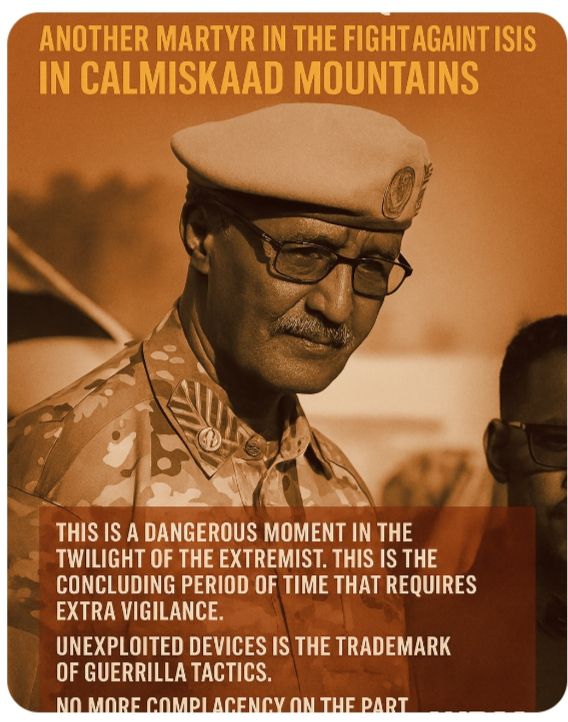
The result was a foregone conclusion: a resounding defeat. The cost, however, was borne not by Deni alone, but by all of Puntland. The democratization process was shelved indefinitely. The political capital was squandered. The state was left more polarized and disillusioned than before his gambit. Get me right. There is nothing wrong for Puntland State producing able and competent national candidates, however, we are sick and  tired of using Puntland resources for personal political ambitions.

Déjà Vu: The 2026 Re-Run

Now, in 2025, the promises have returned. The rhetoric of elections is being dusted off. But the calculus remains just as cynical. Deni’s new currency for his second bid is not reform, but militarism. The ongoing offensive against ISIS militants in the Cal Miskaad mountains is being meticulously packaged and paraded as Exhibit A of his strong leadership. The objective is clear: to transmute security victories into electoral currency at the federal level, making him an indispensable candidate for a nation besieged by Al-Shabaab.

But this is a devastating bargain. The citizens of Puntland are once again being asked to mortgage their own democratic future to fund their leader’s national campaign. The blood and treasure spent in Cal Miskaad should secure Puntland’s stability, not serve as a stepping stone for one man’s ambition.

The Laascaanood Catastrophe: A Strategic Surrender

If the betrayal of democratization was Said Abdullahi Deni’s first political sin, the Laascaanood debacle was his second — and the one that will define his legacy. Puntland poured blood and treasure into the liberation of SSC (Sool, Sanaag, and Cayn) territories from Somaliland’s occupation. Puntland soldiers fought and died in the trenches of Goojacade and Tukaraq. The state treasury was emptied to finance the war effort. Every ounce of political capital Puntland had accumulated since 1998 was staked on the cause.

History has long memories. General Mohamud Muse Hersi “Adde Muse” was punished at the ballot box after losing Laascaanood to Somaliland in 2007. Yet Deni — despite presiding over its liberation — committed an even greater crime: allowing the victory to be hijacked and rebranded in Mogadishu.

Through a stunning mixture of political negligence, reckless opportunism, and strategic myopia, Deni presided over Puntland’s single greatest geopolitical loss in its modern history. SSC, once the northern buffer and strategic depth of Puntland, was surrendered not to Somaliland but to Villa Somalia — a hostile, Damul Jadiid–aligned federal project intent on dismantling Puntland as the last functioning federal member state.

This was not merely a blunder. It was a strategic self-destruction, a gift-wrapped victory for Mogadishu’s centralizers and Puntland’s fiercest rivals. Deni’s political ambition blinded him to the cost: the slow-motion erosion of Puntland’s northern frontier, the demoralization of its armed forces, and the fracturing of its social contract. The “Laascaanood Catastrophe” will be remembered as the moment when Puntland’s hard-won territorial leverage was bargained away in exchange for nothing — except Deni’s second ill-fated dream of Villa Somalia’s top seat.

The Silent Coup: Elite Complicity in a Rigged System

To lay the blame solely at Deni’s feet, however, is to ignore the rotten foundation upon which his rule is built. Puntland’s political class—a constellation of clan elders, complicit parliamentarians, and business oligarchs—is deeply invested in the status quo. They engage in a carefully choreographed theater of debating democracy while quietly ensuring the selection-based system remains intact. This system is their insurance policy, a mechanism that guarantees the continuous recycling of power within a closed, elite circle without the messy uncertainty of the public will.

They are not bystanders; they are co-conspirators in the deferral of democracy.

The Reckoning

Puntland stands at a precipice. President Deni’s failure to deliver public suffrage is more than a broken promise; it is an existential crisis that threatens to nullify Puntland’s founding claim to be Somalia’s most stable, functional, and progressive state.

The path forward is not complicated, but it requires courage. The citizens of Puntland—its youth, its intellectuals, its business community—must now make a choice. They can continue to acquiesce to the endless cycle of ambition and neglect, or they can demand that their future be prioritized over one man’s pursuit of power in Mogadishu.

The message must be clear: If Said Abdullahi Deni wishes to chase Villa Somalia once more, he is free to do so. But he must do it on his own time and with his own resources. Puntland’s democracy is not his campaign fund. It is time to leave the mirage behind and build the real thing.

Somalia Between CIA and KGB: A Legacy of Intervention and the Struggle for Sovereignty

Courtesy

Somalia Between CIA and KGB: A Legacy of Intervention and the Struggle for Sovereignty

Abstract This paper examines Somalia’s modern history through the lens of foreign intervention and its corrosive impact on sovereignty. It traces the trajectory from colonial partition and Cold War proxy politics to the era of conditional aid and counter-terrorism partnerships. The argument advanced is that Somalia’s instability is not an inherent condition but a legacy of external manipulation and the failure of successive Somali leadership to construct resilient, accountable institutions. The conclusion posits that a patriotic and realistic foreign policy—anchored in economic sovereignty, technology transfer, and mature diplomacy—is the only path toward ending dependency and realizing the nation’s latent potential.  

1. Introduction: The Geopolitical Crucible

Somalia is a state born out of external design. Its borders, carved by European colonial powers, disregarded ethnic and cultural unity and imposed fragmentation. This fragmentation embedded permanent insecurity and made Somalia a prime target for Cold War competition. In the decades following independence, Somalia oscillated between Soviet and Western patronage, experiencing military rule, state collapse, and externally driven interventions under humanitarian or counter-terrorism labels. This paper argues that a realistic understanding of Somalia’s historical trajectory is essential for building sovereign policy anchored in economic development, accountability, and diversified partnerships.  

2. Colonial Division and the Cold War Trap (1960s–1980s)

2.1 The Colonial Legacy and Independent Non-Alignment

Somalia emerged from colonialism divided among British, Italian, and French administrators. Independence in 1960 gave rise to a Republic whose borders excluded Somali-inhabited regions in Ethiopia, Kenya, and Djibouti. The early government under President Abdirashid Ali Sharmarke experimented with non-alignment, cautiously maintaining ties with both Cold War blocs while leaning toward the West in style but engaging the Soviet Union for military assistance.

2.2 The Soviet Embrace and Military Rule

The USSR invested heavily in Somalia’s military establishment, training officers, embedding advisers, and supplying advanced equipment. By the mid-1970s, over 1,400 Soviet military advisers were present, and thousands of Somali officers were trained in Moscow. This Soviet-backed military elite facilitated the 1969 coup, installing Siad Barre and orienting Somalia toward Marxism-Leninism. Italy, by contrast, pursued institution-building, focusing on police and judicial structures.

2.3 The Ogaden Betrayal and Western Realignment

In 1977, Somalia invaded Ethiopia’s Ogaden region. The USSR abandoned Somalia in favor of Ethiopia, supporting Addis Ababa with Cuban troops and material aid. Somalia’s defeat exposed the risks of overreliance on a single patron. Barre expelled Soviet advisers and turned to Western and Arab allies, yet the authoritarian structure remained. The United States, eager to counter Soviet influence, tolerated Barre’s governance failures, reinforcing corruption and a lack of accountability.  

3. State Collapse and the Era of Chaos (1991–2000s)

The fall of Barre in 1991 left a vacuum that foreign and regional actors quickly exploited.

  • UNOSOM II and the Mogadishu Crisis (1993): The U.S.-UN humanitarian mission devolved into direct combat with Somali factions. The October 1993 “Black Hawk Down” battle, resulting in 18 U.S. soldier deaths and hundreds of Somali casualties, prompted a full American withdrawal. Somalia was branded a “failed state,” and Washington retreated to containment strategies: limited intelligence operations, occasional strikes, and minimal aid.
  • Proxy Warfare: Neighboring and Gulf states armed rival Somali factions, worsening fragmentation. Foreign manipulation perpetuated civil war and obstructed reconciliation.

4. The New Frontier: Counter-Terrorism and Conditional Aid

The rise of the Islamic Courts Union and Al-Shabaab reframed Somalia’s conflict through the counter-terrorism paradigm.

  • Terrorist Creation and Empowerment: Indiscriminate strikes and interventions fueled radicalization, expanding militant recruitment.
  • The Conditional Aid Trap: Billions in aid were securitized, tied to military purchases and donor agendas. Aid dependence entrenched, enriching foreign contractors rather than empowering Somali citizens.

5. A Patriotic Path Forward: Realism, Sovereignty, and Development

Somalia’s contemporary partnerships, particularly with Turkey and Qatar, suggest new models linking security cooperation with infrastructure, education, and health investment. For a sustainable future, Somalia requires a patriotic and realistic foreign policy based on:

  1. Sovereign Accountability: Leadership must answer to citizens, not foreign donors. Ending corruption is central to public trust.
  2. Economic Diplomacy: Somalia possesses vast underutilized resources:
    • 1 million hectares of arable land capable of achieving food sovereignty.
    • Africa’s largest livestock population with potential for export-led growth.
    • A 3,333 km coastline rich in fishing and blue economy prospects.
    • Suspected mineral and hydrocarbon reserves requiring transparent management.
  3. Technology Transfer, Not Just Aid: Foreign partnerships must prioritize training, university cooperation, and industrial capacity-building.
  4. Balanced, Mature Foreign Relations: Somalia should diversify partners, avoiding dependence on any single bloc, while cultivating a professional diplomatic corps capable of navigating multipolar realities.

6. Conclusion

Somalia’s instability is the product of colonial partition, Cold War proxy politics, authoritarianism, and externally imposed interventions. Neither Soviet militarization nor American containment fostered sovereignty. Italy’s institution-building efforts, though more modest, were overshadowed by superpower rivalry. Post–Cold War interventions deepened chaos, while counter-terrorism frameworks reduced Somalia to a security problem rather than a sovereign partner. The path forward lies not in another foreign roadmap but in an internal awakening: institution-building, resource-based development, and a mature foreign policy. Somalia must leverage its human and natural capital, pursuing partnerships grounded in equality, technology transfer, and economic growth. By addressing root causes—poverty, inequality, and weak governance—Somalia can achieve stability and independence, standing as a sovereign actor in a multipolar world.  

References

Britannica. (n.d.). Black Hawk Down. In Encyclopedia Britannica. Retrieved from https://www.britannica.com Cambridge University Press. (n.d.). Soviet-Somali relations in the 1970s. Country Studies. (n.d.). Somalia: A country study. Library of Congress. Office of the Historian. (n.d.). U.S. relations with Somalia: Cold War era. U.S. Department of State. Scribd. (n.d.). Somalia and the Ogaden War. The Guardian. (2013). Black Hawk Down: The lasting legacy of America’s ill-fated mission in Somalia. Retrieved from https://www.theguardian.com Wikipedia. (n.d.). Ogaden War. Retrieved from https://en.wikipedia.org Brelience Research http://www.brcsom.com 2025.

[Courtesy: Copyright ©️ Brilliance Research and Consulting].

WDM EXCLUSIVE: The Laascaanood Gambit – Villa Somalia’s Hostile Takeover of SSC

Copyright ©️ 2025 WDM

By Ismail H. Warsame

A New Cast, Same Director

Laascaanood’s political theatre has changed its actors, but the director in Villa Somalia remains the same. President Hassan Sheikh Mohamud’s latest move is not nation-building—it is a hostile corporate takeover of SSC-Khatumo’s hard-earned autonomy. His endgame is clear: dismantle Puntland, the last effective check on his centralizing project, and replace it with a compliant “North East Entity,” a Mogadishu-loyal clone of Hirshabeele and GalMudugh.

The rhetoric of “liberation” is nothing but a hollow marketing slogan. The true mission is to install Chairman Abdikadir Aw Ali (Firdhiye) as Mogadishu’s proxy governor, rush his handpicked delegates to the federal parliament, and redraw Somalia’s political map with SSC’s blood as the ink for Puntland’s obituary.

Dueling Delegations: The Constitutional Bomb

Garowe will not sign its own death warrant. Puntland will appoint its own parliamentary delegation from SSC territories—territories it has legally represented for over two decades. The result: two rival delegations claiming the same seats, two competing mandates, one federal parliament thrown into chaos.

This is no mere “political impasse.” It is a constitutional detonation. Somalia’s Provisional Constitution contains no mechanism for resolving parallel representation. The fallout will shred what little legitimacy remains in the federal system, paralyze Mogadishu’s governance, and expose the entire state-building process as a façade.

The West’s Broken Playbook

Cue the well-worn script: foreign diplomats descending with tired calls for “dialogue” and “reconciliation.” But this is no misunderstanding. It is a calculated act of political aggression. Mediation under these circumstances will not resolve the conflict—it will entrench it, forcing Puntland to negotiate the terms of its own dismemberment under the gaze of international chaperones.

SSC’s Pyrrhic Victory

For SSC, this is the bitterest twist of fate. They fought and died to free themselves from Hargeisa’s grip, only to find themselves turned into Mogadishu’s pawn in its cold war against Puntland. Chairman Firdhiye now risks becoming the administrator of SSC’s second occupation—this time under the velvet glove of Villa Somalia rather than the iron fist of Muse Bihi.

And when Puntland is weakened and no longer a threat? Mogadishu will discard SSC like yesterday’s news, leaving them politically stranded, weaker and more divided than before.

The Real Stakes

This is bigger than 2026 elections. This is about whether Somalia will remain a federation or slide back into a centralized dictatorship with decorative regions as window-dressing.

Break Puntland over SSC, and the federal experiment dies. The likely response from Garowe? Total withdrawal from the federal project—an exit that could trigger state collapse and usher in international trusteeship, a scenario no Somali patriot should wish for.

WDM VERDICT: A Declaration of Political War

Make no mistake: Hassan Sheikh Mohamud is not integrating SSC. He is annexing it. This is nothing less than a declaration of political war on Puntland and on federalism itself.

If the international community chooses to “mediate” this crisis, they become co-authors of Somalia’s undoing. The only principled path forward is to uphold the constitutional order and reject any parallel institutions designed to weaken Puntland’s mandate.

WDM WARNING:

The future of Somalia will not be decided at the ballot box but in this manufactured crisis. To endorse Villa Somalia’s fiction is to greenlight the collapse of the Somali state. The stakes could not be higher.

Policy Brief

September 13, 2025 Issue: Urban Transport Crisis & Public Safety Emergency in Garowe, Puntland, Proposed By:Warsame Digital Media (WDM) – Policy Analysis Unit

1. Executive Summary

This brief addresses the critical public safety and urban management crisis in Garowe caused by the unregulated proliferation of auto-rickshaws (Bajaj). The current situation poses an immediate threat to citizen safety, hinders economic activity, and signifies a major failure in transport governance. The root causes are identified as: uncontrolled importation of vehicles, lack of regulatory enforcement, and absence of formal public transport alternatives. This brief recommends a five-point policy intervention strategy, beginning with an immediate moratorium on Bajaj imports, to restore order, safety, and sustainable urban mobility in Garowe.

2. Background and Problem Statement

Garowe, the administrative capital of Puntland, is experiencing an acute crisis driven by an oversaturation of Bajaj three-wheelers. The unchecked importation of these vehicles has led to:

· A Public Safety Emergency: A dramatic rise in traffic accidents, injuries, and fatalities involving untrained, uninsured, and often underage drivers.
· Severe Urban Congestion: Critical arteries and market roads are paralyzed, impeding commerce and emergency services.
· Social and Environmental Degradation: Excessive noise and air pollution diminish quality of life, while the exploitation of unemployed youth fosters social tension.
· Governmental Authority Erosion: The consistent lack of enforcement has normalized lawlessness and eroded public trust in institutions.

This is not merely a traffic issue but a multifaceted policy failure requiring urgent and coordinated intervention.

3. Key Findings and Analysis

· Root Cause 1: Unregulated Import: The continuous flow of new Bajaj imports is the primary driver of market oversaturation, making the problem exponentially worse.
· Root Cause 2: Regulatory Vacuum: The absence of licensing, insurance, and traffic enforcement has created a perilous “wild west” environment on the roads.
· Root Cause 3: Economic Desperation: High youth unemployment has created a cheap labor force for Bajaj operators, who prioritize small profit over public safety.
· Root Cause 4: Lack of Alternatives: Citizens are forced to use Bajajs due to the non-existence of a safe, reliable, and formal public transport system.

4. Policy Recommendations

We urge the Puntland Administration to adopt the following coordinated policy measures:

1. Impose a Moratorium on Bajaj Imports
   · Implementing Body: Ministry of Trade, Ministry of Finance
   · Key Objectives: Immediately halt the influx of new vehicles to stabilize the situation and allow for effective management of the existing fleet.
2. Implement a Mandatory Licensing & Registration Framework
   · Implementing Body: Ministry of Transport, Traffic Police
   · Key Objectives:
     · Mandate driver’s licenses (minimum age 18)
     · Register all commercial Bajajs
     · Require mandatory third-party insurance
     · Enforce regular vehicle safety inspections
3. Launch a Targeted Traffic Enforcement Campaign
   · Implementing Body: Garowe Traffic Police Department
   · Key Objectives: Rigorously enforce traffic laws, penalizing infractions like reckless driving, overloading, and operating without a license or insurance.
4. Establish a City-Wide Operating Permit Cap
   · Implementing Body: Garowe Municipal Council, Ministry of Public Works.
   · Key Objectives: Limit the total number of Bajajs allowed to operate commercially based on a study of the city’s carrying capacity. The import moratorium (Action 1) is a prerequisite for this.
5. Initiate a Feasibility Study for a Public Bus System
   · Implementing Body: Ministry of Public Works, Planning Ministry
   · Key Objectives: Commission a study to design a safe, regulated, and reliable public bus network to provide a long-term alternative and create formal employment.

5. Expected Outcomes and Benefits

· Enhanced Public Safety: A drastic reduction in accidents and fatalities through regulated drivers and insured vehicles.
· Improved Urban Mobility: Reduced congestion and more orderly traffic flow.
· Economic Formalization: Creation of a structured, accountable transport sector that contributes to the formal economy.
· Increased Government Revenue: Generation of income through licensing, registration, insurance, and permit fees.
· Restored Public Trust: Demonstrating effective governance and a commitment to citizen welfare.

6. Conclusion

The Bajaj crisis is a solvable policy challenge. Continued inaction will result in further loss of life, economic damage, and social disorder. The recommended actions are sequential and interdependent. An immediate moratorium on imports is the critical first step to preventing the problem from worsening, while the other measures work to bring the existing situation under control and provide a sustainable future for Garowe’s transport system. We urge the relevant authorities to act with urgency to implement this strategy.

———

Contact: Warsame Digital Media(WDM) Garowe, Puntland. ismailwarsame@gmail.com, +252 90 703 4081.

Prime Time for One, Rubble Time for Many: The Algorithm of Western Grief

Copyright ©️ 2025 WDM

This week, the Western media conducted a live, unblinking A/B test on the free market of human sympathy.

Group A: The assassination of a conservative activist, Charlie Kirk, in Utah, USA. The result: wall-to-wall coverage. Prime-time specials. Expert panels parsing the shooter’s motives, his diet, his childhood. A nation invited to mourn in high definition.

Group B: The systematic obliteration of Gaza. The result: a children’s hospital bombed becomes a 30-second clip, often followed by a cheerful ad for a new car. Mass graves are a “developing story” to be briefly acknowledged before returning to the important business of a celebrity’s new fragrance.

The metrics are in. The data is clear. One tragedy is a narrative; the other is noise. One life is a precious thread in the social fabric; ten thousand are a statistical blur.

This is not an oversight; it is a formula. It is the cold calculus of newsworthiness where proximity, politics, and pigment determine a victim’s value.

Western media postures as a monolithic guardian of truth—but it is a curator of convenience. It holds power to account only when that power is foreign, adversarial, or politically expedient to challenge. The result? A single death on home soil is framed with the gravity of a world-altering event. Meanwhile, a world-altering event abroad is shrink-wrapped into digestible, disposable segments of distant despair.

The language betrays the bias. An American is “tragically slain.” A Palestinian is “reportedly killed.” One is a loss; the other is a ledger entry.

“WE INTERRUPT THIS BROADCAST OF GAZA’S HUMANITARIAN CRISIS FOR A LIVE LOOK AT A VIGIL IN Utta.”

But the networks won’t run these. The irony is too real. It’s easier to host a six-hour panel on the mental state of a lone gunman than to spend six minutes examining the state of a conscience that can normalize the death of a child under rubble.

WDM Verdict

This is the scandal of our age: not just the violence we do, but the violence we yawn at. The moral failure is not only in the act but in the aperture—the lens so tightly focused on “us” that it renders “them” invisible.

The West’s sermon on human rights rings hollow when its megaphone, the media, operates on a sliding scale of humanity. This selective sorrow isn’t just bias; it is the rot at the core of a civilization that claims universal values. If this stands, history’s judgment will be severe: it will not record that we failed to stop a genocide, but that we failed to even look.

Garowe’s Bajaj Apocalypse: When Poverty Rides on Three Wheels

Ismail H. Warsame,                            Warsame Digital Media (WDM),     September 12, 2025

Copyright ©️ 2025 WDM

Abstract

This paper examines the escalating public safety and urban management crisis in Garowe, Puntland, driven by the unregulated proliferation of auto-rickshaws (locally known as Bajaj). It argues that what is often presented as grassroots entrepreneurship is, in fact, a symptom of weaponized poverty, enabled by uncontrolled imports and governmental failure, leading to urban chaos and increased fatalities. The analysis concludes with an urgent call for a multi-pronged strategy, including curtailing imports, comprehensive regulation, and investment in sustainable public transport.

1. Introduction: A City Under Siege

Garowe, the administrative capital of Puntland, is experiencing a crisis that threatens its social fabric and public safety. This crisis is not born from traditional conflict but from an unchecked invasion of mechanical chaos: the overwhelming and unregulated influx of Bajaj three-wheeled vehicles. Imported en masse without any restrictive policy and operated without oversight, these vehicles have transformed Garowe’s streets from orderly pathways into hazardous zones, representing a critical failure in urban planning and regulatory enforcement.

2. The Anatomy of the Crisis: A Flood of Metal and Desperation

The problem is threefold: the source of the machines, their mechanical impact, and the system that deploys them.

· The Unchecked Flood: The primary catalyst for the crisis is the uncontrolled importation of Bajaj vehicles from international markets. This constant stream of new three-wheelers has saturated the city’s limited infrastructure, making congestion and conflict inevitable.
· The Mechanical Menace: The Bajajs on Garowe’s streets are typically low-quality, smoke-belching vehicles. Their sheer numbers create unbearable noise pollution, traffic congestion, and environmental degradation, diminishing the quality of life for all residents.
· The Human Factor: The industry is built on the exploitation of a desperate workforce. The drivers are predominantly unemployed youth, often minors with no formal training, licensing, or insurance. Hired by profit-seeking operators, these young men are incentivized to drive aggressively to maximize daily fares, turning the city into a real-life racetrack with deadly consequences.

3. The Root Cause: The Economy of Desperation

The Bajaj epidemic cannot be understood outside the context of Puntland’s socio-economic challenges and policy failures.

· Unregulated Trade: The lack of a policy to curtail the import of Bajajs has directly led to market oversaturation, making the crisis a problem of scale as much as conduct.
· Youth Unemployment: A significant “youth bulge” with limited formal employment opportunities makes driving a Bajaj one of the few available sources of income.
· Exploitative Entrepreneurship: Small-time entrepreneurs capitalize on this desperation, creating a business model that externalizes all risk onto the drivers, passengers, and the general public.
· Government Negligence: The authorities have abdicated their responsibility at multiple levels, from controlling import flows to regulating operations. The absence of a regulated public transport system has created a vacuum filled by this anarchic private enterprise.

4. Consequences: Urban Dystopia and Social Breakdown

The impact of this neglect is severe and multifaceted:

· Public Safety Emergency: Traffic accidents, injuries, and fatalities have skyrocketed. Pedestrians, especially women and children, navigate streets at their own peril.
· Economic Damage: Shopfronts are plagued by noise and fumes. Motorists face constant risk of accidents with uninsured drivers, potentially leading to financial ruin.
· Normalization of Crisis: A dangerous public ennui has set in, where accidents are “shrugged off” and near-death experiences become routine.
· Erosion of Civic Trust: The government’s failure to protect its citizens and regulate both trade and traffic undermines its legitimacy.

5. Call to Action: A Path Toward Regulation and Order

Warsame Digital Media (WDM) calls for immediate and decisive action from the Puntland authorities to avert further catastrophe. We propose a multi-pronged strategy:

1. Curtail the Import of Bajajs: Impose an immediate moratorium on the importation of new Bajaj vehicles into Puntland. This is the essential first step to halt the flooding of the market and prevent the problem from escalating beyond control.
2. Licensing and Regulation:
   · Mandate official driver’s licenses with verified age requirements (no minors).
   · Require mandatory third-party insurance for all commercial Bajajs.
   · Implement official registration and mechanical inspection for all vehicles.
3. Restoration of Law and Order:
   · Empower and direct the traffic police to enforce traffic laws without exception. Reckless driving, overloading, and flouting of traffic rules must be met with fines and penalties.
4. Capping and Managing Numbers:
   · Formalize a city-wide cap on the number of operating permits. The import moratorium will make this cap achievable and enforceable.
5. Investment in Sustainable Alternatives:
   · Begin planning and investment in a safe, regulated, and reliable public bus system to provide a dignified alternative for citizens and create formal employment.

6. Conclusion

The Bajaj crisis in Garowe is a stark case study in what happens when uncontrolled imports, economic desperation, and governmental neglect converge. The streets of Garowe are on the brink of becoming “Somalia’s largest open-air casualty ward” not due to war, but due to a catastrophic failure of governance. The solution must begin at the source: the unchecked import of vehicles that fuels this chaos. The authority must act now to stem the tide, regulate the industry, protect its citizens, and reclaim the city for all who call it home. The future of Garowe’s civic life depends on it.

Warsame Digital Media (WDM) is an independent media organization dedicated to analytical journalism and commentary on issues affecting Somalia, the Horn of Africa, and beyond.

The Manufactured Nation: Empire, Myth, and the 1945 Rebranding of Ethiopia

Deconstructing the Politics of Statehood in the Horn of Africa

By Ismail H. Warsame, Founder of Puntland State of Somalia; Former Chief of Staff (1998–2004); Warsame Digital Media(WDM)

Abstract

This paper critically examines the constructed narrative of Ethiopia as an “ancient and continuous nation-state.” Through archival research, cartographic analysis, and postcolonial historiography, it contends that the 1945 renaming of the Abyssinian Empire as “Ethiopia” was a strategic act of imperial consolidation rather than a genuine national rebirth. Championed by Western powers as a triumph of African independence, this rebranding legitimized the violent annexation of diverse nations—including the Oromo, Somali, Sidama, and Afar—into a single imperial project. This study argues that this manufactured nationhood is a primary source of the enduring political instability and cycles of rebellion that define the modern Ethiopian state.

Introduction

A 1945 international press dispatch carried a seemingly minor announcement: “the territory known as Abyssinia officially changed its name to Ethiopia and became a nation.” This proclamation, however, marked a seismic shift in political identity. It was not a simple change of name but a profound act of re-creation—reframing an ancient, expansionist empire as a modern, unified nation-state. This paper argues that Ethiopia’s post-war “birth” was a calculated exercise in imperial legitimation, designed to secure international sovereignty and obscure the realities of conquest. The enduring consequences of this manufactured identity continue to fuel conflict and challenge the very foundations of the state in the Horn of Africa.

The Myth of a Timeless Nation

Western historiography has long perpetuated the image of Ethiopia as the “world’s oldest continuous Christian kingdom.” This narrative, as I.M. Lewis notes, was meticulously cultivated by 19th-century European travelers and missionaries fascinated by this perceived “Christian island” in a sea of Islam. Donald Donham further argues that the Abyssinian state was retroactively reimagined as a proto-nation, a framing that deliberately disguised its fundamentally imperial character.

Historical evidence, however, reveals a more complex reality. Prior to the late 19th century, the region consisted of a mosaic of independent sultanates, kingdoms, and pastoralist confederacies. The modern state is a product of the violent imperial campaigns of Menelik II, baptised as Sahle Mariam, Sultan of Shewa, and Emperor of Abyssinia (r. 1889–1913), who dramatically expanded the Abyssinian empire southward and eastward, subjugating Oromo, Sidama, Wolayta, and Somali territories. Haile Selassie later systematized this conquest through aggressive centralization policies, suppressing local languages and imposing Amharic culture as a unifying—and assimilative—state doctrine.

1945: Codifying the Imperial Project

The year 1945 was a critical juncture. Following the defeat of Fascist Italy and Haile Selassie’s restoration, the rebranding from “Abyssinia” to “Ethiopia” was ratified on the world stage. This was not merely symbolic; it was a diplomatic masterstroke. By joining the United Nations as a founding member under this new name, the empire received international recognition as a sovereign nation-state, thereby sanctifying its contested borders and internal hierarchies.

This transformation aligned perfectly with Anglo-American strategic interests in the nascent Cold War. As historian Bahru Zewde argues, Ethiopia was groomed to be an “African showcase state”—a stable, pro-Western monarchy that could symbolize African potential while reliably suppressing internal dissent. This international endorsement effectively granted the empire a free hand to continue its assimilationist policies, removing the plight of subjugated nations from the sphere of global concern.

Cartography as a Tool of Erasure

The official map presented to the world in 1945 meticulously delineated Ethiopia’s international borders with Eritrea, Somalia, and others. Yet, it presented the interior as a monolithic whole, devoid of any internal national boundaries. Following J.B. Harley’s assertion that maps are “never neutral” but instruments of power, this cartography performed a act of political violence. It naturalized the empire’s conquests, transforming a collection of annexed nations into a seemingly coherent and pre-ordained national territory. The map, in effect, legitimized domination through representation.

The Enduring Consequences: Resistance and Rebellion

The political instability that has plagued Ethiopia for decades is a direct legacy of this manufactured unity. The successful thirty-year struggle for Eritrean independence (1993) delivered the first major blow to the myth of an indivisible Ethiopia. It was followed by persistent armed and political resistance from groups such as the Oromo Liberation Front (OLF), the Ogaden National Liberation Front (ONLF), and the Tigray People’s Liberation Front (TPLF)—each movement a testament to the unresolved national questions deliberately buried in 1945. These are not aberrations but predictable eruptions of a foundational tension: the conflict between a state built on imperial incorporation and the aspirations of the nations within it.

Conclusion

The 1945 rebranding of Abyssinia as Ethiopia was not an authentic national awakening. It was the sophisticated codification of an imperial project, repackaged for the modern international system. This act of political invention created a state whose legitimacy is perpetually contested from within. The cycles of rebellion and conflict that continue to define Ethiopia demonstrate that a state forged by conquest cannot achieve stability through force alone. Lasting peace requires a fundamental reimagining of the state itself—one that moves beyond the myth of a singular nation and finally recognizes the historical sovereignty and right to self-determination of the many nations locked within its borders. Until then, Ethiopia remains an empire masquerading as a nation-state.

Notes

1. I.M. Lewis, A Modern History of the Somali: Nation and State in the Horn of Africa, 4th ed. (Oxford: James Currey, 2002), 12–15.
2. Ibid., 14.
3. Donald Donham, “Old Abyssinia and the New Ethiopian Empire: Themes in Social History,” in The Southern Marches of Imperial Ethiopia: Essays in History and Social Anthropology, ed. Donald Donham and Wendy James (Cambridge: Cambridge University Press, 1986), 3–48.
4. Bonnie Holcomb and Sisai Ibssa, The Invention of Ethiopia: The Making of a Dependent Colonial State in Northeast Africa (Trenton, NJ: Red Sea Press, 1990), 52–75.
5. Bahru Zewde, A History of Modern Ethiopia, 1855–1991, 2nd ed. (Oxford: James Currey, 2001), 151–180.
6. Ibid., 187–190.
7. Ibid., 200.
8. J.B. Harley, “Maps, Knowledge, and Power,” in The Iconography of Landscape, ed. Denis Cosgrove and Stephen Daniels (Cambridge: Cambridge University Press, 1988), 277–312.
9. Ismail H. Warsame, “Ethiopia’s Manufactured Birth in 1945,” Warsame Digital Media (WDM), 2025.                                .                                  10. Spencer, John H. Ethiopia at Bay: A Personal Account of the Haile Selassie Years. Algonac, MI: Reference Publications, 1984.

The 4.5 Clan Power-Sharing Formula: Somalia’s Indispensable, If Imperfect, Constitutional Bridge

By Ismail H. Warsame Founder,Puntland State of Somalia • Chief of Staff, 1998–2004, Author, Talking Truth to Power

Abstract

The 4.5 Clan Power-Sharing Formula is the most consequential yet contentious institutional innovation in modern Somali politics. While widely criticized for institutionalizing clan identity, this paper argues that it functioned as a critical pragmatic compromise—a necessary social contract that provided the sole viable pathway from utter statelessness to a nascent constitutional order. To reject its foundational role is to ignore the socio-political realities of post-collapse Somalia and to overlook the unprecedented protections it afforded marginalized communities. The formula must be understood not as an end-state, but as a transitional bridge that must be dismantled only once the structure of a civic state is secure.

Introduction: The Engine of a Fragile State

Since its formal adoption at the 2000 Arta Conference in Djibouti, the 4.5 formula has been the paradoxical engine of Somalia’s state-building project. It allocates political representation among the four major clan-families (Darod, Hawiye, Dir, and Digil-Mirifle), with a critical “half-share” reserved for minority clans and groups, creating a collective, if unequal, stake in governance (Menkhaus 2004, 16).

Though publicly derided by the very elites it empowers, the formula is the bedrock upon which every post-2000 government has been built. It transformed zero-sum clan competition into a structured, albeit flawed, positive-sum game. As Warsame (2023) contends, this “pragmatic genius” provided the necessary incentive for warring factions to lay down arms and negotiate, creating a political table where none existed.

Historical Context: From Anarchy to Structured Negotiation

The collapse of the Somali state in 1991 resulted in a landscape defined by clan-based militias and warlord fiefdoms (Lewis 2002). Early reconciliation conferences in Addis Ababa (1993) and Cairo (1997) failed precisely because they attempted to impose a civic nationalist model on a society that had reverted to its primary, segmentary lineage structures for security and identity.

The breakthrough of the Arta Process was its stark realism. Rather than denying clanism, it codified it into a clear, predictable, and inclusive arithmetic of power-sharing. This was not a surrender to tribalism, but a strategic co-optation of it. As Samatar (2002, 104) observed, Arta’s success lay in its “acceptance of the social facts on the ground,” turning a source of conflict into a framework for collaboration.

The Progressive Core: The Revolutionary Half-Share

A common oversight in critiques of the 4.5 system is the disregard for its most transformative element: the guaranteed representation for minority clans and communities (e.g., Bantu/Jareer, Benadiri, Gabooye). This “0.5” was a radical democratic innovation.

In the pre-1991 Somali Republic, these groups were systematically excluded from political power. The 4.5 formula, for the first time, constitutionally embedded an affirmative action principle, guaranteeing them a voice in the national legislature (Bradbury 2008, 85). It acted as a proto-bill of rights, protecting the most vulnerable from the tyranny of the majority in a context where no other protections existed.

Political Hypocrisy: The Public Critique and Private Reliance

A profound hypocrisy defines the Somali political class’s relationship with the 4.5 system. Politicians publicly vilify “clanism” as a backward scourge while privately relying on their clan networks as the fundamental base of their power and legitimacy.

This duality is not merely cynical; it is structurally logical. In a pastoral society where the state’s monopoly on violence is absent or weak, the clan remains the primary unit of security, trust, and mobilization (Besteman 1999). This creates a political reality where, as Warsame (2023) astutely notes, “denouncing clanism is the required public performance, while mastering its calculus is the essential private practice.” This mirrors societies that rhetorically condemn racism while being structured by it, revealing the gap between aspirational politics and on-the-ground realities.

Addressing the Critiques: Scaffolding, Not a Pillar

The primary critique—that 4.5 entrenches clan identities and impedes the development of a merit-based, civic political culture—is not without merit (International Crisis Group 2011). However, this argument presupposes a stable political environment where civic identity can flourish, a condition Somalia has not enjoyed for decades.

The formula was never intended to be permanent. Its purpose was always transitional: to be the scaffolding that allows the state structure to be rebuilt. As Warsame (2023) warns, the danger lies not in the desire to move beyond 4.5, but in dismantling this scaffolding prematurely. Abolishing it without a consensus-based, secure, and clearly defined alternative risks catastrophic backsliding into the very clan-driven conflict it was designed to mitigate. The imperative is not rejection, but managed reform.

Charting a Post-4.5 Future: A Phased Transition

The ultimate goal of a one-person, one-vote democracy remains valid. Achieving it requires a deliberate and phased strategy to ensure stability:

1. Piloting Civic Elections: Implementing direct elections first at the local municipal level, where issues of service delivery can help forge a civic identity distinct from clan loyalty.
2. Intensive Civic Education: A national curriculum focused on citizenship rights and responsibilities, teaching Somalis that political identity can be rooted in shared residence and national interest, not just lineage.
3. Constitutional Entrenchment of Minorities: Ensuring that any future electoral model constitutionally preserves the hard-won political rights of minority groups, safeguarding the spirit of the 0.5 share.

The 4.5 formula was a masterstroke of realpolitik that forged a precarious stability from outright anarchy. This crude but necessary compromise arrested Somalia’s spiral into permanent disintegration, functioning not as a final destination but as a critical bridge. It was a pragmatic acknowledgment of a foundational sociological truth: that Somali politics is inextricably rooted in clan identity. By guaranteeing all groups—including marginalized minorities—a seat at the table, it manufactured a collective stake in the peace process. The profound irony lies in its critics: elites who leverage clan patronage for power while publicly decrying the very “tribalism” that enables it, all while offering no viable alternative. Ultimately, the legacy of 4.5 will be judged not by the hypocrisy of its opponents, but by whether Somalia uses this negotiated framework to mature into a genuine constitutional democracy based on one-person-one-vote. This was the historic, pragmatic breakthrough of the 1997 Sodare Group, which institutionalized 4.5 as the sole antidote to warlordism and the essential first step toward rebuilding a state.

Conclusion: The Indispensable Bridge

The 4.5 Clan Power-Sharing Formula is not an antithesis to democracy; it was its necessary precondition in a context of state collapse. It represents a pragmatic, culturally-grounded solution to the existential problem of statelessness. While its clan-based mechanics are incongruous with liberal democratic ideals, it provided the minimal consensus required to restart a state. It is the bridge that carried Somalia across the river of anarchy. The task ahead is not to curse the bridge for being imperfect, but to carefully cross it and build a more durable political home on the other side, ensuring everyone has a room within it.

References

Besteman, Catherine. Unraveling Somalia: Race, Violence, and the Legacy of Slavery. Philadelphia: University of Pennsylvania Press, 1999.

Bradbury, Mark. Becoming Somaliland. Bloomington: Indiana University Press, 2008.

International Crisis Group. “Somalia: Transforming Hope into Stability.” Africa Report No. 170, December 2011.

Lewis, I. M. A Modern History of the Somali: Nation and State in the Horn of Africa. Oxford: James Currey, 2002.

Menkhaus, Ken. State Collapse and the Threat of Violence in Somalia. Washington, DC: CSIS Press, 2004.

Samatar, Abdi Ismail. “Somalia’s ‘Arta’ Process: Success or Illusion?” Review of African Political Economy 29, no. 91 (2002): 97–111.

Warsame, Ismail H. “Why Somalis Complain about Clan Power-Sharing Formula.” Warsame Digital Media (WDM), 2023.

The Doha Deluge: How a Crisis Shattered American Credibility

Copyright ©️ 2025 WDM

September 10, 2025

The scenes from Doha are more than a tragic headline; they are a geopolitical watershed. Israel’s bombardment of the Qatari capital—a hub regarded as a neutral forum for global diplomacy—has triggered not just outrage, but a fundamental realignment. As the world condemns the assault, the United States stands alone, performing a familiar yet increasingly futile role: the diplomatic shield for its ally. Washington’s efforts at damage control now resemble a patron making excuses for a partner that has spiraled out of control.

This time, however, the world is no longer listening.

The Abraham Accords: A Mirage Exposed

The “Abraham Accords,” once touted as a masterstroke of regional diplomacy, now lie in ruins. Even Saudi Arabia, the anticipated crown jewel of normalization, has publicly suspended talks. Riyadh understands that association with an Israel that acts with such impunity is political suicide. The Doha attack has achieved what years of diplomacy could not undo: it has poisoned the well of Arab-Israeli rapprochement for a generation. Netanyahu’s government hasn’t merely disrupted a process; it has incinerated its very foundation.

A Region Gripped by a New Reality

A palpable sense of vulnerability grips the Middle East. If Qatar’s diplomatic immunity can be so violently breached, no capital feels safe. This despair is compounded by the realization that the “rules-based international order” offers no protection. With the U.S. providing unwavering diplomatic cover—vetoing resolutions, justifying escalations—a dangerous consensus forms: Israel operates above international law. Arab regimes now face dual pressures: the fury of their own streets and the terrifying precedent set by Doha.

The region has become a tinderbox. The attack itself may be the spark that ignites a wider conflagration.

The Illusion of Impunity Shattered

For decades, the U.S. and Israel cultivated an aura of untouchable authority, often controlling narratives and leveraging international institutions to their ends. That era is over. The global spotlight is no longer fixed on designated “rogue states” or extremist groups, but is now trained directly on Washington and Tel Aviv. They are no longer perceived as guarantors of stability, but as primary sources of chaos and instability.

The Multipolar World Seizes the Initiative

In Beijing and Moscow, analysts are not just watching—they are recalibrating. The U.S.’s failure to restrain its ally is seen as a strategic failure of the highest order, confirming the overreach of American power. This crisis accelerates a shift that is economic as much as it is political. The conversation is now centered on de-dollarization, alternative financial systems, and economic sovereignty.

China advances the petroyuan, Russia builds sanctions-proof trade corridors, and an expanded BRICS incorporates energy giants. The Global South, long weary of Western double standards, sees in Doha a potent symbol and an opportunity to break from economic and political subservience. The message is clear: if the United States will not uphold the rules, the world will forge a new system without it.

The Unraveling of a 75-Year Order

The international architecture built after World War II—the UN system, Bretton Woods institutions, American security guarantees—is fracturing. In its place, a defiantly multipolar world is emerging, where power is contested and dispersed. Netanyahu’s bombs over Doha may be remembered as the catalyst that made the world’s long-simmering skepticism untenable.

The collapse is comprehensive: it is moral, strategic, and financial. The United States is hemorrhaging credibility. Israel is sacrificing its legitimacy. And the world is moving on.

Conclusion: The Turning Point

Modern conflict is waged with currencies, alliances, and information as much as with munitions. In Doha, Israel dropped bombs, but it also detonated the last remnants of American hegemony. The “rules-based order” has been exposed as a vehicle for power politics. What emerges next remains uncertain, but one fact is undeniable: the multipolar age is no longer a forecast. It is our present reality, being built in real time amid the rubble of yesterday’s assumptions.

Doha is not an ending. It is a brutal and decisive beginning.

BREAKING ANALYSIS: The Doha Strike – Israel’s Gamble and the Unraveling of World Order

Copyright ©️ 2025 WDM

September 9, 2025 | WDM Global Insight

DOHA – The world order, a fragile construct painstakingly built from the ashes of 20th-century wars, tonight lies in tatters. In a stunning escalation that defies precedent, Israeli warplanes struck multiple targets inside the State of Qatar, a nation not at war and a key U.S. ally. The attack, which Qatari authorities confirm hit a communications facility and a suspected Hamas political office in a diplomatic compound, has resulted in an unknown number of casualties and sent shockwaves through every world capital.

This is not merely a military strike; it is a strategic earthquake. By extending its battlefield into the heart of the Arabian Gulf, Israel has not just crossed a red line—it has erased it. The foundational principles of sovereignty and non-aggression that have underpinned international relations for decades have been openly flouted by a nation acting with a sense of ultimate impunity.

The Anatomy of an Unprecedented Strike

Initial reports are chaotic, but details emerging from Doha and confirmed by satellite imagery analysts paint a picture of a precise, calculated operation. Shortly after 22:00 local time, Israeli F-35s, likely operating from undisclosed airspace, launched a barrage of missiles.

· Target Alpha: A sophisticated communications hub west of Doha. Intelligence experts suggest this site was crucial for Hamas’s external leadership’s encrypted communications, a prize Israel has long coveted.
· Target Bravo: A villa within a secure compound often used by Hamas political officials for meetings. The legality of striking a political wing inside a sovereign nation’s territory is a legal minefield, one Israel has just charged into.

The Israeli government, in a terse statement from the office of Prime Minister claimed the strike was a “necessary and proportional action against the central nervous system of Hamas terror,” stating that Qatar had “repeatedly harbored and enabled” the group’s operations. The statement ended with a stark warning: “Any nation that provides sustenance to terrorists will be held accountable.”

The Death of Diplomatic Immunity

The true magnitude of this event lies in its target. Qatar is not Gaza, Lebanon, or Syria. It is a GCC member, a major non-NATO U.S. ally, and home to the largest American military base in the Middle East, Al Udeid Air Base. For decades, Doha has mastered the art of transactional diplomacy, positioning itself as the indispensable mediator—brokering talks between the U.S. and the Taliban, calming tensions with Iran, and even serving as the primary channel for Israeli-Hamas negotiations and hostage deals.

This attack transforms the mediator into a victim. It signals a catastrophic failure of back-channel diplomacy and a brutal declaration by Israel that the rules of the game have changed. The message to every middle power—from Turkey to Singapore—is chilling: your neutrality is worthless; your sovereignty is conditional.

The Global Reaction: A Vacuum of Power

The international response has been swift in condemnation but utterly hollow in action, proving the central thesis of the crisis.

The United Nations: The Security Council is set to convene in an emergency session, but expectations are nil. The U.S., Israel’s primary guarantor, is poised to veto any consequential resolution, rendering the world’s premier security body a tragic farce.
· The Arab World: Reactions range from furious to terrified. The Gulf Cooperation Council (GCC) has called for an emergency summit. For Saudi Arabia and the UAE, which have tentatively pursued normalization with Israel, this is a nightmare. Public outrage will force them into a corner, forcing a choice between their people’s sentiment and their strategic ties with Washington.
· Iran and Turkey: Tehran has already issued a statement condemning the “ Zionist regime’s adventurism” and calling for united Arab action. Ankara is likely to follow suit. Both rivals will seize this opportunity to rally regional opposition against Israel and its allies, positioning themselves as the true defenders of Muslim sovereignty.
· The United States: The Trump administration is in a state of crisis. caught between an ironclad commitment to Israel and the terrifying reality of an attack on a host nation for 10,000 U.S. troops. The statement from the White House, calling for “all parties to de-escalate,” rings painfully weak. The strategic balance of the entire region has been upended from within Washington’s own alliance system.

The Fallout: A New World Disorder

The implications are dark and boundless:

1. Regional Conflagration: The risk of a wider war has skyrocketed. Iran-backed proxies may now feel justified in launching attacks against U.S. interests from within Qatar itself, potentially dragging the massive U.S. presence at Al Udeid into a direct conflict.
2. The End of Mediation: Who will trust Qatar to mediate now? Who will trust any mediator? This strike has poisoned the well of diplomacy for a generation.
3. The Authoritarian Playbook: Autocrats around the world are watching closely. Israel has provided a ready-made playbook: manufacture a “terrorist” threat, claim self-defense, and violate any border you choose. If they can do it, why can’t we?
4. The Collapse of Deterrence: The calculated ambiguity that has kept regional conflicts contained is gone. The old red lines have been vaporized. We have entered an era of terrifying unpredictability.

WDM Verdict: The Obituary of an Era

History will record September 9, 2025, as the day the post-Cold War world finally died. It had been ailing for years, weakened by the Iraq War, the Syrian conflict, and the rise of unabashed nationalism. But Israel’s strike on Qatar is the coup de grâce.

It proves that there is no longer a rules-based order. There is only a power-based reality. The strong do what they can, and the weak suffer what they must. The sacred principle of national sovereignty—the cornerstone of the UN Charter—was sacrificed on the altar of one nation’s security doctrine.

The smoke rising over Doha tonight is not just from bombed-out buildings. It is the funeral pyre of international law, collective security, and the very idea that diplomacy can temper the raw will to power. The world has not just become more dangerous; it has become fundamentally different. And there is no going back.

The Ethiopian Renaissance Dam: A Cathedral of Power on a Foundation of Sand

Copyright ©️ 2025 WDM

Ethiopia has unveiled its masterpiece, casting the Grand Ethiopian Renaissance Dam (GERD) as the glittering crown jewel of an African industrial rebirth. This is the narrative sold from Addis Ababa: a nation leaping from a perceived feudal past into a high-voltage future of turbines, steel, and light. It is a potent symbol of sovereignty, a declaration that Ethiopia will no longer be defined by poverty but by its potential. Yet, behind the polished facade of national pride lies a more dangerous reality. Scratch beneath the surface of this propaganda, and one smells not the promise of ozone from new energy, but the unmistakable scent of gunpowder, hinting at wars yet to come.

The Mirage of Modernity

Ethiopia’s national psyche is built on a triad of imperial history, ancient Christian legitimacy, and a narrative of resilient independence. The GERD is the modern embodiment of this identity—a concrete-and-steel pharaoh’s pyramid for the 21st century. It promises to catapult the nation into modernity, lifting millions from darkness and powering an industrial revolution.

However, this “leap” looks increasingly like a perilous gamble. The project is not just an engineering feat; it is a political weapon wielded by a state struggling to maintain its own fragile unity. While Addis Ababa may light up, the project risks short-circuiting regional stability, potentially plunging the Horn of Africa into a conflict where water replaces oil as the most precious and contested resource. The dam’s true power may not be in generating electricity, but in generating tension.

Egypt’s Existential Calculus

To dismiss Egypt’s opposition as mere regional rivalry is a catastrophic misreading. For Cairo, the Nile is not a resource; it is the sole lifeline for a nation of over 100 million people living on a narrow, fertile strip surrounded by desert. The river is Egypt’s history, its economy, and its future security. Any upstream threat to its flow is not a policy dispute—it is an existential threat.

Ethiopia’s unilateral move to fill the dam, dismissing decades of colonial-era treaties that granted Egypt veto power, is seen not as bold sovereignty but as an act of aggression. Cairo doesn’t need a lesson in hydrology; it needs guarantees. Addis Ababa’s triumphalist rhetoric, framing the dam as a national awakening, sounds to Egyptian ears like the steady beat of war drums. The message is clear: “Touch our Nile, and you touch our nation’s jugular.”

Regional Fractures: The Unintended Battlefields

The shockwaves of the GERD dispute extend far beyond the Nile Basin, turning vulnerable nations into potential proxy battlefields.

· Sudan: Caught in the middle, Khartoum faces a dual reality. The dam could offer benefits like flood control and regulated flow, but it also surrenders Sudan’s water security entirely to Ethiopian discretion. A shift in the status quo threatens its own agricultural projects and could destabilize a nation already teetering on the brink.
· Somalia: Perennially the punching bag of Horn of Africa politics, Somalia finds itself in the crossfire. As Addis Ababa and Cairo vie for influence, Mogadishu becomes a chessboard. Ethiopian ambitions, Egyptian financial and political patronage, and the ever-present threat of Al-Shabaab create a toxic cocktail where the dam’s ripple effects could ignite yet another front in a perpetual war.
· Eritrea: The regime in Asmara, a seasoned arsonist in regional conflicts, sees the GERD as both a threat and an opportunity. An isolated Ethiopia, bogged down in a dispute with Egypt, is a vulnerable Ethiopia. Eritrea can leverage this to settle old scores, meddle in Ethiopian internal conflicts, and position itself as a key player for external powers like Egypt or the Gulf States, all while fanning the flames for its own gain.

From Hydropower to Powder Keg

The GERD was never a neutral infrastructure project. It is political TNT, a monument to national pride that risks becoming a tombstone for regional peace. What Ethiopia hails as a “Renaissance,” its neighbors may rightly decry as recklessness. Instead of a rising tide lifting all boats, it threatens to anchor the region in a cycle of permanent conflict:

· Egypt, backed into a corner, sharpens both its diplomatic knives and its military arsenal.
· Ethiopia gambles its fragile national unity and economic future on a single concrete megaproject.
· Sudan is destabilized, forced into an impossible balancing act.
· Somalia is dragged into proxy wars it cannot afford.
· Eritrea gleefully stokes the embers of conflict.

This is not merely an energy project; it is the blueprint for a regional war economy in waiting.

Conclusion: The Damp Renaissance

The bitter irony is profound. In its quest to escape a feudal past, Ethiopia may have instead constructed the engine for a new era of resource-driven, feudal-style conflict—where hydro-politics replace horsemen and satellites monitor river flow instead of troop movements. From Khartoum to Mogadishu, from Cairo to Asmara, the debate is no longer about megawatts; it is about sovereignty, survival, and supremacy.

And so, the heralded “Renaissance” dam risks becoming what Ethiopia has, at times in its history, been tragically adept at producing: damp illusions and dry wars. Electricity may indeed hum through the grid in Addis Ababa, but for the rest of the region, the dominant sound is the ominous drone of military drones and the rhetoric of escalation.

Welcome to the true Ethiopian Renaissance Damp: where hydroelectric dreams are short-circuited by geopolitical nightmares, and the flickering lights of progress illuminate the path to forever wars.

The Manufactured Nation: Deconstructing Ethiopia’s 1945 Rebirth

September 9, 2025

A discovered newspaper clipping from 1945 is more than an artifact of nostalgia—it is a piece of propaganda preserved in parchment. It boldly declares that the territory known as Abyssinia “officially changed its name to Ethiopia and became a nation.” This seemingly innocuous statement is a political earthquake, for it exposes the foundational deception that has sustained one of Africa’s most potent and enduring myths: the idea of Ethiopia as an ancient, continuous, and unified nation-state.

Deconstructing the Myth of Timelessness

For generations, a powerful narrative—championed by Western orientalists, historians, and the Ethiopian imperial court itself—has been meticulously woven. It portrays Ethiopia as the world’s oldest Christian kingdom, a timeless polity that miraculously escaped the Scramble for Africa and emerged into the modern world with its ancient sovereignty intact. This narrative served a purpose: it provided a symbol of Black resistance and pride in a colonized continent.

However, the 1945 clipping slyly admits a different truth. “Ethiopia” was, in a crucial modern sense, invented—a consciously manufactured nation-state project imposed upon a diverse constellation of conquered peoples. The adoption of the name was not an organic evolution but a strategic act of political rebranding.

From Abyssinian Empire to Ethiopian Nation-State

Until the mid-20th century, the core political entity was more accurately termed the Abyssinian Empire. This was a highland kingdom dominated by Amhara and Tigrayan feudal elites, whose expansionist ambitions were rooted in the concept of “Restoration of the Solomonic Empire.” It was never a nation in the modern sense of a voluntary social contract among a cohesive people, but an empire forged through relentless conquest.

In the late 19th and early 20th centuries, under Emperors Menelik II and Haile Selassie, Abyssinia embarked on a violent campaign of southern, eastern, and western expansion. It swallowed entire nations and kingdoms: the Oromo nations, the Somali Sultanate of Ajuran, the Sidama kingdoms, the Afar sultanates, and the peoples of Gambella and Benishangul, among many others. This process, known as “Agar Maqnat” (land grabbing), was not one of integration but of subjugation. It was achieved through the blood of massacres (e.g., Anole, Chelenko), the imposition of feudal land tenure (gebbar system), and cultural erasure.

Therefore, the 1945 proclamation was not a birth of freedom but the codification of conquest. It was the moment the empire, having been restored after the brief Italian interlude, sought to shed its explicit imperial skin and don the modern garb of a unified nation-state, thereby legitimizing its annexed territories as innate parts of a whole.

The Geopolitical Baptism: A Convenient Fiction for the Post-War Order

The timing was no accident. The end of World War II and the dawn of the Cold War created a perfect storm of geopolitical opportunism. The West, eager to crown an African “exceptionalism” and secure a stable, loyal Christian outpost in the strategically vital Horn of Africa, willingly accepted the fiction.

The League of Nations had disgraced itself by its feeble response to Mussolini’s invasion in 1935. Restoring Haile Selassie was not just an act of justice; it was an opportunity for a reset. The empire was not restored as a multi-national entity but rebranded as a singular state—“Ethiopia.” This new-old name, with its classical and biblical resonances, was palatable and impressive to Western audiences.

This suited the powers of the nascent United Nations perfectly. Ethiopia was ushered in as a founding member in 1945, held up as Africa’s showcase state, all while Somali territories (the Ogaden), Eritrea (federated and later annexed), and Oromo lands languished under a system of enforced assimilation and centralization. The Cold War demanded stable, anti-communist allies, not messy ethnographic truths. Washington and London needed Ethiopia to be eternal, indivisible, and Christian—a bulwark against Soviet influence. Thus, they stamped the Abyssinian Empire’s new passport with the name “Ethiopia” and collectively agreed to call it ancient.

Cartographic Violence: Erased Nations, Silenced Histories

A closer look at the accompanying map is instructive. It describes Ethiopia as “bordered by Eritrea, Djibouti, Somalia, Sudan, and Kenya.” This external framing reinforces the illusion of a natural, pre-existing unit. But the true violence lies in the internal silence.

What of the nations within? The Oromo, who likely constitute the largest ethnic group and whose language and history were suppressed for a century? The Somali of the Ogaden, forcibly incorporated in 1887 and whose aspirations for self-determination have been met with brutal repression in every subsequent decade? The Sidama, Afar, Gambella, Wolayta, and dozens more—each with their own rich histories, governance systems, and identities—were all reduced to mere provinces (teklay gizats) on a map, their very existence subsumed into a “new nation” born without their consultation or consent.

This cartography is not neutral; it is violence disguised as ink. It is the ultimate tool of the imperial project: to make the conquered lands and peoples disappear into the homogenizing fabric of the state, making rebellion seem like secession from a natural whole rather than resistance against an unnatural union.

The Inevitable Political Reckoning: The Empire Strikes Back

The foundational lie of 1945 haunts the Horn of Africa to this day. A state built not on consent but on conquest is inherently brittle. Every major conflict in modern Ethiopian history is a direct manifestation of this original sin:

· Eritrea’s 30-year war of independence (1961-1991) was a direct rejection of Haile Selassie’s abrogation of their federal arrangement.
· The Oromo liberation struggle, ongoing for decades, is a fight against political and cultural marginalization.
· The Ogaden rebellions are a continuous demand for Somali self-determination.
· Even the recent Tigray War (2020-2022), while complex, features elements of a core region (Tigray) that once dominated the imperial project clashing with a central government it no longer controls.

Ethiopia was not born in 1945; it was imposed. That imposition created a façade of unity, perpetually cracked by the unresolved questions of national self-determination and the empire’s refusal to genuinely transform into a voluntary multinational federation.

Conclusion: A Confession Wrapped in a Celebration

This map and its celebratory headline—“Born in the Year 1945”—should not be read as a simple historical record. It is a confession. A confession that Abyssinia’s rebranding was a calculated, modern act of statecraft—a colonial-style reorganization of an internal empire to suit a post-colonial world order.

It is a birthday card for a lie. A lie that erased nations, legitimized conquest, and planted the seeds for perpetual war. The lesson is clear: the modern Ethiopian state was not born; it was manufactured. Until the peoples within its borders can openly confront this history and renegotiate their coexistence on terms of mutual respect and genuine equality—rather than continued domination by any center—the empire will remain a ticking time bomb, wrapped in the fraying parchment of a “timeless” myth.

The UN Walks Out of New York: A Rebellion in Diplomatic Theater

Copyright ©️ 2025 WDM

By Ismail H. Warsame
Warsame Digital Media (WDM)

The circus has finally left New York. After nearly eight decades of American visa tantrums, security paranoia, and weaponized airport interrogations, the United Nations General Assembly has voted to pack up its September 2025 session and stage the show in Geneva. The trigger? Washington’s refusal to grant Palestinian President Mahmoud Abbas and some 80 senior officials visas, in blatant violation of the 1947 UN Headquarters Agreement. The Americans, who love to lecture the world about “rules-based international order,” suddenly forgot the first rule of hosting: you open the door to your guests, even the ones you hate.

154 nations said enough. Only the United States and Israel stood together like two stubborn drunks refusing to leave the bar at closing time. Britain, true to its declining empire’s tradition, abstained—too timid to clap, too cowardly to resist.

A Historic Slap in the Face

This isn’t just a relocation. It’s a global slap to Washington’s face. The memory of 1988, when the US denied Yasser Arafat a visa, has come back to haunt them. Back then, the world convened in Geneva for a one-off meeting. Now, in 2025, the General Assembly is formally walking out of the American house party. Geneva, land of chocolate and neutrality, will host the 80th session, while New York sulks like a jilted landlord.

Make no mistake: this is the UN’s revenge. For decades, America used the UN as a stage prop—preaching democracy while vetoing justice, hosting cocktail receptions while starving Palestinians, and turning Turtle Bay into a diplomatic Disneyland with FBI surveillance on the side. Now, the tenants are saying, “If the landlord can’t honor the lease, we’ll take our rent elsewhere.”

Washington: From Host to Outcast

The irony is thicker than Manhattan traffic. The United States still calls itself the “indispensable nation,” but in the eyes of 154 member states, it has become the indecent nation. What good is a host who locks the door on half the guests? What credibility remains when the so-called champion of democracy sabotages the very forum of global diplomacy?

In truth, the US always liked the UN only when it could boss it around. When the votes went their way, it was “the voice of humanity.” When they lost—as in this 154–2 humiliation—it suddenly becomes “irrelevant.” Washington wants the UN to be a cheerleading squad, not an assembly of sovereign nations. Geneva’s relocation proves the world is done playing along.

The Collapse of the American Monologue

This is not about Mahmoud Abbas alone. It is about the principle: if Palestine cannot enter the hall, then the hall itself will move. This moment signals a deeper crack in America’s control of the international stage. The UNGA has essentially told Washington: “You are not the bouncer of global diplomacy.”

For years, the US bullied others with visas—denying entry to Iranian diplomats, restricting Russians, and humiliating Africans at JFK airport. But this time, the world has acted collectively. The empire’s monologue has been interrupted by a global chorus saying: “Pack your arrogance, we are moving.”

What Geneva Means

Geneva is more than a change of venue. It is symbolic exile. The September 9, 2025 opening session will not just be a routine debate; it will be the inauguration of a post-American UN stage. Diplomats will sip Swiss coffee instead of New York bagels. Delegates will stroll along Lake Geneva instead of dodging NYPD barricades. And the United States will learn the bitter lesson that even empires can be boycotted.

The fact that only Israel joined Washington in opposition speaks volumes. When your only friend at the table is the very state accused of war crimes in Gaza, you are not a leader—you are an accomplice.

The End of UN in New York?

This move could be the beginning of the end for the UN’s American address. If Geneva succeeds—and it likely will—why should the world return to a host that treats the UN as its doormat? America’s veto in the Security Council may still function, but morally and symbolically, Washington has been evicted.

The United Nations was meant to embody universality. If universality cannot live in New York, it will find a home elsewhere. Geneva, Vienna, Nairobi—anywhere but the shrinking empire that refuses to share its stage.

Conclusion: A Warning Shot

The relocation of the 80th UNGA is a warning shot to Washington: your monopoly on global diplomacy is over. The rest of the world has finally realized that the UN does not need the US, but the US desperately needs the UN to pretend it still matters.

In 1947, the world handed America the keys to the UN. In 2025, the world has begun taking them back. For the first time in decades, the empire must sit in the corner and watch as the show goes on—without its permission, without its control, and without its arrogance.

Welcome to Geneva, Nairobi, Cairo, Addis Ababa or elsewhere, the new capitals of world diplomacy.

Somalia’s Future: An Unforgiving Forecast of Collapse and Intervention

Copyright ©️ 2025 WDM

By Ismail H. Warsame Warsame Digital Media (WDM) September 8, 2025

To predict Somalia’s future is to navigate a labyrinth of perpetual crisis. This is a nation where reality consistently outpaces even the most pessimistic speculation, where each new “worst-case scenario” is rapidly rendered obsolete by the grim lived experiences of its citizens. While forecasting is perilous, existing trends paint a picture that is not only dark but alarmingly coherent. The trajectory, if unaltered by a miraculous national awakening, points toward a catastrophic climax.

The Illusion of a Capital: Mogadishu’s Slow Strangulation

The notion of Mogadishu as a sovereign capital is becoming a fiction. The city exists in a state of virtual siege, not by a traditional army at its gates, but by an insidious and adaptive extremist insurgency. Al-Shabab, a Taliban-like force perfected through years of resilience, operates with a lethal synthesis of rigid ideology and pragmatic opportunism. It systematically extorts businesses, infiltrates institutions, and governs shadow districts with brutal efficiency, all while tightening a noose around the city’s economic and supply lines.

The response from the Federal Government of Somalia (FGS) has been a masterclass in political theater. Grandly announced “offensives” consistently devolve into fleeting photo-opportunities for officials, yielding no lasting territorial gain or strategic advantage. The Somali National Army (SNA), hamstrung by clan loyalties, corruption, and inadequate support, remains a fragmented and ineffective force. The tragic, undeniable reality is that there are no coherent, unified, or meaningful efforts underway to reverse the tide. Mogadishu is not a bastion of statehood but a precarious island, slowly eroding.

The Architecture of Failure: Political Paralysis and International Divestment

Somalia’s political class has perfected a system of self-sabotage. The foundational model of governance—4.5 power-sharing—has devolved from a necessary compromise into a permanent cage. It incentivizes clan competition over national interest, turning the Federal Parliament into a marketplace for quota disputes rather than a chamber for legislation and oversight. This dysfunction is acutely felt by those outside the center of power. There is a pervasive and damaging perception that non-Hawiye members of the federal Parliament, particularly those hailing from the assertive Federal Member States of Puntland and Jubaland, are treated as poor guests rather than equal partners in governance. This political othering—whether real or perceived—fuels profound resentment and ensures that crucial legislation and national strategies are bogged down in petty disputes and boycotts, rather than being debated on their merit.

The incessant power struggles between the Federal Government and the Federal Member States (FMS) have created a vacuum where no central authority can effectively govern. This political paralysis is met with growing and unmistakable fatigue from the international community. Donors who have poured billions into state-building now see diminishing returns on their investment. The patience of regional allies like Ethiopia, Kenya, and the Gulf States is wearing thin, replaced by a cold, pragmatic calculus. Somalia is rapidly becoming the “permanent project” that the world is no longer willing to fund indefinitely, especially when its leaders appear unwilling to forge a unified path forward.

The Inevitable Conclusion: Two Grim Scenarios

Given this unchecked decay, the endgame is now coming into focus, and it offers two horrifying choices.

1. The Militant Takeover: Left unchecked, Al-Shabab’s methodical campaign will continue. They will not necessarily storm Mogadishu in a dramatic battle; instead, they will suffocate it, gradually rendering the government irrelevant until it collapses under its own weight. South-Central Somalia would fall under a harsh, theocratic rule, reminiscent of the pre-2012 Islamic Courts Union era, but far more entrenched and internationally connected.

However, unlike the Taliban’s takeover of Afghanistan, the world—and more importantly, regional powers—will not stand idly by. This leads to the second, and perhaps more likely, scenario.

2. The Re-Occupation and Regionalization of the Conflict: The strategic waters of the Red Sea and the Gulf of Aden are simply too vital to global commerce and military strategy. No international power—not the United States, Turkey, Egypt, or the Gulf Coalition—will tolerate a hostile force like Al-Shabab (potentially in alliance with or mimicking the Houthis of Yemen) controlling such a critical chokepoint.

The result will not be a UN-sanctioned peacekeeping mission like ATMIS, but a forced, violent re-occupation. This could take the form of a regional coalition or unilateral interventions under the banner of “stabilization,” but it will be driven by hard national security interests, not altruism. The outcome will not be peace. It will be a new chapter of brutal warfare, foreign forces against a guerrilla insurgency, with Somali civilians caught in the crossfire. Sovereignty would become a distant memory, replaced by the reality of a nation partitioned into spheres of influence by foreign powers.

A Choice That Must Be Made

This is the unvarnished future that awaits: either collapse into militant rule or a devastating foreign intervention that sacrifices sovereignty for a brutal, imposed “order.” Neither option offers dignity, prosperity, or self-determination.

The profound tragedy is that this fate is not yet sealed. The power to avert it rests almost entirely with Somalia’s political elites and clan elders. It requires a radical, immediate self-correction: a genuine political truce, the prioritization of national army building over partisan militias, and a unified front against extremism. The Somali people have repeatedly demonstrated breathtaking resilience, but their leaders have consistently squandered it. The clock is not ticking; it is flashing red. The time for slogans is over; the time for action is now, if it is not already too late.

SOMALI MEN’S SACRED RELATIONSHIPS WITH MOTHERS-IN-LAWS AREN’T SO SACRED ELSEWHERE

By Ismail Warsame

Opinion Columnist

In Somali culture, men hold deep reverence for their mothers-in-law (sodoh). This respect is not casual but almost sacred—any man who dares break the unwritten rule risks ostracism. As I traveled beyond Somalia, I discovered this norm is far from universal. In countries like India, for instance, the mother-in-law often carries a far less honored status.

Over the years, while interacting with East Indian colleagues in the workplace and on my travels, I was struck by how often conversations turned to “the mother-in-law”—usually in tones of disdain, ridicule, or outright hostility. I initially dismissed such attitudes as crude and inhumane, until one day a friend of mine shared with me a deeply unsettling story of a Somali man whose experience with his mother-in-law shifted my perspective.

This man, out of duty and kindness, brought his wife’s mother from the unforgiving countryside of Galdogob, in Mudugh Region, to Mogadishu. He wanted to spare her the torment of scorching heat, parched earth, and chronic thirst. In his home, he gave her a self-contained room, where she began to study the Qur’an and pray five times a day, deeply grateful for the new life her son-in-law had provided.

But then came January 1991, when Mogadishu descended into the fires of civil war and clan cleansing. As the family attempted to flee, they were stopped at a militia checkpoint. The gang agreed to release his wife and children unharmed but targeted the elderly mother-in-law for rape. The son-in-law surrendered the last of his meager savings—the family’s escape money to Kismayo—to ransom her dignity. By doing so, he saved her from the worst of horrors.

In time, the family found refuge in North America. Yet the story took a bitter turn. The once-grateful mother-in-law grew hostile. One day, in a moment of rage, she slapped her son-in-law and ordered him out of his own home. He obeyed, left North America entirely, and resettled in Europe. His sons, left behind, grew up fatherless and spoiled, the family bond fractured forever.

It was then that I began to understand the attitudes of many Indian men toward their mothers-in-law. Their disdain, though still harsh, seemed less abstract after hearing such a painful story from within my own community.

http://www.amazon.com/author/ismailwarsame

POSTSCRIPT

Among the countless tragedies of Somalia’s Civil War are stories too harrowing to forget. One such incident involved women being abducted at gunpoint from a lorry in the dead of night to be gang-raped. At dawn, one of the perpetrators made a devastating discovery: two of the victims were his own sisters.

During General Aideed’s USC occupation of Galkayo on March 3, 1991 and 1992, at least five hundred women were subjected to gang rape. Some were pregnant and miscarried from the trauma. These crimes, alongside the mass abuses in Mogadishu, stand as stark reminders of the unimaginable human toll of Somalia’s conflict.