From Punt to Puntland: Somalia’s Enduring Aromatic Legacy and the “Land of the Gods”

By Ismail H. Warsame — Warsame Digital Media (WDM Historical Essay, 2025)

Abstract

This essay posits that the modern Puntland State of Somalia is the direct geographical and cultural heir to the ancient Egyptian Ta Netjer—the fabled “Land of the Gods,” known as Punt. By synthesizing archaeological records, textual evidence, and contemporary ecological data, this study traces an unbroken thread of aromatic-resin production from the Pharaonic era to the present day. It concludes that Puntland’s resource base is not merely an economic asset but a living testament to its role in one of history’s earliest and most prestigious global trade networks.

1. A Legacy Carved in Stone and Landscape

Ancient Egyptian inscriptions vividly portray Punt as a distant southern coast, a land of aromatic trees, ivory, and exotic animals (Breasted 1906, 231). The famed reliefs from Pharaoh Hatshepsut’s temple at Deir el-Bahari provide a visual map: they depict stilted huts, lush coastal vegetation, and distinctive mountain ridges that strikingly mirror the Golis Range and Bari coastal plains of modern Puntland. This correlation strongly suggests that the northern Somali coastline—from Bosaso to Qandala and the ancient port of Hafun—formed the core of the legendary Punt (Kitchen 1993, 27; Manzo 2017, 180).

2. The Incense Belt: An Unbroken Ecological Heritage

The heart of Punt’s wealth was its flora. The unique botanical zone of Commiphora myrrha (myrrh) and Boswellia carteri (frankincense) runs almost exclusively through Puntland’s Golis and Cal Miskaad mountains. Significantly, Egyptian cargo lists from Hatshepsut’s expedition describe the transport of “myrrh trees with their roots,” a detail that aligns perfectly with the biological range of these species (Naville 1898, pl. LXVII).

This connection is not merely historical. Modern scientific analyses, including DNA and isotopic testing of resins, confirm that the highest-quality myrrh in today’s global perfume and pharmaceutical markets still originates from the Bari and Sanaag regions (Dominy et al. 2020; Fattovich 2012, 207). Puntland, therefore, is not just a historical site but a living archive of the Puntite environment, its hills continuing to produce the same precious resins after four millennia.

3. From Ancient Ritual to Modern Markets: The Resin Economy

The aromatic wealth of Puntland extends beyond frankincense and myrrh. Local communities also harvest natural chewing gums derived from Acacia species, exported as gum arabic and gum myrrh. These are the very same plant exudates that the ancient Egyptians prized for embalming and temple rituals (Redford 2003, 168), creating a direct link between ancient sacred practices and modern global industries like confectionery, cosmetics, and medicine.

Field surveys by the FAO and local cooperatives indicate that Puntland’s annual potential for exporting frankincense and natural gums exceeds 10,000 metric tons, representing a multi-million-dollar renewable economy (FAO 2021). However, this potential remains underdeveloped, with harvesting methods often artisanal and environmentally unsustainable, threatening the very resource that has defined the region for centuries.

4. Reclaiming an Identity: The Meaning of “Puntland”

The official adoption of the name “Puntland” in 1998 was a profound act of cultural and historical reclamation. It was a conscious effort by the region’s founders to anchor a modern political identity in a deep, pre-existing civilizational heritage. This naming symbolizes a declaration that Somali state-building can draw strength from its own historical authenticity. The ancient title “Land of the Gods” thus evolves into a powerful metaphor for self-reliance, maritime heritage, and ecological stewardship in the modern era.

5. From Historical Successor to Economic Leader

Recognizing Puntland as the successor to Punt reframes its economic potential. This is not a subsistence economy, but a heritage-based one. Strategic policies that protect resin-producing trees, regulate sustainable harvesting, and promote branded products like “Puntland Myrrh” or “Puntland Natural Gum” can transform an ancient trade into a premium modern industry.

Furthermore, Puntland’s strategic ports—Bosaso and the historic Qandala—occupy the same locations where Egyptian and Greco-Roman ships once anchored to load their precious cargo. By reactivating these maritime routes through legal, eco-certified trade, Puntland can reclaim its ancient stature as a commercial hub within the modern Red Sea economy.

6. Conclusion

The same sun-baked escarpments that once perfumed the temples of the pharaohs today sustain the livelihoods of Somali harvesters. From the myrrh trees depicted in Hatshepsut’s reliefs to the bustling resin markets of modern Bosaso, the continuity is undeniable. The “Land of the Gods” endures—not as a forgotten myth, but in the tangible, fragrant tears of gum and incense that continue to flow from Puntland’s trees, connecting a legendary past to a promising future.

Bibliography

Bard, Kathryn A., and Rodolfo Fattovich. Harbor of the Pharaohs to the Land of Punt: Archaeological Investigations at Mersa/Wadi Gawasis, Egypt (2001–2009). Naples: Università degli Studi di Napoli “L’Orientale,” 2010.

Breasted, James H. Ancient Records of Egypt. Vol. 2. Chicago: University of Chicago Press, 1906.

Dominy, Nathaniel J., et al. “Mummified Baboons Reveal the Far-Reaching Trade of Ancient Egypt.” eLife 9 (2020): e57523.

FAO. Non-Wood Forest Products of Somalia: Frankincense, Myrrh and Natural Gums. Rome: Food and Agriculture Organization, 2021.

Fattovich, Rodolfo A. “The Red Sea and the Horn of Africa in the Ancient World.” African Archaeological Review 29, no. 2 (2012): 199–212.

Kitchen, Kenneth A. The Land of Punt. London: University College London Press, 1993.

Manzo, Andrea. “Eastern Africa and the Horn in the Middle Kingdom and New Kingdom: A View from Egypt.” African Archaeological Review 34, no. 2 (2017): 173–195.

Naville, Edouard. The Temple of Deir el-Bahari: The Expedition to Punt. London: Egypt Exploration Fund, 1898.

Redford, Donald B. The Oxford Encyclopedia of Ancient Egypt. Vol. 3. Oxford: Oxford University Press, 2003.

WDM Political Satire: “The Gospel According to the IMF”


By Ismail H. Warsame

The International Monetary Fund and the World Bank – the twin high priests of global finance – have a peculiar religion. They worship spreadsheets, recite fiscal prayers, and preach sermons about “economic restructuring” to the starving faithful of the Global South. They never speak of corruption, only “leakages.” They don’t mention poverty, only “growth potential.”

You will never hear an IMF mission chief whisper the word thievery, even when billions vanish overnight from aid budgets. They call it “misallocation of resources.” When their Structural Adjustment Programs (SAPs) demand the shutdown of hospitals, schools, and local industries, they describe it as “fiscal discipline.” And when an African or Latin American minister flies first class to Washington to beg for another loan, it’s labeled a “capacity-building dialogue.”

The irony? These institutions claim to fight poverty by prescribing the same poison that caused it—tighten your belts, sell your assets, and privatize what’s left of your soul. They never ask who benefits from the pain they inflict. This is not a bug in the system; it is a feature. As one analysis notes, austerity is a tool for “shifting resources away from working people and into the hands of the wealthy elite,” ensuring that “austerity is for the workers, not for the millionaires.”

Their favorite mantra is “revenue mobilization.” Translation: tax the people who can’t escape. In Egypt, this meant quadrupling the price of subsidized bread, a staple for 65 million citizens, and hiking the cost of thousands of medicines. Never mind that the elites stash billions abroad with the silent complicity of Western banks. Never mind that every so-called reform program leads to more suffering, more dependency, and more photo-ops for the same recycled economists who caused the problem in the first place.

The IMF doesn’t see people—it sees ratios. It levies punitive “surcharges” on its most indebted borrowers, which act like junk fees on a late loan payment, further draining the budgets of nations like Morocco, which is still recovering from a devastating earthquake and a severe water crisis. The World Bank doesn’t see families—it sees feasibility studies. Together, they turn nations into laboratory rats, testing economic experiments no Western country would dare apply to itself. This dynamic is a modern form of neo-colonialism, a system of control that, as Thomas Sankara observed, doesn’t always come with guns but often arrives in the subtle form of a loan or blackmail.

In Somalia, Ethiopia, or Sudan, they call it “support for resilience.” In reality, it’s the same old neocolonial script with a digital signature. The poor are told to be patient. The rich are told to invest. And the IMF is told to continue the good work.

Welcome to the gospel according to the IMF—where corruption is invisible, suffering is data, and salvation comes with a PowerPoint presentation.

WDM Verdict:
They don’t fix economies—they restructure despair.

The Addis Abdication: Auctioning Federalism to Stay at Villa

By Ismail H. Warsame, WDM Editorial Board

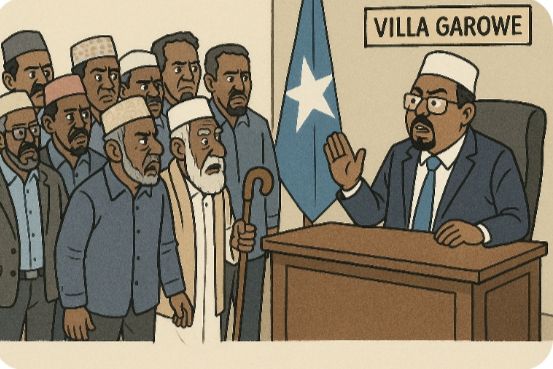
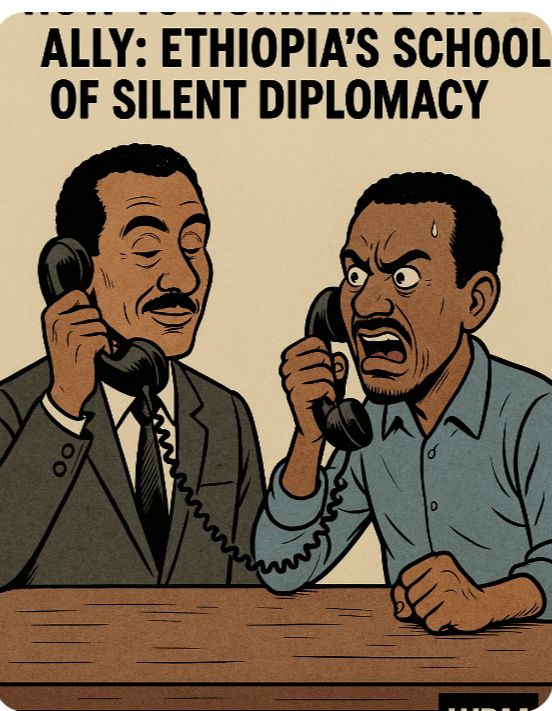
President Hassan Sheikh Mohamud’s pilgrimage to Addis Ababa is a spectacle of tragic repetition. Under the gilded ceilings of Prime Minister Abiy Ahmed’s palace, amidst the sterile choreography of state visits, a far more cynical transaction was being negotiated. This was not diplomacy; it was the liquidation of sovereignty, a desperate barter of Somalia’s hard-won federal structure for a short-term political lifeline.

The agenda, pieced together from diplomatic cables and strategic leaks, reveals a mission of stunning paradox. The President, who once cloaked himself in the rhetoric of nationalist resolve, now travels to a historical regional hegemon not to discuss mutual interests, but to solicit its intervention in Somalia’s most delicate internal affairs: the fractious politics of Jubaland and the Gedo region. His initiative, dubbed “New Jubaland,” is not an organic political movement but a contrivance—a proxy project engineered in the sealed chambers of Villa Somalia. The formula is familiar: identify local dissent, infuse it with Damul Jadiid patronage, and seek a foreign power’s imprimatur to legitimize the illegitimate.

The profound absurdity lies in the betrayal. Federalism, however imperfect, remains the only constitutional framework preventing a return to the centralized ruin that plunged the nation into chaos. It is the fragile covenant between Mogadishu and the regions. Yet here is the President, not building bridges but burning them, offering this very covenant as a bargaining chip to an external actor. He is not strengthening the state; he is dismembering it to retain a piece of the throne.

For Abiy Ahmed, the calculus is clear. He acquires a pliant partner in Mogadishu, gains a lever to control the strategic Jubba corridor, and burnishes his credentials as an indispensable regional power broker. For President Hassan Sheikh, the gain is purely optical—a staged display of relevance and international backing, even if that backing comes at the cost of national dignity and long-term stability. It is the politics of the sugar rush: intensely sweet now, destined for a debilitating crash.

On the ground, the consequences are already felt. The people of Gedo are subjected to yet another abstract political experiment conceived in a distant capital. How many times must the map be redrawn from Mogadishu before leadership understands that nations are built on consent, not coercion? This administration’s track record—the political engineering in Galmudug, the manipulation in the Southwest, the invention of Hirshabelle—suggests a compulsive refusal to learn. This “New Jubaland” is merely the latest chapter in a doomed saga of centralist revivalism.

The handshakes in Addis Ababa represent more than a diplomatic misstep; they are an abdication of a national vision. Somalia does not need a president who seeks validation in foreign capitals to wage war on his own federal members. It needs a leader who will return to Mogadishu, open the constitution, and engage in the arduous, unglamorous work of building a genuine, negotiated federation.

President Hassan Sheikh, however, seems condemned to replay the past. Today’s photo-op may provide a fleeting sense of victory, but it is a pyrrhic one. When the flags are furled and the delegations depart, Somalia is left with a sobering reality: its leadership has once again chosen the path of dependency, and the bill for this diplomatic theater will be paid by generations to come.

WDM VERDICT:
A president who seeks a foreign power’s blessing to subdue his own people does not practice statecraft. He engages in surrender. Federalism was not merely discussed in Addis Ababa; it was placed on the auction block.

WDM – Talking Truth to Power.

The Split Screen of Global Hypocrisy: Media Bias in the Gaza Conflict

By Ismail H. Warsame

Introduction: The Fractured Mirror of Global Media

The polarized split screen—Al Jazeera on one side, Western media like the BBC and CNN on the other—during coverage of Gaza’s conflicts represents more than a visual metaphor. It reflects a fundamental schism in how reality is constructed and presented to global audiences. This division captures the new world order of media representation: truth is increasingly tribal, filtered through geopolitical alignments and editorial biases that shape public consciousness. While Al Jazeera broadcasts from within the rubble, Western networks often report from sterile studios, creating what amounts to parallel realities of the same events .

This essay examines how this split screen manifests, its consequences for public understanding, and what it reveals about the state of contemporary journalism. The analysis extends beyond surface-level comparisons to explore systematic patterns confirmed by internal whistleblowers, academic research, and the testimony of journalists working within these institutions .

The Systematic Bias of Western Media: Evidence Beyond Anecdote

Western journalism, once considered a global model of integrity, has demonstrated consistent patterns of bias that extend beyond individual stories to systemic editorial practices. The evidence for this bias is substantial and comes from multiple sources:

· Internal testimony: Over 100 BBC staff members and 200 media professionals signed a letter accusing the broadcaster of systematic bias in its coverage of Israel’s war in Gaza, noting that “basic journalistic tenets have been lacking when it comes to holding Israel to account for its actions” . Similar concerns have emerged from CNN, where journalists reported being unable to describe Israeli actions as “air strikes” without Israeli confirmation—a standard not applied to other conflict zones .
· Academic analysis: A critical discourse analysis published in January 2025 compared Al Jazeera English and BBC’s online reporting on the 2023 Gaza War, finding “drastic differences in the quoting patterns and negative lexicalization,” with BBC refraining from emphasizing accusations against Israel of committing “genocide,” “ethnic cleansing,” “terrorism,” and “war crimes” .
· Language asymmetry: Analysis by The Nation revealed that during the first 30 days of the conflict, emotive words like “brutal,” “massacre,” “slaughter,” “barbaric,” and “savage” were “overwhelmingly used to describe the killing of Israelis and Ukrainians, and almost never that of Palestinians” .

These patterns represent what the Al Jazeera Journalism Review has termed “systematic double standards in Western journalism” , where the same events are framed through entirely different moral and linguistic lenses depending on which network is reporting.

Table: Comparative Language in Conflict Coverage

Term Western Media Usage and Al Jazeera Usage
Palestinian casualties “Palestinians killed” “Palestinians killed by Israeli forces”
Israeli casualties “Israelis killed by Hamas” “Israeli settlers/killed”
Descriptive terms for casualties Rarely uses “slaughter,” “massacre” Frequently uses these terms for Palestinian deaths
Historical context Limited reference to occupation Regular reference to historical context

The Manufactured Objectivity of Western Outlets

The performance of objectivity in Western media often masks deeply embedded biases that serve political interests. This “manufactured objectivity” manifests in several ways:

Selective Sourcing and Verification

Internal BBC communications reveal a systematic approach to vetting guests that disproportionately scrutinized Palestinian perspectives. According to a former BBC journalist, potential Palestinian interviewees were subjected to intense scrutiny in internal group chats, while Israeli spokespeople “were given a lot of free rein to say whatever they wanted with very little pushback” . This created a fundamental imbalance in whose perspectives were legitimized and challenged.

Structural Conflicts of Interest

At the BBC, structural conflicts have been identified that potentially influence coverage. Over 400 media figures, including 111 BBC staffers, signed a letter demanding the removal of board member Robbie Gibb over his “consistent efforts to stifle legitimate coverage of Israel’s war on Gaza” . The letter specifically noted Gibb’s ties to the Jewish Chronicle, which “has repeatedly published anti-Palestinian and often racist content,” creating what signatories viewed as an untenable conflict of interest for someone involved in editorial decisions .

Editorial Intervention and Censorship

At CNN, a long-standing policy requires that “every CNN journalist covering Israel and Palestine must submit their work for review by the news organization’s bureau in Jerusalem prior to publication” . While CNN describes this as ensuring “accuracy in reporting on a polarizing subject,” critics argue it places editorial control under the shadow of a bureau operating with permission from the Israeli government and military .

Al Jazeera: Ground-Level Reporting Amid Geopolitical Complexities

Al Jazeera’s coverage, while operating within its own geopolitical context rooted in Qatari funding, has provided perspectives largely absent from Western reporting. The network’s distinctive approach includes:

Unflinching Documentation

Al Jazeera’s reporters have consistently documented the human toll of the conflict with a persistence that has come at tremendous cost. The network has suffered significant journalist casualties in Gaza, highlighting their ground-level presence in conflict zones . Their reporting often includes raw visuals and testimonies that convey the visceral reality of destruction and loss.

Willingness to Challenge Dominant Narratives

While Western media frequently avoid terms like “genocide” and “ethnic cleansing” in reference to Palestinian suffering, Al Jazeera has consistently employed this vocabulary when appropriate . This linguistic directness stands in stark contrast to the cautious, often euphemistic language of Western outlets.

Contextual Reporting

Unlike Western coverage that often isolates events from their historical background, Al Jazeera typically frames current violence within the broader context of occupation, settlement expansion, and historical Palestinian displacement . This approach provides audiences with a more comprehensive understanding of the conflict’s roots.

The Global Consequences of Media Fragmentation

The split screen phenomenon extends beyond journalism to impact international relations, public consciousness, and the very possibility of shared reality:

Erosion of Shared Facts

When the same events are reported through fundamentally different frameworks, the possibility for consensus on basic facts diminishes. This fragmentation mirrors political polarization and undermines the potential for diplomatic solutions grounded in mutually acknowledged realities.

Differential Humanization

The consistent framing of Israeli and Palestinian suffering through different moral lenses creates what scholars have called “hierarchies of humanity” . As one BBC journalist noted anonymously, “we can see blatantly that certain civilian lives are considered more worthy than others—that there is some sort of hierarchy at play” .

Impaired Moral Judgment

When information systems provide radically different accounts of suffering and responsibility, the foundation for ethical response is compromised. This allows governments and international bodies to operate without accountability, as their constituents receive carefully filtered information that aligns with predetermined policy positions.

Conclusion: Beyond the Split Screen

The split screen between Al Jazeera and Western media outlets represents more than editorial differences—it signals the collapse of a universal truth framework in global journalism. This division has profound implications for how conflicts are understood, remembered, and addressed through international mechanisms.

The solution lies not in pretending that perfect objectivity is possible, but in demanding transparency about perspectives, acknowledging biases, and consciously diversifying news sources. Audiences must become active media consumers who recognize that every network operates within particular geopolitical contexts and allegiances.

The true tragedy of the 21st century media landscape is not that different outlets offer different perspectives—this can be healthy—but that these differences have become so entrenched in power dynamics that some realities are systematically erased while others are amplified. The split screen does not merely show us different angles on the same event; it shows us how geography, power, and ideology determine which sufferings are rendered visible and which remain invisible to global audiences.

WDM Verdict:
The next time you see the split screen, recognize that you are not just watching different news channels—you are witnessing the fragmentation of global conscience itself. In this divided media landscape, the most radical act may be to consciously view both screens simultaneously, holding the tension between perspectives until a more complete picture emerges.

(WDM – Warsame Digital Media).

The Qardho Breakfast Debate: Can Deni Crack the Somali Presidential Code?

By Ismail H. Warsame – WDM Editorial Analysis, Qardho, Puntland

The Scene: A Heated Political Debate in Qardho

In the cool morning breeze of Qardho—a city where every tea stall doubles as a parliament in miniature—four men debated over shaah and canjeero. Their topic: the most tantalizing question in Somali politics today. Can Said Abdullahi Deni capture Villa Somalia in 2026?

The conversation was a microcosm of a nation weary of recycled elites and hollow slogans. Each man vied to sound the most politically astute, but by the end, one of them distilled the essence of Somali presidential politics with brutal clarity:

“A Somali president emerges from just two forces: a coalition of clans, and the collective hatred for the incumbent.”

The Two Keys to Villa Somalia

This formula has dictated Somali presidential elections with uncanny precision.

1. A Multi-Clan Coalition: A fragile alliance, stitched together from the raw arithmetic of clan, financed by secret, often questionable financial resources and the diaspora, and sealed by opportunistic promises.
2. The Rejection Mood: A powerful wave of resentment against the sitting president, often masquerading as a movement for reform.

There is no ideology. No substantive policy platform. Only clan arithmetic and anger.

In 2017, Mohamed Abdullahi Farmajo rode this wave of rejection against the establishment. By 2022, the pendulum had swung, and Hassan Sheikh Mohamud became the “least objectionable” alternative—a compromise chosen not for his vision, but because others were distrusted more.

The Somali political marketplace operates on a simple principle: it’s not about who can lead best, but who we hate least.

Deni’s Dilemma: A Coalition Too Thin, A Resentment Too Tepid

This is where Deni’s ambition meets a formidable wall.

1. The Coalition Factor: A House of Cards?

Deni’s core base—the Majerteen Darood—is politically savvy but numerically insufficient. His attempts to build bridges beyond Puntland have been perceived as transactional, not transformational. Still he has strong opposition within Puntland like traditional elders and rival politicians, some connected to DamulJadiid Team.

· The Dir remain psychologically anchored to Hawiye politics in Mogadishu, an almost insurmountable barrier.
· The Digil & Mirifle are pragmatic, their support swaying by whoever offers the most convincing promise of inclusion and tangible benefit.
· The Hawiye, particularly the powerful Damul Jadiid bloc, still view Deni as a northern challenger to Mogadishu’s political hegemony.

In short, Deni’s national coalition is brittle. In Somali politics, brittle coalitions don’t win Villa Somalia—they merely anoint the winner.

2. The Hatred Factor: An Unfocused Fury

The second key—the galvanizing hatred of the incumbent—also eludes him. Despite his administration’s shortcomings, Hassan Sheikh Mohamud retains a formidable defensive apparatus:

· The well-oiled and well-funded Damul Jadiid network.
· Enduring clan sympathy within Hawiye circles.
· The institutional leverage of incumbency over parliament, ministries, and the security organs that indirectly influence the electoral process.

Deni has failed to become the vessel for this anti-incumbent sentiment. His posture and closed door administration doesn’t even enjoy support with his own cabinet and members of the House —lacks the fire to ignite a national movement. To unseat a president in Somalia, one must weaponize national frustration and channel it through tribal calculus. Deni has mastered neither.

Puntland’s Paradox: A Power Base That Becomes a Cage

Deni’s greatest asset—his leadership of Somalia’s most stable federal member state—is also his most significant liability. While Puntland sees him as their champion, national politics penalizes strong regional identities. The unspoken rule of Somali federalism is clear: no powerful federal state can be allowed to dominate the center.

Unless Deni can perform a profound political metamorphosis—shedding the skin of “Garowe’s President” to emerge as “Somalia’s Compromise”—his ambitions will expire on the tarmac of Aden Adde International Airport, never reaching the gates of Villa Somalia.

2026: The Chessboard of the Familiar

The 2026 electoral landscape is unlikely to feature new players; rather, it will be a rearrangement of the same familiar pieces. Deni, Hassan Sheikh, Sheikh Sharif, among others, and perhaps a Gulf-backed wild card. The rules of the game, however, will remain immutable:

· The 4.5 formula will still set the board.
· A security-vetted parliament will still place the crown.
· The public will remain spectators in a play directed and funded by foreign embassies.

The only unknown is whether the nation’s desperation for change will be potent enough to disrupt the cycle—or if fragmentation will prevent a credible election altogether.

Conclusion: The Arithmetic of Ambition

Back at the Qardho breakfast table, the debate concluded with a final, piercing insight:

“Deni’s dream is not impossible. But Somalia is not ready for a man without potent enemies.”

In the theater of Somali politics, popularity is a fleeting sentiment—but focused resentment is a currency of power. Deni’s challenge is not to win a popularity contest, but to strategically cultivate the right enemies. Until he does, his path to the presidency will remain a mirage, shimmering just beyond the political deserts of Mogadishu.

WDM Verdict:
Said Abdullahi Deni is unconvincing national candidate. His coalition is narrow, his narrative undefined, and his opposition too polite. Barring a seismic shift that turns 2026 into a pure referendum on Hassan Sheikh Mohamud, Deni will likely be campaigning for political relevance, not the presidency.

The British Conundrum in Bosaso – Decoding His Majesty’s Mystery Missions

By Ismail H. Warsame, WDM Political Desk

Bosaso’s streets, once again, echo with the sound of polished shoes and the rustle of diplomatic pleasantries. Another British convoy has materialized—the 3rd, or perhaps the fourth this year—each visit a masterclass in discretion. No communiqués,  only photo op with the President. Just a flurry of handshakes, closed doors, and the familiar, whispered lexicon of  “partnership.” In the absence of transparency, speculations are rife in Puntland that US Africom is seeking new relocation and real estate on the Gulf of Aden. Britain is always attached to whatever the Americans are doing in the world. To them, Bosaso is attractive now.

It appears London’s diplomatic corps has developed a curious fondness for discreet pilgrimages to Puntland. The official record lists their mission as “Assisting Puntland State in Countering ISIS, Partnership, and Stability.” Yet in the tea stalls and public squares, few are convinced. The talk is that ISIS is merely the convenient headline — a diplomatic fig leaf for deeper, undisclosed objectives. Both sides maintain a studied silence. Meanwhile, the perennial political theater between Garowe and Villa Somalia may well feature as a quiet subplot in these shadowy exchanges, viewed from Puntland’s vantage point.

One must ask: why the relentless secrecy? Puntlanders are no strangers to diplomacy; they simply possess a keen allergy to the scent of colonial nostalgia. The British arrive carrying the heavy baggage of a history written with pens sharper than any sword—from the cartographic surgery that created “Northern Protectorate” to tutoring Somalis in the art of signing away their own coasts. The ghost of Britain still walks the Horn, its offers of “assistance” forever footnoted with unspoken conditions.

So, what is the true agenda this time? A “counter-terrorism partnership”? A “stabilization dialogue”? Or is it another elegantly drafted, invisible agreement, composed in the Queen’s English but translated in the corridors of Garowe as, “You assume the risk, we secure the interest”?

The people of Puntland are left in the dark, their view limited to the curated, polished images on social media. The state government in Garowe appears to overlook a fundamental principle: the public has a right to know what objectives foreign powers are pursuing on their soil and what is being pledged behind closed doors. Transparency is not a Western import; it is the very bedrock of public trust. Yet, in the halls of power, a culture of secrecy persists, treating statecraft as an exclusive affair for the initiated, rather than a matter of collective destiny.

Let us not forget the context: Britain wields the pen for Somalia at the UN Security Council. It is the architect of resolutions, the shaper of international perception, the subtle pilot of global policy towards our nation. This fact transforms every British handshake in Bosaso from a gesture of goodwill into an act of high-stakes politics. When the same hand that drafts the world’s verdict on Somalia begins frequenting Puntland’s shores, it is not paranoia to inquire: what narrative is being written about us, and who holds the power to edit it?

If His Majesty’s diplomats are here to lecture on the realities of SSC-Khaatumo, they should be reminded that Puntland requires no cartography lessons—it drafted the map of Somali federalism long before Mogadishu acknowledged its existence. And if the mission’s true aim is to gently nudge Puntland into acquiescing to Villa Somalia’s latest political fantasies, then we wish them luck—Puntland has endured two decades of such “luck” from the international community.

The rhythm of these visits is telling: a quiet arrival, hushed meetings, a void of transparency, and a swift departure—like a colonial-era specter clocking in for a modern-day assignment. Each exit leaves the same, lingering question hanging in the coastal air: What, precisely, was the purpose?

Perhaps it is time for Puntland’s leadership to cease treating foreign envoys as visiting royalty and start demanding that diplomacy serve the people, not just the diplomats. The era of governing by obfuscation is over—or, at the very least, its expiration date is long past due.

Until that day comes, Bosaso will continue to sweep its streets for mysterious motorcades, perfecting the art of pretending not to notice as another “friendly mission” descends from the skies, its purpose as unannounced as its arrival.

WDM Verdict: Britain never truly left Somalia; it simply upgraded its departure board to include direct flights to Bosaso.

WDM – Talking Truth to Power
(© Ismail H. Warsame / Warsame Digital Media)

WDM STATE OF THE UNION: THE POINT OF NO RETURN

By Ismail H.Warsame
Warsame Digital Media(WDM)

Somalia stands at a precipice, haunted by a single, unavoidable question: where do we go from here?

In the north, Puntland State—the federation’s last functioning polity—is concluding a grueling campaign against ISIS in the Cal-Miskaad ranges. The black flags have been torn down, but the war drums echo from the Calmadoow Mountains, where Al-Shabab’s shadow government still levies taxes, enforces its rule, and harvests the disillusioned and gemstones alike. This is the next battle, looming and unwon, pending the whims of distant patrons.

Those patrons, the United Arab Emirates and the United States, are now uncertain allies in a world fractured by new wars and economic tremors. Their commitment wavers with the potential next Donald J. Trump’s tweet, a figure who could erase yesterday’s pledges with such unpredictability. Should American aid vanish, Puntland’s soldiers may find themselves standing against the storm in little more than sandals and sheer will.

At home, Puntland’ democratic momentum has frozen. President Said Abdullahi Deni, rather than securing the legacy of his governance reforms, is captivated by the siren call of Villa Somalia in 2026. The ballot boxes in Garowe lie silent; the project of democracy is on indefinite hold.

Meanwhile, Villa Somalia is reaping the whirlwind of its own political arson. The “smart politics” of President Hassan Sheikh Mohamud and his Damul-Jadiid cadre have proven to be a masterclass in miscalculation, exposing a dangerous cocktail of arrogance and ineptitude. The regime’s “stabilization mission” is now a bitter punchline in Mogadishu’s tea shops.

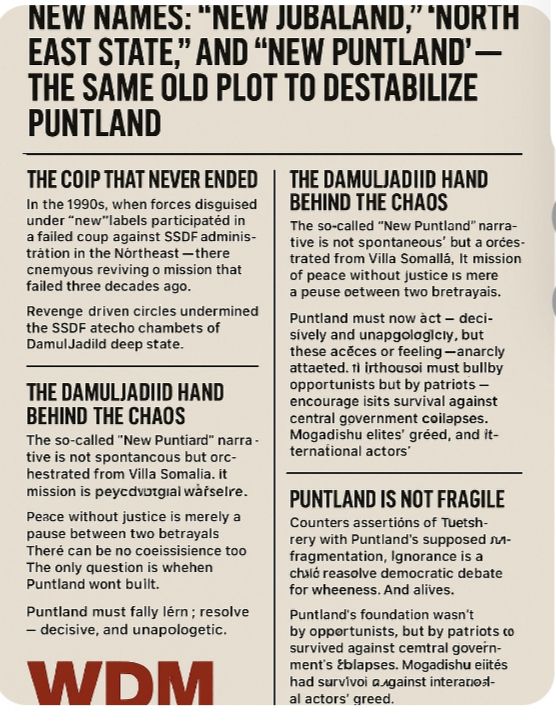
Its deliberate campaign to destabilize the federal member states has backfired spectacularly. The artificial “North East State,” concocted in Laascaanood, is unraveling like a cheap mat from Bakaaraha market. Its administrators issue decrees to extort local financial agencies to stay relevant. The parallel fantasy of a “New Jubaland” is another lit fuse—a scheme destined to fail, but only after further poisoning the well between Mogadishu and Kismayo.

As for Hirshabeelle, Galmudug, and Southwest, these are not states but subsidiaries, their leaders governing on borrowed legitimacy and donor stipends. The federal model has been hollowed out, mutated from a structure of governance into a network of patronage.

And through the cracks, Al-Shabab marches. They no longer infiltrate the capital; they operate with impunity. The city’s “most secure zones” like Godka Jilicoow, guarded by NISA and African Union forces, have become stages for public humiliation. Each blast is a stark reminder: Mogadishu is under a siege that its own government seems powerless to lift.

Inside the Halane compound, the diplomatic bubble where optimism is imported and reheated, the mood has curdled. The envoys who once championed the Damul-Jadiid “success story” now scramble to explain how their project became an obituary for functional federalism. Their talking points are exhausted; their credibility, bankrupt.

So, where do we go from here?

The answer will not be found in Mogadishu’s sterile conferences or the anodyne communiqués of donors. Somalia’s fate will be decided by its local realities, not imported slogans. Puntland and Jubaland now shoulder the crumbling pillars of the federation, even as the center collapses. Unless a surge of reason dispels the pyromania in Villa Somalia, the Union itself may not survive the next blaze.

This is the state of our union: fractured, fatigued, its future flickering faintly against the gathering dark. The ghosts of division are dancing, and the music is reaching a crescendo.

Welcome to the Somali paradox: a nation at war with its own reflection.

WDM Commentary:
This is not a prediction; it is a diagnosis. Somalia’s crisis is not an accident of fate, but the direct yield of calculated irresponsibility. Until a new ethos of leadership rises from the ashes of Mogadishu’s hubris, the next state of the union will read not as a warning, but as an autopsy.

© Warsame Digital Media (WDM)
Qardho,Puntland
“Talking Truth to Power— One Editorial at a Time.”

CLAN AND MARRIAGE — TWO BINDING TIES IN SOMALI CULTURE

By Ismail H. Warsame, WDM

In the glittering hall of white linen and bottled milk, men and women gather — not merely for a wedding, but for the continuation of an ancient Somali ritual: the binding of clans through marriage. Behind the laughter, the speeches, and the perfumed atmosphere lies a silent constitution — older than any written law — where kinship replaces contracts, and bloodlines define both politics and peace.

This was my second time in Qardho witnessing such a union — a spectacle that is part diplomacy, part social insurance, and part clan arithmetic. When a Somali marriage takes place, it is not simply two souls uniting. It is the quiet reshuffling of genealogical alliances; a recalibration of power between sub-clans that might tomorrow either share camels or fight over wells.

The event begins long before the guests arrive. It starts with negotiations, deliberations, and sometimes even historical reconciliations between elders who still remember who offended whose grandfather over a grazing patch or a political appointment. The bride’s hand, formally requested, becomes a symbol of truce — a peace pact in white fabric and henna, sealed not by written law, but by maternal lineage and whispered blessings.

In such ceremonies, men and women usually sit separately or attend in different sessions — men in formal daytime gatherings of speeches, blessings, and agreements; women in vibrant evening events of singing, dancing, and expressing the folklore prowess of Somali womanhood. The two sessions together complete the cultural circle: solemn diplomacy by day, joyful cultural continuity by night.

Yet beneath this noble gesture lies the irony of Somali society: the very ties that unite us are the same that divide us. The mothers whose names echo in every family tree are both peacemakers and progenitors of rivalry. Each birth is a celebration, but also a demographic declaration — another branch in the ever-expanding tree of sub-clans that fracture, multiply, and compete for prestige, land, and leadership.

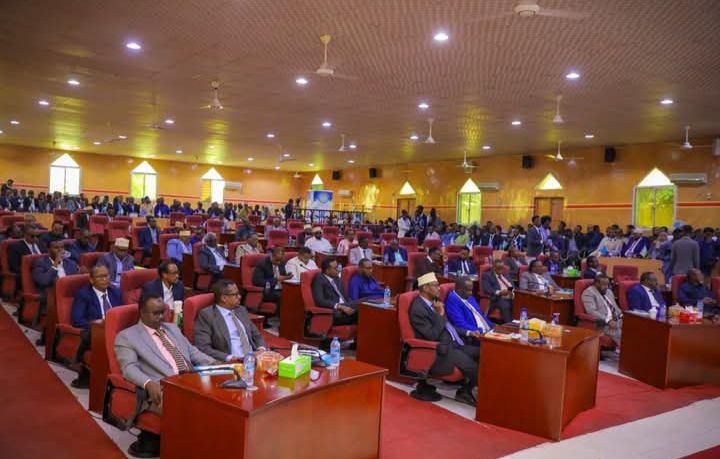
At the ceremony, I looked around the hall — rows of men in white, seated in careful symmetry, exchanging blessings and political gossip between sips of milk. This is the Somali parliament in its truest form — not in Villa Somalia, but here, under chandeliers and tribal memory. Every marriage is an unwritten treaty, every smile a signal of alignment, every whispered prayer a continuation of a 1,000-year clan contract.

When historians search for the roots of Somali political resilience — and its endless cycles of reconciliation and rupture — they should start not in Mogadishu’s corridors, but at these wedding tables. Here, the future is negotiated over bottles of milk and lineage, and every bride becomes a bridge between clans — or a border line drawn in beauty.

WDM Conclusion:
Marriage in Somali culture is the most stable political institution — an unspoken parliament of kinship. It binds us in peace, births our rivalries, and keeps our nation spinning in its familiar orbit of clan and connection.

© Warsame Digital Media (WDM)
City of Qardho, Karkaar Region

WDM Editorial: Qardho — From Roaring Debates to Quiet Calculations

By Ismail H. Warsame, Qardho, Karkaar Region, Puntland

There was a time when Qardho’s air was thick with argument, debate, and political ferment — a city that never slept without a new controversy. From clan assemblies to student circles, from mosques to teashops, the voice of Qardho was the pulse of Puntland’s civic life. It was here that ideas clashed, policies were tested, and political currents were sensed before they reached Garowe. Qardho earned its reputation as the “City of Debates and Controversies,” where nothing passed unquestioned and no leader escaped scrutiny.

Today, something is changing. The once noisy crossroads of Puntland’s political thought is learning a new rhythm — that of quiet, cool calculation. The political tempest that once defined Qardho’s public squares has given way to reflective silence, economic pragmatism, and slow, deliberate planning. The city that once spoke loudly is now thinking deeply.

In recent years, Qardho has emerged as a learning hub — a city of affordable education, housing, and calm community life. Its universities, training centers, and private schools are drawing youth from across Puntland. This intellectual transformation is reshaping Qardho’s identity from a political battlefield to an academic haven. Yet, beneath this positive evolution lies a worrying trend: opportunity is slipping away faster than it is created.

Job scarcity has become the city’s quiet crisis. The very youth who animate Qardho’s new intellectual scene are also the ones boarding buses, flights, and ships — seeking work in Garowe, Bosaso, Mogadishu, and beyond. The irony is painful: a city known for nurturing brains now exports them. The debates have stopped not because the people have lost curiosity, but because they are too busy surviving.

Qardho’s streets, once echoing with political chants and intellectual arguments, now hum with the sound of construction — affordable housing projects, small shops, and the buzz of daily hustle. The city is learning to measure progress not in decibels of debate, but in bricks, books, and banknotes. It’s a quiet evolution, one that could either anchor its future or flatten its spirit.

The challenge now is to balance Qardho’s newfound calm with its old courage — to blend calculation with conviction. A city that stops talking risks becoming stagnant, but a city that only talks and never builds remains poor. Qardho must find the middle path: to build its economy without losing its voice, to nurture its youth without pushing them away, to remain the thinking heart of Puntland while securing a future for its sons and daughters.

The future of Qardho depends not on the silence of its streets, but on the smart, deliberate ideas that grow within them. The city that once led debates must now lead development — with the same passion, purpose, and courage that once made it the intellectual capital of Puntland.

WDM — Talking Truth to Power.

WDM Political Analysis: The Economics of Delusion in Laascaanood

By Ismail H. Warsame
City of Qardho, Karkaar Region, Puntland

When a leader exhausts all logic, he resorts to decrees. When that leader is Firdhiye, the result is an economic suicide pact, imposed upon the already-battered families of Laascaanood.

In a move that would embarrass the most creative of Mogadishu’s financiers, the so-called Firdhiye Administration has demanded that local financial institutions and telecom-linked money transfer agencies surrender five million U.S. dollars. This sum, he claims, is to fund the phantom treasury of his “North East State” project. One must ask: does he mistake Laascaanood for a financial hub, or believe companies like Dahabshiil and Amal Express mint currency in their back offices?

Adding institutional insult to this economic injury, he has ordered these vital agencies to relocate their headquarters to Laascaanood. This presumes a world where global finance orbits his self-styled Ministry of Fiction. Not even Somaliland’s long-standing political campaign has staged such a theatrical and economically destructive farce.

This is not governance; it is a ransom note written in the language of authority. Shuttering remittance services is not statecraft—it is an act of economic terrorism against the most vulnerable. It is an assault on widows awaiting funds for rent, on orphans reliant on diaspora support for schooling, and on families depending on those transfers for mere sustenance. Firdhiye’s decree deliberately severs the primary economic lifeline that has sustained Laascaanood in its fragile recovery.

Who stands to gain from this collapse? Certainly not the people of SSC-Khaatumo, whose remittance-dependent economy now teeters on the brink. The only logical conclusion is that Firdhiye believes by bankrupting the city, the desperate diaspora will be coerced into funding his political fantasy.

Laascaanood’s struggle is being twisted into a tragic satire—a self-imposed siege where the would-be liberator becomes the chief architect of his people’s deprivation. The liberation Laascaanood urgently requires is from this very cycle of irrational leadership and economic sabotage.

True financial ecosystems are built on trust and stability, not on extortion and empty slogans. If reason prevails, remittance agencies must prioritize the people’s welfare over political pressure. Capital flees instability; it is not conjured by it.

WDM Verdict:
Firdhiye’s “North East State” resembles less a government and more an armed GoFundMe campaign, with the people of Laascaanood held as collateral.

WDM (Warsame Digital Media)
“Talking Truth to Power”

WDM Editorial: Puntland’s Mogadishu-Based Opposition — Agents of Disruption, Not Reform

By Ismail H. Warsame, City of Qardho, Karkaar Region

In a fresh display of political blindness, a cluster of self-styled “Puntland opposition parties,” mostly operating from Mogadishu hotel lobbies and political backrooms, have voiced their opposition to the recent Puntland–Somaliland understanding on security cooperation. It is an unfortunate, though predictable, stance — one that exposes their detachment from Puntland’s ground realities and their quiet servitude to DamulJadiid’s shadow networks in Villa Somalia.

Let’s get this straight: Puntland’s leadership has the constitutional right and political maturity to engage with any neighboring administration — including Somaliland — on issues that directly affect the peace, stability, and economic lifeline of its people. Security coordination and mutual understanding between the two sides are not acts of betrayal; they are the very essence of responsible governance in a volatile region.

Those opposing this initiative from Mogadishu, however, are not thinking of Puntland’s interests. They are echoing the whispers of DamulJadiid operatives who have long sought to destabilize Puntland from afar, to weaken its institutions, and to create internal friction that could be exploited politically in Villa Somalia’s favor. These are the same cynical actors who inspired and funded the Aaran Jaan network that violently disrupted Garowe’s peace a few years ago.

Their motives are transparent. They thrive on chaos. They oppose anything that strengthens Puntland’s autonomy and legitimacy. In their narrow political calculus, peace and cooperation are threats to their political survival — because their only currency is confusion.

The Mogadishu-based “Puntland opposition” should be honest with the people: they are not fighting for democracy in Puntland; they are fighting for relevance in the capital. Their statements are not drafted in Garowe or Qardho; they are dictated by handlers in Villa Somalia who see Puntland’s stability as a political liability.

The people of Puntland are not fooled. They understand that coexistence with Somaliland, however complex, is a pragmatic necessity. Border communities, shared clans, trade routes, and the collective fight against terrorism demand coordination — not hostility. The Mogadishu opposition’s short-sightedness only confirms that they are far removed from the land they claim to represent.

Let it be said clearly: Puntland’s peace and progress will not be dictated from Mogadishu’s hotel corridors. The State of Puntland was founded on the principle of self-determination, negotiation, and local consensus — not on imported chaos.

WDM Verdict:
The Puntland opposition operating from Mogadishu has lost both political compass and credibility. Their hostility toward Puntland–Somaliland cooperation mirrors the same destructive mindset that once unleashed Aaran Jaan’s violence in Garowe. Puntland will continue to talk, negotiate, and cooperate for the sake of peace — with or without their approval.

© WDM – Warsame Digital Media, 2025
“Talking Truth to Power.”

Greetings to WDM Readers

Warm greetings from the great traditional city of Qardho, in the heart of Karkaar Region, Puntland — a land of history, courage, and enduring Somali resilience.
Arriving here this afternoon, I am once again reminded that Qardho is not just a city — it is the living symbol of Puntland’s spirit and the heartbeat of Somali self-determination.

Stay tuned to WDM for truth-driven analysis and fearless commentary from the ground — unfiltered, unapologetic, and always committed to reality.

Ismail H. Warsame
Founder, Warsame Digital Media (WDM)

A Reality Check for a Nation in Denial: An Open Letter to WDM Readers

Dear Esteemed WDM Readers,

At Warsame Digital Media (WDM), we don’t write to please. We write to awaken. Every essay, editorial, and academic paper published here is a mirror held to the Somali soul — reflecting the unfiltered reality of our politics, our personality, and our fractured national psyche. What you read on these pages is not fiction, not propaganda, but a reality check on where Somalia stands and where it is heading.

For students of Somali Studies, historians of our turbulent past, and analysts of our uncertain future, these writings are not mere commentaries — they are living documents of a nation still struggling to understand itself. Each article challenges the comfort of denial, exposing the deep contradictions within Somali leadership, society, and self-perception.

But truth-telling comes at a price. WDM survives not on advertisements or political patronage, but on your participation, your intellectual engagement, and your generosity. If you believe that independent Somali thought must be preserved, nurtured, and amplified — then join us.

Contribute your ideas. Comment with courage. Subscribe and share. Donate to sustain this Somali-led platform for truth and national reflection.

Let’s build together a culture where honesty replaces hypocrisy, and knowledge overcomes ignorance.

With appreciation and resolve,
Ismail H. Warsame
Founder & Chief Editor, Warsame Digital Media (WDM)
Talking Truth to Power — One Article at a Time

WDM EDITORIAL: HASSAN SHEIKH AND MADOOBE — COURAGE AMIDST CALCULATED CHAOS

By Ismail H. Warsame

In a rare moment of political sobriety, President Hassan Sheikh Mohamud and Jubaland leader Ahmed Mohamed Islam “Madoobe” sat across from each other in Kismayo yesterday — a meeting many in Somalia’s fractured political scene never thought possible. Yet, instead of welcoming this bold act of dialogue, much of the public chatter — the “political noise machine” of Mogadishu — has chosen to focus on what might have gone wrong, rather than what finally went right.

This meeting, however brief, represents something profoundly important in Somali politics: the courage to talk amidst mutual suspicion and political exhaustion. It is easy to wage wars of words from Mogadishu podiums or clan-based press briefings. It is far harder to sit down face-to-face in a region where power, loyalty, and geography are all contested. Whoever enabled this encounter deserves recognition — for in Somalia, dialogue itself is an act of defiance against the politics of perpetual stalemate.

But make no mistake: the test begins now.

President Hassan Sheikh Mohamud has often been accused — with justification — of treating federalism as an inconvenience rather than a constitutional reality. His administration’s flirtation with the idea of a so-called “New Jubaland,” or attempts to carve out a “North East State” to rival Puntland, would not only destroy the fragile trust earned in Kismayo but would ignite the very tensions he claims to be resolving.

Let it be clear: you cannot unify Somalia by dismantling the federal foundation upon which its fragile peace rests. Any attempt by Villa Somalia to engineer parallel administrations or divide existing federal states from within will backfire politically and strategically. It will not weaken regional leaders — it will strengthen their legitimacy, uniting their constituencies against what they will see as naked centralist aggression.

Moreover, such reckless political experiments — creating new Jubaland, new North East State, or any other artificial constructs — will not create peace or prosperity. Instead, they will turn Somalia into an ungovernable mosaic of fiefdoms, where every faction declares its own “statehood,” and where the authority of the federal government becomes nothing more than a hollow echo. This path leads not to unity, but to the unraveling of Somalia as we know it.

President Hassan Sheikh Mohamud must also understand that the issue at hand is far bigger than Ahmed Madoobe’s political legitimacy in Kismayo. It is not about who controls Jubaland’s port or commands local loyalty — it is about Somalia’s very survival as a state. Every move from Villa Somalia today echoes across the fragile federal system. A single miscalculated decision can either pave the way for a more cohesive federation — or accelerate Somalia’s descent into irreversible fragmentation.

The Kismayo meeting was therefore not just another handshake; it was a test of statesmanship. Hassan Sheikh Mohamud has been given an opportunity to rise above the politics of vengeance and vindication. If he chooses dialogue over division, and genuine federal partnership over administrative manipulation, history might finally remember him as the man who learned from his own mistakes.

But if he returns to Mogadishu with the old mindset of domination — hiding behind the rhetoric of “reform” while scheming to create a New Jubaland or North East State — then this fleeting moment of hope will turn into yet another episode of Somalia’s tragic political déjà vu.

In the end, the path forward is simple but steep: talk more, interfere less, and respect the federal equation. Somalia does not need another federal member state in crisis; it needs a federal president who understands the value of coexistence.

For once, let dialogue mean more than damage control.

——–

WDM Conclusion:
The Kismayo meeting should not be dismissed as political theater. It is a mirror showing the possibility of reconciliation — if only the actors involved resist the temptation to break it. Somalia’s survival depends not on creating new states, but on respecting the ones that already exist.

— Warsame Digital Media (WDM)
“Talking Truth to Power.”

WDM EDITORIAL: THE PSYCHOLOGY OF LAASCAANOOD’S FEAR

By Ismail H. Warsame, WDM Founder

Introduction: The Echo of Old Wounds

In the current uproar surrounding Puntland–Somaliland “security cooperation,” one hears not so much the clash of political logic as the tremor of old psychological fears. Laascaanood’s anxiety is not rooted in facts or tangible concessions but in the emotional residue of betrayal, marginalization, and historical trauma. The real problem is not that Garowe and Hargeisa talk—it’s that Laascaanood has never fully trusted anyone to talk on its behalf without suspicion of being sold out.

When history is weaponized by insecurity, perception becomes reality. The current leadership in Laascaanood, particularly figures like Firdhiye, mistake dialogue for compromise and cooperation for conspiracy. Yet the truth is far less dramatic and far more strategic: mutual understanding—no matter between whom—is always in the collective interest of the Somali people.

Historical Context: When Abdullahi Yusuf and Egal Talked

The unease we see today is not new. During the formative years of Puntland, when the late Abdullahi Yusuf engaged in discussions with Somaliland’s Mohamed Haji Ibrahim Egal, Puntland’s own vice president from SSC territory, Mohamed Abdi Hashi, objected. His words were striking:

“We don’t mind when you talk with leaders of Hawiye, but you must talk to the leaders of Isaaq through us.”

This wasn’t a political demand—it was a psychological reflex. It revealed a deep-seated insecurity that SSC’s agency could be bypassed, that others could determine its fate behind closed doors. It is an emotional scar from decades of marginalization—first under northern domination, then southern neglect.

Laascaanood’s fear, therefore, is a memory, not a policy. It’s the aftertaste of exclusion, not an objective assessment of current realities.

The Fallacy of Firdhiye’s Politics

Firdhiye’s rhetoric is historically shortsighted. His worldview is trapped in the narrow confines of clan sentiment rather than strategic foresight. By portraying every cross-border understanding as a “betrayal of SSC,” he inadvertently isolates his constituency from the broader currents of Somali politics.

He fails to understand that communication between Puntland and Somaliland is not about surrender; it’s about stability. It’s about preventing further bloodshed in a region where every gunshot echoes across multiple states and every misunderstanding can spiral into conflict.

The politics of paranoia is not leadership—it’s insecurity dressed in extremist clothing.

Puntland’s Strategic Rationality

Puntland’s leadership, past and present, has recognized one immutable fact: sustainable peace requires talking to everyone—including rivals. Abdullahi Yusuf understood this when he negotiated with both the Hawiye and the Isaaq leadership. Said Abdullahi Deni knows this when he maintains dialogue even with adversaries.

True leadership is not about pandering to fears but about managing them. Puntland’s talks with Somaliland—whether over security coordination, border stability, or trade routes—do not negate SSC interests; they safeguard them. Because a stable northern frontier is in Puntland’s interest, and therefore in SSC’s interest too.

The Bigger Picture: Dialogue as Security

Somalia’s tragedy is that every conversation is treated as conspiracy and every handshake as surrender. The country’s disintegration into clan fiefdoms has turned politics into psychological warfare. But dialogue—especially between Puntland and Somaliland—is not betrayal; it is the essence of statecraft.

If Laascaanood truly seeks autonomy, it must transcend its paranoia. It must learn that influence is not preserved by emotional veto but by strategic engagement. Real power lies in shaping conversations, not in silencing them.

Conclusion: Healing the Psychological Faultline

The Laascaanood dilemma is a symptom of a deeper Somali condition—the inability to separate emotion from interest, fear from strategy. What Abdullahi Yusuf understood, and what SSC leaders have yet to grasp, is that politics is not about perpetual grievance but about building bridges that outlast the emotions of the day.

Laascaanood’s fears are understandable, but they must not dictate policy. The wounds of history will not heal through isolation but through honest, mutual understanding. Puntland and Somaliland talking is not a threat—it is therapy for a fractured homeland.

WDM COMMENTARY:
Somalis must learn to replace suspicion with strategy. When Puntland and Somaliland engage, SSC should not retreat into psychological trenches—it should join the table with confidence, not fear.

Revisiting Somalia’s First Republic (1960–1969): Myths, Fallacies, and Historical Misreadings

By Ismail H. Warsame | WDM Analysis

1. Introduction: The Danger of Historical Simplification

The digital age has democratized history-telling but also weaponized misinformation. Social media platforms like X (formerly Twitter) have turned complex historical debates into viral narratives built on partial truths and populist outrage. One such case is the viral thread by @LtKhalifa, which purports to expose the “corruption and failures” of Somalia’s first civilian government under President Aden Abdulle Osman (Aden Adde) between 1960 and 1969. The thread, citing alleged “CIA declassified documents,” claims that the Somali Republic received over $330 million in foreign aid—equivalent to $3 billion today—yet achieved nothing tangible in national infrastructure or governance.

While emotionally compelling, this narrative commits several logical fallacies, relies on unverifiable evidence, and distorts the historical context of a newly independent African state navigating postcolonial chaos and Cold War geopolitics.

2. The Fallacy of the “CIA Declassified” Evidence

The most eye-catching claim in the thread is that “CIA declassified documents” show that Aden Adde’s civilian government “took $330 million in aid.” This statement raises immediate red flags:

1. No source citation or document link is provided. The CIA’s CREST archive contains thousands of declassified documents on Somalia, yet none confirm this figure. Without citation, the claim remains anecdotal hearsay masquerading as evidence.

2. The figure itself—$330 million in the 1960s—is implausibly high. At independence, Somalia’s annual GDP was under $100 million, and total U.S. and U.N. aid combined during that decade did not exceed $150 million. To allege that Aden Adde alone “took” this sum is historically inaccurate and economically illogical.

3. The inflation-adjusted conversion (“$330 million equals $3 billion today”) is also methodologically flawed. Using the U.S. Bureau of Labor Statistics CPI calculator, $330 million in 1965 equals roughly $3.3 billion today—but this assumes the original number was accurate, which it was not.

This misuse of “CIA” branding is a rhetorical trick often found in conspiracy or pseudo-academic narratives—invoking institutional authority to lend credibility to otherwise baseless assertions.

3. The Infrastructure Myth: “No Road Between Hargeisa and Berbera”

Another major claim is that “despite massive aid, Aden Adde failed to build a deep-water port for Mogadishu, and there wasn’t even a road between Hargeisa and Berbera.”

This too collapses under scrutiny:

Mogadishu already had a functioning port built and expanded during Italian administration in the 1950s. What Somalia lacked was a second deep-water port in the north—something that came later under Chinese-Somali cooperation during the 1970s.

The Hargeisa-Berbera road existed as a colonial-era route. It was unpaved but functional for livestock and trade. The later Chinese reconstruction (1972–1974) upgraded it—not built it from scratch.

The Aden Adde administration did prioritize education, civil service development, and agriculture, laying institutional groundwork rather than vanity infrastructure projects.

To claim “there wasn’t even a road” is a factual distortion typical of ahistorical social media narratives that equate “development” only with concrete and steel, ignoring institutional and administrative capacity-building.

4. The Corruption Narrative: Moralizing Without Evidence

The thread describes the Aden Adde era as “largely unpopular” and “rampantly corrupt.” Again, no documentation supports this sweeping indictment. In fact, comparative political studies (see: I.M. Lewis, A Modern History of the Somali, 2002; Abdi Ismail Samatar, The State and Rural Transformation in Northern Somalia, 1989) indicate the opposite:

Somalia’s first decade was remarkably democratic for its time. The 1967 peaceful transfer of power from Aden Adde to Abdirashid Ali Sharmarke was the first voluntary handover between civilian presidents in independent Africa.

The corruption that did exist—patronage, clan favoritism, and weak bureaucracy—was typical of postcolonial African states but not systemic looting. Somalia’s bureaucracy was small, donor-dependent, and largely transparent under international supervision.

The “unpopularity” claim ignores that Aden Adde lost a democratic election, not a coup. His defeat reflected political pluralism, not popular rebellion.

The moral absolutism of the thread—portraying Aden Adde’s government as a failed kleptocracy—collapses under historical evidence and scholarly consensus.

5. Misreading the Political Economy of the 1960s

The 1960s Somali economy was aid-dependent but not aid-wasteful. The problem was structural dependence, not theft. Key realities include:

Somalia inherited two incompatible colonial economies—British pastoralist north and Italian agrarian south—without fiscal or infrastructural integration.

Foreign aid was fragmented across Cold War lines: Italy, the U.S., the USSR, and China all funded competing projects, creating institutional incoherence, not enrichment.

The government had no sovereign control over customs, ports, or central banking until the late 1960s. Blaming Aden Adde for lack of modern infrastructure is akin to blaming a toddler for not running.

These nuances vanish in the thread’s simplistic cause-effect logic: “Aden Adde got aid → Aden Adde failed → therefore he was corrupt.” This is the post hoc fallacy—assuming correlation equals causation.

6. The Colonial Comparison Fallacy

The author also claims that “livestock and agricultural exports had to be shipped from the south to Berbera,” implying economic paralysis. This argument confuses colonial logistics with postcolonial neglect.

Berbera was historically the British export port for northern Somali livestock—its dominance persisted due to geography, not Aden Adde’s failure.

Somalia’s southern exports (bananas, sugar, hides) were shipped from Mogadishu and Kismayo, which were already operational ports.

The infrastructural imbalance between north and south was colonial inheritance, not corruption.

This reasoning exemplifies the anachronism fallacy—judging a 1960s African republic by 21st-century standards of infrastructure, and then concluding “failure” where structural constraints existed.

7. The Narrative of Neglect and the Myth of “Strongman Efficiency”

Threads like Lt. Khalifa’s often set up a contrast: Aden Adde’s “weak democracy” versus Siyad Barre’s “strong state.” This is an old fallacy that romanticizes authoritarian modernization while vilifying pluralist governance.

Yes, Barre built roads, ports, and factories—but through coercion, centralization, and Soviet funding, not national economic strength.

Aden Adde, in contrast, respected civil liberties, elections, and parliament, choosing institutional integrity over industrial showmanship.

To label him a failure because he didn’t “build a port” is to misunderstand governance itself. State legitimacy is built not just with cement, but with law, participation, and accountability—qualities Aden Adde’s administration embodied before being overthrown by militarism in 1969.

8. The Modern Impulse to Rewrite History

The popularity of such threads reveals more about contemporary Somali disillusionment than about 1960s reality. Young Somalis, alienated by current corruption and statelessness, project their anger backward, seeking villains in history to explain the present.

But revisionism without rigor is intellectual escapism. It replaces historical inquiry with digital tribalism—simplifying the past to validate current political or clan loyalties. The invocation of “CIA documents,” “billions lost,” and “failed leaders” without evidence is a form of historical populism: emotionally satisfying but empirically hollow.

9. Conclusion: History as a Discipline, Not a Battlefield

Somalia’s First Republic (1960–1969) was not perfect—it was messy, experimental, and constrained. Yet it remains the most democratic and law-abiding era in Somali history. Its leaders were flawed human beings, but not thieves of billions.

The Lt. Khalifa thread fails as history because it substitutes moral outrage for analysis and rumor for evidence. History cannot be rewritten through viral indignation; it must be reclaimed through documentation, context, and humility before facts.

As WDM has long argued: Without historical literacy, a nation becomes prisoner of its myths.

References

Lewis, I. M. A Modern History of the Somali: Nation and State in the Horn of Africa. 4th ed. Athens: Ohio University Press, 2002.

Samatar, Abdi Ismail. The State and Rural Transformation in Northern Somalia, 1884–1986. Madison: University of Wisconsin Press, 1989.

Laitin, David D., and Said S. Samatar. Somalia: Nation in Search of a State. Boulder: Westview Press, 1987.

CIA CREST Archives. “Somalia—Economic and Political Situation Reports, 1961–1968.” Accessed 2025.

United Nations Economic Commission for Africa. Annual Economic Report on Somalia, 1964–1968. Addis Ababa: UNECA.

THE CYCLE OF SOMALI POLITICAL STUPIDITY

By Ismail H. Warsame

In Somali politics, déjà vu is not a coincidence—it’s a governing principle. What you saw yesterday, you’ll see again tomorrow, only with a new set of tired faces pretending to be reformers. The script is older than the Somali Republic itself: clans quarrel, politicians pretend, donors pay, and the people pray.

Two constants define this endless political rerun: Clan and Conflict. Everything else is decorative chaos. Add in the chronic mistrust of politicians and public institutions—born in the ashes of civil war—and you get the perfect Somali cocktail: flattery, fraud, and failure served with a sprinkle of false hope.

Now comes Hassan Sheikh Mohamud, the self-appointed “smartest politician” Banadir ever exported. He thought he could charm Ahmed Madoobe with the same tired tricks he used on Sheikh Sharif and Abdul-Aziz “Laftegreen.” But Kismayo wasn’t fooled. Ahmed Madoobe, the survivor-in-chief of Somali power plays, smiled politely while keeping his political dagger under the table.

Hassan Sheikh had to cut short his trip—a premature evacuation of ego. It turns out that Jubaland’s political chessboard doesn’t play by Mogadishu’s recycled scripts. He discovered, perhaps too late, that his usual combination of clan manipulation and sweet talk only works north of Afgooye.

And so, the Cycle of Stupidity continues:

1. The President overestimates himself.

2. The regions resist.

3. Talks collapse.

4. Donors issue statements.

5. Everyone pretends progress was made.

No surprises. No lessons learned. Just the eternal Somali loop of power without purpose—where the past is never past, and the future is always yesterday.

WDM: Talking Truth to Power

The Unpredictable Character of the Somali Personality: A Historical and Political Inquiry

Hassan Sheikh Mohamud, Ahmed Madoobe, Said Abdullahi Deni and Abdirahman Irro represent the fluid Somali character.

By Ismail H. Warsame

Abstract

This paper explores the paradoxical nature of Somali political and social behavior through the lens of history, identity, and clannism. It argues that the unpredictable alliances and betrayals that define Somali politics are not mere political opportunism, but deeply rooted in the social structure and survival mechanisms of a pastoral society. The central thesis posits that the permanence of clannism, rather than ideology or religion, defines Somali identity and continues to shape its volatile political landscape. The essay examines historical precedents, social anthropology, and political developments to demonstrate how this “fluidity of loyalty” has both sustained and sabotaged the Somali state.

1. Introduction: The Enigma of the Somali Psyche

Somalis have long fascinated scholars, colonial administrators, and political observers for their capacity to shift alliances, reconcile mortal enemies, and reengage in conflict without lasting institutional memory. The paradox of Somali personality lies in this “elasticity of enmity”—a quality that renders yesterday’s enemy an ally today, and tomorrow, a sworn adversary again. This cyclical behavioral pattern, often misinterpreted as political immaturity, in fact, reflects the pastoral logic of survival in an environment where fluidity of loyalty was a strategy for adaptation rather than betrayal.

As I. M. Lewis observes, Somali society is “highly segmentary, egalitarian, and unstable in its political balance” (Lewis 1994, 17). This instability is not an accident of modernity but a structural inheritance of nomadic life. The Somali political personality remains shaped by this anthropology of shifting solidarities—a pattern that modern institutions have failed to discipline or transcend.

2. Clannism as the Permanent Political Identity

Clannism is not merely a social affiliation in Somali life; it is the primary lens of reality. From kinship systems to political representation, economic exchange, and even religious allegiance, clan identity remains the ultimate arbiter. In the words of Abdi Ismail Samatar, “the clan is the only durable political institution that survived both colonial rule and state collapse” (Samatar 1992, 639).

Foreign powers and Somali politicians alike have exploited this permanence. During the colonial partition of the Somali territories, both British and Italian administrators relied on clan rivalries to pacify resistance movements. After independence, Somali leaders continued this practice—repackaging clannism under nationalist rhetoric while reproducing its divisive logic.

The collapse of the Somali state in 1991 exposed this permanent fault line. The central government, deprived of nationalist legitimacy, fragmented along clan lines, producing warlord fiefdoms. As Alex de Waal notes, the Somali civil war became a “clanized anarchy” in which the pursuit of security was inseparable from the assertion of lineage (de Waal 1996, 114).

3. The Political Utility of Unpredictability

Somali unpredictability is not entirely irrational. In a political culture where fixed alliances can be fatal, fluidity becomes a rational survival mechanism. This dynamic explains the shifting coalitions in Somali politics—from the Somali Salvation Democratic Front (SSDF) and Somali National Movement (SNM) aligning with Ethiopia in the 1980s against Siad Barre, to Puntland’s fluctuating relations with Mogadishu.

The Somali elite often manipulate this unpredictability to sustain personal or clan power. As Menkhaus (2014) argues, Somali politics functions as a “permanent negotiation,” where no agreement is binding beyond its immediate utility. In this sense, the “Somali personality” mirrors the pastoralist ethos: mobility, pragmatism, and opportunism are virtues in a volatile environment.

4. Irreversible Damage and the Failure of Institutionalization

The repeated exploitation of clan divisions has eroded the moral fabric and collective trust necessary for state-building. Federalism, designed to balance clan interests, has instead institutionalized them. The 4.5 power-sharing formula, intended as a temporary measure, ossified clan identity into constitutional architecture. As a result, political allegiance to the Somali nation remains weaker than allegiance to the clan.

This structural dilemma makes the Somali political crisis not merely a failure of leadership but a failure of social cohesion. Once trust is privatized along kin lines, the national project becomes permanently compromised. The damage, as the thesis of this paper contends, may be irreversible without a radical reimagination of Somali identity beyond clan calculus.

5. Conclusion

The unpredictable character of the Somali personality, long perceived as a defect, is in fact a mirror of the society’s adaptive genius—a legacy of nomadic survival transposed into the modern state. Yet, when exploited by cynical elites and external powers, this fluidity becomes a weapon of self-destruction. Somalia’s tragedy lies in the transformation of a cultural virtue into a political vice. Unless the Somali polity finds a moral equilibrium between clan identity and civic nationalism, the cycle of unpredictable alliances and betrayals will remain its defining curse.

Hassan Sheikh Mohamud, Ahmed Madoobe, Said Abdullahi Deni, and Abdirahman Irro embody this paradox. Their politics of shifting alliances, pragmatic recalibrations, and strategic betrayals are not aberrations but reflections of the national psyche itself. Unless Somalia discovers a moral equilibrium that reconciles clan loyalty with civic nationalism, the cycle of unpredictable alliances and betrayals will remain its defining curse—and perhaps its enduring mirror.

Bibliography

de Waal, Alex. “Contemporary Warfare in Africa: Changing Contexts, Changing Strategies.” IDS Bulletin 27, no. 3 (1996): 6–17.

Lewis, I. M. Blood and Bone: The Call of Kinship in Somali Society. Lawrenceville, NJ: Red Sea Press, 1994.

Menkhaus, Ken. “State Failure, State-Building, and Prospects for a ‘Functional Failed State’ in Somalia.” The Annals of the American Academy of Political and Social Science 656, no. 1 (2014): 154–172.

Samatar, Abdi Ismail. “Destruction of State and Society in Somalia: Beyond the Tribal Convention.” Journal of Modern African Studies 30, no. 4 (1992): 625–641.

Samatar, Ahmed I. The Somali Challenge: From Catastrophe to Renewal? Boulder, CO: Lynne Rienner, 1992.

CONFEDERALISM—THE LAST SOMALI FRONTIER

WDM EDITORIAL SATIRE
By Ismail H. Warsame, WDM

The Federal Illusion: Mogadishu’s Mirage Factory

For three decades, Mogadishu has been selling Somalis a dream called “federalism” disengeniously while dismantling it from within—serving a half-cooked meal cold and salted with clan manipulation It was meant to heal the wounds of dictatorship and balance of power between center and periphery. Instead, it became a political snake oil sold by Villa Somalia to keep its rent-collecting machine alive.

Centralists in Mogadishu never believed in federalism; they merely tolerated it until the “right moment” to strangle it. But in doing so, they’ve destroyed their only bridge to national unity. Puntland and Somaliland will never crawl back into the belly of Mogadishu’s centralist monster. The more Mogadishu resists devolution, the closer Somalia drifts toward confederalism—not as theory, but as survival.

Confederalism: Somalia’s Unwritten Constitution

Confederalism is not imported from Brussels or Washington. It is embedded in Somali social DNA. Before colonial borders, Somalis organized around clan confederacies: the Hawiye Confederacy, the Dir Confederacy, the Digil and Mirifle Confederacy, the Darood Confederacy. These were not centralized kingdoms but organic power-sharing unions—where autonomy and consensus coexisted.

So when modern politicians chant “national unity” while begging foreign donors to fund it, they are defying history. Somalis have never been governed by command from one center. Even the late Siyad Barre, with tanks, torture, and Soviet backing, failed to centralize this restless nation. What makes today’s recycled elites think they can?

Puntland and Somaliland: The Unfolding Reality

Whether Mogadishu likes it or not, the map of Somali governance has already redrawn itself. Puntland is practically a functioning republic within a dysfunctional federation. Somaliland, though politically estranged, has demonstrated what local governance can look like—warts and all. Together, these two entities embody a new Somali logic: self-rule before symbolism.

Even if tomorrow’s president of Somalia hails from Garowe, Galkayo, or even Hargeisa, the old unitary state will not resurrect. Once sovereignty is shared, it cannot be re-centralized. That door is permanently closed. The best Mogadishu can hope for is a confederal arrangement—a loose partnership of equals sharing defense, currency, and diplomacy, but not subordination.The Way Forward: Accepting Somali Reality

The Way Forward: Accepting Somali Reality

The writing is on the wall, written in both Somali history and current political geography. Confederalism is not secession—it’s the only realistic bridge between unity and autonomy. Those clinging to the fantasy of a centralized Somali state are clinging to a ghost.

The question is not whether Somalia should move toward confederalism—it already is. The question is whether Mogadishu’s elites will accept it peacefully or resist until the system collapses again.

Federalism was a compromise. Confederalism is destiny. The sooner the political class in Villa Somalia accepts this, the better for the survival of what remains of the Somali Republic.

WDM STAMP:
“Truth doesn’t destroy nations. Denial does.” – WDM.

An Inconvenient Union: Deni, Madoobe, and the Theater of Somali Politics

Somali politics has long been a theater of the absurd, but the latest act—featuring Puntland’s Said Abdullahi Deni and Jubaland’s Ahmed Madoobe—plays less like a strategic alliance and more like a mismatched sitcom. The scene is set: two rivals compelled to share a stage not by shared vision or belief in a greater Somalia, but by the unifying pressure of Hassan Sheikh Mohamud’s Damul Jadiid regime.

Deni, the perennial aspirant, still chases the Villa Somalia mirage with the desperation of a man dying of thirst. The sting of 2022, when Madoobe abandoned him at the political altar, remains fresh. Yet in Somali politics, betrayal is the coin of the realm. Now, Deni has no choice but to place his bets on the very man who shattered his ambitions. The smile he offers Madoobe is not one of friendship, but of grim resignation—the look of a gambler who knows the dice are loaded but rolls them all the same.

Across the table, Ahmed Madoobe operates in pure survival mode. He has perfected the art of outlasting regimes without committing to a single, meaningful principle. His alliances are like sandcastles on the shores of Kismaayo: meticulously built at high tide, only to be washed away by the morning sun. Is he reliable? He is steadfast only in his own self-interest. To allies and adversaries alike, he is a political mirage—shimmering with promise from a distance, dissolving into nothing upon approach.

Presiding over this spectacle from Villa Somalia is Hassan Sheikh Mohamud, a leader slowly and publicly deflating. By May 2026, he will not be a symbol of authority but an empty vessel, hissing with the last gasps of influence. His legacy is already settling as a fine dust of governance failures, corruption, and the hollow projects of Damul Jadiid. Even his traditional Hawiye base is fractured, leaving him isolated and exposed.

What is most striking amid this political circus is the profound vacuum at its center. Somalia’s battered governance has no credible successor waiting in the wings. The Deni-Madoobe pact is not a roadmap to a better future; it is a detour into the politics of mutual necessity. It is the politics of “for now,” a temporary ceasefire in a war of all against all.

The Somali people deserve visionaries, but they are perpetually handed gamblers, opportunists, and fading icons. The only certainty is that this alliance will end as all such arrangements in Somalia do: with concealed knives beneath the table, polished smiles for the cameras, and history repeating itself in a farce of forgotten promises.

WDM Verdict: This is not the birth of a coalition. It is the sight of two political fossils huddling for warmth against the cold wind of public discontent, while the Damul Jadiid regime implodes from the vacuum of its own failed leadership.

Get informed.

Warsame Digital Media WDM: https://ismailwarsame.blog/2025/08/06/wdm-needs-your-support-subscribe-donate-now/
Warsame Digital Media WDM: Want to read WDM regularly? Subscribe.

From Pumping Gas to Herding Camels—Puntland’s Ladder of Success

In Puntland, the career ladder has just two rungs: the one you stand on, and the one you fantasize about from the bottom.

Take the young man from Laascaanood. He didn’t make headlines for founding a company or winning a seat in parliament. His news was quieter, more tragic. He abandoned his job at the Horn Petrol Station in Garowe—a position that, in its stability, was already the envy of many—to chase the shimmering promise of Oman. He was sold a vision of the Gulf desert as a land of greater opportunity than Puntland’s dusty roadside kiosks.

His career progression was not what his family pictured when they bid him farewell at the bus station. Instead of climbing a corporate ladder, he was handed a stick and assigned to herd camels across sun-scorched plains. Then, fate added a cruel twist: a diabetes diagnosis, unimpressed by his foreign visa, took a violent turn. The blunt herding stick of his new life became a “pointed objective,” and his health, fragile to begin with, shattered. The result was the unthinkable: the amputation of his lower leg.

The irony is a physical blow. A man who once fueled the engines of Puntland at the Horn Petrol Station now cannot walk without assistance. This is more than a personal tragedy; it is a political verdict on a system that has spectacularly failed its people.

The Mirage Economy

Let’s be clear: in Puntland today, meaningful work is as mythical as a forest in the Haud. The Horn Petrol Station was not a dream job, but it was a lifeline—it meant work, bread, and a shred of dignity. Yet, the potent myth of Gulf wealth lured him away. His “promotion” abroad saw him demoted from petroleum attendant to camel attendant. This is the inevitable result when a society exports its human capital like a raw commodity, having failed to build the industries to employ it at home.

Our elites dine on stories of oil concessions and donor conferences, their prosperity propped up by diaspora remittances. Meanwhile, the common man is trapped in a devil’s choice: pump petrol at Horn Petrol or polish camel hooves abroad. The very leaders who vacation in Dubai malls leave their citizens to tend livestock in the deserts those malls overlook.

State-Sponsored Ignorance

To blame this tragedy solely on one man’s poor choice is to miss the point entirely. This was a systemic failure, a case of state-sponsored ignorance.

It is the ignorance of leaders who see vocational training as an expense, not an investment. It is the ignorance of policymakers who treat remittances as an economic strategy rather than a symptom of failure. It is the ignorance of a society that applauds politicians for building villas in Garowe while its youth are building a resume of servitude overseas.

Our protagonist from Laascaanood was a product of this system. He was ignorant of his own value, of his rights, of the very concept that his nation owed him a future. He left his pump at Horn Petrol believing the mirage was real, and he paid for that belief with his leg.

The Final, Bitter Punchline

And so we arrive at the satirical punchline, so absurd it borders on parody: Puntland’s economy is so barren that losing a limb in a Omani camel pen can be framed as a step up from a job at the Horn Petrol Station. This is the theater of the absurd we now call normal.

If Puntland cannot—or will not—forge a real economy for its youth, this exodus will not just continue; it will define us. We are not exporting engineers, doctors, or innovators. We are exporting desperate men, and what we get back in return are the amputees of our own collective neglect.

Based on a true story.

WESTERN TRASH EXPORT – THE NEW HUMAN TRAFFICKING

  October 4, 2025 

WDM SATIRE

The West has perfected a new export commodity: its own criminals.

When once upon a time Europe exported philosophy, democracy, and industrial technology, today it exports convicted felons – all nicely packaged with “Somali-Swedish” or “African-American immigrant” labels. The United States, under policies promoted by the Trump administration, is now a leader in this field, actively negotiating deals with African nations to accept “third-country” deportees . Sweden, the so-called land of Nobel Prizes and neutrality, has become the Nobel laureate of deportation hypocrisy.

Instead of investing in rehabilitation or bearing the full cost of incarceration for its own societal dregs, the West now treats Africa like a dumping ground for toxic waste. Except this time the waste breathes, steals, and kills. The rhetoric is flowery – “third-country deportation,” “security cooperation,” and removing “uniquely barbaric monsters” from American soil . But peel the diplomatic wrapping paper, and you find something uglier: a form of human trafficking in reverse, a practice that echoes the dynamics of “waste neocolonialism,” where environmental burdens are shifted onto the Global South .

Poverty as Landfill

Why Somalia? Why Eswatini? Because poverty and political vulnerability make it easy. Fragile states and desperate leaderships are presented with a “carrot and stick” approach by Western powers . As one analyst noted, some African governments agree to receive convicted deportees as a “goodwill gesture, aiming to improve US ties and be in Trump’s good books” . Western governments engage in “robust high-level engagements,” and then load a “Special Plane” with hardened criminals for delivery. Somalia and Eswatini get more instability and more gang wars, while Washington and Stockholm get cleaner streets, lower prison bills, and applause from their far-right echo chambers.

This practice is not accidental; it is a systemic feature. It mirrors the “hypocrisy of the Western aid regime,” where governments that officially promote human rights simultaneously support and engage in policies that undermine the sovereignty and safety of African nations . The very countries expressing outrage at regional security collaborations are the ones offloading their security problems onto the same region .

Nordic Hypocrisy Meets African Complicity

What we are watching is not just deportation. It is a joint-venture between Western hypocrisy and African complicity. It is a marriage of convenience between smug bureaucrats in Washington and officials in Mogadishu or Mbabane. The U.S. waves the flag of the “rule of law,” claiming deportees “received due process and had a final order of removal from an immigration judge” , while critics argue the receiving nations are betraying their citizens’ right to security. In Eswatini, opposition leaders have denounced the move as making their country a “criminal dumpsite” and an abuse of national sovereignty .

A Grim Satire of “Aid”

Aid used to be (in theory) for schools, clinics, and roads. Today, it can include budget lines for dumping criminals. Development cooperation is being reduced to crime outsourcing. While the U.S. insists it offers no financial reward for accepting deportees , the broader system of aid and engagement creates powerful incentives. Somalia gets killers and a broken social order, while Eswatini, with its prisons already operating at over 170% capacity, is forced to house foreign criminals . Meanwhile, officials fly to Geneva to lecture about “partnerships for peace.”

WDM Final Word

When citizens of Somalia or Eswatini are forced to live with foreign-trained, Western-naturalized gangsters disguised as “returnees” or “third-country nationals,” one must ask: what kind of sovereignty is this? What kind of leadership trades its people’s safety for geopolitical goodwill?

This is not merely deportation. It is neo-colonial waste management, a direct parallel to the export of hazardous electronic and plastic waste to the developing world . And the garbage, tragically, is human.

 Sweden’s Descent into Trumpism – From Olof Palme’s Legacy to Human Trafficking in Deportees

WDM SATIRE & ESSAY:

October 3, 2025

Sweden’s Descent into Trumpism – From Olof Palme’s Legacy to Human Trafficking in Deportees

There was once a Sweden the world admired. The Sweden of Olof Palme — progressive, humanitarian, and outspoken against oppression from Vietnam to apartheid South Africa. That Sweden prided itself on compassion, social democracy, and moral clarity. Fast-forward to 2025, and what do we find? The Sweden of deportation deals, secret aid-for-expulsion bargains, and a political culture so intoxicated by Donald J. Trump’s echo-chamber that Stockholm might as well be a satellite of Mar-a-Lago.

It is nothing short of grotesque.
The ultraconservative dog whistles of Trump — bordering on outright racism — have not only infected America, but are now poisoning even the Nordic nations once thought immune. Sweden, a nation that built its international image on fairness and transparency, has been caught trafficking deportees like human cargo, selling out both its principles and Somali lives for the price of a budgetary footnote.

The Echo Chamber Disease

Trump’s America invented the “echo chamber”: repeat the lie until it becomes truth. Sweden, once allergic to such populism, now parrots it with fluency. Migrants are scapegoats, asylum seekers are “burdens,” and deportations are not administrative processes but political theater staged for voters who fear the Other. The Sweden of the Nobel Prize is now the Sweden of “cash-for-deportation schemes.” Olof Palme must be turning in his grave.

Humanitarianism for Sale

When a country that once lectured the world about human rights secretly ties aid money to the forced deportation of refugees, it is not policy — it is human trafficking with diplomatic paperwork. Somali deportees become bargaining chips, collateral for votes in Riksdag debates where immigration hysteria has replaced rational governance. What Trump calls “deals,” Sweden now calls “reforms.” But to the rest of the world, it is plain corruption of the nation’s conscience.

Satire of the Nordic Soul

Picture this:
A Swedish minister in a crisp suit, proudly declaring transparency while secretly handing over deportees on a “special plane without a manifesto.” The performance would be hilarious if it weren’t tragic. The country that gave us ABBA, Ingmar Bergman, and Palme’s fiery UN speeches is now reduced to exporting refugees like expired IKEA furniture — “Return Policy: No Refunds.”

The New Sweden, or the Imported Trumpism?

The irony is breathtaking. Trumpism, born in American fear and ignorance, now wears Scandinavian wool. The echo chamber has globalized. And in its poisoned acoustics, the moral Sweden has disappeared. What remains is a nation hiding behind deals, secrecy, and a slow moral collapse.

Sweden once taught the world that small nations could stand tall for justice. Now, infected by Trump’s rhetoric, it teaches us something else: even the most progressive democracies can be hollowed out from the inside, echo by echo, deportee by deportee.

WDM Final Verdict:
If Sweden wanted to honor Olof Palme, it should fight injustice, not imitate Donald Trump. Deportees are not bargaining chips. Aid is not hush money. And transparency is not a slogan — it is a duty. Anything else is political theater bordering on human trafficking.

WDM EDITORIAL

Sweden–Somalia Secret Deal: When Transparency Died in Stockholm and Mogadishu

Ekot has dropped a political bombshell that neither Stockholm nor Mogadishu can sweep under the carpet. For all the talk of “transparency” and “accountability,” the Swedish government cut a 100 million kronor secret deal with the Somali Prime Minister’s Office—a deal tied directly to the forced deportation of Somali citizens, including convicted criminals, from Sweden.

“Former Minister Johan Forssell stood in December 2023 boasting about “efficiency and transparency” in aid reform. One week earlier, his government signed off on a backroom arrangement that reeks of hypocrisy. This was not aid. This was a ransom payment—a crude exchange: money for migrants.”

Somali Complicity: Leaders for Sale

Breaking news from WDM sources confirms that Prime Minister Hamse Abdi Barre, his Director General Jamaal Guutaale, and his close adviser Ahmed Dahir (Uleex) were central to this shady deportation scheme. Somalia’s fragile sovereignty was auctioned off for cash, while Mogadishu officials enriched themselves under the cover of “UNDP partnership.”

The Somali public was kept in the dark because exposure would have destroyed the regime’s credibility at home. Instead, Somali leaders quietly signed away dignity, turning deported Somalis into bargaining chips for political rent.

Swedish Hypocrisy: Transparency Betrayed

Swedish Foreign Ministry and Sida staff were ordered to keep the deal secret. Freedom of Information requests were blocked, documents were systematically masked, and silence was enforced. For a government that lectures the world about democracy, this is a shameful betrayal.

Sweden’s global brand as a beacon of open, principled aid is now in tatters. What credibility remains when aid is reduced to a political bribe to keep deportees out of Stockholm’s suburbs?

The Dirty Alliance

This deal illustrates the corruption of both elites:

In Mogadishu: leaders who sell sovereignty for cash.

In Stockholm: politicians who lie to their people while using aid to outsource domestic political headaches.

Both sides hoped secrecy would protect them. Ekot has proven them wrong

The Unanswered Questions

Who in Somalia personally pocketed this money?

What was UNDP’s role in sanitizing the transaction?

Why is Minister Benjamin Dousa now pretending “there was no formal agreement”?

Why are Swedish officials still unnamed and unaccountable?

Final Word

This is not migration policy. This is human trafficking in diplomatic clothing.
This is not aid. This is political bribery dressed as development cooperation.

Sweden and Somalia have both betrayed their people. One sold transparency, the other sold sovereignty. The victims are ordinary Somalis—treated as commodities in a cynical marketplace of political expediency.

WDM calls for full exposure of all officials, Somali and Swedish alike, involved in this shameful bargain.

WDM EDITORIAL: A “Returns-for-Rents” Pact — How Stockholm and Mogadishu Turned People into Policy Chips

Breaking News: Names Behind the Secret Pact

WDM sources confirm that Prime Minister Hamse Abdi Barre, his Director General Jamaal Guutaale, and his close advisor Ahmed Dahir Hussein (Uleex) are reportedly involved in orchestrating Somalia’s end of the Sweden deportation-for-aid scheme. These names connect directly to the Somali executive office that demanded the aid redirection into their control.

On the Swedish side, the officials who greenlighted and executed this pact remain in the shadows—shielded by bureaucratic silence and political ambiguity. Their identities are not speculation; they exist. They signed. They moved money. They facilitated deportations. The fact that they remain unexposed is an indictment of Stockholm’s press and oversight institutions. The Swedish architects of this scheme should be named, scrutinized, and held to account with the same rigor.

The scandal in one paragraph

Ekot has exposed a secret 100-million-kronor arrangement struck in December 2023: Sweden rerouted aid so that projects near Somalia’s Prime Minister’s Office gained greater influence, and in return Somalia agreed to accept forced deportations. Cash first landed in 2024 (SEK 40m), with a further SEK 60m disbursed this summer under a UNDP tie-in with the PM’s Office—while deportations spiked to 28 last year. Both sides sought secrecy; Sida staff raised alarms; and independent analysts called it a high-risk set-up with vague goals and weak indicators. That’s not cooperation; that’s calibrated political rent-seeking with human beings as the currency.

But here is the deeper problem: Ekot Report didn’t go far enough to expose the corrupt officials from both sides who engineered and benefited from this bargain. By focusing on the structures and not the names, the scandal remains half-covered. Accountability without naming names is accountability denied.

Why this is worse than Ekot’s framing

1. Conflict-of-interest by design
Routing state-to-state aid so the Prime Minister’s political circle has enlarged influence collapses the firewall between development funds and patronage. In a country ranked 179/180 on TI’s 2024 Corruption Index, that’s not naïveté—it’s foreseeable capture.

2. Policy swap that commodifies citizens
Tying returns to rents turns deportees into bargaining chips. Even Sweden’s own line—“we linked aid and migration to increase returns”—admits the quid-pro-quo logic while deflecting operational responsibility to Sida and embassies. Responsibility without control = impunity.

3. Vague objectives = audit-proof slush
Experts reviewing the project describe general goals and unclear indicators—code words auditors use when money is structurally untraceable to outcomes. When a project’s theory of change is fog, patronage becomes the de facto KPI.

4. Secrecy is the red flag, not a footnote
Ekot reports both governments wanted the deal secret. Secrecy in aid conditionality isn’t “sensitive diplomacy”; it’s pre-meditated opacity that disables parliaments, watchdogs, and press from doing their jobs.

5. Converging allegations demand urgent scrutiny
Somali political figures have publicly alleged pay-per-deportee kickbacks tied to European removals. These are accusations, not proven facts—but they raise the risk profile of this arrangement and increase the burden of proof on both governments and UNDP.

WDM verdict

This is not a one-off bureaucratic misstep; it is an architecture of plausible deniability: Stockholm claims policy wins (“returns up”), Mogadishu claims development wins (“funds in”), while citizens bear the hidden costs and political networks harvest the visible gains.

And yet—Ekot Report failed to name the corrupt officials on both the Somali and Swedish sides. Without names, without accountability, this “exposé” becomes another layer of cover for the guilty.

The fix isn’t spin. The fix is sunlight, documents, names, audits, and enforceable safeguards—now.

The Somali Republics: A Constitutional and Historical Briefing

1. The First Somali Republic (1960–1991)

The Somali Republic was established on 1 July 1960 following the union of the former British Somaliland Protectorate and the Italian-administered Trust Territory of Somaliland. This republic existed under a unitary framework:

1960–1969: A multiparty parliamentary democracy.

1969–1991: A centralized military regime under Mohamed Siad Barre, following a coup d’état.

Despite the change in governance style, the state remained the same republic. A coup does not constitute the founding of a new republic unless accompanied by a new constitutional order. The collapse of central authority in January 1991 marked the end of the First Republic.

2. The Interregnum and Statutory Vacuum (1991–2004)

From 1991 to 2004, Somalia experienced state collapse. Various reconciliation efforts—Djibouti (1991), Addis Ababa (1993), Arta (2000)—produced transitional arrangements, but none achieved the legal durability or institutional consolidation of a republic. This period was therefore characterized by:

Absence of a functioning central state.

Proliferation of factional and regional administrations.

Internationally mediated but temporary transitional authorities.

This was not a republic but rather a vacuum in national sovereignty.

3. The Second Somali Republic (2004–Present)

The adoption of the Transitional Federal Charter (October 2004, Nairobi) constituted the founding of a new republic with a federal character. Key features distinguishing it from the First Republic include:

Federalism: The charter established Somalia as a federal state, in contrast to the unitary model of 1960.

Power-Sharing: Clan-based representation (the “4.5 formula”) was formalized as the framework for transitional governance.

Institutional Reset: A new presidency, parliament, and council of ministers were created under transitional mandates.

In 2012, the Provisional Federal Constitution replaced the Charter, entrenching the Federal Republic of Somalia. Despite ongoing political fragility, this framework remains in force, and Somalia is still legally in its Second Republic.

4. On the Misconception of a “Third Republic

The idea of a “Third Republic” is a misconception rooted in:

Conflation of regime changes with republics. Military coups or leadership turnovers do not amount to the founding of a new republic without constitutional refoundation.

Weak civic education. The erosion of historical and constitutional literacy has led to blurred distinctions between governments, regimes, and republics.

Political rhetoric. Actors may invoke “Third Republic” for rhetorical or aspirational purposes, but it lacks constitutional basis.

5. Correct Periodization of Somali Statehood

First Republic (1960–1991): Unitary state, collapsed in 1991.

Statutory Vacuum (1991–2004): State collapse, transitional experiments.

Second Republic (2004–Present): Federal framework, established by the 2004 Charter and entrenched by the 2012 Provisional Constitution.

Conclusion:
Somalia remains in its Second Republic. Any discussion of a “Third Republic” would only be accurate if Somalis adopt a new constitutional settlement that supersedes the federal arrangement. Until then, the term is historically and legally unfounded.

The Tilted Scales: Wealth-Based Inequality in the Western Criminal Justice System

By Ismail H Warsame, MSc, PhD Candidate, Author of Talking Truth to Power in Undemocratic Tribal Conttext.         
Warsame Digital Media (WDM).     September 30, 2025

Keywords: criminal justice, wealth inequality, bail, pretrial detention, public defense, prosecutorial discretion, legal aid, social control.

Abstract: The Western world proudly proclaims itself the cradle of democracy, human rights, and the rule of law. Its courtrooms are stages for a noble performance of impartial justice. Yet, behind this veneer of order and due process lies a system deeply compromised by a fundamental bias: not of ideology, but of income. The machinery of justice, while coded in the language of fairness, often functions as an instrument of social control that systematically disadvantages the poor and marginalizes communities of color. This paper argues that the foundational principles of Western justice are subverted by a wealth-based tiering of the system, evident in the practices of pretrial detention, the crisis of legal aid, and the perverse incentives of prosecutorial conduct, ultimately transforming the ideal of justice from a fundamental right into a purchasable commodity.

Wealth-Based Detention: The Presumption of Innocence at a Price

The cornerstone legal principle of “innocent until proven guilty” is critically undermined at the juncture of the bail hearing. In theory, bail ensures a defendant’s return to court; in practice, it has become a mechanism for the detention of the indigent. As legal scholar John Pfaff argues, the rapid expansion of pretrial detention is a primary driver of mass incarceration in the United States. For the affluent, bail is a procedural formality; freedom is purchased, allowing them to await trial at home, maintain employment, and collaborate intensively on their defense. For the poor, however, pretrial detention is the default. Unable to afford even modest sums, they remain in jail for months or even years. The consequences are catastrophic: jobs are lost, homes are forfeited, and families are fractured—all before a verdict is reached. This dynamic creates a coercive pressure to plead guilty, regardless of actual guilt, simply to escape jail time. This is not a punishment for a proven crime, but a severe penalty for poverty, effectively creating a two-track system where liberty is contingent on wealth.

The Illusion of Defense: The Systemic Failure of Legal Aid

The Sixth Amendment right to counsel is guaranteed, but the quality and efficacy of that counsel are not. The institution of legal aid and public defense, intended to level the adversarial playing field, is in a state of chronic crisis. Public defenders are often heroic in their efforts but are hopelessly overburdened, carrying caseloads that far exceed professional standards and make vigorous representation a mathematical impossibility. This systemic underfunding creates an inherent conflict. As organizations like the Brennan Center for Justice have documented, defenders are institutionally enmeshed within the very state apparatus they are meant to challenge, leading to a “meet ’em and plead ’em” culture in many jurisdictions. The accused is not represented by a gladiatorial advocate but by a case manager operating under triage conditions. This profound resource disparity means that from the outset, the defense is outmatched by a prosecution armed with the full investigative and financial power of the state, rendering the constitutional right to counsel a hollow formality for many.

The Incentive for Conviction: Prosecutorial Discretion and the Pursuit of Victory

The prosecutor’s ethical duty is to seek justice, not merely to convict. However, the institutional and professional incentives within the prosecutorial system often prioritize conviction rates. As legal scholar Angela J. Davis demonstrates, prosecutors wield immense discretionary power with minimal accountability, and their decisions are frequently influenced by political and career ambitions. Each conviction becomes a quantifiable “win,” a credential for election campaigns or a stepping stone to a judgeship. This transforms the courtroom from a search for truth into an adversarial arena where the primary goal is victory. The pressure to secure plea bargains and high-profile convictions can eclipse the ethical duty to disclose exculpatory evidence or pursue dismissals in weak cases.The casualties of this careerist competition are, predictably, those who lack the social and economic capital to mount a formidable defense: the poor, minorities, and other marginalized groups. This dynamic reinforces the system’s discriminatory outcomes and undermines its legitimacy.

Conclusion: The Corrosion of a Democratic Ideal

The evidence from these three critical areas—pretrial detention, public defense, and prosecutorial incentives—reveals a justice system that is not merely malfunctioning but is fundamentally flawed in its design. A system that promises equal protection under the law while delivering outcomes predicated on financial capacity is a monument to systemic hypocrisy. It perpetuates cycles of poverty and incarceration, erodes public trust, and betrays the core democratic principle that the law should be a shield for the vulnerable. The commodification of justice ensures that the system remains self-perpetuating, processing the marginalized to feed the prison-industrial complex. Meaningful reform—such as the abolition of cash bail, the radical reinvestment in public defense, and the creation of robust prosecutorial oversight—is necessary to begin restoring integrity. Until there is a collective will to dismantle these profit-driven and punitive structures, Western courts will remain sophisticated engines of inequality, betraying the very ideals they were established to uphold.

——

Bibliography

Davis, Angela J. Arbitrary Justice: The Power of the American Prosecutor. New York: Oxford University Press, 2007.

Gideon v. Wainwright, 372 U.S. 335 (1963).

Gottschalk, Marie. Caught: The Prison State and the Lockdown of American Politics. Princeton: Princeton University Press, 2015.

Pfaff, John F. Locked In: The True Causes of Mass Incarceration and How to Achieve Real Reform. New York: Basic Books, 2017.

Rabbit, Leah, and Emily Zubrovsky. “The Causes and Consequences of Overworked Public Defenders.” Brennan Center for Justice, August 10, 2022.

Subramanian, Ram, et al. Incarceration’s Front Door: The Misuse of Jails in America. New York: Vera Institute of Justice, 2015.

Alexander, Michelle. The New Jim Crow: Mass Incarceration in the Age of Colorblindness. New York: The New Press, 2010.

THE NEVER-ENDING CIRCUS AT VILLA SOMALIA

September 29, 2025

Ladies and gentlemen, take your seats. The house lights are dimming on Somalia’s most enduring production, a theatrical masterpiece in its fifth encore: The Election. The script is cat-eared, the actors are reciting lines from a decade ago, and the audience knows every beat by heart. Yet, the show must go on, meticulously stage-managed by the Damul Jadid crew, who have at least invested in some new, distracting scenery.

Center stage, the Federal Parliament performs its signature act. This esteemed body has perfected the art of the rubber stamp to such a degree that it could single-handedly solve the national liquidity crisis, if only its endorsements were legal tender. As its mandate wheezes to a close, the only anticipated explosions are the synthetic ones—carefully curated to divert attention from the crumbling set.

In the wings, the opposition is rehearsing its own tragicomic subplot. It’s a symphony of ambition without an orchestra, where leaders hold daily press conferences to passionately debate who should be the conductor. Their primary mobilization strategy appears to be the strategic deployment of press releases and the occasional heated argument with their own reflections. The public? They are not in the audience; they are just the backdrop.

Our leading men are in fine form:

Said Abdullahi Deni, who once envisioned a triumphant march into Villa Somalia, now watches his political capital evaporate faster than a puddle in the Mogadishu sun. His path to power has narrowed to a tightrope, and he’s balancing it over a pit of his own making.

The ever-mercurial Ahmed Madoobe continues his residency as the master gamesman of Jubaland. He plays a solitary game of cards, dealing from a deck only he can see. His strategy is a masterpiece of ambiguity: a bluff here, a strategic fold there, all designed to ensure that no matter who claims to win, the house—Madoobe’s house—always wins.

Then there is Somaliland, the perennial solo artist demanding a separate stage and a starring role in the international program. They’ve been hammering at the door of global recognition for so long, the only thing that’s splintered is the handle of their own hammer. With Laascaanood acting like shifting sands beneath their feet, their diplomacy has devolved into a hopeful monologue to an empty hall.

And let us not forget the SSC territories, the human chessboard in President Hassan Sheikh Mohamud’s grand strategy. They are the pawns pushed forward with bold declarations, waiting for a move that resembles a plan rather than a gambit. Their future is the subject of a high-stakes teashop bet, where the only certainty is that they won’t be holding the winnings.

So, the circus is in town. The same clowns, the same tired tricks, the same roar of the crowd that is really just a sigh of collective exhaustion. The true genius of this production is its funding model: the audience pays for the ticket with their children’s futures, and the run of the show is guaranteed, indefinitely.

Federalism as a Somali Solution, Not an Ethiopian Imposition: A rebuttal

https://wardheernews.com/federalism-as-a-somali-solution-not-an-ethiopian-imposition-a-rebuttal/?fbclid=IwdGRzaANEZ5JjbGNrA0RlZWV4dG4DYWVtAjExAAEeCVjRrHoCcSxQdPNnoRCbxXjFNaiPv4Nump2vjZWerUS9FmJVCXpcFVjfB2A_aem_G6zXFk8fVmKIo4UiWKLmQQ&sfnsn=mo

WDM POLITICAL SATIRE: THE “COUNTRY” THAT WASN’T

https://x.com/GuledWiliq/status/1971305480988541296/video/1

So, ladies and gentlemen, we finally got it. The head of state of the Federal Somali Republic—yes, the man supposedly tasked with defending its sovereignty—steps up to a press podium and calls Somaliland a country. You heard it right. Not a “region,” not a “self-declared administration,” not even the diplomatic cliché of “Somaliland authorities.” Nope. Straight from the Villa Somalia dictionary of political blunders: country.

Is Hassan Sheikh Mohamud stupid, ignorant, or just auditioning for a UN press officer role in Hargeisa?

A President Who Can’t Read His Own Constitution

The same constitution he swore to uphold clearly spells out that Somalia is one, indivisible, sovereign state. Yet here he is, in front of flashing cameras, doing public relations for a secessionist project. If this isn’t political malpractice, then Somalia must have invented a new category: treason by microphone.

Somaliland Leaders Must Be Laughing

Imagine the scene in Hargeisa. Ministers sipping tea, watching Hassan on flat-screen TVs, bursting into applause. “He finally said it! We don’t need recognition from Washington, Brussels, or the African Union anymore—Mogadishu’s very own president just gave it to us live on air!” Congratulations, Mr. President. You just became Somaliland’s unpaid foreign minister.

Somalia’s Unity: Outsourced and Auctioned

This is the tragicomic state of affairs: while Ethiopian soldiers are “peacekeeping” in Beledweyne, Al-Shabaab is planting IEDs, Puntland is bleeding in CalMiskaad mountains, and youth are fleeing across deserts to die in dinghies—our president is busy redefining geopolitics at a press conference, handing out sovereignty like it’s a charity project.

The WDM Verdict

Somalia doesn’t need enemies. Not when its president is on the payroll of stupidity. Not when the man trusted with holding the Somali flag can’t distinguish between “state,” “federal member state,” and “country.” Hassan Sheikh Mohamud has just graduated summa cum laude in Diplomatic Idiocy.

And if the Somali public doesn’t shout back, loud and clear, then tomorrow he’ll be calling Puntland a kingdom, Galmudug an emirate, and Banadir a papal state.

WDM Stamp of Shame: Hassan Sheikh Mohamud – Somalia’s accidental secessionist-in-chief.

The Scapegoat and the Saboteur: How the Mogadishu Regime Undermines Somali Federalism

Introduction: The Misplaced Blame
A persistent narrative within certain Somali political circles claims federalism is the root cause of the nation’s instability,insecurity, and fragmentation. This centralist critique, often tinged with nostalgia, conveniently identifies the federal member states—Puntland, Jubbaland —as the primary obstacles to unity. This essay argues that this diagnosis is not merely incorrect; it is a dangerous diversion. The true engine of Somalia’s dysfunction is not the federal model itself, but the Mogadishu regime, which has systematically sabotaged the federal compact while expertly scapegoating it for its own catastrophic failures.

The Organic Origins of Federalism: A Shield, Not a Weapon
To blame federalism for Somalia’s collapse is to fundamentally misread history.Federalism was not an imported ideology imposed upon a functioning state. It was an organic, necessary response to the total vacuum left by the collapse of the centralist dictatorship in 1991. For decades, the Mogadishu-centric state was built on repression, clan favoritism, and rampant corruption, leading to its inevitable implosion. In the ensuing chaos, local communities were left to fend for themselves, forging regional administrations to provide security, justice, and basic services that Mogadishu could not. Therefore, federalism is not the cause of disintegration but a pragmatic framework to manage diversity and rebuild a fractured nation from the bottom up. It is a shield against the very tyranny that shattered the country.

The Mogadishu Regime: A Cartel of Division
The so-called Federal Government of Somalia(FGS) often operates less as a national unifier and more as a rent-seeking cartel, sustained by international donor funds and foreign security proxies. Rather than nurturing the federal project as envisioned in the Provisional Constitution, it has waged a relentless campaign of political and financial attrition against the member states. The regime in Mogadishu has perfected a cynical strategy of divide-and-rule, manipulating clan tensions and pitting regional administrations against one another to prevent a united front that could demand accountability.

This sabotage is not merely rhetorical; it is operational. Critical national functions like border control, immigration, and customs—the very levers of sovereignty—are concentrated in Mogadishu. The unchecked demographic shifts and security threats often blamed on the federal states are, in reality, enabled by a central regime that treats entry permits and border policy as political currency. While member states are accused of separatism, it is Mogadishu that fails to provide equitable infrastructure, economic opportunity, or even a reliable share of national resources, thereby creating the very conditions of neglect it then decries.

The Centralist Mirage: A Return to Failure
The argument that recentralizing power would”save” Somalia is a recipe for repeating the catastrophes of the past. The hyper-centralized state is the failed model that led to civil war. Dismantling federalism would not restore unity; it would strip communities of their hard-won autonomy and reignite the very conflicts that the federal structure seeks to manage. While the current federal system is imperfect and its implementation often contentious, it remains the only viable mechanism for balancing power and ensuring that all Somali communities have a stake in the national project. To weaken it is to empower the same centralizing impulses that destroyed the nation.

Conclusion: Accountability Over Allegory
The problem is not federalism.The problem is a Mogadishu regime that refuses to be a government for all Somalis, thrives on manufactured crises, and evades accountability by blaming the federal architecture. Somalia’s path forward does not lie in dismantling the federal system but in strengthening it. This requires building genuine partnership between the center and the states, adhering to the constitution, and, most importantly, holding the Mogadishu regime responsible for its role as a saboteur rather than a savior. True patriotism demands that we identify the real culprit, not its convenient scapegoat.

SOMALIA’S E-VISA: A DIGITAL TOLLBOOTH AT THE HOMELAND’S GATE

The government’s new visa system doesn’t welcome the diaspora—it monetizes their return.


September 25,2025

At the gleaming terminals of Heathrow, JFK, and Frankfurt, a new ritual of rejection unfolds. Somali travelers arrive, clutching hard-won passports from distant nations—some are worn leather testaments to stateless survival; others, fresh plastic tokens of a state supposedly reborn. Their reward for this journey home is bureaucratic whiplash: “Double Visa Required. Pay, or turn back.”

These are the diaspora Somalis—the very people who fled the ruins of civil war, who funded schools in Puntland, built hospitals in Somaliland, and whose remittances have long served as the nation’s de facto life support. Now, their own government greets them with a surcharge on their identity. The recent launch of the federal E-Visa system, demanding payment from all foreigners, deliberately ignores the unique status of the diaspora, treating them not as sons and daughters of the soil, but as revenue streams.

The irony is profound. A generation ago, the military regime of Siad Barre sowed the seeds of conflict by denying travel rights to citizens from the north. Today, a government in Mogadishu, whose authority barely extends beyond its own capital, asserts the power to tax the diaspora’s return to regions like Puntland and Somaliland—effectively demanding a fee for the right to visit their family homes. This is not federalism; it is a shakedown enabled by software. Why collect one fee when the architecture of a fractured state allows for two?

They call this “modernization.” But behind the glossy interface lies an extraction scheme with the ingenuity of a cartel and the empathy of a pickpocket. This is not digitization; it is the monetization of longing.

This policy is not governance; it is humiliation masquerading as administration. The diaspora is left to wonder: What was the sacrifice for, if the “rebuilt” homeland greets them not with open arms, but with an online payment portal?

Somalia’s E-Visa is not a travel document. It is a satirical masterpiece—a ticket to nowhere, embossed with a state seal. It teaches a final, brutal lesson: that the most intimate predation often comes from the hand that claims to hold your own passport.

Camel Bells vs. Concrete Towers: A Somali Satire

Tonight, Frontier University in Garowe, Puntland State, played host to a spectacle courtesy of the May Fakaraan Society. The main attraction was Faisal Roble, a Los Angeles–polished “urban planning” guru, flown in at great expense to lecture us on the gospel of asphalt, the sacrament of zoning codes, and the mystical virtues of public parks. Somalia, he declared in an imaginary PowerPoint certainty, must surrender to “modern urbanisation.” The hall, filled with eager converts, nodded, clapped, and scribbled in their notebooks as if transcribing divine revelation.

Yet, while Roble’s mental slides glowed with sterile visions of boulevards and roundabouts, a quieter, more profound reality was being paved over. The nomadic soul of Somalia—the camel herder guided by jingling bells and ancient stars—is being silently entombed beneath imported cement. The irony is a bitter pill, thicker than the smog over Mogadishu’s gridlock: a society that once mocked permanent walls now scrambles to build gated compounds; a people who once measured wealth in the strength of their herds now chase status in half-finished villas and the gleam of a Toyota V8.

What we call progress is not progress at all—it is a poorly staged parody. We have imported the worst excesses of the world: the cancerous sprawl of Los Angeles without its revenue, the hollow towers of Dubai without their plumbing technicians, the suffocating traffic of Nairobi without its resourceful matatus. And what of the true nomads? They are exiled to the margins, to IDP camps where they herd plastic bottles across dust-blown wastes, a tragic pantomime of their former dignity.

A more honest title for Faisal Roble’s lecture would have been: “From Camel Culture to Cement Culture: A Guide to Excavating a Nation’s Soul.” For what remains of Somali identity when the campfire tale is extinguished by generator hum? When the clan’s mobile parliament, once convened beneath a generous acacia, is replaced by the sterile bureaucracy of a municipal office? We are a people sustained by poetry and camel’s milk, yet we are raising a generation on imported soda, dodging open sewers that mock our aspirations.

The truth is, urban planning here has little to do with planning and everything to do with a deep, collective panic. It is the panic of an elite that mistakes concrete for civilization and fences for safety. It is the panic of a government that cannot manage a septic tank yet dreams of sketching skylines. It is the panic of a people who have traded timeless mobility for a 30-year mortgage, barter for predatory bank loans, and inherent dignity for the conditional charity of diaspora remittances.

Yes, cities will rise in Somalia. But if we pave over the nomadic spirit—the very bedrock of our adaptability and strength—we will not become an urban nation. We will become a nation of displaced souls in concrete labyrinths, a country that modernized its facade while selling its soul for scrap.

So we are left with the defining question: Will Somali urbanisation build a future, or merely pour a concrete grave for the last echo of the camel bell?

U.S. Ambassador Praises “National” Police Force While Backing Plan That Arms Some Clans Against Others

The Onion: Global Affairs Edition

Dateline: Mogadishu / Washington D.C. / The Green Zone of Reality

In a moving ceremony held securely within Mogadishu’s international airport—a bubble so secure most Somalis need a visa to enter their own capital—U.S. Ambassador Richard Riley stood before a handpicked group of Somali police officers and declared a resounding victory for… well, for something.

“I see before me a group of Somalis who are dedicated to the protection of their country and its people,” the Ambassador beamed, presumably reading from a teleprompter that carefully censored the words “unbalanced tribal militia,” “clan wars,” and “holistic approach”.

The new Crisis Response Team (CRT), a unit trained and equipped with a generous grant, is now officially certified to respond to terrorist attacks. This is a brilliant strategy, akin to funding an elite team of highly trained umbrella bearers to mop up water in a living room while politely ignoring the fact that the roof is on fire because you’re actively arming some of the residents to set fire to their neighbors’ sections.

The Clan-Tastic “National” Army

The cornerstone of this dazzling success is the international community’s unwavering commitment to building a “national” army. This involves a sophisticated, time-tested strategy: identify a few clans you can work with, give them guns, and call them the Somali National Army (SNA). What could possibly go wrong?

This approach is not without its critics. As recently as 2023, the Jubaland state government publicly accused federal actors of using the fight against Al-Shabaab as a pretext to arm clan militias for the purpose of destabilizing the regional state. A Jubaland minister warned that such a move was a “recipe for disaster,” hinting that “a more dangerous outfit was likely to emerge” from the attempt. But these concerns are clearly just the tedious complaints of local officials who don’t appreciate the elegant simplicity of international peacebuilding.

This policy brilliantly ignores the fact that Al-Shabaab itself, despite its claims to transcend clan politics, is deeply enmeshed in and manipulates these very dynamics. By adopting a similar strategy of co-opting some clans and alienating others, the internationally-backed government is essentially fighting fire with gasoline. The table below illustrates the chaotic genius of this approach.

Actor Stated Goal Satirical Reality (The “Clan-Blind” Strategy)
International Donors Build a unified, national security force. Fund and arm clan-based militias, creating parallel structures that undermine the very state they claim to build.
Federal Government of Somalia Extend its authority and defeat Al-Shabaab. Exploit clan rivalries for short-term military gains, risking long-term inter-clan conflict that could dwarf the current insurgency.
Al-Shabaab Establish an Islamic state that transcends clan. Masterfully exploit the grievances created by the government’s clan-based favoritism, using it as a powerful recruitment tool.

A Return to the Good Old Days (Of Civil War)

The ultimate satire is that this policy is not new; it’s a nostalgic revival of the conditions that led to the state’s collapse in 1991. By strengthening armed clan identities, the strategy expertly undermines the project of building a unified national identity. The fear among analysts is that a poorly managed campaign could simply plunge the country back into open clan-based fighting, but from the perspective of an arms dealer or a diplomat counting short-term “victories,” that’s a problem for a future funding cycle.

The real “Crisis Response Team” needed isn’t the one graduating in Mogadishu. It’s a team needed to respond to the crisis of a foreign policy that, in its desperate search for a simple solution, is actively reassembling the very bomb it claims to be defusing. But don’t worry, the diplomats are safe in their Green Zone, and the PowerPoint presentations showing declining Al-Shabaab attack statistics are absolutely stunning.

This satire is based on analysis and reporting from sources including the Security Council Report, the European Union Agency for Asylum, the European Union Institute for Security Studies, and news reports detailing internal Somali politics.

WDM ESSAY: Orchestrating Legitimacy — The Choreography of Abdullahi Yusuf’s Eldoret Moment

From Eldoret to Villa Somalia

Take a watch this historic video:

https://www.facebook.com/share/v/16FnZEw4r4/

In the theater of statecraft, there are no accidents—only carefully crafted illusions of inevitability. The 2002 Somali Peace and National Reconciliation Conference, which began in Eldoret and concluded in Mbagathi, was presented as a forum of equals: a gathering of warlords, clan elders, and civil society under the auspices of IGAD. But for our circle within Abdullahi Yusuf’s camp—I served then as his Chief of Staff in the Puntland administration—the conference was not a dialogue. It was a stage. And we intended to ensure that when the curtain rose, Yusuf would be the lead actor.

The Stratagem: A Calculated Entrance

Our maneuver was elegant in its simplicity, devastating in its effect. We would orchestrate Abdullahi Yusuf’s entry into the main conference hall to occur moments before the arrival of the IGAD Heads of State. This was not left to chance; it was a precise operational detail.

The result was political theater at its most potent. As Yusuf entered, the room’s focus—the diplomats, the journalists, the collective anticipation—snapped to him. The energy shifted. Then, the IGAD leaders processed in, not as the main event, but as guests arriving at a reception already in full swing, hosted by the commanding figure of Abdullahi Yusuf. The intended hierarchy was instantly inverted.

The Payoff: A Narrative Seized

Diplomatic conferences run on rigid protocols, each handshake and introduction meant to reinforce a predetermined order. Our choreography shattered that order. Yusuf was not presented by others; he presented himself through the sheer force of timing and presence. The optics became an unassailable argument: here was a man who commanded the room not by force of arms, but by the authority of his bearing. Rival faction leaders watched, marginalized by a spectacle they had not anticipated. The international community witnessed a leader who looked the part.

The Strategic Imperative: Why Theater Matters

Eldoret was more than a peace talk; it was an attempt to conjure a state from the void of anarchy. IGAD and its international partners were not seeking the most powerful warlord; they were desperate for a credible head of state—a symbol of order. Legitimacy in a collapsed state is not merely about control; it is about perception. It is a performance that must be believed before it can be institutionalized. We understood that to win the presidency, Yusuf first had to perform the presidency. Eldoret was his audition, and he passed unequivocally.

The Legacy: From Stagecraft to Statecraft

The resonance of that single day in Eldoret defined the entire transition. As the talks moved to Mbagathi, Yusuf carried the aura of a frontrunner. Donors engaged him as the central player, IGAD mediators saw him as the anchor for stability, and Somali delegates, however reluctantly, began to orient their strategies around his perceived inevitability. His subsequent election as President of the Transitional Federal Government in Nairobi in 2004 was not a sudden victory but the logical culmination of a legitimacy narrative set in motion two years prior.

The Enduring Lesson

Cynics will call it manipulation. Strategists will recognize it as the essential art of political positioning. In moments of profound uncertainty, leadership is often decided not by who has the most compelling platform, but by who most effectively dramatizes their claim to power. We engineered that moment of drama. We understood that before a leader can govern a reality, he must first command the stage.

We wrote the script for Eldoret. And history played its part.

WDM EDITORIAL: THE THEATER OF POWER: SECRECY VS. CLAN CASUALTY

A single photograph can eclipse a thousand press releases. On one side of the table sits the American delegation—postures rigid, expressions guarded, every movement a study in controlled diplomacy. Theirs is a language of power spoken through closed folders and measured gestures, a performance where confidentiality is the ultimate currency.

Across from them, the delegation representing President Hassan Sheikh Mohamud presents a jarring contrast. Notebooks lie open, blue folders are strewn about, pens scratch away without restraint. It is not transparency on display, but vulnerability. The inner sanctum of Villa Somalia appears laid bare for foreign appraisal. More alarming than the lack of discretion is the delegation’s composition: it resembles not a cabinet of state professionals, but an assembly of kin, where bloodlines seemingly outweigh institutional credentials.

This visual chasm reveals the core of Somalia’s diplomatic disadvantage. The Americans arrive with a unified strategy; Mohamud arrives with a coterie of clansmen. One side operates behind a shield of disciplined secrecy; the other parades a casualness that borders on negligence. While Washington ensures no word is spoken out of turn, Mogadishu’s representation ensures that even our weaknesses are on the negotiating table.

This is the essence of our political stagnation. We face international power brokers who operate with the precision of a state machinery, while our leadership counters with the informality of a family council. Negotiations in such settings are not between equals. They are between a well-oiled institution and a gathering in government attire, pretending to statehood.

Somalia deserves a delegation that meets discretion with discretion, strategy with strategy, and national interest with unwavering resolve. We must demand a government that understands diplomacy is not a family affair, but the serious business of safeguarding sovereignty. Until then, we will continue to bargain away our future at tables where only one side knows the rules of the game.

Contested Mediation: Somali Agency and Ethiopian Power After the Arta Conference

Abstract
This paper analyzes the political confrontation between Puntland President Abdullahi Yusuf Ahmed and Ethiopian Prime Minister Meles Zenawi’s government following the 2000 Arta peace process.Drawing on the eyewitness account of Ismail H. Warsame, Chief of Staff of the Puntland Presidency, it argues that Ethiopia’s strategy of coercive mediation—using diplomatic pressure to enforce its security interests—was met with sophisticated resistance. The study demonstrates how Yusuf leveraged tactics of boycott, alternative alliance-building, and the invocation of sub-state institutional legitimacy to counter both Ethiopian hegemony and perceived manipulation by Djibouti. This clash crystallized a pattern of deep-seated distrust, revealing that sustainable political solutions in Somalia cannot be imposed by external actors but must emerge from processes that respect local agency.

Introduction
The collapse of the Somali state in 1991 created a political landscape where emergent regional entities like Puntland pursued autonomy while neighboring states,particularly Ethiopia, intervened to shape outcomes. Prime Minister Meles Zenawi’s government adopted a dual role as both mediator and power broker in Somalia, driven by a policy of “securitized regionalism” aimed at neutralizing threats and maintaining influence (Abbink, 2003). This paper examines a critical episode in this dynamic: the attempt by Ethiopia to compel Puntland’s Abdullahi Yusuf to endorse the Transitional National Government (TNG) created at the Djibouti-hosted Arta Conference, and Yusuf’s decisive resistance.

Using the first-hand testimony of Ismail H. Warsame (2021), a central participant in these events, this study contends that the post-Arta confrontation was not merely a diplomatic dispute but a defining moment that highlighted the limits of external coercion. It reveals how Somali leaders, even from a position of relative weakness, exercise significant agency by strategically navigating the demands of regional powers. The enduring legacy of this clash is a persistent distrust that continues to complicate relations between Somalia and Ethiopia.

The Arta Conference and the Roots of Contention
The Arta Conference(2000) was a significant international effort to re-establish a central government in Somalia, resulting in the TNG. However, the process was flawed. From the perspective of Puntland officials, including Chief of Staff Ismail Warsame, the conference was compromised by the meddling of Djiboutian President Ismail Omar Guelleh, who was seen as steering outcomes to favor certain Mogadishu-based actors (Warsame, 2021). Furthermore, the exclusion of major armed factions and regional leaders like Yusuf led Puntland to reject the TNG’s legitimacy. For Yusuf, endorsing Arta meant surrendering Puntland’s hard-won autonomy to a process he viewed as illegitimate and externally manipulated.

Ethiopia’s Coercive Mediation
Alarmed by the TNG’s perceived links to Islamist elements,Ethiopia moved to control the political fallout. As recounted by Warsame, Addis Ababa deployed a strategy of coercive mediation. This involved dispatching a private jet to transport the Puntland delegation to Djibouti, where senior Ethiopian officials like Foreign Minister Seyoum Mesfin applied direct pressure on Yusuf to join the TNG. The objective was clear: to incorporate and thereby neutralize a powerful rival by bringing him under the umbrella of an Ethiopian-influenced government. Yusuf was faced with a choice: submit to Ethiopian and Djiboutian dictates or chart an independent course.

The Repertoire of Somali Agency: Boycott, Alliances, and Institutional Legitimacy
Abdullahi Yusuf’s response demonstrated a sophisticated repertoire of resistance.His strategy was threefold:

1. Conditional Demands: He countered Ethiopian pressure not with a flat refusal, but with a strategic condition: the inclusion of Mogadishu’s powerful warlords, who had also been excluded from Arta. This was a move to undermine the TNG’s exclusivity and strengthen his own bargaining position.
2. Symbolic Boycott: Yusuf and his delegation ultimately refused the Ethiopian-chartered flight, opting instead for commercial travel. This was a powerful symbolic act, asserting independence from Addis Ababa’s orchestration.
3. Invocation of Institutional Sovereignty: Most significantly, Yusuf insisted that any decision to join the TNG required consultation with Puntland’s legislative council. This elevated his resistance from a personal stance to a defense of Puntland’s institutional sovereignty, providing a legitimate platform to reject external coercion.

This combination of tactics illustrates that Somali actors were not passive recipients of foreign policy but active strategists working to defend their political interests and institutional projects.

Consequences and Enduring Distrust
The immediate consequence was a sharp rift between Yusuf and Zenawi.Ethiopia temporarily shifted its support to other Somali figures. The fluidity of Somali politics, however, led to a paradoxical outcome: by 2004, Yusuf became president of the Ethiopian-backed Transitional Federal Government (TFG). This shift underscores the pragmatic, interest-driven nature of alliances in the region. However, the foundational distrust born from the Arta confrontation persisted. Yusuf’s presidency remained fraught with tension and ultimately ended in 2008 amid disagreements over Ethiopian military presence, proving the instability of arrangements built on coerced cooperation.

Conclusion
The clash between Abdullahi Yusuf and Meles Zenawi over the Arta Conference was a microcosm of broader regional dynamics.Ethiopia’s coercive mediation collided with the determined agency of a Somali leader who skillfully used diplomatic conditioning, symbolic actions, and claims to institutional legitimacy to resist. The episode demonstrates that while external powers can influence Somali politics, they cannot control them without generating resistance and enduring suspicion. The lesson for contemporary state-building and mediation efforts is clear: sustainable peace requires inclusive processes that respect local autonomy and agency. Solutions imposed through pressure risk replicating the very cycles of conflict and fragmentation they aim to resolve.

References

Abbink, J. (2003). Ethiopia and the Horn of Africa after the Cold War: The politics of securitization. African Affairs, 102(406), 507–523.

Warsame, I. H. (2021, January 31). Departing ways with Meles Zenawi government. Warsame Digital Media. https://ismailwarsame.blog/2021/01/31/departing-ways-with-meles-zenawi-government/

How the Somali Flag came to be

https://www.facebook.com/share/v/18n5FN9cU7/

WDM EDITORIAL: GOVERNMENT INACTION IS PUNTLAND’S BIGGEST THREAT

Executive Summary

Puntland’s gravest threat is not foreign invasion but government inaction. The blood spilled in Garowe’s elections has gone unanswered; criminals roam free, emboldened by silence. Now, Mogadishu-aligned actors shift their operations into Garowe itself, embedding within clan networks and pushing SSC-style alternatives to hollow Puntland from within—while President Deni looks away, chasing Villa Somalia. Refusal to enforce the law is complicity. Each unpunished crime invites the next; each silence cedes sovereignty. Puntland is not a pawn on Mogadishu’s chessboard. It demands leadership with courage to defend its institutions before the point of no return.

Full Editorial

The law is not ornamental prose for dusty shelves nor a polite suggestion to be ignored at will. It is the foundation of governance—the shield that protects rulers and ruled alike. When broken and left unenforced, it ceases to be law at all. What follows is impunity, and impunity is the slow poison that kills a state from within.

Puntland today stands at that precipice. Pre-election violence that should have provoked swift justice was buried under silence. Who answers for the blood spilled in Garowe during the last election cycle? Dozens of lives were lost—yet not a single perpetrator has been held to account. Instead, those responsible are emboldened, regrouping and destabilizing Puntland from Mogadishu and Laascaanood, daring the state to act. They test the limits of our patience and sovereignty with confidence that there will be no reckoning.

And what has been the response from the Deni Administration? A studied look in the other direction. Call it cowardice, call it cynical calculation—the result is the same: Puntland’s stability pawned off for short-term political convenience. Worse still, these dark forces are not hiding in caves or compounds. They walk freely in Garowe itself—the seat of government—shielded by clan structures and emboldened by local advocates. This is not merely negligence; it is betrayal.

What is the broader plan? The shift of political operations from Mogadishu into Garowe is no accident. It is a calculated strategy to destabilize Puntland at its core while Deni’s focus drifts toward Villa Somalia. Federal-aligned actors have perfected this playbook: infiltrate through local allies, fuel clan divisions, and legitimize alternative administrations like SSC-Khaatumo to chip away at Puntland’s territorial and political coherence. The aim is simple—hollow Puntland from within while presenting Mogadishu as the indispensable center of power.

President Deni seems to believe appeasement will smooth his way to the throne of Villa Somalia. But Puntland is not a pawn on Mogadishu’s chessboard. It is a hard-won state, built with blood, sacrifice, and struggle. To gamble with its security for personal ambition is a sin history does not forgive. The price of inaction will be fragmentation: Garowe reduced to a hollow capital, districts peeling away under the lure of federal patronage, and Puntland’s bargaining power within the union stripped bare.

Let us be clear: refusing to enforce the law is not neutrality—it is complicity. Every crime unpunished becomes an invitation to the next. Every silence from leadership is an endorsement of chaos. Each failure to act chips away at Puntland’s sovereignty until nothing is left but a fragile shell ripe for takeover.

Leaders who trade their people’s future for personal gain are condemned not by rhetoric but by history itself. Puntland deserves more than silence, more than cowardice, more than transactional politics. It demands leadership that defends its institutions, enforces its laws, and shields its people. The hour is late, but not yet past saving—if courage replaces calculation before the point of no return.