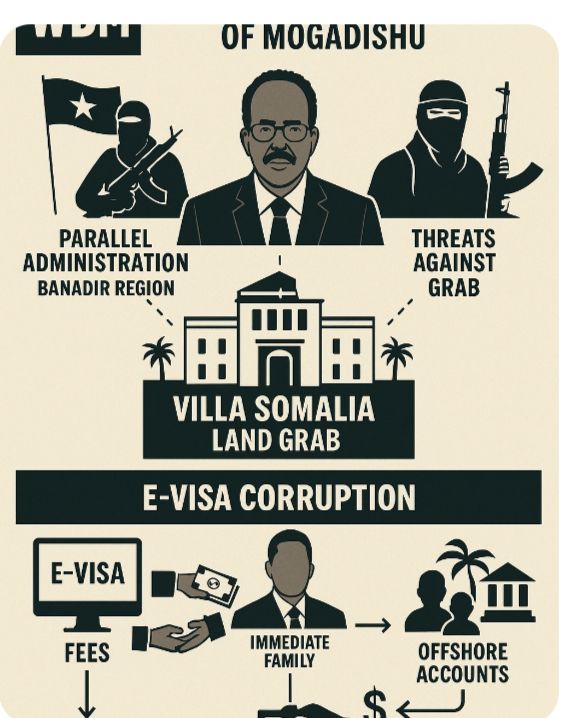
WDM EXCLUSIVE: The Mirage – How Deni’s Villa Somalia Obsession Is Bankrupting Puntland’s Democratic Future

By Ismail H. Warsame

GAROWE – In Puntland, the dream of democracy is not dead; it has been taken hostage. The ransom is the presidential ambition of one man: Said Abdullahi Deni. His grand promise of “one person, one vote”—a reform pledged to transform this federal state into Somalia’s democratic vanguard—has evaporated like a mirage, leaving behind the familiar, cracked earth of clan-based selection politics.

The international community applauded. Donors opened their coffers. Puntland’s intellectuals and youth dared to hope. For a fleeting moment, it seemed the region would make history, becoming the first in Somalia since 1969 to elect its leaders by direct public suffrage. The machinery was set in motion: voter registration drives, civic education campaigns, and a timeline that pointed toward a transformative election.

Then came the siren call of Villa Somalia.

The Calculated Betrayal

In 2022, instead of shepherding Puntland’s fragile democratic experiment to maturity, President Deni pivoted. State resources, political capital, and the goodwill of his constituents were mobilized not for local elections, but for a lavish, high-stakes campaign in Mogadishu. He arrived with a coterie of lobbyists and a portfolio of political IOUs, chasing the federal presidency.

The result was a foregone conclusion: a resounding defeat. The cost, however, was borne not by Deni alone, but by all of Puntland. The democratization process was shelved indefinitely. The political capital was squandered. The state was left more polarized and disillusioned than before his gambit. Get me right. There is nothing wrong for Puntland State producing able and competent national candidates, however, we are sick and  tired of using Puntland resources for personal political ambitions.

Déjà Vu: The 2026 Re-Run

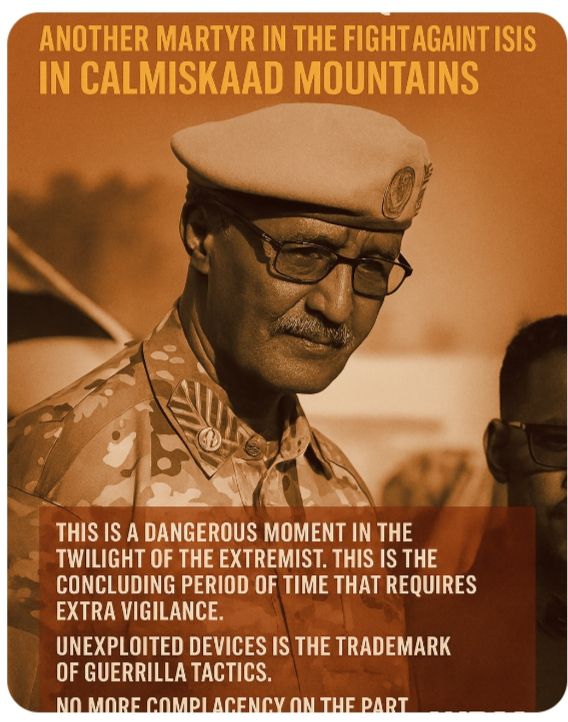
Now, in 2025, the promises have returned. The rhetoric of elections is being dusted off. But the calculus remains just as cynical. Deni’s new currency for his second bid is not reform, but militarism. The ongoing offensive against ISIS militants in the Cal Miskaad mountains is being meticulously packaged and paraded as Exhibit A of his strong leadership. The objective is clear: to transmute security victories into electoral currency at the federal level, making him an indispensable candidate for a nation besieged by Al-Shabaab.

But this is a devastating bargain. The citizens of Puntland are once again being asked to mortgage their own democratic future to fund their leader’s national campaign. The blood and treasure spent in Cal Miskaad should secure Puntland’s stability, not serve as a stepping stone for one man’s ambition.

The Laascaanood Catastrophe: A Strategic Surrender

If the betrayal of democratization was Said Abdullahi Deni’s first political sin, the Laascaanood debacle was his second — and the one that will define his legacy. Puntland poured blood and treasure into the liberation of SSC (Sool, Sanaag, and Cayn) territories from Somaliland’s occupation. Puntland soldiers fought and died in the trenches of Goojacade and Tukaraq. The state treasury was emptied to finance the war effort. Every ounce of political capital Puntland had accumulated since 1998 was staked on the cause.

History has long memories. General Mohamud Muse Hersi “Adde Muse” was punished at the ballot box after losing Laascaanood to Somaliland in 2007. Yet Deni — despite presiding over its liberation — committed an even greater crime: allowing the victory to be hijacked and rebranded in Mogadishu.

Through a stunning mixture of political negligence, reckless opportunism, and strategic myopia, Deni presided over Puntland’s single greatest geopolitical loss in its modern history. SSC, once the northern buffer and strategic depth of Puntland, was surrendered not to Somaliland but to Villa Somalia — a hostile, Damul Jadiid–aligned federal project intent on dismantling Puntland as the last functioning federal member state.

This was not merely a blunder. It was a strategic self-destruction, a gift-wrapped victory for Mogadishu’s centralizers and Puntland’s fiercest rivals. Deni’s political ambition blinded him to the cost: the slow-motion erosion of Puntland’s northern frontier, the demoralization of its armed forces, and the fracturing of its social contract. The “Laascaanood Catastrophe” will be remembered as the moment when Puntland’s hard-won territorial leverage was bargained away in exchange for nothing — except Deni’s second ill-fated dream of Villa Somalia’s top seat.

The Silent Coup: Elite Complicity in a Rigged System

To lay the blame solely at Deni’s feet, however, is to ignore the rotten foundation upon which his rule is built. Puntland’s political class—a constellation of clan elders, complicit parliamentarians, and business oligarchs—is deeply invested in the status quo. They engage in a carefully choreographed theater of debating democracy while quietly ensuring the selection-based system remains intact. This system is their insurance policy, a mechanism that guarantees the continuous recycling of power within a closed, elite circle without the messy uncertainty of the public will.

They are not bystanders; they are co-conspirators in the deferral of democracy.

The Reckoning

Puntland stands at a precipice. President Deni’s failure to deliver public suffrage is more than a broken promise; it is an existential crisis that threatens to nullify Puntland’s founding claim to be Somalia’s most stable, functional, and progressive state.

The path forward is not complicated, but it requires courage. The citizens of Puntland—its youth, its intellectuals, its business community—must now make a choice. They can continue to acquiesce to the endless cycle of ambition and neglect, or they can demand that their future be prioritized over one man’s pursuit of power in Mogadishu.

The message must be clear: If Said Abdullahi Deni wishes to chase Villa Somalia once more, he is free to do so. But he must do it on his own time and with his own resources. Puntland’s democracy is not his campaign fund. It is time to leave the mirage behind and build the real thing.

Somalia Between CIA and KGB: A Legacy of Intervention and the Struggle for Sovereignty

Courtesy

Somalia Between CIA and KGB: A Legacy of Intervention and the Struggle for Sovereignty

Abstract This paper examines Somalia’s modern history through the lens of foreign intervention and its corrosive impact on sovereignty. It traces the trajectory from colonial partition and Cold War proxy politics to the era of conditional aid and counter-terrorism partnerships. The argument advanced is that Somalia’s instability is not an inherent condition but a legacy of external manipulation and the failure of successive Somali leadership to construct resilient, accountable institutions. The conclusion posits that a patriotic and realistic foreign policy—anchored in economic sovereignty, technology transfer, and mature diplomacy—is the only path toward ending dependency and realizing the nation’s latent potential.  

1. Introduction: The Geopolitical Crucible

Somalia is a state born out of external design. Its borders, carved by European colonial powers, disregarded ethnic and cultural unity and imposed fragmentation. This fragmentation embedded permanent insecurity and made Somalia a prime target for Cold War competition. In the decades following independence, Somalia oscillated between Soviet and Western patronage, experiencing military rule, state collapse, and externally driven interventions under humanitarian or counter-terrorism labels. This paper argues that a realistic understanding of Somalia’s historical trajectory is essential for building sovereign policy anchored in economic development, accountability, and diversified partnerships.  

2. Colonial Division and the Cold War Trap (1960s–1980s)

2.1 The Colonial Legacy and Independent Non-Alignment

Somalia emerged from colonialism divided among British, Italian, and French administrators. Independence in 1960 gave rise to a Republic whose borders excluded Somali-inhabited regions in Ethiopia, Kenya, and Djibouti. The early government under President Abdirashid Ali Sharmarke experimented with non-alignment, cautiously maintaining ties with both Cold War blocs while leaning toward the West in style but engaging the Soviet Union for military assistance.

2.2 The Soviet Embrace and Military Rule

The USSR invested heavily in Somalia’s military establishment, training officers, embedding advisers, and supplying advanced equipment. By the mid-1970s, over 1,400 Soviet military advisers were present, and thousands of Somali officers were trained in Moscow. This Soviet-backed military elite facilitated the 1969 coup, installing Siad Barre and orienting Somalia toward Marxism-Leninism. Italy, by contrast, pursued institution-building, focusing on police and judicial structures.

2.3 The Ogaden Betrayal and Western Realignment

In 1977, Somalia invaded Ethiopia’s Ogaden region. The USSR abandoned Somalia in favor of Ethiopia, supporting Addis Ababa with Cuban troops and material aid. Somalia’s defeat exposed the risks of overreliance on a single patron. Barre expelled Soviet advisers and turned to Western and Arab allies, yet the authoritarian structure remained. The United States, eager to counter Soviet influence, tolerated Barre’s governance failures, reinforcing corruption and a lack of accountability.  

3. State Collapse and the Era of Chaos (1991–2000s)

The fall of Barre in 1991 left a vacuum that foreign and regional actors quickly exploited.

  • UNOSOM II and the Mogadishu Crisis (1993): The U.S.-UN humanitarian mission devolved into direct combat with Somali factions. The October 1993 “Black Hawk Down” battle, resulting in 18 U.S. soldier deaths and hundreds of Somali casualties, prompted a full American withdrawal. Somalia was branded a “failed state,” and Washington retreated to containment strategies: limited intelligence operations, occasional strikes, and minimal aid.
  • Proxy Warfare: Neighboring and Gulf states armed rival Somali factions, worsening fragmentation. Foreign manipulation perpetuated civil war and obstructed reconciliation.

4. The New Frontier: Counter-Terrorism and Conditional Aid

The rise of the Islamic Courts Union and Al-Shabaab reframed Somalia’s conflict through the counter-terrorism paradigm.

  • Terrorist Creation and Empowerment: Indiscriminate strikes and interventions fueled radicalization, expanding militant recruitment.
  • The Conditional Aid Trap: Billions in aid were securitized, tied to military purchases and donor agendas. Aid dependence entrenched, enriching foreign contractors rather than empowering Somali citizens.

5. A Patriotic Path Forward: Realism, Sovereignty, and Development

Somalia’s contemporary partnerships, particularly with Turkey and Qatar, suggest new models linking security cooperation with infrastructure, education, and health investment. For a sustainable future, Somalia requires a patriotic and realistic foreign policy based on:

  1. Sovereign Accountability: Leadership must answer to citizens, not foreign donors. Ending corruption is central to public trust.
  2. Economic Diplomacy: Somalia possesses vast underutilized resources:
    • 1 million hectares of arable land capable of achieving food sovereignty.
    • Africa’s largest livestock population with potential for export-led growth.
    • A 3,333 km coastline rich in fishing and blue economy prospects.
    • Suspected mineral and hydrocarbon reserves requiring transparent management.
  3. Technology Transfer, Not Just Aid: Foreign partnerships must prioritize training, university cooperation, and industrial capacity-building.
  4. Balanced, Mature Foreign Relations: Somalia should diversify partners, avoiding dependence on any single bloc, while cultivating a professional diplomatic corps capable of navigating multipolar realities.

6. Conclusion

Somalia’s instability is the product of colonial partition, Cold War proxy politics, authoritarianism, and externally imposed interventions. Neither Soviet militarization nor American containment fostered sovereignty. Italy’s institution-building efforts, though more modest, were overshadowed by superpower rivalry. Post–Cold War interventions deepened chaos, while counter-terrorism frameworks reduced Somalia to a security problem rather than a sovereign partner. The path forward lies not in another foreign roadmap but in an internal awakening: institution-building, resource-based development, and a mature foreign policy. Somalia must leverage its human and natural capital, pursuing partnerships grounded in equality, technology transfer, and economic growth. By addressing root causes—poverty, inequality, and weak governance—Somalia can achieve stability and independence, standing as a sovereign actor in a multipolar world.  

References

Britannica. (n.d.). Black Hawk Down. In Encyclopedia Britannica. Retrieved from https://www.britannica.com Cambridge University Press. (n.d.). Soviet-Somali relations in the 1970s. Country Studies. (n.d.). Somalia: A country study. Library of Congress. Office of the Historian. (n.d.). U.S. relations with Somalia: Cold War era. U.S. Department of State. Scribd. (n.d.). Somalia and the Ogaden War. The Guardian. (2013). Black Hawk Down: The lasting legacy of America’s ill-fated mission in Somalia. Retrieved from https://www.theguardian.com Wikipedia. (n.d.). Ogaden War. Retrieved from https://en.wikipedia.org Brelience Research http://www.brcsom.com 2025.

[Courtesy: Copyright ©️ Brilliance Research and Consulting].

WDM EXCLUSIVE: The Laascaanood Gambit – Villa Somalia’s Hostile Takeover of SSC

Copyright ©️ 2025 WDM

By Ismail H. Warsame

A New Cast, Same Director

Laascaanood’s political theatre has changed its actors, but the director in Villa Somalia remains the same. President Hassan Sheikh Mohamud’s latest move is not nation-building—it is a hostile corporate takeover of SSC-Khatumo’s hard-earned autonomy. His endgame is clear: dismantle Puntland, the last effective check on his centralizing project, and replace it with a compliant “North East Entity,” a Mogadishu-loyal clone of Hirshabeele and GalMudugh.

The rhetoric of “liberation” is nothing but a hollow marketing slogan. The true mission is to install Chairman Abdikadir Aw Ali (Firdhiye) as Mogadishu’s proxy governor, rush his handpicked delegates to the federal parliament, and redraw Somalia’s political map with SSC’s blood as the ink for Puntland’s obituary.

Dueling Delegations: The Constitutional Bomb

Garowe will not sign its own death warrant. Puntland will appoint its own parliamentary delegation from SSC territories—territories it has legally represented for over two decades. The result: two rival delegations claiming the same seats, two competing mandates, one federal parliament thrown into chaos.

This is no mere “political impasse.” It is a constitutional detonation. Somalia’s Provisional Constitution contains no mechanism for resolving parallel representation. The fallout will shred what little legitimacy remains in the federal system, paralyze Mogadishu’s governance, and expose the entire state-building process as a façade.

The West’s Broken Playbook

Cue the well-worn script: foreign diplomats descending with tired calls for “dialogue” and “reconciliation.” But this is no misunderstanding. It is a calculated act of political aggression. Mediation under these circumstances will not resolve the conflict—it will entrench it, forcing Puntland to negotiate the terms of its own dismemberment under the gaze of international chaperones.

SSC’s Pyrrhic Victory

For SSC, this is the bitterest twist of fate. They fought and died to free themselves from Hargeisa’s grip, only to find themselves turned into Mogadishu’s pawn in its cold war against Puntland. Chairman Firdhiye now risks becoming the administrator of SSC’s second occupation—this time under the velvet glove of Villa Somalia rather than the iron fist of Muse Bihi.

And when Puntland is weakened and no longer a threat? Mogadishu will discard SSC like yesterday’s news, leaving them politically stranded, weaker and more divided than before.

The Real Stakes

This is bigger than 2026 elections. This is about whether Somalia will remain a federation or slide back into a centralized dictatorship with decorative regions as window-dressing.

Break Puntland over SSC, and the federal experiment dies. The likely response from Garowe? Total withdrawal from the federal project—an exit that could trigger state collapse and usher in international trusteeship, a scenario no Somali patriot should wish for.

WDM VERDICT: A Declaration of Political War

Make no mistake: Hassan Sheikh Mohamud is not integrating SSC. He is annexing it. This is nothing less than a declaration of political war on Puntland and on federalism itself.

If the international community chooses to “mediate” this crisis, they become co-authors of Somalia’s undoing. The only principled path forward is to uphold the constitutional order and reject any parallel institutions designed to weaken Puntland’s mandate.

WDM WARNING:

The future of Somalia will not be decided at the ballot box but in this manufactured crisis. To endorse Villa Somalia’s fiction is to greenlight the collapse of the Somali state. The stakes could not be higher.

Policy Brief

September 13, 2025 Issue: Urban Transport Crisis & Public Safety Emergency in Garowe, Puntland, Proposed By:Warsame Digital Media (WDM) – Policy Analysis Unit

1. Executive Summary

This brief addresses the critical public safety and urban management crisis in Garowe caused by the unregulated proliferation of auto-rickshaws (Bajaj). The current situation poses an immediate threat to citizen safety, hinders economic activity, and signifies a major failure in transport governance. The root causes are identified as: uncontrolled importation of vehicles, lack of regulatory enforcement, and absence of formal public transport alternatives. This brief recommends a five-point policy intervention strategy, beginning with an immediate moratorium on Bajaj imports, to restore order, safety, and sustainable urban mobility in Garowe.

2. Background and Problem Statement

Garowe, the administrative capital of Puntland, is experiencing an acute crisis driven by an oversaturation of Bajaj three-wheelers. The unchecked importation of these vehicles has led to:

· A Public Safety Emergency: A dramatic rise in traffic accidents, injuries, and fatalities involving untrained, uninsured, and often underage drivers.
· Severe Urban Congestion: Critical arteries and market roads are paralyzed, impeding commerce and emergency services.
· Social and Environmental Degradation: Excessive noise and air pollution diminish quality of life, while the exploitation of unemployed youth fosters social tension.
· Governmental Authority Erosion: The consistent lack of enforcement has normalized lawlessness and eroded public trust in institutions.

This is not merely a traffic issue but a multifaceted policy failure requiring urgent and coordinated intervention.

3. Key Findings and Analysis

· Root Cause 1: Unregulated Import: The continuous flow of new Bajaj imports is the primary driver of market oversaturation, making the problem exponentially worse.
· Root Cause 2: Regulatory Vacuum: The absence of licensing, insurance, and traffic enforcement has created a perilous “wild west” environment on the roads.
· Root Cause 3: Economic Desperation: High youth unemployment has created a cheap labor force for Bajaj operators, who prioritize small profit over public safety.
· Root Cause 4: Lack of Alternatives: Citizens are forced to use Bajajs due to the non-existence of a safe, reliable, and formal public transport system.

4. Policy Recommendations

We urge the Puntland Administration to adopt the following coordinated policy measures:

1. Impose a Moratorium on Bajaj Imports
   · Implementing Body: Ministry of Trade, Ministry of Finance
   · Key Objectives: Immediately halt the influx of new vehicles to stabilize the situation and allow for effective management of the existing fleet.
2. Implement a Mandatory Licensing & Registration Framework
   · Implementing Body: Ministry of Transport, Traffic Police
   · Key Objectives:
     · Mandate driver’s licenses (minimum age 18)
     · Register all commercial Bajajs
     · Require mandatory third-party insurance
     · Enforce regular vehicle safety inspections
3. Launch a Targeted Traffic Enforcement Campaign
   · Implementing Body: Garowe Traffic Police Department
   · Key Objectives: Rigorously enforce traffic laws, penalizing infractions like reckless driving, overloading, and operating without a license or insurance.
4. Establish a City-Wide Operating Permit Cap
   · Implementing Body: Garowe Municipal Council, Ministry of Public Works.
   · Key Objectives: Limit the total number of Bajajs allowed to operate commercially based on a study of the city’s carrying capacity. The import moratorium (Action 1) is a prerequisite for this.
5. Initiate a Feasibility Study for a Public Bus System
   · Implementing Body: Ministry of Public Works, Planning Ministry
   · Key Objectives: Commission a study to design a safe, regulated, and reliable public bus network to provide a long-term alternative and create formal employment.

5. Expected Outcomes and Benefits

· Enhanced Public Safety: A drastic reduction in accidents and fatalities through regulated drivers and insured vehicles.
· Improved Urban Mobility: Reduced congestion and more orderly traffic flow.
· Economic Formalization: Creation of a structured, accountable transport sector that contributes to the formal economy.
· Increased Government Revenue: Generation of income through licensing, registration, insurance, and permit fees.
· Restored Public Trust: Demonstrating effective governance and a commitment to citizen welfare.

6. Conclusion

The Bajaj crisis is a solvable policy challenge. Continued inaction will result in further loss of life, economic damage, and social disorder. The recommended actions are sequential and interdependent. An immediate moratorium on imports is the critical first step to preventing the problem from worsening, while the other measures work to bring the existing situation under control and provide a sustainable future for Garowe’s transport system. We urge the relevant authorities to act with urgency to implement this strategy.

———

Contact: Warsame Digital Media(WDM) Garowe, Puntland. ismailwarsame@gmail.com, +252 90 703 4081.

Prime Time for One, Rubble Time for Many: The Algorithm of Western Grief

Copyright ©️ 2025 WDM

This week, the Western media conducted a live, unblinking A/B test on the free market of human sympathy.

Group A: The assassination of a conservative activist, Charlie Kirk, in Utah, USA. The result: wall-to-wall coverage. Prime-time specials. Expert panels parsing the shooter’s motives, his diet, his childhood. A nation invited to mourn in high definition.

Group B: The systematic obliteration of Gaza. The result: a children’s hospital bombed becomes a 30-second clip, often followed by a cheerful ad for a new car. Mass graves are a “developing story” to be briefly acknowledged before returning to the important business of a celebrity’s new fragrance.

The metrics are in. The data is clear. One tragedy is a narrative; the other is noise. One life is a precious thread in the social fabric; ten thousand are a statistical blur.

This is not an oversight; it is a formula. It is the cold calculus of newsworthiness where proximity, politics, and pigment determine a victim’s value.

Western media postures as a monolithic guardian of truth—but it is a curator of convenience. It holds power to account only when that power is foreign, adversarial, or politically expedient to challenge. The result? A single death on home soil is framed with the gravity of a world-altering event. Meanwhile, a world-altering event abroad is shrink-wrapped into digestible, disposable segments of distant despair.

The language betrays the bias. An American is “tragically slain.” A Palestinian is “reportedly killed.” One is a loss; the other is a ledger entry.

“WE INTERRUPT THIS BROADCAST OF GAZA’S HUMANITARIAN CRISIS FOR A LIVE LOOK AT A VIGIL IN Utta.”

But the networks won’t run these. The irony is too real. It’s easier to host a six-hour panel on the mental state of a lone gunman than to spend six minutes examining the state of a conscience that can normalize the death of a child under rubble.

WDM Verdict

This is the scandal of our age: not just the violence we do, but the violence we yawn at. The moral failure is not only in the act but in the aperture—the lens so tightly focused on “us” that it renders “them” invisible.

The West’s sermon on human rights rings hollow when its megaphone, the media, operates on a sliding scale of humanity. This selective sorrow isn’t just bias; it is the rot at the core of a civilization that claims universal values. If this stands, history’s judgment will be severe: it will not record that we failed to stop a genocide, but that we failed to even look.

Garowe’s Bajaj Apocalypse: When Poverty Rides on Three Wheels

Ismail H. Warsame,                            Warsame Digital Media (WDM),     September 12, 2025

Copyright ©️ 2025 WDM

Abstract

This paper examines the escalating public safety and urban management crisis in Garowe, Puntland, driven by the unregulated proliferation of auto-rickshaws (locally known as Bajaj). It argues that what is often presented as grassroots entrepreneurship is, in fact, a symptom of weaponized poverty, enabled by uncontrolled imports and governmental failure, leading to urban chaos and increased fatalities. The analysis concludes with an urgent call for a multi-pronged strategy, including curtailing imports, comprehensive regulation, and investment in sustainable public transport.

1. Introduction: A City Under Siege

Garowe, the administrative capital of Puntland, is experiencing a crisis that threatens its social fabric and public safety. This crisis is not born from traditional conflict but from an unchecked invasion of mechanical chaos: the overwhelming and unregulated influx of Bajaj three-wheeled vehicles. Imported en masse without any restrictive policy and operated without oversight, these vehicles have transformed Garowe’s streets from orderly pathways into hazardous zones, representing a critical failure in urban planning and regulatory enforcement.

2. The Anatomy of the Crisis: A Flood of Metal and Desperation

The problem is threefold: the source of the machines, their mechanical impact, and the system that deploys them.

· The Unchecked Flood: The primary catalyst for the crisis is the uncontrolled importation of Bajaj vehicles from international markets. This constant stream of new three-wheelers has saturated the city’s limited infrastructure, making congestion and conflict inevitable.
· The Mechanical Menace: The Bajajs on Garowe’s streets are typically low-quality, smoke-belching vehicles. Their sheer numbers create unbearable noise pollution, traffic congestion, and environmental degradation, diminishing the quality of life for all residents.
· The Human Factor: The industry is built on the exploitation of a desperate workforce. The drivers are predominantly unemployed youth, often minors with no formal training, licensing, or insurance. Hired by profit-seeking operators, these young men are incentivized to drive aggressively to maximize daily fares, turning the city into a real-life racetrack with deadly consequences.

3. The Root Cause: The Economy of Desperation

The Bajaj epidemic cannot be understood outside the context of Puntland’s socio-economic challenges and policy failures.

· Unregulated Trade: The lack of a policy to curtail the import of Bajajs has directly led to market oversaturation, making the crisis a problem of scale as much as conduct.
· Youth Unemployment: A significant “youth bulge” with limited formal employment opportunities makes driving a Bajaj one of the few available sources of income.
· Exploitative Entrepreneurship: Small-time entrepreneurs capitalize on this desperation, creating a business model that externalizes all risk onto the drivers, passengers, and the general public.
· Government Negligence: The authorities have abdicated their responsibility at multiple levels, from controlling import flows to regulating operations. The absence of a regulated public transport system has created a vacuum filled by this anarchic private enterprise.

4. Consequences: Urban Dystopia and Social Breakdown

The impact of this neglect is severe and multifaceted:

· Public Safety Emergency: Traffic accidents, injuries, and fatalities have skyrocketed. Pedestrians, especially women and children, navigate streets at their own peril.
· Economic Damage: Shopfronts are plagued by noise and fumes. Motorists face constant risk of accidents with uninsured drivers, potentially leading to financial ruin.
· Normalization of Crisis: A dangerous public ennui has set in, where accidents are “shrugged off” and near-death experiences become routine.
· Erosion of Civic Trust: The government’s failure to protect its citizens and regulate both trade and traffic undermines its legitimacy.

5. Call to Action: A Path Toward Regulation and Order

Warsame Digital Media (WDM) calls for immediate and decisive action from the Puntland authorities to avert further catastrophe. We propose a multi-pronged strategy:

1. Curtail the Import of Bajajs: Impose an immediate moratorium on the importation of new Bajaj vehicles into Puntland. This is the essential first step to halt the flooding of the market and prevent the problem from escalating beyond control.
2. Licensing and Regulation:
   · Mandate official driver’s licenses with verified age requirements (no minors).
   · Require mandatory third-party insurance for all commercial Bajajs.
   · Implement official registration and mechanical inspection for all vehicles.
3. Restoration of Law and Order:
   · Empower and direct the traffic police to enforce traffic laws without exception. Reckless driving, overloading, and flouting of traffic rules must be met with fines and penalties.
4. Capping and Managing Numbers:
   · Formalize a city-wide cap on the number of operating permits. The import moratorium will make this cap achievable and enforceable.
5. Investment in Sustainable Alternatives:
   · Begin planning and investment in a safe, regulated, and reliable public bus system to provide a dignified alternative for citizens and create formal employment.

6. Conclusion

The Bajaj crisis in Garowe is a stark case study in what happens when uncontrolled imports, economic desperation, and governmental neglect converge. The streets of Garowe are on the brink of becoming “Somalia’s largest open-air casualty ward” not due to war, but due to a catastrophic failure of governance. The solution must begin at the source: the unchecked import of vehicles that fuels this chaos. The authority must act now to stem the tide, regulate the industry, protect its citizens, and reclaim the city for all who call it home. The future of Garowe’s civic life depends on it.

Warsame Digital Media (WDM) is an independent media organization dedicated to analytical journalism and commentary on issues affecting Somalia, the Horn of Africa, and beyond.

The Manufactured Nation: Empire, Myth, and the 1945 Rebranding of Ethiopia

Deconstructing the Politics of Statehood in the Horn of Africa

By Ismail H. Warsame, Founder of Puntland State of Somalia; Former Chief of Staff (1998–2004); Warsame Digital Media(WDM)

Abstract

This paper critically examines the constructed narrative of Ethiopia as an “ancient and continuous nation-state.” Through archival research, cartographic analysis, and postcolonial historiography, it contends that the 1945 renaming of the Abyssinian Empire as “Ethiopia” was a strategic act of imperial consolidation rather than a genuine national rebirth. Championed by Western powers as a triumph of African independence, this rebranding legitimized the violent annexation of diverse nations—including the Oromo, Somali, Sidama, and Afar—into a single imperial project. This study argues that this manufactured nationhood is a primary source of the enduring political instability and cycles of rebellion that define the modern Ethiopian state.

Introduction

A 1945 international press dispatch carried a seemingly minor announcement: “the territory known as Abyssinia officially changed its name to Ethiopia and became a nation.” This proclamation, however, marked a seismic shift in political identity. It was not a simple change of name but a profound act of re-creation—reframing an ancient, expansionist empire as a modern, unified nation-state. This paper argues that Ethiopia’s post-war “birth” was a calculated exercise in imperial legitimation, designed to secure international sovereignty and obscure the realities of conquest. The enduring consequences of this manufactured identity continue to fuel conflict and challenge the very foundations of the state in the Horn of Africa.

The Myth of a Timeless Nation

Western historiography has long perpetuated the image of Ethiopia as the “world’s oldest continuous Christian kingdom.” This narrative, as I.M. Lewis notes, was meticulously cultivated by 19th-century European travelers and missionaries fascinated by this perceived “Christian island” in a sea of Islam. Donald Donham further argues that the Abyssinian state was retroactively reimagined as a proto-nation, a framing that deliberately disguised its fundamentally imperial character.

Historical evidence, however, reveals a more complex reality. Prior to the late 19th century, the region consisted of a mosaic of independent sultanates, kingdoms, and pastoralist confederacies. The modern state is a product of the violent imperial campaigns of Menelik II, baptised as Sahle Mariam, Sultan of Shewa, and Emperor of Abyssinia (r. 1889–1913), who dramatically expanded the Abyssinian empire southward and eastward, subjugating Oromo, Sidama, Wolayta, and Somali territories. Haile Selassie later systematized this conquest through aggressive centralization policies, suppressing local languages and imposing Amharic culture as a unifying—and assimilative—state doctrine.

1945: Codifying the Imperial Project

The year 1945 was a critical juncture. Following the defeat of Fascist Italy and Haile Selassie’s restoration, the rebranding from “Abyssinia” to “Ethiopia” was ratified on the world stage. This was not merely symbolic; it was a diplomatic masterstroke. By joining the United Nations as a founding member under this new name, the empire received international recognition as a sovereign nation-state, thereby sanctifying its contested borders and internal hierarchies.

This transformation aligned perfectly with Anglo-American strategic interests in the nascent Cold War. As historian Bahru Zewde argues, Ethiopia was groomed to be an “African showcase state”—a stable, pro-Western monarchy that could symbolize African potential while reliably suppressing internal dissent. This international endorsement effectively granted the empire a free hand to continue its assimilationist policies, removing the plight of subjugated nations from the sphere of global concern.

Cartography as a Tool of Erasure

The official map presented to the world in 1945 meticulously delineated Ethiopia’s international borders with Eritrea, Somalia, and others. Yet, it presented the interior as a monolithic whole, devoid of any internal national boundaries. Following J.B. Harley’s assertion that maps are “never neutral” but instruments of power, this cartography performed a act of political violence. It naturalized the empire’s conquests, transforming a collection of annexed nations into a seemingly coherent and pre-ordained national territory. The map, in effect, legitimized domination through representation.

The Enduring Consequences: Resistance and Rebellion

The political instability that has plagued Ethiopia for decades is a direct legacy of this manufactured unity. The successful thirty-year struggle for Eritrean independence (1993) delivered the first major blow to the myth of an indivisible Ethiopia. It was followed by persistent armed and political resistance from groups such as the Oromo Liberation Front (OLF), the Ogaden National Liberation Front (ONLF), and the Tigray People’s Liberation Front (TPLF)—each movement a testament to the unresolved national questions deliberately buried in 1945. These are not aberrations but predictable eruptions of a foundational tension: the conflict between a state built on imperial incorporation and the aspirations of the nations within it.

Conclusion

The 1945 rebranding of Abyssinia as Ethiopia was not an authentic national awakening. It was the sophisticated codification of an imperial project, repackaged for the modern international system. This act of political invention created a state whose legitimacy is perpetually contested from within. The cycles of rebellion and conflict that continue to define Ethiopia demonstrate that a state forged by conquest cannot achieve stability through force alone. Lasting peace requires a fundamental reimagining of the state itself—one that moves beyond the myth of a singular nation and finally recognizes the historical sovereignty and right to self-determination of the many nations locked within its borders. Until then, Ethiopia remains an empire masquerading as a nation-state.

Notes

1. I.M. Lewis, A Modern History of the Somali: Nation and State in the Horn of Africa, 4th ed. (Oxford: James Currey, 2002), 12–15.
2. Ibid., 14.
3. Donald Donham, “Old Abyssinia and the New Ethiopian Empire: Themes in Social History,” in The Southern Marches of Imperial Ethiopia: Essays in History and Social Anthropology, ed. Donald Donham and Wendy James (Cambridge: Cambridge University Press, 1986), 3–48.
4. Bonnie Holcomb and Sisai Ibssa, The Invention of Ethiopia: The Making of a Dependent Colonial State in Northeast Africa (Trenton, NJ: Red Sea Press, 1990), 52–75.
5. Bahru Zewde, A History of Modern Ethiopia, 1855–1991, 2nd ed. (Oxford: James Currey, 2001), 151–180.
6. Ibid., 187–190.
7. Ibid., 200.
8. J.B. Harley, “Maps, Knowledge, and Power,” in The Iconography of Landscape, ed. Denis Cosgrove and Stephen Daniels (Cambridge: Cambridge University Press, 1988), 277–312.
9. Ismail H. Warsame, “Ethiopia’s Manufactured Birth in 1945,” Warsame Digital Media (WDM), 2025.                                .                                  10. Spencer, John H. Ethiopia at Bay: A Personal Account of the Haile Selassie Years. Algonac, MI: Reference Publications, 1984.

The 4.5 Clan Power-Sharing Formula: Somalia’s Indispensable, If Imperfect, Constitutional Bridge

By Ismail H. Warsame Founder,Puntland State of Somalia • Chief of Staff, 1998–2004, Author, Talking Truth to Power

Abstract

The 4.5 Clan Power-Sharing Formula is the most consequential yet contentious institutional innovation in modern Somali politics. While widely criticized for institutionalizing clan identity, this paper argues that it functioned as a critical pragmatic compromise—a necessary social contract that provided the sole viable pathway from utter statelessness to a nascent constitutional order. To reject its foundational role is to ignore the socio-political realities of post-collapse Somalia and to overlook the unprecedented protections it afforded marginalized communities. The formula must be understood not as an end-state, but as a transitional bridge that must be dismantled only once the structure of a civic state is secure.

Introduction: The Engine of a Fragile State

Since its formal adoption at the 2000 Arta Conference in Djibouti, the 4.5 formula has been the paradoxical engine of Somalia’s state-building project. It allocates political representation among the four major clan-families (Darod, Hawiye, Dir, and Digil-Mirifle), with a critical “half-share” reserved for minority clans and groups, creating a collective, if unequal, stake in governance (Menkhaus 2004, 16).

Though publicly derided by the very elites it empowers, the formula is the bedrock upon which every post-2000 government has been built. It transformed zero-sum clan competition into a structured, albeit flawed, positive-sum game. As Warsame (2023) contends, this “pragmatic genius” provided the necessary incentive for warring factions to lay down arms and negotiate, creating a political table where none existed.

Historical Context: From Anarchy to Structured Negotiation

The collapse of the Somali state in 1991 resulted in a landscape defined by clan-based militias and warlord fiefdoms (Lewis 2002). Early reconciliation conferences in Addis Ababa (1993) and Cairo (1997) failed precisely because they attempted to impose a civic nationalist model on a society that had reverted to its primary, segmentary lineage structures for security and identity.

The breakthrough of the Arta Process was its stark realism. Rather than denying clanism, it codified it into a clear, predictable, and inclusive arithmetic of power-sharing. This was not a surrender to tribalism, but a strategic co-optation of it. As Samatar (2002, 104) observed, Arta’s success lay in its “acceptance of the social facts on the ground,” turning a source of conflict into a framework for collaboration.

The Progressive Core: The Revolutionary Half-Share

A common oversight in critiques of the 4.5 system is the disregard for its most transformative element: the guaranteed representation for minority clans and communities (e.g., Bantu/Jareer, Benadiri, Gabooye). This “0.5” was a radical democratic innovation.

In the pre-1991 Somali Republic, these groups were systematically excluded from political power. The 4.5 formula, for the first time, constitutionally embedded an affirmative action principle, guaranteeing them a voice in the national legislature (Bradbury 2008, 85). It acted as a proto-bill of rights, protecting the most vulnerable from the tyranny of the majority in a context where no other protections existed.

Political Hypocrisy: The Public Critique and Private Reliance

A profound hypocrisy defines the Somali political class’s relationship with the 4.5 system. Politicians publicly vilify “clanism” as a backward scourge while privately relying on their clan networks as the fundamental base of their power and legitimacy.

This duality is not merely cynical; it is structurally logical. In a pastoral society where the state’s monopoly on violence is absent or weak, the clan remains the primary unit of security, trust, and mobilization (Besteman 1999). This creates a political reality where, as Warsame (2023) astutely notes, “denouncing clanism is the required public performance, while mastering its calculus is the essential private practice.” This mirrors societies that rhetorically condemn racism while being structured by it, revealing the gap between aspirational politics and on-the-ground realities.

Addressing the Critiques: Scaffolding, Not a Pillar

The primary critique—that 4.5 entrenches clan identities and impedes the development of a merit-based, civic political culture—is not without merit (International Crisis Group 2011). However, this argument presupposes a stable political environment where civic identity can flourish, a condition Somalia has not enjoyed for decades.

The formula was never intended to be permanent. Its purpose was always transitional: to be the scaffolding that allows the state structure to be rebuilt. As Warsame (2023) warns, the danger lies not in the desire to move beyond 4.5, but in dismantling this scaffolding prematurely. Abolishing it without a consensus-based, secure, and clearly defined alternative risks catastrophic backsliding into the very clan-driven conflict it was designed to mitigate. The imperative is not rejection, but managed reform.

Charting a Post-4.5 Future: A Phased Transition

The ultimate goal of a one-person, one-vote democracy remains valid. Achieving it requires a deliberate and phased strategy to ensure stability:

1. Piloting Civic Elections: Implementing direct elections first at the local municipal level, where issues of service delivery can help forge a civic identity distinct from clan loyalty.
2. Intensive Civic Education: A national curriculum focused on citizenship rights and responsibilities, teaching Somalis that political identity can be rooted in shared residence and national interest, not just lineage.
3. Constitutional Entrenchment of Minorities: Ensuring that any future electoral model constitutionally preserves the hard-won political rights of minority groups, safeguarding the spirit of the 0.5 share.

The 4.5 formula was a masterstroke of realpolitik that forged a precarious stability from outright anarchy. This crude but necessary compromise arrested Somalia’s spiral into permanent disintegration, functioning not as a final destination but as a critical bridge. It was a pragmatic acknowledgment of a foundational sociological truth: that Somali politics is inextricably rooted in clan identity. By guaranteeing all groups—including marginalized minorities—a seat at the table, it manufactured a collective stake in the peace process. The profound irony lies in its critics: elites who leverage clan patronage for power while publicly decrying the very “tribalism” that enables it, all while offering no viable alternative. Ultimately, the legacy of 4.5 will be judged not by the hypocrisy of its opponents, but by whether Somalia uses this negotiated framework to mature into a genuine constitutional democracy based on one-person-one-vote. This was the historic, pragmatic breakthrough of the 1997 Sodare Group, which institutionalized 4.5 as the sole antidote to warlordism and the essential first step toward rebuilding a state.

Conclusion: The Indispensable Bridge

The 4.5 Clan Power-Sharing Formula is not an antithesis to democracy; it was its necessary precondition in a context of state collapse. It represents a pragmatic, culturally-grounded solution to the existential problem of statelessness. While its clan-based mechanics are incongruous with liberal democratic ideals, it provided the minimal consensus required to restart a state. It is the bridge that carried Somalia across the river of anarchy. The task ahead is not to curse the bridge for being imperfect, but to carefully cross it and build a more durable political home on the other side, ensuring everyone has a room within it.

References

Besteman, Catherine. Unraveling Somalia: Race, Violence, and the Legacy of Slavery. Philadelphia: University of Pennsylvania Press, 1999.

Bradbury, Mark. Becoming Somaliland. Bloomington: Indiana University Press, 2008.

International Crisis Group. “Somalia: Transforming Hope into Stability.” Africa Report No. 170, December 2011.

Lewis, I. M. A Modern History of the Somali: Nation and State in the Horn of Africa. Oxford: James Currey, 2002.

Menkhaus, Ken. State Collapse and the Threat of Violence in Somalia. Washington, DC: CSIS Press, 2004.

Samatar, Abdi Ismail. “Somalia’s ‘Arta’ Process: Success or Illusion?” Review of African Political Economy 29, no. 91 (2002): 97–111.

Warsame, Ismail H. “Why Somalis Complain about Clan Power-Sharing Formula.” Warsame Digital Media (WDM), 2023.

The Doha Deluge: How a Crisis Shattered American Credibility

Copyright ©️ 2025 WDM

September 10, 2025

The scenes from Doha are more than a tragic headline; they are a geopolitical watershed. Israel’s bombardment of the Qatari capital—a hub regarded as a neutral forum for global diplomacy—has triggered not just outrage, but a fundamental realignment. As the world condemns the assault, the United States stands alone, performing a familiar yet increasingly futile role: the diplomatic shield for its ally. Washington’s efforts at damage control now resemble a patron making excuses for a partner that has spiraled out of control.

This time, however, the world is no longer listening.

The Abraham Accords: A Mirage Exposed

The “Abraham Accords,” once touted as a masterstroke of regional diplomacy, now lie in ruins. Even Saudi Arabia, the anticipated crown jewel of normalization, has publicly suspended talks. Riyadh understands that association with an Israel that acts with such impunity is political suicide. The Doha attack has achieved what years of diplomacy could not undo: it has poisoned the well of Arab-Israeli rapprochement for a generation. Netanyahu’s government hasn’t merely disrupted a process; it has incinerated its very foundation.

A Region Gripped by a New Reality

A palpable sense of vulnerability grips the Middle East. If Qatar’s diplomatic immunity can be so violently breached, no capital feels safe. This despair is compounded by the realization that the “rules-based international order” offers no protection. With the U.S. providing unwavering diplomatic cover—vetoing resolutions, justifying escalations—a dangerous consensus forms: Israel operates above international law. Arab regimes now face dual pressures: the fury of their own streets and the terrifying precedent set by Doha.

The region has become a tinderbox. The attack itself may be the spark that ignites a wider conflagration.

The Illusion of Impunity Shattered

For decades, the U.S. and Israel cultivated an aura of untouchable authority, often controlling narratives and leveraging international institutions to their ends. That era is over. The global spotlight is no longer fixed on designated “rogue states” or extremist groups, but is now trained directly on Washington and Tel Aviv. They are no longer perceived as guarantors of stability, but as primary sources of chaos and instability.

The Multipolar World Seizes the Initiative

In Beijing and Moscow, analysts are not just watching—they are recalibrating. The U.S.’s failure to restrain its ally is seen as a strategic failure of the highest order, confirming the overreach of American power. This crisis accelerates a shift that is economic as much as it is political. The conversation is now centered on de-dollarization, alternative financial systems, and economic sovereignty.

China advances the petroyuan, Russia builds sanctions-proof trade corridors, and an expanded BRICS incorporates energy giants. The Global South, long weary of Western double standards, sees in Doha a potent symbol and an opportunity to break from economic and political subservience. The message is clear: if the United States will not uphold the rules, the world will forge a new system without it.

The Unraveling of a 75-Year Order

The international architecture built after World War II—the UN system, Bretton Woods institutions, American security guarantees—is fracturing. In its place, a defiantly multipolar world is emerging, where power is contested and dispersed. Netanyahu’s bombs over Doha may be remembered as the catalyst that made the world’s long-simmering skepticism untenable.

The collapse is comprehensive: it is moral, strategic, and financial. The United States is hemorrhaging credibility. Israel is sacrificing its legitimacy. And the world is moving on.

Conclusion: The Turning Point

Modern conflict is waged with currencies, alliances, and information as much as with munitions. In Doha, Israel dropped bombs, but it also detonated the last remnants of American hegemony. The “rules-based order” has been exposed as a vehicle for power politics. What emerges next remains uncertain, but one fact is undeniable: the multipolar age is no longer a forecast. It is our present reality, being built in real time amid the rubble of yesterday’s assumptions.

Doha is not an ending. It is a brutal and decisive beginning.

BREAKING ANALYSIS: The Doha Strike – Israel’s Gamble and the Unraveling of World Order

Copyright ©️ 2025 WDM

September 9, 2025 | WDM Global Insight

DOHA – The world order, a fragile construct painstakingly built from the ashes of 20th-century wars, tonight lies in tatters. In a stunning escalation that defies precedent, Israeli warplanes struck multiple targets inside the State of Qatar, a nation not at war and a key U.S. ally. The attack, which Qatari authorities confirm hit a communications facility and a suspected Hamas political office in a diplomatic compound, has resulted in an unknown number of casualties and sent shockwaves through every world capital.

This is not merely a military strike; it is a strategic earthquake. By extending its battlefield into the heart of the Arabian Gulf, Israel has not just crossed a red line—it has erased it. The foundational principles of sovereignty and non-aggression that have underpinned international relations for decades have been openly flouted by a nation acting with a sense of ultimate impunity.

The Anatomy of an Unprecedented Strike

Initial reports are chaotic, but details emerging from Doha and confirmed by satellite imagery analysts paint a picture of a precise, calculated operation. Shortly after 22:00 local time, Israeli F-35s, likely operating from undisclosed airspace, launched a barrage of missiles.

· Target Alpha: A sophisticated communications hub west of Doha. Intelligence experts suggest this site was crucial for Hamas’s external leadership’s encrypted communications, a prize Israel has long coveted.
· Target Bravo: A villa within a secure compound often used by Hamas political officials for meetings. The legality of striking a political wing inside a sovereign nation’s territory is a legal minefield, one Israel has just charged into.

The Israeli government, in a terse statement from the office of Prime Minister claimed the strike was a “necessary and proportional action against the central nervous system of Hamas terror,” stating that Qatar had “repeatedly harbored and enabled” the group’s operations. The statement ended with a stark warning: “Any nation that provides sustenance to terrorists will be held accountable.”

The Death of Diplomatic Immunity

The true magnitude of this event lies in its target. Qatar is not Gaza, Lebanon, or Syria. It is a GCC member, a major non-NATO U.S. ally, and home to the largest American military base in the Middle East, Al Udeid Air Base. For decades, Doha has mastered the art of transactional diplomacy, positioning itself as the indispensable mediator—brokering talks between the U.S. and the Taliban, calming tensions with Iran, and even serving as the primary channel for Israeli-Hamas negotiations and hostage deals.

This attack transforms the mediator into a victim. It signals a catastrophic failure of back-channel diplomacy and a brutal declaration by Israel that the rules of the game have changed. The message to every middle power—from Turkey to Singapore—is chilling: your neutrality is worthless; your sovereignty is conditional.

The Global Reaction: A Vacuum of Power

The international response has been swift in condemnation but utterly hollow in action, proving the central thesis of the crisis.

The United Nations: The Security Council is set to convene in an emergency session, but expectations are nil. The U.S., Israel’s primary guarantor, is poised to veto any consequential resolution, rendering the world’s premier security body a tragic farce.
· The Arab World: Reactions range from furious to terrified. The Gulf Cooperation Council (GCC) has called for an emergency summit. For Saudi Arabia and the UAE, which have tentatively pursued normalization with Israel, this is a nightmare. Public outrage will force them into a corner, forcing a choice between their people’s sentiment and their strategic ties with Washington.
· Iran and Turkey: Tehran has already issued a statement condemning the “ Zionist regime’s adventurism” and calling for united Arab action. Ankara is likely to follow suit. Both rivals will seize this opportunity to rally regional opposition against Israel and its allies, positioning themselves as the true defenders of Muslim sovereignty.
· The United States: The Trump administration is in a state of crisis. caught between an ironclad commitment to Israel and the terrifying reality of an attack on a host nation for 10,000 U.S. troops. The statement from the White House, calling for “all parties to de-escalate,” rings painfully weak. The strategic balance of the entire region has been upended from within Washington’s own alliance system.

The Fallout: A New World Disorder

The implications are dark and boundless:

1. Regional Conflagration: The risk of a wider war has skyrocketed. Iran-backed proxies may now feel justified in launching attacks against U.S. interests from within Qatar itself, potentially dragging the massive U.S. presence at Al Udeid into a direct conflict.
2. The End of Mediation: Who will trust Qatar to mediate now? Who will trust any mediator? This strike has poisoned the well of diplomacy for a generation.
3. The Authoritarian Playbook: Autocrats around the world are watching closely. Israel has provided a ready-made playbook: manufacture a “terrorist” threat, claim self-defense, and violate any border you choose. If they can do it, why can’t we?
4. The Collapse of Deterrence: The calculated ambiguity that has kept regional conflicts contained is gone. The old red lines have been vaporized. We have entered an era of terrifying unpredictability.

WDM Verdict: The Obituary of an Era

History will record September 9, 2025, as the day the post-Cold War world finally died. It had been ailing for years, weakened by the Iraq War, the Syrian conflict, and the rise of unabashed nationalism. But Israel’s strike on Qatar is the coup de grâce.

It proves that there is no longer a rules-based order. There is only a power-based reality. The strong do what they can, and the weak suffer what they must. The sacred principle of national sovereignty—the cornerstone of the UN Charter—was sacrificed on the altar of one nation’s security doctrine.

The smoke rising over Doha tonight is not just from bombed-out buildings. It is the funeral pyre of international law, collective security, and the very idea that diplomacy can temper the raw will to power. The world has not just become more dangerous; it has become fundamentally different. And there is no going back.

The Ethiopian Renaissance Dam: A Cathedral of Power on a Foundation of Sand

Copyright ©️ 2025 WDM

Ethiopia has unveiled its masterpiece, casting the Grand Ethiopian Renaissance Dam (GERD) as the glittering crown jewel of an African industrial rebirth. This is the narrative sold from Addis Ababa: a nation leaping from a perceived feudal past into a high-voltage future of turbines, steel, and light. It is a potent symbol of sovereignty, a declaration that Ethiopia will no longer be defined by poverty but by its potential. Yet, behind the polished facade of national pride lies a more dangerous reality. Scratch beneath the surface of this propaganda, and one smells not the promise of ozone from new energy, but the unmistakable scent of gunpowder, hinting at wars yet to come.

The Mirage of Modernity

Ethiopia’s national psyche is built on a triad of imperial history, ancient Christian legitimacy, and a narrative of resilient independence. The GERD is the modern embodiment of this identity—a concrete-and-steel pharaoh’s pyramid for the 21st century. It promises to catapult the nation into modernity, lifting millions from darkness and powering an industrial revolution.

However, this “leap” looks increasingly like a perilous gamble. The project is not just an engineering feat; it is a political weapon wielded by a state struggling to maintain its own fragile unity. While Addis Ababa may light up, the project risks short-circuiting regional stability, potentially plunging the Horn of Africa into a conflict where water replaces oil as the most precious and contested resource. The dam’s true power may not be in generating electricity, but in generating tension.

Egypt’s Existential Calculus

To dismiss Egypt’s opposition as mere regional rivalry is a catastrophic misreading. For Cairo, the Nile is not a resource; it is the sole lifeline for a nation of over 100 million people living on a narrow, fertile strip surrounded by desert. The river is Egypt’s history, its economy, and its future security. Any upstream threat to its flow is not a policy dispute—it is an existential threat.

Ethiopia’s unilateral move to fill the dam, dismissing decades of colonial-era treaties that granted Egypt veto power, is seen not as bold sovereignty but as an act of aggression. Cairo doesn’t need a lesson in hydrology; it needs guarantees. Addis Ababa’s triumphalist rhetoric, framing the dam as a national awakening, sounds to Egyptian ears like the steady beat of war drums. The message is clear: “Touch our Nile, and you touch our nation’s jugular.”

Regional Fractures: The Unintended Battlefields

The shockwaves of the GERD dispute extend far beyond the Nile Basin, turning vulnerable nations into potential proxy battlefields.

· Sudan: Caught in the middle, Khartoum faces a dual reality. The dam could offer benefits like flood control and regulated flow, but it also surrenders Sudan’s water security entirely to Ethiopian discretion. A shift in the status quo threatens its own agricultural projects and could destabilize a nation already teetering on the brink.
· Somalia: Perennially the punching bag of Horn of Africa politics, Somalia finds itself in the crossfire. As Addis Ababa and Cairo vie for influence, Mogadishu becomes a chessboard. Ethiopian ambitions, Egyptian financial and political patronage, and the ever-present threat of Al-Shabaab create a toxic cocktail where the dam’s ripple effects could ignite yet another front in a perpetual war.
· Eritrea: The regime in Asmara, a seasoned arsonist in regional conflicts, sees the GERD as both a threat and an opportunity. An isolated Ethiopia, bogged down in a dispute with Egypt, is a vulnerable Ethiopia. Eritrea can leverage this to settle old scores, meddle in Ethiopian internal conflicts, and position itself as a key player for external powers like Egypt or the Gulf States, all while fanning the flames for its own gain.

From Hydropower to Powder Keg

The GERD was never a neutral infrastructure project. It is political TNT, a monument to national pride that risks becoming a tombstone for regional peace. What Ethiopia hails as a “Renaissance,” its neighbors may rightly decry as recklessness. Instead of a rising tide lifting all boats, it threatens to anchor the region in a cycle of permanent conflict:

· Egypt, backed into a corner, sharpens both its diplomatic knives and its military arsenal.
· Ethiopia gambles its fragile national unity and economic future on a single concrete megaproject.
· Sudan is destabilized, forced into an impossible balancing act.
· Somalia is dragged into proxy wars it cannot afford.
· Eritrea gleefully stokes the embers of conflict.

This is not merely an energy project; it is the blueprint for a regional war economy in waiting.

Conclusion: The Damp Renaissance

The bitter irony is profound. In its quest to escape a feudal past, Ethiopia may have instead constructed the engine for a new era of resource-driven, feudal-style conflict—where hydro-politics replace horsemen and satellites monitor river flow instead of troop movements. From Khartoum to Mogadishu, from Cairo to Asmara, the debate is no longer about megawatts; it is about sovereignty, survival, and supremacy.

And so, the heralded “Renaissance” dam risks becoming what Ethiopia has, at times in its history, been tragically adept at producing: damp illusions and dry wars. Electricity may indeed hum through the grid in Addis Ababa, but for the rest of the region, the dominant sound is the ominous drone of military drones and the rhetoric of escalation.

Welcome to the true Ethiopian Renaissance Damp: where hydroelectric dreams are short-circuited by geopolitical nightmares, and the flickering lights of progress illuminate the path to forever wars.

The Manufactured Nation: Deconstructing Ethiopia’s 1945 Rebirth

September 9, 2025

A discovered newspaper clipping from 1945 is more than an artifact of nostalgia—it is a piece of propaganda preserved in parchment. It boldly declares that the territory known as Abyssinia “officially changed its name to Ethiopia and became a nation.” This seemingly innocuous statement is a political earthquake, for it exposes the foundational deception that has sustained one of Africa’s most potent and enduring myths: the idea of Ethiopia as an ancient, continuous, and unified nation-state.

Deconstructing the Myth of Timelessness

For generations, a powerful narrative—championed by Western orientalists, historians, and the Ethiopian imperial court itself—has been meticulously woven. It portrays Ethiopia as the world’s oldest Christian kingdom, a timeless polity that miraculously escaped the Scramble for Africa and emerged into the modern world with its ancient sovereignty intact. This narrative served a purpose: it provided a symbol of Black resistance and pride in a colonized continent.

However, the 1945 clipping slyly admits a different truth. “Ethiopia” was, in a crucial modern sense, invented—a consciously manufactured nation-state project imposed upon a diverse constellation of conquered peoples. The adoption of the name was not an organic evolution but a strategic act of political rebranding.

From Abyssinian Empire to Ethiopian Nation-State

Until the mid-20th century, the core political entity was more accurately termed the Abyssinian Empire. This was a highland kingdom dominated by Amhara and Tigrayan feudal elites, whose expansionist ambitions were rooted in the concept of “Restoration of the Solomonic Empire.” It was never a nation in the modern sense of a voluntary social contract among a cohesive people, but an empire forged through relentless conquest.

In the late 19th and early 20th centuries, under Emperors Menelik II and Haile Selassie, Abyssinia embarked on a violent campaign of southern, eastern, and western expansion. It swallowed entire nations and kingdoms: the Oromo nations, the Somali Sultanate of Ajuran, the Sidama kingdoms, the Afar sultanates, and the peoples of Gambella and Benishangul, among many others. This process, known as “Agar Maqnat” (land grabbing), was not one of integration but of subjugation. It was achieved through the blood of massacres (e.g., Anole, Chelenko), the imposition of feudal land tenure (gebbar system), and cultural erasure.

Therefore, the 1945 proclamation was not a birth of freedom but the codification of conquest. It was the moment the empire, having been restored after the brief Italian interlude, sought to shed its explicit imperial skin and don the modern garb of a unified nation-state, thereby legitimizing its annexed territories as innate parts of a whole.

The Geopolitical Baptism: A Convenient Fiction for the Post-War Order

The timing was no accident. The end of World War II and the dawn of the Cold War created a perfect storm of geopolitical opportunism. The West, eager to crown an African “exceptionalism” and secure a stable, loyal Christian outpost in the strategically vital Horn of Africa, willingly accepted the fiction.

The League of Nations had disgraced itself by its feeble response to Mussolini’s invasion in 1935. Restoring Haile Selassie was not just an act of justice; it was an opportunity for a reset. The empire was not restored as a multi-national entity but rebranded as a singular state—“Ethiopia.” This new-old name, with its classical and biblical resonances, was palatable and impressive to Western audiences.

This suited the powers of the nascent United Nations perfectly. Ethiopia was ushered in as a founding member in 1945, held up as Africa’s showcase state, all while Somali territories (the Ogaden), Eritrea (federated and later annexed), and Oromo lands languished under a system of enforced assimilation and centralization. The Cold War demanded stable, anti-communist allies, not messy ethnographic truths. Washington and London needed Ethiopia to be eternal, indivisible, and Christian—a bulwark against Soviet influence. Thus, they stamped the Abyssinian Empire’s new passport with the name “Ethiopia” and collectively agreed to call it ancient.

Cartographic Violence: Erased Nations, Silenced Histories

A closer look at the accompanying map is instructive. It describes Ethiopia as “bordered by Eritrea, Djibouti, Somalia, Sudan, and Kenya.” This external framing reinforces the illusion of a natural, pre-existing unit. But the true violence lies in the internal silence.

What of the nations within? The Oromo, who likely constitute the largest ethnic group and whose language and history were suppressed for a century? The Somali of the Ogaden, forcibly incorporated in 1887 and whose aspirations for self-determination have been met with brutal repression in every subsequent decade? The Sidama, Afar, Gambella, Wolayta, and dozens more—each with their own rich histories, governance systems, and identities—were all reduced to mere provinces (teklay gizats) on a map, their very existence subsumed into a “new nation” born without their consultation or consent.

This cartography is not neutral; it is violence disguised as ink. It is the ultimate tool of the imperial project: to make the conquered lands and peoples disappear into the homogenizing fabric of the state, making rebellion seem like secession from a natural whole rather than resistance against an unnatural union.

The Inevitable Political Reckoning: The Empire Strikes Back

The foundational lie of 1945 haunts the Horn of Africa to this day. A state built not on consent but on conquest is inherently brittle. Every major conflict in modern Ethiopian history is a direct manifestation of this original sin:

· Eritrea’s 30-year war of independence (1961-1991) was a direct rejection of Haile Selassie’s abrogation of their federal arrangement.
· The Oromo liberation struggle, ongoing for decades, is a fight against political and cultural marginalization.
· The Ogaden rebellions are a continuous demand for Somali self-determination.
· Even the recent Tigray War (2020-2022), while complex, features elements of a core region (Tigray) that once dominated the imperial project clashing with a central government it no longer controls.

Ethiopia was not born in 1945; it was imposed. That imposition created a façade of unity, perpetually cracked by the unresolved questions of national self-determination and the empire’s refusal to genuinely transform into a voluntary multinational federation.

Conclusion: A Confession Wrapped in a Celebration

This map and its celebratory headline—“Born in the Year 1945”—should not be read as a simple historical record. It is a confession. A confession that Abyssinia’s rebranding was a calculated, modern act of statecraft—a colonial-style reorganization of an internal empire to suit a post-colonial world order.

It is a birthday card for a lie. A lie that erased nations, legitimized conquest, and planted the seeds for perpetual war. The lesson is clear: the modern Ethiopian state was not born; it was manufactured. Until the peoples within its borders can openly confront this history and renegotiate their coexistence on terms of mutual respect and genuine equality—rather than continued domination by any center—the empire will remain a ticking time bomb, wrapped in the fraying parchment of a “timeless” myth.

The UN Walks Out of New York: A Rebellion in Diplomatic Theater

Copyright ©️ 2025 WDM

By Ismail H. Warsame
Warsame Digital Media (WDM)

The circus has finally left New York. After nearly eight decades of American visa tantrums, security paranoia, and weaponized airport interrogations, the United Nations General Assembly has voted to pack up its September 2025 session and stage the show in Geneva. The trigger? Washington’s refusal to grant Palestinian President Mahmoud Abbas and some 80 senior officials visas, in blatant violation of the 1947 UN Headquarters Agreement. The Americans, who love to lecture the world about “rules-based international order,” suddenly forgot the first rule of hosting: you open the door to your guests, even the ones you hate.

154 nations said enough. Only the United States and Israel stood together like two stubborn drunks refusing to leave the bar at closing time. Britain, true to its declining empire’s tradition, abstained—too timid to clap, too cowardly to resist.

A Historic Slap in the Face

This isn’t just a relocation. It’s a global slap to Washington’s face. The memory of 1988, when the US denied Yasser Arafat a visa, has come back to haunt them. Back then, the world convened in Geneva for a one-off meeting. Now, in 2025, the General Assembly is formally walking out of the American house party. Geneva, land of chocolate and neutrality, will host the 80th session, while New York sulks like a jilted landlord.

Make no mistake: this is the UN’s revenge. For decades, America used the UN as a stage prop—preaching democracy while vetoing justice, hosting cocktail receptions while starving Palestinians, and turning Turtle Bay into a diplomatic Disneyland with FBI surveillance on the side. Now, the tenants are saying, “If the landlord can’t honor the lease, we’ll take our rent elsewhere.”

Washington: From Host to Outcast

The irony is thicker than Manhattan traffic. The United States still calls itself the “indispensable nation,” but in the eyes of 154 member states, it has become the indecent nation. What good is a host who locks the door on half the guests? What credibility remains when the so-called champion of democracy sabotages the very forum of global diplomacy?

In truth, the US always liked the UN only when it could boss it around. When the votes went their way, it was “the voice of humanity.” When they lost—as in this 154–2 humiliation—it suddenly becomes “irrelevant.” Washington wants the UN to be a cheerleading squad, not an assembly of sovereign nations. Geneva’s relocation proves the world is done playing along.

The Collapse of the American Monologue

This is not about Mahmoud Abbas alone. It is about the principle: if Palestine cannot enter the hall, then the hall itself will move. This moment signals a deeper crack in America’s control of the international stage. The UNGA has essentially told Washington: “You are not the bouncer of global diplomacy.”

For years, the US bullied others with visas—denying entry to Iranian diplomats, restricting Russians, and humiliating Africans at JFK airport. But this time, the world has acted collectively. The empire’s monologue has been interrupted by a global chorus saying: “Pack your arrogance, we are moving.”

What Geneva Means

Geneva is more than a change of venue. It is symbolic exile. The September 9, 2025 opening session will not just be a routine debate; it will be the inauguration of a post-American UN stage. Diplomats will sip Swiss coffee instead of New York bagels. Delegates will stroll along Lake Geneva instead of dodging NYPD barricades. And the United States will learn the bitter lesson that even empires can be boycotted.

The fact that only Israel joined Washington in opposition speaks volumes. When your only friend at the table is the very state accused of war crimes in Gaza, you are not a leader—you are an accomplice.

The End of UN in New York?

This move could be the beginning of the end for the UN’s American address. If Geneva succeeds—and it likely will—why should the world return to a host that treats the UN as its doormat? America’s veto in the Security Council may still function, but morally and symbolically, Washington has been evicted.

The United Nations was meant to embody universality. If universality cannot live in New York, it will find a home elsewhere. Geneva, Vienna, Nairobi—anywhere but the shrinking empire that refuses to share its stage.

Conclusion: A Warning Shot

The relocation of the 80th UNGA is a warning shot to Washington: your monopoly on global diplomacy is over. The rest of the world has finally realized that the UN does not need the US, but the US desperately needs the UN to pretend it still matters.

In 1947, the world handed America the keys to the UN. In 2025, the world has begun taking them back. For the first time in decades, the empire must sit in the corner and watch as the show goes on—without its permission, without its control, and without its arrogance.

Welcome to Geneva, Nairobi, Cairo, Addis Ababa or elsewhere, the new capitals of world diplomacy.

Somalia’s Future: An Unforgiving Forecast of Collapse and Intervention

Copyright ©️ 2025 WDM

By Ismail H. Warsame Warsame Digital Media (WDM) September 8, 2025

To predict Somalia’s future is to navigate a labyrinth of perpetual crisis. This is a nation where reality consistently outpaces even the most pessimistic speculation, where each new “worst-case scenario” is rapidly rendered obsolete by the grim lived experiences of its citizens. While forecasting is perilous, existing trends paint a picture that is not only dark but alarmingly coherent. The trajectory, if unaltered by a miraculous national awakening, points toward a catastrophic climax.

The Illusion of a Capital: Mogadishu’s Slow Strangulation

The notion of Mogadishu as a sovereign capital is becoming a fiction. The city exists in a state of virtual siege, not by a traditional army at its gates, but by an insidious and adaptive extremist insurgency. Al-Shabab, a Taliban-like force perfected through years of resilience, operates with a lethal synthesis of rigid ideology and pragmatic opportunism. It systematically extorts businesses, infiltrates institutions, and governs shadow districts with brutal efficiency, all while tightening a noose around the city’s economic and supply lines.

The response from the Federal Government of Somalia (FGS) has been a masterclass in political theater. Grandly announced “offensives” consistently devolve into fleeting photo-opportunities for officials, yielding no lasting territorial gain or strategic advantage. The Somali National Army (SNA), hamstrung by clan loyalties, corruption, and inadequate support, remains a fragmented and ineffective force. The tragic, undeniable reality is that there are no coherent, unified, or meaningful efforts underway to reverse the tide. Mogadishu is not a bastion of statehood but a precarious island, slowly eroding.

The Architecture of Failure: Political Paralysis and International Divestment

Somalia’s political class has perfected a system of self-sabotage. The foundational model of governance—4.5 power-sharing—has devolved from a necessary compromise into a permanent cage. It incentivizes clan competition over national interest, turning the Federal Parliament into a marketplace for quota disputes rather than a chamber for legislation and oversight. This dysfunction is acutely felt by those outside the center of power. There is a pervasive and damaging perception that non-Hawiye members of the federal Parliament, particularly those hailing from the assertive Federal Member States of Puntland and Jubaland, are treated as poor guests rather than equal partners in governance. This political othering—whether real or perceived—fuels profound resentment and ensures that crucial legislation and national strategies are bogged down in petty disputes and boycotts, rather than being debated on their merit.

The incessant power struggles between the Federal Government and the Federal Member States (FMS) have created a vacuum where no central authority can effectively govern. This political paralysis is met with growing and unmistakable fatigue from the international community. Donors who have poured billions into state-building now see diminishing returns on their investment. The patience of regional allies like Ethiopia, Kenya, and the Gulf States is wearing thin, replaced by a cold, pragmatic calculus. Somalia is rapidly becoming the “permanent project” that the world is no longer willing to fund indefinitely, especially when its leaders appear unwilling to forge a unified path forward.

The Inevitable Conclusion: Two Grim Scenarios

Given this unchecked decay, the endgame is now coming into focus, and it offers two horrifying choices.

1. The Militant Takeover: Left unchecked, Al-Shabab’s methodical campaign will continue. They will not necessarily storm Mogadishu in a dramatic battle; instead, they will suffocate it, gradually rendering the government irrelevant until it collapses under its own weight. South-Central Somalia would fall under a harsh, theocratic rule, reminiscent of the pre-2012 Islamic Courts Union era, but far more entrenched and internationally connected.

However, unlike the Taliban’s takeover of Afghanistan, the world—and more importantly, regional powers—will not stand idly by. This leads to the second, and perhaps more likely, scenario.

2. The Re-Occupation and Regionalization of the Conflict: The strategic waters of the Red Sea and the Gulf of Aden are simply too vital to global commerce and military strategy. No international power—not the United States, Turkey, Egypt, or the Gulf Coalition—will tolerate a hostile force like Al-Shabab (potentially in alliance with or mimicking the Houthis of Yemen) controlling such a critical chokepoint.

The result will not be a UN-sanctioned peacekeeping mission like ATMIS, but a forced, violent re-occupation. This could take the form of a regional coalition or unilateral interventions under the banner of “stabilization,” but it will be driven by hard national security interests, not altruism. The outcome will not be peace. It will be a new chapter of brutal warfare, foreign forces against a guerrilla insurgency, with Somali civilians caught in the crossfire. Sovereignty would become a distant memory, replaced by the reality of a nation partitioned into spheres of influence by foreign powers.

A Choice That Must Be Made

This is the unvarnished future that awaits: either collapse into militant rule or a devastating foreign intervention that sacrifices sovereignty for a brutal, imposed “order.” Neither option offers dignity, prosperity, or self-determination.

The profound tragedy is that this fate is not yet sealed. The power to avert it rests almost entirely with Somalia’s political elites and clan elders. It requires a radical, immediate self-correction: a genuine political truce, the prioritization of national army building over partisan militias, and a unified front against extremism. The Somali people have repeatedly demonstrated breathtaking resilience, but their leaders have consistently squandered it. The clock is not ticking; it is flashing red. The time for slogans is over; the time for action is now, if it is not already too late.

SOMALI MEN’S SACRED RELATIONSHIPS WITH MOTHERS-IN-LAWS AREN’T SO SACRED ELSEWHERE

By Ismail Warsame

Opinion Columnist

In Somali culture, men hold deep reverence for their mothers-in-law (sodoh). This respect is not casual but almost sacred—any man who dares break the unwritten rule risks ostracism. As I traveled beyond Somalia, I discovered this norm is far from universal. In countries like India, for instance, the mother-in-law often carries a far less honored status.

Over the years, while interacting with East Indian colleagues in the workplace and on my travels, I was struck by how often conversations turned to “the mother-in-law”—usually in tones of disdain, ridicule, or outright hostility. I initially dismissed such attitudes as crude and inhumane, until one day a friend of mine shared with me a deeply unsettling story of a Somali man whose experience with his mother-in-law shifted my perspective.

This man, out of duty and kindness, brought his wife’s mother from the unforgiving countryside of Galdogob, in Mudugh Region, to Mogadishu. He wanted to spare her the torment of scorching heat, parched earth, and chronic thirst. In his home, he gave her a self-contained room, where she began to study the Qur’an and pray five times a day, deeply grateful for the new life her son-in-law had provided.

But then came January 1991, when Mogadishu descended into the fires of civil war and clan cleansing. As the family attempted to flee, they were stopped at a militia checkpoint. The gang agreed to release his wife and children unharmed but targeted the elderly mother-in-law for rape. The son-in-law surrendered the last of his meager savings—the family’s escape money to Kismayo—to ransom her dignity. By doing so, he saved her from the worst of horrors.

In time, the family found refuge in North America. Yet the story took a bitter turn. The once-grateful mother-in-law grew hostile. One day, in a moment of rage, she slapped her son-in-law and ordered him out of his own home. He obeyed, left North America entirely, and resettled in Europe. His sons, left behind, grew up fatherless and spoiled, the family bond fractured forever.

It was then that I began to understand the attitudes of many Indian men toward their mothers-in-law. Their disdain, though still harsh, seemed less abstract after hearing such a painful story from within my own community.

http://www.amazon.com/author/ismailwarsame

POSTSCRIPT

Among the countless tragedies of Somalia’s Civil War are stories too harrowing to forget. One such incident involved women being abducted at gunpoint from a lorry in the dead of night to be gang-raped. At dawn, one of the perpetrators made a devastating discovery: two of the victims were his own sisters.

During General Aideed’s USC occupation of Galkayo on March 3, 1991 and 1992, at least five hundred women were subjected to gang rape. Some were pregnant and miscarried from the trauma. These crimes, alongside the mass abuses in Mogadishu, stand as stark reminders of the unimaginable human toll of Somalia’s conflict.

THE SECOND DISTRACTION

In 1991, the United Somali Congress (USC) militias and clan warlords violently seized control of Mogadishu, Somalia. What followed was not just a military takeover but the deliberate destruction of Somalia’s future. The USC dismantled state institutions, ruined infrastructure, plundered systems and assets, and left the nation without the capacity to recover.

The devastation did not stop in Mogadishu. USC’s actions triggered a wave of killings, mass displacement, and indiscriminate destruction that spread across Somalia. Millions were uprooted from their homes, entire communities shattered, and the dream of a functioning Somali state collapsed. This deliberate wreckage marked Somalia as one of the world’s most glaring examples of state failure in modern history. The consequences were not confined to the capital but rippled through every city and region of the nation.

Mogadishu, once hailed as a proud African capital and cultural hub, descended into chaos. The city became synonymous with warlordism, violence, and organized crime. For decades, tribal militias and factional leaders turned the city into a battlefield, exploiting its people while denying them the peace and dignity they once enjoyed.

Even after years of international interventions and national reconstruction efforts, Somalia’s recovery has been repeatedly sabotaged by corrupt leadership. Among the most notorious figures is Hassan Sheikh Mohamud, a former civil war clerk turned politician, who squandered every chance to rebuild Mogadishu. Instead, he empowered militias and cronies through embezzlement, looting, exploitation, and wasteful spending—deliberately undermining the recovery of both the city and the Somali nation.

The tragedy of Mogadishu, and by extension Somalia, is not simply the legacy of the USC warlords of the 1990s but the ongoing betrayal by political elites who have weaponized clan loyalty, corruption, and international aid to deny their people a second chance at stability and prosperity.

If Somalia is ever to recover, it must confront this legacy of destruction and betrayal—both from warlords of the past and politicians of the present.

Ahmed Siad
September 7, 2025

Talking Truth to Power

Preface

When I first compiled these essays into Talking Truth to Power, my purpose was simple: to memorialize the turbulent years of Somalia’s recent political history through independent critical analysis. What was written then, as commentary in real time, now reads like a record of warnings unheeded.

In 2025, the issues raised in these pages remain painfully relevant. Somalia’s federal experiment continues to falter, sabotaged from within by federal leaders who exploit clan identities for short-term power rather than building national institutions. The federal system, instead of evolving into a mechanism for cooperation and shared sovereignty, has become a battlefield of mistrust. The consequences are visible in the hollowing of governance, the erosion of public trust, and the weaponization of constitutional ambiguity.

Foreign interference, which I described years ago as “so many spearmen fighting over an ostrich,” has only deepened. Turkey, Qatar, the UAE, Ethiopia, and Kenya remain active players in Somalia’s politics—each pursuing strategic interests while Somalia itself remains fractured and vulnerable. Their money, weapons, and proxies have fueled division, leaving ordinary Somalis disillusioned and displaced.

At the same time, the Somali people are quietly voting with their feet. Cairo, Istanbul, Nairobi, Dubai, Kampala, and beyond now host growing Somali diasporas who left because of inflation, insecurity, and a sense that home offers little hope. This silent exodus, often overlooked in political debates, may prove one of the most significant shifts of our era: the loss of human capital and the quiet resignation of citizens who have ceased to believe in their state.

The essays in this volume—whether about Puntland’s lack of strategic vision, Mogadishu’s capture by foreign agendas, or the failures of leaders to rise above clan politics—stand as both analysis and indictment. They remind us that Somalia’s crises were neither sudden nor inevitable. They were cultivated by choices, by negligence, and by an elite class unwilling to learn from past mistakes.

Yet, there is still a lesson in these pages for the future. The Somali people have always shown resilience. SSC-Khatumo’s reassertion of political agency, Puntland’s insistence on federal rights, and civil voices demanding accountability are signs that the struggle for self-determination is not over. If anything, these scattered sparks point to the possibility of renewal—if only leaders can place principle above power, and citizens above clan.

This 2025 preface is not a republication of the book. It is a reminder that the fight to “talk truth to power” remains unfinished. My hope is that readers—whether students, diplomats, policymakers, or Somali citizens at home and abroad—will engage these writings not only as history, but as a challenge to act differently in the years ahead.

— Ismail H. Warsame

Garowe / Nairobi / Toronto, 2025

WDM EDITORIAL: THE NATION IS BLEEDING

©️ 2025 WDM

There are now rampant reports—too loud to ignore—that Somalis are quietly packing their bags, not to return home, but to flee once again. Cairo, Istanbul, Nairobi, Dubai, you name it—our people are going anywhere but here. And why wouldn’t they? Life in Somalia has been reduced to a nightmare of skyrocketing prices, runaway inflation, insecurity on every corner, fake schools with certificates for sale, and political fistfights between the Federal Government (FGS) and the Federal Member States (FMS).

This is no longer just a rumour—it is a reality visible in the empty houses of Mogadishu, the ghost towns of our provincial cities, and the endless queue of Somali passports at foreign embassies. Once upon a time, people returned to Somalia, believing in the promise of recovery. Today, they are leaving again—silently voting with their feet against a failed state.

What is worse than the exodus itself? The silence of those who claim to be leaders. Not a single public institution has dared to address this distressing trend. Not a word, not a plan, not even a hollow press release. Why? Because they are too busy looting aid budgets, counting clan seats, and scheming for the next power-sharing deal in Mogadishu’s political casino.

Let us be clear: this silent exodus is a referendum on Somali leadership. And the result is already in—total rejection. When citizens would rather sweat as dishwashers in Istanbul or squeeze into Nairobi’s slums than live in their own homeland, that is not migration. That is a vote of no confidence. Somalia is being emptied out, not by war this time, but by neglect, incompetence, and greed.

The ruling class must be held accountable. If leaders cannot stabilise the cost of living, then they should stop calling themselves leaders. If they cannot provide basic security, they should vacate their offices and let someone else try. If they cannot educate the next generation, then they are not building a country—they are dismantling it brick by brick. And if they cannot even lower the burden of utility bills, then at least create a public–partnership model to cut the costs and give ordinary families some breathing space.

WDM demands urgent intervention. Enough of the endless conferences in Nairobi hotels. Enough of the donor-funded charades. Enough of the finger-pointing between FGS and FMS. This is the hour for real statesmanship—if any still exists in this country. Subsidise food and fuel, restore security with iron resolve, invest in genuine education, cut the utility bills through public–partnership initiatives, and end the toxic, childish quarrels between federal leaders before Somalia becomes a land without people.

Somalia is bleeding. Its people are leaving. And its leaders are feasting. History will not forgive them, and neither will the people.

Somalia’s Political Trajectory and the Question of Secession: A Rebuttal

Abstract

This article challenges selective historical narratives that portray Somaliland as uniquely victimized under Siad Barre and thus uniquely justified in pursuing unilateral secession from Somalia. By reconstructing a national timeline of repression and armed resistance, the study highlights the foundational role of the Somali Salvation Democratic Front (SSDF), the first and most inclusive armed opposition to Barre’s regime. Drawing on scholarly and human rights sources, the analysis demonstrates that SSDF significantly weakened Barre before the United Somali Congress (USC) ousted him in 1991, and that Somali state violence targeted communities nationwide, not exclusively in Somaliland. The article also highlights an often-overlooked fact: SSDF financed and armed the Somali National Movement (SNM) during its formative years, even negotiating unification between the two fronts. The article argues that Somali fragmentation has been driven as much by historical distortions as by genuine grievances, and that federalism, exemplified by Puntland, provides a more inclusive framework than secession for addressing Somalia’s collective past.

Keywords: Somalia, Somaliland, SSDF, USC, SNM, Siad Barre, secession, federalism, Somali civil war

Introduction

Since Somaliland’s unilateral declaration of independence in May 1991, its proponents have sought to ground secession in a narrative of exceptional victimhood at the hands of Somalia’s central state. The argument is that the north suffered unique atrocities under Siad Barre’s regime, justifying permanent separation. While the suffering of Somalilanders was real and severe, this narrative omits critical facts: authoritarian repression was nationwide, and the Somali Salvation Democratic Front (SSDF)—not the Somali National Movement (SNM) or United Somali Congress (USC)—was the first and most inclusive armed opposition to the regime.

This article re-situates Somaliland’s experience within Somalia’s broader political trajectory. By emphasizing SSDF’s pioneering role—including its support of SNM in its early years—it challenges historical distortions and underscores the federalist alternative embodied by Puntland.

The 1969 Coup and Revolutionary Reforms

In October 1969, Major General Mohamed Siad Barre led a coup following the assassination of President Abdirashid Ali Sharmarke. The ousted civilian government was widely perceived as corrupt and clannish, dominated by a Majeerteen president and an Isaaq prime minister (Adam, 1994). The coup was welcomed nationwide, including in the northern regions.

The early years of the Supreme Revolutionary Council (1969–1974) witnessed progressive reforms: adoption of the Latin script in 1972, mass literacy campaigns, advances in women’s rights, and rhetorical campaigns against clannism (Lewis, 2002). These reforms initially created optimism, before the regime descended into authoritarianism.

The Ogaden War and the Rise of Opposition

Somalia’s defeat in the Ogaden War (1977–78) marked a turning point, weakening the regime and intensifying authoritarian control (Samatar, 1988). In response, opposition movements emerged, the earliest and most significant being the SSDF.

Founded in Ethiopia in 1978 by exiled officers after a failed coup, SSDF was remarkable for its inclusivity. It was chaired by Mustafe Haji Nur (Isaaq), with Omar Sterlin (Hawiye/Abgaal), once a mayor of Mogadishu, as vice-chairman, and later Mohamed Farah Jamaale (Hawiye/Habar Gidir) in leadership (Compagnon, 1992). While Majeerteen formed a strong base, SSDF’s outlook was pan-Somali, setting it apart from later clan-based movements such as SNM (Isaaq) and USC (Hawiye).

SSDF and the Formation of SNM

One of the most overlooked aspects of Somali opposition history is the relationship between SSDF and SNM. When SNM was formed in London and later based in Ethiopia in 1981, it faced acute resource shortages and organizational fragility. For roughly three years following SNM’s founding, SSDF supplied it with weapons, military hardware, and financial resources.

Moreover, SSDF leaders held negotiations with successive SNM chairmen—Ahmed Ismail Abdi “Duqsi,” Colonel Abdikadir “Koosaar,” and Yusuf Sheikh Ali Madar—seeking to unify the two fronts into a single armed opposition. Though these efforts failed, they illustrate that SSDF envisioned the Somali struggle as a collective national project rather than a set of regional or clan-based rebellions (Lefebvre, 1991).

This critical historical fact undermines claims that SNM’s struggle was wholly autonomous or exclusively grounded in northern exceptionalism.

SSDF’s Role in Weakening Barre

By the early 1980s, SSDF had already significantly weakened Siad Barre’s regime. Its insurgency drained resources, eroded military cohesion, and exposed the regime’s fragility (Laitin & Samatar, 1987). Mengistu Haile Mariam’s manipulation and sabotage of SSDF reduced its effectiveness, yet its campaigns in Mudug, Nugaal, and Galgaduud forced the regime into brutal retaliations, including destruction of wells and massacres of civilians (Human Rights Watch, 1990).

Later opposition movements built on these openings. The USC itself emerged as a splinter faction of SSDF, led by Hawiye leaders such as General Mohamed Farah Aidid (Menkhaus, 2003). Meanwhile, SNM, strengthened by earlier SSDF support, pursued its campaigns in the northwest.

Repression as a Nationwide Phenomenon

Contrary to secessionist claims, Siad Barre’s repression was not regionally isolated.

In the northeast, Majeerteen civilians were massacred, and vital wells destroyed during anti-SSDF campaigns (Human Rights Watch, 1990).

In the northwest, Hargeisa and Burco were bombarded in 1988 during SNM’s uprising (Africa Watch, 1990).

In the capital, Hawiye communities suffered massacres in 1989–1990 (Amnesty International, 1990).

Thus, state violence was systematic and nationwide, targeting communities wherever opposition movements emerged.

Collapse and Aftermath

By 1990, Siad Barre’s regime was mortally weakened by years of SSDF insurgency, combined with the intensified offensives of SNM and USC. In January 1991, the USC captured Mogadishu, forcing Barre into exile. In May of that year, SNM declared Somaliland’s unilateral re-independence.

Even after Barre’s fall, SSDF continued to defend Somali unity. When Aidid’s USC attempted to seize Galkayo, SSDF militias repelled them, safeguarding the northeast (Prunier, 1995). This resistance provided the foundation for Puntland’s creation in 1998, a federalist entity committed to Somali unity rather than secession (Hoehne, 2015).

Competing Futures

The post-Barre collapse produced divergent political trajectories:

Somaliland, rooted in SNM’s legacy, pursued secession.

Puntland, drawing on SSDF’s inclusive federalist vision, advanced unity through autonomy.

South/Central Somalia, dominated by USC splinters, descended into destructive warlordism.

Among these, Puntland’s federalist experiment represents the most inclusive response to Somalia’s shared history of repression.

Conclusion: The Unabated Political Trajectory

The historical distortions around Somaliland’s unilateral secession often ignore the deeper trajectory of Somali politics since 1969. From Siyad Barre’s initial reforms, through the rise of SSDF as an inclusive opposition movement, to its role in materially supporting SNM and weakening the regime before USC’s final push, the record shows a complex interplay of national unity efforts, factional rivalries, and external manipulation.

Yet this trajectory did not end with the collapse of Siyad Barre. The current federal system, established after the 2004 Transitional Federal Government, was meant to resolve Somalia’s governance crisis and balance federal autonomy with national unity. However, the reality has been far less promising. Today, Somalia’s political trajectory continues unabated under an ineffective federal system that is being sabotaged from within by its federal leaders. Instead of building inclusive institutions, these leaders have often entrenched clannism, weakened cooperation with federal member states, and undermined the very unity the federal system was designed to safeguard.

This ongoing dysfunction underscores the continuity of Somalia’s political crisis: a state oscillating between unity and fragmentation, with elites perpetuating the cycle of manipulation and sabotage. Understanding the true role of SSDF, SNM, USC, and their interactions provides not only a correction of the historical record but also a lens through which to interpret Somalia’s contemporary challenges under federalism.

References

Adam, H. M. (1994). Formation and recognition of new states: Somaliland in contrast to Eritrea. Review of African Political Economy, 21(59), 21–38.

Africa Watch. (1990). Somalia: A government at war with its own people: Testimonies about the killings and the conflict in the north. Human Rights Watch.

Amnesty International. (1990). Somalia: A long-term human rights crisis. London: Amnesty International.

Compagnon, D. (1992). Somali armed movements: The interplay of political entrepreneurship & clan-based factions. African Studies Review, 35(2), 85–108.

Hoehne, M. V. (2015). Between Somaliland and Puntland: Marginalization, militarization and conflicting political visions. Rift Valley Institute.

Human Rights Watch. (1990). Somalia: A government at war with its own people. New York: Human Rights Watch.

Laitin, D., & Samatar, S. (1987). Somalia: Nation in search of a state. Boulder: Westview Press.

Lefebvre, J. A. (1991). The Somali coup d’état of 1978 and the emergence of armed opposition. Journal of Modern African Studies, 29(2), 227–251.

Lewis, I. M. (2002). A modern history of the Somali: Nation and state in the Horn of Africa (4th ed.). Athens, OH: Ohio University Press.

Menkhaus, K. (2003). State collapse in Somalia: Second thoughts. Review of African Political Economy, 30(97), 405–422.

Prunier, G. (1995). The Somali civil war. In The Rwanda crisis: History of a genocide (pp. 111–134). New York: Columbia University Press.

Samatar, A. I. (1988). The state and rural transformation in Northern Somalia, 1884–1986. Madison: University of Wisconsin Press.

Policy Brief

From Begging Bowl to Breadbasket: A Skills-First Path for Somalia’s Economy
September 2025

Executive Summary

Somalia is a nation rich in resources but poor in applied skills. With Africa’s largest livestock herd, the continent’s longest coastline, significant mineral potential, fertile land, and emerging hydrocarbons, Somalia should be a regional breadbasket. Instead, it relies heavily on aid and remittances, with limited productive skills to leverage its wealth.

This brief outlines a five-year skills-first agenda targeting livestock, fisheries, construction, and extractives services. By prioritizing vocational training, employer-led standards, and outcome-based financing, Somalia can transition from aid dependence to a skills-driven economy.


The Challenge: A Wealthy Nation Behaving Poor

  • Livestock: ~7 million camels, 5 million cattle, 30 million goats, 14 million sheep—Somalia’s greatest export asset.
  • Fisheries: A 3,330 km coastline with underexploited tuna and pelagic stocks.
  • Minerals & Hydrocarbons: Uranium, iron ore, gypsum, and offshore oil exploration agreements underway.
  • Land: 70% classified as agricultural/pastoral land.

Yet Somalia imports food, suffers recurring famines, and remains donor-dependent. Vocational and technical education is almost absent:

  • Few accredited veterinary para-professional programs.
  • Little structured fisheries or marine training.
  • Construction trades lack certification, lowering safety and productivity.
  • Young people overwhelmingly seek NGO or office jobs instead of skilled work.

Bottom line: Somalia is rich in natural assets, but lacks the workforce to turn them into wealth.


Aid, Remittances, and the “Office Economy”

  • Remittances (20–25% of GDP) sustain families but reinforce consumption.
  • Foreign aid dominates the fiscal framework, but donor fatigue and cuts threaten stability.
  • NGO employment absorbs educated youth but distorts skills away from productive sectors.

Without vocational pathways, the economy orients toward aid-funded clerical jobs rather than livestock markets, fishery exports, or construction trades.


A Five-Year Skills-First Agenda (2026–2030)

1. Build a Skills Governance System

  • Establish a Somalia Skills Commission with employer-led sector skills councils.
  • Create a National Qualifications Framework (NQF) for trades and certifications.

2. Invest in Livestock Competitiveness

  • Train thousands of veterinary para-professionals, abattoir technicians, and cold-chain workers.
  • Modernize quarantine stations and introduce animal ID systems.
  • Promote HACCP/ISO standards in meat exports to Gulf markets.

3. Develop Fisheries Training Hubs

  • Establish 3 coastal training hubs (Bosaso, Mogadishu, Kismayo).
  • Train skippers, marine engineers, refrigeration technicians, and HACCP specialists.
  • Upgrade landing sites with ice, water, and hygiene facilities.

4. Professionalize Construction Trades

  • Require apprenticeships on all donor-funded and public works.
  • Certify masons, electricians, plumbers, HVAC technicians, and surveyors.
  • Enforce safety standards to lower accidents.

5. Prepare for Hydrocarbons & Minerals Responsibly

  • Focus first on transferable skills: HSE officers, welders, environmental technicians, logistics.
  • Publish contracts and data to ensure transparency and avoid “boom-bust” training.

Financing the Transition

  • Domestic revenue growth: allocate a fixed share to vocational training and labs.
  • Donor alignment: shift funding from clerical/NGO-heavy projects to TVET and applied skills.
  • Remittance leverage: offer matching schemes for apprentices to buy toolkits and equipment.
  • Results-based financing: pay training providers only for certifications, job placements, and retention.

Risks and Mitigation

  • Aid volatility: modular programs allow scaling up/down with available funds.
  • Security & climate shocks: mobile training units and drought-resilient fodder systems.
  • Elite capture: employer councils oversee standards and outcomes, not politicians.
  • Hype in extractives: skills focused on services useful across sectors.

Headline Targets by 2030

  • 50,000 new certified workers in livestock, fisheries, construction, and maintenance.
  • 30% increase in export livestock meeting international standards.
  • Tripled fish landings through Somali-managed vessels and certified landing sites.
  • 25,000 apprentices trained in construction trades, reducing site accidents.

Conclusion

Somalia’s paradox is clear: immense wealth in resources, yet chronic dependence on aid. The answer is not more conferences or more clerks, but practical skills, vocational pathways, and employer-led standards.

A five-year, skills-first agenda—anchored in livestock, fisheries, construction, and extractives services—can turn Somalia’s begging bowl into a breadbasket.

Somalia must shift from “aid-fed” to “skills-led.”

Somalia’s Resource Paradox: From Aid Reliance to a Skills-Led, Productive Economy

White Paper
September 4, 2025

Executive Summary

Somalia is richly endowed—with one of Africa’s largest livestock herds, the longest mainland coastline on the continent, under-explored hydrocarbons and minerals, and significant agricultural potential. Yet the country’s growth model remains heavily tilted toward aid, remittances, and low-productivity services. This white paper diagnoses the structural reasons behind the paradox—particularly the chronic shortage of vocational, technical, and applied tertiary skills—and proposes a 5-year, skills-first transformation agenda focused on livestock value chains, fisheries, construction, and light manufacturing. The recommendations emphasize practical training, standards and certification, enabling regulation, targeted public investment, and results-based financing tied to jobs.

1) Context and Problem Statement

Somalia’s economy has grown on the back of agriculture and services, but remains exposed to climate shocks and volatile aid flows. In 2024 real GDP growth reached ~4.0%, supported by agriculture and livestock, yet the outlook is clouded by cuts to foreign aid. Remittances remain a critical lifeline (about a quarter of GDP in recent years), cushioning domestic demand but reinforcing a consumption-heavy, import-dependent structure. Domestic revenue mobilization is still among the lowest globally, limiting the state’s capacity to invest in productive skills and infrastructure.

At the same time, the education and training system undersupplies technicians, veterinary professionals, fisheries officers, master builders, machinists, welders, and maintenance technicians. While universities and some faculties exist, provision is fragmented and thin relative to need. Technical and vocational education and training (TVET) remains underdeveloped and weakly connected to employers, standards, and certification systems.

2) Somalia’s Resource Endowments (What’s on the Table)

2.1. Livestock

Livestock is Somalia’s largest economic asset, with recent estimates placing the national herd at ~7.1 million camels, 5.3 million cattle, 30.9 million goats, and 13.6 million sheep—driving exports and rural incomes when sanitary and trade conditions allow. In arid zones, camel production is especially important.

2.2. Fisheries and the Ocean Economy

Somalia has Africa’s longest mainland coastline—≈3,330 km—bordering rich upwelling systems that support tuna and other pelagics. FAO and IOTC documentation highlight considerable, still-underexploited potential within the EEZ, long constrained by governance, security, and limited domestic capacity for monitoring, control, and surveillance (MCS), as well as processing and cold-chain gaps.

2.3. Hydrocarbons

Somalia has moved to re-open offshore exploration. In March 2024, Somalia and Türkiye signed an inter-governmental cooperation agreement covering exploration and, upon discovery, development and production; Turkish Petroleum’s seismic vessel Oruç Reis was slated to conduct extensive 3D surveys. Earlier licensing initiatives and block delineation by national authorities also point to renewed investor interest. While commerciality remains unproven, upstream activity could be catalytic if transparently governed.

2.4. Minerals

Legacy geological work and UN/IAEA briefs list uranium, iron ore, tin, gypsum, bauxite, copper, salts, limestone and industrial minerals as prospective but largely unexploited, reflecting the long hiatus in systematic exploration and infrastructure deficits. Modern re-mapping and responsible, transparent licensing would be prerequisites to any development.

2.5. Arable and Pastoral Land

While only ~1.7–2% of land is classified as arable, agricultural land (including rangelands) covers roughly 70% of the territory, underscoring the centrality of climate-smart pastoralism, fodder systems, and water management rather than rain-fed cropping alone.

3) The Binding Constraint: A Missing Skills Ecosystem

The complaint that “everyone trains to be an office clerk or NGO staffer” exaggerates—but flags a real distortion. Somalia’s TVET system is fragmented; employer linkages, quality assurance, and competency standards are embryonic; and training finance rarely rewards job placement or productivity gains. Even where sector-specific faculties exist (e.g., veterinary medicine at Somali National University, Benadir University, Mogadishu University), scale and applied training infrastructure (clinics, demonstration farms, abattoir QA labs, mobile vet services) are insufficient for the national herd, export ambitions, and disease surveillance needs.

In fisheries, the bottlenecks are similar: few accredited programs in skipper training, marine engineering, cold-chain logistics, HACCP/ISO 22000, stock assessment, and MCS operations; weak paths for artisanal fishers to formalize and upskill; and limited processing skills for value addition (filleting, canning, fishmeal and fish oil, by-product utilization).

Construction—one of the largest urban employers—faces shortages of certified foremen, masons, electricians, plumbers, HVAC techs, survey technicians, and materials testers, keeping productivity and safety low and raising costs. Global TVET evidence underscores that competency-based standards and employer-designed curricula are essential to close such gaps.

4) Political Economy of Aid, Remittances, and “Office Economy”

Debt relief under HIPC and successive IMF reviews have improved macro-stability, but also spotlighted the risk of aid retrenchment. World Bank and IMF assessments warn that foreign-aid cuts are already dampening the growth outlook, while domestic revenues remain low by international standards. Remittances—estimated around 20–25% of GDP in recent years—sustain consumption but can crowd skilled labor into distribution and services rather than traded sectors if productive opportunities are scarce. NGO ecosystems deliver lifesaving aid, yet studies note capacity gaps and donor-driven priorities that may not align with building productive skills at scale. The net effect: a relatively large share of educated youth gravitates to donor projects and clerical services instead of technical trades.

5) What Success Could Look Like: Four Priority Value Chains

5.1. Livestock Health, Quality, and Market Access

Goal: Lift export earnings and pastoral incomes by upgrading animal health, fodder, finishing, and cold-chain.
Critical skills: field epidemiology; veterinary paraprofessionals; HACCP/ISO 22000; abattoir QA; feed formulation; cold-chain maintenance; live-animal logistics.
Rationale: Somalia’s herd scale offers comparative advantage, particularly in Gulf markets; camels and small ruminants command premium prices with reliable certification and handling.

5.2. Artisanal and Semi-Industrial Fisheries

Goal: Multiply domestic landings captured by Somali vessels and increase value-added processing.
Critical skills: skipper and marine-engine training; MCS operators; HACCP; refrigeration and ice-plant technicians; by-product processing; SME management for landing sites.

5.3. Urban Construction and Materials

Goal: Raise productivity, safety, and standards in booming cities (Mogadishu, Hargeisa, Garowe, Kismayo, Bosaso).
Critical skills: certified foremen; masonry/electrical/plumbing/HVAC; surveying; concrete/materials testing; prefab assembly; site safety; maintenance.

5.4. Hydrocarbon & Mineral Services (Foundational Stage)

Goal: Build domestic technical services to support exploration: environmental baseline, logistics, fabrication, and HSE—before any production decision.
Critical skills: HSE officers; welders/rig mechanics; geotech and environmental technicians; lab techs; GIS; procurement; port logistics.

6) A Five-Year Skills-First Reform Agenda (2026–2030)

1. Create a Somalia Skills Commission (SSC) and National Qualifications Framework (NQF).
Mandate sector skills councils (livestock, fisheries, construction, energy/minerals) to co-design competency standards, apprenticeship norms, and assessments tied to employer demand.

2. Scale “dual” TVET via Results-Based Financing (RBF).
Public funds pay providers for verified outcomes: certifications earned, apprenticeships completed, and 6-/12-month job retention—differentially weighted toward priority trades and underserved regions. Global TVET reviews support outcome-linked finance to improve relevance and accountability.

3. Rebuild Veterinary and Fisheries Training Infrastructure.

Equip SNU/Benadir/MU vet faculties with field clinics, mobile vaccination units, abattoir QA labs, and disease surveillance linkages; certify veterinary paraprofessionals for last-mile services.

Establish three coastal Fisheries Training Hubs (e.g., Bosaso, Kismayo, Mogadishu) for skipper/engineer training, MCS, cold-chain maintenance, HACCP, and entrepreneurship.

4. National Apprenticeship Compact with Industry.
Co-finance 25,000 apprenticeships in construction trades and maintenance over five years; require firms on public works to take apprentices and certify supervisors; embed site-safety standards.

5. Livestock Export Competitiveness Program.
Modernize quarantine stations; introduce electronic animal ID and movement tracking in export corridors; expand fodder/finishing pilots; mainstream HACCP and animal-welfare standards in export abattoirs.

6. Fisheries MCS and Landing-Site Upgrades.
Fund VMS/AIS integration, patrol capacity, and landing-site utilities (ice, water, electricity, hygiene); introduce transparent licensing/royalties; support co-management with fishing communities.

7. Transparency for Extractives (Pre-Production).
Adopt open data for licensing, contracts, and seismic results; require local-content plans focused on transferable technical skills (HSE, welding, fabrication, logistics) rather than short-term clerical hires.

8. Align Public Finance with Skills.
Protect training budgets against aid volatility by earmarking a share of growing domestic revenues; gradually shift from general budget support reliance toward domestic resource mobilization.

7) Financing and Governance

Macrofiscal space: Debt relief milestones widen access to concessional resources, but aid cuts require prioritization. Channel IDA and AfDB windows into skills infrastructure with RBF contracts and rigorous procurement.

Domestic revenues: Intensify tax digitalization and customs reforms that recently lifted collections; ring-fence a portion for TVET and sector labs.

Diaspora and remittances: Offer matched savings for toolkits, certification fees, and SME equipment for returning apprentices; leverage remittance corridors for skills finance.

Accountability: Publish TVET scorecards (enrollment, completion, placement, earnings), value-chain dashboards (export volumes, HACCP compliance), and MCS statistics (licensed vessels, inspections, infringements).

8) Risks and Mitigations

Aid volatility: Design programs with tranche-based RBF and modular procurement so scaling can match cash flow.

Security and climate shocks: Prioritize mobile training delivery, drought-resilient fodder systems, and contingency apprenticeships linked to public works.

Capture and credential inflation: Keep employers in the driver’s seat via sector skills councils; publish pass rates and job outcomes by provider.

Extractives hype: Sequence skills toward horizontal services (HSE, maintenance, logistics) valuable beyond oil and minerals to avoid “boom-bust training.”

9) Measuring Success (Headline Targets, 2026–2030)

50,000 new nationally certified workers across veterinary para-professionals, fisheries, construction, and maintenance; 70% placed or self-employed at 12 months.

+30% increase in value-added livestock exports meeting HACCP/animal-welfare standards; >80% vaccination coverage in targeted corridors.

Tripled domestic fish landings handled through upgraded landing sites with HACCP certification; zero major MCS compliance gaps in pilot zones.

25,000 apprentices trained on public and donor-funded construction sites; measurable reductions in site accidents.

10) Conclusion

Somalia is not “poor” in assets; it is underserved in capabilities. A skills-first strategy—rooted in the country’s natural endowments and executed through employer-led standards, outcome-based financing, and transparent governance—can flip the economy from aid-reliant consumption to export-driven production. The agenda above is pragmatic, sequenced, and measurable. With consistent execution, Somalia can replace the “begging bowl” narrative with one of earned income, certification, and competitiveness.

References (selected)

Livestock & Agriculture: ILRI (2023) livestock herd estimates; FAO camel/pastoral biomass contributions.

Coastline & Fisheries: UNEP-GRID (coastline length); FAO/IOTC/FGS fisheries reports and World Bank sector analysis.

Hydrocarbons: Reuters/AP coverage of the 2024 Türkiye–Somalia cooperation and planned Oruç Reis surveys; Somalia Petroleum Authority notices.

Minerals: IAEA/USGS briefs on Somalia’s mineral occurrences and exploration potential.

Land Use: World Bank WDI (arable land and agricultural land shares).

Aid, Revenues, Remittances: World Bank and IMF 2024–2025 reports on growth, aid cuts, and domestic revenue; UNCDF diagnostics on remittances.

TVET & Skills Systems: UNESCO-UNEVOC TVET country profiles; World Bank technical notes on competency-based TVET and outcome-linked financing.

Civic Deficits and State Fragility in Somalia: The Case for a New Civic Education Framework

Figure 1

By Ismail H. Warsame, PhD Candidate, McGill University, Montreal, Canada

Table of Contents

1. Abstract

2. Introduction

3. Historical Context of Somali State Fragility

4. The Garowe Debate: An Ethnographic Vignette

5. Civic Education in Theory and Practice

6. The Somali Case: Civic Collapse and Informal Substitutes

7. Consequences of Civic Deficits for Somali Federalism

Figure 1. Conceptual Model of Civic Deficit and State Fragility in Somalia

8. International Actors and the Civic Question in Somalia

9. Civic Education as Nation-Building: Pathways Forward for Somalia

10. Conclusions and Recommendations

11. References

Abstract

Somalia’s three-decade state crisis is often attributed to clan conflict, foreign intervention, or elite predation. This dissertation argues, however, that beneath these explanations lies a less explored but critical factor: the collapse of civic education and the erosion of shared societal values. Drawing on an ethnographic vignette from Garowe, complemented by historical analysis and theoretical framing, this study examines how deficits in civic education have undermined Somali federalism, exacerbated clan dominance, and hindered democratic participation. While acknowledging the limitations of its evidence base, the study advances a model of “civic deficit” as a driver of state fragility. It also considers counter-arguments about causality, explores indigenous civic traditions, and assesses the challenges of implementing civic education in a fragmented polity. The conclusion outlines pathways for a Somali-specific civic curriculum that synthesizes clan, Islamic, and modern state identities, positioning civic education as an indispensable tool for nation-building.

1. Introduction

Where did Somalia’s troubles begin? In a Garowe internet café, students and teachers debated whether the country’s crisis began with Aden Adde’s refusal to let Western powers explore Somali resources, or with the Arta Conference of 2000. Yet the true answer, this dissertation argues, is deeper: Somalia faltered when it abandoned civic education and the cultivation of societal values.

This dissertation explores the link between civic deficits and state fragility in Somalia. It does so through historical analysis, ethnographic observation, and theoretical engagement with civic education. It proposes that civic collapse was both a cause and a consequence of state failure, producing a vicious cycle that continues to undermine federalism today.

2. Historical Context of Somali State Fragility

Somalia’s postcolonial trajectory was shaped by missed opportunities. The democratic optimism of the 1960s collapsed under military dictatorship, while Siad Barre’s regime manipulated clan loyalties even as it modernized education. The state’s implosion in 1991 produced decades of civil war, fragmentation, and warlordism.

Most scholarship focuses on clan conflict, war economies, and foreign interventions. Yet hidden in the background was the slow erosion of civic identity. The collapse of public education removed the institutional base for cultivating civic virtues. What emerged instead was a generation socialized through war, displacement, and fragmented authority, devoid of the shared civic reference points necessary for statehood.

3. The Garowe Debate: An Ethnographic Vignette

In 2024, inside a Garowe café filled with young men and women hunched over laptops, a debate raged: when did Somalia’s troubles begin? One declared Aden Adde was to blame; another insisted the Arta Conference was the turning point. For ninety minutes, opinions clashed. Yet none raised the issue of civic education or the values once taught in schools and homes.

This vignette is evocative, but it is not exhaustive. It reflects discourse in Garowe — a city in Puntland that has enjoyed relative stability compared to Mogadishu or Beledweyne. As such, the vignette is best read as an illustrative microcosm rather than a comprehensive account. Broader ethnographic work across Somalia would be needed to generalize its findings. Nonetheless, it crystallizes the gap this dissertation addresses: the invisibility of civic education in Somali public debates.

4. Civic Education in Theory and Practice

Civic education refers to the cultivation of the knowledge, skills, and values necessary for democratic participation and national belonging. In many societies, it is taught through schools, media, and public rituals.

In Somalia, however, the term must be defined carefully. A distinctly Somali civic education would need to engage three intersecting domains:

1. Clan identity (qabiil) – the enduring basis of belonging and loyalty.

2. Islamic principles – the moral compass of Somali society.

3. Modern citizenship – the constitutional ideal of equal participation in a federal state.

A viable framework would weave these strands into a Religious-Civic Synthesis, aligning Qur’anic ethics, Somali customary values, and constitutional principles. Anything less risks alienation.

5. The Somali Case: Civic Collapse and Informal Substitutes

The 1991 collapse destroyed formal civic education, but informal mechanisms persisted. Poetry (maanso) continued to teach moral lessons; clan assemblies (shir) provided forums for deliberation; Qur’anic schools (dugsi) instilled ethical discipline.

Yet these forms, while vital, were insufficient for national integration. They nurtured strong local identities but failed to scale upward into a cohesive civic consciousness. Somalis became civic-rich locally but civic-poor nationally.

This tension helps explain why federalism remains fragile: without a unifying civic narrative, political identity defaults to clan, not state.

6. Consequences of Civic Deficits for Somali Federalism

Civic deficits have several consequences:

Weak Institutions – Laws are contested not on civic grounds but on clan allegiances.

Dominance of Clan Politics – Federal institutions are arenas of clan competition, not citizen representation.

Fragile Federalism – Lacking civic glue, federal states oscillate between autonomy and secession.

This relationship can be visualized through a conceptual model (Figure 1), which traces how the erosion of civic education cascades into institutional weakness, clan dominance, and ultimately state fragility.

A note of caution is necessary: civic decline may not be the sole cause. One could argue that state collapse made civic education impossible, making it an effect rather than a cause. The more accurate interpretation is cyclical: state collapse and civic decline reinforce one another in a vicious loop.

Figure 1. Conceptual Model of Civic Deficit and State Fragility in Somalia
(Author’s elaboration)

7. International Actors and the Civic Question in Somalia

Donors and external actors have heavily invested in Somalia’s state-building: elections, constitutions, and federal negotiations. Yet they have largely ignored the civic dimension, assuming that technical institutions could substitute for civic trust.

International NGOs occasionally sponsor civic programs, but these are sporadic, donor-driven, and rarely adapted to Somali realities. Moreover, civic education framed as “secular” often provokes resistance from religious constituencies, inadvertently fueling suspicion rather than legitimacy.

8. Civic Education as Nation-Building: Pathways Forward for Somalia

Rebuilding Somalia requires civic education that is contextually grounded and practically feasible. Recommendations include:

1. Curriculum Development – Design a national framework that integrates clan, Islamic, and modern civic values.

2. Religious-Civic Integration – Partner with religious leaders to legitimize civic teaching within Qur’anic frameworks.

3. Regional Flexibility – Allow federal member states to tailor curricula within a national framework.

4. Phased Implementation – Begin in stable regions, while developing contingency models for insecure zones.

5. Community Participation – Civic education should not only be top-down (schools) but also bottom-up (local assemblies, poetry, radio).

Practical challenges remain. Al-Shabaab will resist any civic initiative. Regional autonomy complicates curriculum design. Teachers need retraining, and resources are scarce. Yet these hurdles should not deter reform; they underscore the need for sequencing, creativity, and political will.

9. Conclusions and Recommendations

Somalia’s fragility cannot be explained by clan politics alone. Beneath the surface lies a civic vacuum — a deficit of shared values and educational foundations that could bind citizens to the state.

This dissertation makes four contributions:

1. It identifies civic deficit as a key driver of Somali state fragility.

2. It demonstrates how informal civic forms persisted but failed to scale to the national level.

3. It situates the Somali case within global debates on civic education, showing the need for contextual adaptation.

4. It offers a framework for a Somali-specific civic curriculum that integrates clan, Islam, and citizenship.

Future research should broaden ethnographic evidence beyond Garowe, test the cyclical causality model more rigorously, and explore the politics of implementing civic education in insecure zones.

In sum, without civic education, federalism in Somalia will remain fragile scaffolding on a hollow foundation. With it, however, Somalia may yet build a durable state.

References

Ahmed, I. I. (1999). The Heritage of War and State Collapse in Somalia and Somaliland: Local-level Effects, External Interventions and Reconstruction. Third World Quarterly, 20(1), 113–127.

Ali, A. (2015). Clan, Religion, and the Failure of Somali State Reconstruction. African Affairs, 114(456), 1–23.

Barakat, S. (2010). Understanding Somali Identity: Tradition, Religion, and Modernity. Conflict Studies Quarterly, 8, 45–67.

Elmi, A. A. (2010). Understanding the Somalia Conflagration: Identity, Political Islam and Peacebuilding. Pluto Press.

Lewis, I. M. (2008). Understanding Somalia and Somaliland: Culture, History, Society. Columbia University Press.

Samatar, A. I. (2016). The Dialectics of Piracy in Somalia: Historical Materialism and Globalization. Review of African Political Economy, 43(150), 23–41.

UNESCO. (2011). Civic Education and Peacebuilding in Post-Conflict Societies. Paris: UNESCO.

GAROWE INTERNET CAFÉ: THE BIRTHPLACE OF “SOMALI SOLUTIONS”

©️ WDM

In a bustling internet café in Garowe, where the hum of modems competes with the aroma of overpriced coffee, a grand debate unfolded. University students furrowed brows at screens, teachers of intermediate and high schools gestured wildly, and one man, fingers dancing on a laptop, solemnly declared: “It all began with Aden Adde!” Why, you ask? Because the late president apparently snubbed the Western nations’ delicate offer to exploit Somalia’s untapped resources. The audacity!

Before the echo of that bombshell faded, another voice chimed in, armed with a memory stick of “facts”: “No, no, it was the Arta Somali Conference of 2000 in Djibouti. Clearly.” The debate swirled like a cyclone, each participant more confident than the last, one hour… two hours… a mere 90 minutes of intellectual gladiatorial combat, punctuated by the occasional sip of lukewarm cappuccino.

And there I sat, observing this scholarly wrestling match, silently wondering if anyone noticed the elephant in the room: Somalia’s problem didn’t start with Aden Adde’s foreign policy snub, nor with a fancy conference in Djibouti. No, dear patriots of Garowe café! The real culprit was much less glamorous: the day we tossed aside civic education and let societal values wander off like lost camels in the desert.

Ah yes, who needs history, geography, or ethics when we can blame past presidents and international conferences? Let the debates rage, my friends, for the real problem is simpler than any of your laptops can compute: an entire society that forgot how to be civilized.

SOMALIA: A DEMOCRACY-FREE ZONE

©️ WDM

Democracy, we are told, is about choice, accountability, and the consent of the governed. In Somalia, however, democracy is considered an imported disease—like coronavirus—something that only afflicts foreigners with passports and embassies in Mogadishu. The Somali cure? Clan conferences under an acacia tree, where warlords sip camel milk and agree that the only vote worth casting is for the man with the largest militia, loudest insults, or deepest pocket lined with qat leaves.

Federalism was meant to be the antidote, a fragile attempt to distribute power and stop the endless parade of strongmen with delusions of being Somali Gaddafis. Yet, in the Somali imagination, federalism is not about checks and balances—it is about checks from donors and balances in offshore accounts. Federalism exists only on PowerPoint slides in foreign-funded workshops where “leaders” nod politely, collect per diems, and then return home to declare: “There is only one leader, me.”

And here’s the real absurdity: When was the last time, SOMALIS—government, opposition, civil activists, intellectuals—sat around a table or even under a tree, inside their own country, and engaged in civil, constructive dialogue to deal with the critical issues facing their motherland? The answer is brutal: never. Instead, the Somali political class packs its bags for Djibouti, Nairobi, Embagathi, Addis Ababa—anywhere but Mogadishu. There, in five-star hotels, enemies and opportunists of Somalia line up to offer “mediation,” a euphemism for divide-and-rule. The irony is thicker than Mogadishu dust: Somalis must fly abroad to learn how to quarrel politely, while foreign waiters serve them cappuccinos.

So the question remains: Are Somalis hardwired to kneel before a strongman? Judging by history, the answer is depressingly clear. The national pastime has never been football—it has been applauding the tyrant until the tyrant’s helicopter takes off in flames. Then, as tradition dictates, the people quickly recalibrate to praise the next man with a big voice, a bigger stomach, and the promise of “rebuilding Somalia.” The cycle continues: clap, collapse, repeat.

Ask any Somali elder about democracy, and you’ll hear a sermon about how it cannot work in a country where every man believes himself a president-in-waiting. The ballot box is mistrusted, not because it is foreign, but because it cannot be stuffed with clan loyalty. Better a dictator who “keeps the peace” than a parliament of a thousand egos arguing over which camel track constitutes a border.

The irony? Those same Somalis will fly to America, Europe, or even Nairobi and enjoy democracy like a five-star hotel buffet. They will cast votes, demand their rights, sue the government, and send long Facebook rants about human rights violations back home. Yet when it comes to Somalia, democracy is suddenly “un-Islamic, un-Somali, and unworkable.”

What this reveals is not an allergy to democracy but an addiction to the theater of power. The Somali psyche respects the man who can shout the loudest, imprison rivals, and distribute patronage like wedding sweets. Federalism, in their eyes, is weakness; consensus is cowardice; compromise is betrayal. The Somali strongman is celebrated not despite his tyranny, but because of it. He embodies order in a society terrified of its own chaos.

So let’s be honest: Somalia is not a democracy-in-waiting. It is a democracy-refusing experiment where ballots are replaced by bullets, parliaments by palaces, and constitutions by clan constitutions. Federalism is not respected because it threatens the only thing Somalis still worship: power without responsibility.

Maybe, just maybe, Somalia is not “behind” on the road to democracy. Maybe Somalia is on a different road entirely—the eternal highway of Strongman Rule, where the destination is always the same: ruins, regret, and another strongman promising salvation.

THE CLAN WARS OF VILLA SOMALIA

©️ WDM

“HSM: A President or Just the Hawiye Tribal Chairman?”

In Mogadishu’s marble palace, the man in the chair still believes the Somali state is his clan’s chessboard. Hassan Sheikh Mohamud, the self-proclaimed “national reconciler,” has spent two terms proving that he is nothing more than a tribal bookkeeper—counting how many Darood heads he can keep out of Villa Somalia’s banquet hall.

During his first season of Villa sitcom, he flopped spectacularly at stopping Jubaland, a Darood-dominated federal member state, from surfacing. Furious that the “wrong clan” had managed to organize itself, Mohamud scribbled together two artificial states—Hirshabelle (a half-baked wedding between Hiraan and Shabelle) and Galmudug (the constitutional miscarriage of central Somalia). These were intended to be anti-Darood sandbags, stacked hurriedly to block Jubaland’s rise.

When that circus failed to satisfy his clan arithmetic, Hassan Sheikh dusted off the script from Mohamed “the naïve” Farmaajo, his predecessor who mistook dismantling federalism for statesmanship. Mohamud, instead of correcting Farmaajo’s constitutional vandalism, doubled down on it with tribal relish. His campaign? Harass Puntland and Jubaland—because nothing screams “national unity” like targeting presumably Darood federal states for extinction.

And when even that effort stumbled on the rock-hard resilience of Garowe and Kismayo, Hassan Sheikh went for the nuclear option: invent another Galmudug clone for an unsuspecting Darood subclan constituency, the Dhulbahante clan to fight off Puntland state. Forget the Constitution, forget federalism, forget the state-building project—what matters is blocking Puntland at all costs, even if Somalia itself burns in the process.

In his twisted tribal doctrine, “nation-building” equals Darood dismantling, and constitutional law equals whatever satisfies Beesha Hawiye and his accomplice: His cousins-in-arms and family members.  He waves the flag of Somalia, but the reality is uglier: Hassan Sheikh isn’t a president; he’s the chairman of a clan militia disguised as a government.

History will not remember him as a unifier, a peacemaker, or even a competent politician. It will remember him as the man who tried to shrink Somalia into a Mogadishu-sized clan fiefdom, and failed—again and again.

THE GREAT NORTH EAST PARLIAMENTARY SOAP OPERA: “Mr Speaker, Point of Order!”

In the freshly carpeted chamber of the North East State of Somalia’s Parliament—where microphones squeak louder than the MPs’ brains—a solemn debate unfolded. The Speaker, that great traffic officer of Somali politics, banged the gavel and declared:

©️ WDM

“Let us debate where we go from here.”

Translation: We are lost, gentlemen. Open the floor for confusion.

The first honourable member, a man with a voice borrowed from BBC Somali Service, rose gallantly:

“Mr Speaker, our political and economic options are dire. We have difficult decisions to make.”

The House clapped politely, mostly because clapping covered the fact that no one understood what “dire” meant.

A rival MP leapt up, wagging his finger as though he was disciplining goats:

“Mr Speaker, I must remind the Honourable Member that what he speaks of are the tasks of the executive branch. We are legislators, not fishermen, not port-builders, not ministers.”

Translation: We only chew qat and shout Point of Order, nothing else.

But another MP, tired of watching Puntland and Villa Somalia turn their parliaments into echo chambers, insisted:

“Mr Speaker, although we are a legislative assembly, we can’t afford to become a rubber stamp! We must set priorities:

1. Recognition by Central Government of North East State.

2. Reconciliation with Puntland.

3. Acquiring a seaport—we are landlocked!”

The chamber gasped. The word “seaport” was treated as if he had invoked jinn. Acquiring a seaport without even owning a single fishing boat? It was like a nomad demanding an airport while his camel starves.

Finally, the wisest elder MP, who had spent 20 years losing elections but never giving up qat chewing, rose with his final truth bomb:

“Mr Speaker, let us not kid ourselves. We are part of the 4.5 clan formula. We have our share through Puntland. We must know our political constituency.”

Translation: Stop dreaming of sovereignty. Stick to your quota like a good child.

And so the debate ended, not with a resolution, not with a plan, but with the same Somali parliamentary tradition: chaos, laughter, and adjournment for tea. The only “option” agreed upon was that the Speaker’s microphone needed replacing.

Thus, the North East Parliament proved once again the eternal Somali principle: parliaments do not govern, they perform stand-up comedy at the nation’s expense.

UNINTENDED CONSEQUENCES OF THE MOGADISHU UNION OF ISLAMIC COURTS

Once upon a time, Mogadishu produced the Union of Islamic Courts (UIC)—a legal innovation so “brilliant” it collapsed faster than a mud hut in the Gu rainy season. Like all great Somali experiments in governance, the UIC was born out of high ideals, khat-fueled debates, and an unshakable faith in recycling old warlords under new titles. Its unintended consequence? The birth of a rebellious teenager called Al-Shabab, who took the family name but never came back for family dinners.

Who is the Mother of Al-Shabab?

The question is not whether Al-Shabab came from the UIC womb—it is whether Mogadishu’s political class still pays child support. If UIC was the mother, then Damul-Jadid was surely the doting uncle, always sneaking the child candy and ideological bedtime stories. Hassan Sheikh Mohamud, then a middle-class academic entrepreneur turned militia sponsor, stood shoulder to shoulder with the Al-Shabab maternity ward, making sure the baby was born strong enough to one day terrorize the entire Somali state.

But let us not forget the SIMAD College Tragedy of 2006. Instead of graduation gowns, bright-eyed students were handed rusty rifles and packed into trucks for the Baydhaba front line—Somalia’s version of a compulsory internship. The Ethiopian army and the TFG gave them their performance evaluation in the form of heavy artillery, and like every unpaid intern, they were discarded and unaccounted for. The crime was never registered, and accountability was sent to the same graveyard as the missing students.

The President’s Amnesia

Fast forward to today, and President Hassan Sheikh Mohamud parades around Villa Somalia as if history began only after his second term swearing-in ceremony. He speaks of “fighting Al-Shabab” with a straight face, while skeptics whisper: “But weren’t you their classmate, neighbor, and at one point, tactical ally?” The irony is thicker than Mogadishu dust: the very man who once outsourced young blood to Al-Shabab’s apprenticeship program now claims to be Somalia’s top anti-terrorist general.

The President’s speeches against Al-Shabab are like a father publicly condemning truancy while secretly buying his delinquent son new sneakers. Everyone claps politely, but the street remembers who funded the bus rides to Baydhaba. Until Hassan Sheikh produces receipts for those lost SIMAD students, his anti-terror campaign remains less about eradicating Al-Shabab and more about editing Wikipedia pages.

A Country That Forgets Too Easily

Somalia’s tragedy is not merely Al-Shabab’s existence, but the collective amnesia that allows perpetrators to rebrand as saviors. Warlords become ministers, extremists become reformists, and sponsors of student militias become “His Excellency.” Meanwhile, the bodies of the unaccounted still echo in the silence of Baydhaba fields.

Perhaps the biggest unintended consequence of the UIC was not just Al-Shabab, but also the normalization of Somali political recycling. Yesterday’s rebel is today’s president, today’s president is tomorrow’s exile, and tomorrow’s exile will return as a peace negotiator sponsored by the UN. And the cycle spins on—slicker than a khat dealer’s tongue.

The Burden of Proof

Until President Hassan Sheikh Mohamud can answer for the Baydhaba students, until he can acknowledge Damul-Jadid’s role in Al-Shabab’s teenage years, and until Mogadishu stops pretending history began last week, every anti-terror campaign out of Villa Somalia will remain suspect.

As for the rest of us, we are left to watch this tragicomedy unfold—another episode in Somalia’s long-running soap opera: “UIC: The Mother That Ate Her Children.”

The Sanctions Boomerang: How Washington Dug Its Own Grave

©️ WDM

Once upon a time, American sanctions were supposed to be the magic wand of empire. You point, you punish, and a foreign government trembles into submission. Cuba? Starved. Iraq? Crippled. Iran? Crushed. That was the Washington fantasy. But the 21st century is not the 1990s—and now the magic wand has snapped in the sorcerer’s hand.

Take Venezuela: America’s sanctions were meant to suffocate the oil state into regime change. Instead, the patient didn’t die—it found a Chinese doctor with endless pockets and a taste for oil. Beijing swooped in, oil-for-loans in hand, bypassing the almighty dollar and wiring life support into Caracas. Result? Venezuela may be limping, but it is still standing. China got the energy it craved. And the U.S. got nothing—except the bitter taste of sanctions blowing back like a shotgun fired backwards.

And Venezuela is no isolated mishap. Russia was supposed to collapse under sanctions after Ukraine. Remember the predictions of a “ruble in rubble”? Instead, the ruble wobbled, then stabilized; Moscow rerouted oil and gas eastward, strengthening its axis with China, India, and the so-called “Global South.” The sanctions hurt Europe far more than Russia—German factories paying triple for energy, while Moscow laughed its way into yuan settlements and BRICS expansion.

Everywhere Washington swings the sanctions hammer, cracks appear not in its enemies but in its own global dominance. Iran found new partners in Beijing; Africa, long treated as a sanctions playground, now courts Russian and Chinese investment without Washington’s permission slip. The “rules-based order” has become a punchline, a club where the U.S. writes the rules and everyone else stops showing up.

The deeper truth is this: sanctions were supposed to keep the unipolar moment alive, but instead they have accelerated its funeral. By weaponizing the dollar, America forced the world to search for alternatives—and alternatives they have found. Yuan-denominated oil, BRICS currency talks, barter systems, parallel banking networks: the architecture of a multipolar order is being built brick by brick, financed ironically by the failures of American policy.

So yes, Washington still loves to preach about “sanctioning rogue states.” But the rogues are adapting, and the empire is eroding. What was meant as punishment has become an apprenticeship in resilience for America’s rivals. While the U.S. ties itself in knots of overreach, Beijing and Moscow stroll into the gaps with oil contracts, infrastructure deals, and no sermons attached.

The end result? The sanctions regime is no longer a weapon of power—it is the obituary notice of U.S. hegemony. Washington wanted to crush Venezuela, Russia, Iran, and beyond. Instead, it taught them how to survive without it. That is not strategy—it’s suicide by arrogance.

The Great Puntland Note-Taking Crisis

In the gilded salons of Garowe, where the curtains are heavier than the policy papers, the Puntland administration has discovered a new form of governance: sitting still, looking serious, and ensuring that not a single note is ever written down.

Look carefully at the photo. Not a pen. Not a notebook. Not even the humble biro stolen from a hotel reception desk. Instead, the honorable gentlemen and ladies of Puntland State sit like wax statues in a Somali Madame Tussauds, staring ahead as though waiting for Allah Himself to record the minutes.

The governorate of Puntland has apparently abolished the primitive practice of “note-taking” in favor of a new model called Memory Governance™. The theory is simple: if you remember the meeting later, it was important; if you forget, it probably wasn’t.

But here lies the tragicomedy: the man in the blue suit with the tie patterned like Mogadishu pavements nods sagely, while the one in the red tie leans back as if calculating how much of his stomach tax revenue could cover. Yet no one dares break the sacred silence by pulling out a notebook. For in Puntland, the first person to take notes becomes the secretary, and nobody wants that cursed job.

Even the women on the other side of the room, draped in colorful hijabs, sit calmly, clutching their handbags like they might contain the lost archives of Puntland State—hidden there since 1998. If only one brave soul would unzip and pull out a pen!

In the middle, His Excellency sits between the Somali flag and the Puntland flag, two cloth witnesses to this administrative theatre, presiding over what might be the most unrecorded meeting in Somali political history. Generations from now, scholars will debate what was said here—because nobody wrote it down.

Until then, Puntland continues to govern through the oral tradition of nodding heads and folded hands, while the minutes of every meeting evaporate.

THE IMPERIAL CHRONICLE

©️ wdm

“All the Lies Fit to Print”
WDM Special Edition: The Decline of the American Empire

EMPIRE ROTS IN PUBLIC

Washington once strutted as “Leader of the Free World.”
Now it’s a bankrupt landlord, shaking down its own tenants.

“America First means Allies Last.” — Donald Trump, Tariff Messiah

NATO — WORLD’S MOST EXPENSIVE CLOWN SHOW

Macron: “Brain Dead.”

Freirich Merz: “Do we still have tanks?”

Stamer: “I’ll be Churchill once my AI speechwriter finishes the draft.”

NATO WhatsApp group leaks:

POLAND: “RUSSIA IS COMING!!”

FRANCE: “I’m leaving this chat.”

USA: “PAY 5% OR DIE.

GAZA GENOCIDE — MADE IN USA

Hospitals bombed, children starved, rubble funded by Washington.
Trump calls it “support for Israel’s right to defend itself.”
nods. Ursula von der Leyen cries in Tel Aviv (on cue).

“Rules-Based Order means we make the rules, and you follow the orders.” — State Department, off the record

UKRAINE — BLOOD ATM FOR NATO

Weapons delivered on layaway. Europe pays, Ukraine bleeds, America profits.
Macron sends speeches, Britain sends PowerPoint, Germany sends… condolences.

DOLLAR DYING, ELVIS STYLE

The dollar still sings, but bloated and sweating in Vegas.
BRICS plan funeral playlist.

“Don’t worry, the dollar will last forever.” — Treasury official, moments before converting savings to gold

IMF + WORLD BANK = USELESS PRIESTS OF DEBT

Africa yawns, Latin America walks away, Asia borrows from China.
The sermons continue, but the pews are empty.

SIDEBAR: EUROPE — AMERICA’S NERVOUS COLONY

Macron dreams “strategic autonomy” every night. Wakes up in NATO’s bed every morning.

Freirich transforms Germany into an economic hospice.

Keir Stamer still thinks the UK is an empire. No one told him it’s a food bank.

PAX AMERICANA → POX AMERICANA

Rome had gladiators. Spain had conquistadors. Britain had gunboats.
America? Tariffs on Canada. Bombs on Gaza. Lectures no one listens to.

The Empire’s obituary writes itself:
Not a glorious collapse — a tragicomedy, live-streamed.

History: Creation of the Bretton Woods System

Library archives

U.N. Monetary Conference

July 1944

A new international monetary system was forged by delegates from forty-four nations in Bretton Woods, New Hampshire, in July 1944. Delegates to the conference agreed to establish the International Monetary Fund and what became the World Bank Group. The system of currency convertibility that emerged from Bretton Woods lasted until 1971.

U.N. Monetary Conference  (Photo: Associated Press; Photographer: Abe Fox)


by Sandra Kollen Ghizoni

The United Nations Monetary and Financial Conference was held in July 1944 at the Mount Washington Hotel in Bretton Woods, New Hampshire, where delegates from forty-four nations created a new international monetary system known as the Bretton Woods system. These countries saw the opportunity for a new international system after World War II that would draw on the lessons of the previous gold standards and the experience of the Great Depression and provide for postwar reconstruction. It was an unprecedented cooperative effort for nations that had been setting up barriers between their economies for more than a decade.

They sought to create a system that would not only avoid the rigidity of previous international monetary systems, but would also address the lack of cooperation among the countries on those systems. The classic gold standard had been abandoned after World War I. In the interwar period, governments not only undertook competitive devaluations but also set up restrictive trade policies that worsened the Great Depression.

Those at Bretton Woods envisioned an international monetary system that would ensure exchange rate stability, prevent competitive devaluations, and promote economic growth. Although all participants agreed on the goals of the new system, plans to implement them differed. To reach a collective agreement was an enormous international undertaking. Preparation began more than two years before the conference, and financial experts held countless bilateral and multilateral meetings to arrive at a common approach. While the principal responsibility for international economic policy lies with the Treasury Department in the United States, the Federal Reserve participated by offering advice and counsel on the new system.1 The primary designers of the new system were John Maynard Keynes, adviser to the British Treasury, and Harry Dexter White, the chief international economist at the Treasury Department.

Keynes, one of the most influential economists of the time (and arguably still today), called for the creation of a large institution with the resources and authority to step in when imbalances occur. This approach was consistent with his belief that public institutions should be able to intervene in times of crises. The Keynes plan envisioned a global central bank called the Clearing Union. This bank would issue a new international currency, the “bancor,” which would be used to settle international imbalances. Keynes proposed raising funds of $26 million for the Clearing Union. Each country would receive a limited line of credit that would prevent it from running a balance of payments deficit, but each country would also be discouraged from running surpluses by having to remit excess bancor to the Clearing Union. The plan reflected Keynes’s concerns about the global postwar economy. He assumed the United States would experience another depression, causing other countries to run a balance-of-payments deficit and forcing them to choose between domestic stability and exchange rate stability.

White’s plan for a new institution was one of more limited powers and resources. It reflected the concerns that much of the financial resources of the Clearing Union envisioned by Keynes would be used to buy American goods, resulting in the United States holding the majority of bancor. White proposed a new monetary institution called the Stabilization Fund. Rather than issue a new currency, it would be funded with a finite pool of national currencies and gold of $5 million that would effectively limit the supply of reserve credit.

The plan adopted at Bretton Woods resembled the White plan with some concessions in response to Keynes’s concerns. A clause was added in case a country ran a balance of payments surplus and its currency became scarce in world trade. The fund could ration that currency and authorize limited imports from the surplus country. In addition, the total resources for the fund were raised from $5 million to $8.5 million.

The Mount Washington Hotel, White Mts., N.H. (Photo: Library of Congress, Prints & Photographs Division, Detroit Publishing Company Collection, LC-D4-19762)

The 730 delegates at Bretton Woods agreed to establish two new institutions. The International Monetary Fund (IMF) would monitor exchange rates and lend reserve currencies to nations with balance-of-payments deficits. The International Bank for Reconstruction and Development, now known as the World Bank Group, was responsible for providing financial assistance for the reconstruction after World War II and the economic development of less developed countries.

The IMF came into formal existence in December 1945, when its first twenty-nine member countries signed its Articles of Agreement. The countries agreed to keep their currencies fixed but adjustable (within a 1 percent band) to the dollar, and the dollar was fixed to gold at $35 an ounce. To this day, when a country joins the IMF, it receives a quota based on its relative position in the world economy, which determines how much it contributes to the fund.

In 1958, the Bretton Woods system became fully functional as currencies became convertible. Countries settled international balances in dollars, and US dollars were convertible to gold at a fixed exchange rate of $35 an ounce. The United States had the responsibility of keeping the price of gold fixed and had to adjust the supply of dollars to maintain confidence in future gold convertibility. The Bretton Woods system was in place until persistent US balance-of-payments deficits led to foreign-held dollars exceeding the US gold stock, implying that the United States could not fulfill its obligation to redeem dollars for gold at the official price. In 1971, President Richard Nixon ended the dollar’s convertibility to gold.


Endnotes

Bibliography

Bernstein, Edward. “Reflections on Bretton Woods.” In The International Monetary System: Forty Years After Bretton Woods, 15-20. Boston: Federal Reserve Bank of Boston, May 1984.

Bordo, Michael D. “Gold Standard.” In The Concise Encyclopedia of Economics. Library of Economics and Liberty. Article published 2008.

Bordo, Michael, Owen Humpage, and Anna J. Schwartz, “U.S. Intervention during the Bretton Wood Era: 1962-1973,” Working Paper 11-08, Federal Reserve Bank of Cleveland, Cleveland, Ohio, April 2011.

Eichengreen, Barry. Exorbitant Privilege: The Rise and Fall of the Dollar and the Future of the International Monetary System. New York: Oxford University Press, 2011.

Kenen, Peter. “Bretton Woods System.” In The New Palgrave Dictionary of Economics, Second Edition, edited by Steven N. Durlauf and Lawrence E. Blume. Palgrave Macmillan, 2008.

Meltzer, Allan H. “U.S. Policy in the Bretton Woods Era.” Federal Reserve Bank of St. Louis Review 73, no. 3 (May/June 1991): 54-83. doi: https://doi.org/10.20955/r.73.53-83. Available on FRASER

Patinkin, Don. “Keynes, John Maynard (1883-1946).” In The New Palgrave Dictionary of Economics, Second Edition, edited by Steven N. Durlauf and Lawrence E. Blume. Palgrave Macmillan, 2008.

The Professor of Propaganda

©️ 2025 WDM

Professor Abdiwahaab Sheikh Abdisamad has once again proven that there are professors, and then there are performers masquerading as professors. When Puntland’s gallant forces were sweating blood in the rugged caves of the Cal Miskaad Mountains to flush out ISIS militants, the professor sat comfortably on TV panels dismissing the battle as nothing more than “Deni’s propaganda.”

This is not just ignorance—it is a crime against truth. To belittle the frontline soldiers who face suicide bombers and landmines, who bury comrades in the unforgiving mountains, is to spit on their graves. Puntland is not inventing ISIS; the bullets, the casualties, and the martyrs are real. But in the professor’s world, reality is negotiable—especially when it comes wrapped in clan prejudice and political cynicism.

And then comes the shadow of his own story. In 2022, when he was kidnapped in Nairobi under mysterious circumstances, the professor emerged from captivity in silence. Not a word about who kidnapped him, why, or under whose payroll the thugs operated. A man who cannot expose his own kidnappers is suddenly brave enough to expose Puntland’s anti-terror campaign as “propaganda.” How convenient. How hollow. How suspicious.

One wonders: Who bankrolls the professor’s tongue? For whose agenda is he sharpening his chalk of clan arithmetic? Because this is no longer academic critique—this is political mercenarism dressed in a professor’s gown. He lectures not from books, but from a script written elsewhere.

Somalis know this breed too well: the “television professors” who serve as court jesters for Mogadishu’s villa politics, who throw mud at those fighting real battles while they perform empty intellectual acrobatics for the cameras. Puntland bleeds, soldiers die, mothers mourn—but the professor prefers cheap soundbites over solidarity.

If truth had a conscience, Professor Abdiwahaab would be standing with those fighting ISIS, not mocking them. If integrity had a place in his dictionary, he would expose his kidnappers before lecturing Puntland about terrorism. Instead, he chooses the coward’s path: silence when his life is threatened, noise when brave men defend their land.

The Somali public deserves to ask: Is this man a professor of knowledge—or a professor of sabotage?

The Hawiye–Darood Punchline Politics

©️ 2025 WDM

Somali politics is now reduced to stand-up comedy. Not the witty, clever sort of comedy—but the type that makes you choke on your shaah because you can’t decide whether to laugh, cry, or book the next flight out of Aden Adde Airport.

In one corner, President Hassan Sheikh Mohamud plays the role of tribal comedian-in-chief. His latest “joke” to Prime Minister Hamse’s Ahmed Nur Uleex went like this:

“The bad guys of Hawiye kicked you Darood out of Mogadishu with Siyad Barre. Now let the good boys of Hawiye rule you.”

Cue nervous laughter.

If Somalia’s bloody civil war is now a punchline, then the man at Villa Somalia is the MC of a dark comedy club where no one asked to buy a ticket. Jokes about mass displacement, clan-driven purges, and the bones of Mogadishu’s rubble don’t usually get laughs—but in the world of clan-state politics, they count as presidential banter.

Meanwhile, former Interior Minister Abdikarim Hussein, with his trademark arrogance, took his turn at the mic to bash the Murursade clan. He expected applause for the insult. Instead, President Hassan Sheikh—this time channeling his inner tribal referee—jumped in to defend Murursade, reminding everyone that Murursade “played an important role when General Siyad Barre was being chased out of Mogadishu.”

Translation: Yes, they helped burn down the house, so they deserve a seat at the table while we argue over the ashes.

This is the political circus Somalia is trapped in: rulers exchanging clan jokes like it’s open mic night, where history’s bloodiest tragedies are reduced to inside jokes between political elites. Today’s insult is tomorrow’s defense, all depending on which faction needs stroking.

The tragedy? Somalia’s statecraft has become little more than clan-memory karaoke, where leaders sing old war ballads in new tones. The people starve, the roads rot, the soldiers block highways demanding unpaid salaries—but in Villa Somalia, the entertainment program continues.

If there is one lesson here, it’s that our politicians no longer govern—they perform. They juggle clan grievances, toss around tribal jokes, and pretend it’s leadership. And as long as the audience keeps clapping, the comedy club will never close.

The Unique Story of Martisoor Hotel in Garowe, Puntland State

The story of https://martisoorhotel.com/ in Garowe, Puntland State, is more than the tale of a business venture. It represents a journey of resilience, adaptation, and the slow but steady construction of professional standards in a context where modern service industries remain fragile and underdeveloped. The hotel’s history, as recounted by its owners, reveals not only the entrepreneurial spirit that drives local investment but also the immense difficulties of operating in an environment with scarce skilled labor, poor infrastructure, and minimal institutional support. In many ways, Martisoor Hotel is a symbol of the struggle to establish quality-driven businesses in Somalia’s emerging economy.

The Challenge of Building in a Fragile Context

When the owners of Martisoor Hotel embarked on their dream of building a premium hospitality establishment in Garowe, they were aware that the task ahead would not be easy. Construction itself posed enormous challenges. Skilled labor, the backbone of any quality building project, was either nonexistent locally or so limited that it was unreliable. This meant that much of the work either had to be carried out by non-native laborers, who came with their own sets of difficulties, or through costly imports of expertise from abroad. The frustration was not simply about availability; it was also about work ethic and quality standards, both of which were inconsistent at best.

The situation forced the owners into a series of hard choices. Should they continue to rely on external workers who were expensive and often disconnected from the cultural environment of Garowe? Or should they attempt to train a local workforce that lacked the initial skills and expertise but carried the promise of long-term sustainability? Both paths were fraught with risk, and the dilemma highlighted the deeper structural issues faced by business owners in Somalia’s post-conflict context.

Daily Struggles in Operation

Even after the hotel’s physical structure was completed, running it became another battlefront. On one evening early in the hotel’s operations, one of the owners, Mohamed Abdinur, expressed his frustration at a seemingly simple issue: the smell of food and smoke escaping the kitchen. What appeared minor to a customer was, in fact, emblematic of the systemic difficulties faced by the hotel. As Mohamed explained, “Everything in this country has to be imported. If an equipment breaks, we have to import from Dubai.” This dependence on external supply chains meant that the hotel was vulnerable to delays, high costs, and operational breakdowns at even the smallest mishap.

In the restaurant and kitchen, matters were even more complicated. Abdihodan, another owner of Martisoor, recalls vividly the early days when wastage of food items like fruits and vegetables was rampant. Local cooks, untrained in professional standards, lacked knowledge of hygiene, efficiency, and food safety. Cross-contamination was likely, as the same utensils were used for different raw foods. Hygiene protocols—so fundamental to hospitality—were not yet part of the local culinary culture. For customers, this translated into dissatisfaction, long waiting times, and inconsistent service, all of which threatened the reputation of a hotel aspiring to be “premium” in an unforgiving market.

The Turning Point: Asking the Right Questions

Faced with these frustrations, Abdihodan refused to surrender to circumstance. Instead, he began asking what he described as “hard questions.” Why were customers unhappy, and what could be done about it? How could waste be reduced when every kilogram of imported produce was precious? What would it take to introduce quality control measures that matched international hospitality standards? How could staff be motivated, trained, and organized so that efficiency became part of the daily rhythm of the hotel?

These questions became the foundation of Martisoor’s transformation. The decision to invest in training local workers was not only a business strategy but also a social contribution. By training local cooks, waiters, cleaners, and maintenance staff, the hotel slowly built a team capable of managing daily operations without constant reliance on foreign labor. In doing so, it planted the seeds of a local professional culture in hospitality—something previously absent in Garowe. Training was not only about skills but also about instilling discipline, hygiene, and respect for service quality.

From Struggle to Success

Years later, the story of Martisoor Hotel has taken a different turn. Sitting inside the hotel today, Abdihodan proudly notes that the earlier challenges have largely been resolved. The smoke in the kitchen no longer troubles customers; equipment is better managed; wastage has been significantly reduced; and food preparation meets the expectations of guests, both local and international. Trained workers now run the hotel with confidence, and customer satisfaction has become the norm rather than the exception.

The hotel’s success did not come from external aid or foreign expertise, but from the deliberate decision to nurture and invest in local talent. In a country where unemployment is high and youth often migrate abroad for opportunities, Martisoor Hotel has demonstrated that local capacity can be built, and that training can transform unskilled labor into professional service providers. This approach not only strengthened the business but also contributed to the wider economic and social fabric of Garowe.

A Symbol of Resilience and Local Development

The unique story of Martisoor Hotel is more than a tale of one business—it is a lesson in resilience and adaptability for the wider Somali private sector. It shows that quality service and professionalism are not imported commodities; they can be cultivated locally with patience, vision, and investment. The hotel’s journey from chaos to order, from dissatisfaction to customer loyalty, is an inspiring example for other entrepreneurs who may be discouraged by Somalia’s difficult business environment.

In many respects, Martisoor Hotel is a microcosm of Somalia’s broader struggle for state-building and economic recovery. Just as the country has had to rebuild its institutions, reestablish rule of law, and create a functioning civil service, so too did Martisoor have to build a professional culture from scratch. The lesson is clear: success requires not only resources but also persistence, creativity, and a belief in the potential of local people.

Conclusion

The story of Martisoor Hotel in Garowe stands as a testament to determination in the face of adversity. What began as a daunting experiment—building and running a premium hotel in a fragile and underdeveloped environment—has turned into a symbol of what can be achieved through persistence, problem-solving, and local capacity building. For its owners, the journey has been filled with frustration, setbacks, and countless lessons. For Puntland, however, Martisoor Hotel represents something larger: a living example of how businesses can thrive, professional standards can be established, and local communities can rise to meet the demands of a modern economy.

PUNTLAND IS FOR ASYMMETRICAL FEDERALISM

To effectively advocate for asymmetrical federalism, leveraging its resources and historical political strength, Puntland State has to follow these structured recommendations: 1. Historical and Political Contextualization 2. Legal and Constitutional Frameworks 3. Resource Management and Economic Arguments 4. Coalition Building and Diplomacy 5. Education and Advocacy Strategies 6. Addressing Challenges 7. Strategic Messaging Key Examples […]

PUNTLAND IS FOR ASYMMETRICAL FEDERALISM

“The Emirati ‘Puntland Project’: Somali and Colombian Mercenaries Between Sudan and the Horn of Africa” by Ammar AlAraki (August 17, 2025):

“The Emirati ‘Puntland Project’: Somali and Colombian Mercenaries Between Sudan and the Horn of Africa” by Ammar AlAraki (August 17, 2025):


A Review

Strengths of the Document

  1. Timely and Politically Relevant
    • The piece connects developments in Sudan’s war (RSF vs. SAF) with wider Horn of Africa dynamics, especially Puntland’s role.
    • It situates the UAE as a central external actor with a consistent playbook: financing mercenaries, destabilizing fragile states, and manufacturing proxies.
  2. Investigative Value
    • Names specific Somali casualties from Bosaso, grounding the story in verifiable human details rather than vague allegations.
    • References satellite imagery analysis (Nyala airport, drones) to support claims of Emirati military involvement.
    • Identifies recruitment numbers (two Somali contingents: 320 and 670) and Colombian involvement, which enhances credibility.
  3. Analytical Depth
    • Links the RSF model in Sudan to a “Puntland experiment”, drawing parallels between Hemeti’s militia and President Said Abdullahi Deni’s foreign-funded security structures.
    • Raises broader implications for proxy warfare, sovereignty erosion, and youth commodification.
  4. Narrative Clarity
    • Well-structured sections (background, revelations, analysis, conclusion).
    • Strong framing with memorable phrases: “engineering chaos and manufacturing proxies,” “open mercenary market.”

Weaknesses / Gaps

  1. Source Limitations
    • The primary evidence rests heavily on Brown Land News, an independent but little-known platform. Without triangulation (UN reports, major media, academic studies), skeptics may dismiss it as speculative.
    • The Somali Press reference on Deni’s remarks feels only tangentially connected to the mercenary issue.
  2. Lack of Hard Evidence on Puntland Government Complicity
    • While Bosaso is highlighted as a logistical hub, the text does not prove direct Puntland state sanction or Deni’s involvement.
    • The leap from “casualties from Bosaso” to “Puntland authorities complicit” risks overextension unless more documentation is provided.
  3. Geopolitical Context Could Be Expanded
    • The report underplays Ethiopia, Eritrea, and Turkey/Qatar’s competing roles in Somalia and Sudan. Focusing only on UAE may oversimplify the proxy landscape.
    • Colombia’s mercenaries are mentioned but not fully contextualized (Why Colombians? Previous UAE use of ex-Colombian soldiers in Yemen could have been detailed).
  4. Map Inclusion
    • While the Britannica map provides regional grounding, it feels under-integrated into the narrative (more visual-analytical commentary on troop movements or ports would strengthen it).

Overall Assessment

  • Impact: This document is a hard-hitting investigative piece that exposes an under-reported Emirati project linking Somalia, Sudan, and Colombia in a mercenary network.
  • Credibility: Moderately strong but still vulnerable to criticism due to reliance on a single independent news source and limited corroborating data.
  • Analytical Value: High. It draws important parallels between RSF structures and Puntland’s externally financed forces, raising alarms about future destabilization across the Horn.
  • Usefulness: Excellent for policy analysts, researchers, and journalists examining UAE foreign policy, mercenary warfare, and Somali politics.

Verdict:
The piece is an important but preliminary exposé. It successfully frames the Emirati “Puntland Project” as part of a broader proxy warfare strategy but requires further corroboration, comparative analysis, and cross-referencing to achieve maximum impact and withstand scrutiny.

NOMADIA GOVERNMENT LOSES ITS WAY IN SOMALIA

By WDM — Published November 17, 2024 In Somalia, the concept of “Nomadia”—a fusion of pastoral democracy and modern statecraft—was meant to provide a governance model grounded in both tradition and effective civil administration. However, reality has fallen far short of our aspirations. Today, institutions are largely dysfunctional, serving symbolic roles while power has become […]

NOMADIA GOVERNMENT LOSES ITS WAY IN SOMALIA

Somali Culture: A Society Shackled by Tribe, Betrayed by Religion

©️ WDM

By WDM

Introduction

Somali culture pretends to be Islamic, but the truth is raw and ugly: it is shackled by tribe and family. The supposed “collective good” is a fragile mirage, shattered every time clan interest is invoked. Religion, that mighty moral compass elsewhere, in Somalia is reduced to a thin layer of paint covering tribal cracks. When fairness collides with tribal allegiance, fairness dies. Even Al-Shabab, with its fiery slogans of puritan Islam, bends its knees before the tribal altar.

Clan: Somalia’s True Constitution

Forget constitutions, parliaments, or federal charters. The real Somali constitution is written in blood and bone (Lewis, 1994). Kinship defines identity, guarantees protection, and dictates justice.

Security comes not from state institutions, but from diya-paying groups, who avenge or pay blood-compensation for crimes.

Justice is not blind but tribal, arbitrated by elders under the xeer, where guilt and innocence are calculated against lineage loyalties.

Identity is not citizenship but clan membership, where “Somaliness” itself fractures into hostile sub-clan silos.

This structure is older, stronger, and deadlier than any Somali state. It ensures that the nation remains a hostage to its own genealogy. As Menkhaus (2006) argues, attempts to build a modern state collapse because every state project becomes just another weapon for clan dominance.

Religion: Sacred but Subservient

Islam is the universal Somali faith, but in politics it plays second fiddle. When survival, land, or political power are at stake, religion is downgraded to decoration.

Somali elites invoke Islam when they want legitimacy, but behind the curtain, every decision is filtered through clan arithmetic. Even the revered Sufi brotherhoods of the past were entangled in clan rivalries (Samatar, 1992). The Somali civil war proved this hierarchy once and for all: mosques multiplied, preachers multiplied, but justice and fairness disappeared.

Somalis shout “Islam” on their lips, but whisper “clan” in their hearts. Every administration in Somalia—past and present, national or regional—has proven itself nothing more than a family business masquerading as a government. From Siyad Barre’s military dictatorship to today’s fragile federal states, the pattern is the same: clan first, country last. The only fleeting exception came during 1960–1969, when the Somali Youth League (SYL) tried to impose an anti-tribal political order. That brief decade remains a rare pause in the relentless march of clannism that continues to cripple Somalia. However, the current level of nepotism and cronyism is unprecedented in history.

Al-Shabab: Tribalism Wearing a Turban

Al-Shabab sells itself as a force to erase tribalism under Sharia. Nonsense. The group thrives only because it negotiates with the very tribal structures it condemns.

Recruitment: Fighters join through clan networks, and elders act as brokers.

Governance: Clan representation is carefully balanced inside Al-Shabab’s leadership.

Survival: When disputes arise, the group bows to clan elders or risks annihilation (International Crisis Group, 2019).

This is the great Somali paradox: even the most fanatical Islamist insurgency cannot escape clan gravity. The gun may be draped in black flags, but its trigger finger still points where the clan dictates.

The Somali Dilemma: A Nation Devouring Itself

What does this mean? Somalia is trapped.

1. Statehood remains a fantasy, because the state is never national; it is always clan property.

2. Fairness is a joke, because justice serves only the tribe, never the citizen.

3. Religion is neutered, because tribalism amputates Islam’s universal principles and shrinks them into clan bargaining chips.

The Somali body-politic is cannibalistic. Every attempt at nationhood is consumed by the tribal stomach. No constitution, no peace accord, no international intervention has broken the iron law of lineage.

Conclusion

Somali culture is not merely influenced by tribalism—it is suffocated by it. Family and clan remain the alpha and omega of identity, while religion is tolerated only when it does not interfere with lineage loyalty. Even Al-Shabab, waving the banner of Islam, cannot break free from the chains of clan.

This is Somalia’s curse: a people who pray in Islam five times daily but prostrate to the tribe six times daily. Until this hierarchy is reversed—until Somalis learn to treat the collective goods above the clan—the state will remain a hollow carcass, the nation a battlefield of cousins, and religion a mask for tribal greed.

References

Lewis, I. M. (1994). Blood and Bone: The Call of Kinship in Somali Society. Lawrenceville, NJ: Red Sea Press.

Menkhaus, K. (2006). “Governance without Government in Somalia: Spoilers, State Building, and the Politics of Coping.” International Security, 31(3), 74–106.

Samatar, A. I. (1992). “Destruction of State and Society in Somalia: Beyond the Tribal Convention.” Journal of Modern African Studies, 30(4), 625–641.

International Crisis Group. (2019). Al-Shabaab Five Years After Westgate: Still a Menace in East Africa. Nairobi/Brussels: ICG.

André, L. (Ambassador, ret.). “Somaliland Status Policy Review: Proceed Carefully, Consult Widely, Consider Facts.” Substack. Available at: https://larryandre61.substack.com/p/somaliland-status-policy-review.

Warsame, I. H. (2021, February 3). “Why Somalis Complain about 4.5 Clan Power-Sharing Formula.” Warsame Digital Media (WDM) Blog. Available at: https://ismailwarsame.blog/2021/02/03/why-somalis-complain-about-4-5-clan-power-sharing-formula-2/.

Warsame, I. H. (2024, November 17). “Nomadia Government Losing Its Way in Somalia.” Warsame Digital Media (WDM) Blog. Available at: https://ismailwarsame.blog/2024/11/17/nomadia-government-losing-its-way-in-somalia/.

Puntland: Returning to Civil War Checkpoints

When the army takes to the highway, it is not war—it is hunger on parade. Mutinous Puntland soldiers, unpaid and ignored, now declare the nation’s busiest roads as their new battleground. Checkpoints rise like mushrooms, not out of strategy, but out of despair. Guns are pointed not at enemies, but at commuters. The road becomes a cashbox, and the rifle becomes a receipt.

Traffic stretches for miles. Truckers curse. Families wait in sweltering heat. Vegetables rot before reaching markets, medicine never arrives on time, and the economy clogs up like a sick man’s arteries. All because leaders thought loyalty could be maintained with speeches instead of salaries.

This is the Puntland paradox: soldiers without pay, leaders without authority, people without movement. No delegation of power, no functional chain of command, no coherent state. Just a crumbling road network where sovereignty is reduced to the barrel of a gun and the endless question at every checkpoint: “Halkee lacag taa laa?”

Instead of defending borders, the army now defends empty stomachs. Instead of building the state, it dismantles it one roadblock at a time. Puntland is not dismembered by Somaliland, nor Mogadishu, nor foreign conspiracies—but by its own unpaid soldiers, turning highways into hostages.

And when a government cannot guarantee the free movement of goods and people, it ceases to be a government. It becomes just another bystander in its own collapse.

WDM ©️

Scene:

A long highway, jammed with trucks, donkey carts, and buses, stuck in endless gridlock.

At the center, ragged Puntland soldiers in mismatched uniforms set up makeshift checkpoints with sandbags and rusty barrels.

One soldier holds up a STOP sign with “SALARY” written across it.

Another soldier collects money from frustrated drivers, while behind him a billboard reads: “Welcome to Puntland – Where the Road Belongs to the Hungry.”

In the background, government officials are seen hiding inside a palace, looking out the window with binoculars, pretending they see nothing.

Puntland: Legacy of Closed Door Policy and Political Absenteeism. Haylaan and Sanaag photo ops.

WDM ©️

Deni is shown in the front row, wearing an oversized suit that doesn’t fit, smiling nervously while trying to polish his image. Behind him, the elders stand stiff like cardboard cutouts, lifeless props for the PR exercise.

In the background, a giant Puntland map hangs on the wall — but pieces of it are falling off like puzzle parts: Sool and Buuhoodle already missing, Sanaag cracked down the middle, Haylaan dangling by a thread.

On the ground, scavenger vultures labeled “Somaliland” and “SSC-Khatumo” peck at the fallen regions.

Deni is holding a broom, trying to sweep the disappearing map fragments under a carpet labeled “Closed Door Politics”.

A speech bubble from Deni: “See? Puntland is united and strong… as long as you don’t look at the map.”