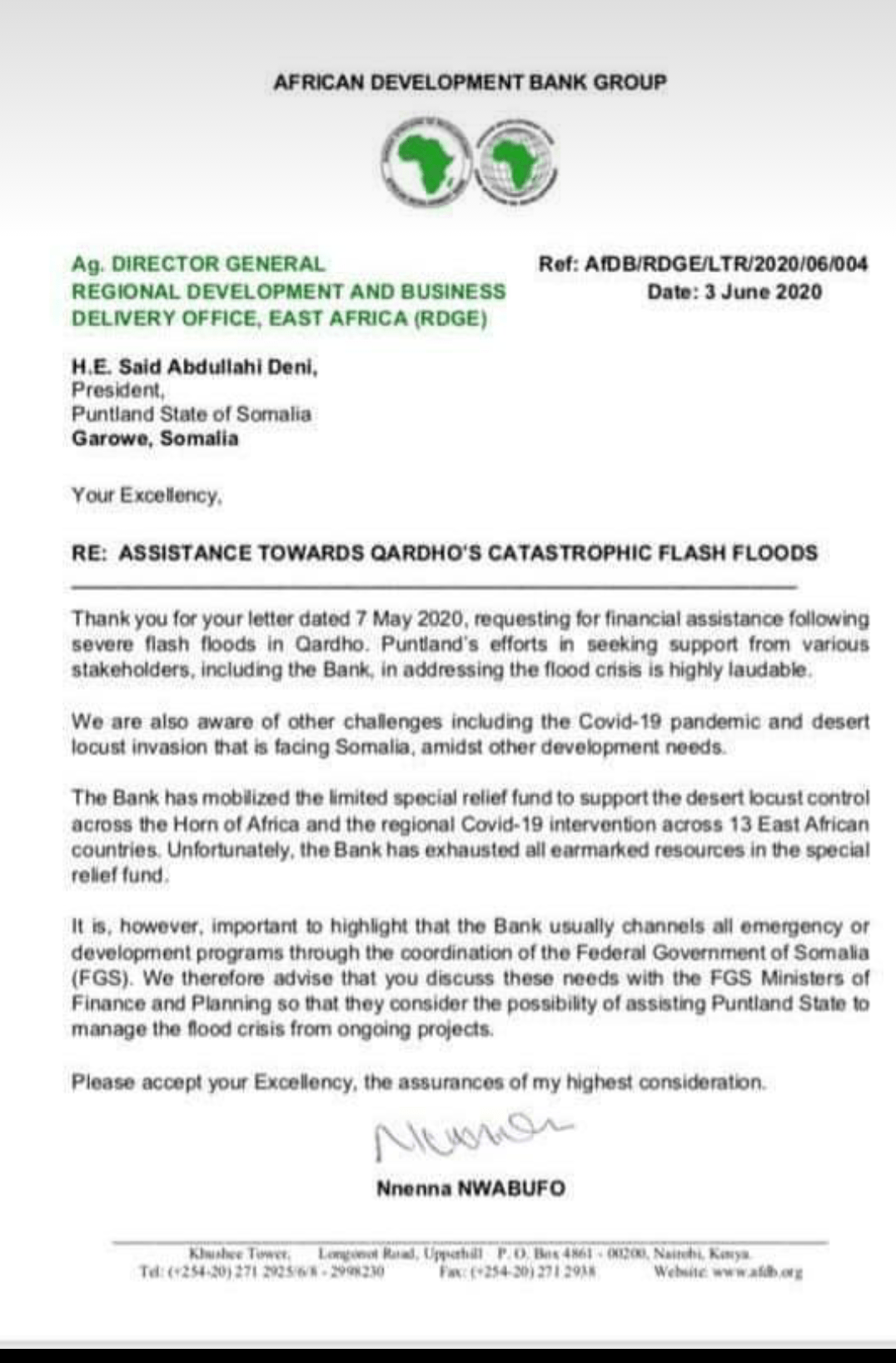
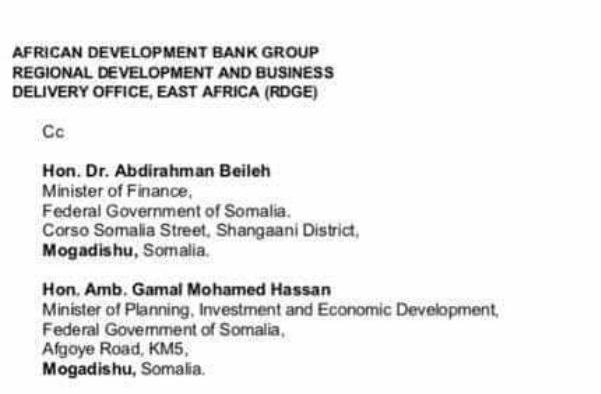
AN EMBARASSMENT

First of all, nobody in his right mind seeks charity directly from a bank.

Secondly, if you were ill-advised to write such an odd request, you should have noted the relief assistance already given by the Somali Federal Government in an attempt to persuade the Bank Management that the FGS is in support of such humanitarian aid, and copying to the Federal President for this strange correspondence to the Bank.

http://amazon.com/author/ismailwarsame

Postscript. One reader comments on the article this way:

“Ooh poor man!! he was not informed that his predecessor had given the go ahead that all grants from the International Financial Institutions would be received through the FGS. If you read the second last paragraph, he was reminded of the right gate of entry”

LOOKING BACK IN HISTORY

President Hassan Sh. Mohamud Policy of seeking allies of any political background to resist voluntary formation of federated states and his attempt to shape Somalia from Mogadishu perspective only without allowing inputs from residents in the regions, risks escalation of renewed hostilities and dangerous conflagration to finish off what is still left of Somalia as we know it. He is better advised to listen, arbitrate and seek consensus among his people before it becomes too late as an odd man. Has the Prime Minister Shirdon got what it takes to come out of the shadow and claim rightfully his role in history?

http://amazon.com/author/ismailwarsame

BOOK DESCRIPTION

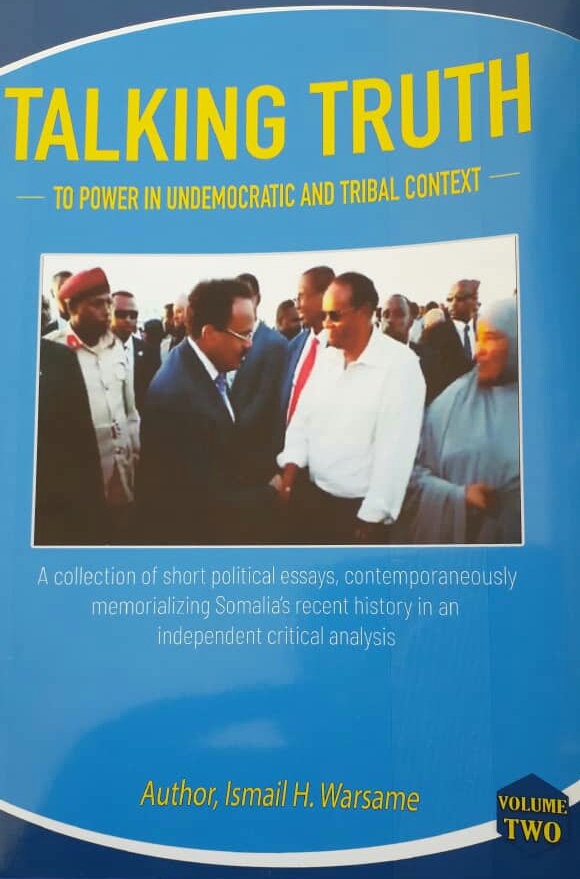
“Talking Truth to Power, Articles of Impeachment, Volume Two, introduces the present difficulties Somalia faces with regards to its relationships with its neighbor countries of Kenya, Ethiopia, Uganda, Eritrea and Djibouti, and within regional power play, with Turkey, Qatar, United Arab Emirates, Egypt and Kingdom of Saudi Arabia.

Volume Two, mainly, however, delves into the foundational documentation of the 2nd Somali Republic in October 2004, after the 1st Republic failed in January 1991. This Volume exposes, in historic documents, the work done then by the Transitional Federal Government of the Somali Republic, and in particular, on the through preparation of the nation for comprehensive National Reconciliation following a vicious civil war.

Students of contemporary Somali history, researchers, media, politicians and diplomats would find this volume handy and refreshing.

It is available on Amazon in many countries, both in print and digital formats. It is a must have book on one’s book shelf as new important acquisition”.

The Author http://amazon.com/author/ismailwarsame

IN SOMALIA, WE NEED TO BE CREATIVE THINKERS.

Examples.

#MSPP Stands for Member of State Parliament of Puntland.

#POS President of Somalia

#PSP President of State of Puntland

#PSH President of State of Hirshabelle

#MSPSW stands for Member of State Parliament of South-west and so on

http://Amazon.com/author/ismailwarsame

CIID MUBAARAK

CIID MUBAARAK!

http://Amazon.com/author/ismailwarsame

https://ismailwarsame.blog

Annual subscription

$37.00

The Historic Swearing-in Ceremony of the President of the Transitional Federal Government of the Somali Republic, Abdullahi Yusuf, October 2004.

Take a watch:

President Abdullahi Yusuf Ahmed


http://amazon.com/author/ismailwarsame

Tentacles of Somali Clan Politics

The Ways of the Somalis

By Ismail Warsame

!st edition

To succeed in Somali Politics requires more than hard work and luck. Like in many communities in other parts of the world, name recognition would move someone to a fifty percent chance. The 2nd prerequisite is to have an extended clan and sub-clan links and relationships. Having such linkages across different clans would produce and move up to forty percent. Only the remaining ten percent would come from the political skills of the candidate and his/her resources.

In Somali clan politics, you have to have or develop personal relationships and political alliances with key personalities from the five major clan system of Darood, Hawiye, Dir, Digil & Mirifle and coalition of the so-called the “fifth Clan” consisting of amalgamation of many minority clans put together for clan power sharing purpose and thus ensuring minorities have their political rights protected to prevent tyranny of majority clans. Tentacles of Somali clan politics go deeper into these alliances through marriage, kinship and associations with key figures of clans. There is a Somali saying that advises father-to-be that the best help he could give to his future son is to weigh his choice in marrying son’s future mother

To prove that one’s success in Somali clan politics critically depends on such relationships, let us take of account of the rating of past and present political leaders of Somalia.

Start with current Federal President of Somalia, Mohamed Abdullahi Farmaajo. He hails from Darood sub-clan of Mareexan. He is related to former leader of Somalia, Siyaad Barre securing name recognition by association. His wife is from Hawiye sub-clan of Murursade. His mother is from Darood sub-clan of Dhulbahante. Although Farmaajo came from humble family, he has a name recognition in his affinity with Siyaad Barre and has alliances through marriage and by birth.

Take Aden Abdulle Osman (Aden Cadde), the first President of Somalia. He was from Hawiye sub-clan of Udaajeen, married to a wife of prominent Darood sub-clan of Majeerteen. The story goes to every successful Politician of Somalia.

Variations in Alliances by Marriage and Birth

Isaxaaq Sub-Clans

They are known to be totally consumed by their own sub-clan rivalry and have no time and consideration for someone else. Alliance with them by marriage doesn’t amount much to support an ambitious politician from non-Isaxaaq clans. In addition, any politician would burn out himself financially before he is able to get started.

Dhulbahante

Dhulbahante a Sub-Clan of Darood. Marriage, kinship, and birth relationships amount nothing to Dhulbahante, unless you are already a strongman from other Darood sub-clans. They have no history of their own self-government, and are all unlikely to support any seemingly weak hopeful politician from other sub-clans. However, they could be dangerous too to hurt the chances of a promising and potential candidate. On the top, they have a unique problem of the blunders and plunders among themselves during the Derwish Movement of the 19th century that have not been settled yet for reconciliation.

Digile & Mirifle

They are the most suitable group of Somali sub-clan system that adopts a politician/candidate by birth or marriage.

Majeerteen

Only Mahamud Suleyman is worth speaking here in terms of numerical superiority, potential support and higher quality of support and available resources.

Habar-Gidir/Sacad

Habar-Gidir/Sacad is worth mentioning here as they are known historically to support a politician related to them by marriage or birth.

Disclaimer

Based on the experience of the author, this essay isn’t ignoring the rest of Somalis, whose descriptions fall into negligible portion of this story.

Check out the new popular books by the same author at:

http://amazon.com/author/ismailwarsame

STRAIGHT TALK TO UNSTRAIGHT WORLD OF SOMALIA

HAYAAN

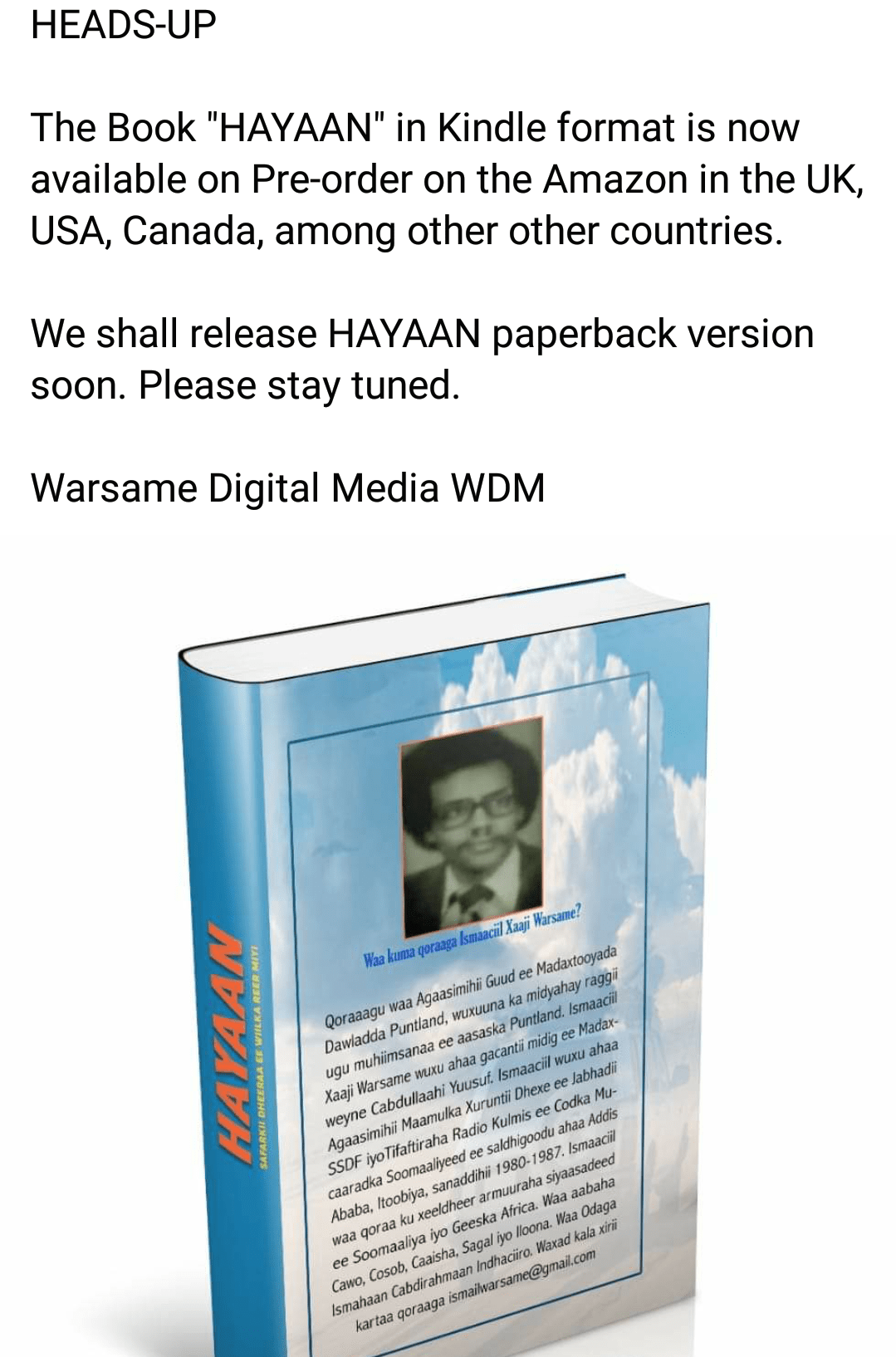
The Book “HAYAAN” is now available in almost all major digital formats from major book retailers, including Apple.

http://smashwords.com/ismailwarsame

Annual subscription

$37.00

HAYAAN

HAYAAN

HAYAAN, paperback and Kindle format, 203 pages, Somali edition,
By Ismail H. Warsame

HAYAAN is a new book that fills in the gaps in Somali political narrative and captures the turning points in Somali recent history since independence in 1960.

It is a candid account memorializing major political developments of this troubled nation over the past four decades. It is a must read book by all interested in history, politics and law.

By the Author

https://amazon.com/author/ismailwarsame

Annual subscription

$37.00

HAYAAN

HAYAAN is now available live on Amazon worldwide. You may get your paperback or Kindle format instantly to your device.

https://m.facebook.com/story.php?story_fbid=10222584044537857&id=1473969186

https://amazon.com/author/ismailwarsame

HAYAAN

https://amazon.com/author/ismailwarsame

Annual subscription

$37.00

HAYAAN

https://ismailwarsame.blog

https://amazon.com/author/ismailwarsame

Annual subscription

$37.00

BOOK SELECTION

Readers are asking me which one of my recent books would buy first.

I would like to respond to them this way:
It all depends on what you want:

  1. If you want critical political essays of what is happening now or was happening in Somalia in the past 30 years contemporaraneously recorded, then go for Book One of “Talking Truth to power, Articles of Impeachment”.
  2. If you want to read a memoir of an inside man on what was happening to Somalia or was happening inside and outside Somalia (in Ethiopia, Kenya, Djibouti, Egypt, Yemen etc), go for HAYAAN written in Somali.You may learn many things here unknown to many Somalis.

The books are here: https://amazon.com; amazon.co.uk; amazon.ca; amazon.fr; amazon.co.jp; amazon.de etc/author/ismailwarsame

https://amazon.com/author/ismailwarsame

HAYAAN

Attention!

“HAYAAN”, Safarkii Dheeraa ee Wiilka Reer Miyiga, will be live on Amazon Worldwide in the next few hours, both in digital and paperback formats.

Don’t miss out to grab your copy. It is worth your money.

https://amazon.com/author/ismailwarsame

Annual subscription

$37.00

HADRAAWI

Hadraawi. MAANSADII DABA’HUWAN!

https://amazon.com/author/ismailwarsame

Annual subscription

$37.00

HAYAAN

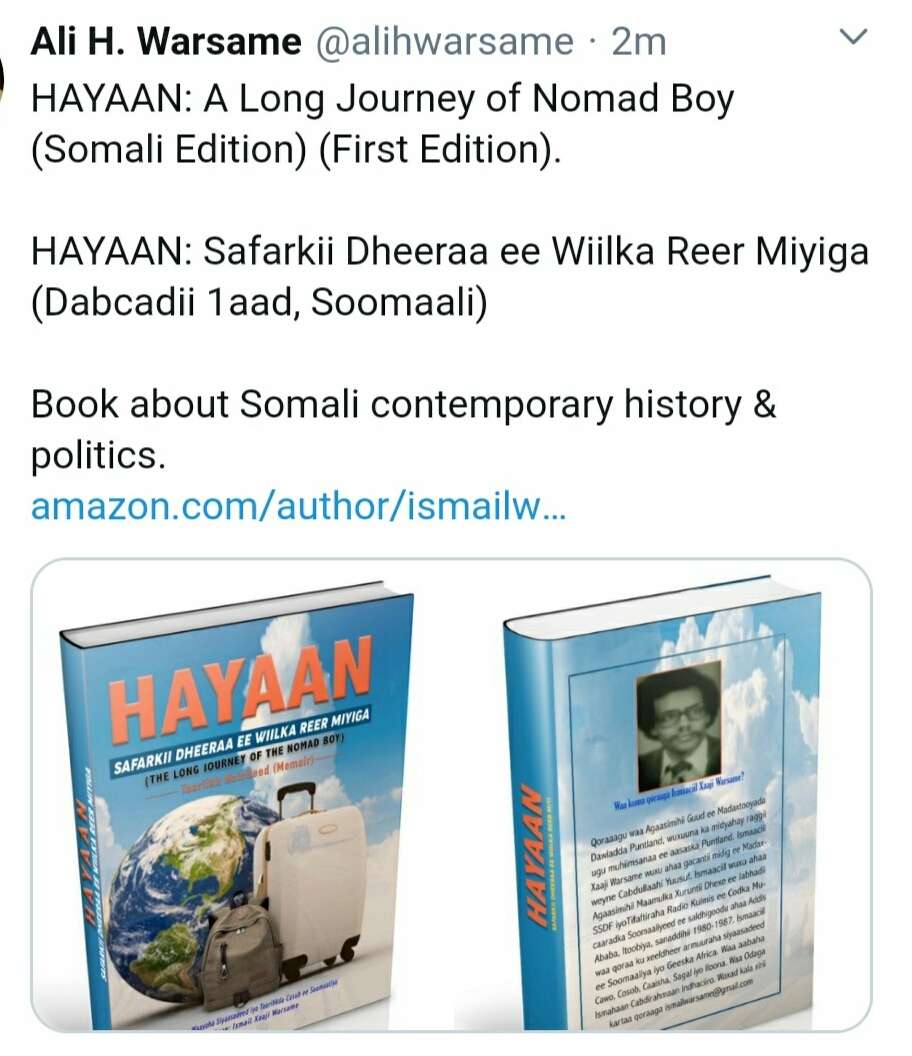
[04-26, 6:35 AM] Ismail Warsame: Check this out: HAYAAN: A Long Journey of Nomad Boy (Somali Edition) (First Edi… https://www.amazon.co.uk/dp/B087NMY7R4/ref=cm_sw_r_wa_awdo_t1_5dqPEbBBG3MCF
[04-26, 6:40 AM] Ismail Warsame: Description
HAYAAN
SAFARKII DHEERAA EE WIILKA REER MIYI

(The long Journey of the Nomad Boy)

Buug Waayaha Siyaasadeed iyoTaarikhda Cusub ee Soomaaliya

Hayaan, Safarkii Dheeraa ee Wiilka reer Miyiga wuxu falanqayn doonaa arrimo badan ee la xiriirra jawaabaha su’aallaha kor xusan iyo kuwo kaloo muhim ah, si dadban iyo si toosba ah, aadna xasaasi u ah, oo geesinimo dheeraad ah u baahan si buuggu u noqdo mid dhacal gal ah, oo caadifad qabiil iyo mid shakhsiba ka fogaada. Sidaa aweed, waxay noqoneysaa in loo dhabar adayg, canaan iyo maagba buuggani muggisu soo jiidandoono. Gaar ahaan, buuggani wuxu baallal badan ama qoraal dheer siindoonaa taariikhdii iyo dhacdooyinkii siyaasadeed ee Soomaliya waayihii dambe sida:

1.Baraarrugii ugu horeeyey ee siyaasadeed ee Qoraaga mudadii lixdamaadkii iyo taariikh nololeedkiisii.

2.Taariikhdii Jabhadda Dimoqoraadiga Badbaadinta Soomaliya (SSDF), mucaaradkii siyaasadeed iyo ciidan ee abaabulaa ee ugu horeyey, oo ka soo horjestay Dawladdii Saraakiishii uu u sareeyey Maxamed Siyaad Barre ee hogaamiye u ahaa. SSDF waxay asaasantay ka dib Dagaalkii Ogaden 1977-1978. Halgangii SSDF wuxu keenay in ay ka daba abuurmaan Dhaqdaqaaqa Wadaniga Soomaaliyeed (SNM) iyo Golaha Midowga Soomaaliyeed (USC), oo iyadu ahayd koox ka go’day SSDF, markii burbur siyaasadeed kusii dhacay Soomaaliya, halganka hubaysan ee SSDF iyo fasaad dhaqan-dhaqaale gudaha Soomaaliya awgood.

3.Dadaaladii ku aadanaa middaynta uruurrada ka hor jeeda si loo fuliyo afgambi xoog ah oo lagu sameeyo Dawladdii keli taliye Siyaad Barre. Ujeedooyinka Mengistu Haile Mariam ka lahaa dhismaha ururro mucaarad Soomaaliyeed. Weli ma isbedeshay, laga soo bilaabo Menelik, danaha Ethiopia ka leedahay Soomaaliya? Intee bay gaarsiisantahay heer aragtiga iyo cabirka madaxda Soomaliyeed markay arrimuhu taaganyihiin danno qaran oo maguuraan ama joogta ah?
4.Wada-wadalladii ama Shirarkii Soomaaliyeed ee Dib-u-Heshisiinta Qaran, 1997-2004 ee qoraagu la jaan-qaaday.

5.Dadaalkii loo soo maray dhismaha Dawladda Puntland ee Soomaaliya-aasaskeeda oo ruunti salka ku haya: A) Ismari waagii siyaasadeed ee Shirarka Dib-U-Heshisiinta Soomaaliyeed markii ugu dambaynsana lagu baajiyey Shirkii Qaran ee Boosaaso 1997, isla sanadkaana kii Qaahira oo loogu tagalay in looga hortago kan Boosaaso, luguna fashiliyo. B) Dadweynaha Puntland oo diidan ilaa maanta in dib loogu laabto xukuumad dheexe ee awood badan, oo wada marooqsata talada dalka. C) Ujeedooyinka laga lahaa dhismahii Dawladda Puntland. D) Ujeedoonyinka Somaliland iyo Puntland oo ugu dambayntii isku mid ah balse leh soojin iyo hanaan kala duwan, marka laga eego dib-u-dhis qaran Soomaaliyeed oo xoogan iyo dawlad dhexe oo si siman loo wadaago iyo ismaamul gobolleedyo awood dawladnimo balaarran leh.

6.Dhismihii Dawladda Federaal Ku Meel Gaar ah ee Jamhuuriyedda Soomaaliya ee Shirkii Dib-u-Heshisiinta Qaran ee Eldorate/Mbagati/Kenya, 2001-2004.

https://amazon.com/author/ismailwarsame

https://ismailwarsame.blog

Annual subscription

$37.00

PRE-ORDER YOUR COPY OF THE BOOK “HAYAAN”

Buugga HAYAAN

https://ismailwarsame.blog

Annual subscription

$37.00

WE WELCOME THE HOLY MONTH OF RAMADAN

Warsame Digital Media WDM seizes this opportunity to congratulate Muslims on the Holy month of Ramadan, wishing all happy fasting, moments of repentance, devotion and reflection.

WDM recommends that essential food and drinks enterprises stay open for the sick, travelers and children. There are always exceptions to the general rule for a reason and humane compassion. One wouldn’t just bandwagon to close every business.

Please help the needy and have mercy during this most sacred month of Ramadan.

https://ismailwarsame.blog

Annual subscription

$37.00

More Than 4 Million Filed Unemployment Claims Last Week: Live Updates – The New York Times

https://www.nytimes.com/2020/04/23/business/stock-market-today-coronavirus.html

TOWFIIQ

Towfiiq

https://ismailwarsame.blog

Annual subscription

$37.00

An Expression of Compassion at Odd Place.

Today I was driving in Garowe, Puntland State, behind a number of vehicles. Suddenly, a car at front raw stopped in the middle of the road. A man in the passenger seat stepped out of the car, crossed the street and came up to disabled man, who was sitting at roadside to beg for help and solicit compassion from by-passers. Strangely, the helping man was in military uniform.

We, the other drivers, didn’t mind the odd compassionate behavior of that fine officer, despite the fact that he grossly violated the traffic rules, although there is no enforceable high code and therefore no traffic police in Puntland to rely on.

https://ismailwarsame.blog.

Annual subscription

$37.00

CORONAVIRUS DEVASTATION IN ONTARIO, CANADA

STEVE JOBS: LAST WORDS

Steve Jobs

https://ismailwarsame.blog

Live Stock Market Tracker During Coronavirus Pandemic – The New York Times

https://www.nytimes.com/2020/04/20/business/stock-market-live-trading-coronavirus.html

ANTI-LOCKDOWN PROTESTER WEARS FULL PROTECTIVE GEAR

ANTI-LOCKDOWN

(Courtesy: The Independent)

https://ismailwarsame.blog

Americans at World Health Organization transmitted real-time information about coronavirus to Trump administration

How Trump and the World Health Organization ended up on a collision course.


The Post’s Senior national security correspondent Karen DeYoung explains what’s behind President Trump’s World Health Organization funding cut. (Zach Purser Brown/The Washington Post)
By
Karen DeYoung,
Lena H. Sun and
Emily Rauhala
April 19, 2020


More than a dozen U.S. researchers, physicians and public health experts, many of them from the Centers for Disease Control and Prevention, were working full time at the Geneva headquarters of the World Health Organization as the novel coronavirus emerged late last year and transmitted real-time information about its discovery and spread in China to the Trump administration, according to U.S. and international officials.
A number of CDC staffers are regularly detailed to work at WHO in Geneva as part of a rotation that has operated for years. Senior Trump-appointed health officials also consulted regularly at the highest levels with the WHO as the crisis unfolded, the officials said.
The presence of so many U.S. officials undercuts President Trump’s charge that the WHO’s failure to communicate the extent of the threat, born of a desire to protect China, is largely responsible for the rapid spread of the virus in the United States.

The administration has also sharply criticized the Chinese government for withholding information.

World Health Organization building in Geneva on Feb. 6. (Denis Balibouse/Reuters)
But the president, who often touts a personal relationship with Chinese President Xi Jinping and is reluctant to inflict damage on a trade deal with Beijing, appears to see the WHO as a more defenseless target.
Asked early Sunday about the presence of CDC and other officials at the WHO, and whether it was “fair to blame the WHO for covering up the spread of this virus,” Deborah Birx, the State Department expert who is part of the White House pandemic team, gently shifted the onus to China, and the need to “over-communicate.”
Sign up for our Coronavirus Updates newsletter to track the outbreak. All stories linked in the newsletter are free to access.
“It’s always the first country that get exposed to the pandemic that has a — really a higher moral obligation on communicating, on transparency, because all the other countries around the world are making decisions on that,” Birx told ABC’s This Week. “And when we get through this as a global community, we can figure out really what has to happen for first alerts and transparency and understanding very early on about … how incredibly contagious this virus is.”
Trump slammed globally after White House freezes WHO funding amid coronavirus pandemic
President Trump received global condemnation for halting funding for the World Health Organization April 14, over its handling of the coronavirus pandemic. (Reuters)

Following a Trump-hosted video conference of the leaders of the Group of Seven industrialized nations on Thursday, a White House statement said “much of the conversation centered on the lack of transparency and chronic mismanagement of the pandemic by the WHO.”
Trump’s focus on WHO may resonate but it may be a diversion
The group’s focus on the global health organization during the call stemmed largely from Trump’s announcement two days earlier that he was freezing all U.S. funding for it, saying donors would be discussing “what do we do with all of that money that goes to WHO.” The United States provides up to $500 million a year in assessed and voluntary contributions, significantly more than any other nation.
In statements following the G-7 call, however, other leaders emphasized the need to build up the WHO, rather than tear it down.

French President Emmanuel Macron “expressed his support for the WHO and underscored the key role it must play,” according to a statement from his office. German Chancellor Angela Merkel “made clear that the pandemic can only be defeated with a strong and coordinated international response,” her spokesman said. “In this context, she expressed full support for the WHO as well as a number of other partners.”
German Foreign Minister Heiko Maas warned that the WHO “cannot be weakened or in any way be called into question politically. … Every inch that the U.S. withdraws from the wider world, especially at this level, is space that will be occupied by others — and that tends to be those that don’t share our values of liberal democracy,” he said.
Canada, Japan and the European Union — all of whom participated in the call — also issued strong statements backing the organization.

A G-7 statement issued after the call supported the need to review WHO performance. “We cannot have business as usual and must ask the hard questions about how [the pandemic] came about,” British Foreign Secretary Dominic Raab, standing in for virus-stricken Prime Minister Boris Johnson, said. But he stressed a post-crisis review should be “driven by science.”
U.S. sent millions of face masks to China early this year, ignoring warning about emerging pandemic
In announcing the funding cutoff, Trump charged last week that the WHO parroted incorrect Chinese statements and “failed to investigate credible reports … that conflicted directly with the Chinese government’s official accounts.” He criticized “the inability of the WHO to obtain virus samples” that China continues to refuse to supply.
A Senate aide who has tracked the issue said “there was clearly an effort” by China “not to provide transparent data and information” in the early stages of the outbreak.

“We were looking to WHO to provide that information, and they did not. It was unclear as to whether they didn’t get that transparency from the Chinese, or that they chose not to share what they did get under pressure from the Chinese,” said the aide who, like others, spoke on the condition of anonymity to discuss a sensitive matter.
But some noted that the WHO has no power to compel member governments to do its bidding.
The organization “has no intelligence capabilities, and no investigatory power,” said Daniel Spiegel, who served as ambassador to the United Nation’s Geneva-based organizations, including the WHO, for the Clinton administration. “They should have been more skeptical about what the Chinese were telling them, but they’re totally at the mercy of what governments provide.”

Among his complaints, Trump seems most aggrieved by the initial WHO failure to support his Jan. 31 decision to partially ban incoming travel from China. Days later, at a meeting of the WHO executive board, Director General Tedros Adhanom Ghebreyesus said there was no need to “unnecessarily interfere with international travel and trade” to halt the spread of the disease. That message reiterated what he had said before Trump’s announcement, after meeting with Xi in Beijing.
Trump called Tedros’ statement “one of the most dangerous and costly decisions from the WHO. … They were very much opposed to what we did,” he said last week. “Fortunately, I was not convinced and suspended travel from China, saving untold numbers of lives.”
International public health experts have long debated whether border closures helped stem the spread of infectious diseases, or worsen the situation by blocking cooperation among countries. But many, including Antony Fauci, head of the National Institute of Allergies and Infectious Diseases and a leading member of the administration’s coronavirus task force, have said it was probably helpful in this case as the efforts of individual countries to contain and mitigate the virus were outpaced by its rapid global spread.

On Saturday, Trump said without elaboration that “we’re finding more and more problems” with the WHO. Speaking at a White House virus briefing, he said the administration was “doing some research” on “other ways” to spend money originally intended for both the WHO and the National Institutes of Health, which he said was “giving away $32 billion a year.”
The meaning of Trump’s reference to NIH, whose fiscal year 2020 budget totals $41.6 billion, was unclear.
The administration’s 2019 Global Health Security Strategy advocates increased cooperation with the WHO and other international health organizations. But although the United States has a three-year seat on the WHO executive board, expiring in 2021, the post has remained vacant. Last month, Trump nominated Assistant Secretary for Health Brett Giroir for the position.

U.S. participation in the range of Geneva-based U.N. organizations is supervised by the State Department’s Bureau of International Organization Affairs, whose assistant secretary left office last November after the department’s inspector general issued a sweeping condemnation of his leadership, including “political harassment” of career officials deemed insufficiently loyal to Trump. It is currently headed in an acting capacity by a deputy.
But below the level of political appointments, communication between the U.S. government’s public health bureaucracy and the WHO has continued throughout the Trump administration.
In addition to working at WHO, on assignments first reported Saturday by Washington Post columnist Dana Milbank, CDC officials are often members of its many advisory groups. The emergency committee advising the organization on whether to declare “a public health emergency of international concern” during deliberations in mid to late January included Martin Centron, director for CDC’s Division of Global Migration and Quarantine.
When China eventually agreed to let a joint WHO mission into the country in mid-February, it included two U.S. scientists among 25 national and international experts from eight countries, although the Americans were not permitted to visit the “core area” in Wuhan.
From the beginning of the outbreak, CDC officials were tracking the disease and consulting with WHO counterparts. A team led by Ray Arthur, director of the Global Disease Detection Operations Center at CDC, compiles a daily summary about infectious disease events and outbreaks, categorized by level of urgency, that is sent to agency officials.
Arthur, according to a CDC official who spoke on the condition of anonymity to discuss internal deliberations, has participated in the CDC daily “incident management” calls, discussing information he learned from WHO officials.
Information is passed up the chain of command from CDC to the Department of Health and Human Services in daily reports and telephone discussions, this official said.
Any information of a sensitive nature about the growing outbreak was and continues to be shared by CDC officials with other U.S. officials in a secure facility located behind the CDC’s Emergency Operations Center at its Atlanta headquarters.
In the early days of the virus response, those officials included HHS Secretary Alex Azar. Information about what the WHO was planning to do or announce was often shared days in advance, the CDC official said.

Anne Gearan and Yasmeen Abutaleb contributed to this report

https://ismailwarsame.blog

(Courtesy: Washingtonpost.com)

REMEMBERING MJ

Remembering Michael Jackson

https://ismailwarsame.blog

Annual subscription

$37.00

COVID-19 CASES IN SOMALIA

BREAKING NEWS

Garowe, April 18, 2020

According to reliable information sources, confirmed Coronavirus cases in Somalia are over 116 persons. Five of these cases were confirmed dead, based on the information obtained by Warsame Digital Media WDM.

https://ismailwarsame.blog

Annual subscription

$37.00

TALKING TRUTH TO POWER, ARTICLES OF IMPEACHMENT DELIVERED TO YOUR HOME, OR DEVICE WORLDWIDE

https://ismailwarsame.blog

Annual subscription

$37.00


TALKING TRUTH TO POWER,ARTICLES OF IMPEACHMENT

الحديث عن الحقيقة إلى السلطة في سياق غير ديمقراطي و قبلى. مقالاات عن المساءلة
Synopsis ملخص
The collapse of Somalia’s Central Government and its status as a failed state presents a unique case and problem to the international community as it constitutes an unprecedented threat to international order as community of nations and to the world as orderly societies with predictable laws and manners of civilized behaviour.
The author of this book strongly believes that the absence of free press and checks and balance of power had contributed, to the greatest extent, this national and internationally worrisome political situation in that country. This book, Talking Truth to Power in Undemocratic and Tribal Context, Articles of Impeachment, is a collection of a series of short articles written contemporaneously on the current political developments within the frameworks of the efforts being made by now fledgling transitional administrations of the Federal Government of Somalia and its Federal Member States. These are articles of critical analysis and essays on the latest political developments in Somalia. The articles are objective and unbiased take on major political issues of Somalia at moment.
Some of these essays had been recently published execluvely in the author’s personal blog at http://ismailwarsame.blog, attracting considerable readers’ interest, who are now also requesting for the compilation of these essays into a book. The author is responding to their persistent requests. These requests are also an indication that this book would sell well in a competitive book market.
The book could be a good source material for students and teachers learning English as a 2nd language in their composition papers and reporting skills. The book could also enlighten foreign diplomats and politicians on current political issues in Somalia, and efforts being made by Somalis to re-instate and re-construct their failed state.
By Ismail H. Warsame

https://puntlandpost.net/2020/04/16/a-new-book-by-an-influential-somali-blogger-makes-a-splash/

https://ismailwarsame.blog

Annual subscription

$37.00

ARE YOU PREPARED?

https://ismailwarsame.blog

Annual subscription

$37.00

GARA’AD ON THE MOVE

https://ismailwarsame.blog

Annual subscription

$37.00

PUNTLANDPOST ON THE NEW BOOK “TRUTH TO POWER”

https://ismailwarsame.blog

Annual subscription

$37.00

The problem with militias in Somalia: Almost everyone wants them despite their dangers

Vanda Felbab-BrownTuesday, April 14, 2020, United Nations University

For media inquiries, contact:
Media Inquiries 202.797.6103

Editor’s Note:

The following introduction is an excerpt from the case study, “The problem with militias in Somalia: Almost everyone wants them despite their dangers,” produced by Vanda Felbab-Brown for the United Nations University report, “Hybrid conflict, hybrid peace: How militias and paramilitary groups shape post-conflict transitions,” of which Adam Day was the project lead. The full case study can be found here.

INTRODUCTION

Militia groups have historically been a defining feature of Somalia’s conflict landscape, especially since the ongoing civil war began three decades ago. Communities create or join such groups as a primary response to conditions of insecurity, vulnerability and contestation. Somali powerbrokers, subfederal authorities, the national Government and external interveners have all turned to armed groups as a primary tool for prosecuting their interests. State-aligned militias help to offset the weakness of Somalia’s official security forces, produce greater motivation and better intelligence and enhance bonds with local communities, perhaps even suppressing crime and intraclan violence.

Senior Fellow – Foreign PolicyCenter for 21st Century Security and Intelligence

However, Somalia’s State-aligned militia groups are also an underlying source of insecurity, violent contestation, abusive rule, impunity and pernicious outside manipulation. They give rise to and allow the entrenchment of powerful militant groups such as the Al-Qaida- supporting, jihadist Harakat al-Shabaab al-Mujahideen, commonly referred to as al-Shabaab. As such, their increasingly central role in the fight against al-Shabaab is a double-edged sword: short-term military gains must be balanced against the militias’ longer-term, destabilizing impact.

This study analyses the pros and cons of relying on militias for security provision and counter-terrorism objectives in Somalia. It details the evolution, effectiveness and effects on stabilization efforts of several militia groups — Macawiisleey, Ahlu SunnaWal Jama’a, South-West Special Police, Mukhtar Robow’s militias, Ahmed Madobe’s militias (the Jubbaland State Forces), the Puntland Maritime Police Force (PMPF) and the Puntland Security Force (PSF). The study then assesses the effectiveness and shortcomings of existing responses to militias in Somalia, providing recommendations to national actors, policymakers and practitioners.

At the beginning of 2020, militias are once again at the forefront of a major policy debate about the strategy for State-building and security in Somalia. Since 2012, after helping to dramatically weaken a brutal, dangerous al-Shabaab regime that controlled much of the country, the international community has assisted in building State institutions in Somalia, which had been overwhelmingly destroyed in two and half decades of civil war. As part of its continuing efforts to combat al-Shabaab, the international community has partnered with Somalia’s national Government to build Somalia’s official armed and law enforcement forces and civilian institutions of governance, while advancing a plan to devolve power to the country’s states (known as federal member states).

But eight years later, many of these efforts have not yet delivered results. Al-Shabaab remains one of Somalia’s most powerful political and military actors. In fact, since 2018, the group has gained momentum and deepened its political entrenchment, prompting some members of the international community to question whether the State-building model is the right approach. Despite USD $1 billion of international financial assistance and international training since 2012, the Somali National Army (SNA) continues to lack the gamut of fighting capacities, relying instead on international forces to wrest territory from al- Shabaab, or even to keep the group from openly retaking other large territories, including majorcities. Existing efforts to strengthen the SNA and other official forces are not producing adequate numbers of sufficiently competent Somali national soldiers. Intensified rivalries between Somalia’s federal Government and the federal member states further hamper the deployment and effectiveness of the SNA.

As a result, countries such as the United States, Kenya, Ethiopia and the United Arab Emirates — the former three of which have military forces in Somalia — are losing their appetite for the State-building project in Somalia.[1] With the SNA chronically underperforming, these countries are poised to intensify their cultivation of pro- Government militias to fight against al-Shabaab. Even countries such as the United Kingdom and Germany (which have been at the forefront of multilateral efforts in Somalia) are increasingly motivated to support at least one set of militia groups — the State-supported paramilitary darwish (also known as “special police forces”) — through financial and possibly other non- lethal support.[2] These countries’ rationale is that, although reliance on militia groups for counter-terrorism and security is problematic, it is equally unsustainable and problematic to rely on the small and incompetent SNA and the national Somali Police Force (SPF). The situation in Somalia is putting growing pressures on both the Somali Government and the international community to scale up the use of such militias.

Related

This strategy based on auxiliary forces competes with ongoing efforts to bolster the State-building effort, including training of the official Somalinational forces (which include the national military, police and intelligence agencies), expanding a defectors’ programme for al- Shabaab and efforts to integrate at least some of demobilized militias into the official security sector.

Embracing militias carries many risks: As this study details, the loyalties of militia groups are fluid, as they are susceptible to recruitment by their enemies and may prioritize their own interests — or those of an external patron — over those of the State. Militias also divert manpower and resources from Somalia’s official forces, including by incentivizing defections. Worse still, Somalia’s militia groups, particularly without supervision or assured sustainable income, tend to engage in predatory and, at times, violent behaviour, both on rival communities and even within their own. Deeply entrenched in the political economy of Somalia, militias have strong tendencies to appropriate political authority, strengthen authoritarian forms of rule, monopolize local economies and engage in other mafia-like economic and political activities. In these ways, they exacerbate localconflicts, increase grievances and enable al- Shabaab’s political entrenchment in parts of the country. They compete with each other and, at times, with the federal Government. A poorly concluded defeat of al-Shabaab could actually plunge the country back into open fighting as the remaining militias compete for power. Foreign actors also instrumentalize Somalia’s militias, undermining Somalia’s sovereignty and entangling the country in geopolitical rivalries that could further destabilize the region.

At the same time, militias may be the best hedge against even more direct intervention by outside actors. If existing joint efforts fail to weaken al-Shabaab’s military, political and economic power, intensified bilateral interventions such as US air strikes and enlarged deployments of Ethiopian and Kenyan forces grow more likely. These forces operate outside of the mandate and framework of the African Union and the United Nations, and harken back to the troubled period of Ethiopia’s intervention in Somalia between 2006 and 2009. Other actors with substantial military assistance in Somalia, such as the Emirates and Turkey, may not be able to resist the temptation to intervene more forcefully.

Related Books

Part of the risk of greater foreign intervention in Somalia arises from intensified regional and geopolitical rivalries, which shape local contestations in Somalia — and are also shaped by those local dynamics. The cold war conflict between Qatar and Turkey, on the one hand, and Saudi Arabia and the Emirates, on the other, intersects with and exacerbates conflicts and tensions between Somalia’s Government and the country’s federal member states, themselves already at a level of tension and suspicion not seen in years. For the Government, federal member states and international actors, militias are a favored tool against al-Shabaab, but their utility extends far beyond that fight. For instance, the federal member states — which carefully guard their autonomy, despite the existence of a formally agreed Somali national security infrastructure framework — see the militias as a crucial security hedge against the power of Mogadishu, Somalia’s capital. The states can use the militias as a bargaining tool in their negotiations with Mogadishu over power distribution.

Many local communities deeply distrust and resent the SNA, which they perceive as more of a conglomeration of militias than as a competent State security service. The SNA is alleged to be unreliable in delivering basic security. Rather than respond to the military chain of command, many local SNA units display greater loyalty to their own clan and community interests; they use the SNA to abuse and exploit rival clans. In response, clan elders and local communities have bolstered their own clan militias as protection — not only against al-Shabaab, but also against the SNA.

The decision to double down on pro-Government militias to address the threats posed by al- Shabaab thus risks producing new drivers of conflict while perpetuating deeply rooted intercommunal tensions. As a United Nations official in Mogadishu put it, “We have tried to get to reduced killing in Somalia without ever resolving Somalia’s conflicts.”[3] And in the words of an international military advisor in Baidoa: “Fighting a war through proxies is fraught with proxy problems downstream.”[4] There is growing evidence that embracing militias rewards entrepreneurs of violence, reinforces impunity, and perpetuates violence.

Nonetheless, rolling back militias in Somalia does not seem feasible at this time, given al- Shabaab’s new momentum and the lack of progress in building up the State’s capacities. Instead, policies should be adopted to reduce at least some of the most pernicious effects of militias and to mitigate their worst tendencies, even while working through and with them. Steps should be taken to hold accountable the most egregiously behaving militias. Critically, the Somali Government, the federal member states and the international community should refocus efforts on reducing local conflicts, as part of the broader strategy to combat al-Shabaab and build stronger relations between State and society.

A. Outline of this study

This study first provides an overview of the evolution and current state of the political, economic and battlefield power of al-Shabaab, alongside the capacities and deficiencies of both the various Somali national security services and the African Union Mission in Somalia (AMISOM). These dynamics take place in a fraught political context: tensions have risen between the Government and the federal member states, and there is broader geopolitical and regional competition for influence in Somalia.

The second part of the study analyses the structural and political drivers of militia formation and persistence in Somalia. It also describes the pro-militia arguments made by Somali politicians, government officials, clan elders and international actors. The second section of the study also reviews various types of militia groups in Somalia, including clan-based forces, contract militias, federal member state paramilitary darwish and militias sponsored by external actors. To understand how these militias form and operate, the study provides a detailed portrait of several prototypical militiagroups — namely, Macawiisleey, Ahlu Sunna Wal Jama’a, the South-West Special Police, Mukhtar Robow’s militias, Ahmed Madobe’s militias (the Jubbaland State Forces), the PMPF and the PSF. The section concludes with an analysis of the specific risks associated with the activities of the main militias across Somalia.

The third section of the study describes the lack of a consistent policy towards militia groups in Somalia and the increasing tendency of various international actors to embrace and bolster militias. This portion of the study explains the international community’s dilemmas in deciding how to deal with these newly strengthened forces. It reviews current and potential policies for reducing the scale and negative effects of the militias, identifying the feasibility and likely effectiveness of each. The assessed policies include:

  1. Integrating militias into formal security forces;
  2. Putting them on payroll and providing them with non-lethal assistance without integrating them into formal forces;
  3. Disarmament, demobilization, and reintegration (DDR);
  4. Addressing local conflicts as an indirect approach to eliminating the impetus for militias.

The final section of the study, on recommendations, builds on the analysis of current responses and offers concrete steps that would enable the Somali Government and international partners to limit the risks posed by militias while also benefiting from their unique capacities. The recommendations focus on the following areas:

  1. Avoiding or minimizing the creation of new militia groups;
  2. Appropriate vetting of militias prior to integration into the Somali official forces;
  3. Steps to end impunity for human rights violations;
  4. Provision of human rights and civics training;
  5. Establishment of a salary system for militia members integrated into the Somali national forces;
  6. Creation of an international payroll for some militias (for example, darwish) conditioned on a serious vetting process for human rights abuses;
  7. Establishment of a DDR programme
    for militias, possibly accompanied by a reconsideration of the existing “ high risk defectors” programme for al-Shabaab;
  8. Developing a strategy for al- Shabaab that prioritizes support to local conflict resolution within communities and across clans.

B. Methodology

In addition to reviewing the relevant existing literature, this study is principally based on fieldwork conducted in Mogadishu and Baidoa, Somalia, in January 2020. During that fieldwork, the author conducted 51 interviews with current and former officials of the Somali Government and the federal member states, current and former officers of Somalia’s national security forces, Somali politicians, business leaders, representatives of nongovernmental organizations (NGOs), Somali clan elders, United Nations officials, international advisors to the Somali Government and international diplomats. The study also builds on the author’s previous fieldwork in Somalia in March 2015 and December 2017.[5] To protect the safety of interlocutors and to encourage them to speak honestly and openly, all interviews during this and previous fieldwork trips are reported without the use of names.

The full case study can be found here.

This material has been funded by UK aid from the UK government; however the views expressed do not necessarily reflect the UK government’s official policies.

FOOTNOTES

  1. 1United Nations officials and international diplomats, interviews with the author, Mogadishu, January 2020.
  2. 2Ibid.
  3. 3Interview with the author, Mogadishu, January 2020.
  4. 4Interview with the author, Baidoa, January 2020.
  5. 5See, Vanda Felbab-Brown, “The Hard, Hot, Dusty Road to Accountability, Reconciliation, and Peace in Somalia: Amnesties, Defectors’ Programs, Traditional Justice, Informal Reconciliation Mechanisms, and Punitive Responses to al Shabaab,” in The Limits of Punishment: Transitional Justice and Violent Extremism, ed. Cale Salih (Tokyo: United Nations University, 2018), https://i.unu.edu/media/cpr.unu.edu/ attachment/3129/4-LoP-Somalia-final.pdf.


https://ismailwarsame.blog

BREAKING NEWS: RESISTANCE TO NIGHT CURFEW IN MOGADISHU

Reports from Mogadishu say that many layers of the society were resisting the fledgling government effort to impose a night curfew in the wild city.

Multiple shootings are heard from many quarters of Mogadishu, according to eyewitness accounts.

Stay tuned.

https://ismailwarsame.blog

BOOK RELEASE TO THE WORLD

[04-14, 9:51 PM] Ismail Warsame: https://www.amazon.com/Talking-Truth-Undemocratic-Tribal-Context-ebook/dp/B0871N6N4D/ref=mp_s_a_1_2?dchild=1&keywords=ismail+warsame&qid=1586886791&sr=8-2
[04-14, 9:51 PM] Ismail Warsame: https://www.amazon.it/Talking-Truth-Undemocratic-Tribal-Context-ebook/dp/B0871N6N4D/ref=mp_s_a_1_3?dchild=1&keywords=ismail+warsame&qid=1586887052&sr=8-3
[04-14, 9:51 PM] Ismail Warsame: Amazons of all Western countries, Japan and South Korea have been covered and exposed to the book.
[04-14, 9:51 PM] Ismail Warsame: https://www.amazon.ca/Talking-Truth-Undemocratic-Tribal-Context/dp/B086Y5JL17/ref=mp_s_a_1_4?keywords=ismail+warsame&qid=1586886919&sr=8-4
[04-14, 9:51 PM] Ismail Warsame: https://www.amazon.fr/Talking-Truth-Undemocratic-Tribal-Context-ebook/dp/B0872J5BGS/ref=mp_s_a_1_2?dchild=1&keywords=ismail+warsame&qid=1586887722&sr=8-2
[04-14, 9:51 PM] Ismail Warsame: https://www.amazon.co.uk/Talking-Truth-Undemocratic-Tribal-Context-ebook/dp/B0871N6N4D/ref=mp_s_a_1_1?dchild=1&keywords=ismail+warsame&qid=1586887316&sr=8-1

https://ismailwarsame.blog
HOW RELIABLE IS THIS INFO?

The stracture of Al-Ashabab

It sounds that the speaker knows what is talking about -an inside story. Or is it?

https://ismailwarsame.blog

Annual subscription

$37.00

HEADS-UP ON BOOK RELEASE

“Talking Truth to power, Articles of Impeachment”, Volume One, in both ebook and paperback, is now available and live worldwide at reasonable prices. Grab your copies right away.

By tomorrow, Volume Two shall also be ready.

“HAYAAN, Safarkii Dheera ee Wiilka Reer Miyiga, a Memoir, will be the next to get released in days.

Enjoy reading.

Author

https://ismailwarsame.blog

Annual subscription

$37.00