
A reformed and fairer 4.5 Rule could be developed into a suitable Somali Federalism. The job is more than half done alreay. Congratulate the Founding Fathers of 2nd Somali Republic.
Author: warsame digital media
About the blogger:
This blog is associated with the former Chief of Staff in Puntland State Presidency, 1998-2004. He also worked with the UN and World Bank Joint Secretariat for Somalia’s Re-construction and Development Program (RDP), 2005-2006, as a Zonal Technical Coordinator for Puntland and later as National Aid Technical Coordinator with the Transitional Federal Government of Somalia and European Union. He is now an independent political analyst and commentator on current issues and occasionally gives historical perspective on modern Somalia’s politics. He lives and works in Toronto, Canada. He can be reached at: ismailwarsame@gmail.com
ON SOMALIA’S FEDERALISM
Tribes are native characteristics of the Somali society. You can’t do away in laws, but you can regulate them, as you say, in social construct as we did in 4.5 clan power-sharing approach. So far, nobody came up with a better construct, where the rights of minority are better protected as in 4.5. Its problems, though, lie in minorities disregarding the numerical superiority of the majority, and demanding more than equal rights in everything.
In a true one-person-one-vote scenario, Somali minorities have no chance of securing representation, in which case there wouldn’t be genuine democracy. It would be a tyranny of the majority. So, reserving quota for minorities would be necessary under any construct.
What you call provinces in Canadian federalism is called here “Dawlad-Gobolleed”. It is the same thing, where the Indians, French, English and immigrants in the Province of Quebec, for example, act in the same way as tribes in Somalia, with Somalis in the Dawlad-Gobolleed having closer affinity, an advantage rather than disadvantage.
GAROWE HERITAGE CONFERENCE. UPDATE
Garowe Conference sponsored by #HeritageInstitute is a combination of several competing interests. 1. For the organisation, it is the first time it is holding its Annual Conference inside Somalia that gives it relevance and exposure in Somali setting and influence. For Allah Sheikh and Damul-Jadid groups, it is an election campaign and political platforum for former president and presidential candidate Election 2021, Hassan Sheikh Mohamud, to which both the leadership of Puntland and HeritageInstitute seem to be committed to 3. Presidential candidates and stray ranking leaders of the Federal entities and Jubaland delegation are trying find a way out of current political impasse in the country.
Hirshabelle and Southwest State are absent from the gathering, and Abdi Gaariye (Qoor Qoor) of Galmudugh is doing a delicate balancing act for President Farmaajo’s Political Camp and Re-election Campaign.
Federal Deputy Prime Minister, Mahdi Guled, is technically an envoy of President Farmaajo, but he is a politician who wants to survive too after the demise of his boss.
Observers of Garowe Conference believe that a reconcialatory communique to seek Interim Agreement with President Farmaajo on holding the election peacefully would eventually come out as first option. But, this is a developing story. Stay tuned.
ADDRESSING SOME PUBLIC CONCERNS
Having commended #HeritageInstitute for holding its Annual Conference inside Somalia for the first time, this Garowe Meeting in Puntland bringing together almost all Somalia’s Political stakeholders has special significance in managing expectations in facilitating diverse views in a neutral fashion and handling Conference conclusions devoid of any editorial biases.
As the Garowe Conference is underway, #HeritageInstitute became subject of inquiries in the social media on the issue of its policy independence and neutrality on opposing political views with regards to Somalia’s constitutional framework and respect for the solemn accord reached at Somalia’s Peace and National Reconciliation Conference (SPNRC) in Mbagati, Kenya, 2004, that was enshrined in the National Charter, following the Civil War.
#HeritageInstitute is required to respond publicly to the sceptics and people, who have some concerns on those issues on the policy and institutional principles of the organization.
CURRENCY CRISIS IN SOMALIA
Based on the conversations and debates on the currency crisis in Puntland economy, I suspect that people limit their understanding on inflation. The case here is more complex than this.
What does it mean when traders refuse to accept a currency? Where is the role of National Central Bank of Somalia? Why the FGS have been failing that long to handle its obligations to citizens of the country and the national economy with regards to monetary policies and supply of Somali Shillings and secure and reliable exchange mechanism? How long does a country keep going on without the supply of new and legitimate banknotes?
The neglect and irresponsibility of many decades are now catching up, and hence a dangerous monetary crisis is exploding before our eyes.
What is needed now are calm and cool educated nerves to study the problem and submit advice to:
- All levels of the government
- International partners.
- Supply of legal Somali Banknotes
Among immediate tasks, there must be some positive intervention (Do no further harm measures) to build confidence in Somali Shilling by making guarantees and availabillty of exchange rates.
There must be some limits to and issuance of regulations on existing electronic money firms, which are taking over the Somali economy and operations of transactions and finance.
One would ask why this currency crisis is particularly acute in Puntland, that exists nowhere else in Somalia?
If you don’t want to call the spade a spade, you would always be beating about the bush. This Puntland market crisis is a result of ill-advised Puntland government intervention. It has been instigated by the Government demanding taxes at Bosaso Port to be paid in higher percentage in US dollars to the resistance of merchants and importers/exporters, also by making further damages by imposing minimum US$1 restrictions in Sahal payment, hurting low-income residents in towns. Additionally, by imposing a fixed exchange rate without guaranteed available exchange centers willing to carry out government ruling or orders.
Now, it looks that merchants and President Deni are in loggerheads in a new economic power struggle with religious, factional underpinnings.
If not managed carefully, this Puntland situation could develop into political explosion and economic catastrophe.
Watch “Top Democrat LOSES IT, destroys Trump in viral Christmas speech” on YouTube
PUNT
Watch “Halima Aden, the hijab-wearing model changing fashion – BBC HARDtalk” on YouTube
Watch “Lawrence: Emily Murphy Lied About The Transition For 15 Days | The Last Word | MSNBC” on YouTube
Watch “President Hassan Sheikh Mohamud | Full Address and Q&A | Oxford Union” on YouTube
Watch “Trump is Spiraling Out of Control, Family Reportedly Planning Intervention” on YouTube
Watch “Chris Murphy incredible take down of Team Lame Duck Trump for not conceding & accepting GOP lost” on YouTube
Watch “Foreign Leaders Eager To Embrace New U.S. Administration | Rachel Maddow | MSNBC” on YouTube
Watch “‘Loser’: Trump Goes Quietly In Defeat To Biden | The Beat With Ari Melber | MSNBC” on YouTube
Watch “Trump’s A Loser: What Does His 2020 Loss Mean For America? | The Beat With Ari Melber | MSNBC” on YouTube
Watch “▶ Dr. Claud Anderson on Inappropriate Behavior “A Road Block to Empowerment”” on YouTube
AN AMERICAN AND INTERNATIONAL RELIEF FROM A PITY DICTATOR DONALD TRUMP
Watch “‘Total Failure’: As Trump Trails, Pelosi Says US Can Soon ‘Forget About Him’ | MSNBC” on YouTube
Possible and Impossible Solutions to Ethnic Civil War
By Summaryhub.com
This article focuses on how to end an ethnic civil wars and reviews alternative solutions. The author defends partition as the most favorable and practical solution to ethnic civil wars after briefly considering other alternatives. Kaufmann argues that international community tends to exert effort to restore multi-ethnic states and pave the way for politics in an ethnically diverse societies. Instead, he suggests, in case of an ethnic civil war international community must exert effort to “facilitate and protect population movements to create true national homelands”. He believes that rival ethnic groups should not live within the same political entity because grievances during the conflict can cause resumption of violence. Thefore, separation of fighting groups demographically into defensible enclaves is the only stable resolution. Separation, he argues, eliminates both incentives and opportunity for further combat and reduces the risk of ethnic cleansing. He also argues that partition after ethnic civil wars and creating ethnically homogenous new territories will eliminate the security dilemma which is considered an important cause of ethnic conflict. Armed forces of an ethnic group can defend people. Since they will be in a defensive position, offensive dimension of the forces will disappear. Hence, security dilemma will fade away. According to him, separation of groups should not necessarily mean creation of ethnically homogenous states. He notes that remaining minorities must be small in number so that they do not consitute a threat for the host group. He also defends that inter-group boundaries should be drawn along the best defensive terrain, such as rivers and mountain ranges. Lines should also be as short as possible to allow the heaviest manning of defensive fronts. Kaufman admits that ethnic separation does not guarantee peace. With separation, possibility of ethnic cleansing and rescue imperative disappear. Once the ethnic groups are moved to new regions and homogenous states are created, the conflict changes from civil war to interstate war. Both side will have deterrent power to deter each other. Therefore, probability of a war between the state and the newly formed ethnic state is not zero, but very low. He reviews four alternative solution to ethnic civil wars and shows why these are not feasible.
1. Suppresion. Ethnic civil wars can be suppressed by one side with a total victory. Kaufman argues that this may be a temporary solution because suppression may reduce violence in the short run but the suppressed groups are likely to rebel again in the future when they conditions are ripe.
2. Reconstruction of ethnic identities. According to Kaufmann, this is the most ambitious program. If ethnic conflicts are caused by exlusive and pernicious identities, people can be encouraged to adopt more inclusive identities. In this case, elite rivalries within a community is the key factor. Leaders can redefine, reinterpret and invent facts to suit their arguments, including alleged atrocities and exaggerated or imagined threats. But when individuals are encouraged to adopt a larger supra-identity, antagonism among ethnic groups will fade away over time.
3. Power-sharing. Another alternative solution to ethnic civil wars is establishment of a political system that is based on power-sharing. In such a system, peoples’ political demands can be mobilized along ethnic lines, government is run jointly, minority group has veto power. However, according to Kaufmann, we cannot know whether such systems can bring peace under the conditions of violence and extreme ethnic mobilization. Kaufmann argues that power-sharing cannot be a good solution because it is voluntaristic. Its success highly relies on concious decisions and coopeartion of the elites. Under conditions of hypernationalist mobilization and real security threats, leaders of ethnic groups are unlikely to act with benign intentions and compromise easily.
4. State-building. This proposes rescue of failed states by the international community through creation of “conservatorship” in the states where governments do not function. Application of this solution requires occupation of the country and coercion all sides to accept democratic system. Kaufman argues that unless the electoral outcome protects all parties’ interests and safety, whether conservatorship costs less, create a functioning government does not matter. He believes that power-sharing agreement will still be necessary.
Finally, Kaufmann discusses objections to ethnic separation and partition. He reviews them briefly and shows why these objections cannot be valid.
1. Partition encourages splintering of states. Some argue that partition will have domino effect and more states will be encouraged to rebel against their government to follow the pattern that leads to seccession. Kaufmann argues that people know that secessionist movements cost much. Otherwise, he argues, any expectation that the international community will never intervene, encourages repression of minorities.
2. Population transfers cause suffering. This is articulated mostly by humanitarian organizations because it leads to huge waves of refugees. Kaufmann suggests that planned population transfers are safer. He notes that populatione exchange took place between Bulgaria, Greece and Turkey in the 1920s and these countries have not fought since.
3. Separation merely substitutes international for civil wars. The article mentions arguments that partitions will lead to inter-state wars instead of intra-state wars. However, Kaufman argues that ethnic partitions in the 20th century doesn not prove such a contention. He also makes a hard-to-prove contention that civilian deaths would almost certainly have been higher without partition as in the Israel-Palestine case.
4. Rump states will not be viable. In response to this objection, Kaufmann argues that there is not a single example of a partitioned state that failed for economic reasons. If what is questioned is military viability, then international cummunity can help the separated group by providing security.
5. Partition does not resolve ethnic hatreds. He notes that it is quite difficult to resolve ethnic hatred once ethnic violence occurs. But in the long run, separation may help reduce inter-ethnic antagonism and hypernationalist appeals will fall on deafer ears. In conclusion, the article presents a sound and detailed argument about why separation of ethnic groups is a good solution and other alternatives are not.
Article: Secrets and spies: Behind the doors of the UK’s most enigmatic government agency
Secrets and spies: Behind the doors of the UK’s most enigmatic government agency https://flip.it/MUED.f
Watch “Tim O’Brien: Trump’s Reported Chinese Bank Account Is A National Security Threat | The Last Word” on YouTube
KNOW MORE ABOUT CORONAVIRUS AND PREVENTION

Watch “Former Trump chief of staff unleashes on the President to friends” on YouTube
Watch “Election 2020: what the data tell us | The Economist” on YouTube
Watch “Twitter Is Destroying Trump’s Online Army Of Trolls” on YouTube
USA UNDER PRESIDENT TRUMP IS A THREAT TO THE WORLD ORDER
Ethiopia, Somalia and Kenya face devastating drought
Watch “”The Shady Bunch” a Roy Zimmerman song parody” on YouTube
Watch “THE FLY SONG – by Founders Sing, Featuring the Fly on Pence’s Head” on YouTube
Report: Trump Wants To Pull U.S. Forces Out Of Somalia In Bid To Fulfill Campaign Promise
Watch “How Kamala Harris & Corey Booker closed down Trumps Amy Coney Barrett supreme court hearing” on YouTube
Watch “Trump Might Steal Election Because Of THIS” on YouTube
Republicans express fears Trump will lose presidential election | Republicans | The Guardian
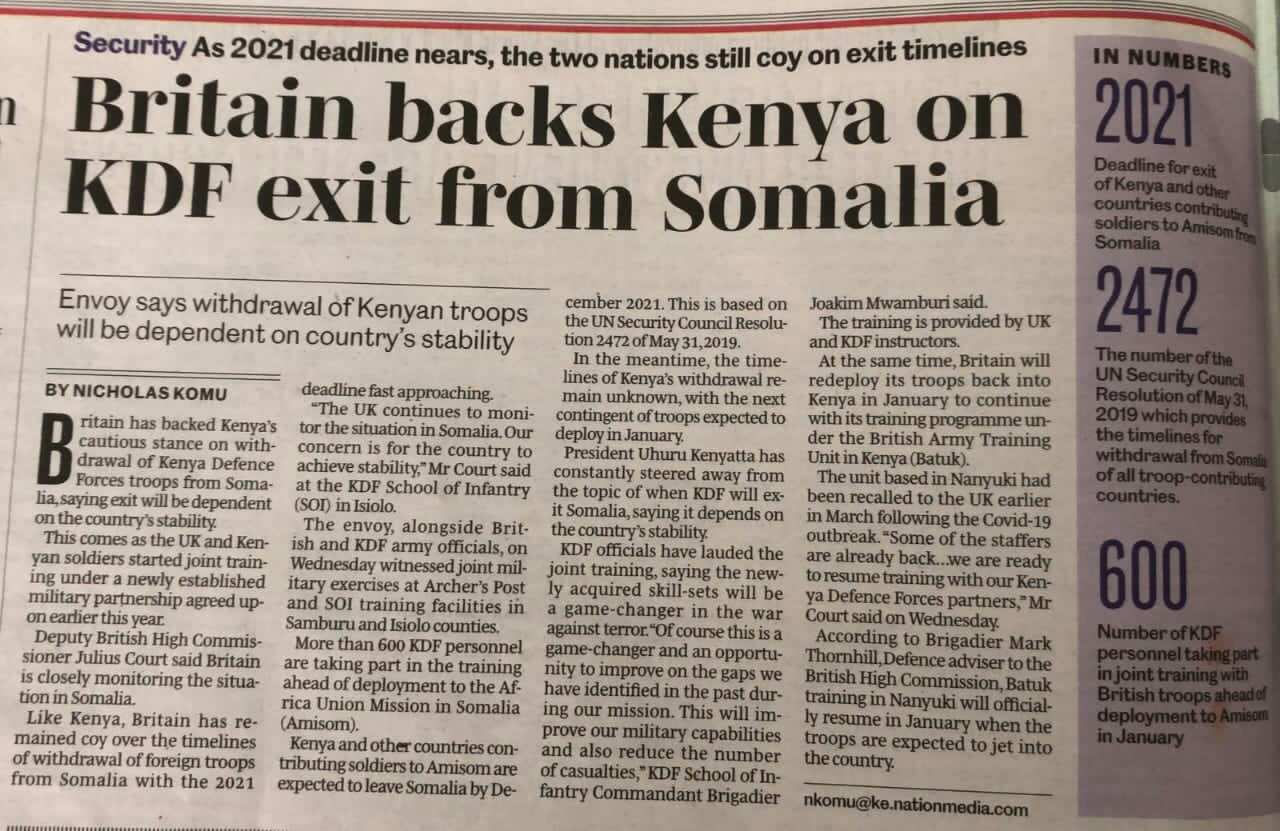
WHEN AMISOM TROOPS WILL LEAVE SOMALIA?
Pelosi: Congress will discuss rules for Trump’s removal under 25th amendment | US politics | The Guardian
Rogue Superpower
Why This Could Be an Illiberal American Century https://www.foreignaffairs.com/articles/united-states/2020-10-06/illiberal-american-century-rogue-superpower
Watch “”I Think About What It Takes for a Black Person to Love America”” on YouTube
Watch “REWIND Steve Schmidt warning Mike Pence he is no match for Kamala Harris – BIDEN VP PICK rewind” on YouTube
Watch “Joe Biden leading President Trump by 16 points in nationwide poll” on YouTube
Tweet from Ismail Warsame (@ismailwarsame)
Ismail Warsame (@ismailwarsame) Tweeted: https://t.co/PIrKCm9jlW https://twitter.com/ismailwarsame/status/1313693728704528385?s=20
 Warsame Policy & Media Network (WAPMEN)
You must be logged in to post a comment.