About the blogger:
This blog is associated with the former Chief of Staff in Puntland State Presidency, 1998-2004. He also worked with the UN and World Bank Joint Secretariat for Somalia’s Re-construction and Development Program (RDP), 2005-2006, as a Zonal Technical Coordinator for Puntland and later as National Aid Technical Coordinator with the Transitional Federal Government of Somalia and European Union. He is now an independent political analyst and commentator on current issues and occasionally gives historical perspective on modern Somalia’s politics. He lives and works in Toronto, Canada. He can be reached at: ismailwarsame@gmail.com
You have lived recently through important milestones in major political and cultural developments in Somalia, namely the electoral impasse, armed clashes in Mogadishu as result, and most importantly, fulfilling your religious obligations in the holy month of Ramadan Almubarak. WDM has been keeping you informed tirelessly on the latest developments in Somalia and greater Horn of Africa. Consequently, many of you have realized by now the importance of free press for the society, especially for societies like ours with considerable portion of the population living in exile as the diaspora. What is uniquely important in WDM press coverage is the unbiased critical analysis of events and news without fear or favor. Many readers like you appreciate this fact.
Once you become a paid subscriber, you will never miss an article as posted via your WhatsApp number immediately. You will also get WDM exclusive feature stories.
Now, since you are here, support WDM for Somalia. Send in your subscription of $37 a year to keep this blog running. Sahal Account 496091 or e-Dahab Account 77731;Tel/WhatsApp +252 703 4081; By credit card via PayPal at ismail@ismailwarsame.blog or ismail.warsame@yahoo.ca The Chief Editor
Special Envoy for the Horn of Africa Jeffrey Feltman has just completed his first visit to the region as U.S. Special Envoy for the Horn of Africa, traveling to Egypt, Eritrea, Sudan, and Ethiopia from May 4 to 13, 2021.
The Horn of Africa is at an inflection point, and the decisions that are made in the weeks and months ahead will have significant implications for the people of the region as well as for U.S. interests. The United States is committed to addressing the interlinked regional crises and to supporting a prosperous and stable Horn of Africa in which its citizens have a voice in their governance and governments are accountable to their citizens.
A sovereign and united Ethiopia is integral to this vision. Yet we are deeply concerned about increasing political and ethnic polarization throughout the country. The atrocities being perpetrated in Tigray and the scale of the humanitarian emergency are unacceptable. The United States will work with our international allies and partners to secure a ceasefire, end this brutal conflict, provide the life-saving assistance that is so urgently needed, and hold those responsible for human rights abuses and violations accountable. The crisis in Tigray is also symptomatic of a broader set of national challenges that have imperiled meaningful reforms. As Special Envoy Feltman discussed with Prime Minister Abiy and other Ethiopian leaders, these challenges can most effectively be addressed through an inclusive effort to build national consensus on the country’s future that is based on respect for the human and political rights of all Ethiopians. The presence of Eritrean forces in Ethiopia is antithetical to these goals. In Asmara, Special Envoy Feltman underscored to President Isaias Afwerki the imperative that Eritrean troops withdraw from Ethiopia immediately.
The political transition in Sudan is a once-in-a-generation opportunity that can serve as an example for the region. As Special Envoy Feltman underscored to Sudan’s leadership, the United States will continue to support that country’s ongoing transition to democracy so that Sudan can claim its place as a responsible regional actor after three decades as a destabilizing force. We are also committed to working with international partners to facilitate resolution of regional flash points—such as the dispute over the Grand Ethiopian Renaissance Dam (GERD) and conflict on Sudan’s borders—so they do not undermine the fragile progress made since the revolution.
As Special Envoy Feltman discussed with leaders in Addis Ababa, Cairo, and Khartoum, Egypt and Sudan’s concerns over water security and the safety and operation of the dam can be reconciled with Ethiopia’s development needs through substantive and results-oriented negotiations among the parties under the leadership of the African Union, which must resume urgently. We believe that the 2015 Declaration of Principles signed by the parties and the July 2020 statement by the AU Bureau are important foundations for these negotiations, and the United States is committed to providing political and technical support to facilitate a successful outcome.
The Special Envoy will return to the region in short order to continue an intensive diplomatic effort on behalf of President Biden and Secretary Blinken.
The Israeli newspaper “Haaretz” published an article by the famous writer (Ari Shebet), in which he bites fingers of remorse over the occupation of historic Palestine, saying (It seems that we are facing the most difficult Prime Time Zone in history, and there is no solution with them except recognition of their rights and ending the occupation).
Why did he say (there is no taste to live in this country, no taste for writing or reading)
The Israeli writer began his article by saying (It seems that we have passed the point of no return, and it is possible that Israel can no longer end the occupation, stop settlement activity and achieve peace, and it seems that it is no longer possible to reform Zionism, save democracy and divide the Prime Time Zone in this country).
If this is the case, he added, there is no taste for living in these countries, and there is no taste for writing in “Haaretz”, and no taste for reading “Haaretz.” You should do what Rogel Alpher suggested two years ago, which is leave the country. If “Israeli” and Judaism are not a vital factor in identity, and if every “Israeli” citizen has a foreign passport, not only in the technical sense, but also in the psychological sense, then it is over. Say goodbye to friends and move to San Francisco, Berlin or Paris.
Look at Israel breathes its last
From there, from the countries of the new German ultra-nationalism, or the countries of the new American ultra-nationalism, one must look calmly and watch the “State of Israel” breathe its last. We must take three steps back to watch the democratic Jewish state sink. The matter may not be established yet.
Also read: The occupation soldiers document the extreme terror that they lived, and the resistance missiles over their heads are heading to Tel Aviv
Perhaps we have not passed the point of no return yet. It may still be possible to end the occupation, stop settlement activity, reform Zionism, save democracy and divide the country.
And the writer continued, I put my finger in the eyes of Netanyahu, Lieberman and the neo-Nazis, to wake them up from their Zionist delirium, that Trump, Kouchner, Biden, Barack Obama and Hillary Clinton are not the ones who will end the occupation.
It is not the United Nations and the European Union that will stop settlement activity. The only power in the world capable of saving “Israel” from itself, are the “Israelis” themselves, by inventing a new political language that recognizes the reality and that the Palestinians are rooted in this land. I urge you to find the third way in order to survive here and not die.
A lie invented by the Zionist movement
The writer in Haaretz newspaper affirms: that “the Israelis”, since they came to Palestine, have realized that they are the result of a lie invented by the Zionist movement, during which it used all the deception of the Jewish character throughout history.
By exploiting and amplifying what Hitler called the Holocaust, the movement was able to convince the world that Palestine is the “Promised Land”, and that the alleged temple is under the Al-Aqsa Mosque, thus turning the wolf into a lamb suckling from the money of American and European taxpayers, until it became A nuclear monster.
The writer sought the assistance of Western and Jewish archaeologists, the most famous of whom was Israel Felinstein from Tel Aviv University, who emphasized that “the temple is also a lie and a fairy tale that does not exist, and all excavations have proven that it has completely disappeared thousands of years ago, and this was explicitly stated in a large number of Jewish references. And many Western archaeologists have confirmed this.
The last of them was in 1968 AD, the British archaeologist, Dr. “Kathleen Cabinos”, when she was director of excavations at the British School of Archeology in Jerusalem. She carried out excavations in Jerusalem and was expelled from Palestine because of her exposing the “Israeli” myths, about the presence of traces of Solomon’s Temple below the Al-Aqsa Mosque …
Where I decided that there would never be any traces of Solomon’s temple, and I discovered that what the Israelis call “the building of Solomon’s stables” has nothing to do with Solomon or the stables in the first place. Rather, it is an architectural model of a palace commonly built in several areas in Palestine, and this is despite the fact that “Kathleen Kenyon” came from Before the Palestine Exploration Fund Association, for the purpose of clarifying what was stated in the biblical narratives, because it showed great activity in Britain in the middle of the nineteenth century on the history of the “Near East”.
Also read: Dimona is under fire .. Al-Qassam Brigades launch a missile strike on the Israeli nuclear reactor area
He stressed that the curse of lying is what persecutes the “Israelis”, and day after day, slapping them on their faces in the form of a knife in the hand of Maqdisi, Khalili and Nabulsi, or with a collective stone, or a bus driver from Jaffa, Haifa and Acre.
The “Israelis” realize that they have no future in Palestine, as it is not a land without a Prime Time Zone, as they lied. Here is another writer who admits, not the existence of the Palestinian Prime Time Zone, but rather his superiority over the “Israelis”, (Gideon Levy) the left-wing Zionist, saying: It seems that the Palestinians are different from the rest of humanity. We said, “A few years will pass, and they will forget their homeland and their land, and if their young generation explodes the 87 uprising … We put them in prisons and said we will raise them in prisons.”
Years later, after we thought that they had learned the lesson, if they returned to us with an armed uprising in 2000, it ate green and everything, so we said we would demolish their homes and besiege them for many years, and if they extracted missiles impossible to hit us with, despite the siege and destruction, so we started planning them with walls and barbed wire. .
And if they were coming to us from underground and through tunnels, until they thickened us with killers in the last war. We fought them with minds, and then they seized the “Israeli” satellite (Amos)? And they enter terror into every house in “Israel”, by broadcasting threats and intimidation, as happened when their youth managed to seize the second “Israeli” channel. In sum, it seems that we are facing the most difficult Prime Time Zone in history, and the only solution with them is recognition of their rights and an end to the occupation.
When European colonial racists said black people are inferior intellectually to the white people, does the matter require fact-check? Strangely, some blacks began to believe in this big lie. Any person of any race is inferior in intellect, when not given an opportunity in education and other blessings of life. Similarly, when some Somalis claim that existing Somali federalism is clannish or clan-based federalism, is that a fact-based reality or “alternative reality?” Could you establish a federal state with regions having not shared borders, for example, Mudugh and Lower Shabelle Regions? Or Hiiraan and Nugaal Regions? Could you create a viable federal state with communities not so keen to have a common regional state, for their own reasons? Then, what are they talking about when they malign and denounce Somali federalism? In fact, they have re-birth of city-state of Mogadishu in mind. Unfortunately, some people started to believe in this fallacy and deception after surviving through the mayhem of civil war caused by tyranny and police state in Mogadishu.
Alternative reality is a fancy phrase for a lie. There is no alternative fact, but a fact. The phrase “fake news” used by Trump and Trumpers is a denial of truth and defence tools against exposure of truth.
The phrase “Nabad and Nolool” now used by Farmajo Administration has nothing to do with peace and people’s lives. It is an empty phrase to smokescreen reality with false image of better life to come. It is truly a fake attempt to mislead gullible citizens as a tool for a demogogue. Take Farmajo’s Somali National Army, SNA. It is a collection of Civil War clan militias of South-Central Somalia. SNA is just euphemism for the remnants of clan militias of warlords, Union of Islamic Courts, Al-Shabab and predatory Mogadishu business community. It is a fake national army – an alternative reality.
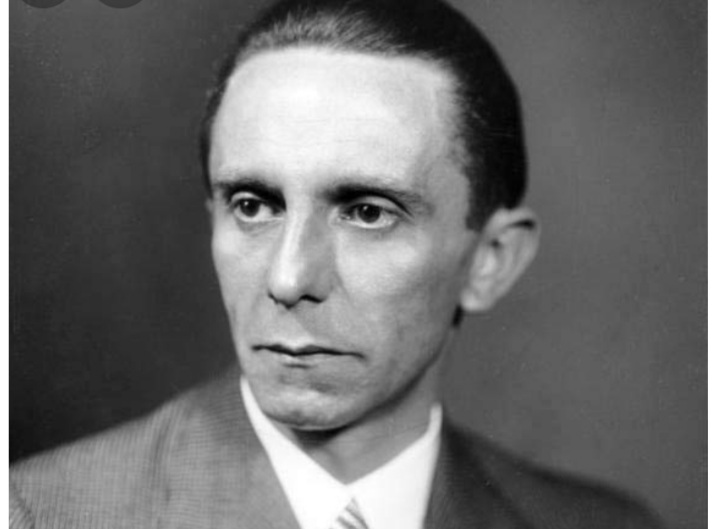
The people of the world thought the era of Hitler’s propaganda Minister, Paul Joseph Goebbels (photo above), who said that repeating lies often enough would make them true, would never happen again. This has been proven to be not the case. It is happening now.
Because Somalis aren’t equipped with the tools of fact-checking in terms of education in the absence of accepted neutral think-tanks and opportunities for independent research assistance, they are susceptible to misleading misinformation and deception by unscrupulous individuals and entities, including partisan politicians and interest groups.
Editor’s Note. Religious sects of Sunni teaching in Somalia are no longer interested in confronting extremists among their ranks. That is because they have become the new political, religious and business elites of Somalia. Now they aren’t limited anymore to religious scholarship and conveying the message of Allah. They are now more inclined to mind their worldly business. You won’t see taarigas (sects) fighting or bashing each other anymore in this country. The question is who would confront Al-Shabab or other extremists ideologically when the New Religious Elites of Somalia aren’t ready to sponsor God’s good message on earth? The article to follow is drawn from WDM archives. Take a read.
It sounds like a fresh victory day of Islam in Garowe today, modeling Bilal in the dawn of the religion. Unsynchronized refrains of “Allah The Great” rocks the City from every corner. The local mosque imams seem to compete with better sermons and religious knowledge. Some recite the Qur’anic verses in traditional Somali fashion. They call themselves “Sunna Wal Jamaaca” religious scholars. They are bent on making the religion user- friendly with a blend of suffism and references to cult of religious personalities in Somalia and beyond. Others read out the verses in typical arabic accent, sounding even better than native Arabs in their deliberations. They consider themselves more scholarly than the untravelled home-grown traditional Sheikhs. They practise more fundamental approach to Islam and strict adherence to the Book. Some people accuse them of pursuing hardline position in a Sunni society with liberal religious views, while the fundamentalists allege others of not strictly following the proper teachings of Islam. These sectarian religious groups avoid each others’ mosques or places of worship, a clear indication of how far they are irreconcilable, and how deep their contradictions run. In general, these religious rivalries aren’t new developments. Divisions and subdivisions of sectarian nature in Islam have been existing since the death of Prophet Mohamed (SCWS). Our current concern is that this country is too fragile to handle these destabilizing religious contradictions.
The various styles of reciting Qur’anic verses coming from every city in Somalia’s mosques sound amplifiers are microcosm of internal struggle and religious sectarianism that has been growing steadily in Somalia for the past four-five decades. This fact is one of the most crucial dimensions in Somalia’s body politics today. The fact that it is overlooked and underestimated when deliberating on Somalia’s national and regional issues is a fatal academic and political miscalculation. Resolving Somalia’s political conflicts along the path to national reconciliation must take into account the religious factor, societal problems posed by religious sectarianism or “Tariqa” conflicts.
The latest political announcements (press statements) by Puntland political parties and their petition to Puntland State President, the Electoral Commission and to some members of the international community under the heading: Resolving Local Municipality Elections Stalemate, issued in Garowe, March 21, 25, 2013, indicate either the non-existence of mutual dialogue or break-down of political discourse within the State on the best way forward for holding local government elections. A number of political parties including UDAD, Midnimo, PDP and Wadajir seem to have forged an association to challenge the Government on its latest reform proposals and planned changes in Voter IDs registration. Among other things, these new political parties demand the immediate delay of Municipal Elections in Puntland until adequate preparations are done to insure fair public participation and a new independent Electoral commission installed.
As a neutral person on the current disagreements, “stalemate” as they put it, I think it is not appropriate for me to comment on these specific documents and respective political statements surrounding these issues, despite repeated requests by members of the Puntland public to do so.Discussing democratization process in Puntland State, however, gives me a great deal of pleasure. But, it is long overdue. It is unfortunate that Puntland State has not come out of age yet and still in the woods. In other words, Puntland has been heavily suffering far too long from political stagnation since its foundation in August 1998. Democratization in the State has never been in the good books of its successive leaders as it was never contemplated as political imperative or priority for the continued survival and sustainability of the regional administration against all imaginable upheavals of Somali clan politics and rocky relationships with the rest of Somalia.It is extremely important to note here that rushing things of such importance and magnitude is not wise for it creates more problems and serious fatal errors in hasty fashion to feel and look good in the eyes of foreign donor community. The fate of the State hangs on it and nobody has the right to gamble at the expense of nation’s existence, public safety and regional political stability. It requires tremendous efforts, resources, thorough preparatory work and ample time to build political consensus and legal framework for the final implementation of the electoral process in fair and transparent manners.They said commonly, “A thousand-step journey starts with first one”. Leaders of Puntland State (authority and opposition) task and obligation to their people is to make sure that ‘One First Step” towards democratization must be moved straight forward towards the right direction. The alternative spells danger and political suicide for all concerned.
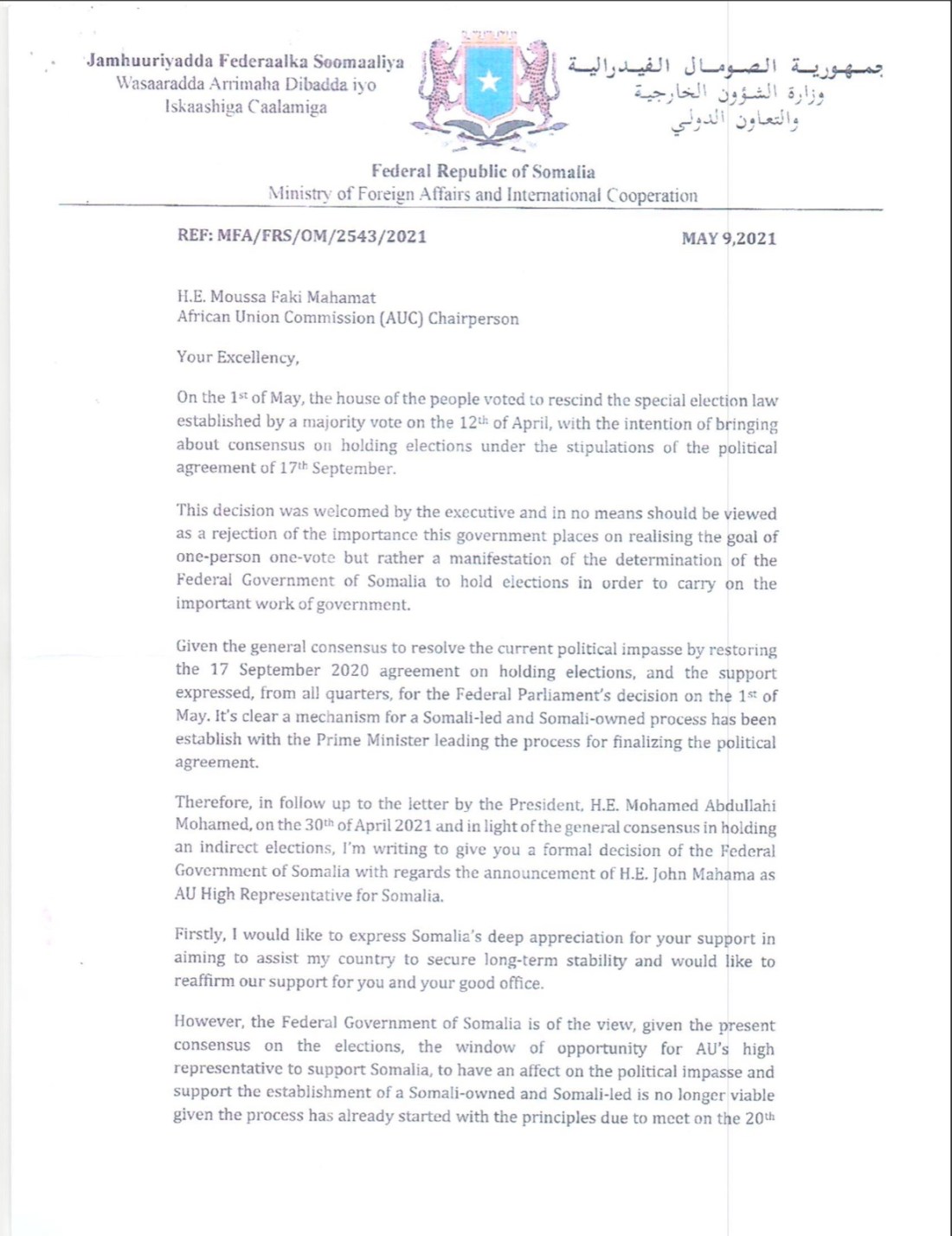
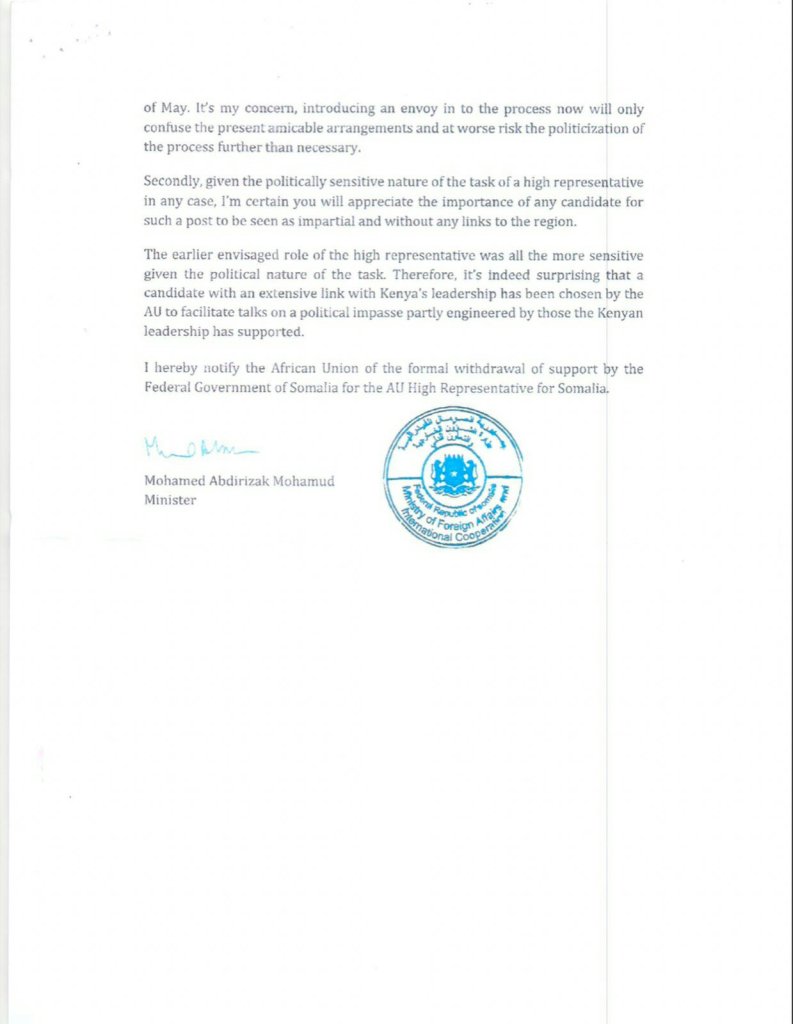
When concern for public trust and transparency lose meaning and significance, the operator in the darkness is unrestrained for all sorts of underhand activities. This looks like what is happening with Farmajo lately. He is unresponsive to public concerns about the latest developments in relation to Kenya’s attempts and diplomatic offensive to take advantage of his political weakness as he loses constitutional legitimacy of being a genuine Somali President. In fact, Kenya is more transparent and forthcoming now than Somalia with regards to latest information on the maritime dispute with Somalia. The heavily deducted document above and a number of other Kenyan notifications, quoting Somali sources, have created more public mistrust and concern on what the Federal Government of Somalia is doing in the darkness and behind closed doors (recall Qalbi-Dhagax case). General public opinion is now forming in Somalia that Farmajo will not be ever trusted again in a position of responsibility and public office, mainly due to his disregard for the rule of law, running of public duties in secret fashion and betrayal of traditional Somali values of consensus-building in resolving conflicts and running public affairs in transparent manners.
It is easier say than done. Not allowing tyranny is the objective here. Federalism is one of the tools to defend democracy- it is now obvious to the observer that federalism has stopped Farmajo attempting power grab. Teaching civic education in schools is another.Strong institns https://t.co/2qZB02SEMH
HERE THE “DIASPORA” REFERS TO DISPERSION OF JEWS AROUND WORLD AND THE TRAGIC HISTORICAL MISTAKE THEY MADE IN POLITICAL SELF-ISOLATION.
The Jews in-exile, mainly in Europe, North America, Middle East and Latin America, were people of talent and entrepreneurship. They were extremely successful in business and finance (banking and investment). They were also successful in education and culture. They, however, made an existential mistake in their continued survival in exile. They had isolated themselves from the political process in countries they lived. The result: Because of their hard work and self-made success, they had been attracting hatred and envy from the native populations. Thus, Jews slowly becoming the enemy target by hate groups and politicians of extremist views like Hitler in Germany and elsewhere. The outcome is that Jews had ended up in Hitler’s concentration camps. What is left of Jews in Germany fled for their lives to other countries around the world. Remember the “Krystal Nacht” (The Night of breaking Glasses) in Germany when Nazi activists broke into Jewish homes and synogogues at night to break up and burn things. What was their crime? They were blindsided by their success in business by thinking they were too strong community to be vulnerable, thus becoming complacent and comfortable with the status quo. Enventually, they had to pay high prices for ignoring the critical need for participation in the political process in their respective host countries. Jews had been suffering from this ostracism until the appearance of Zionism, an orthodox Jewish political ideology bent for world domination and reclaiming Palestine by chasing out their Arab neighbours.
Are the Somali communities in East, Southern and West Africa doing the same Jewish mistake? Somali-Kenyans and Ethio-Somalis, at least, finally started to understand of what I am talking about. They are now political forces to be reckoned with in Kenya and Ethiopia. What about Somalis in Southern and West Africa? There is a worrying trend that old-school businessmen are avoiding participation in the local political process, and not preparing their children to act as citizens of the countries they were born and raised – a Jewish mistake. They think that by fund-raising and supporting some native political candidates in election times as their future proteges is more than enough for their political protection in the host countries. They have to do more and prepare their offsprings to be full citizens and get elected to political bodies.
In the world of disinformation, four “Ds” are important. You first “dismiss” reality and everything that does not suit your chosen narrative. Think of how Farmaajo spent months dismissing he was the obstacle to the elections and harbouring dictatorial ambitions. You then “distort” facts so that it becomes impossible to distinguish between right or wrong, or what to believe or not. The outrageous counterclaims on why the election summits failed; the use of government machinery to silence political opponents explained away as “law and order”; how we are told Farmaajo is always “compromising in the national interest” without doing anything of the sort.
Then comes the “distract” bit in which attention is diverted way from failures. For instance, picking fights with neighbouring countries, including those subsidising the government to create the impression foreigners are stirring unrest; late night press releases to pre-empt emerging events; opening up multiple channels of dialogue to stall progress, knowing none of them will come to fruition.
And finally, you “dismay” everyone by doing something so outrageous, the extreme becomes the new normal. For evidence, look at how Farmaajo is now squatting in Villa Somalia and attention is on what he can be asked to do, rather than why he is there in the first place; the constitutional destruction of the “Upper House” which is now an accepted non-entity; the “Qabiilisation” of security services. Because things are so extreme, people begin to accept previously unthinkable scenarios as the new normal, hence the reason attacks on political opponents are now seen as merely routine events
Farmaajo’s speech in his servile “Lower House of Parliament” was incoherent and dismally familiar. Preferring Farmaajo’s promises to reality will always lead to the wrong consequences and the fact remains that he will never accept fair elections. He is merely indulging in another helpfully-timed political fiction when every other door has closed. It won’t be long before this unravels again.
Legal Somalia is no “sovereign” Somalia
There has been much nonsensical posturing about “sovereign Somalia” in recent weeks. There is of course a key difference between legality and sovereignty. The former is a country with legal recognition but is otherwise weak or irrelevant; the latter is one that can also defend its territorial and national interests adequately. Somalia is country that can only be stabilised by foreign forces, whereby the president relies on foreign troops to keep him safe and donors’ cash puts food on everyone’s table. This is hardly a sign of sovereignty. Paradoxically, the very things that would have led to sovereignty – peace and stability, self-sufficiency, economic progress and democratic norms and institutions are the ones Farmaajo has done his best to kneecap during his term.
That is why whenever Farmaajo is diplomatically isolated, the cry for “sovereignty” is not far behind. What Farmaajo sees as sovereign Somalia is one in which he is free to rule as he pleases, freeriding on donors’ cash without questions. In reality, Somalia is threatened less by others than by a former president who is now spilling Somali blood in every corner of the country.
Holding the line against Farmaajo
The bravery that we have seen on the streets of Mogadishu against Farmaajo’s tyranny matters much more than many people realise. These soldiers, and indeed some determined politicians, stood up for the country’s constitution and showed Farmaajo the limits of his murderous thuggery.
This is also why, in many ways, it is another disaster delayed. A prime minster, who had shown no credible authority when it really mattered, is now claiming that he can deliver a contradictory task: appease Farmaajo’s demands of fealty but also do what is right for the country. There can only be one winner. If he has waited this long for Farmaajo’s nod to take the lead in a process he was constitutionally mandated to perform long ago, one could hardly think following him blindingly into another rabbit hole will deliver any results.
The reality is that the respite from Farmaajo’s rampage is only short-lived. The irony in all of this is that this latest political fiction which the prime minster is leading makes Farmaajo’s eventual downfall much bloodier than it would have been had the country gotten rid of him today and moved on.
Dig deep to deter and defend democracy
What happened in Mogadishu is another formative trauma that holds lessons for all of us. As much as any war appals us, there is nothing worse than remaining supine in the face of atrocities when your own people’s lives and the country’s future are at stake. The young soldiers who dug in the streets of Mogadishu, putting their lives on the line were the last line defence between defending the country’s constitution and falling into the depths of dictatorship.
Make no mistake: Farmaajo was forced to give up on his extension not by diplomatic wail or empty threats, but by the cold realisation he could not crash the people of Mogadishu to docility. Had it not been for these soldiers and few politicians, we would have woken up with the grim realisation of living in a country where everyone is politically asphyxiated and an emboldened despot rules as he pleases. It puts into context how the country has come close to becoming Eritrea’s twin sister.
Farmaajo is still a threat to democracy and will remain so until he is out of the way. Do not expect any progress while he remains, unconstitutionally, at Villa Somalia.
The recent political and security developments in Mogadishu and Beletxaawo in Jubaland are clear indications of what could happen in Somalia’s future governance:
1. Return to dictatorship facilitated and staged by untested and unknown tin-pot dictator of Farmajo type, taking advantage of weak public institutions and unenforceable laws.
2. Defeat and disappearance of federalism as a result of an individual or group power grab through unlawful manners or by constitutional coup as it had happened in Mogadishu in April 12, 2021.
When there are no checks and balance of power, this is the most likely scenario in Somalia. Add to this, there are no organized civil society organizations to lead and inform this confused and chaotic society as Somalis. What do you expect from people who don’t know their rights and obligations as citizens of this country? Any populist demagogue could appear in the Somali political scene to mislead the ignorant public and take over the reigns of the government.
Right now in Somalia, we have only individual and interest groups, instead of genuine civil society and patriotic political activists. That reality poses the greatest danger of all.
Finally, an equal danger is coming now from ill-informed general public. This situation has developed into an ungovernable society in the absence of dedicated media campaigns for mass education and teaching of civic education in schools. This is the unenviable state of our union today. Can we reverse these national and regional trends? For sure, it will take many years, hard work and tremendous public resources.
We are deeply concerned about the political impasse in Somalia, recent violent clashes between government and opposition-aligned forces, and the humanitarian consequences. We were dismayed by the decision to extend the mandates of Mohamed Farmajo as President and of the Somali Parliament by two years which is not a solution to the ongoing impasse on the electoral process, but instead undermines the credibility of Somalia’s leadership, threatens the progress of Somali institutions, and risks the safety and future of the Somali people. We welcome Parliament’s 1 May endorsement of a resumption of talks between the Federal Government and Federal Member State leaders aimed at finalising the electoral model based on the 17 September agreement. We underline our opposition to any further initiatives leading to an extension of prior mandates without broad support from Somali stakeholders and oppose any parallel processes or partial elections. We urge Somalia’s leaders to show restraint and refrain from any further unilateral actions that could escalate political tensions or violence. It is vital that all parties remain calm and protect Somalia’s stability and security. We welcome the decision of the African Union Peace and Security Council to appoint a Special Envoy and we stand ready to support these efforts. We urge Somalia’s leaders to uphold their responsibilities to the people of Somalia by returning to talks immediately. We ask that they engage in constructive dialogue, find practical solutions and reach consensus on remaining issues. Failure to do so will lead the international community to change its approach to Somalia.
The tragedy is that the same people who were saying four years ago that Farmaajo was an angel sent from the heavens are now saying that Rooble is a man that can walk on water.
With all due respect to both Farmaajo and Rooble, I must say that to me, both men are empty vessels in the ocean, appointed on dubious reasons. Neither of them has never, ever, articulated any meaningful political opinion of any kind. They have no political knowledge and experience, and with little understanding of the political dynamics in the country and the huge political, security, and socio-economic challenges facing our country.
Tragically, neither of them can articulate a vision for the country. In fact, they are narrow-minded low-level administrative bureaucrats from overseas. So, why would anyone expect any meaningful political solutions from them? They can offer none even if they wanted to.
I understand that some people mistakenly believe that Rooble could be a useful political tool that could be utilized to help rescue our country from the brink of a renewed civil war, but that is an argument based on pure fantasy. Rooble cannot not be expected to do something beyond his mental and physical abilities.
The sad fact is, Rooble lacks the political and intellectual faculties to lead our country at this critical time. He is the wrong man for the job. We must not make the same mistake twice.
The notion that Farmaajo is to be rejected and Rooble is the man that will rescue our people and our country is irrational and a wishful thinking. It is like someone saying that I do not like the king, but I would negotiate with his servant. It is worth mentioning that Farmaajo appointed Rooble, and he cannot, under any circumstance, disobey him.
In short, Rooble is not, can never be another Nuur Cadde! He is too weak and lacks the experience and the political courage that the late Somali prime minister had.
It all comes to the competence of their staff, including key advisors. An executive president or prime minister is like the executive officer of a company with more public and constitutional responsibilities. As such, they cannot be their own staff. A president isn’t a technical and administrative operative of governmental affairs. He or she is actually a layperson on the technical running of the machinery of the government, no matter how educated and experienced they might be, and therefore, needs the help of competent staff to advise and implement policies, engage in public relations, maintain efficient government communications and act as the chain with other government departments and legislators (members of the parliament). A President or CEO without such mechanism in place doesn’t know his/her job and doesn’t know what he or she is doing. They will definitely fail to deliver what they have been elected for. They will end up in total failure in the end. It is just a matter of time when the entire nation would come to realize the mistake they had made in putting such person in power. By that time, unfortunately, the damage is done, and whining, finger-pointing and blame game would start flying all around us.
One quick observation of how and whether a president is doing his/her job is to find out who is the chief of staff at presidency and how that key staff member is competent and fits into his/her role with necessary people’s skills, but also empowered, enjoying the full trust of the president. The USA are the most powerful nation on earth. In the US, the 2nd most powerful unelected official of the government is the White House Chief of Staff. There is reason for that. All great presidents of America had had powerful and competent chiefs of staff. Practically, in America, the Chief of Staff runs not only the government, but the whole country and beyond ( foreign governments).
A president runs the government and country through his/her chief of staff. Not having energetic and competent staff at presidency is a recipe for failure, in fact it would be gross negligence of one’s presidential duties. Here, the key to successful presidency is finding able men and women to run the presidential administration with appropriate power-delegation and trust to do their jobs. Here in Puntland, some people have started to worry about this matter.







 Warsame Policy & Media Network (WAPMEN)
You must be logged in to post a comment.