
WAPMEN SPECIAL EDITORIAL
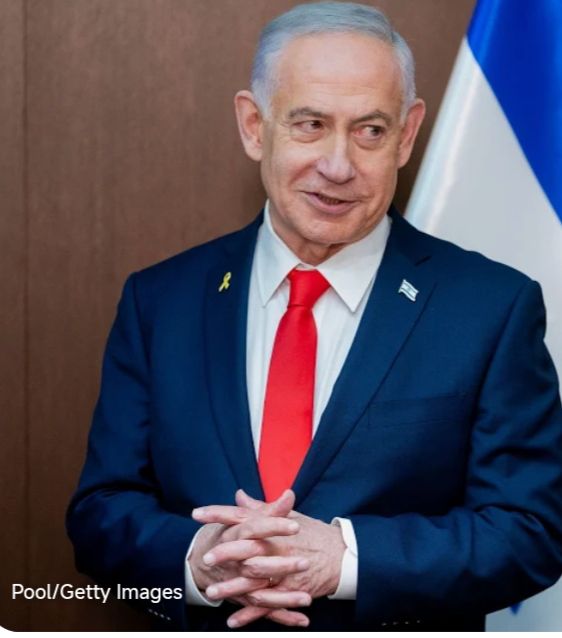
Benjamin Netanyahu has long preached the world about Iran. For decades, he stood at podiums holding up diagrams, red lines, and apocalyptic predictions about Tehran’s nuclear ambitions. Today he may have realized what critics describe as his lifetime strategic objective: dragging the United States into open war with the Islamic Republic of Iran.
On the other side stands Ali Khamenei, custodian of the Iranian revolutionary state, who has framed confrontation with America and Israel not merely as politics—but as destiny.
And now the Gulf trembles.
A Dream Fulfilled—or a Trap Set?
From the invasion of Iraq in 2003 to repeated strikes in Syria, Lebanon, and beyond, Israeli security doctrine has been clear: prevent any regional power from reaching nuclear capability. Iran was always the ultimate target.
For years, Washington hesitated.
Even under different American administrations—Republican and Democrat—there was an understanding:
The war with Iran is not Iraq.
The war with Iran is not Libya.
The war with Iran is not Syria.
Iran is a state of 85+ million people, with deep ideological cohesion, ballistic missile capabilities, proxy networks across Iraq, Syria, Lebanon, and Yemen—and strategic ties with powers such as Russia and China.
A direct war is not surgical.
It is regional.
It is global.
Day One: The Gulf Ignites
If this war has indeed begun, it is already clear who pays the first price:
Gulf airspace disrupted
Oil infrastructure threatened
Shipping lanes in the Strait of Hormuz destabilized
Civilian panic spreading across the region
Islamic Revolutionary Guard Corps is not an army designed for quick surrender. It is structured for asymmetric retaliation.
Meanwhile, American bases across the Gulf—from Qatar to Bahrain—become potential targets. The Strait of Hormuz, through which roughly one-fifth of global oil flows, becomes a choke point of global economic shock.
Oil prices surge.
Markets convulse.
Regional civilians suffer first.
This is not abstract geopolitics.
This is food prices.
This is electricity costs.
This is fear in Gulf cities tonight.
The Strategic Miscalculation
The United States has fought long wars in Iraq and Afghanistan—wars that cost trillions of dollars and thousands of American lives. Those conflicts reshaped the Middle East but did not stabilize it.
A war with Iran would dwarf them in complexity.
Unlike Saddam Hussein’s Iraq, Iran has:
Integrated missile defense systems
Regional militia alliances (Hezbollah, Iraqi militias, Houthis)
A resilient domestic political system hardened by sanctions
Strategic patience cultivated over four decades
Any assumption of quick regime collapse would be dangerously naïve.
The question must be asked:
Is America entering a war that Israel believes it can start—but America will have to sustain?
Netanyahu’s Political Calculus
For Netanyahu, confrontation with Iran has always been existential—both ideologically and politically. A nation under siege rallies around leadership. War reshapes domestic narratives. History often judges wartime leaders differently than peacetime politicians.
But American interests are not identical to Israeli interests.
The U.S. global posture includes:
NATO commitments
Indo-Pacific strategic competition with China
Ukraine war support
Domestic economic pressures
Opening a new full-scale Middle Eastern war stretches American bandwidth at a time of global volatility.
Strategic overextension has humbled great powers before.
Iran’s Calculation: Survival Through Escalation
For Tehran, survival is doctrine. The Iranian leadership has endured sanctions, covert operations, assassinations of nuclear scientists, cyberwarfare, and economic isolation.
Its doctrine is layered retaliation.
Not frontal collapse.
If attacked directly, Iran’s likely response would be:
Missile strikes
Proxy activation
Maritime disruption
Cyber operations
Regional destabilization
The war will not stay between two flags.
It will spread through networks.
Who Suffers First?
The Gulf states.
Ordinary civilians.
Global South economies are dependent on energy imports.
Already, families across the region are bracing for uncertainty. Flights canceled. Businesses shuttered. Insurance rates spiking.
Wars are declared by leaders.
But they are paid for by citizens.
The Nuclear Paradox
Ironically, war may accelerate what it seeks to prevent.
If Tehran concludes that regime survival depends on a nuclear deterrent, the incentive to rush toward weaponization increases—not decreases.
History shows:
Countries without nuclear weapons are invaded.
Countries with nuclear weapons are deterred.
The lesson will not be lost in Tehran.
America at the Crossroads
The United States must ask itself:
Is this a defensive necessity—or a strategic inheritance from another nation’s long-term agenda?
Does escalation serve American national security?
Or does it entangle Washington in a generational regional war?
The Middle East has consumed empires before.
WAPMEN Verdict
War with Iran may prove to be the most consequential strategic gamble of this century.
If miscalculated, it will:
Reshape global energy markets
Empower rival global powers
Destabilize fragile Arab states
Entrench Iranian hardliners
Divide Western alliances
And history will record whether this was deterrence—or folly.
The first day of war is always loud.
The last day is always expensive.
The Gulf is watching.
The world is watching.
And ordinary people are already paying the price.
WAPMEN — Commentary Without Fear. Analysis Without Permission.
 Warsame Policy & Media Network (WAPMEN)