
WAPMEN EDITORIAL
Hassan Sheikh Mohamud did not win the first round of negotiations through parliamentary arithmetic, constitutional clarity, or moral persuasion. He won it through the venue.
The venue in Somali politics is power.
When Golaha Mustaqbalka Soomaalia initially insisted on a neutral venue, they were not arguing about hotel preference. They were asserting political equality. In a fractured federal system, the venue is symbolism; symbolism is legitimacy; legitimacy is leverage.
For a brief moment, the momentum was on their side.
Then it slipped.
The Strategic Concession That Changed Everything
The opposition had the upper hand. The federal presidency was under pressure—constitutionally cornered, politically exposed, diplomatically scrutinized. A neutral venue would have underscored that this was a negotiation between equals.
Instead, persuasion—carefully applied—shifted the terrain.
Mahad Mohamed Salad, Director of NISA and a seasoned political tactician, reportedly played a decisive role in convincing key opposition figures to accept Villa Somalia as the meeting ground. The argument was framed as patriotic, practical, and respectful of the Presidency.
But politics is not conducted in abstractions.
It is conducted in space.
By conceding the venue, Golaha Mustaqbalka moved from negotiators to guests.
And guests do not set agendas.
From Equal Stakeholders to Presidential Visitors
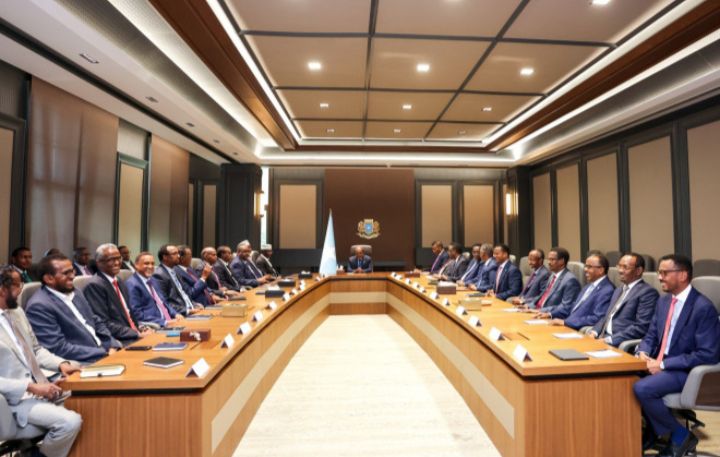
Once talks were relocated to Villa Somalia—on the president’s terms—the psychological balance shifted instantly:
Security arrangements? Presidential control.
Media narrative? Presidential framing.
Diplomatic briefings in Halane? Presidential influence.
Optics of arrival and reception? Presidential choreography.
The symbolism became unmistakable: opposition leaders entering Villa Somalia’s orbit rather than summoning the presidency to neutral ground.
In Somali politics, perception hardens into reality with alarming speed.
The president now holds initiative. He sets tempo. He controls sequencing. He can prolong, accelerate, fragment, or selectively engage. Momentum is no longer shared.
The Weak Links in the Chain
More troubling than the venue concession is what it reveals about internal cohesion.
Some members of Golaha Samatabixiinta Soomaaliya appear uncertain in conviction. Their public rhetoric does not always match their negotiating discipline. In coalitional politics, one hesitant actor can fracture the entire front.
A chain is not broken by its strongest link.
It is broken by its weakest.
If even a handful of figures are tempted by proximity to power—by accommodation rather than principle—the unity of Golaha Mustaqbalka becomes fragile. And fragility is exactly what seasoned incumbents exploit.
History teaches us: Somali political coalitions collapse not because of ideological defeat, but because of internal erosion.
Geography as Strategy: A Somali Pattern
This is not new.
Time and again, Somali politics has demonstrated that:
Control the capital → control the narrative.
Control the venue → control the optics.
Control the optics → control the tempo.
Control the tempo → control the outcome.
Those who dismissed the venue question as trivial misunderstood Somali political psychology. Neutral ground was not logistical—it was strategic.
Once surrendered, initiative followed.
The Illusion of Hospitality
There is a quiet but powerful dynamic at play: hospitality as hierarchy.
When negotiations occur at the president’s invitation, under presidential security, within presidential space, the psychological framing is subtle but decisive.
Opposition leaders become visitors seeking accommodation rather than partners demanding structural correction.
The president does not need to defeat them outright.
He only needs to outlast them.
A Moment of Reckoning
The question now is simple:
Will Golaha Mustaqbalka reclaim strategic coherence, or will internal hesitation dilute their leverage?
Unity must move beyond press statements. It must be reflected in disciplined negotiation strategy. Without it, the presidency will continue to dictate sequencing—constitutional amendments, electoral modalities, timelines—piece by piece.
Political momentum, once surrendered, is rarely restored without cost.
The Broader Stakes
This is not merely about personalities. It is about whether Somalia’s federal crisis will be resolved through genuine consensus or through incremental presidential dominance masked as dialogue.
The early rounds have demonstrated a hard truth:
In Somali politics, neutrality is strength.
Concession without reciprocity is a weakness.
And optics often precede outcomes.
Golaha Mustaqbalka Soomaalia entered these talks with momentum.
They must now decide whether they are negotiators of the future—or attendees of a carefully managed process.
The difference will determine not just this negotiation, but the trajectory of Somalia’s fragile federal order.
——-
Support WAPMEN — the home of fearless, independent journalism that speaks truth to power across Somalia and the region. Tel/WhatsApp: +252 90 703 4081.
 Warsame Policy & Media Network (WAPMEN)