
A WAPMEN satirical essay
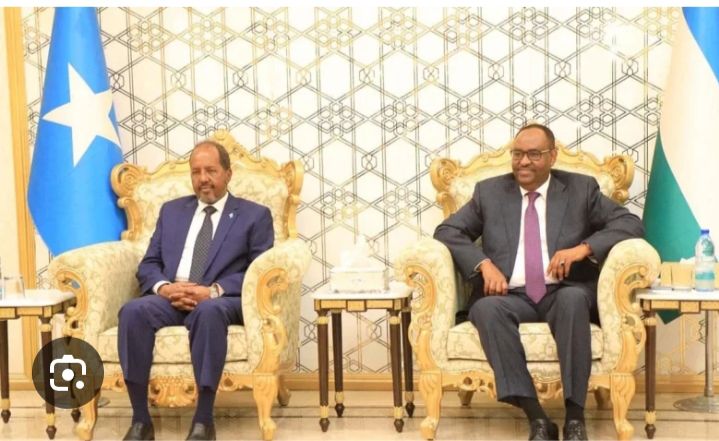
Somali politics has perfected a rare art: the ability for all principal actors to win their personal battles while the country itself collapses in the background. The latest “interesting take” making the rounds claims that President Hassan Sheikh Mohamud has politically defeated Puntland President Said Abdullahi Deni, while Deni, in turn, has defeated the will and aspirations of Puntland society. The final scoreline? Somali federalism lying on a hospital bed, connected to tubes, while politicians argue over who owns the oxygen tank.
At first glance, the argument sounds clever—almost elegant in its symmetry. Hassan beats Deni. Deni beats his people. Federalism loses. Curtain closed. Applause. But let us open the curtain again, because the tragedy is not that one man defeated another; it is that both men have been playing different games on the same broken field.
Hassan Sheikh: The Grandmaster of Checkmates on Paper
From Mogadishu, President Hassan Sheikh Mohamud appears to have outmaneuvered Puntland politically. He has centralized authority, dictated the tempo of national debate, and reduced federal member states to guests who must RSVP to Villa Somalia. Jubaland is scolded, Puntland is isolated, SSC-Khaatumo is instrumentalized, and federalism is rebranded as a “consultative suggestion” rather than a binding constitutional arrangement.
If political victory is measured by dominating the narrative, then yes—Hassan Sheikh is winning. But this is the kind of victory achieved by a man who burns down the house to prove he owns the keys. His triumph is not over Deni alone; it is over the very idea that Somalia is a negotiated union rather than a Mogadishu-issued decree.
This is not statesmanship. It is an administrative conquest dressed up as constitutional reform.
Deni: The President Who Defeated His Own Constituency
President Said Abdullahi Deni, meanwhile, has achieved something even more extraordinary. Without tanks, without Mogadishu’s budget, without international backing, he has managed to politically exhaust Puntland society itself. He promised democratization and delivered postponement. He promised decentralization and delivered presidential solitude. He promised leadership and delivered long absences.
If Hassan Sheikh defeated Deni politically, Deni responded by turning inward and defeating the very constituency that legitimizes him. The public’s aspirations—for security, participation, institutional governance, and a coherent Puntland voice in Somali affairs—have been quietly shelved in favor of survival politics and personal calculus.
This is not resistance. It is retreat disguised as dignity.
Federalism: The Real Casualty, Without a Funeral
Here is where the assessment becomes painfully accurate: the cumulative result is the near collapse of Somali federalism. Federalism cannot survive if Mogadishu treats states as disobedient provinces and state leaders treat their societies as inconvenient audiences. Federalism is not sustained by communiqués or summits; it survives on mutual restraint, constitutional respect, and leaders who fear their people more than they fear each other.
Today, Hassan Sheikh rules as if federalism is a temporary inconvenience on the road to centralization. Deni governs as if Puntland society is a passive spectator, not a stakeholder. Between them, federalism is neither defended nor reimagined—it is simply used.
Do I Agree With the Assessment?
Yes—but with a sharper conclusion.
Hassan Sheikh did not defeat Deni because he is politically superior; he defeated him because the federal system has no enforcement mechanism against a determined centralizer.
Deni did not defeat Puntland society because he is powerful; he defeated it because prolonged disappointment eventually looked like consent.
And federalism did not collapse because of one man or one presidency—it collapsed because Somalia’s political class treats governance as a zero-sum duel rather than a shared burden.
Final Satirical Note
Somalia today resembles a boxing ring where:
One fighter wins by refusing to follow the rules,
The other wins by refusing to fight,
And the referee—called the Constitution—was knocked out in the first round.
In the end, both presidents may claim victory. History, however, will record something far less flattering: that when Somalia needed leadership, it got rivalries; when it needed federalism, it got feudalism; and when it needed statesmen, it got men busy defeating everyone except the problems.
———
WAPMEN — fearless, independent journalism that refuses to clap while the house burns.
 Warsame Policy & Media Network (WAPMEN)