
The recognition of Somaliland by Israel is not a diplomatic breakthrough; it is a perilous trap. In a desperate bid to end three decades of international isolation, the leadership in Hargeisa has shaken hands with a partner that is itself increasingly isolated, morally compromised, and engaged in multiple regional wars. Far from unlocking a path to global acceptance, this move has triggered a unified wall of international condemnation, entangled Somaliland in the geopolitics of the Middle East, and exposed it to severe and unforeseen security and political risks.
A Chorus of Condemnation, Not a Bandwagon of Recognition
Contrary to Somaliland’s hopes, Israel’s move has not sparked a wave of followers. Instead, it has provoked a near-universal diplomatic backlash that has reinforced Somaliland’s isolation.
Somalia’s government, calling the recognition a “naked invasion” and an “existential threat,” has declared it null and void, vowing to pursue all diplomatic and legal avenues in response.
The response from regional and international bodies has been unequivocal:
· The African Union (AU) firmly rejected the move, warning it “sets a dangerous precedent” for peace and stability across the continent and undermines the sacrosanct principle of colonial-era borders.
· A bloc of 21 Arab and African nations and the Organization of Islamic Cooperation issued a joint statement condemning the recognition as a grave violation of international law.
· Key regional powers, including Egypt, Turkey, Saudi Arabia, and Djibouti, have all stood with Somalia, rejecting the agreement.
· The European Union and the United States have both publicly reaffirmed their commitment to Somalia’s sovereignty and territorial integrity. U.S. President Donald Trump, when asked, simply replied “no” to recognizing Somaliland.
This unified opposition makes it clear: Israel is not a key that unlocks doors; it is a pariah whose endorsement only bolsters the resolve of the international community to keep those doors shut.
Strategic Mirage: An Invisible and Vulnerable Partner
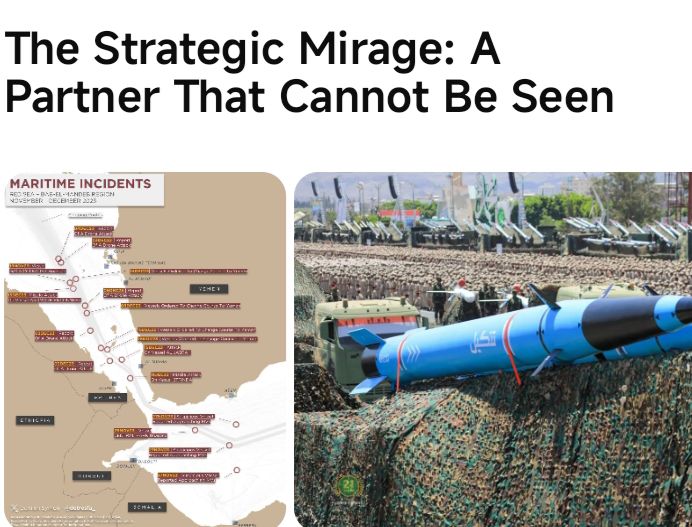
Israel’s primary strategic interest is blatantly transparent: to secure a foothold on the Red Sea opposite Yemen to counter the Houthi movement. However, this very objective guarantees that Israel cannot be the robust, visible partner Somaliland needs.
· A Covert, Not Open, Presence: Given the ferocity of the ongoing conflict between Israel and the Houthis—which has included Israeli airstrikes leveling the Sana’a airport and Houthi drones striking deep inside Israel—any open Israeli presence in Hargeisa would instantly make Somaliland a direct target. Therefore, any Israeli involvement will necessarily be covert, intelligence-focused, and militarily limited, offering Somaliland little tangible security benefit while absorbing massive risk.
· The Houthi Veto: The Houthis have proven to be a resilient, strategically smart adversary that has withstood a years-long military campaign and continues to challenge Israel directly. They have explicitly stated they will not allow Israelis to function in the region. Their demonstrated capacity to strike distant targets means this is not an idle threat but a severe and imminent danger to Somaliland’s stability.
The Toxic Motivations Behind Netanyahu’s “Gift”
Somaliland’s recognition is less about Hargeisa and more about the desperate political calculations of Benjamin Netanyahu.
· A Diversion from Isolation: Netanyahu, besieged by war crimes allegations and unprecedented international isolation, is using this move as a low-cost diplomatic spectacle to create an illusion of statesmanship and break out of his pariah status.
· A Geopolitical Provocation: The move is a direct challenge to Turkey, a major supporter of Somalia’s government, and part of Israel’s broader rivalry for influence in the Horn of Africa and Red Sea.
· Tainted by the “Displacement” Shadow: Most alarmingly, analysts note that the recognition is entangled with discussions about the forced displacement of Palestinians from Gaza. This associates Somaliland’s sovereign aspirations with a project of demographic erasure, poisoning its moral standing and aligning it with what much of the world views as a ongoing atrocity.
A Path to Peril, Not Prosperity
For Somaliland, the consequences of this gamble are dire and multifaceted:
1. Deepened Regional Hostility: The move has turned diplomatic frost into active hostility from its most important neighbors and the entire African bloc.
2. Fuel for Internal Fracture: It risks inflaming internal tensions within Somaliland’s own contested borders, particularly in the eastern regions like Sool and Sanaag, where allegiance to Somalia remains strong.
3. Security as a Target: Somaliland has volunteered to become a front in the Israel-Houthi-Iran conflict, jeopardizing its hard-won relative stability.
4. Symbolic, Not Material, Gain: With major powers refusing to follow Israel’s lead, Somaliland remains locked out of international financial institutions and meaningful multilateral aid.
Somaliland’s leaders have bet their people’s future on a partner who is using them as a pawn. True sovereignty and lasting recognition cannot be built on a foundation of geopolitical cynicism, widespread condemnation, and imminent security threats. The only viable path forward for Somaliland’s aspirations is not through a desperate pact with a pariah, but through good-faith, African-led dialogue with Mogadishu, supported by the international community that has just resoundingly rejected this dangerous shortcut. To ignore this reality is to court disaster.
 Warsame Policy & Media Network (WAPMEN)