
There is a fundamental rule of statecraft: a nation that does not control its territory cannot control its destiny. For years, Somalia’s profound security challenges and fragmented governance have made its sovereignty negotiable in the eyes of rival foreign powers. Today, the most severe bill for this vulnerability has arrived.
Israel’s recognition of Somaliland as an independent state is not merely a provocative diplomatic act. It is the direct outcome of a long-term erosion of Somali sovereignty—an erosion accelerated by internal divisions and exploited by external actors pursuing their own strategic contests on Somali soil.
Sovereignty Hollowed Out: A Stage for Regional Rivalries
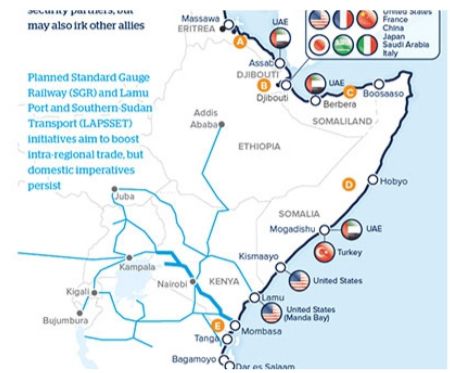
Somalia’s fragility has transformed it into an arena for regional and global competitions.The search results confirm a pattern of external interference:
1. Gulf Rivalries: The Horn of Africa has become a theater for a “great game”-style contest, primarily between Saudi Arabia and the United Arab Emirates (UAE), with their competition playing out in Somalia’s political and economic spheres.
2. Neighborhood Pressures: Ethiopia’s quest for sea access led to a controversial memorandum of understanding with Somaliland in early 2024, which Somalia condemned as a violation of its sovereignty. Turkey has positioned itself as a key mediator, brokering the Ankara Declaration between Ethiopia and Somalia in December 2024.
3. Global Interests: Beyond the Gulf, countries including Egypt, Qatar, and Turkey have vested interests, often aligned in competing blocs.
The claim that Somalia “invited them all in at once” is an oversimplification. Engagement with these powers is often a necessity for a government grappling with an existential threat from al-Shabaab, which launched a major offensive in 2025. However, the consequence is a perilous dependency. As one analysis notes, a nation cannot reclaim sovereignty while it depends on foreign forces for its core security.
The Recognition Crisis: Symptom of a Larger Disease
Israel’s move is a stark exploitation of this fractured landscape.Key facts from the search results include:
1. Israel framed its recognition as being “in the spirit of the Abraham Accords”.
2. The international reaction was swift: Somalia rejected it as an “unlawful action”, and a broad coalition—including Egypt, Turkey, Djibouti, the African Union, and the Organization of Islamic Cooperation—reaffirmed support for Somalia’s unity and territorial integrity.
3. Analysts warn this sets a dangerous precedent, making state recognition “transactional rather than principled” and risks emboldening other secessionist forces within Somalia’s federal system.
This crisis is not solely about Israel or Somaliland. It is about the cumulative effect of Somalia’s compromised sovereignty. A country where the federal government struggles to project authority, where federal states like Puntland and Jubaland have contested its authority, and where foreign partners fund, train, and build bases, inevitably finds its unity questioned in foreign capitals.
The Reckoning and the Path Forward
The battlefield in Somalia is multi-layered:against al-Shabaab, within its own political structures, and now against diplomatic maneuvers that threaten its map. The solution cannot be a wholesale rejection of foreign partnerships, which are currently essential for security. It must be the rigorous and unified pursuit of a coherent national strategy.
Somalia must anchor its foreign policy in unwavering national consensus. This means clearly defining its red lines, coordinating all external engagements through a single sovereign framework, and relentlessly building its own security institutions to reduce asymmetric dependencies. The alternative is to accept a permanent future as a geopolitical arena, where its borders and destiny are debated by others.
 Warsame Policy & Media Network (WAPMEN)