
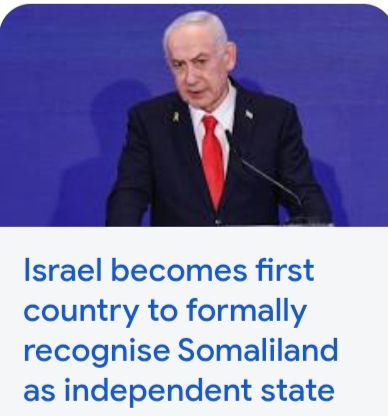
The outrage is loud. Social media is aflame. Statements are flying. Somalia’s political class has rediscovered its vocal cords—all because Israel has become the first United Nations member state to grant full diplomatic recognition to Somaliland.
Yes, the outrage is justified. This act is a serious assault on Somalia’s sovereignty and sets a dangerous precedent. It has rightly drawn condemnation from the international community, including from members of the League of Arab States who have rejected the move as a violation of international law. Saudi Arabia explicitly stated it contradicts international law and entrenches unilateral measures, while Egypt coordinated with regional partners to condemn it.
But let us be honest—brutally honest, as WAPMEN must be.
Israel did not invent Somalia’s dismemberment. It is merely the latest external actor to step into a vacuum of sovereignty that has been meticulously carved out by Somalis themselves over decades. The precedent was not set in Tel Aviv; it was nurtured in Villa Somalia and in regional presidential palaces.
Selective Outrage Is a Moral and Strategic Failure
Browse the internet and you will find wall-to-wall condemnation of Israel. Turkey, a close ally of Somalia, has enlisted firmly on Mogadishu’s side, calling Israel’s recognition “overt interference in Somalia’s domestic affairs”. Yet one question is conspicuously absent: What made Somalia so vulnerable to this?
The truth is, Israel’s move, while unprecedented in its formality, follows a well-worn path of external engagements with Somalia’s breakaway regions. Somaliland has for years cultivated informal ties with entities like Taiwan and the United Arab Emirates. Just months ago, Ethiopia pursued a memorandum of understanding that would have granted it sea access in exchange for recognizing Somaliland, backing down only under intense diplomatic pressure.
Why has no sustained outrage been directed at the domestic political vandalism that hollowed out Somali sovereignty long before any foreign power decided to formalize its fracture?
Somalia Was Not Betrayed Overnight — It Was Systematically Undermined
Somalia did not wake up to find itself dismembered. It has been methodically weakened by a ruling elite whose political culture has been identified by analysts as the primary impediment to state resurrection—a culture aloof from society and rooted in personal gain over national interest.
Federalism, conceived as a mechanism for shared governance, has been converted into a tool for fragmentation. We do not need to speak in abstractions.
· Puntland, following controversial constitutional amendments in March 2024, declared it would operate as an independent government. It later signed a separate cooperation agreement with Ethiopia, directly counter to Mogadishu’s authority.
· Jubaland, in November 2024, suspended all cooperation with the federal government after an arrest warrant was issued for its president. This political dispute has escalated into armed clashes between federal and regional forces.
These are not the actions of stakeholders in a collective republic. They are the hallmarks of quasi-states conducting parallel foreign and security policies. Once you normalize the defiance of the central state, do not act shocked when foreign capitals normalize the defiance of Somalia.
Recognition Is Not the Disease — It Is the Symptom
Israel’s recognition is a stark diagnosis of a profound sickness within.
A country whose leaders wage political war against their own federal units, whose center and regions consistently violate the provisional constitution for short-term advantage, and whose political class trades long-term sovereignty for immediate survival cannot credibly demand the world respect borders it fails to enforce itself.
Sovereignty is not declared; it is enforced—politically, legally, and institutionally. Somalia stopped enforcing it long ago.
The Silence on Leadership Failure Is Complicity
It is easy to point fingers outward. It is harder—but necessary—to confront the internal wreckage.
The same political class now crying foul over Israel—and now benefiting from the diplomatic solidarity of allies like Turkey and Arab states—has for years cheered constitutional violations when it suited them, applauded federal overreach to weaken rivals, and justified fragmentation when it brought leverage. They stayed silent as the very idea of a single Somali political will was eroded.
They planted the wind. Now they reap the whirlwind.
WAPMEN’s Uncomfortable Conclusion
Israel’s move is dangerous and must be challenged with every diplomatic and legal tool available. The condemnations from Ankara, Riyadh, Cairo, and beyond are a necessary and welcome defense of international principles.
But Somalia’s greatest enemy is not in Tel Aviv. It is in the culture of impunity that treats the state as a disposable instrument rather than a collective trust. It is in the leadership failure that remains, as scholars have documented, the central obstacle to the state’s resuscitation.
Until Somali leaders are held accountable for dismantling their own country’s sovereignty—brick by brick, agreement by unauthorized agreement—foreign powers will continue to do what opportunists always do: step into the ruins and claim what the owners abandoned.
WAPMEN does not trade in illusions. We deal in causes, not symptoms.
And the cause of Somalia’s vulnerability is Somali political irresponsibility—first, foremost, and ongoing.
 Warsame Policy & Media Network (WAPMEN)