
WDM EDITORIAL: Somalia’s Political Decline Through the Eyes of Those Who Lived It.
Somalia is a country where the elderly remember too much, the youth know too little, and the so-called leaders know nothing except the quickest route to the nearest per diem.
The historical account in the referenced video is not merely nostalgia—it is a testimony, a confession, and a verdict. It is a window into how a proud nation bled itself to death while its current rulers continue the same recklessness with new vocabulary, new acronyms, and new foreign sponsors.
It is the story of a people who once produced giants—statesmen, scholars, commanders—now replaced by men whose greatest diplomatic achievement is securing a photo-op in Doha or Abu Dhabi.
It is the story of how we got here, and why we refuse to leave this miserable crossroads of misrule, clan ego, and institutional vandalism.
The Past Was Not Perfect—But It Had Men of Substance
The elder recounts the Somalia of yesterday—its political discipline, national projects, intellectual debates, and military ethos. It was not paradise, but it had structure, hierarchy, and ownership.
Those men disagreed, sometimes violently, but they stood for something.
They believed in a Somali state—even when they mismanaged it.
What do we have today?
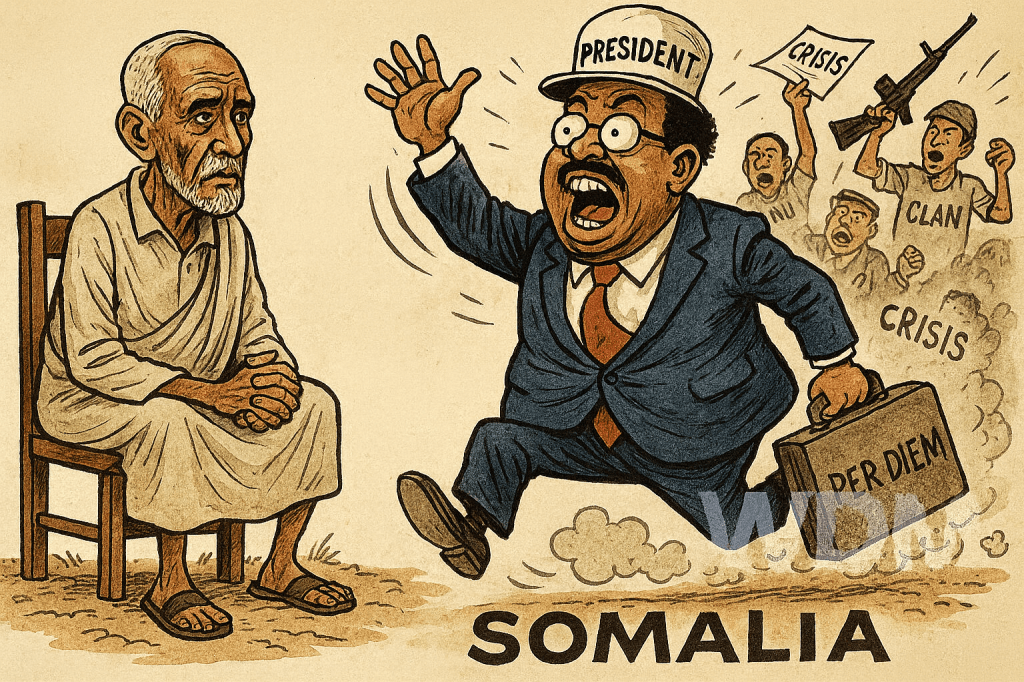
A class of political scavengers whose loyalty is auctioned to the highest bidder.
Men who have replaced national ideology with foreign quotations, replaced political strategy with WhatsApp leaks, replaced statecraft with hotel-lobby conspiracies.
The past had flaws.
The present has fraudsters.
The Disease of Leadership: From Nation Builders to Per Diem Nomads
The elder’s testimony exposes a central truth: Somalia did not collapse from poverty. It collapsed from leadership rot.
And that disease continues.
Today:
Presidents travel more than flight attendants.
Prime ministers serve as ceremonial scapegoats.
Federal Member States behave like NGOs.
Parliament is a marketplace with microphones.
Security forces are clan-private companies in uniform.
“Experts” speak for 60 minutes but say nothing that survives 60 seconds.
Somali politics has become a never-ending audition for foreign donors, think-tanks, and intelligence handlers. The country is full of leaders who can recite Western buzzwords—inclusivity, resilience, governance, climate adaptation—while unable to govern a single neighborhood without AMISOM guns.
The Elders Warned Us—We Mocked Them, and Then Repeated Their Mistakes
The video is an indictment of the current generation of politicians who inherited a broken state and decided to break it further.
The elders warned:
“Respect institutions.”
We responded with: destroy them.
“Put country before clan.”
We elevated clan over constitution, clan over competence, clan over common sense.
“Avoid foreign manipulation.”
Today Somali leaders treat foreign embassies the way addicts treat dealers—with loyalty, obedience, and desperation.
“Build reconciliation.”
Instead we perfected the art of political revenge, gatekeeping, and exclusion.
“Unite the army.”
Instead of unity, we have a shopping mall of militias.
We did not just ignore the elder’s warnings—we perfected the opposite.
Somalia’s Current Affairs: A Mirror of Yesterday’s Mistakes—But Worse
The historical account uncovers patterns that are identical to Somalia’s present crisis:
1. Unrestrained Power Hunger
Leaders cling to power not because they have a vision, but because they fear accountability, exposure, and irrelevance. That is why Somalia is permanently in “transitional” paralysis.
2. Manufactured Crises
Just like the factions of the late 1980s, today’s leaders engineer crises to maintain relevance—extensions, parallel governments, clan agitation, media propaganda. Crisis is their oxygen.
3. Foreign Dependence
Yesterday it was the Cold War.
Today it is Gulf rivalry, Turkish influence, Ethiopian ambition, Western aid addiction.
Somalia’s sovereignty is a press-release fiction.
4. No National Project
Yesterday Somalia pursued literacy campaigns, ports, military reforms, foreign policy doctrine.
Today our national project is…
“Which politician travelled to which hotel?”
5. The Death of Accountability
The elder recalls people losing positions for minor failures.
Now leaders are rewarded for scandals, promoted for corruption, and celebrated for incompetence.
The Tragedy: History Speaks, But Somali Leaders Don’t Listen
What makes the elder’s account powerful is that it exposes how Somalia consistently recycles the same errors:
The arrogance of leaders
The betrayal of institutions
The manipulation of clans
The ignorance of youth
The opportunism of elites
The erosion of national vision
Somalia is not suffering because it lacks knowledge.
It is suffering because it refuses to act on knowledge.
Every elder’s testimony is a warning.
Every warning is ignored.
A Country That Forgot Its Past Cannot Govern Its Present
Somalia’s political class mocks history as “old stories,” yet they repeat the same madness with greater intensity and less shame. History is not our teacher—it is our hostage.
That is why the country is run by people who:
travel instead of govern,
threaten instead of negotiate,
beg instead of plan,
and blame instead of lead.
They are the children of collapse—raised in chaos, ruling in chaos, and addicted to chaos.
WDM VERDICT
Somalia’s elders gave us a mirror.
Somalia’s leaders turned it into a weapon.
The historical account reveals a painful truth: Somalia is governed by men who inherited a broken house and decided to use the remaining bricks to build personal kingdoms.
We are not simply victims of history.
We are victims of leaders who refused to learn from it.
Until Somalia produces a generation that:
values institutions over personalities,
nationhood over clanhood,
integrity over per diem,
and planning over firefighting,
the country will remain trapped in an endless loop of collapse, confusion, and counterfeit “leadership.”
This is the tragedy the elder warned us about.
This is the tragedy we continue to choose.
 Warsame Policy & Media Network (WAPMEN)