Ismail H Warsame: A Summary of Professional Background

Ismail H. Warsame is a Somali-Canadian political figure, author, and analyst. He played a foundational role in establishing the Puntland State of Somalia and is a prominent voice in Somali politics through his writings.

Area Details
Political Role First Chief of Staff/Cabinet for Puntland State (1998-2004). Key architect of Somali federalism.
International Work Zonal/National Technical Coordinator for UN/World Bank Reconstruction (2005-2007). Aid Coordinator for Somali TFG with EU (2007-2009).
Current Profile Political analyst and commentator. Runs “Warsame Digital Media” blog. Author of books on Somali politics.
Education Master’s in Thermal Power Engineering. Multilingual (fluent in Russian).

Political Career and Founding of Puntland

Ismail Warsame was a key founder of the Puntland State of Somalia in 1998. As the first Chief of Staff (also known as Chief of Cabinet) from 1998 to 2004, he was responsible for laying the administrative and ideological foundations of the state during its formative years. He is widely regarded as one of the original architects of the federal system in Somalia, which was envisioned as a way to rebuild the country after the civil war by decentralizing power and restoring trust in public institutions.

International Development Work

Following his service in Puntland, Warsame contributed to national reconstruction efforts with international organizations:

· From 2005 to 2007, he worked with the joint UN and World Bank Secretariat on Somalia’s Reconstruction and Development Programme (RDP), first as the Zonal Technical Coordinator for Puntland and later as the National Authorizing Officer (NAO).
· From 2007 to 2009, he served as the National Aid Technical Coordinator and Liaison Officer for the Transitional Federal Government (TFG) of Somalia with the European Union.

Current Work as Writer and Analyst

Now based in Toronto, Canada, Ismail Warsame is an influential independent political analyst. He runs a blog called “Warsame Digital Media” (WDM), where he publishes critical analyses and commentaries on modern Somali politics and current affairs. He is also a published author. One of his books, “Talking Truth to Power in Undemocratic Tribal Context,” became an Amazon bestseller.

Educational Background

Warsame has a strong technical educational background. He holds a Master’s degree in Thermal Power Engineering and is also a PhD candidate in the same field. He is multilingual and fluent in Russian.

From Heroes to Hustlers

WDM EDITORIAL: Somalia’s Political Decline Through the Eyes of Those Who Lived It.

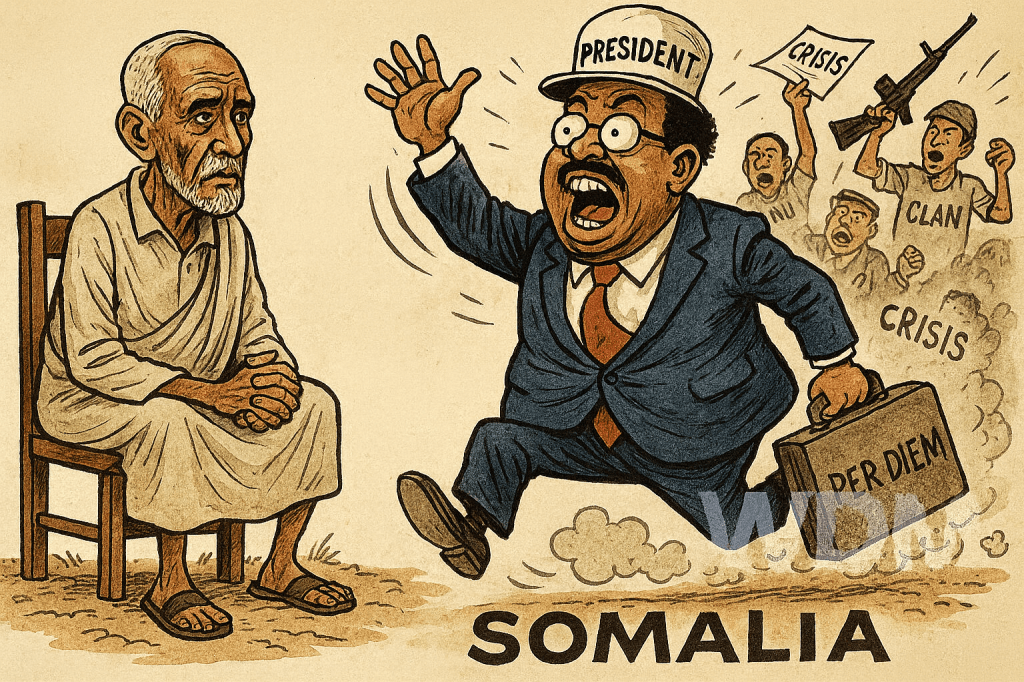
Somalia is a country where the elderly remember too much, the youth know too little, and the so-called leaders know nothing except the quickest route to the nearest per diem.
The historical account in the referenced video is not merely nostalgia—it is a testimony, a confession, and a verdict. It is a window into how a proud nation bled itself to death while its current rulers continue the same recklessness with new vocabulary, new acronyms, and new foreign sponsors.

It is the story of a people who once produced giants—statesmen, scholars, commanders—now replaced by men whose greatest diplomatic achievement is securing a photo-op in Doha or Abu Dhabi.

It is the story of how we got here, and why we refuse to leave this miserable crossroads of misrule, clan ego, and institutional vandalism.

The Past Was Not Perfect—But It Had Men of Substance

The elder recounts the Somalia of yesterday—its political discipline, national projects, intellectual debates, and military ethos. It was not paradise, but it had structure, hierarchy, and ownership.

Those men disagreed, sometimes violently, but they stood for something.
They believed in a Somali state—even when they mismanaged it.

What do we have today?

A class of political scavengers whose loyalty is auctioned to the highest bidder.
Men who have replaced national ideology with foreign quotations, replaced political strategy with WhatsApp leaks, replaced statecraft with hotel-lobby conspiracies.

The past had flaws.
The present has fraudsters.

The Disease of Leadership: From Nation Builders to Per Diem Nomads

The elder’s testimony exposes a central truth: Somalia did not collapse from poverty. It collapsed from leadership rot.

And that disease continues.

Today:

Presidents travel more than flight attendants.

Prime ministers serve as ceremonial scapegoats.

Federal Member States behave like NGOs.

Parliament is a marketplace with microphones.

Security forces are clan-private companies in uniform.

“Experts” speak for 60 minutes but say nothing that survives 60 seconds.

Somali politics has become a never-ending audition for foreign donors, think-tanks, and intelligence handlers. The country is full of leaders who can recite Western buzzwords—inclusivity, resilience, governance, climate adaptation—while unable to govern a single neighborhood without AMISOM guns.

The Elders Warned Us—We Mocked Them, and Then Repeated Their Mistakes

The video is an indictment of the current generation of politicians who inherited a broken state and decided to break it further.

The elders warned:

“Respect institutions.”
We responded with: destroy them.

“Put country before clan.”
We elevated clan over constitution, clan over competence, clan over common sense.

“Avoid foreign manipulation.”
Today Somali leaders treat foreign embassies the way addicts treat dealers—with loyalty, obedience, and desperation.

“Build reconciliation.”
Instead we perfected the art of political revenge, gatekeeping, and exclusion.

“Unite the army.”
Instead of unity, we have a shopping mall of militias.

We did not just ignore the elder’s warnings—we perfected the opposite.

Somalia’s Current Affairs: A Mirror of Yesterday’s Mistakes—But Worse

The historical account uncovers patterns that are identical to Somalia’s present crisis:

1. Unrestrained Power Hunger

Leaders cling to power not because they have a vision, but because they fear accountability, exposure, and irrelevance. That is why Somalia is permanently in “transitional” paralysis.

2. Manufactured Crises

Just like the factions of the late 1980s, today’s leaders engineer crises to maintain relevance—extensions, parallel governments, clan agitation, media propaganda. Crisis is their oxygen.

3. Foreign Dependence

Yesterday it was the Cold War.
Today it is Gulf rivalry, Turkish influence, Ethiopian ambition, Western aid addiction.
Somalia’s sovereignty is a press-release fiction.

4. No National Project

Yesterday Somalia pursued literacy campaigns, ports, military reforms, foreign policy doctrine.
Today our national project is…
“Which politician travelled to which hotel?”

5. The Death of Accountability

The elder recalls people losing positions for minor failures.
Now leaders are rewarded for scandals, promoted for corruption, and celebrated for incompetence.

The Tragedy: History Speaks, But Somali Leaders Don’t Listen

What makes the elder’s account powerful is that it exposes how Somalia consistently recycles the same errors:

The arrogance of leaders

The betrayal of institutions

The manipulation of clans

The ignorance of youth

The opportunism of elites

The erosion of national vision

Somalia is not suffering because it lacks knowledge.
It is suffering because it refuses to act on knowledge.

Every elder’s testimony is a warning.
Every warning is ignored.

A Country That Forgot Its Past Cannot Govern Its Present

Somalia’s political class mocks history as “old stories,” yet they repeat the same madness with greater intensity and less shame. History is not our teacher—it is our hostage.

That is why the country is run by people who:

travel instead of govern,

threaten instead of negotiate,

beg instead of plan,

and blame instead of lead.

They are the children of collapse—raised in chaos, ruling in chaos, and addicted to chaos.

WDM VERDICT

Somalia’s elders gave us a mirror.

Somalia’s leaders turned it into a weapon.

The historical account reveals a painful truth: Somalia is governed by men who inherited a broken house and decided to use the remaining bricks to build personal kingdoms.

We are not simply victims of history.
We are victims of leaders who refused to learn from it.

Until Somalia produces a generation that:

values institutions over personalities,

nationhood over clanhood,

integrity over per diem,

and planning over firefighting,

the country will remain trapped in an endless loop of collapse, confusion, and counterfeit “leadership.”

This is the tragedy the elder warned us about.
This is the tragedy we continue to choose.

Somalia’s Federalism in Paralysis

WHITE PAPER

The Puntland Case, Federal Overreach, and the Terminal Crisis of the Somali State

Warsame Digital Media (WDM) White Paper — November 2025
Critical Analysis, Policy Briefing & Strategic Forecast

Executive Summary

Somalia’s federal experiment—marketed in 2004 as the grand compromise to save a collapsed state—has now entered its terminal crisis stage. Federal–State relations have decayed into mutual suspicion, coercion, and political trench warfare. The epicenter of this long-running friction has always been Puntland, the founding architect and early defender of federalism.

Contrary to shallow narratives, the conflict did not begin with Said Abdullahi Deni, nor with the 2016 or 2022 political cycles. It was baked into the system from the start:
a flawed federal charter, a Mogadishu political class wedded to centralism, and national leadership incapable of honest reconciliation or constitutional fidelity.

Today, Somalia stands at a historic deadlock:

Most mandates expired or expiring;

NCC transformed from a coordination body into a coercive presidential whip;

Federalism reduced to a battlefield of grudges;

And a looming political vacuum inviting authoritarianism, fragmentation, and extremist exploitation.

This white paper dissects the historical roots, constitutional failures, federal overreach, Puntland’s defensive posture, the crisis of expired mandates, and presents actionable pathways forward.

1. Historical Roots of the Crisis

(2004–2025)

1.1 The Original Sin of Somali Federalism

The Transitional Federal Government (TFG), established in 2004 in Nairobi, was born under duress, foreign bargaining, and elite compromise. Key fractures appeared immediately:

Puntland demanded a negotiated federal design.

Mogadishu elites insisted on a centralized restoration of the unitary republic.

The TFG constitution was ambiguous by design—its drafters feared hard choices and left core powers undefined.

This ambiguity guaranteed decades of conflict.

1.2 Puntland’s Foundational Position

As co-architect of the 1998 Puntland Charter and federalism advocate since Abdullahi Yusuf’s era, Puntland insisted on:

Real power-sharing

Resource-sharing agreements

National reconciliation before state reconstruction

A civil service built on merit, not clan capture

These principles were ignored, sidelined, and later weaponized.

1.3 Mogadishu’s Post-2004 Centralist Mindset

Successive federal presidents—Abdullahi Yusuf excluded—saw federalism as:

A temporary inconvenience

A “necessary lie” to win international legitimacy

A project they would later reverse through political engineering

This included:

Manipulating parliamentary selections

Appointing “friendly” state leaders

Weaponizing security forces

And, eventually, repurposing the National Consultative Council (NCC) as an enforcement mechanism rather than a consultative forum.

2. The NCC:

From Dialogue Platform to Federal Weapon

2.1 Intended Purpose

The NCC was designed as a coordination venue for election planning, federal–state dialogue, and conflict resolution.

2.2 Actual Evolution

Under the regimes of Farmaajo and Hassan Sheikh Mohamud, the NCC became:

A forum to pressure Puntland and Jubaland

A mechanism to fabricate a façade of “consensus”

A tool to override federalism through “agreements” drafted in Mogadishu

A platform where federal leaders imposed decisions under donor pressure and security leverage

2.3 Break with Puntland and Jubaland

When NCC meetings shifted from negotiation to dictation, Puntland declared:

“The NCC cannot replace the Federal Constitution.”

This was the moment the system fractured beyond repair.

3. Structural Causes of Non-Collaboration

3.1 Constitutional Ambiguity

Key unresolved issues:

Natural resources

Fiscal federalism

Internal security powers

Boundaries of states

Status of the capital

Division of authority between federal and state institutions

With no constitutional court, no arbitration mechanism, and no political trust, Somalia’s federal architecture is held together with masking tape.

3.2 Federal Overreach

The central government has repeatedly imposed:

Hand-picked state presidents

Unilateral election models

Procurement and revenue centralization attempts

Security interference

Diplomatic representation monopoly

Manipulation of foreign aid distribution

3.3 Puntland’s Defensive Posture

Puntland’s political doctrine since 1998 remains consistent:

Federalism cannot exist without shared sovereignty

National institutions must be neutral, inclusive, and constitutional

Mogadishu cannot dictate political outcomes for regional states

No federal leadership can impose decisions through force or donor leverage

This doctrinal difference—not Deni’s personality—drives the conflict.

4. The Current Crisis (2023–2025)

4.1 Expired Mandates, Expired Legitimacy

Somalia is entering constitutional twilight:

Federal parliament: at or near expiration

Federal government: embroiled in extension maneuvers

State governments:

Southwest: expired

Hirshabelle: expired

Galmudug: expired

Jubaland: Extension (election) contested

Puntland: internal contest but functional

NCC: effectively suspended

Constitution: Unilaterally violated by the Federal Government, and permanently “provisional”

4.2 Deadlock and Governance Paralysis

This gridlock means:

No credible authority to lead national elections

No consensus on electoral model

No institution with country-wide legitimacy

A donor community fatigued and skeptical

A political class incapable of compromise

4.3 Risk Trajectory: Point of No Return

Somalia now faces:

Fragmentation into de facto confederal units

Parallel governments (Garowe vs Mogadishu model)

Security vacuums quickly filled by Al-Shabaab

Increased foreign meddling

Economic free-fall as budget support becomes conditional

A crisis of national identity and fate


5. Puntland as the Case Study:

Why the Friction is Structural—not Personal

5.1 Misdiagnosing the Conflict

Observers often blame:

Deni

Political competition

Election cycles
But the reality predates 2004.

5.2 Puntland’s Consistent Position Across Administrations

Puntland has maintained the same red lines across:

Abdullahi Yusuf

Mohamud Muse Hersi

Abdirahman Farole

Abdiweli Gaas

Said Abdullahi Deni

Different personalities.
One constitutional position.

5.3 Why Puntland is the Test Case

Because Puntland:

Was the first to formalize state administration (1998)

Hosts some of Somalia’s most stable districts

Produces a disproportionate share of technocrats

Acts as the bellwether for federal–state relations

If Mogadishu fails to partner with Puntland,
the entire federal project collapses.

6. Policy Recommendations

6.1 Constitutional Finalization with Guaranteed State Rights

Somalia must finalize the constitution with:

Resource sharing formulas

Fiscal federalism

Security powers

Clear division of authorities

A functioning Constitutional Court

Without a constitutional court, federalism is a political bar fight.

6.2 Rebuilding Trust through Genuine National Dialogue

A real National Reconciliation & Constitutional Conference (NRCC)—not NCC theatrics—is needed.

Held outside Mogadishu, with:

States

Civil society

Elders

Diaspora experts

Neutral facilitation

Guaranteed implementation mechanisms

6.3 Reforming the NCC (or Replacing It)

The NCC must be transformed from:

A presidential enforcement tool
Into:

A rules-based intergovernmental council with fixed mandates, rotating chairs, and consensus requirements.

6.4 Establishing an Independent Electoral Commission

To prevent every election cycle from becoming a coup attempt.

6.5 Mandate Synchronization

All FMS and the FGS must harmonize electoral calendars to avoid the current rolling crisis.

6.6 Create a Federal Arbitration Mechanism

A joint court or panel for resolving disputes between states and Mogadishu.
No more “winner takes all.”

7. Strategic Outlook: 2025–2030

If reforms fail, Somalia will enter a decade of:

Fragmentation

Parallel administrations

Regional interference (UAE, Qatar, Ethiopia, Turkey)

Fiscal collapse

Federalism abandoned in practice

Mogadishu reduced to a city-state with symbolic authority

If reforms succeed, Somalia could achieve:

Shared sovereignty

Predictable governance

Economic stabilization

Genuine federal democracy

National reconciliation after 30 years of conflict

Conclusion

Somalia’s federal crisis is not an accident. It is the predictable outcome of two competing visions of the Somali state, battling since 2004:

Centralists who dream of re-creating the pre-1991 dictatorship with a modern façade

Federalists who recognize that Somalia’s survival demands decentralization, compromise, and shared sovereignty

Puntland represents the federalist doctrine.
Mogadishu political elites remain welded to the centralist fantasy.

Unless Somalia confronts these contradictions—honestly, urgently, and transparently—the country is heading not toward a failed state, but a fragmented, irretrievable non-state.

Somali leadership must choose:
Federalism with integrity, or disintegration with inevitability.

© 2025 Warsame Digital Media (WDM)
Support fearless independent journalism that speaks truth to power.
Tel/WhatsApp: +252 90 703 4081

Examining the Legal Basis for Challenging Somalia’s EALA Nomination Before the East African Court of Justice

Horn Observer

    Examining the Legal Basis for Challenging Somalia’s EALA Nomination Before the East African Court of Justice

by: Bashiir M. Sheikh Ali | 16 November 2025 16:48

EALA logo. Photo courtesy

Somalia’s accession to the East African Community (EAC) in 2023 marked a transition from an exclusively domestic legal framework to a dual system in which national institutions will need to operate alongside binding supranational obligations. Few tests illustrate this shift more clearly than the dispute surrounding Somalia’s nomination of its first representatives to the East African Legislative Assembly (EALA).

According to media reports, a group of Somali legislators has challenged the legality of the nomination process before the East African Court of Justice (EACJ). Because the Court has not yet published the pleadings, the analysis in this essay relies on publicly reported allegations; any conclusions drawn here remain subject to revision should the official filings diverge from the facts reported.

Somalia’s entry into the EAC carried with it a set of binding obligations arising from the Treaty for the Establishment of the EAC. As I have explained more fully here, the Treaty establishes a distinct legal order complete with its own hierarchy of norms, guiding principles, enforcement mechanisms, and judicial institutions. By joining the Community, Partner States knowingly accept limits on aspects of their previously unrestricted sovereignty in fields governed by the Treaty, and they undertake to apply the Community’s legal norms consistently and in good faith. This framework is essential for understanding both the rules that regulate elections to the EALA and the authority of the EACJ to scrutinize those elections.

The supranational character of the EAC legal order has several important features. First, the Treaty’s provisions create binding obligations that are not dependent on domestic incorporation for their validity. Partner States, by acceding to the Treaty, accept its normative force and undertake to give effect to its requirements. The obligations set forth in the Treaty are autonomous; they do not derive their authority from national parliaments or executives. Second, in areas falling within the competence of the Community, EAC law enjoys primacy over inconsistent national law. This principle is essential for guaranteeing uniformity and preventing the fragmentation of obligations across Partner States. Third, the Community legal order confers rights directly upon individuals. For example, Article 30 of the the Treaty allows any person resident in a Partner State to bring before the EACJ a challenge to the legality of any act, regulation, directive, decision, or action taken by a Partner State or by an institution of the Community, on the ground that it is unlawful or infringes the Treaty. This mechanism distinguishes the EAC from traditional intergovernmental organizations and allows the Court to review domestic practices directly, without requiring referral through national institutions.

Within this system, the EACJ plays a central role. For instance, the Court is the final authority on the interpretation and application of the Treaty. Its judgments guarantee the consistency of EAC law and ensure that Partner States observe their obligations. National courts remain competent in matters internal to their own constitutional arrangements, but they do not determine compliance with the Treaty, nor do they review the legality of Partner State actions in relation to EAC obligations unless expressly provided. In the context of EALA elections, this division of jurisdiction is reinforced by Article 52 of the Treaty, which reserves to national courts “questions of membership” to EALA but does not confer on them the authority to evaluate whether the procedures used to elect members comply with Article 50(1). The legality of the process—not the legitimacy of individual membership—is the province of the EACJ.

The EACJ’s jurisdiction over matters relating to the election of EALA members has been clarified in two major decisions. In Among A. Anita v Attorney General of Uganda, the applicant challenged the legality of Uganda’s rules for electing its EALA representatives under Article 50(1) of the Treaty. Uganda argued that the dispute fell under Article 52 and therefore belonged exclusively to national courts, but the EACJ rejected this position. The Court held that examining whether national rules and processes comply with Article 50(1) is squarely within its jurisdiction under Articles 23, 27, and 30, because the issue concerns adherence to Treaty obligations rather than disputes over the qualification or seating of individual members. Substantively, domestic election rules satisfy Article 50(1) when they provide equal opportunity to become a candidate, allow full participation and competition among the required groupings, and ultimately ensure their effective representation in the EALA. Further, Partner States cannot insulate domestic electoral procedures from supranational review by invoking Article 52.

The second significant precedent is Wani Santino Jada v Attorney General of South Sudan, which concerned allegations that the President of South Sudan had directly appointed nine nominees to EALA without conducting the parliamentary election required by Article 50(1). Reviewing the circumstances on their face, the Court found that the process appeared inconsistent with the Treaty because Article 50(1) demands an election by the National Assembly, not executive designation. Given the imminence of the swearing-in ceremony, the Court issued interim orders restraining EALA from administering the oath of office pending a full hearing. This case illustrates the Court’s willingness to intervene to prevent possible Treaty violations from taking effect, and it confirms that the EACJ may review state conduct affecting EALA representation so long as the question concerns the legality of the process rather than the entitlement of a specific individual to hold office.

Against this jurisprudential backdrop, Article 50(1) of the Treaty imposes clear and binding obligations on Partner States. The provision requires that each State elect nine members to EALA through its National Assembly and that the elected representatives, “as much as feasible,” reflect political parties, shades of opinion, gender representation, and other interest groups. While the Treaty allows each National Assembly to determine its own procedure for conducting the election, this discretion is not unfettered. As the Uganda case shows, the procedures must be consistent with the overarching principles of good governance, democracy, rule of law, and participation embodied in Articles 6(d) and 7(2) of the Treaty. Partner States must adopt rules that ensure transparency, fairness, and genuine opportunity for competition.

In the context of Somalia’s EALA nomination, media reporting suggests that the challengers claim Somalia’s process departed from the Treaty’s requirements in several ways, though the accuracy of those reports can only be assessed once official documents become available. The allegations reportedly include that Somalia’s Federal Parliament did not conduct a competitive, transparent election and instead endorsed a list emerging from political agreements or internal negotiations without broad participation or open competition. The allegations also appear to include that Somalia has not adopted domestic rules of procedure specifically governing the election of EALA representatives. These assertions resemble the kinds of procedural defects that could lead the Court to conclude that national rules are inconsistent with the Treaty because they do not provide adequate procedures, representation, or transparent selection.

Another concern reflected in media accounts is whether Somalia’s process permitted the participation of political parties, women, youth, and other interest groups. Article 50(1) does not require proportional representation or fixed quotas. However, it does require that representation be feasible. As the Court explained in Among, feasibility is assessed through the design of the process. If the procedures prevent the participation of significant constituencies, then the State may be in violation of the Treaty even if the ultimate list includes individuals from multiple backgrounds. The emphasis is on opportunity, not outcome.

Media reporting also raises questions about possible executive influence in the nomination process, though this too can only be confirmed once official records are available. It is reported that the allegations include that the shortlist or final list of nominees was shaped largely through executive involvement rather than through an independent parliamentary election. If these assertions are proven, the parallels with the South Sudan precedent become significant, as the Court held that even the appearance of an executive-driven appointment process—unmediated by proper parliamentary procedures—could amount to a violation of Article 50(1). The similarity between that scenario and the allegations concerning Somalia, if proven in court, would indicate a substantial risk of non-compliance.

In evaluating the Somali situation within the broader supranational framework, it is important to recall that Partner States cannot rely on internal political dynamics to justify deviation from Treaty obligations. Once a State accedes to the Treaty, legal compliance becomes an objective requirement assessed by reference to Community standards, not domestic political convenience. Where domestic practices conflict with the Treaty, the Treaty prevails. This principle ensures uniformity, predictability, and legal integrity across the region. Somalia’s domestic parliamentary traditions, political context, or internal balance of power cannot therefore override the supranational obligations imposed by Article 50(1).

The remedies available to the Court depend on the stage of the process. If the Somali nominees have not yet been sworn in, the Court may issue interim orders similar to those granted in the South Sudan case, preventing their seating until the legality of the process is determined. If they have already taken the oath, the Court may avoid retroactive unseating—though this is not an absolute rule—and may instead issue prospective orders requiring Somalia to adopt compliant procedures for future elections. In both the Uganda and South Sudan cases, the Court balanced the need to protect the integrity of the Treaty with the practical consequences of disrupting a regional legislative body’s functioning.

The likely outcome of the Somali case, based solely on reported allegations, is that the Court will assert jurisdiction under Articles 23, 27, and 30 and reject any argument that the matter falls exclusively within national jurisdiction under Article 52. The Court will then examine whether Somalia conducted a genuine parliamentary election, whether transparent procedural rules were adopted, whether representation was feasible, and whether executive involvement compromised the process. If the reported deficiencies are proven, the Court may conclude that Somalia failed to meet the requirements of Article 50(1) and may direct the State to rectify its procedures. These conclusions remain provisional; they may change significantly once the actual pleadings clarify the factual circumstances.

Somalia’s first engagement with the supranational legal mechanisms of the EAC carries broader implications. By acceding to the Treaty, Somalia has accepted that its internal procedures may be reviewed by the EACJ, and this dispute marks the first practical exercise of that authority. The discipline imposed by supranational oversight is foundational to ensure that integration operates through uniform standards, predictable processes, and enforceable legal obligations. The controversy surrounding the EALA nominations is therefore less about the individuals involved and more about Somalia’s entry into a legal order in which state conduct is subject to binding regional scrutiny. It signals the beginning of Somalia’s adjustment to a system that requires legal harmonisation, institutional responsibility, and adherence to supranational norms—an evolution that should shape Somalia’s legal system and its participation in the Community.

——

The author is a Somali-American lawyer based in Nairobi. The views expressed in this analysis are his own and do not reflect those of any organization with which he may be affiliated. He can be reached at bsali@yahoo.com.

[Courtesy]

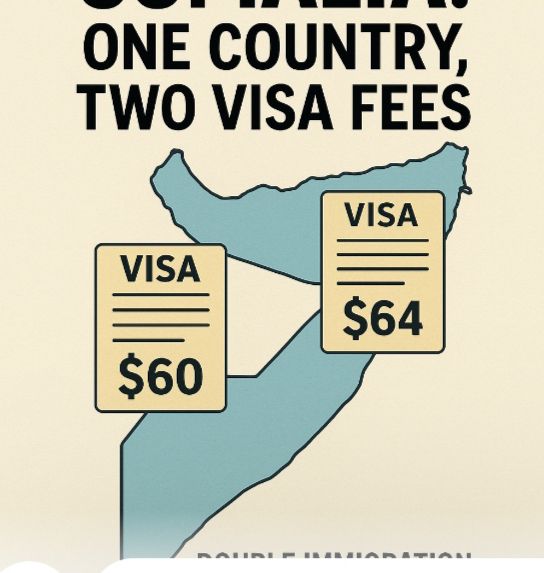
Somalia’s Visa Circus: One Country, Many Prices, Zero Shame

WDM – Critical Analysis, News & Commentaries
20 November 2025

Welcome to the Federal Republic of Fee-Somalia — a place where entering your own homeland is now a geopolitical adventure, a bureaucratic lottery, and a fiscal ambush. In this country, the price of stepping onto Somali soil depends entirely on which political fiefdom stamped your paper, which desk warlord decided to innovate a fresh “revenue stream,” and which checkpoint commander woke up today convinced he runs an independent republic.

Somalia — the state that cannot run an election, cannot secure its capital, and cannot unify a single institution — has mastered only one specialty:
charging its own dual citizens multiple fees to enter their own country, proudly and illegally.

This isn’t governance.
This isn’t federalism.
This isn’t even clan politics.
This is institutional schizophrenia performed live on a national stage.

Visa Fees by Geography: A Tragicomedy of Errors


Try using a Mogadishu visa in Garowe or Hargeisa.
Try explaining your Somali citizenship to officials acting like UN border forces.

One country.
Different fees.
Different systems.
Zero shame.

Somalia is now the only country where nationality is valid in theory, invalid in practice, and negotiable at the checkpoint. This is not autonomy. It is not federal experimentation. This is raw incompetence marketed as policy innovation.

A Government at War With Itself

The world politely calls Somalia a “federal state.”
In reality, it is a quilt of territorial toll-booths disguised as governments.

Every region behaves like a mini-embassy:
Minting fees.
Inventing regulations.
Treating fellow Somali regions as foreign threats.

Which government charges its own citizens double entry?
Which country negotiates with itself at airports?
Which leadership watches this circus and says, “Excellent — proceed”?

Only in Somalia do leaders treat parts of their own territory as enemy states — and then fly around the world to beg donors for funds to “strengthen national unity.”

Diplomacy of the Absurd

You cannot shame people who feel no shame.

The federal government pretends it oversees one immigration system.
Regional authorities pretend they each run their own country.
Travellers — Somali or foreign — are collateral damage in this somatic identity crisis.

Somalia is the only place where:

A Somali citizen becomes an undocumented alien by crossing provincial lines.

A Somali passport is recognized in foreign capitals but invalid in parts of Somalia.

Visa rules are determined by feuding political factions, not laws or institutions.

Even the African Union, famous for its patience with chaos, looks at Somalia and whispers:
“This is getting embarrassing.”

No Solutions. No Shame. No Leadership.

Fixing this mess requires:
A committee → that needs a workshop → that demands a donor-funded retreat → that requires per diems → that necessitates new visa fees → and so the snake eats its tail.

The stalemate is deliberate.
Because chaos is profitable.
Shame requires accountability — and none exists.
Reform threatens revenue — so reforms never come.

WDM Verdict

This situation is not merely dysfunctional-
it is insane.

A country that cannot guarantee a unified entry system for its own citizens has lost its administrative spine. Somalia has reduced governance to a roadside kiosk economy and turned immigration into political ransom.

Until leaders stop behaving like rival airport franchise operators, Somalia will remain a country united by passport covers and divided by entry fees.

WDM will continue exposing this rotten governance until someone, somewhere in Somalia’s political theatre decides to behave like a statesman instead of a checkpoint cashier.

Support WDM — the home of fearless, independent journalism that speaks truth to power across Somalia and the region.
Tel/WhatsApp: +252 90 703 4081.

Puntland’s Phantom Republic: Where Ghosts Draw Salaries and Leaders Chase Mirages

Welcome to Puntland—once the bedrock of a fragile Somali federation, now a mirage built not on sand but on collective fiction. The state that once prided itself as the first pillar of the federal experiment has quietly misplaced its founding objectives somewhere between donor conference buffets and expired project memoranda.

Its “institutions” stand like archaeological ruins: a labyrinth of abandoned aid projects gathering dust; pillars made of yellowing, unsigned reports; and a civil service populated not by public servants but by specters. Not the noble shades of heroic ancestors—no, these are the infamous Ghost Government Workers: apparitions with payroll numbers, invisible desks, non-existent job descriptions, and salaries that vanish into private pockets faster than a minister signs a new “capacity-building MoU.”

Here, the only thing growing faster than corruption is the headcount of non-existent employees. The public sector has become an open marketplace where ghost-hiring is a profitable side hustle, budget discipline is a myth, and foreign donors unknowingly sponsor entire cemeteries of phantom staff. Meanwhile, leaders are too busy auditioning for the role of Villa Somalia Tenant-in-Waiting to notice the institutional rot hollowing out the very state they claim to defend.

Puntland’s civil service is less an institution than a graveyard of temporary solutions, each tombstone engraved with a donor’s logo. Ministries materialize overnight, bloom like mushrooms in the rainy season of foreign aid, and just as quickly wither when the funding dries up and the international gaze shifts to a new crisis. In this cycle, the very concepts of a local budget, sustainable planning, or a functioning Civil Service Commission are not just neglected; they are treated as mythical concepts, as elusive as the Ark of the Covenant.

The Spectral Economy: An Industry of Ghosts

The “ghost worker” is no longer a scandal in Puntland; it is the cornerstone of a parallel economy. This is a fully realized phantom civil service, a shadow government whose HR department is run on nepotism, political patronage, and the discreet negotiations held in Garowe’s tea shops after dark.

The system thrives on duplication and invention.
One qualified accountant in the Finance Ministry?The solution is not efficiency, but proliferation: hire six “assistant auditors,” four “regional fiscal coordinators,” and three “inter-ministerial liaison officers.” None have ever seen a government ledger, but all are paid. On time. Every month. Their existence is managed by a select priesthood of payroll clerks who perform the miracles that keep the ghosts on the books.

· State-building? A rhetorical question.
· State-draining? The primary industry.
· Sustainable governance? A fantasy.
· Sustainable corruption? Puntland’s most resilient native product.

The Fiscal Fantasy: Budgeting Without a Budget

Puntland’s fiscal strategy is a masterclass in dependency, a four-act play performed for an audience of international donors:

1. The Appeal: Lament a crisis of legitimacy and capacity.
2. The Absorption: Spend the incoming funds with maximal opacity.
3. The Exhaustion: Test the donor’s patience until warnings are issued.
4. The Repentance: Launch a new “reform initiative” to appeal to their conscience.

Rinse and repeat.

The radical notion that local revenue could fund public institutions is dismissed not as impractical, but as heretical—a dangerous Western idea that threatens the delicate ecosystem of graft and dependency.

The Absentee Landlords: Leadership Focused on Mogadishu

While Puntland’s bureaucratic house crumbles, its landlords are perpetually away, gazing longingly at Villa Somalia. Puntland has perfected aspirational governance, where the state is not an end to be served, but a steppingstone to be used.

Why bother fixing a broken ministry in Garowe when you can draft a speech about fixing the entire nation from Mogadishu? Why deliver services to your constituents when you can campaign for a grander title? Every official, from director-general to “acting consultant,” maintains two resumes: one for the job they neglect, and one for the office they covet in the next government.

The central, unifying political question in Puntland is not “How do we improve this?” but “Maxaa laga helaa Villa Somalia?”—What’s in it for me in Mogadishu?

The Collapse in Slow Motion: A Union Sealed with Donor Duct Tape

The Puntland “State of the Union” is a tragic farce: a government without governance, institutions without integrity, workers without work, and leaders without a trace of shame.

The few real civil servants—the skeletal crew that keeps the lights on—are drowning in a sea of meaningless paperwork, implementing policies designed only for progress reports, and maintaining programs already slated for termination. They are the living, struggling in a kingdom of the dead.

Meanwhile, the ghosts multiply. The donors grow weary. The leaders campaign. The public despairs. And the entire phantom republic quietly collapses under the weight of its own fiction.

The Final Diagnosis

Puntland’s ailment is not a poverty of resources, but a poverty of seriousness.

A state cannot be built on spectral employees, donor whims, and the presidential ambitions of its caretakers. It cannot survive when its institutions are retirement schemes for the connected, its projects are photo-opportunities, and its payroll is a ledger of the damned.

The people of Puntland deserve a government that exists in daylight. Somalia deserves a partner that is functional, not fictional. The very idea of governance demands more than this elaborate charade.

Until then, the haunted house remains open for business, and the ghosts continue to collect their pay.

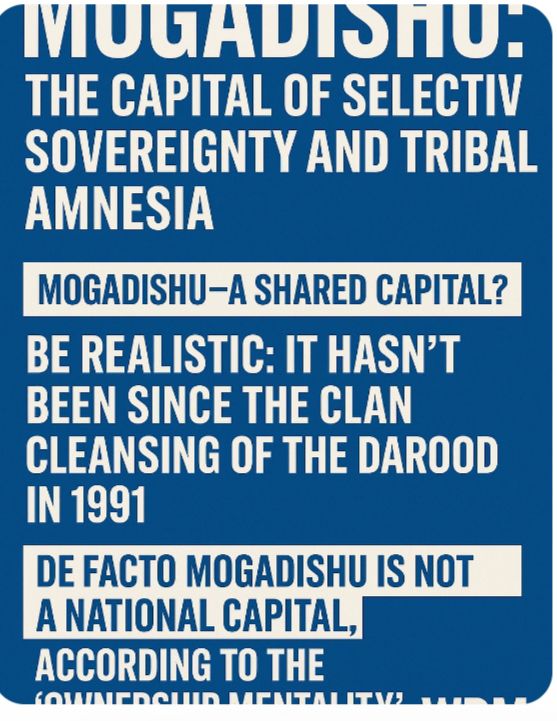
Mogadishu: The Capital of Selective Sovereignty and Tribal Amnesia

Be realistic — painfully realistic, the kind of realism that makes people shift in their seats and reach for the nearest excuse. Mogadishu is no longer a “shared capital.” It hasn’t been for more than three decades, yet the political class still recites the lie with the enthusiasm of a badly trained parrot.

What stands today on the Banadir coastline is not a federal capital, nor a symbol of national unity, nor the beating heart of a reborn Somali Republic. No, Mogadishu is a fortified clan foxhole, a trench lined with roadblocks, Tigre-imported cement, and the selective memory of those who pretend the Civil War ended everywhere except in their own political psyche.

Let’s call things by their names before the masquerade consumes us all.

THE MYTH OF THE “NATIONAL CAPITAL”

A capital belongs to the nation.
Mogadishu, in practice, belongs to the mentality of its owners — a single clan holding the city as a victory trophy ever since the 1991 clan cleansing that violently uprooted Darood communities who had lived peacefully there for generations.

This is a historic fact.
Not an insult.
Not a provocation.
A documented, unrepented wound.

And yet, each time a Darood politician visits Mogadishu, they are expected to behave like thankful guests, not constitutional stakeholders. They must walk like diplomats in a foreign state — escorted, monitored, barely tolerated, and reminded silently: “This is not yours anymore.”

Anyone pretending otherwise is either:

Delusional

Nostalgic

Or dangerously hopeful

WDM recommends medical check-ups for all three conditions.

THE DE FACTO REALITY: OWNERSHIP MENTALITY REPUBLIC

In today’s Mogadishu:

Federalism is tolerated only when it serves Mogadishu’s political merchants.

The constitution is cited only when it helps retain power.

The “national capital” label is weaponized to extract resources while keeping other regions politically paralyzed.

The unwritten code of modern Mogadishu politics is simple:

“What’s yours is mine.
What’s mine is absolutely mine.”

It is a city administered by a clan, defended by a clan, narrated by a clan, and mythologized by a clan — yet publicly marketed as a capital for all.

This is not a capital city; it is a clan condominium with a ceremonial national flag.

THE WARLORD WHO SPEAKS THE TRUTH

And here lies the great satire of Mogadishu politics:

During a recent parliamentary debate, a warlord-turned-senator — a man who once patrolled the capital in a technical, ruling neighborhoods with the arrogance of a medieval baron — stood up and spoke with surprising clarity about Mogadishu’s ownership mentality.

And ironically, tragically, his worldview is closer to Mogadishu’s reality than that of Said Dahir and the “Mogadishu belongs to all Somalis” dreamers.

The warlord, Muse Saudi Yalaxow, understands the city because he once ran it.
He knows its unspoken truth:

“Mogadishu belongs to us. Everyone else is here by convenience, not by right.”

Said Dahir and his like inside and outside the rubber-stamped parliament— idealists preaching Scandinavian-style inclusivity — may be sincere, but they are speaking to a Mogadishu that does not exist, has not existed since 1991, and will not exist until the psychological barricades fall.

In Mogadishu, the warlord is the realist.
The intellectual is the romantic.
And the city remains a fortress pretending to be a capital.

DAROOD “OWNERSHIP CLAIM”? A SAD COMEDY OF SELF-DECEPTION

Let’s address the elephant in the ruined villa:

Some Darood elites keep whispering, “Mogadishu is our capital too.”

WDM responds:
“With what army, what rights, what demographic footprint, and what political leverage?”

If a capital cannot guarantee:

free movement,

equal property rights,

political neutrality,

and safety without clan sponsorship,

then one cannot call it a capital.
Call it something else: a tribal headquarters with UNDP branding.

Those clinging to the dream of shared ownership are still mentally living in pre-1991 postcards.

History moved on.
They didn’t.

THE CONSEQUENCE: A COUNTRY WITH A HOSTAGE CAPITAL

When the capital belongs to one clan, what happens?

1. Federalism collapses.
Every negotiation becomes a hostage negotiation.

2. Other regions operate like independent states.
Because they cannot trust a city that doesn’t treat them as equals.

3. National elections become Mogadishu family business.

4. Every president becomes a clan-appointed caretaker, not a national leader.

5. The Civil War continues in political form, wearing a suit and speaking donor-friendly English.

THE SATIRE OF “NATIONAL OWNERSHIP”

Mogadishu is presented as:

National capital

Seat of sovereignty

Symbol of unity

Federal heartbeat

But ask any honest resident of the city who owns Mogadishu, and they will laugh you out of KM4.

Laughter — the final stage of truth.

THE WDM VERDICT

WDM issues its ruling:

Mogadishu, as currently constituted, cannot be the capital of a functioning federal republic.
It is the inherited foxhole of 1991, wrapped in a national flag.

Until the city:

confronts its past,

acknowledges what happened,

dismantles the ownership mentality,

and treats other Somalis as stakeholders,
there will never be a “Somali capital,”
only a Hawiye metropolis hosting federal tourists.

This is not hatred.
This is historical realism stripped of political cosmetics.

Somalia cannot build a republic on landmines of selective memory.

——-

Support WDM — the home of fearless, independent journalism that speaks truth to power across Somalia and the region.
Tel/WhatsApp: +252 90 703 4081.

The Citizenship Hustle: Welcome to the Land of the Vanishing Passport

Imagine you – you did everything right. You waited. You filled out the papers. You answered the questions. You pledged allegiance. You became a citizen of United States. You believed you had joined the club. You believed citizenship meant you were safe.
And then: poof. Someone upstairs decides you weren’t good enough after all. Someone digs out something old, something negligible, something they say changed your status. They rip your certificate, snatch your rights. Suddenly you’re a “former citizen.” Your home becomes an alien land.

This isn’t fiction. According to reporting by the Associated Press, naturalized citizens in the U.S. are increasingly wary of denaturalization policies under the guise of “immigration enforcement” — effectively undoing the contract between citizen and state.
The dream of citizenship becomes the nightmare of uncertainty.

Fear Wears a Flag

For many, citizenship is the crown jewel of belonging. It says: “I am one of you.” It says: “I belong here.” Yet, in this new American concoction, citizenship can now wear a flimsy label: “You belong until we decide you don’t.”
The news story notes that even those who thought they were safe are having nightmares: what if the state comes and says: “Change your status. We changed our mind.”
When the state stops being the guarantee and starts being the threat, fear becomes the new civic duty.

This is deeply political. The state that once promised permanence is now issuing caveats. Citizenship becomes “provisional,” not in oath, but in practice. Rights become conditional. Membership becomes revocable.
For diaspora communities, immigrants, people building lives — this is not just bureaucratic. It hits identity, security, trust.

Denaturalization as Policy, Denial as Identity

What does it mean when you can become a citizen and later have that right withdrawn?
It means the state holds the power of “belonging” in its hands like a bouncer at a nightclub. You’re admitted. You dance. Then the bouncer whispers: “Actually, we’re shutting the club. You – you’re out.”
And your citizenship certificate? The souvenir becomes the proof of what you used to be.

Such acts are not only legal maneuvers but symbolic messages: “We grant you membership, but you must remember: it is revocable.”
This sends a chilling signal to all who stood in line, filled the forms, waited the years: trust the state less. Participate less? Speak up less?
Fear becomes the invisible chain.

A Mirror for Somalia’s Diaspora? Why This Matters Beyond America

You and I may be far in theology — you in Puntland, engaged in civic identity projects — but this American story resonates for global citizens, for diaspora, for anyone building life across borders.

In Somalia, diaspora communities invest in homeland infrastructure; they regenerate lives. In the U.S., naturalised citizens invested in the American promise — homes, businesses, families — and find the ground shifting beneath them.
If citizenship is destabilised in the world’s most powerful democracy, what message does that send for fragile states, for people whose belonging has always been negotiable?

It underscores a global truth: when the state treats citizenship as a privilege rather than a right, another form of marginalisation creeps in.
You might hold documents. You might swear an oath. But your status is only as safe as the political convenience that underpins it.

The Big–Picture Politics: Fear as a Weapon

Let’s pull the curtain back. Why the fuss over naturalisation and denaturalisation? Because fear is power.
When people fear that citizenship can be taken away, they self-censor. They stop complaining. They avoid risk. They shrink.
That’s not a bug. It’s a feature. The state that casts the shadow of revocation over its citizens wields compliance without truth.
And let’s not forget: policies like this emerge in the broader context of immigration enforcement, securitisation, and the shifting politics of identity. The story of denaturalization is not only about immigrants. It’s about how states redefine loyalty, belonging, and consent.

The Punchline (But It Hurts)

So here’s the hard truth: In the land of the free, you might be free… until you’re not.
Citizenship was once the fortress of rights. Now it’s the house built on sand.
It doesn’t matter if you earned your certificate fairly, if you’ve lived the life of a citizen. If someone finds a thread in your paperwork, you can be un-made.

For those of us across the world watching this unfold — whether in Somalia, Puntland, or the diaspora communities of Kenya, Gulf, or Europe — it should raise alarms. Because if the U.S. can break this social contract, what hope do weaker states have for stabilising belonging?

Call to Action

If you hold citizenship anywhere: check your documents. Know your rights. Don’t assume permanence.
If you are part of the diaspora: worry not only about investment in infrastructure but about the investments made in identity — in belonging.
If you are a journalist, an editor, a civic educator: sharpen your voice. Denaturalization is the next frontier of disenfranchisement, the quiet removal of rights through paperwork and fear.

——–

Support WDM — the home of fearless, independent journalism that speaks truth to power across Somalia and the region. Tel/WhatsApp: +252 90 703 4081.

THE REPUBLIC OF EXTORTION: HOW HASSAN SHEIKH TURNED A FAILED STATE INTO A PERSONAL ATM

WDM EDITORIAL

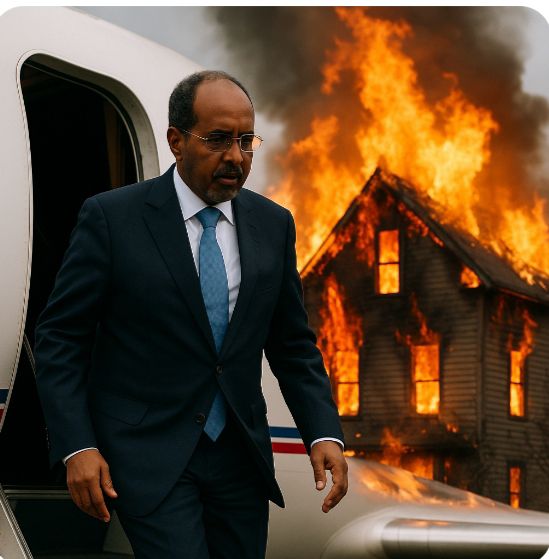
Somalia’s federal experiment was never meant to be glamorous, but it was at least supposed to function. Today, even that modest expectation has collapsed into a farce so grotesque it would make a kleptocrat blush. The so-called Federal Government of Somalia has ceased to exist in every capacity except one: as a passport for one man, Hassan Sheikh Mohamud, to hop around the world in an endless parade of irrelevant conferences where deputy ministers should be the ones shaking hands.

This is not diplomacy.
This is not leadership.
This is state-funded tourism.

While Mogadishu’s institutions crumble like stale biscuits, the president has transformed the country into a one-man travel agency. His itinerary is full; his country is empty. Federal ministries operate on autopilot. Parliament is a cemetery of legislation. National courts and commissions are sleeping under layers of dust. And security? Let’s not embarrass ourselves.

But the latest scandal—charging an extortion fee to enter Villa Somalia—is the final insult. The people’s house, the symbolic heart of the republic, has been reduced to a toll gate. Citizens must now pay to see the man who claims to govern them. It is the purest metaphor for a regime that only understands the country as a revenue source, not a republic.

Every week brings a new scandal:

Illegal appointments

Phantom contracts

Misused international funds

Secret deals with foreign powers

Political persecutions

Clan-based manipulation

Abuse of state security units
Yet none of it slows Hassan Sheikh. The man walks through accusations the way a seasoned thief walks through a dark alley: with confidence, familiarity, and no fear of accountability.

Why? Because no institution in Mogadishu has the spine—or independence—to hold him in check.

Somalia is not witnessing simple misrule; it is witnessing the criminalization of governance itself. The thin line between public office and organized extortion has been erased. The presidency has become a private enterprise. The so-called federal government is merely a storefront with broken windows.

And all the while, the man smiles, travels, waves, and lectures the world about “peacebuilding,” “governance reform,” and “democracy transition.” A Hollywood actor couldn’t keep a straight face under such a script.

Somalis are now living in a republic of shenanigans, where corruption is policy, dysfunction is routine, and extortion is a legitimate revenue stream. No state can survive this. No people can tolerate it indefinitely.

RECOMMENDATIONS: HOW TO COUNTER THE MADNESS AND RESTORE SANITY

1. Build a Unified Opposition Front With Real Leadership

Not the chaotic, ego-driven gatherings we see today. Somalia needs a disciplined, coordinated political bloc capable of ending Hassan Sheikh’s circus. Puntland, Jubaland, Banadir opposition, and civic forces must adopt:

A joint election roadmap

A shared anti-corruption charter

A single spokesperson structure
Without unity, Hassan Sheikh will divide, bribe, and outmaneuver them all.

2. Document Every Abuse—Create an Evidence Archive

Every scandal, every extortion scheme, every illegal appointment must be documented.
Produce a national corruption ledger for public release and international submission.
Do not let these crimes disappear into memory.

3. Mobilize Public Opinion—Digital and Traditional

Somalis are no longer voiceless.
Coordinate:

Social media campaigns

Community forums

Diaspora petitions
Expose Villa Somalia’s behavior relentlessly.
Silence is complicity.

4. Encourage Federal Member States to Assert Constitutional Autonomy

Puntland and Jubaland must not wait for Mogadishu’s permission to function.
The constitution grants them rights—use them:

Reject illegal directives

Strengthen local institutions

Build alliances with civil society
A functioning periphery can counter a rotten center.

5. Press the International Community for Conditional Engagement

The donors love pretty speeches from Mogadishu.
Force them to confront the truth:
No reforms should be funded without measurable benchmarks and oversight.
Insist on:

Independent audits

Transparency requirements

Sanctions against corrupt officials

Make it expensive for the world to ignore Somalia’s decay.

6. Prepare for a Post–Hassan Sheikh Transition

The writing is on the wall.
When this regime collapses under its own greed and incompetence, there must be:

A credible interim framework

A caretaker structure agreed upon by FMS

A clear roadmap to stabilize governance
Chaos benefits only extremists and power brokers.

7. Establish Civic Protection Networks Against Extortion

Communities in Mogadishu must organize safe reporting channels, legal assistance pools, and watchdog groups to fight extortion at checkpoints, ministries, and Villa Somalia gates.

CONCLUSION: A COUNTRY SHOULD NOT BE A COLLECTION BOX

Somalia is not a marketplace for presidential greed.
It is not a donation basket.
It is not a private travel budget.

It is a nation struggling to breathe, strangled by a presidency that no longer even pretends to govern.

Somalis must push back—peacefully but forcefully—before the republic collapses completely into a theatre of extortion and chaos.

—–

Support WDM — the home of fearless, independent journalism that speaks truth to power across Somalia and the region.
Tel/WhatsApp: +252 90 703 4081.

Farmaajo: The Architect of Federal Dysfunction – Or, How to Dismantle a Nation with a Smile

WDM EDITORIAL

Let us begin with a simple civic riddle: Who broke Somalia’s fragile federal experiment long before Hassan Sheikh began hammering in the final nails?
Clue: He wore a presidential sash like a Halloween costume, weaponized the NISA like a private militia, and called every sub-national leader “Walaal” while plotting their political funerals behind closed doors.

Yes—Mohamed Abdullahi Farmaajo, the man who marketed himself as the “saviour of federalism” while conducting the most aggressive anti-federal coup ever attempted in Somalia’s history.

And now, strangely, he floats in the political pond pretending to be neutral, claiming innocence like a fox wiping feathers from his mouth.

THE GREAT GOVERNOR-MAKER OF VILLA SOMALIA

Let’s not suffer from national amnesia.
Who turned the constitutionally elected federal member state presidents into Mogadishu-appointed district commissioners?

Who converted state-building into a political slaughterhouse?

Ahmed Qoor Qoor (GalMudug) – delivered from Villa Somalia’s labour room.

Abdiaziz Laftagareen (Southwest) – delivered by forceps, courtesy of Ethiopian commandos and Villa Somalia’s cash register.

Ali Guudlaawe (Hirshabeelle) – a president for a state he constitutionally could not lead, rushed through in a political C-section without anesthesia.

All three were produced in Farmaajo’s political factory, where state presidents were assembled like cheap plastic toys—shiny, fragile, and remote-controlled.

And then he dared lecture the nation about “constitutional order.”

THE MAN WHO TRIED TO SHRINK PUNTLAND AND JUBALAND

Before HSM began his reckless centralist crusade, there was Farmaajo—the original federal vandal.

It was Farmaajo who first attempted to:

Reduce Puntland to a ceremonial afterthought, a governorate that salutes visitors in Villa Somalia’s waiting room.

Bully Jubaland into submission, deploying every foreign muscle he could borrow—Ethiopian troops, Qatari funds, political sabotage—anything short of hiring a marching band.

Isolate both states from national decision-making, turning the FGS–FMS relationship into a hostage negotiation.

And now, in 2025, he walks around Mogadishu with a saintly face, pretending he never signed the death warrant of Somali federalism.

FEDERAL STRUCTURE? FARMAAJO TREATED IT LIKE A SPEED BUMP

Under Farmaajo, Somalia’s federal foundations were not just cracked—they were actively burned, bulldozed, and buried.
He weaponised every federal tool at his disposal:

NISA – turned into a private militia for midnight arrests and political kidnappings.

Federal Budget – transformed into a carrot-and-stick system: loyalty gets cash, dissent gets starvation.

Foreign Military Allies – used as pressure valves against federal states, especially in Southwest and Jubaland.

Parliament – reduced to a rubber-stamp club whose only job was to applaud on command.

This man did not simply damage federalism.
He turned it into a charred carcass, a project Somalis are still trying to resuscitate with bare hands.

THE POLITICAL PYROMANIAC WHO PRETENDS TO BE A NATIONAL PATRIOT

Today, Farmaajo positions himself as the “reasonable statesman,” above the fray, watching the DamulJadiid–Golaha Mustaqbalka–Sirdoon circus as if he didn’t set the stage for this chaos.

He now wants us to believe he is the balanced voice, the misunderstood technocrat, the man Somalia rejected too early.

Nonsense.

He is the one who:

Poisoned federal politics.

Created puppet states.

Normalized federal interference.

Militarized elections.

Paved the road for today’s crisis by turning federalism into a bargaining chip instead of a system of governance.

If Hassan Sheikh is the farmer harvesting Somalia’s political tragedy, Farmaajo is the man who planted the seeds and watered them with authoritarian ambition.

A FINAL WDM VERDICT

Let history record this truth clearly:

No one has done more to undermine Somalia’s federal foundations than Mohamed Abdullahi Farmaajo.
Not out of ideology, not out of strategy—but out of a blind thirst for control and a deep suspicion of decentralization.

He lit the fire.
Others are simply dancing around the flames.

Somalia will not move forward until it confronts the political arsonists—old and new—who treat the federal system as a personal toy, not a national covenant.

WDM will continue to call them out. Loudly. Relentlessly. Without apology.

Somalia at the Edge of the Cliff: A Final Appeal to the World Before Collapse Becomes Inevitable

WARSAME DIGITAL MEDIA (WDM) –  EDITORIAL

Somalia is no longer simply failing. It is being dragged—deliberately—toward fatal disintegration by a presidency that has exhausted its moral legitimacy, constitutional mandate, and political usefulness. Today, every indicator points not to mere instability but to an approaching national event horizon, a point of no return from which no federal system, no institution, and no social compact can be retrieved.

President Hassan Sheikh Mohamud has now crossed the Rubicon. His regime is no longer attempting to govern; it is attempting to rule by decree, extension, manipulation, and substitution of the constitution with personal ambition. His appointment of a new puppet prime minister is not an administrative decision—it is a political demolition charge designed to clear the path for illegally extending his mandate.

Somalia has seen this film before—but never with this level of recklessness.

A Parallel Government? Somalia Approaches Uncharted Territory

The emerging response from the regions and opposition—the Golaha Mustaqbalka (Puntland, Jubaland, and the Mogadishu opposition)—signals a moment Somalia has never witnessed in the post-civil war era:
the open preparation for a parallel federal government.

Their next summit in Kismayo is expected to produce not just communiqués and warnings, but the birth of a competing political authority. This is no longer speculation. It is happening in real time.

Think of the implications:

Two rival federal systems claiming legitimacy

Two “presidents,” two “prime ministers,” two “parliaments”

Competing international alliances

Fragmentation of the command structures of security forces

Collapse of national coordination

Total paralysis of governance

This is the Lebanonization of Somalia.
This is the Libyan scenario in the Horn.
This is the undoing of two decades of international investment—in slow motion.

A Vacuum Waiting to Be Filled by Fire

When political institutions collapse, the vacuum is never empty for long.
Somalia knows this painfully well.

Al-Shabaab, ISIS, and emerging extremist networks thrive in fractured environments:

Rival governments

Distracted politicians

Broken national command structure

Distrust between regions

Security fragmentation

This political meltdown is not simply dangerous—it is fatal.

Extremists do not need permission; they only need opportunity.
President Hassan Sheikh Mohamud is giving them that opportunity on a silver platter.

WDM’s Appeal to the International Community: DO NOT BE COMPLICIT THROUGH SILENCE

The world has invested billions in Somali recovery.
Billions.
Monetary investments, security support, development programs, and political stabilization missions.

All of that now stands at the brink of liquidation.

WDM issues this urgent and uncompromising appeal to:

The United Nations

The African Union / ATMIS

IGAD

The United States

The European Union

The United Kingdom

Turkey

The Gulf States

International partners and global democratic forces

Silence at this moment is complicity.
Your hesitation will be interpreted as approval of an illegal power grab.
Your inaction will accelerate Somalia’s descent into chaos.
Your neutrality will be remembered as abandonment.

Somalia does not need more statements.
Somalia needs decisive international engagement to prevent a total state rupture.

A Call to Somali People With Common Sense

WDM also appeals directly to the Somali public:
the thinkers, the elders, the business community, the youth, the mothers, the diaspora, and those who still believe in the federal vision.

This is your country.
This is your future.
Your silence is giving permission to a political elite determined to wreck the nation for personal survival.

Now is the moment to speak, organize, pressure, demand, and mobilize.
Once the country fractures into parallel governments, it will not be repaired for generations.

Conclusion: Somalia Still Has a Chance—but Not for Long

Somalia is balancing on a razor’s edge.
One wrong political decision, one illegitimate mandate extension, one reckless manoeuvre—and the entire federal system will crumble.

WDM warns, in the clearest terms:
Somalia is entering an irreversible danger zone.
Preventing national collapse is still possible, but only if action is taken now, not after the damage is done.

WDM urges the world community and all Somali citizens with conscience to resist this slide into darkness before the country crosses the final red line.

History will judge all who remained silent.

WDM – Speaking Truth to Power.

Support WDM — the home of fearless, independent journalism that speaks truth to power across Somalia and the region.
Tel/WhatsApp: +252 90 703 4081.

The Great Somali Masquerade: A National Tragedy Served With Salool (Popcorn)

(WDM Edition — No Mercy, No Makeup, No Illusions)

Cue the drums. Light the torches. Release the clowns.
The great Somali political circus is back in town for the 2026 election season — and like every cheap, recycled travelling show, the script hasn’t changed since Siyad Barre rode this horse into the ground. The faces age, the slogans mutate, the logos get rebranded, but the disease remains fatal and untreated: Somalia’s political class isn’t trying to save the nation — only to seize the keys to Villa Somalia and loot whatever organs are still functioning.

Let the masquerade begin.

Act I: The Pretenders Take the Stage

On one side is DamulJadiid, the only faction in Somalia that actually knows how to organize, manipulate, and execute a long game. They are the engine behind a leader whose shadow dreams of a third term are becoming less shadowy by the day — a political ghost haunting Somalia’s already haunted house.

Opposing them is a collection of “coalitions” so flimsy they could be blown away by a desert breeze. These groups don’t resemble political movements; they resemble counselling groups for failed candidates:

• Nabad & Nolol (N&N)

Mohamed Abdullahi Farmaajo has returned to Banadir like a man testing bathwater in a public toilet. Is it warm enough? Are the loyalties for sale? Are old allies still alive — or alive enough to bribe?

Golaha Samatabixinta — “The Salvation Council”

Because nothing screams “We have no plan” like slapping the word “salvation” on a group of career politicians who couldn’t save a houseplant.

Golaha Mustaqbalka — “The Future Council”

A name vague enough to be a telecom company or a pyramid scheme. Their only shared “future” is each one imagining himself sitting on the presidential throne while the others serve tea.

These aren’t alliances — they’re holding pens for presidential candidates, ego camps disguised as political coalitions, and tributes to the old “S-fronts” of the 1980s: Same actors, same delusions, same tragic comedy.

Act II: The Courtship — Romance, Lies, and Diaspora Airbnbs

Brace yourselves for a parade of useless “unity meetings” hosted in Nairobi villas, Doha lounges, Ankara hotels, and Dubai’s most forgettable conference rooms.

Watch sworn enemies grin and clutch hands for the camera, each eyeing the other like a hyena deciding which limb to amputate first.

Press releases will thunder about:

“Historic agreements”

“A new dawn for Somalia”

“Unified vision”

Meanwhile, every signatory will be secretly on WhatsApp with his foreign financiers whispering:
“Don’t worry, I’m still running. These other fools are just temporary luggage.”

Act III: The Auction — Somalia Goes to the Highest Bidder

This is when the real entertainment begins.

MPs-to-be — Somalia’s infamous “electoral college” — transform overnight into political livestock whose market price skyrockets by the hour. Suitcases shuffle through airports. Dollar-shaped halos form above candidate heads. Ministries are promised like bags of sugar.

Ideas? Zero.
Policy? Non-existent.
Reform? Stop dreaming.

This is a nationwide auction where loyalty is sold by the kilo, and every candidate believes he’s the master bidder — not realizing he’s also for sale.

Act IV: The Betrayal — Somalia’s National Sport

Then comes the inevitable crescendo.

A prominent N&N figure will “find religion” and defect to DamulJadiid “for the sake of national unity.”

A member of the “Future Council” will suddenly rediscover the past — specifically whichever past alliance pays better.

The “Salvation Council” will split into more pieces than Mogadishu’s roads.

The so-called opposition will collapse into its natural state:
a stampede of self-propelled egos racing toward individual deals with whoever offers a ministry, a motorcade, and a microphone.

Meanwhile, in the Real Somalia…

While the elites binge on political seduction and betrayal:

Al-Shabaab continues to tax, slaughter, and administer justice.

Droughts tighten the noose.

Displaced families rot in tent cities.

The economy limps along like a wounded camel.

Youth flee — by sea, by plane, or by coffin.

But none of this matters in the Masquerade. Somalia’s suffering is merely a prop in campaign speeches — a decorative tragedy wheeled onstage when convenient, shoved offstage when the applause fades.

The Final Tragedy

The real catastrophe is not that this grotesque performance happens.
It is that Somalis have learned to expect it.

This is not a political process — it is a metronome of dysfunction, a perpetual farce replayed with religious precision every election cycle.

The actors are the same.
The excuses are the same.
The delusions are the same.
The ending is the same.

And the losers — without exception — are the Somali people.

So grab your popcorn.
The Great Somali Masquerade is underway again.
Place your bets.
The clowns are ready.
The stage is collapsing.
And the audience — long-suffering, long-ignored — is left praying the circus burns itself down before the country does.

—–

Support WDM — the home of fearless, independent journalism that speaks truth to power across Somalia and the region.
Tel/WhatsApp: +252 90 703 4081.

On the Establishment of Somali Southwest State

This is where and when we had established Southwest Somalia in 2001. After that, SRRC (SOMALI RECONCILIATION and RECONSTRUCTION COUNCIL), a council of Somali warlords, was established to oppose TNG of AbdulQassin Salad Hassan, who was crowned in Arta (Djibouti) Conference in 2000. You have that story in our Dhaxalreeb videos, 2025.

The Unending War: How Constitutional Betrayal and Political Theater Perpetuate Somalia’s Crisis

The Illusion of Peace in the “Second Republic

Two decades after the establishment of the Second Somali Republic through the 2004 Transitional Federal Charter, the promise of a unified, federal Somalia remains tragically unfulfilled. The official narrative would have us believe that the civil war belongs to the past, that the federal system is steadily consolidating, and that national reconciliation is underway. This narrative is a dangerous fiction. The reality is that Somalia’s war is not over; it has merely evolved. The frontline has shifted from overt clan warfare to a more insidious conflict waged within the very institutions meant to foster peace—a conflict characterized by a systematic dismantling of the federal constitution, a leadership class addicted to a dysfunctional city-state model, and a performative politics that substitutes substance for spectacle. The continuous failure of the Federal Government is not a flaw in the federal design, but the direct consequence of presidents who wear the title of “federal” leader while their actions are guided by a centralist, strong-man mentality that has already proven catastrophic in Somalia’s history.

The Constitutional Façade: A Charter Honored in the Breach

The Provisional Constitution of 2012 was meant to be the foundational social contract, painstakingly designed to rectify the historical grievances born from over-centralization that fueled the 1991 state collapse. It established a federal system to balance power between the center and the Federal Member States (FMS), safeguarding unity while respecting diversity. Yet, from its inception, this contract has been treated not as a binding covenant, but as a suggestion box from which the political elite in Mogadishu can pick and choose.

1. Constitutional Violations as Policy: The constitution explicitly defines Somalia as “an indivisible federal republic” (Art. 1) and mandates power-sharing. In practice, the Federal Government of Somalia (FGS) routinely usurps state prerogatives over security, taxation, and resources, rendering the Intergovernmental Relations Framework (Art. 51) and the Constitutional Court (Art. 109) deliberately dormant. This creates a legal vacuum where intergovernmental disputes fester without impartial arbitration. This is not an implementation failure; it is a strategy of deliberate institutional paralysis.
2. The Land Grabs and Human Cost: The most visceral betrayal of the constitution is seen in the violent forced evictions plaguing Mogadishu. Critics and a coalition of lawmakers have directly accused President Hassan Sheikh Mohamud of authorizing the sale of public lands without due process, leading to the forceful eviction of thousands of poor and displaced families. These actions, allegedly enriching the president’s inner circle while displacing citizens, violate constitutional guarantees of property rights (Articles 25, 27) and the state’s duty to protect citizen welfare (Articles 10, 12). The result is a humanitarian crisis and a stark confirmation that for the powerful in Villa Somalia, the constitution is merely parchment.

The Security Theater: Militants Advance as Leaders Play Politics

The devastating human cost of this governance failure is most apparent in the ongoing military conflict. While the government engages in political theatrics, the threat from Al-Shabaab remains potent and deadly.

Table: Selected Al-Shabaab Attacks and Operations in 2025

Date Event Impact & Significance
February 20, 2025 Launch of the “Shabelle Offensive” Coordinated attacks on multiple villages and military positions in Middle Shabelle region, aiming to encircle Mogadishu.
February 27, 2025 Capture of Balad Militants temporarily seized this strategic town just 30km north of the capital, storming a military base and freeing prisoners.
March 18, 2025 Assassination Attempt on the President A roadside bombing targeted President Hassan Sheikh Mohamud’s entourage near Villa Somalia, a brazen attack he narrowly survived.
June 2, 2025 Seizure of Hawadley Al-Shabaab took control of a village 91km northeast of Mogadishu after Burundian AUSSOM forces withdrew from a strategic base.

This relentless insurgency persists precisely because political energy is diverted. As the opposition “National Salvation Forum” has stated, political disputes and mismanagement in Mogadishu have directly distracted from defeating Al-Shabaab. The government is simultaneously fighting an insurgency and a political war of its own making, and it is failing on both fronts.

The Failed Promise of Reconciliation and the Rise of Confederal Options

The profound failure to implement a genuine federal system has bred a dangerous new cynicism, pushing some regions to consider even more radical and disuniting solutions.

1.  The Mirage of National Reconciliation: The 2017 National Reconciliation Framework (NRF) was launched with grand promises of being a “Somali-led and supported effort – for the people and by the people”. It recognized that past conferences, dominated by politicians and military leaders, had failed because they were not inclusive, community-based processes. Yet, this initiative too has been undermined by the same lack of political will. True reconciliation requires dealing with the past and building trust in institutions—a prospect impossible when those institutions are actively being weaponized.
2. The Lure of Confederalism: In this vacuum of legitimate federal governance, the idea of confederalism has emerged as a provocative alternative, most notably proposed by Puntland’s intellectuals. This model, which would reduce the FGS to a nominal authority and grant near-full sovereignty to member states, is a symptom of terminal frustration.

The “Never-Ending Circus” and the Mentality of Failure

The core of Somalia’s crisis is not structural; it is a crisis of character and mentality within the political class. The governance of Somalia has been described as a “never-ending circus” at Villa Somalia, a theatrical production in its fifth encore where the script is tired and the audience is ignored. The Federal Parliament often acts as a rubber stamp, while the opposition mobilizes through press releases rather than popular action.

This spectacle is powered by a regressive political mentality that is fundamentally at odds with a modern federal state:

1. The City-State Delusion: Somalia’s presidents, despite their titles, have failed to transition from the mindset of a Mayor of Mogadishu to that of a national leader. They cling to the illusion that governing the capital is synonymous with governing the nation, treating federal member states as rebellious districts rather than constitutional partners. This is the same strong-man mentality that led to the state’s initial collapse, now repackaged in a federal guise.
2. The Zero-Sum Trap: The political elite operates in a zero-sum game, where one leader’s gain must be another’s loss. As noted by analysts, “Somalia’s greatest obstacle is not structural or financial. It is the refusal of its political class to rise above a zero-sum mindset”. This mentality sacrifices long-term national cohesion for short-term political points, making the cooperation and compromise essential for federalism impossible.

Conclusion: The Stubborn Reality and the Path Not Taken

Somalia stands at a precipice. The “Second Republic” is failing not because federalism is unworkable, but because it has been systematically sabotaged from within. The solution is not another grand constitutional overhaul. The solution is a fundamental reckoning with reality.

Until Somalia’s leaders—and the citizens who enable them—accept the de facto situation on the ground that emerged from the civil war, a reality of diverse regional identities and interests that demand a genuine power-sharing arrangement, nothing will change. The path forward is not mysterious. It requires:

1. A return to constitutional order, operationalizing the dormant institutions like the Constitutional Court and respecting the distribution of powers.
2. An end to the political theater and the adoption of a cooperative, positive-sum political culture.
3. A sincere, community-owned national reconciliation that addresses historical wounds rather than using them as political weapons.

The weapons of the civil war may have largely fallen silent, but the war for Somalia’s soul and statehood continues. It is being lost not on the battlefield, but in the corridors of power, through every violated article of the constitution, every evicted family, and every cynical political calculation. The war will only be over when the constitution is more than just ink on paper—when it becomes the lived reality of Somali governance.

“The Somaligate”

https://www.financialafrik.com/en/2025/11/10/the-somaligate-whistleblower-abshir-aden-ferros-decade-long-fight-against-alleged-eu-influence-peddling-is-taking-a-new-twist/?fbclid=IwdGRzaAOBEK9jbGNrA4EOd2V4dG4DYWVtAjExAHNydGMGYXBwX2lkDDM1MDY4NTUzMTcyOAABHmHfgwAZsxXaqoF_EZZyuA5lXq7ExvRVKCXy7FvELOPLIAkpPQknOE5vzd_G_aem_xvs-uxHrMzGiPacXQ38dhA&sfnsn=mo

The Usual Suspects — Somalia’s Power Lottery

WARSAME DIGITAL MEDIA (WDM)

In the twilight of Hassan Sheikh Mohamud’s second reign — a tenure best described as “busy abroad, bankrupt at home” — the hyenas are circling the carcass of Villa Somalia. The scent of decaying legitimacy has spread far beyond the marble walls of Mogadishu, attracting three familiar packs of political predators, each convinced it was born to “save the nation” from the very mess it helped create.

The First Pack: Damul Jadiid — The Monks of Manipulation

Once the self-anointed reformist movement, Damul Jadiid has now aged into a cynical cult of survivalists. They speak the language of “vision,” but practice the religion of “position.” The group that promised to modernize Somalia now specializes in manufacturing smokescreens, distributing ministries among loyal disciples, and sending “technical advisers” who can’t distinguish between a constitution and a campaign slogan. Their slogan remains unspoken but clear: If it moves, politicize it; if it breathes, tax it; if it questions, exile it.

The Second Pack: Golaha Mustaqbalka — The United Front of Disunity

Enter the self-proclaimed “Future Council” — Golaha Mustaqbalka — a confusing coalition of Puntland, Jubaland, and Mogadishu’s restless opposition. United only by mutual distrust of Villa Somalia, this fragile front looks like a camel trying to sing in harmony. Puntland wants autonomy, Jubaland wants security, Banadir wants recognition — and none wants to share the microphone. Their slogan might as well be: “Together, apart.”

They meet in posh hotels, issue lengthy communiqués, and hold press conferences to condemn the government for corruption — before retiring to private dinners sponsored by the same business cartels they denounce.

The Third Pack: Sirdoon & The Shadow Broker

Then comes the intelligence gang — former Prime Minister Sirdoon and his one-time puppeteer, Fahad Yasin, Somalia’s self-made Machiavelli. Having divorced Farmaajo in public but not in ambition, they now lurk in the alleys of regional politics, exchanging dossiers and whispering alliances. In the chessboard of Somali politics, these two are not players; they are the smoke between the pieces. Their plan: restore order by reclaiming control of chaos.

And Farmaajo, the silent watcher, plays his old trick again — pretending neutrality while secretly measuring the curtains for Villa Somalia’s windows. To the untrained eye, he looks detached; to seasoned observers, he’s counting the spoils before the gunfire starts.

Foreign Investors in Somali Politics Inc.

No Somali election is complete without Emirati and Qatari sponsorships. Doha funds “vision,” Abu Dhabi funds “stability” — both fund instability. Somalia’s ballot box is now a diplomatic ATM. The Arabs play their favorite sport: “Bet on every horse, collect from the winner.” The result is a federation of beggars, each state auctioning loyalty to the highest bidder.

The Predictable Tragedy

The tragedy is not that these men compete; it’s that they all have already ruled and failed. Each carries a record of mismanagement, missed opportunities, and miraculous self-enrichment. None offers a vision beyond “I should be president next.” Somalia, therefore, is not electing leadership — it is recycling leadership.

As the next political storm brews, the public watches with weary eyes. The choice remains the same: between incompetence, corruption, and manipulation. The only suspense left is who will hold the key to the treasury when the music stops.


Support WDM — the home of fearless, independent journalism that speaks truth to power across Somalia and the region.
Tel/WhatsApp: +252 90 703 4081.

The Great Bosaso Mirage — Who Authorized the Flight Plans, if true?

When rumor becomes news and noise becomes “investigative journalism,” you know Somalia has entered another round of the absurd theatre called “Blame Puntland.”
This week’s episode: The Bosaso Military Base Saga.

Supposedly, cargo planes belonging to the United Arab Emirates have been taking off from Bosaso, heading to Sudan, dropping off weapons for the Rapid Support Forces (RSF). A shocking revelation indeed — except for one minor detail: airports in Somalia, including Bosaso, are under federal control for flight permissions. Every foreign aircraft, every cargo manifest, every clearance request is stamped — not by Garowe, but by Mogadishu’s own Civil Aviation Authority.

So let’s ask the forbidden question: Who signed on those flight permits?

The Flight of Convenient Hypocrisy

If there were indeed military flights to Sudan, Mogadishu’s men with stamps and suits had to authorize them. Planes don’t just land or take off in a federal republic as if it were a camel camp. The radar, the air traffic, the flight plans — all belong to the Somali Civil Aviation Authority under the Federal Government’s supervision. Yet, the blame machine points north.
Why? Because Puntland is the convenient scapegoat — the punching bag of Villa Somalia’s propaganda factory. When there’s failure in governance, blame Puntland. When there’s hunger in Baidoa, blame Puntland. When there’s chaos in Mogadishu, blame Puntland.

The Art of Smokescreen Politics

President Hassan Sheikh Mohamud’s administration, facing collapsing legitimacy, unpaid soldiers, angry elders, and expired mandates, suddenly finds oxygen in foreign scandals. Why address the rotting domestic front when you can wave the flag of “Bosaso conspiracy” and look patriotic?
The RSF issue becomes a perfect smokescreen to distract from Mogadishu’s political paralysis. Meanwhile, the same people pointing fingers in press conferences are the ones signing “classified cooperation agreements” with foreign powers in VIP lounges.

Puntland: The Perennial Villain

Let’s be clear — Puntland has neither the mandate nor the motive to fund wars in Sudan. But the political theatre demands a villain. Puntland is independent-minded, refuses to bow to Mogadishu’s centralist tantrums, and speaks the uncomfortable truth — and that is unforgivable in the Somali political circus.
So they invent treason where there is none. They turn routine flights into “secret operations,” trade partnerships into “covert deals,” and logistical cooperation into “UAE’s Bosaso conspiracy.”

The Real Treason Lies Elsewhere

The true treason is not a phantom cargo plane. It is in the Federal Government’s failure to safeguard the nation’s airspace, to maintain transparency, to build institutions that work. The real betrayal is turning the Somali people’s attention away from famine, insecurity, and corruption — to chase shadows in the Gulf of Aden skies.

Before they shout “Puntland is guilty,” perhaps they should look into the flight logs in Mogadishu. The ink stains might still be wet on their own desks.

——
Support WDM — the home of fearless, independent journalism that speaks truth to power across Somalia and the region. Tel/WhatsApp: +252 90 703 4081.

Dancing Around the Fire: The Somali Way of Avoiding Real Issues

WARSAME DIGITAL MEDIA (WDM)

Somalia is burning — politically, economically, and institutionally — but its political class insists on dancing around the fire instead of putting it out. The air is thick with smoke, but the conversations in Mogadishu salons ( Parliament), TV talk shows, and social spaces sound like the chatter of people discussing the color of the curtains while their house collapses.

While federal and state mandates expire faster than milk in the sun, the so-called “leaders” keep themselves busy with distractions. President Hassan Sheikh Mohamud — the man who turned political escapism into an art form — is globe-trotting again, cutting ribbons, signing irrelevant communiqués, and blaming everyone but himself for the implosion of the system he was supposed to lead.

His courtiers — the ever-loyal Damul Jadiid apostles — have perfected the game of diversion. When inflation bites, they talk about “federal harmony.” When the parliament stops functioning, they organize “consultations.” When security collapses, they whisper about “external conspiracies.” When they run out of excuses, they shout “Puntland problem!” or anything else but accountability.

The real issues — constitutional vacuum, corruption, insecurity, clan rivalry, and economic paralysis — are swept under a thick rug woven from donor reports and fake optimism. The central government acts like a street magician pulling a rabbit from a broken hat while the audience, weary and cynical, wonders when the next blackout will hit.

Federalism, which was meant to decentralize hope, has instead devolved into a patchwork of expired mandates and expired leaders. Some cling to office like it’s a family inheritance. Others negotiate “extensions” as if time itself were for sale. And yet, no one dares speak of real governance reform — that would spoil the party.

Somalis deserve leaders who face the fire, not those who dance around it. Governance is not a masquerade of empty conferences or staged press briefings — it is the moral obligation to manage the lives and hopes of millions. But Hassan Sheikh Mohamud and his band of smoke merchants seem content to keep the country guessing, deflecting, and drifting.

In the end, Somalia’s tragedy isn’t just bad leadership — it’s the normalization of distraction. Every crisis becomes an opportunity for another meeting, another committee, another slogan. And the people, once again, are told to wait for “the next phase.”

WDM’s verdict: Stop the smoke. Face the fire. Somalia’s survival depends on leaders who govern, not performers who evade.

Support WDM — the home of fearless, independent journalism that speaks truth to power across Somalia and the region.
Tel/WhatsApp: +252 90 703 4081.

A UNITED FRONT OR A FRAGMENTED HOPE?

WARSAME DIGITAL MEDIA (WDM) EDITORIAL

President Hassan Sheikh Mohamud’s desperate grip on power has now become an existential threat to Somalia’s fragile political recovery. His obsession with personal rule — camouflaged under slogans of “Soomaali Heshiis ah” ( but in reality being divided), is systematically dismantling the modest gains earned through blood, dialogue, and sacrifice since 2004. His administration has turned the Provisional Constitution into a playbook for authoritarian improvisation. Every institution — the parliament, the judiciary, the security apparatus — is being reshaped into tools for his second-term entrenchment.

But finally, and perhaps too late, a coalition calling itself Golaha Mustaqbalka — a mix of Puntland, Jubaland, and the Golaha Samatabixinta opposition group in Mogadishu — has emerged. Their stated mission: to stop Hassan Sheikh Mohamud’s creeping dictatorship and restore balance to Somalia’s federal compact. On paper, it looks promising. In practice, it is dangerously fragile.

Fragmented Personalities, No Command Structure

This coalition is not a disciplined political front. It is a loose assembly of political survivors — each with ambitions to replace Hassan Sheikh Mohamud, not necessarily to reform the system he has corrupted. Puntland and Jubaland have their own state interests and controversial state presidents. Mogadishu opposition elites want personal redemption after years of political marginalization. Without a unified leadership, clear agenda, or mobilization strategy, this “united front” risks being outplayed, infiltrated, or bought out — as Villa Somalia has done to every alliance before.

Hassan Sheikh’s Advantage: Divide, Distract, Dominate

Hassan Sheikh Mohamud’s political genius lies not in nation-building, but in political arithmetic — dividing blocs, buying loyalties, and weaponizing clan insecurities. His administration thrives on confusion. He will exploit every gap between Puntland and Jubaland, every ego among opposition figures, every delay in their coordination. By the time the “united front” agrees on its letterhead, Villa Somalia will have staged another constitutional manipulation, or called another “national consultation” in Djibouti, Ethiopia, or somewhere equally irrelevant.

Somalia at a Dangerous Crossroads

The stakes are existential. If this coalition fails, Hassan Sheikh will consolidate a centralist, personality-driven regime — erasing federal autonomy, militarizing politics, and delegitimizing regional governments. Puntland and Jubaland will be cornered into survival mode; Mogadishu opposition will be neutralized through arrests, intimidation, or co-option. Somalia’s fragile peace will revert to confrontation.

RECOMMENDATIONS: HOW TO EFFECTIVELY OPPOSE HASSAN SHEIKH MOHAMUD

1. Form a Central Leadership Council:
Establish a small, credible command structure of respected figures — not aspiring presidents. A council that speaks with one voice, defines clear objectives, and executes a united political strategy.

2. Develop a Federal Defense Charter:
Puntland and Jubaland should formalize a joint defensive and political pact — a “Federal Integrity Compact” — to resist unconstitutional interference from Villa Somalia. This must include security coordination, economic cooperation, and diplomatic outreach.

3. Control the Narrative:
The opposition must dominate the information war. Create a joint media platform — independent, multilingual, and digital — to expose Villa Somalia’s manipulations and present an alternative vision of governance. Let the Somali people see the truth daily.

4. Mobilize Civil and Religious Leaders:
Bring the moral weight of the community into the political equation. Somali elders, clerics, and professional associations should issue statements against the erosion of federalism. Legitimacy must move away from Mogadishu’s palace back to the people.

5. Engage International Partners Early:
The coalition must diplomatically preempt Villa Somalia’s propaganda. Present their case to the UN, AU, EU, and IGAD as defenders of constitutional federalism, not as spoilers. Use facts, not rhetoric.

6. Set a Timetable and Vision:
Announce a roadmap for political transition — not just resistance. Define what a post-Hassan Sheikh era looks like: constitutional review, electoral reforms, and a national reconciliation plan led by federal member states.

CONCLUSION

Somalia’s future will not be saved by eloquent communiqués or endless conferences. It will be saved by political discipline, federal unity, and strategic courage. If the opposition fails to evolve from personalities into principles, Hassan Sheikh Mohamud will succeed — not because he is strong, but because his opponents are weak, disorganized, and late.

WARSAME DIGITAL MEDIA (WDM)
Fearless. Independent. Speaking truth to power.

Support WDM — the home of fearless, independent journalism that speaks truth to power across Somalia and the region.
Tel/WhatsApp: +252 90 703 4081.

The Runaway President and the Hidden Blessing of Federalism

WARSAME DIGITAL MEDIA (WDM)

WDM Satire

President Hassan Sheikh Mohamud must hold a world record — not for good governance, but for air miles. He is everywhere except where he should be — Mogadishu. Whether it’s a mid-level education forum in Brussels, a charity dinner in Doha, or an irrelevant “peace symposium” in Tashkent, you can be sure Hassan Sheikh will be there — front row, smiling, flag pin shining, pretending Somalia is stable while the house burns at home.

You start to wonder if he is allergic to Villa Somalia. Maybe he sees coup d’état attempts in every hallway, or fears that the State House itself might one day declare independence. While he roams the world with the energy of a man running from his own shadow, some federal member state leaders seem to have joined his hide-and-seek game — living comfortably in Mogadishu instead of governing their states. Perhaps Garowe, Baidoa, or Kismayo have become too “provincial” for their tastes.

And yet, despite this theatre of absentee leadership, Somalia is not in total flames. Clans, though weary, are not at each other’s throats. Regional administrations function, however imperfectly. Markets open, children go to school, and local police handle their own affairs. The miracle behind this relative calm? Federalism.

Federalism — the very system demonized by centralists in Mogadishu — is quietly doing what no strongman ever could: keeping Somalia governable by dividing power among many hands instead of one. It allows every clan, every community, every corner of the republic to breathe, to self-manage, to avoid being smothered by the delusion of “one-size-fits-all” governance. It is federalism, not Mogadishu’s noise, that has prevented a return to the chaos of the 1990s.

Ironically, the same centralists who shout about “unity” from Mogadishu are the biggest beneficiaries of decentralization. They fly safely because Puntland controls its roads, Jubaland guards its ports, and Galmudug keeps its militia busy. But mark this: those who underestimate the quiet blessings of federalism will only realize its worth after they lose it. And when that happens, Hassan Sheikh may find himself travelling not to Paris or Doha — but to exile, holding yet another irrelevant conference on “Somali Unity,” hosted by whichever dictator offers him a chair and a microphone.

Moral of the satire: Somalia survives not because of its leaders, but despite them. Federalism is the invisible glue keeping the nation from collapsing under its own hypocrisy.

Support WDM — the home of fearless, independent journalism that speaks truth to power across Somalia and the region.
Tel/WhatsApp: +252 90 703 4081.

Garowe vs. Mogadishu: The Looming Political Collision Course

WARSAME DIGITAL MEDIA (WDM) EDITORIAL

Somalia is once again staring down the barrel of an avoidable political crisis — this time, not born of clan warfare or extremist insurgency, but of institutional decay and an irreconcilable tug-of-war between Garowe and Mogadishu. The very foundations of the federal project — the hard-earned covenant between center and periphery — are on the verge of collapse.

The next parliament selection and presidential election — once expected to mark a peaceful transition — are now trapped in the murk of manipulation, mistrust, and competing claims of legitimacy. What should have been a routine constitutional process is instead evolving into a showdown that could decide Somalia’s future political geography.

A Federation or a Fracture Zone?

For months, Mogadishu has been tightening its political noose under the guise of “harmonizing” federal elections. But in truth, the Villa Somalia administration is attempting to turn the Federal Member States into provincial municipalities — satellites orbiting its personal ambitions. Garowe, on the other hand, has drawn a constitutional red line. Puntland insists that no credible election can occur under an incumbent who has repeatedly violated both the letter and spirit of federalism.

Thus, two centers of political gravity are emerging:

Garowe, representing federalism, regional autonomy, and continuity of the 2004–2012 constitutional order.

Mogadishu, representing presidential absolutism cloaked in federal rhetoric — an imitation of unity without consent.

Observers whisper of two rival conferences: one in Garowe, another in Mogadishu — each preparing to crown its own “interim parliament” and perhaps even a “president.” The parallel legitimacy paths echo the fractures of 1990–2000, when Somalia became a battlefield of competing authorities claiming the same nation.

The Return of the Transitional Abyss

If Somalia indeed witnesses two simultaneous parliaments and two claimants to the presidency, it will mark a political implosion not seen since the early 2000s. The irony is cruel: after two decades of rebuilding from chaos, Somalia risks returning to the same transitional paralysis it once escaped.

The constitutional vacuum, already stretched by illegal term extensions and executive overreach, cannot hold indefinitely. Without a neutral arbiter, Somalia’s so-called “federal compact” may unravel entirely — and with it, the fragile trust that binds Puntland, Jubaland, Galmudug, and others to the federal framework.

Garowe’s Dilemma and Mogadishu’s Gamble

Garowe is preparing for what it calls a “constitutional correction” — a national dialogue free from Villa Somalia’s control. It seeks to reassert the principle that the federal center is not the owner of sovereignty, but its trustee. Mogadishu, however, is gambling on the inertia of international diplomacy — assuming that donor fatigue and geopolitical disinterest will allow it to entrench power by default.

But Somalia’s politics have shifted. Federal states, once dependent, are now assertive. The public, once passive, is now politically literate. Any attempt to force a Mogadishu-centered transition will ignite resistance, not obedience.

This isn’t mere political posturing — it’s an existential defense of Somalia’s plural legitimacy.

The Coming Fork in the Road

Somalia stands at a fork where two futures diverge sharply:

1. A negotiated consensus — led by Garowe’s insistence on genuine federalism and the rule of law.

2. A dangerous fragmentation — where Mogadishu’s unilateralism spawns rival governments, contested institutions, and international confusion.

The world should take note: a country at the heart of the Horn of Africa, geopolitically vital yet institutionally fragile, cannot afford another collapse of legitimacy. The choice between Garowe and Mogadishu is not merely about location — it is about the soul of the Somali Republic.

In the end, Somalia’s destiny will not be decided in one conference hall or another — but by whether Somalis can reclaim their constitution from those who treat power as private property.

—–

Support WDM — the home of fearless, independent journalism that speaks truth to power across Somalia and the region.
Tel/WhatsApp: +252 90 703 4081.

The Politics of Manufactured Complicity

Rebuttal to Abdisaid Muse Ali’s “Somalia’s Complicity in the El Fasher Tragedy” (WardheerNews, October 31, 2025)

1. The Fallacy of Guilt by Geography

WardheerNews’ article commits the oldest propaganda trick in the playbook — conflating geography with guilt.
Because a plane allegedly touched Bosaso’s runway, the author stretches this into “Somalia’s complicity” in Sudan’s tragedy. That is not journalism; it is conjecture.
WDM’s data shows no credible evidence, photographic or documentary, that any flight carried munitions through Puntland’s Bosaso Airport. All civil aviation movements were logged and cleared under ICAO-compliant civilian manifests. The “identical tail numbers” claim cited from unnamed intelligence leaks remains unverified and unverifiable.

2. Political Motive Behind the Story

The piece is not investigative — it is politically weaponized writing, designed to deflect attention from the Villa Somalia–Damul Jadiid foreign policy collapse in Sudan and Jubaland. By dragging Puntland into the Sudanese quagmire, Abdisaid attempts to sanitize the central government’s inaction and restore his own lost relevance as a former foreign minister.
This is not the first time WardheerNews has amplified narratives aligning with Villa Somalia’s smear campaign against Puntland. The same pattern appeared after the failure of the SSC-Khaatumo manipulation and the Arta-Djibouti fiasco.

3. The Data Holds

WDM’s independent monitoring of Bosaso Airport (April–October 2025) records:

Zero cargo flights filed under diplomatic or military clearance.

All IL-76 aircraft logged under civilian cargo classification, delivering humanitarian goods and construction equipment from the UAE.

No deviation in ICAO-filed flight paths toward Sudanese coordinates.

Satellite-verified cargo volume and local eyewitness reports confirm routine commercial operations — not covert transfers. If Abdisaid has any “US intelligence report,” let him produce it. Until then, it remains the typical proxy whisper journalism used to justify diplomatic attacks on Puntland’s autonomy.

4. Real Complicity: Villa Somalia’s Silence

The real complicity lies in Villa Somalia’s paralysis:

Mogadishu granted unrestricted overflight rights without federal inspection protocols.

The Civil Aviation Authority remains unreformed and politically captured, issuing diplomatic clearances with no transparency.

The so-called “national foreign policy” is dictated by Qatari intermediaries, not by the Somali parliament.

When Abdisaid speaks of “institutional negligence,” he is describing his own legacy as the architect of Mogadishu’s dependency diplomacy — where foreign actors lease sovereignty by cheque.

5. Puntland’s Record Speaks for Itself

Puntland has consistently upheld international compliance and transparency:

Its ports and airports are jointly monitored by private logistics contractors with Emirati and Somali oversight.

No international sanction or compliance warning has ever cited Bosaso or Garowe.

Puntland’s focus remains economic recovery and regional stability, not participation in Sudan’s internal wars.

Accusing Puntland of “leasing sovereignty” is both false and defamatory — coming from an administration that outsourced its own sovereignty to Turkish and Qatari bases around Mogadishu.

6. Sudan’s Pain, Somalia’s Shame

Yes, El Fasher is a tragedy — but to weaponize Sudan’s suffering to smear Somali regions is morally obscene. The Sudanese people deserve solidarity, not propaganda scapegoats. Puntland has provided humanitarian corridors for Sudanese refugees and stood against RSF atrocities in every regional forum it attended.

7. Journalism vs. Political Memoir

WardheerNews printed a political manifesto disguised as journalism. Its author, Abdisaid Muse Ali, is no longer an independent observer; he is a discredited political operative whose career thrived on the very “proxy diplomacy” he now pretends to expose.
True journalism demands evidence, documentation, and neutrality — none of which appear in this 3,000-word essay of innuendo.

Conclusion

WDM rejects the baseless accusation that Puntland or Somalia as a whole is complicit in the El Fasher tragedy.
The real scandal is the collapse of state responsibility in Mogadishu — where foreign clearance stamps are sold as political favors and propaganda is exported through sympathetic media outlets.

Facts matter. Evidence matters. Geography is not guilt.

Ismail H Warsame,  WDM, Garowe, Puntland, Somalia.

Somali Immigrants Are Rewriting the Rules of Regional Politics — From Minneapolis to Malmö

WDM EDITORIAL

The headline is simple: Somali immigrants are not “participating” in Western politics — they’re shaping it. Minnesota is the clearest case study: a tight, disciplined, neighborhood-level machine built on mosques, tenant unions, small-business corridors, and relentless door-knocking has turned a once-invisible refugee community into a decisive bloc in primaries, city halls, and statehouses. And Europe is watching the same movie with a short delay.

Minnesota: From Refugee Apartments to Power Brokers

Start in Minneapolis’ Ward 6 — Cedar-Riverside, Little Mogadishu. Abdi Warsame broke the ceiling in 2013, became councilmember, then moved to run the city’s Public Housing Authority — institutional power, not symbolism. Jamal Osman succeeded him and chairs the Business, Housing & Zoning Committee — real leverage over permits, landlords, and development pipelines.

At the state level, Rep. Ilhan Omar moved from the Minnesota House to Congress in 2018, anchoring an unapologetically progressive 5th District operation. Meanwhile, Sen. Omar Fateh became the first Somali American in the Minnesota Senate and, in 2025, briefly secured the DFL endorsement for Minneapolis mayor before party officials voided the convention — a drama that still signals how far Somali organizers have pushed inside the machine. Zaynab Mohamed’s win made her one of the first Black women — and the youngest woman — in the Minnesota Senate. Add Rep. Hodan Hassan’s tenure and you get a full bench, not a one-person brand.

Zoom out to mayoral politics. Deqa Dhalac in Maine (first Somali-American mayor, selected by council in 2021) and Nadia Mohamed in St. Louis Park, Minnesota (first Somali American elected mayor of a U.S. city in 2023) show executive-office reach beyond Minneapolis proper. That’s institutional normalization, not a protest wave.

Data check. Minnesota hosts the country’s largest Somali-American community, concentrated in the Twin Cities — a base big enough to swing primaries and municipal RCV tallies, and diverse enough to punish national parties when they misread local sentiment (see Somali-heavy precincts’ visible dissent in 2024).

What Makes the Minnesota Model Work

1. Grassroots density: apartment blocks, cooperative markets, and mosque networks translate into rapid turnout operations that outperform their size.

2. Issue discipline: housing, immigration services, wage enforcement, and diaspora foreign-policy concerns (Horn of Africa, Gaza) align local to global.

3. Institutional savvy: leaders moved into committees that control budgets, zoning, and public housing — the levers that change daily life.

This is why Muslim-American wins shattered records in the 2022 midterms — it’s not just demographic drift; it’s hard organizing.

Europe: The Parallel Story

If Minnesota is the lab, Europe is the replication:

Sweden: Leila Ali Elmi became the first Somali-Swedish MP (Green Party) in 2018, rooted in Gothenburg community work.

Finland: Suldaan Said Ahmed entered Parliament in 2021 — first Somali-Finnish MP — after city-level organizing in Helsinki.

Norway: Marian Hussein rose to deputy leader of the Socialist Left Party, a strategic seat in coalition arithmetic.

United Kingdom: Magid Magid jumped from Sheffield councillor to Lord Mayor and then to the European Parliament — a masterclass in insurgent branding plus grassroots ties.

The Research: Why This Keeps Scaling

Solid scholarship explains the engine behind these wins:

Transnationalism with teeth. Somali diasporas fuse local service work with long-distance political agendas — remittances, advocacy, and elite brokerage — making them unusually organized compared to other newcomer groups. (Lindley; Danstrøm et al.; Liberatore; EUI studies on Somalis in Europe).

From “remitters” to policymakers. After years of being framed as senders of money, diaspora leaders now sit at tables that allocate public money — committees and ministries — a qualitative shift in power. (SOAS/Anna Lindley’s corpus; peacebuilding roles mapped in Nordic journals).

The Political Consequence

When parties respect this base, it delivers. When they don’t, it defects or abstains, sending shockwaves through supposedly safe urban strongholds. And that’s the point: Somali-origin voters are no longer a footnote; they are a veto and a vehicle — capable of elevating candidates (Omar, Fateh, Mohamed, Dhalac) and punishing those who take them for granted.

The Next Fronts

Executive power: expect more mayors and committee chairs in U.S. cities with RCV and strong ward politics; similar openings in Nordic municipalities.

Policy pipelines: housing authorities, school boards, and immigration ombuds offices are gateways to national clout.

Coalition bargaining: diaspora foreign-policy priorities (Somalia, Red Sea security, refugee protection) will continue to shape endorsements and turnout.

Bottom line: “Refugees” became constituencies, then coalitions, then kingmakers. Minnesota wrote the playbook; Europe is updating it in real time.

Select Evidence & Further Reading

Minnesota seats and figures: Ilhan Omar (U.S. House), Omar Fateh & Zaynab Mohamed (MN Senate), Hodan Hassan (MN House), Jamal Osman & Abdi Warsame (Minneapolis).

Mayoral milestones: Deqa Dhalac (South Portland, 2021) and Nadia Mohamed (St. Louis Park, 2023).

Scale of the U.S. Somali diaspora and Minnesota concentration: Pew; U.S. Census/ACS; Minnesota Compass.

Europe’s Somali-origin officeholders: Sweden (Leila Ali Elmi), Finland (Suldaan Said Ahmed), Norway (Marian Hussein), UK (Magid Magid).

Scholarship on diaspora political incorporation & transnationalism: Lindley & SOAS corpus; Nordic/European studies.

——-

Support WDM — the home of fearless, independent journalism that speaks truth to power across Somalia and the region. Tel/WhatsApp: +252 90 703 4081.

THE DJIBOUTI PROTOCOL: A POLITICAL BLUEPRINT OF MANIPULATION AND MISCHIEF

Warsame Digital Media (WDM) Editorial

A Protocol Written in Bias

Since 1991, Djibouti’s political theatre under successive rulers — from Hassan Gouled Abtidon to Ismail Omar Guelleh — has maintained a consistent “Djibouti Protocol” on Somali affairs. It is a doctrine not written on paper, but etched into every diplomatic gesture, every conference seating plan, and every whispered “brotherly” intervention in Somali politics.

When President Hassan Gouled hosted the first post–civil war Somali Reconciliation Conference, he revealed more than hospitality. He revealed bias. The sharp remark of the late Prime Minister Abdirizak Haji Hussein — “Djibouti has received some of us as brothers and the rest as friends” — was not simply a complaint about protocol. It was a diagnosis of Djibouti’s selective fraternity — a chronic political virus that continues to infect Somali diplomacy three decades later.

The Origins of the Bias

Three geopolitical currents shaped Djibouti’s enduring hostility toward a strong or united Somalia:

1. French Neo-Colonial Leash: Paris never truly released Djibouti; it merely outsourced control. The tiny port-nation remained a garrison for French interests, designed to counter both Somali nationalism and Eritrean independence ambitions. France viewed Somalia as the ghost of Greater Somalia, a dream that once nearly consumed the Horn.

2. Ethiopian Imperial Paranoia: Successive regimes in Addis Ababa, from Menelik II to Abyi Ahmed, maintained a standing doctrine: “Keep Somalia divided or risk Ethiopian fragmentation.” Djibouti became their perfect proxy, a miniature client state designed to suppress Somali nationalism under the banner of “regional stability.”

3. Abtidon’s Inferiority Complex: Siad Barre once treated Djibouti as a natural Somali province — an attitude that insulted Abtidon’s fragile sense of sovereignty. His answer was to exaggerate Djibouti’s independence by humiliating Somali delegates and aligning with forces that would keep Mogadishu weak and divided.

From Arta to Arrogance

The Arta Conference of 2000 was the apotheosis of the Djibouti Protocol — a spectacle disguised as peace. Under Guelleh, Djibouti transformed reconciliation into political theater. Delegates from Puntland and other federalist constituencies were deliberately sidelined, while Hawiye leaders were elevated as “national saviors.” The conference crowned Ali Mahdi Mohamed, the same man whose leadership ignited clan wars in Mogadishu, as the face of Somalia’s “new dawn.”

This was no accident. It was strategy. Arta institutionalized the marginalization of federalist and Darood-aligned regions, creating a political monopoly that Villa Somalia continues to exploit today under Damul Jadiid and its foreign backers.

The Five Pillars of the Djibouti Protocol

1. Political Marginalization of Darood Clans:
The so-called “Erir-Samaale” ethnographic myth is weaponized to delegitimize the Darood political base, painting it as “foreign” or “less Somali.” Djibouti’s propaganda machine sells this nonsense to Hawiye elites who happily buy it — because it keeps them in power.

2. Inheritance of Somali Arab League Seat:
When Somalia collapsed, Djibouti slid into its diplomatic vacuum, masquerading as the Arab world’s “gateway to the Horn.” It now markets Somali suffering as its own strategic capital.

3. Exploitation of Somali Collapse:
Djibouti’s economy thrives on Somali decay. Somali money transfer companies, import-export businesses, and traders keep Djibouti’s ports alive. Somalia’s misery is Djibouti’s GDP.

4. Control through Cultural Narratives:
The “Erir Samaale” myth is not anthropology — it is political anesthesia. It keeps Hawiye politicians loyal to Guelleh’s foreign policy while convincing the rest of Somalia that Djibouti is their benevolent “big brother.”

5. Economic Capture through Banking Dependency:
Djibouti’s banks are the offshore vaults of Somali capital. Every hawala, remittance firm, and logistics company operates through Djibouti’s financial arteries. It’s the perfect colonial model: Somalia’s money builds Djibouti’s skyscrapers.

The Hidden Empire of a Tiny State

Djibouti’s real power lies not in its size, but in its ability to weaponize Somalia’s weakness. With foreign military bases paying rent and Somali elites paying homage, Guelleh’s government has perfected the art of manipulation — dressing exploitation as “regional cooperation.”

From Arta to every subsequent “summit,” Djibouti has played the double game: peace-broker in public, political pickpocket in private. Its latest act — hosting recycled Somali politicians under the guise of “unity” — is nothing but déjà vu.

Conclusion: Djibouti’s Small State, Big Game

The Djibouti Protocol is not diplomacy; it is a doctrine of dependency. It thrives on Somali disunity and foreign indulgence. Every Somali leader who kneels in Arta or Djibouti City strengthens the very hand that profits from Somalia’s brokenness.

Until Somalia — particularly Puntland and the federalist north — confronts this parasitic arrangement, the “Djibouti Protocol” will remain the invisible constitution of Somali politics.

——–

Support WDM — the home of fearless, independent journalism that speaks truth to power across Somalia and the region.
Tel/WhatsApp: +252 90 703 4081.

Villa Somalia’s Smear Campaign Against Puntland: A Desperate Disinformation Offensive

WARSAME DIGITAL MEDIA (WDM) CRITIQUE

The latest flurry of allegations circulated by partisan outlets and amplified by Turkish internet bots reeks of desperation — not journalism. What we are witnessing is a deliberate campaign orchestrated by Villa Somalia’s propaganda machine, designed to deflect from its own humiliating political and military failures in Jubaland and the catastrophic collapse of its SSC-Khaatumo project.

1. The Anatomy of Manufactured Scandal

Middle East Eye’s so-called “exclusive” exposé on Puntland is built on sand — anonymous sources, unverifiable claims, and selective omissions.
Key accusations rely on pseudonymous witnesses whose identities and motives remain hidden. The excuse of “safety” may sound noble, but it conveniently shields fabricators from accountability. Journalism without verifiable sourcing is gossip with grammar.

No shipping manifests. No photographic evidence. No neutral corroboration. Just a string of conjectures recycled from Mogadishu’s rumor mill and dressed up as investigative reporting. Even the report itself admits its one-sidedness: no official comment from UAE or Puntland — not because they are guilty, but because the so-called journalists never intended to verify anything that contradicted their pre-written narrative.

2. Villa Somalia’s Fingerprints Are All Over It

This propaganda was not born in London or Dubai — it was conceived in the shadowy backrooms of Villa Somalia, the same regime that:

Failed to defeat Ahmed Madobe in Jubaland despite lavish funding and Turkish training;

Watched its SSC-Khaatumo puppet project implode in disarray;

Lost the political narrative in Puntland, where state institutions remain intact, independent, and defiant.

Unable to impose its will through diplomacy or force, Villa Somalia resorts to information warfare — planting fake “investigations,” mobilizing Turkish and Qatari social media troll networks, and manipulating Middle Eastern media houses desperate for regional clicks.

And here lies the hypocrisy: if they have any facts on these allegations, why can’t these internet trolls, partisans, and the Damul-Jadiid administration challenge the UAE directly on their so-called findings? Because they know the allegations are hollow — and they believe they can intimidate Puntland into folding under Villa Somalia’s whims. Puntland will not bend. Not to propaganda. Not to political blackmail.

3. The Real Target: Puntland’s Sovereignty

The campaign’s goal is transparent — to delegitimize Puntland’s government, tarnish its partnership with regional allies, and paint it as a “rogue state.” This aligns perfectly with Mogadishu’s broader Damul-Jadiid playbook: weaken the federal states, isolate their leadership, and centralize power around a corrupt and unpopular presidency.

But Puntland’s record speaks louder than propaganda:

It remains Somalia’s most stable and functional regional administration.

It has upheld electoral processes, fiscal discipline, and regional security.

It continues to be the last functional counterweight to Villa Somalia’s authoritarian drift.

The irony is bitter — a government that can’t control one street in Mogadishu lectures Puntland about “foreign meddling.”

4. A Note on Middle East Eye’s “Editorial Line”

MEE has every right to question Gulf policies — but when it echoes Mogadishu’s talking points without cross-checking facts, it becomes complicit in a disinformation war. Its reputation as a critic of Gulf interventionism may serve ideological agendas, but it does not excuse the abandonment of journalistic ethics.

Real journalism demands verification, not regurgitation.

5. The Puntland Response

Puntland owes no apology for cooperating with regional and international partners in pursuit of its own economic and security interests.
It does not need permission from a discredited federal administration that survives on donor stipends and foreign guards. The real scandal is not in Bosaso’s airport — it is in Mogadishu’s palace, where national sovereignty is traded for political survival.

In Conclusion

This latest smear is not investigative journalism — it’s psychological warfare by a nervous regime facing the ruins of its regional projects. Puntland stands unshaken. Let Villa Somalia’s trolls type; Puntland will continue to build, govern, and lead.

——

Support WDM — the home of fearless, independent journalism that speaks truth to power across Somalia and the region.
Tel/WhatsApp: +252 90 703 4081.

Learning Respect the Hard Way — Arta’s Humiliation Theatre

WARSAME DIGITAL MEDIA (WDM) EDITORIAL

Food and beds in Arta

So it finally happened. A convoy of Puntland’s “distinguished” elders — the self-appointed custodians of honor and protocol — travelled to Djibouti thinking they were heading for a royal reception. Instead, they were met with buffet lines and bunk beds. The mighty “delegates” of Puntland State, men accustomed to red carpets and local bodyguards saluting their shadows, found themselves elbow-to-elbow in the Arta dining hall, balancing plastic plates and asking, “Where’s our room?”

Welcome to the Guelleh School of Humility, where arrogance meets reality.

The Great Queue of Shame

What was once sold as a “special invitation” from Djibouti’s master of ceremonies turned out to be an open-door jamboree — a recycled anniversary of the 2000 Arta Conference, now reduced to a noisy crowd of job-seekers, opportunists, and nostalgic relics.
The elders, who imagined themselves as “ambassadors of peace,” discovered they were just another set of names on a guest list longer than a Mogadishu power deal.

There they stood — queuing for food, queuing for rooms, queuing for recognition. Some say a few even asked, “Where is our protocol officer?” The answer was silence — or maybe laughter from Guelleh’s aides who knew exactly what they were doing.

When Dignity Travels Without Direction

The insult wasn’t just logistical — it was political. These elders left Puntland without consultation, without clarity, and without a mandate from the very people they claim to represent. They boarded the flight as “Puntland’s elders” but landed as Guelleh’s extras in a political theatre meant to decorate Hassan Sheikh Mohamud’s desperate propaganda show.

Respect in politics is earned through principle, not invitations. You cannot expect protocol abroad when you ignore your people at home. Those who bypassed their constituencies have now learned the cruel arithmetic of self-importance — that prestige without legitimacy equals humiliation.

Arta: The Ghost of 2000

Twenty-five years later, Arta has returned — not as a peace conference, but as a comedy of errors. The same Guelleh who once used Arta to impose his will on Somalia now uses its anniversary to parade political relics who lost relevance in their own regions. Puntland’s elders became props in a ceremony meant to revive a dead legacy, while Djibouti’s regime showcased them as trophies of submission.

One can imagine Guelleh smirking from his throne, thinking: “Those who ignored Garowe’s authority now beg for food in Arta.”

Lesson Learned — or Not?

If there is one lesson from this fiasco, it’s this: respect is not outsourced. Those who disregard their own institutions and people in pursuit of foreign flattery end up discovering the meaning of respect in the most humiliating way possible — with a plastic plate in hand and no seat at the table.

Let this be a warning to every self-proclaimed elder or envoy: before accepting invitations from foreign regimes with hidden agendas, ask yourself who benefits — your people or your ego?

Because in Arta, ego was the first casualty.

———-

Support WDM — the home of fearless, independent journalism that speaks truth to power across Somalia and the region.
Tel/WhatsApp: +252 90 703 4081.