
WARSAME DIGITAL MEDIA (WDM) EDITORIAL
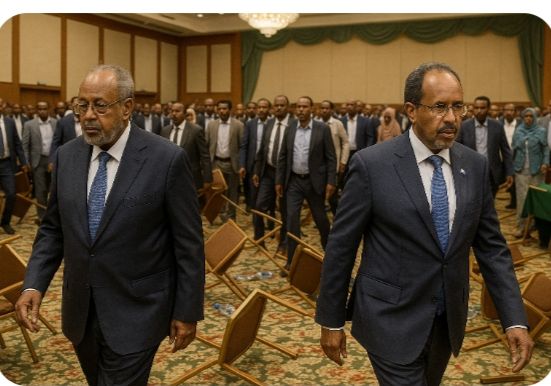
The much-hyped Arta Conference 25th Anniversary was supposed to be a moment of nostalgia and national revival — a political pilgrimage to the birthplace of Somalia’s so-called “reconciliation.” Instead, it ended as an expensive, hollow pageant — a Djiboutian fireworks show with no audience, no substance, and no soul.
What was billed as a “commemorative summit of unity” turned out to be a stage-managed farce. President Ismail Omar Guelleh, desperate to divert attention from his own constitutional coup in Djibouti, invited a cast of recycled politicians, rent-a-elders, and self-proclaimed visionaries to a hotel ballroom in Arta. Cameras rolled, microphones buzzed, and speeches echoed through empty applause. The outcome? Nothing but political confetti scattered across the Horn.
Guelleh’s Distraction and Mohamud’s Desperation
Let’s call it what it was: a double act of political desperation.
Guelleh needed a distraction — a smokescreen to cloud his latest maneuver to make himself president-for-life. Hassan Sheikh Mohamud, on the other hand, needed a stage — any stage — where he could pretend to address “the Somali people” without facing the reality that he can’t gather them in Mogadishu, Beledweyne, Baidoa, or Garowe.
So Guelleh handed Mohamud the microphone — literally.
In that single gesture, Djibouti’s veteran strongman became the voice-giver to Somalia’s struggling federal leader. If irony could blush, this would be its moment. How can a president who cannot summon his citizens on Somali soil travel to a foreign land to be heard through another leader’s amplifier?
The Erasure of TFG History
In the haze of pomp and protocol, another quiet theft took place: the erasure of history.
The Transitional Federal Government (TFG) — led by the late President Abdullahi Yusuf Ahmed — was the real product of Somali reconciliation, born from the sweat and sacrifice of countless patriots at the Mbagathi Conference. But Arta’s revisionists, desperate to rewrite the script, attempted to rebrand the TFG’s legacy as a Djiboutian success story. It’s like a plagiarist celebrating someone else’s thesis at a graduation ceremony.
For those who lived the history, the insult is unbearable.
The TFG was forged through Somali willpower, not Djiboutian choreography. To pretend otherwise is to spit on the memory of the men and women who risked their lives for national restoration.
A Political Stunt Gone Wrong
The masterminds behind this spectacle promised Guelleh that hosting Mohamud’s show would elevate Djibouti’s regional prestige — a “new Arta moment.” Instead, it collapsed under its own self-importance.
No major Somali political faction endorsed it. Puntland ignored it. Jubaland shrugged off. Even the Mogadishu streets yawned. What was meant to be a grand political resurrection became a ghost event — a conference that died before it began.
The symbolism couldn’t be sharper:
A president who can’t govern his capital,
a host clinging to a throne beyond its expiry date,
and a people too weary to applaud another act of elite theatre.
The Verdict: Backfire of the Century
The “Arta@25” spectacle didn’t just fail — it backfired spectacularly.
Instead of projecting power, it exposed weakness. Instead of rewriting Somali history, it reminded everyone who really wrote it. Instead of uniting the Somali people, it proved once again that legitimacy cannot be borrowed — not from Guelleh, not from Arta, not from history’s dustbin.
The lights have dimmed, the guests have departed, and the bill is yet to be paid.
Arta’s 25th anniversary was not a celebration — it was a confession.
——-
Support WDM — the home of fearless, independent journalism that speaks truth to power across Somalia and the region.
Tel/WhatsApp: +252 90 703 4081.
 Warsame Policy & Media Network (WAPMEN)