
WARSAME DIGITAL MEDIA (WDM) EDITORIAL
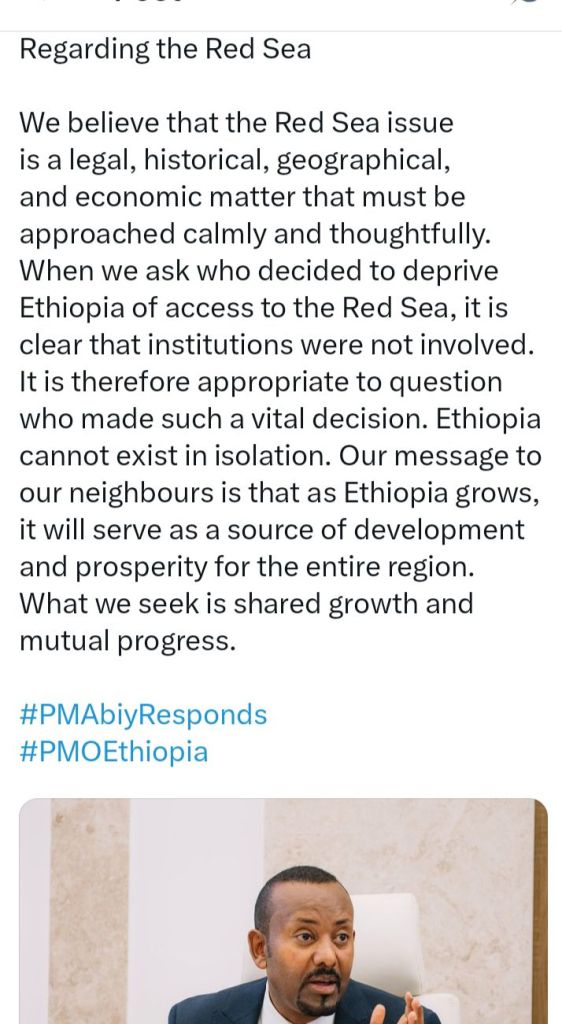
Ethiopia’s latest declaration from the Office of the Prime Minister is not diplomacy — it is delusion disguised as doctrine. When a head of government publicly questions “who decided to deprive Ethiopia of access to the Red Sea,” it signals not historical inquiry but territorial appetite. In Abiy Ahmed’s Ethiopia, fiction has replaced fact, and revisionism has become state policy.
The Return of Imperial Geography
Ethiopia’s political elite has long been haunted by the ghost of its lost coastline. The rhetoric now emanating from Addis Ababa — dressed in the polite vocabulary of “shared prosperity” — is nothing short of a veiled threat. It echoes the expansionist fantasies of the late Emperor Menelik II and Haile Selassie, both of whom saw the Red Sea not as a regional commons but as Ethiopia’s divine inheritance.
But history is not kind to such delusions. Ethiopia was never deprived of the Red Sea; it lost it through war and law — specifically, through its own refusal to respect the self-determination of Eritrea. The 1993 Eritrean referendum, recognized internationally and conducted peacefully, was the very “institutional decision” that the Prime Minister now pretends never happened. It was endorsed by the United Nations and accepted by Addis Ababa itself. To now question that settlement is to reopen the coffin of a century-old imperial corpse.
The Dangerous Myth of “Landlocked Entitlement”
The world is full of landlocked countries — from Switzerland and Austria to Rwanda and Uganda — all of which thrive through diplomacy and economic integration, not invasion or intimidation. Yet Ethiopia’s narrative of “natural entitlement” to the Red Sea reeks of arrogance. What makes Ethiopia different? Only one answer fits: its chronic habit of bullying weaker neighbours.
Landlocked status is not a curse; it is a test of leadership. The problem is not geography — it is psychology. Ethiopia’s ruling class still sees regional cooperation as subservience, and neighbourly sovereignty as negotiable.
Let us be clear: the port access question is not about “shared prosperity.” It is about coercion disguised as partnership. It is about an empire nostalgic for a coastline it lost through its own folly.
Abiy Ahmed’s “Prosperity” or “Predation”?
Prime Minister Abiy Ahmed presents himself as a reformer, but his words increasingly betray the instincts of a revisionist. The Prosperity Party’s ideology has become a cocktail of neo-imperial ambition and domestic distraction. When internal crises multiply — from the Amhara rebellion to the Tigray fallout — Ethiopian leaders look outward for scapegoats. “The Red Sea issue” is now the new smokescreen for failed governance at home.
This is not about trade routes; it is about political survival. The Red Sea rhetoric allows Abiy to rally nationalist sentiment, silence dissent, and portray himself as a defender of Ethiopia’s “historic destiny.” In other words, it is a dangerous mix of populism and paranoia — a familiar cocktail that has poisoned the Horn of Africa before.
A Warning to the Neighbours
For Eritrea, Djibouti, and Somalia — particularly Puntland and Somaliland — this rhetoric is not academic. It is a prelude. When Ethiopia starts invoking “historical and geographical rights” to access the sea, it is preparing the public for confrontation. The neighbours must therefore treat these words not as harmless political theatre but as a strategic signal.
Remember: when Ethiopia, in its sinister motive, talks about “access to the Red Sea,” it is not referring to Yemen, Saudi Arabia, Egypt, or Israel. It is talking about aggression against Somalia and Eritrea — the two countries whose sovereignty and coastline represent the nearest and most vulnerable targets of its ambitions.
Ethiopia’s obsession threatens to militarize the Red Sea corridor and destabilize an already fragile region. The international community must recognize this early — before another Horn of Africa war erupts under the banner of “economic necessity.” The world cannot afford another 1977.
Conclusion: Ethiopia’s Crisis Is Ethiopia’s Own
The truth Abiy refuses to confront is simple: Ethiopia’s crisis is not external — it is internal. It is not about ports — it is about politics. The real deprivation lies not in geography but in governance, not in access to the Red Sea but in access to reason.
Instead of plotting imaginary corridors to the sea, Ethiopia’s rulers should open corridors of justice, reconciliation, and reform inside their own borders. Until they do, every talk of “mutual progress” will ring hollow — a euphemism for domination wrapped in diplomatic deceit.
——–
Support WDM — the home of fearless, independent journalism that speaks truth to power across Somalia and the region. Tel/WhatsApp: +252 90 703 4081.
 Warsame Policy & Media Network (WAPMEN)