WDM EDITORIAL: THE RETURN OF OLD ENEMIES UNDER NEW NAMES: “NEW JUBALAND,” “NORTH EAST STATE,” AND “NEW PUNTLAND” — THE SAME OLD PLOT TO DESTABILIZE PUNTLAND

© Warsame Digital Media (WDM), October 2025
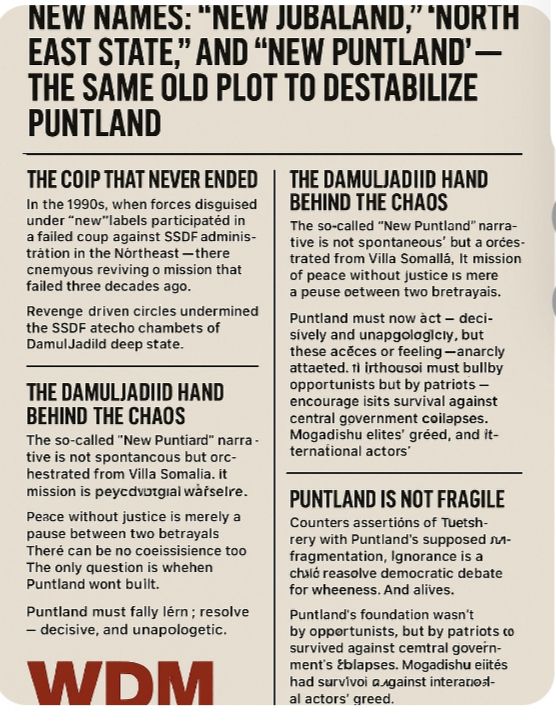
In the cacophony of Somali politics, one begins to notice a familiar pattern — old enemies of Puntland reemerging under new and deceptive banners: “New Jubaland,” “North East State,” “New Puntland.” These are not creative political innovations. They are cynical attempts by Villa Somalia’s DamulJadiid operatives to sow confusion, fracture unity, and test the resilience of Puntland’s federal legacy. What we are witnessing today is not new — it is a recycled strategy drawn from the same poisonous well that once attempted to dismantle the SSDF-led Northeast administration in the early 1990s.

Let’s call things by their real names. These so-called “new” formations are not movements of reform, but agents of regression — political mercenaries reviving a mission that failed three decades ago. Their masters reside in Mogadishu’s marble halls, where the DamulJadiid cartel, hidden behind the façade of federal legitimacy, continues its long war of attrition against Puntland — the mother of federalism, the first bulwark of Somali self-governance.

THE COUP THAT NEVER ENDED

Back in the 1990s, the same forces now disguised under “new” labels participated in a treacherous coup attempt against the SSDF administration in the Northeast — the very crucible from which Puntland State was later born. That coup failed militarily but succeeded in planting the seeds of betrayal and disunity that haunt the Somali political landscape to this day.

When Puntland’s founding fathers later built the State through dialogue and reconciliation, they made one fatal mistake: they forgave too easily. Out of a noble desire for unity, those who once drew guns against the very idea of self-governance were welcomed back under the banner of peace. No one was held accountable. The message was clear: treachery pays if you wait long enough.

Today, the ghosts of that decision have returned. The same circles that sabotaged the SSDF are now the echo chambers of Mogadishu’s DamulJadiid deep state — the same manipulators whispering the language of division in Galkayo, Bosaso, and even Garowe.

THE DAMULJADIID HAND BEHIND THE CHAOS

Let’s not pretend this is spontaneous. Nothing in Somali politics ever is. The so-called “New Puntland” narrative is not the product of political thought or civic discontent; it is a project — drafted, financed, and orchestrated from Villa Somalia, whose current tenants have made a career out of destabilizing federal states that refuse to kneel.

DamulJadiid, the ideological offshoot of the old Islah tariqa elite, has always viewed Puntland as a threat — a living reminder that Somali federalism was born not in Mogadishu, but in Garowe. Their mission is psychological warfare: to make Puntland doubt itself, to make its people forget their own political lineage, and to convince the young generation that their history started yesterday.

A LESSON LONG DELAYED

In the past, Puntland responded to treachery with tolerance. It absorbed political shocks through reconciliation, dialogue, and patience. But that patience has now expired. When these same dark forces last attacked Garowe, they were allowed to melt away into the night — unpunished, unrepentant, and unashamed. That mistake cannot be repeated.

Puntland must now act — decisively and without apology. History has taught us that peace without justice is merely a pause between two betrayals. Those who undermine the State from within must be confronted, exposed, and neutralized politically and legally. There can be no coexistence between nation-builders and saboteurs.

PUNTLAND IS NOT FRAGILE

The architects of chaos have underestimated Puntland’s internal cohesion. They assume fragmentation where there is in fact quiet resolve. They mistake leadership disputes for institutional decay. They confuse democratic debate for weakness. But Puntland is not as brittle as they imagine. Its foundation was not built by opportunists but by patriots who risked everything to give Somalia a second chance at federal survival.

Puntland has survived the collapse of central governments, the manipulation of Mogadishu elites, and the greed of international actors who seek to divide and exploit. It will survive this latest round too. The only question is whether Puntland will finally learn the most important lesson of its history: reconciliation without accountability is suicide by generosity.

CONCLUSION

The so-called “New Puntland” is not a renewal — it is a relapse. Its backers are not reformers — they are repeat offenders in new clothing. Puntland’s response must therefore be not just rhetorical, but strategic and firm. The time has come to draw a clear line between dialogue and defense, between forgiveness and folly.

The era of political amnesia is over. Let those who betrayed Puntland once know: this time, history will not forget — and neither will the people.

WDM STAMP © 2025
Warsame Digital Media – Talking Truth to Power.
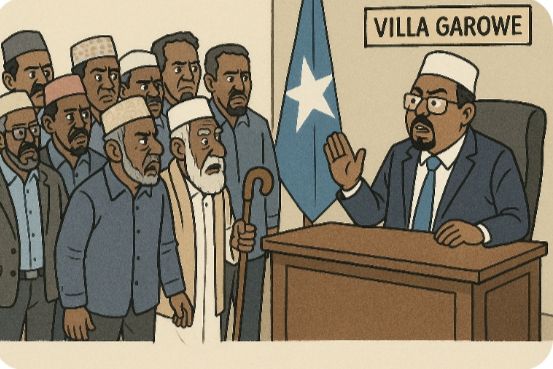
GALKAYO BUSINESSMEN MARCH TO GAROWE: ON THE AIRPORT THAT NEVER TOOK OFF

WARSAME DIGITAL MEDIA (WDM) EDITORIAL

© WDM 2025

The Broken Runway of Promises

The business community of Galkayo has once again landed in Garowe—not for leisure, not for investment forums, but to remind Puntland’s leadership of something so basic, it should have been completed years ago: Abdullahi Yusuf International Airport. Once heralded as a symbol of Galkayo’s rebirth and Puntland’s progress, it now stands as a monument to deceit, dysfunction, and the failure of public policy.

These businessmen—many of whom flew in from Nairobi, Toronto, and Minneapolis—came not as beggars, but as citizens demanding accountability. They brought their own money, their own engineers, their own vision. What they need from Garowe is simple: political will. But in Deni’s Puntland, political will is a rare commodity, traded only for loyalty and kickbacks.

Deni’s Empty Terminal of Promises

President Said Abdullahi Deni has made a career out of launching projects that never take off. The so-called “modernization” of Galkayo’s airport was one of his flagship pledges—a project that appeared on countless speeches, campaign posters, and social media photo ops. Yet, most of Deni’s years on, the airport remains a construction site of political lies, where taxpayers’ hopes have been buried under layers of unfulfilled promises.

It’s not just Galkayo’s runway that’s dilapidated—the very foundation of public trust in Puntland’s institutions has cracked. The state can’t even define what “public-private partnership” means. There is no legislation, no transparency, and no functional mechanism to govern such cooperation. Everything happens behind closed doors, negotiated in whispers, and concluded with handshakes that exclude the public.

The Shadow Zone Called ‘Public-Private Partnership’

In functioning states, PPP (Public-Private Partnership) is a framework that defines who invests, who builds, who owns, and who benefits. In Puntland, it’s a gray zone—a convenient void where political elites can milk donors, delay progress, and silence business leaders with false promises.

Ask any investor: how does one invest in Puntland without being extorted, politically blackmailed, or left hanging in a maze of bureaucracy? The businessmen of Galkayo are not naïve—they have funded, Gara’ad Port, schools, hospitals, and infrastructure before. But now, they face a government that neither facilitates nor cooperates. Instead, it obstructs and controls, as if every development initiative threatens its monopoly over public resources.

The Ghost of Abdullahi Yusuf

The irony is heavy. The airport bears the name of Abdullahi Yusuf Ahmed—the founder of both Puntland State and the Second Somali Republic (the Federal Republic), who fought for Puntland’s autonomy and institutional discipline. He would be horrified to see his city’s airport turned into a political hostage. The late leader understood that development was about action, not speeches. Today’s Puntland leaders seem to understand the reverse: speeches without substance, and projects without progress.

Even Islaan Bashir Islaan Abdulle—normally a figure of moral restraint—was compelled to join the businessmen’s plea. When elders abandon neutrality to lobby for something as fundamental as an airport, it speaks volumes about institutional decay.

Galkayo’s Economic Artery at Risk

Galkayo is not a city of excuses—it’s a commercial artery connecting Somalia with the rest of the world. Every delay in its airport project bleeds the regional economy. Traders lose time, diaspora investors lose faith, and the youth lose opportunities. How long can Garowe play politics while the rest of Puntland stagnates?

This isn’t merely about an airport. It’s about whether Puntland’s leadership can govern, coordinate, and deliver. If Garowe continues to hoard decision-making power while neglecting the rest of the regions, it risks transforming Puntland into a hollow state—one capital city surrounded by frustration and distrust.

The Message from Galkayo: Enough

The message from Galkayo’s business community is clear and unambiguous:

“We are done waiting. We are ready to build.”

They came in good faith, with the intention to collaborate. If Garowe doesn’t respond this time, the people of Galkayo might simply take matters into their own hands—and who could blame them? Development delayed is development denied.

President Deni can no longer hide behind slogans of “reform” or “modernization.” The people are demanding results. Abdullahi Yusuf International Airport must either take off—or the Deni administration must land hard on the runway of accountability.

WDM Verdict:
Puntland’s public-private partnerships are not partnerships at all—they are political traps. The Galkayo airport fiasco is not an isolated case; it is a mirror reflecting a deeper rot in Puntland’s governance culture. Until there is transparency, law, and respect for local initiative, every airport, road, or port project will remain grounded.

© WDM 2025 | warsamedigitalmedia.com | “Talking Truth to Power in a Tribal Context”
(Edited and published under WDM Editorial Series: “Infrastructure of Deceit”)