IN MEMORY OF GENERAL JAMA MOHAMED GHALIB: THE COST OF DICTATORSHIP — A BOOK REVIEW

By Ismail Warsame
First published April 27, 2014 | Updated March 10, 2021

Although I had heard about it for years and often reminded myself to read it, I finally had the opportunity to go through General Jama Mohamed Ghalib’s The Cost of Dictatorship (1995 edition). While I commend the author’s courage in documenting his experience within the notoriously repressive regime he loyally served for decades—and while I share a measure of sympathy for his lifelong advocacy of Somali unity—I found his account riddled with historical distortions, selective omissions, and a deep bias toward the very forces that dismantled the Siyad Barre regime.

Encounter at Mbagathi: A Revealing Moment

Reading The Cost of Dictatorship instantly recalled an episode from the Somali National Reconciliation Conference (Mbagathi, Kenya, 2002–2004). General Ghalib, though claiming to have supported the Somali National Movement (SNM) from Mogadishu, never set foot in Hargeisa after its fall to SNM forces. He remained tethered to Mogadishu, navigating its web of rival warlords and donor-funded “civil society” circles that, ironically, became obstacles to state restoration.

One telling moment occurred at Nairobi’s Safari Park Hotel in 2004, when President Yoweri Museveni—then IGAD Chairman—met Somali delegates to bridge deep divisions. During the discussion, Ms. Ardo, a prominent Digil-Mirifle figure, lamented that “warlords are giving no chance to anyone, including my brother General Jama Mohamed Ghalib.” Museveni turned to the General and, with a mix of humor and disbelief, asked:

“Aren’t you a General? What are you doing here?”

The exchange revealed the contradictions of Ghalib’s self-image: a man oscillating between the uniform of a regime enforcer and the moral posturing of a civilian activist.

Setting the Historical Record Straight

General Ghalib’s narrative glorifies the SNM and USC while erasing the pioneering role of the Somali Salvation Democratic Front (SSDF)—the first organized armed resistance against the military dictatorship. History cannot be rewritten to suit partisan nostalgia.

In 1981, when Isaaq political figures like Duqsi and Jumcale met the Somali Salvation Front (SSF)—successor to the Somali Democratic Action Front (SODAF)—in Addis Ababa, there was no SNM. It was during these meetings that the Isaaq participants were advised either to join SSF collectively or form their own organization to be later unified under a single anti-Barre front.

The Somali National Movement (SNM) was formally launched in London in 1982, after the SSF evolved into the SSDF through a merger with two other groups: the Somali Communist Party (led by Abdirahman Aideed) and the Somali Workers’ Party (led by Said Jama). The SSDF, well-funded by Libya and equipped with modern arms, agreed to support the fledgling SNM with resources and radio facilities—transforming Radio Kulmis into Radio Halgan, the “United Voice of Somali Opposition.”

This cooperation lasted through successive SNM leaderships—Sheikh Yusuf Madar, then Col. Kosaar—until the latter’s assassination in Mustahiil, likely orchestrated by Siyad Barre’s agents. After Ahmed Mohamed Silanyo succeeded Kosaar, relations between SSDF and SNM cooled, particularly after SSDF’s leader, Col. Abdullahi Yusuf Ahmed, was arrested by Mengistu Haile Mariam following political disagreements. That arrest precipitated a split within the SSDF, but not before its ideas, networks, and sacrifices had laid the groundwork for later insurgent movements.

The USC Connection

Ghalib conveniently ignores that the United Somali Congress (USC) originated as a splinter faction of the SSDF after Abdullahi Yusuf’s imprisonment. Key USC figures—including Mohamed Farah Jimcaale, once SSDF’s Deputy Chairman—were direct SSDF offshoots. Even General Aideed’s rise in the USC was facilitated through internal power struggles within SSDF-linked circles.

When Aideed sought Mengistu’s blessing to take over USC leadership from Hussein Ali Shido, he went as far as requesting Abdullahi Yusuf’s release—an audacious move Mengistu firmly rebuffed. These are verifiable episodes the General, with his intelligence training, could not have missed. Yet, his book omits them entirely.

The Duality of Ghalib

It is disingenuous for anyone to serve a dictatorship for two decades—climbing its ranks, enforcing its repressive apparatus—and later rebrand as a human rights advocate or member of “civil society.” One cannot be both a loyal general of tyranny and a moral critic of the same system without confronting one’s complicity.

In The Cost of Dictatorship, Ghalib does not once mention SSDF or Abdullahi Yusuf, the movement’s founder and Somalia’s eventual transitional president. Instead, he elevates his former regime colleagues while portraying himself as a conscience of the nation. Such selective memory does not withstand scrutiny.

A Partial Truth and a National Dilemma

Despite its distortions, Ghalib’s book inadvertently highlights a grim reality: the destructive zeal with which some northern intellectuals pursued Siyad Barre’s downfall, conflating the regime with the Somali nation itself. In their quest to end “southern domination,” they inflicted irreversible damage on the very idea of Somalia as a unified state.

I recall a conversation in Nairobi with the late Mohamud Jama “Sifir,” a UN veteran, reflecting on this tragedy. He recounted a haunting question raised by one of his colleagues:

“Who will ever dig Somalia out of the deep hole of our own making?”

That question lingers—an indictment of our collective complicity in the unmaking of a nation.

Conclusion

The Cost of Dictatorship is valuable as a personal memoir of survival and regret, but it fails as an objective historical record. Its omissions, distortions, and silences reveal more about the author’s psychology than about the dictatorship he condemns. True reconciliation with the past requires not selective amnesia but honest reckoning.

By Ismail H. Warsame
amazon.com/author/ismailwarsame
Support Free Press WDM for a better Somalia. Subscribe annually for $37 to sustain independent Somali analysis.
Sahal Account: 496091 | E-Dahab: 77731 | Tel: +252 703 4081
The Letter That Shook Addis Ababa: SSDF, Betrayal, and the Shadow War Against Abdullahi Yusuf

WARSAME DIGITAL MEDIA (WDM)
Critical Analysis, History, and Political Commentary

By Ismail H. Warsame

The Day Suspicion Became Survival

It was one of those mornings in Addis Ababa in early 1985 when the SSDF Secretariat Office felt unusually tense. The war against tyranny was being waged not only in the field but also in the corridors of intrigue. Abdullahi Yusuf Ahmed, the Chairman of the Somali Salvation Democratic Front (SSDF), and his close associate Abdullahi Mohamed Hassan — known in the Front as Abdullahi Faash, who died in Derg jail presumably under torture— walked into the Secretariat office where I worked as director. Their faces betrayed a mixture of defiance and dread.

They asked me to draft a letter. It was to be addressed to the Ethiopian External Research Department, the counter-intelligence branch of the Ministry of Public Security then liaising with the SSDF. The contents were explosive: evidence of a conspiracy to assassinate Abdullahi Yusuf. The plot, they claimed, involved none other than an Ethiopian intelligence officer, the late Ahmed Mohamed Silaanyo, then Chairman of the Somali National Movement (SNM), and Amina Ahmed Warsame Nur Godane, the wife of SSDF Executive Secretary Abdirahman Aydeed Dhadhable.

That letter would later become a piece of political dynamite — a prelude to Abdullahi Yusuf’s arrest by Mengistu’s Derg regime.

The Anatomy of a Conspiracy

At the time, relations between Abdullahi Yusuf and the Derg government were deteriorating rapidly. Once the favored ally of Addis Ababa, Yusuf had become an irritant — a Somali nationalist who refused to bend entirely to Ethiopian manipulation. The Derg wanted obedience; Yusuf demanded sovereignty.

The alleged assassination plot was not merely about eliminating a man. It was about dismantling a movement. The SSDF represented the first organized Somali resistance against the dictatorship of Siad Barre, but it operated within Ethiopia — a state with its own imperial ambitions over Somali territories. The Derg’s counter-intelligence machinery was notorious for playing double games: nurturing Somali rebels on one hand, neutralizing their leaders on the other.

By bringing in figures like Silaanyo — then leading SNM — and exploiting internal SSDF fissures through figures such as Fadumo Nur Godane, Ethiopia’s intelligence apparatus seemed to be orchestrating a divide, discredit, and destroy campaign.

The Drafting of the Letter

I wrote the letter as requested, my pen trembling over the typewriter keys. It was to be signed by Abdullahi Yusuf himself. The letter outlined the conspiracy, the names involved, and the imminent threat to his life.

When I personally delivered it to the Ministry of Public Security, an officer — with the cold curiosity of a spy — asked me, “What is in this letter?”

I simply replied: “I don’t know.”

In truth, I knew every word of it. But in a city where truth could be fatal, ignorance was the only shield.

That single statement may have saved my life.

The Press, the Proofs, and the Peril

Outside political intrigue, my other duty was more mundane — proofreading Midnimo, SSDF’s quarterly magazine published in English. This was done at Burhan Selam Press, the largest print house in Ethiopia. It was a delicate task, but even the world of printing was not immune to espionage.

One day, as I worked on the English-language proofs, Ethiopian technicians asked me to examine official Somali documents — driver’s licenses, postal stamps, and auto circulation permits. They appeared to be “studying” these documents, but it soon became evident that they were engaged in forging Somali government documents — reproducing official seals and designs for intelligence purposes.

That was when I realized the abyss I was standing over: I was in a room where the machinery of forgery and deception operated under the guise of “printing.” Shortly thereafter, I was quietly told never to enter that room again.

They feared I had seen too much.

I left that building with the haunting awareness that even paper could be a weapon — a tool of political warfare and infiltration.

The Aftermath: Arrest and Silence

Not long after that letter reached the Ministry, Abdullahi Yusuf was arrested by the Derg regime. The very government that once sheltered him turned against him. The conspiracy he warned about may have accelerated his downfall, or perhaps it was used as a convenient pretext to silence him.

The Derg had no patience for Somali independence of mind, even among its supposed allies. SSDF was tolerated only as long as it served Ethiopian interests. The moment Abdullahi Yusuf asserted autonomy, he became expendable.

His arrest sent shockwaves across SSDF ranks and across the world. The Front fractured; trust evaporated. The movement that once symbolized Somali unity against dictatorship was now consumed by internal suspicion and Ethiopian manipulation.

The Lesson in Betrayal

That episode was more than an assassination attempt — it was a defining lesson in political betrayal under foreign shadow. Ethiopia’s involvement with Somali resistance movements was never altruistic; it was always transactional, driven by its own national calculus.

The tragedy of SSDF lies not just in external manipulation but in how easily Somali movements allowed themselves to become arenas for foreign games.

Abdullahi Yusuf survived the assassination plot and the Derg’s prison — but the scars of that era marked him for life. When he later returned to lead Puntland and eventually Somalia, he did so with a hardened realism born from betrayal and captivity.

WDM Verdict

The assassination attempt against Abdullahi Yusuf was real — not in the cinematic sense of bullets and bombs, but in the political sense of premeditated elimination through intrigue, isolation, and imprisonment.

It revealed the true nature of the SSDF–Ethiopia relationship: one of convenience, control, and calculated betrayal. It exposed how revolutionary movements, when hosted by foreign powers, inevitably become hostages to foreign agendas.

And it showed that in the shadow politics of the Horn of Africa, truth is never safe — even in a letter.

Warsame Digital Media (WDM) — speaking truth to power, documenting history without fear or favor.

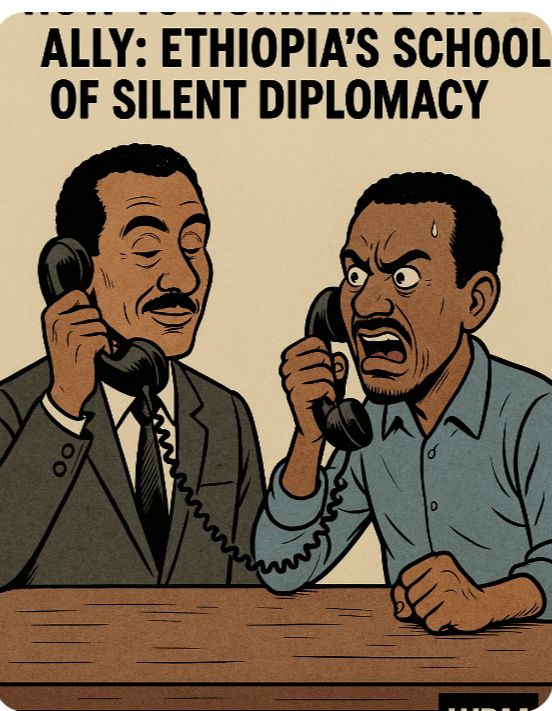
How to Humiliate an Ally: Ethiopia’s School of Silent Diplomacy

By Ismail H. Warsame
Warsame Digital Media (WDM)

Abstract

This paper explores the political and psychological dynamics of Ethiopian–Somali relations during the Somali Salvation Democratic Front (SSDF) era of the 1980s, focusing on the patterns of manipulation, mistrust, and humiliation that characterized Ethiopia’s foreign policy toward Somali liberation movements. Drawing from first-hand experience as a member of the SSDF Secretariat in Ethiopia, this study examines subtle bureaucratic behaviors—such as deliberate silence and symbolic condescension—were used as tools of imperial control. By analyzing the Ethiopian political psyche and its duality of envy and suspicion toward Somali assertiveness, this paper argues that Ethiopia’s approach to Somali actors was rooted in a colonial tradition of containment and domination rather than partnership.

1. Introduction

The relationship between Ethiopia and Somalia has long been defined by rivalry, insecurity, and cultural contrast. From the late nineteenth century, when the Abyssinian Empire expanded eastward under Menelik II, to the Cold War alliances of the Derg era, Ethiopia has treated Somali political formations as both a threat and a strategic necessity.¹ Somali liberation movements such as the SSDF (founded in 1978 after the failed coup against Mohamed Siad Barre) relied heavily on Ethiopian logistical support, yet that dependence came with humiliation and mistrust.

This paper examines this asymmetrical relationship through the lens of bureaucratic behavior—particularly what may be called Ethiopia’s “silent diplomacy.” The author’s personal recollections of Ethiopian officials, such as the mid-level officer “Aklilo,” illustrate how silence and indifference were transformed into mechanisms of political subjugation.

2. Background: SSDF and Ethiopian Patronage

Following the Ogaden War (1977–1978), Ethiopia, then under the Marxist Derg regime led by Mengistu Haile Mariam, offered sanctuary to Somali opposition figures seeking to overthrow Siad Barre.² The SSDF, led initially by Colonel Abdullahi Yusuf Ahmed, was among the first organized Somali resistance movements to operate from Ethiopian soil. However, the alliance was fraught with tension.

Ethiopia’s military intelligence treated the SSDF less as a partner and more as a controlled instrument of statecraft. Access to resources, movement permits, and communications were tightly regulated.³ Requests for routine administrative tasks—such as travel passes to the frontlines—often became exercises in humiliation.

In one revealing incident, an SSDF representative, facing urgent operational needs, called an Ethiopian liaison officer named Aklilo to request official clearance. The officer answered the phone but refused to speak, maintaining a prolonged, uncomfortable silence. Such behavior was not merely rude; it was a subtle assertion of dominance—an unspoken reminder of dependency.⁴

3. The Psychology of Ethiopian Diplomacy

Ethiopia’s statecraft toward Somalis reflected deep historical and psychological contradictions. On one hand, Ethiopians admired the Somali’s independence, eloquence, and mobility; on the other, they feared and resented those very traits.⁵ This oscillation between admiration and hostility produced a political culture that viewed Somalis as both potential allies and existential threats.

The use of silence as a diplomatic weapon symbolized a broader Ethiopian attitude: control through psychological superiority. As Levine (1974) observed in Greater Ethiopia, the Ethiopian elite historically maintained “a politics of guarded distance,” employing ritualized aloofness as a method of asserting hierarchy.⁶ In bureaucratic settings, this manifested as procedural delays, ambiguous communication, and deliberate opacity—techniques designed to reinforce dependence.

During SSDF’s tenure in Ethiopia, such tactics translated into chronic frustration among Somali cadres. While official rhetoric emphasized “solidarity,” the reality was one of containment.⁷ Ethiopia’s silence was not ignorance—it was strategy.

4. Dire Dawa and the Whispered Regrets

During one SSDF conference in Dire Dawa, the author observed an illuminating moment of candid reflection. Outside the meeting venue, a group of Ethiopian officers and civil servants spoke among themselves about the treatment of the Somali movement. Some expressed quiet regret for what they described as the “betrayal” of Somali allies by their own government.⁸

Their tone revealed a dichotomy between the Ethiopian state and its citizens: the regime’s imperial instincts versus the individual’s moral discomfort. This subtle empathy among Ethiopian officials—expressed privately and never officially—underscored the moral fragility of the Derg’s foreign policy. Ethiopia’s leadership feared Somali independence more than it valued genuine regional stability.

5. Silence as Statecraft and the Colonial Continuum

The Ethiopian bureaucratic culture that SSDF encountered was not an invention of the socialist era; it was the continuation of a much older imperial tradition. The Abyssinian court system, and later the modern civil service, were modeled on hierarchical, deferential communication structures where silence symbolized authority.⁹

This cultural dynamic permeated Ethiopia’s external relations. By refusing to engage Somali representatives openly, Ethiopian officials maintained both psychological distance and political leverage. The “diplomacy of silence” became a tool of control, reflecting a belief that dialogue implies equality—something the Ethiopian state historically resisted granting to Somalis.

Such behavior is consistent with the broader colonial psychology described by Fanon, wherein the colonizer enforces hierarchy not only through violence but through symbolic humiliation.¹⁰ Ethiopia’s silence toward Somali liberation actors thus functioned as both a political and psychological form of domination.

6. Conclusion: The Legacy of Humiliation and the Persistence of Defiance

Ethiopia’s “school of silent diplomacy” left a lasting imprint on Somali political consciousness. For the SSDF, the experience revealed the perils of dependency on a neighboring power whose strategic objective was control, not cooperation. The episode of “Aklilo the Mute Bureaucrat” encapsulates a larger truth: silence can wound more deeply than words.

Yet, this history also affirms Somali resilience. Despite humiliation, manipulation, and betrayal, the SSDF laid the groundwork for Puntland State in 1998—an embodiment of Somali political continuity and defiance. The silence of Ethiopian bureaucrats could not erase the voice of Somali determination.

Bibliography

1. Marcus, Harold G. A History of Ethiopia. Berkeley: University of California Press, 1994.

2. Lefebvre, Jeffrey A. “Ethiopia, the Horn of Africa, and U.S. Foreign Policy.” Middle East Policy 5, no. 1 (1997): 144–166.

3. Halliday, Fred, and Maxine Molyneux. The Ethiopian Revolution. London: Verso, 1981.

4. Warsame, Ismail H. Personal Field Notes, SSDF Secretariat, Addis Ababa and Dire Dawa, 1983–1986.

5. Samatar, Ahmed I. “Destruction of State and Society in Somalia: Beyond the Tribal Convention.” Journal of Modern African Studies 30, no. 4 (1992): 625–641.

6. Levine, Donald N. Greater Ethiopia: The Evolution of a Multiethnic Society. Chicago: University of Chicago Press, 1974.

7. Clapham, Christopher. Transformation and Continuity in Revolutionary Ethiopia. Cambridge: Cambridge University Press, 1988.

8. Author interview and recollection, Dire Dawa, 1985.

9. Bahru Zewde. A History of Modern Ethiopia, 1855–1991. London: James Currey, 1991.

10. Fanon, Frantz. The Wretched of the Earth. New York: Grove Press, 1963.