
By Ismail H. Warsame, WDM Political Desk
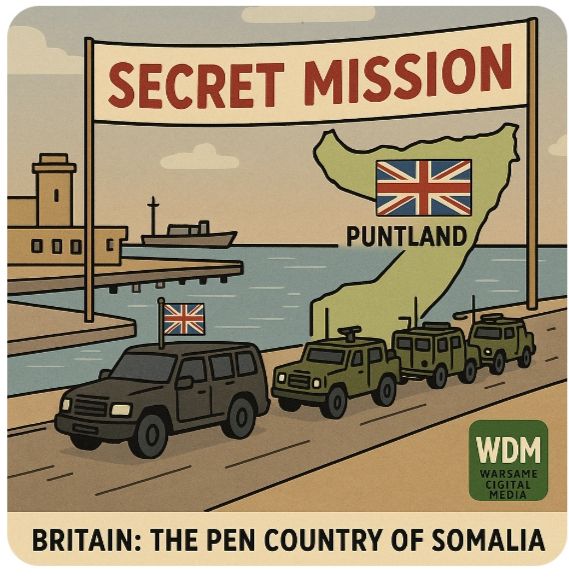
Bosaso’s streets, once again, echo with the sound of polished shoes and the rustle of diplomatic pleasantries. Another British convoy has materialized—the 3rd, or perhaps the fourth this year—each visit a masterclass in discretion. No communiqués, only photo op with the President. Just a flurry of handshakes, closed doors, and the familiar, whispered lexicon of “partnership.” In the absence of transparency, speculations are rife in Puntland that US Africom is seeking new relocation and real estate on the Gulf of Aden. Britain is always attached to whatever the Americans are doing in the world. To them, Bosaso is attractive now.
It appears London’s diplomatic corps has developed a curious fondness for discreet pilgrimages to Puntland. The official record lists their mission as “Assisting Puntland State in Countering ISIS, Partnership, and Stability.” Yet in the tea stalls and public squares, few are convinced. The talk is that ISIS is merely the convenient headline — a diplomatic fig leaf for deeper, undisclosed objectives. Both sides maintain a studied silence. Meanwhile, the perennial political theater between Garowe and Villa Somalia may well feature as a quiet subplot in these shadowy exchanges, viewed from Puntland’s vantage point.
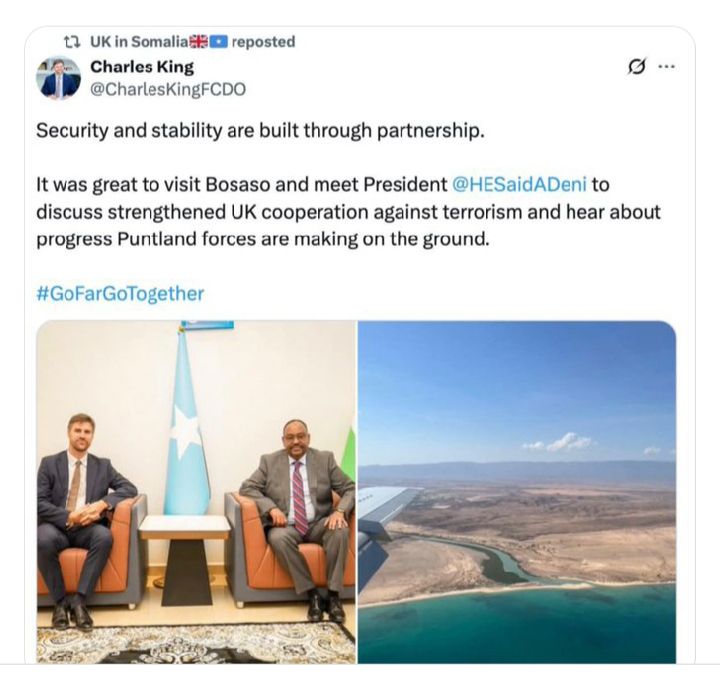
One must ask: why the relentless secrecy? Puntlanders are no strangers to diplomacy; they simply possess a keen allergy to the scent of colonial nostalgia. The British arrive carrying the heavy baggage of a history written with pens sharper than any sword—from the cartographic surgery that created “Northern Protectorate” to tutoring Somalis in the art of signing away their own coasts. The ghost of Britain still walks the Horn, its offers of “assistance” forever footnoted with unspoken conditions.
So, what is the true agenda this time? A “counter-terrorism partnership”? A “stabilization dialogue”? Or is it another elegantly drafted, invisible agreement, composed in the Queen’s English but translated in the corridors of Garowe as, “You assume the risk, we secure the interest”?
The people of Puntland are left in the dark, their view limited to the curated, polished images on social media. The state government in Garowe appears to overlook a fundamental principle: the public has a right to know what objectives foreign powers are pursuing on their soil and what is being pledged behind closed doors. Transparency is not a Western import; it is the very bedrock of public trust. Yet, in the halls of power, a culture of secrecy persists, treating statecraft as an exclusive affair for the initiated, rather than a matter of collective destiny.
Let us not forget the context: Britain wields the pen for Somalia at the UN Security Council. It is the architect of resolutions, the shaper of international perception, the subtle pilot of global policy towards our nation. This fact transforms every British handshake in Bosaso from a gesture of goodwill into an act of high-stakes politics. When the same hand that drafts the world’s verdict on Somalia begins frequenting Puntland’s shores, it is not paranoia to inquire: what narrative is being written about us, and who holds the power to edit it?
If His Majesty’s diplomats are here to lecture on the realities of SSC-Khaatumo, they should be reminded that Puntland requires no cartography lessons—it drafted the map of Somali federalism long before Mogadishu acknowledged its existence. And if the mission’s true aim is to gently nudge Puntland into acquiescing to Villa Somalia’s latest political fantasies, then we wish them luck—Puntland has endured two decades of such “luck” from the international community.
The rhythm of these visits is telling: a quiet arrival, hushed meetings, a void of transparency, and a swift departure—like a colonial-era specter clocking in for a modern-day assignment. Each exit leaves the same, lingering question hanging in the coastal air: What, precisely, was the purpose?
Perhaps it is time for Puntland’s leadership to cease treating foreign envoys as visiting royalty and start demanding that diplomacy serve the people, not just the diplomats. The era of governing by obfuscation is over—or, at the very least, its expiration date is long past due.
Until that day comes, Bosaso will continue to sweep its streets for mysterious motorcades, perfecting the art of pretending not to notice as another “friendly mission” descends from the skies, its purpose as unannounced as its arrival.
WDM Verdict: Britain never truly left Somalia; it simply upgraded its departure board to include direct flights to Bosaso.
WDM – Talking Truth to Power
(© Ismail H. Warsame / Warsame Digital Media)
 Warsame Policy & Media Network (WAPMEN)
You must be logged in to post a comment.